COVID-19, social distancing and furloughs, oh no. It has been a troubling year for those working in the meetings and hospitality industry, with pandemic precautions resulting in huge economic loss—and unfortunately, many unforeseen career changes. Throughout the year, we have been posting resources for the business owners, employees and independent planners navigating their way through this new reality. Whether you are job searching, adding new skills or trying to keep your business afloat, our best career articles of 2020 can offer you some guidance.

Etiquette Tips for Job Hunting on Social Media

“This is no time to be shy. Ask for referrals. Most of the time, you’re just a couple of degrees separation from anyone you might want to talk to.”

From getting the most out of the #OpentoWork hashtag to the appropriate way to reach out to a connection on LinkedIn, these resources will help set you up for success when looking for a new job. Plus, it includes tips on staying mentally healthy when unemployed and psychologically preparing yourself for a big interview.

An Event Business Owner’s Guide to Surviving the Pandemic

“Negotiate more favorable payment terms with suppliers. With little to no revenue coming in, you need to take control of outbound payments, and slow the pace of money going out the door.”

We asked Howard Givner, CEO of the Event Leadership Institute, the engine behind Smart U, to share his insights into how industry leaders are managing during epic COVID disruption. And it has a lot to do with pivoting your business and developing additional skills.

Did we mention we launched Smart U this year to help you do that? You can earn CMPs online, anytime, at the link.

Top 5 Talent Tips for Virtual and Hybrid Events
“In virtual event tech, unexpected delays or tech malfunctions are a reality. Virtual event moderators mitigate the risk of producing an awkward event.”

We wanted to know what skills planners should pick up to remain employable in the coming years. According to Tracy Judge, founder & CEO of Soundings Connect, it all comes down to virtual and hybrid. Be sure to read this if you want to secure engaging virtual vendors, run a seamless online event and avoid awkward silences.

What Meetingprofs Can Do in the Next 18 Months to Prepare for Post-COVID Future

“If you are currently unemployed, consider some similar industries, even if only temporarily. Vacation rentals, country club management and retirement communities have had success hiring hotel leaders at all levels.”

From transferable hospitality skills to unconventional career hacks (like managing a seasonal resort), this article highlights the numerous opportunities (and long-term benefits) that exist for young leaders who are willing to get out of their comfort zone during times of crisis.

5 Steps to Boosting Employee Morale During Tough Times

“Schedule team events three weeks out with attendance required. Ensure your subject line and invite copy is positive and upbeat. With layoffs happening daily, the last thing you want is to scare your employees.”

From delivering special gifts and live messages of encouragement from your CEO to hiring virtual entertainers such as bands, artists and magicians, we highlighted the best ways to cheerlead your employees (or virtual attendees!) while physically apart.

EIC Offers Hope for Displaced Meeting Professionals
“When changing careers, courses and mentorships with people who are doing what you want to do can help.”

After a Zoom call with the co-chairs of the Events Industry Council (EIC) APEX COVID-19 Business Recovery Task Force in September, we highlighted the opportunities listed on EIC’s revamped Career Centre for readers searching for new jobs, online learning, financial support and scholarships.


2020 presented us with the opportunity to try our hand at being as creative as possible. For many of us, this took the form of fun and lively videos. DMOs, CVBs, some of our friends, and our very own Marin Bright, used this to spread positive messages throughout the industry—and poke a little fun at the Zoom meeting.

Below is a recap about some of our favorites.

How are you preparing for changes?

Before we knew what awaited us, Mike Lyons, Smart Meetings TV correspondent, asked meeting professionals how they were preparing for the changes to come in the events industry. Shot at our first event at Grand Hyatt SFO in San Francisco.

Some Good News with Marin Bright

Inspired by actor and director John Krasinski, Marin Bright, founder and CEO of Smart Meetings, shared positive diamonds in the rough of bad news.

The Water Coolers Presents: Zoom Me!

The effort to slow the spread of COVID resulted in Zoom having quite the year, from record high usage to record high stock valuation. While there is are many benefits to Zoom, it isn’t all sunshine and rainbows and our friends “The Water Coolers” made a fun music video about its pitfalls.

Travel Jam 2020 ­– That’s What DMOs are Made To Do

Travel Jam created a music video to promote Destination Organizations and Convention and Visitors Bureaus in their recovery efforts in the travel and tourism industry as a part of the Destinations International Virtual Annual Conference in July 2020.

An Insiders’ Guide to Las Vegas’ Reopening with Kate Patay

Special correspondent Kate Patay set out to test the waters of the Strip’s reopening. Patay met with several industry professionals, as they informed her about Vegas’ latest developments.

Patay wrote an article detailing her experience in one of the meetings industry’s most beloved cities.

How does it feel to meet again?

For a brief and wonderful moment, live meetings were back on. Mike Lyons took the opportunity to find out what our attendees though about getting back to live events.

Welcome Back Contest Winner: Little Rock Convention & Visitors Bureau

During the summer, we asked CVBs to welcome back meeting professionals in the most creative way they could. After reviewing numerous entries, Little Rock Convention & Visitors Bureau came out on top.

Welcome Back Video Contest: Honorable Mentions

Winners in their own right, our honorable mentions are highlighted for the unique ways of showcasing some of what their destinations have to offer.

Even if planners don’t believe the new year will magically fill meetings calendars like it was early 2019, 75 percent of meeting professionals are rebooking meetings, energized by news of a vaccine and safety protocols adopted by venues and hotels.

That’s among the insights of a survey by Knowland, in collaboration with ConferenceDirect, in which 450 meeting planners were asked how they’re feeling about the meetings industry at the end of 2020.

The study underscored that demand is there, but the majority (58 percent) of planners are not comfortable with travel yet. That discomfort may remain even after COVID restrictions have largely lapsed: When asked if they expect to book more or less in-person meetings compared to pre-COVID levels 12 months from now, 49.5 percent reported they expect to continue booking less. As has been repeatedly predicted, hybrid is here to stay.

So how to meet when people are hesitant to travel? Fifty-three percent of planners believe the key is to keep it local.

And what do planners say will bring back in-person meetings? Sixty-five percent are pinning their hopes on the COVID vaccines, and 60 percent believe flexible, low-risk hotel contracts are the second-most important factor. More than three-quarters (79 percent) believe the most impactful thing venues can do to encourage in-person meetings is to follow local safety guidelines.

For one-quarter of planners, true confidence in the return of face-to-face meetings doesn’t begin until the second half of 2021; most planners (72 percent) are confident in-person meetings will widely resume in 2022.

When live meetings are up and running again, 68 percent of meeting professionals believe their events will have 20-40 percent fewer attendees than before. Almost half (46 percent) of planners believe attendance will not return to early 2019 levels until 2023.

‘Twas the night before Expo.

Or Christmas, or Kwanzaa. Or whatever you prefer.

When all through the expo hall, not a creature was stirring, not even a planner.

The seating pods were all disinfected and distanced with care,

in hopes that attendees soon would be there.


The PSAV crew was nestled all snug in their booth,

while visions of global outreach flickered on their screens.

And the client in her ‘kerchief, and the DOS in his cap,

had just finally looked sanguine, resigned to a hybrid chat.


When out on the roof there arose such a clatter,

we all sprang from our safe spots to see what was the matter.

Away to window we flew like a flash,

tore open the blackout curtain, and threw up the sash.


The moon on the breast of the new-fallen snow

gave the luster of midday to objects below,

when what to our wondering eyes should appear

but a miniature SpaceX sleigh and eight tiny robotic reindeer.


With a little old driver, so lively and fast,

we knew in a moment it must be St. Vax.

More rapid than swag snatchers, her tech-enabled valets they came,

And she whistled and shouted and called them by name:


“Now Fauci! Now Pfizer!

Now Moderna and Birx!

On Marriott! On Hyatt!

On, Hilton and Accor!

To the top of the porte cochere!

To the top of the hall!

Now dash away! Dash away!

Dash away all!”


And then, in a twinkling, we heard on the rooftop

the thudding and landing of each little robot.

As we drew in our heads and were turning around,

down the skylight St. Vax came with a bound.


She was dressed in PPE, from her head to her foot,

and her clothes were all garnished with nametags and logos.

A bundle of in-person meetings she had flung on her back,

And she looked like a peddler just opening her pack.


 Her eyes—how they twinkled! Her red mask, how merry!

Underneath, it was certain, her cheeks were like roses, her nose like a cherry!

The rest we couldn’t see, but one thing was telling.

She had a little round COVID belly

That shook when she laughed, like a bowl full of jelly.


She was chubby and plump, a right jolly old elf,

and we laughed when we saw her, in spite of ourselves.

A wink of her eye and a twist of her head

Soon gave us to know we had nothing to dread.


She spoke not a word, but went straight to her work,

and gave out the signed contracts, then turned with a jerk.

And laying her finger aside of her nose,

and giving a nod, up the skylight she rose.


She sprang to her SpaceX, to her team voiced the command.

And away they all flew like they had more meetings to plan.

But we heard her exclaim, ‘ere she drove out of sight,

“Happy Christmas to all, and to all a good night!”


With apologies to the spirit of Clement Clarke Moore.

If you thought this was a rough year, think back to what it must have been like when the Spanish flu broke out 100 years ago—there was no such thing as remote work, and even more alarming, no Instagram either. This year-end roundup is dedicated to the topic of tech, which became more important than ever when physical distancing become necessary…and communication and social interaction became lifelines.

The Robot Takeover: How Coronavirus is Fueling an Industry

“In the post-pandemic era, robots whizzing down hallways will be commonplace.”

Mobile check-in will be child’s play in the years to come, as the pandemic propelled the hotel industry’s interest in touchless technology tenfold. Get ready for the room service of the future.

Up Your Virtual Value Prop

“If you’re not delivering the same caliber of networking or the shared experience of being with like-minded peers, there are no two ways about it—you’re coming up short.”

There was a lot of forgiveness this spring, as the event world realized we wouldn’t be leaving our living rooms anytime soon and took things online. Nearly a year later, the bar is raised, and it’s only getting higher—how do you up your virtual value?

What You Need to Know About Thermal Cameras at Events

As the rules wax and wane with case statistics across the globe, you can bet some initial screening is here for the future. Perhaps the most straightforward of these technologies is the thermal camera. (No individual temperature scans needed.)

Back Light: How to Engage With or Without a Physical Event

New tactics to engage attendees are all the rage in a 2-D event world, and we’ve got tips, tips, tips. “Organizers need to find a way to keep their conference top of mind and seamlessly bridge the gap between the 2019 and 2021 events. Traditional efforts will not be as effective at a time when everyone is communicating digitally.”

Beyond the 800-pound Zoom

Zoom boxes may be ubiquitous, but they are not the only choice.”

Still think Zoom is your only option for virtual engagements? Read on for a lengthy list of alternatives, with an introduction to their individual applications and particular benefits.

4 Social Media Tricks for Showcasing Virtual CSR

How can corporate social responsibility (CSR) continue to have the same impact and benefits in a socially distant world? Alex Plazen of Nifty Method Marketing and Events shares how companies can highlight CSR—a crucial element in securing brand loyalty—by taking a few simple steps to encourage user-generated content across social media platforms.

Editor’s Note: As part of Back Light, a series of articles sharing insider observations, we asked Tracy Judge, founder & CEO of Soundings Connect, for strategies meeting professionals can use to remain employable in the coming years. virtual and hybrid

Tracy Judge

Virtual events have become a mainstay in the business events industry. The shift happened quickly and out of necessity, but a tech disruption in the industry was inevitable.

This year, Cvent made a significant investment in the Virtual Attendee Hub, creating a virtual event experience that integrates with their existing event marketing and event management platform. In November, Bizzabo, a platform for virtual and live event conferences, announced they closed a $138M investment round. These investments signal virtual events are here to stay and the industry is preparing for the growth of hybrid events.

What does this rapid technology shift mean for talent in our industry? In order to continue growing a career in business events, meeting professionals need to have experience with virtual and hybrid events.

A Dry Run for the Future

Earlier this year we launched Soundings Thrive, a platform providing tools for freelancers to stay relevant in the marketplace and accelerate their business. Since the launch, our primary focus has been to help freelancers embrace their potential in the virtual event world.

There’s currently a high demand and low supply of talent experienced in executing virtual and hybrid events. The Soundings Thrive Platform Playground was created to give people the opportunity to try different roles in a safe learning environment and the confidence to run mock events. When we give people the chance to get familiar with event technologies and develop new skills, we facilitate education and translation from live to virtual. Ultimately, we hope to create a smoother transition for stakeholders and continue to create jobs for our industry.


Here are the top five things we have learned from the Platform Playground mock events.

1. We have the talent.

We’ve been experimenting with virtual event roles and we’ve learned that they are similar to traditional event roles. The key difference is that virtual event roles require tech skills and a willingness to step into unfamiliar territory. By looking at live event experiences, soft skills and innate strengths paired with a high aptitude for technology, we are able to identify talent for the new roles that exist today.

2. Meet the new boss. Same as the old boss.

As we see it, the meeting planning role itself hasn’t changed—the venue has. Think of the virtual event platform as the hotel. Virtual event planners are still project managers and logistics experts, but now they’ll treat the platform the way meeting planners would treat a venue.

Along the same lines, there are new types of vendors in the virtual event space, like Virtual Bartenders and Virtual Emcees that cater specifically to virtual event experiences.

3. A little empathy goes a long way.

As the demand for Webcast Producers continues to increase, we need to find talent to support this role. If you think about a live event experience, the Webcast Producer is the equivalent of an audiovisual technician in a meeting or breakout room. Instead of operating physical equipment in the room, webcast producers need to know how to use the virtual event platform and how to handhold speakers through tech checks and presentations.

The major difference between these roles is the increased need for empathy and customer service. Most presenters are not accustomed to presenting virtually. It can make them feel extremely vulnerable and lead to a stressful situation. We found meeting planners and on-site event staff have the soft skills to support these stakeholders.

4. Silence can be awkward. Improvise.

As we adapt to virtual event tech, unexpected delays or tech malfunctions are a reality. We’ve learned virtual event moderators mitigate the risk of producing an awkward event.

Recently, we encouraged one of our freelancers, who is a live event entertainer, to try the role of a virtual event moderator because of her adaptability, flexibility and ability to think fast. During her first event, there was a technical glitch and she kept the group engaged for 15 minutes until the problem was fixed. Instead of uncomfortable dead air, she quickly turned a negative into a positive and created a spontaneous and memorable experience for attendees.

5. Storytelling from start to finish.

Virtual event marketers are starting to align more with broader digital marketing specialist roles. This shift has been a long time coming. Through companies like Cvent, we’ve seen how event tech is an important part of the marketing stack.

The way we approach marketing is still about storytelling, but virtual event marketers need to be adept in digital mediums and understand the nuances of virtual events. People with graphic design, content management and messaging skills will help build anticipation and create a brand story that performs well in the virtual environment.

Conclusion

Shifting from live events to virtual or hybrid is a complex endeavor, and we haven’t had a lot of time to figure it all out. It’s clear that we have the talent resources and the soft skills to meet the challenge and evolve into the new era of meetings and events. It is time to cultivate our existing talent.

Tracy Judge is founder and CEO of Soundings Connect. She is kicking-off 2021 with a mock event series on Symphony, an all-in-one virtual event experience that fosters powerful conversations and deeper insights. Learn more and join the interest list here.

Editor’s Note: As part of Back Light, a series of articles sharing illuminating insider observations, we asked Shameka Jennings, director of meetings and partnership development with National Coalition of STD Directors, to share her experiences planning meetings during a pandemic.

Most meeting planners are in a world of upheaval right now. We must pivot to transition our normally in-person events to virtual platforms, maintain a connection with our communities, and bring in revenue to support our organizations. Over the past few months, I have hosted two virtual conferences and have a lot of lessons learned. While the experience was tough, I had fun challenging myself to be more innovative to produce our virtual events.

Here are seven critical areas to focus on as you pivot your in-person events online.

1. Picking the Right Platform

When planning a virtual conference, start with the end in mind. Design your meeting experience first. Similar to planning in-person events, identify your goals and objectives. Are you trying to foster connections, drive innovation, generate leads, educate, or simply keep your foot in the door? Once you define your goals and the experience you want to deliver, you can identify the right platform.

If you want to foster connections among attendees, then a well-designed chat mechanism is critical. If your event is more about building brand awareness, sharing information or educating attendees, then the video stream’s quality will be key. If one of your desired outcomes is to retain sponsorship, you will want an engaging way for attendees to interact with sponsors.

Here are some questions to ask vendors so you can be sure that it will provide the right features and benefits for your event:

  • What types of communication features and tech integrations does this platform have?
  • Is your support team responsive, knowledgeable and experienced?
  • Do you capture, record and store my event’s content?
  • Does this platform offer branding opportunities, advertisement space or other customization and monetization features?
  • Can I see the backend of the virtual event platform functions?
  • What types of analytics, insight or metrics do you provide?
  • How does your company expect to grow in the upcoming years?

2. Designing an Agenda

Remember that many of your attendees’ lives and routines have changed dramatically due to COVID-19 shut-downs. No attendee wants to sit in front of their computer for hours listening to a series of speakers go on and on.

A digital meeting gives you more flexibility as you plan. You are not confined to a particular set of days in a set number of hours. One advantage of virtual meetings is your agenda can and should extend beyond your typical meeting schedule and live online for a specified time so guests can interact with the material at their leisure.

MoreVirtually Engaged: Ban Boring Events from Your Agenda

This is especially true since your attendees’ time zones now vary dramatically. Your meeting agenda must consider many time zones when planning sessions and have the ability for attendees to interact dynamically.

3. Marketing to Your Audience

People need to know why they should attend your virtual event. If you want to stand out, you need to get them excited and keep them motivated right up until showtime. That takes more than early-bird specials, countdown emails and keynote reveals. A few unique ways to market your virtual event are:

  • Incorporate videos. Get a message from your boss, a member of your community or even a celebrity (using Cameo!) to entice people to come.
  • Word of mouth in business is always a good thing. Create social media badges for attendees to share with their social network and include on their website or email signature to get people talking.

4. Engaging Your Attendees

Unlike in-person meetings and events, virtual events provide attendees with more opportunities to “zone out” as attendees are already on the computer and distraction is only a click away. With event management technology and a little creativity, you can create virtual events that are more than attendees watching a screen.


One way is to ensure the features of your selected platform allow for engagement and attendee interactions. Another is to pivot your traditional social events and put them online. Think virtual trivia, bingo, DJ-dance parties, cocktail making classes, wine tastings. With the right tools, the sky is the limit.

5. Managing Your Speakers

While many presentation skills and best practices apply to both in-person and virtual presentations, expert virtual presenters understand the importance of adjusting their approach to match the medium.

See alsoWhat the Most Popular Speakers in the World Have in Common

Speakers need to be prepared with the right lighting, camera placement, clothing choices and technology. Sessions can be presented live, semi-live, or pre-recorded. It is vital to keep speakers engaged every step of the way with important information and training so they are comfortable with the process and the platform.

6. Identifying Team Roles

Assembling a team that supports your attendees to ensure they are getting the most value from their experience is crucial to a successful virtual event. Break down staff roles into two categories—technical support staff and session support staff.

  • Technical support staff includes platform support, email support and speaker support.
  • Session support staff consists of moderators, emcees and session managers.

7. Engaging Your Sponsors

There is a whole new world of opportunities to monetize virtual sponsorships thanks to the digital nature of virtual events. Consider what a sponsor might typically bring to the table for an in-person event and apply that to a virtual event context.

Does a company normally sponsor signage? Offer banner ads on the platform? Maybe they sponsor a demo session. Move it online. Does a group traditionally exhibit with you? Ask if they’d be interested in a virtual booth.

There are also opportunities for short commercials before sessions begin, sponsored gamification or sponsored mailed gifts. Sponsors are an integral part of your event, so they must generate value from their participation.

Shameka Jennings, MTA, CMP, is director of meetings and partnership development with National Coalition of STD Directors and a 2019 Smart Women in Meetings Award winner.

Among the enduring effects of coronavirus, even after it subsides, will be greater emphasis on not only health, but also security. Of the many things this year has taught us, one is that you can never be too prepared.

And being prepared is right up Mark Cartotto’s alley. Cartotto is complex director of security and risk management for Caribe Royale Orlando in Florida. Since the advent of the pandemic, his top priorities have shifted to considering the travel patterns of guests and employees and the stringent enforcement of mask wearing by guests, who may not always faithfully abide by the requirement.

MoreAre You Responsible for Mask Policing at Events?

Smart Meetings spoke with Cartotto about what new security trends next year may have in store.

Managing the Physical Space

The world of event security now has more to consider. Although COVID vaccines are on the way for many, gathering large groups of people still invites the risk of individuals getting sick. And the more frequented the area, the higher the risk.

Cartotto sees more use of technology to help streamline operations and target areas that may pose an elevated risk. “I would not be surprised to see heat mapping utilized through a property’s video management software (VMS), a feature that was most often used as a way to maximize revenue within retail or sales environments. VMS is now starting to be used to help identify areas that need to be sanitized more frequently than others,” he says.

This practice has been implemented by most—if not all—hotels, but using VMS could help hoteliers identify high-touch areas not previously thought about. Knowing how many people are allowed in one space helps as well, but that isn’t an easy thing to stay on top of. Which leads us to the next trend Cartotto sees in the near term.

He continued: “Another tool would be people-counting technology within access points of meeting spaces for larger events and trade shows to assist in monitoring occupant loads and giving attendees options to visit less crowded areas during specific times. Due to the vast number of asymptomatic cases, I also see face masks and coverings staying a requirement within establishments longer than temperature checks.”

With COVID vaccines now a reality, how much longer is yet to be determined—especially since it’s not yet known if vaccinated persons can still transmit the virus.

Cybersecurity

In a survey by Endless Events, it was found that only 5.3 percent of planners believe cybersecurity should be a priority for events. With the recent boom in hybrid and virtual events, many experts say this number is disturbingly low.

Without taking deliberate precautions, meeting planners and their attendees’ data, including names, phone numbers and addresses, could be left vulnerable to hackers.

So, what can planners do to increase cybersecurity? Good places to start are by making sure your venue has WPA-encrypted Wi-Fi; uses password managers, such as Dashlane and Lastpass, which creates strong, randomized passwords for stronger protection; and uses two-factor authentication for logins. With more and more virtual events, the importance of meetings professionals being proactive against cyber threats has only increased.

Endless Events has a detailed webinar on cyber attacks and how to set up barriers against them.

What Meeting Planners Should Ask Hotels

Planners know to be up to date on the documented protocols of hotels that follow, local, state and federal guidelines, but that’s just the start. According to Cartotto, before booking a hotel, planners should ask several questions. Some of these you may have already thought about, but a review is worth your time.

  • Is the property in an area with a significant number of reported cases or trending higher over the past few weeks?
  • Does the property have adequate meeting space to accommodate the number of attendees while safely meeting the standards for social distancing?
  • Is there signage for masks and other face coverings?
  • Is there an option to have an event in an outdoor event space?
  • What safeguards does the property take for events that have a food and beverage component to it?

Safety trends and guidelines are being constantly updated, and it’s important that these changes are always communicated to employees. When asked what it’ll take for a property to ensure safety for its guests, Cartotto said “a commitment by the property, its leadership and all its employees.”

Most of us, when asked to reflect on 2020, will quickly respond with “good riddance!” And there’s no doubt it has been the meetings industry’s most devastating year of our lifetimes. The economic losses, not to mention the personal ones, have been epic. It’s difficult to remember much more than COVID, civil unrest, divided U.S. politics and frustrating, ever-changing and uncontrolled conditions that have altered our ability to control our own destiny.

Tammy Blount-Canavan

As we face 2021, the new year promises to be one of reinvention and hope. Among all the conditions that upset our world in 2020, there were many lessons learned, advances in technology, and examples of collaboration, generosity and kindness around the globe. As we face this new year of possibilities, we have an opportunity to choose how we will respond. Here are some bits of 2020 I encourage you to embrace.

✨ Innovation

The era of COVID forced us to consider and approach things differently. In many cases, we’ve had to completely empty our toolbox and rearrange or swap things out entirely. This creative and ongoing improvement mindset is a gift—hang onto it as things stabilize, and it will carry you beyond today and into tomorrow.

✨ Flexibility and Adaptation

Cherish that critical skill—now likely a habit—of being flexible and adaptable. For those who have been able to objectively consider their situation and keep on top of circumstances and adapt to them, even create vision around these changes—these are the folks who have dealt well with 2020 and show great promise for 2021. We need processes and guidelines without question. But our ability to figure out how to ensure they remain relevant and support momentum will determine our outcomes.

✨ New Skill Development

If we weren’t adept at using technology platforms before, we sure are now. From something as simple as mastering Zoom to the complicated backend of a virtual conference, we’ve all had to up our game. The creative ideas for executing safe and immersive experiences has poured forth, and there’s plenty of opportunity to learn and share best practices. Keep looking for these opportunities. The skills and talents you brought to the table a year ago may not be so relevant any more. Your value increases exponentially as you master being a cross-functional ninja.

✨ Intentional Communication

Even before 2020, the cause of most business failures has been communication. It is at the root of all the relationships we have with those in our orbit—colleagues, clients, vendors. The strength of these relationships determines the magnitude of our success. When we go to the pressure of a problem, when we ask for or provide clarity, when we ensure systems and processes are in place to enhance and not blockade progress, everyone wins. When we keep things to ourselves, make assumptions, blame others or avoid issues, that’s when we wind up in trouble. Be intentional and purposeful in your communications, always. And when you think you’ve done enough, take it up a notch.

✨ Keep an Eye on the Prize

As the ground continues to move beneath our feet, it can be tempting to get bogged down in triage. That’s important to pay attention to. But it’s even more important to focus on the long-term. Make sure your vision for success 5, 10, 20 years from now doesn’t get blocked by what needs to be addressed this week or next month. Keeping vision and hope ensures that values-based and data-driven decisions guide your work.

✨ Mobility

The ability to perform our work from anywhere we are has become commonplace in a matter of months. With that, we see new opportunities not only for our current workforce, but for the future—minds are more open to hiring people who don’t live where our offices are, and letting them stay there, or to enabling remote work when our existing talent finds themselves needing to move for personal reasons—family, health, etc.

✨ Work When You’re at Your Best

Regular office hours have become a block of time we’re expected to be available, but we might need to shift our focus time to another part of the day because we’re also juggling life—from family issues to simply finding your optimum brain-use time. Finally, morning people and night owls can be on the rhythm that enables them to bring their best self and most creative thinking.

✨ Focus on Wellness

Uncertainty, lack of control, isolation, loss and an abundance of negative messages surrounding us have affected wellness in a big way. This has forced us to figure out how to deal with the stresses that can either sneak up on us gradually or hit us smack in the forehead. In 2021, I encourage you to focus on wellness and promise your work will improve as a result. Get out for a walk. Meditate. Reach out to others. Check in on folks. Ensure there are boundaries so that your work-from-home doesn’t crush the sanctuary you should have there. Make sure you have enough margin in your life to think, vision, breathe.

✨ Attitude of Gratitude

How you choose to respond to circumstances determines everything—how you approach challenges and relationships, and the outcomes of your actions. This is summed up well in a quote from Dr. Anil Kumar Sinha, who said, Gratitude unlocks the fullness of life. It turns what we have into enough, and more. It turns denial into acceptance, chaos to order, confusion to clarity. It can turn a meal into a feast, a house into a home, a stranger into a friend. Gratitude makes sense of our past, brings peace for today and creates a vision for tomorrow.”

Tammy Blount-Canavan, executive vice president, principal, destination and travel practice at Fired Up! Culture came from the event and CVB world and now she helps event professionals grow their careers.

Editor’s note: We updated this story on Dec. 22 to add a call from AHLA to include hotel employees in the initial roll out of the vaccine.

Great Britain and Canada have approved the first vaccine for COVID-19 and the United States looks to be following with more on the way. Now what? Will those millions of glass vials flip the switch back to green for conferences and trade shows?

In a word, no. As we have reported before, the return will be gradual.

U.S. Centers for Disease Control and Prevention is prioritizing vulnerable populations and front-line workers. The American Hotel and Lodging Association (AHLA) is calling on governors and state public health agencies to include hotel employees for inclusion in phase “1b” of the vaccination roll out since they have remained on the front lines—working to support emergency and healthcare workers across the nation through the association’s Hospitality for Hope Initiative. Additionally, many hotels across the nation are now serving as places to quarantine for individuals who may have been exposed to COVID-19. Hotel employees also continue to be on the front lines for interstate travelers, which also adds an exposure risk. “Prioritizing hotel employees with access to the vaccine would provide a necessary layer of protection,” according to an AHLA statement.
And even once a larger swath of the population has gotten the shots, some, including Dr. Dyan Hes, who serves as Medical Director of Gramercy Pediatrics in New York City, are advocating for continued mask-wearing and other protocols until clinical trials show that vaccinated people aren’t “shedding the virus.”

“People are going to think this vaccine is like a pass, like you’re going to have a passport that you’re vaccinated, and that’s not the case,” he said. At least in the beginning.

Vaccine Adoption Indicators

How fast we get to “herd immunity” will also depend on how quickly people step up to be immunized. A recent study from MMGY Global measured traveler sentiment as part of its Travel Safety Barometer report and found that only half said they would get the vaccine as soon as it is available.

MoreNews of Effective Vaccine Sparks Hope for Return to Meeting

The other half, not so much.

Some 40 percent of the 1,200 American leisure and business travelers surveyed in November said they would wait at least a few months before rolling up their sleeves to see if the shot (or shots, as many require follow-up injections a month later) are effective. And nearly one in 10 said they would not get the vaccine at all.

Some government agencies have hired influencers to sway the perception of inoculation. Medical professionals, lawyers and employers are debating the effectiveness and legal challenges to requiring proof of vaccine to fly and/or attend events—or even show up in the office. Meanwhile, potential attendees are weighing an onslaught of confusing messages.

Following are some of the surprising facts behind these attitudes.

Slight Increase in Appeal of Travel Across Sectors

People are becoming more concerned about how family and friends will judge their decisions to travel, with 31 percent of respondents saying the opinions of family and friends are an important consideration affecting future travel plans (an increase from 25 percent in October).
That could be why, to some extent, almost half (41 percent) still plan to take a domestic leisure trip during the next six months. Only one in four said they planned to take an international flight during the next six months, although that is up considerably— just a month earlier, 21 percent said that.

On the business travel side, the percentage of respondents likely to take a domestic business trip during the next six months increased to 38 percent. One in five (21 percent) of business travelers said they are likely to attend a conference or convention, up from 17 percent in October. One in four (24 percent) is likely to attend an off-site business meeting, up from 22 percent in October.

The likelihood of staying in a hotel or rental home stayed steady at about one in three people—roughly the same percentage as in July.

The percentage of respondents likely to take a river cruise increased to 21 percent, surpassing their likelihood of taking an ocean cruise in the next six months, which remained at 20 percent.
Travel by car remains the most likely form of transportation for respondents. One in five travelers is willing to drive more than 500 miles each way for a leisure trip.

Only two out of five respondents (39 percent) said they are likely to visit a bar or restaurant in the next six months. There is little anticipation of going to an indoor or outdoor sporting event, concert or festival, either, with only around a quarter of respondents saying it’s likely in the next six months.

Tappit, a U.K.-based payments company, surveyed 1,500 sports fans, age 18 and older, and found that 41 percent said they would not attend a live game unless a vaccine was widely available.

A majority of respondents among the other 59 percent said the biggest concern impacting their decision to attend a sporting event was sitting too close to other spectators, followed by a diminished fan experience due to COVID-19 restrictions (21 percent).


Marginal Increase in Perceptions of Safety

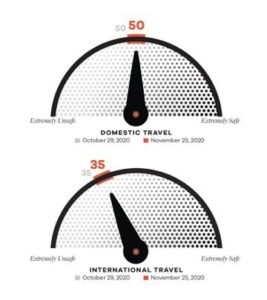
The MMGY Global Travel Safety Barometer also measures American travelers’ perceptions of the safety of specific travel behaviors, on a scale of 0 (extremely unsafe) to 100 (extremely safe). In all seven key areas measured (domestic travel, international travel, lodging, cruising, transportation, dining and entertainment, business travel) barometer scores remained level or even increased slightly from the previous month.

“This is an interesting development considering that COVID-19 infection rates in the U.S. have escalated to their highest levels since the start of the pandemic,” noted the report authors.