Venues, Historic and Future-Facing, Unveil New Meeting Space Around the Globe

New and renovated event venues open in the historic building that housed the first railroad station in Jacksonville, Florida, in-between Australia’s two most famous World Heritage sites and in a vibrant new hotel that celebrates the architecture of Washington Heights in New York City.

The Great American Railroad

A fountain runs in front of a white building with Greek-style architecture
Prime F. Osborne III Convention Center

Originally built in 1919 as the Jacksonville Union Terminal, at the time the largest railroad station in the South, Prime F. Osborne III Convention Center in Jacksonville, Florida, is an impressive historical building now undergoing renovations to elevate its convention and meeting spaces. Visitors today can still engage with the building’s history as they encounter a retired rail car, train bumpers, original signage and over two dozen rail tracks. Amenities include catering by SAVOR…Jacksonville as well as a gift shop.

The renovations introduce new lighting systems, fresh carpet and acoustic panels to many of the venue’s 78,000 sq. ft. of meeting space, made up of 22 rooms of varying sizes with 33-foot ceilings. The main concourse area sees new digital display systems. The Grand Lobby, with 75-foot ceilings and marble walls, sees new carpeting, cabinetry, programmable uplighting and marble wall resealing. The exterior of the building receives painting trim and a new roof.

This historical building maintains its refined, historic feel while adjusting its capabilities to meet all AV and tech needs to build an outstanding modern meeting. Get ready to immerse your event in the classic charm of The Prime.

Read More: Modern Meetings and Ancient History

Seeing Green Between Natural Wonders

The exterior of the Cairns Convention Center
Cairns Convention Center

In Cairns, Australia, alongside two world heritage sites—the Great Barrier Reef and the Wet Tropics Rainforest—Cairns Convention Centre unveils an AUD$176 million renovation project with environmental stewardship at its center. Upon encountering the building, guests can appreciate the biophilic exterior of living greenery, accompanied by 1,200 sun blades. This helps keep the interior of the building cool during hot days without using excess energy – and not to mention, gorgeously green.

Inside the centre’s 10,500 sq. m. (113,021 sq. ft.), which can accommodate up to 2,500 guests across the venue, smart building management systems maintain the sustainable initiative. The space is lit with high-efficiency LED with automated dimming control and motion sensors, and it is kept cool and comfortable with energy efficient fans.

Read More: Sustainable Meetings Through Renewable Concepts

Renovated meeting spaces include three meeting rooms, an exhibition and plenary lecture space and a rooftop banquet space. The Trinity Level offers views of the neighboring Great Barrier Reef and Wet Tropics Rainforest and includes the outdoor Trinity Terrace. The latest AV technology gives meeting planners the flexibility to curate their events and provide access to virtual attendees.

Reaching for the Sky

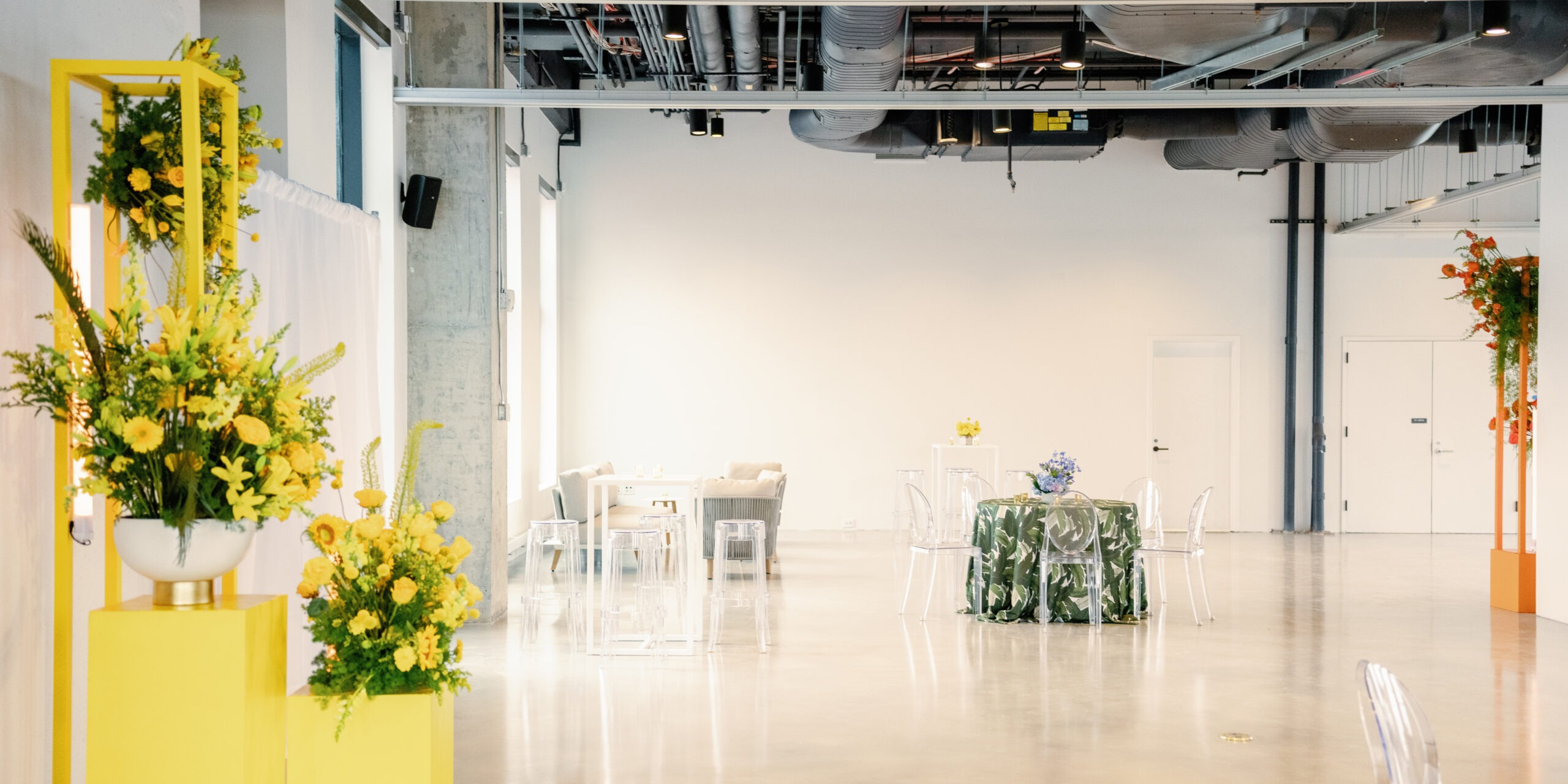
a bright meeting space featuring yellow flowers and exposed industrial roofing
Above the Heights

Nestled atop the New York City skyline is Radio Hotel and its 12th floor meeting and event space Above the Heights. With 9,219 sq. ft. of interior space and a 4,191-square-foot outdoor terrace featuring a pergola retractable roof, accommodating up to 600 guests together, Above the Heights offers an impressive and flexible venue for your next NYC meeting. Guests can enjoy the convenience of a 170-spot underground parking garage on-site.

The colorful blocks of green, yellow, blue, orange and magenta on the exterior of the building, designed by architects MVRDV and Stonehill Taylor, resembles a vertical Washington Heights, inspired by the existing vibrant architecture of the Washington Heights neighborhood Radio resides in. Spacious new guest rooms are decorated with bright colors and feature street-facing windows, walk-in rain showers, HD Smart television, mini refrigerators, in-room safes and workstations equipped with charging ports. Guests can enjoy a tasty Dominican menu at Jalao NYC, the first U.S. location of the famous Santo Domingo restaurant.

Read More: New York: The Empire State Strikes Back

With their renovated rooms, world-famous restaurant and lively design, Radio Hotel and Above the Heights offer a meeting and event location that is sure to stand out.

If Covid-19 has taught us anything, it is that we must be cognizant of the health, well-being, and safety of people attending in-person events. As a global community, we all witnessed how fast a virus can spread and the devastating effect of a pandemic.

As the pandemic has waned, we have taken lessons learned and applied them to contingency plans for events going forward. It’s imperative that event managers and corporate leaders have risk-mitigating strategies for an outbreak of illness, injuries, or other emergency situations.

When sitting down to plan an event, there are questions that the planning team should ask themselves in order to formulate the best risk mitigation strategy. These questions will guide the team in where they should concentrate their efforts, who should be performing what tasks, and what risks exist within an event. Here are some questions that can get an event planning team on the path to developing the best strategy.

What are the risks?

A team cannot hope to mitigate any risks—be they, but not limited to security, health and safety, natural disasters, or technology and infrastructure—without first identifying them. For a health and safety risk, assess the potential of accidents, medical emergencies, or the spread of a contagious disease. A security risk evaluation could include unauthorized access, theft, and disruptions from an individual or group.

Read More: When Mother Nature Is an Unwanted Attendee at Your Meeting or Event

A sporting event being held in a high occupancy stadium will have more dynamic risks than a conference due to the size of the venue and activities taking place. Additional considerations should be given to the number of attendees, crowd management, alcohol-related incidents, traffic management, emergency evacuation, and vendor management. Clearly identifying risks enables event planners to develop and implement targeted mitigation strategies.

What is the potential of each risk?

Once the risks are identified, the team should evaluate each for the potential impact of disrupting the event and compromising brand reputation. What happens to the event should the keynote speaker fall ill, if someone collapses with chest pain, there is an outbreak of food poisoning, coats and bags are stolen from the coat check, or a group of demonstrators arrive?

The sordid tale of someone ill from food poisoning at your event posted on social media will undoubtedly impact your customer trust and brand identity. You can be legally liable if someone is injured and you did not have an appropriate medical response plan. The potential analysis of each risk will help the team prioritize courses of action and allocate appropriate resources for mitigation.

How can the impact be minimized or mitigated?

After assessing and prioritizing the risks, there needs to be a mitigation plan in place for each one. The team should develop strategies and action plans to address each individual risk with a mitigation plan.

Ensure you have appropriate medical support and facilities available to mitigate health and safety risks. Build a response plan that outlines procedures for natural disasters and medical emergencies. For security, implement measures to protect attendees and the event venue. This may include employing security personnel, installing surveillance systems, conducting bag checks, and controlling access points.

An alternate plan for events that are disrupted should all be considered. The team may want to identify an alternate site and develop backups for critical systems, emergency response plans, crisis communication protocols and recovery strategies that are tailored to each individual risk.

Your mitigation strategy should identify key stakeholders and their roles. These include employees, event staff, attendees, exhibitors, vendors, regulatory bodies, and local authorities, as each of these individuals plays a role in contingency plans. Communicate clearly with the stakeholders and event participants. Keep them informed about safety measures, emergency procedures, schedule changes, and, of course, specific risks they should be aware of. Ensure to have a crisis communication plan to address and mitigate reputation risks promptly.

How will the plan be tested and reviewed?

Organizations that exercise and evaluate their emergency plans more frequently have higher success in mitigating risks when a real-world application occurs. Event contingency plan teams should design, develop, and conduct response plan exercises on an established schedule and against their organizations’ capabilities. Exercises can be completed through conferences, drills and tabletop exercises.

A post-exercise evaluation that identifies strengths, weaknesses, and areas of opportunity fosters an environment to further refine, improve and develop an executable response plan. Your response plan should be viewed as a living document, one that can always be amended should the unexpected—or, as we saw with the pandemic, the unprecedented—should arise.

No one desires that illness, injury, violence, or natural disasters disrupt their corporate events, but having a comprehensive risk-mitigating strategy in place, event planners and attendees can move forward with confidence knowing that when the unexpected occurs, they will be prepared.

man sitting down, smiling with fingers crossedAbraham Medina is founder and creator of Global Executive Medicine (GEM), provider of comprehensive health management services for family offices, corporate C-suites, and executive protection programs.

How to maximize meeting impact on new social media tool while minimizing downsides

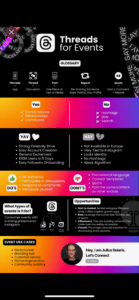
A week ago Julius Solaris (@tojulius), founder of Boldpush, posted on Meta’s new Twitter copycat platform his Threads emoji heart Events infographic celebrating conversations, relationships and comments on the platform while simultaneously bemoaning the lack of hashtags, DMs and search. He was thumbs up for strong celebrity drive, easy account creation, general excitement and the fact that it counted 100 million users in 5 days due to its easy onboarding (one click from Instagram and you are set up with a feed of your followers from there).

He also noted the downside of not having the platform available in Europe, having it so tied to Instagram (you can’t delete without deleting Instagram), that it lacks identity and has a weak algorithm that shows you a lot of random posts. In conclusion, he said that the platform probably works best for consumer events with a strong presence on Instagram, and could be used for backchannel, branding customer service, demand generation and community building. The post received three likes.

The same week, he saw lots of engagement for a musing that “Somebody told me this yesterday and it stuck with me. If you charge more than $150 per hour and you don’t reply within the hour to a client message, then you shouldn’t charge that much. Agree?” The overwhelming reaction was “disagree.” The Events Coach Juliet Tripp (@thejuliettripp) may have summed it up by saying, “It sounds like a co-dependency issue, not a healthy working relationship.”

Read More: Why Event Profs Jumped on Clubhouse in 2021

Due to the shortfalls Solaris outlined, those sorts of rhetorical questions seem to be winning the day on the fast-growing platform. Not, “What is the best barbecue restaurant in Memphis?” but “Why is barbecue the best food ever invented?” That is hypothetical, but feel free to answer either question by hitting us up on @jtlongandco.

What does the Threads mania mean for planners?

interface of "threads for events"Because discovery is so difficult without hashtags, Twitter favorite for the industry #Eventprofs hashtag started @eventprofsonthread to try to connect the events tribe and as of this writing was at 104 followers.

Zillow Executive Producer of Live Content and Smart Women in Meetings Award winner Karen Hartline (@khartline) is one of those. She is feeling reminiscent about the early days of Twitter when conversations were more positive and physical Tweetups brought people together for meaningful connections. She was director of events at Mashable at the time and they were all about the social networks. “You could post that you were going to be in downtown Los Angeles and would anyone want to meet up? That would be asking for trouble the way the platform has shifted to trolls today,” she said.

Hartline credited the positive, chatty tone on Threads to the fact that people come over from Instagram where they are already primed to talk more about personal things than stirring up controversies.

When asked the best way for meeting professionals to use this new tool, she saw it as an investment. “I can see meeting professionals connecting there pre-event as a Slack alternative. The way it connects comments, it can collapse a conversation and ‘thread’ it together without getting noisy. It doesn’t show up in the feed over and over like it does on Slack,” she said.

Hartline suggested putting the snaky symbol on event websites and enlisting speakers to have conversations there to create excitement in advance of an event to get those conversations started.

She also saw potential as a fun way to continue the conversation after the event by encouraging attendees from stage to “Tell us what you thought on Threads.”

The new app megaphone may not be for everyone, she cautions, citing some of the same drawbacks Solaris noted. Just like any other social network, a brand has to have someone managing that and you can’t moderate like on an app or Slack. “You also have to think about whether you have time for another platform in your life,” she said.

“After a few improvements, it could be even more valuable, but event professionals should get on now to get used to it and start building a following,” she concluded.

A Threads To-Do List

Nick Borelli (@nick.borelli), marketing director with Zenus, an ethical facial analysis company, also saw the new platform as an evolving tool. “Meta is behind it, so I think it will last,” he said, ticking off the benefits. He hopes the designers are listening to how relieved people are that it is not as loud and angry as other platforms and will try to maintain that as it grows. “We are in a war for attention and if TikTok gets shut down in the U.S., that will only benefit Threads,” he reasoned.

The introduction of hashtags is a “when not if” situation in his mind. That will make it more valuable for things like selling tickets. But he also looks forward to an improvement in the Algorithm after superusers train it on interaction preferences.

He hypothesized that the platform could be good for associations looking for a sense of belonging between events. “It is the intersection of events and lifestyle,” he said.

When asked how a meeting professional might get started, he had some smart tips:

  • The winning strategy during this land-grab stage is to post more than you normally would to stake your place.
  • Try to find other event planners to see how they are using the space.
  • Don’t look for an “expert.” No one has written the rule book yet because it is brand new so feel free to experiment and be seen as leaders.
  • Building community is your best bet.
  • Customer service might be useful there.
  • It isn’t Instagram so don’t lean on visuals too much.
  • Ask questions.
  • Define what it is for you.

Spark Event Collective founder Anh Nguyen (@atnguyen1123) posted early in the Thread life that “I’m kind of convinced that at the end of the day, all of these apps are just different ways for us to find connection with other humans. So, you can buy the guide, or take the course, but mostly just be a human, regardless of where you’re communicating with people.”

Watch Out for the Downside

The same factors that give Threads staying power (owned by Twitter and leveraging Instagram linkage) could also be the biggest strike against it. “Meta is first and foremost a business and they will bring in advertisers at some time just as they did with their other platforms. That could appeal to advertisers who are now lukewarm at best on Twitter.”

Others look warily at the mothership’s record on data protection, especially since many didn’t even read the privacy policy before clicking the button to give access to their friends data.

“There are lots of reasons for Meta to play it safe when it comes to data protection,” said Borelli, pointing to lawsuits in the U.S. and Europe. “The best strategy is for them to be more conservative about selling data, but then again we know what they have done in the past,” he said.

The City of Innovation has a history of resiliency and is already reinventing itself

Rumors of a mass exodus from San Francisco’s ballrooms and expo floors are turning out to be premature, indeed. After a blow to international travel due to Covid, a wave of tech layoffs and some negative publicity, the city is leaning into its strengths as a diverse, business savvy and beautiful destination to re-emerge stronger. Now the city is benefitting from an AI boost. A reported  $10.7 billion in funding for generative AI startups was announced within the first three months of 2023 alone. We talked to the experts from The Golden Gate to Silicon Valley’s Sand Hill Road in the South Bay to find out what is really going on. 

man wearing suit, crossing armsJoe D’Alessandro, president and CEO, SF Travel

San Francisco’s city flag is adorned with the phoenix rising emblem—a perfect symbol of the city’s indomitable spirit. We’ve survived booms and busts, earthquakes and pandemics, and have come back thriving every time. The city has always had a forward-thinking ethos and spirited resiliency.

We’re thrilled to welcome meeting and event attendees back to the City by the Bay. If there’s one trait that best defines San Francisco, it’s diversity. San Francisco’s iconic landmarks and scenic beauty always captivate, while new experiences showcase the city’s always-evolving nature. Attendees can explore the city’s many unique neighborhoods, discover its historic and thriving LGBTQ community, and visit world-renowned art and cultural institutions. San Francisco’s welcoming people, its unbeatable food scene, and its endless activity regularly lead to record-breaking meeting attendance.

Getting here is easy, with the top-ranked San Francisco International Airport (SFO) just 13 miles from the city. And in the past year, a dozen new meeting and event spaces have opened throughout the city. They offer settings ranging from sophisticated dining destinations to beautifully re-designed gathering spaces in some of the city’s most iconic buildings. With these new venues, San Francisco and the surrounding Bay Area offer more than 360 special event facilities in addition to the city’s impressive Moscone Convention Center. Boasting one of the lowest carbon emissions per delegate compared to other major convention centers in North America, Moscone Center offers more than 502,000 sq. ft. of contiguous space and sits within walking distance to more than 19,000 hotel rooms.

There are so many things that make San Francisco a one-of-a-kind location for events, and one of our most unique offerings is our Welcome Ambassador Program, which launched in 2021. The program’s ambassadors are friendly faces tasked with helping visitors with everything from directions and public transportation to translation requests. They also assist with meetings and events in our downtown area—helping direct business and events visitors. The program has tremendously enhanced visitors’ and attendees’ experience in San Francisco, and we look forward to continuing to offer this unique program to attendees in the year to come.

woman with red hair smilingKristin Hankins, director of sales and marketing, San Francisco Marriott Marquis

Since the first day our doors opened 34 years ago, we’ve been a tower of strength and reliability in times of crisis for all in need. The Loma Prieta Earthquake hit the evening of that opening day back in 1989, with a 6.9 reading on the Richter scale. As a surviving building, the San Francisco Marriott Marquis served as a central resource downtown in the weeks and months to come. Many of the displaced citizens were housed here, as were care workers and construction teams sent in to help rebuild the city.

It’s been that way ever since. During Covid, we kept our doors open and housed first responders. While properties in the neighborhood have turned over and sold and rebranded or simply closed for good, the Marriott Marquis has been the steadying force that travelers and San Franciscans alike have come to rely on for respite in the city.

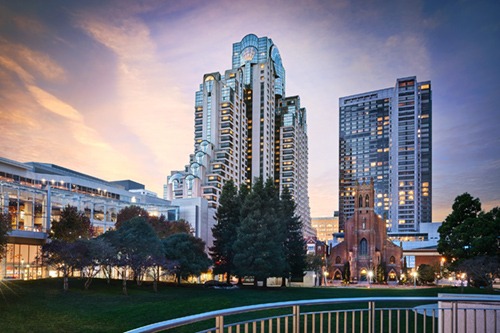
wide shot of hotel, hazy weather in background
San Francisco Marriott Marquis

And we’ve met our most recent challenges by reaching down into this resilience-DNA. Coming out of the pandemic, we’ve taken a leadership role in the city’s new Ambassador Program that joins city government officials with private sector staffs to personally connect on the streets with visitors. General Manager John Anderson identified that the central position of the Marriott Marquis and the proximity to the Moscone Center provides us a unique opportunity to change the narrative perpetrated by national media that has tried to tell our story from afar.

John has personally donned the Welcome Vest and gone out with the other ambassadors to greet and guide business travelers looking for events and directions, or simply sights to see. We’ve had record attendance for our comeback conferences: RSAC, APA and Semi-con—corporate, tech, and association citywide conferences, all who were able to see through the white noise of the press, and all who, once here, marveled at how much the city has turned things around. They have been reminded just how beautiful the city is and how much San Francisco has to offer its visitors. We’ve been able to diversify our reach by attracting back huge leisure groups like fans attending the Dead and Co. concert at Oracle Park. And is there really any more fitting setting for The Dead than the band’s hometown?

Our kitchen staff, led by Executive Chef David Hollands, is a leading force in repurposing food for the needy and recycling our excess. We are huge participants in the Chefs To End Hunger initiative, which connects both excess prepared and unprepared food with shelters around the city, many of which are in our surrounding neighborhoods.

Read More: Wolfgang Puck Catering Turns 25

Back in ’89, though our building came through the quake intact, all the glassware above the bar on the 39th floor was thrown from the shelves and destroyed. A lone martini glass survived. You can find that single glass on display today in the View Lounge where it—and the signature drink that it holds—the martini—serves as an inspirational icon for the San Francisco Marriott Marquis team each day: Shaken, but not Stirred. It represents our unbreakable spirit and commitment to our community and guests.

man smiling, wearing blue tie, white dress shirt and blue sport coatMarkus Treppenhauer, general manager, Fairmont San Francisco

People love San Francisco. It is without question one of the most beautiful cities in the country.  The city boasts a myriad of distinct and vibrant neighborhoods, diverse communities, prolific arts and culture, a world-class culinary scene, hundreds of parks, state-of-the-art innovative companies, and movements that have changed the world.

The Fairmont San Francisco dates to 1903, when two sisters—Theresa Fair Oelrichs and Virginia Fair Vanderbilt—decided to build a spectacular boutique hotel in the heart of San Francisco’s Nob Hill. Dedicated in honor of their father, Senator James Graham Fair, the two hoped that the business would become a renowned local icon. Yet, mere weeks after the building debuted, the San Francisco Earthquake of 1906 struck the region.

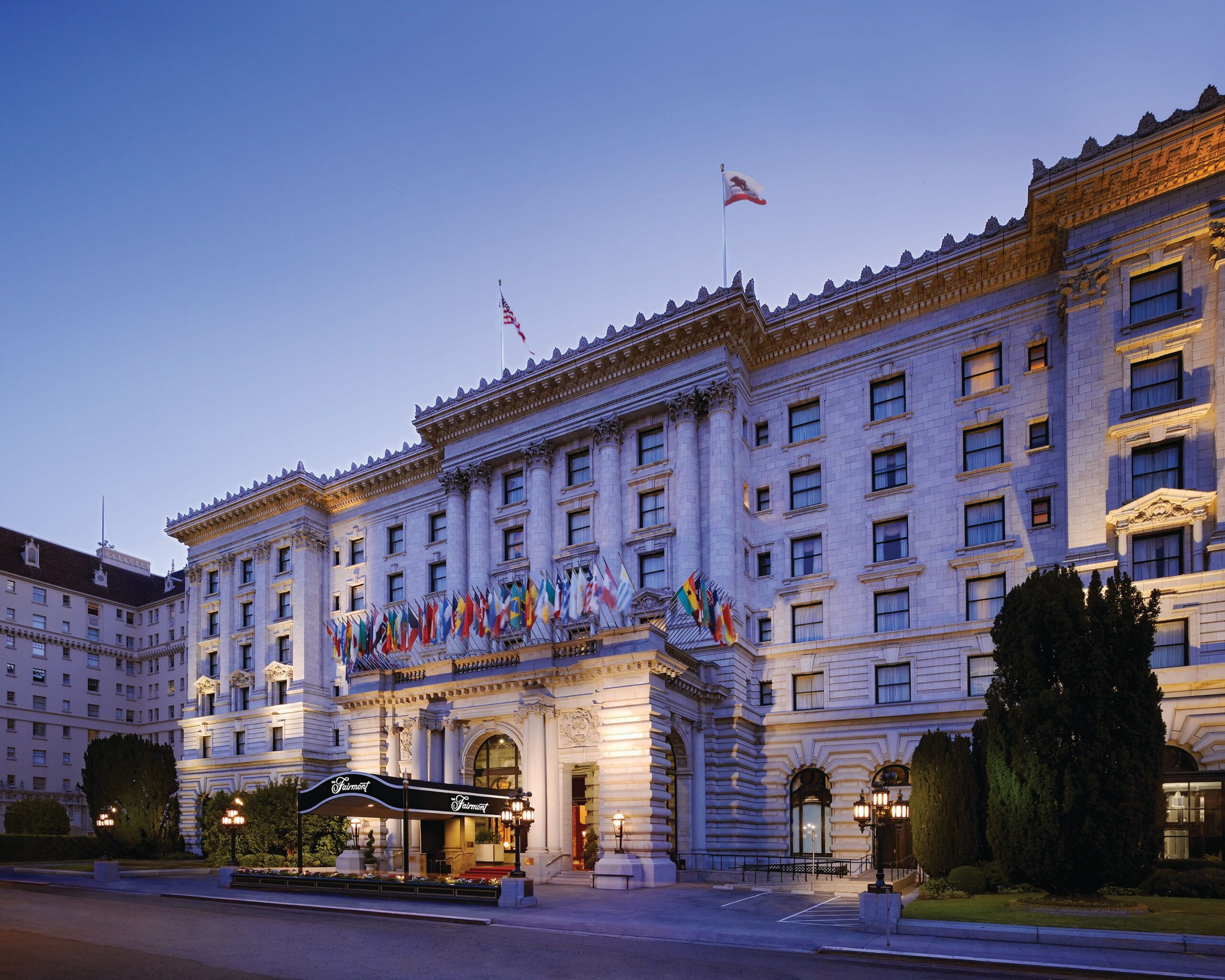
facade of white hotel
Fairmont San Francisco

Like many other buildings in Nob Hill, The Fairmont Hotel was utterly destroyed. Undeterred, the sisters hired architect Julia Morgan—who would later come the nation’s preeminent female architect—to rebuild the entire structure. Exactly one year after the quake, like a phoenix rising from the ashes, the Fairmont Hotel re-opened and soon became the social hub of the city.

Read More: Wellness and Sustainability Top Agenda for Accor

Tourism is vital to San Francisco’s economic recovery and vibrancy. Along with local and statewide destination partners, our teams are aggressively working to bring visitors and meetings to San Francisco and support the city’s economic recovery. Regional recovery will depend on the continued growth of the
convention market and the rebound of visitors from Asia.

Our onsite, national and global (Fairmont) sales teams continue to provide industry-leading levels of service. At Fairmont San Francisco, every solution is built in-house, exclusively for our groups and meeting planners. Guests appreciate world-class facilities, dedicated client support and ongoing innovation.

Innovative public/private partnerships are taking place throughout San Francisco and are making a positive impact. Programming like Yes San Francisco (Yes, SF), launched by Deloitte, Salesforce and World Economic Forum, an Urban Sustainability Challenge.  The first location-based UpLink Challenge created in direct response to the United Nations’ Sustainable Development Goal 11 of making cities more inclusive, safe, resilient and sustainable. The Challenge is a unique call to action for entrepreneurs to submit sustainable solutions that contribute to the city’s needs and to have the opportunity to receive funding and support. YES SF Top innovators will be announced in September at Salesforce’s Dreamforce 2023.

woman smilingJennifer Dunn, director of sales and marketing, InterContinental Mark Hopkins San Francisco

InterContinental Mark Hopkins, a historic landmark hotel in San Francisco, has a remarkable story of resilience. Overcoming earthquakes, economic fluctuations and cultural shifts, it has remained a steadfast provider of exceptional service and guest satisfaction.

In times of adversity, the hotel has consistently adapted and innovated to meet the evolving needs and expectations of its valued guests. Its dedicated team strives to deliver unforgettable experiences, ensuring that each guest feels welcomed, cared for and inspired. Whether it’s recommending the best local attractions, arranging special surprises for a celebration, or simply offering a warm smile and attentive service, we strive to exceed the expectations of our guests and leave them feeling inspired by their time with us.

As a cultural landmark within the city, the hotel takes immense pride in celebrating San Francisco’s rich heritage and its spirit of progress and innovation. It seamlessly blends timeless elegance with contemporary amenities, offering guests an unparalleled experience that reflects the city’s unique character. Imagine stepping into our grand lobby, adorned with exquisite artwork and historic photographs that pay homage to the city’s vibrant history. As you walk through the hallways, you’ll notice tasteful nods to San Francisco’s iconic landmarks and cultural icons, creating a sense of connection and immersion in the city’s heritage.

Understanding the significance of virtual and hybrid meetings in today’s evolving landscape, the hotel offers advanced technology solutions that facilitate seamless connectivity and engagement for both in-person and remote participants. State-of-the-art audiovisual equipment, a robust internet infrastructure, and dedicated technical support ensure a smooth and immersive experience for all attendees.

With an experienced event planning team, we provide personalized assistance and support throughout the planning process. The team works closely with meeting professionals to understand their specific requirements, offering tailored services ranging from audiovisual equipment setups to customized catering options.

As San Francisco continues to recover and rebuild, the InterContinental Mark Hopkins eagerly welcomes meeting professionals and their groups back to the city, and we are particularly excited to show off our newly renovated Peacock Court Grand Ballroom.

Sebastien Pfeiffer, managing director, Beacon Grand

San Francisco’s story of resilience is a testament to the indomitable spirit of its people. From rebuilding after natural disasters to reinventing in the face of tech and economic fluctuations, San Franciscans have consistently embraced change, harnessed their collective creativity, and forged a path towards a brighter future. Although San Francisco is still recovering after the COVID-19 pandemic, the city’s resilience lies in its ability to learn from setbacks, adapt to new circumstances and inspire others with its unwavering determination, ensuring that San Francisco remains a beacon of innovation for generations to come.

Read More: Plan with Your Pups

As Beacon Grand, we are excited to extend a warm welcome to meeting professionals, inviting them to experience the revitalized energy and unwavering spirit of our city. To ensure a seamless and unforgettable visit with deep city connectivity, Beacon Grand provides the expertise of our dedicated Social Hosts who can curate customized itineraries complete with insider recommendations and exclusive offers that only locals could know. From securing dining reservations to arranging off-the-beaten-path excursions, our Social Hosts go above and beyond to create tailored experiences that reflect the city’s vibrant culture, one which we acknowledge continues to evolve.

Food & beverage shines, and our bar team, in particular, offers several engaging opportunities reflective of San Francisco’s flavors, from tastings of our selection of whiskey barrel casks aged on-site to savoring handcrafted cocktails and learning the art of mixology. Through these tailored events, we ensure that each gathering is infused with memorable moments and unparalleled hospitality.

We continue to closely partner with city organizations and local businesses to further support economic development while also fostering city connectivity and inspiring exploration for both our leisure and corporate guests. This spring, we partnered with the Union Square Alliance for their annual ‘Union Square in Bloom’ campaign, a cherished tradition celebrating the rich history of our neighborhood. By participating in this community event, we aimed to inspire our guests to get out and explore the city. Our hotel showcased its support through floral decor, special cocktails, and menu items that encapsulated the excitement and vibrancy of the area. By embracing this initiative, we fostered a sense of community and encouraged visitors to appreciate the beauty of Union Square.

Read More: California, Meet What is Possible

Recognizing the significance of flexibility and value, we’re also offering group promotions and online sales offers to attract meeting professionals and their groups to choose our city as their preferred destination. By showcasing our one-of-a-kind hotel amenities and central location, our promotions entice guests to book their meetings in San Francisco, allowing them to experience firsthand the city’s resilience, innovation and creativity.

man smiling, wearing blue tie, blue sport coat and white dress shirtMatthew Martinucci, vice president of sales and destination services, Visit San Jose

What does a tech destination do when the tech disappears? It goes back to its roots. San Jose has always been at the forefront of innovation. From the first cannery born out of agricultural roots to a welcoming environment for pioneers of the tech industry, we’ve drawn upon our entrepreneurial spirit to rebuild.

San Jose’s DNA is strong. Covid and its aftermath made us look inwards at ourselves. We have what it takes to be attractive to a wide variety of audiences. As the tech industry adjusts to economic climates, we are shifting focus to sustainable recession-proof businesses such as association meetings, youth and national sports (building on our history of successfully hosting events such as the U.S. Figure Skating Championships). Corporate businesses like pharmaceuticals and biosciences are also growing.

Read More: Visit San Jose Makes Adventurous Food a Star

No meeting is too big or small. We treat our convention calendar like a mosaic—there is always a right time and place for each client.

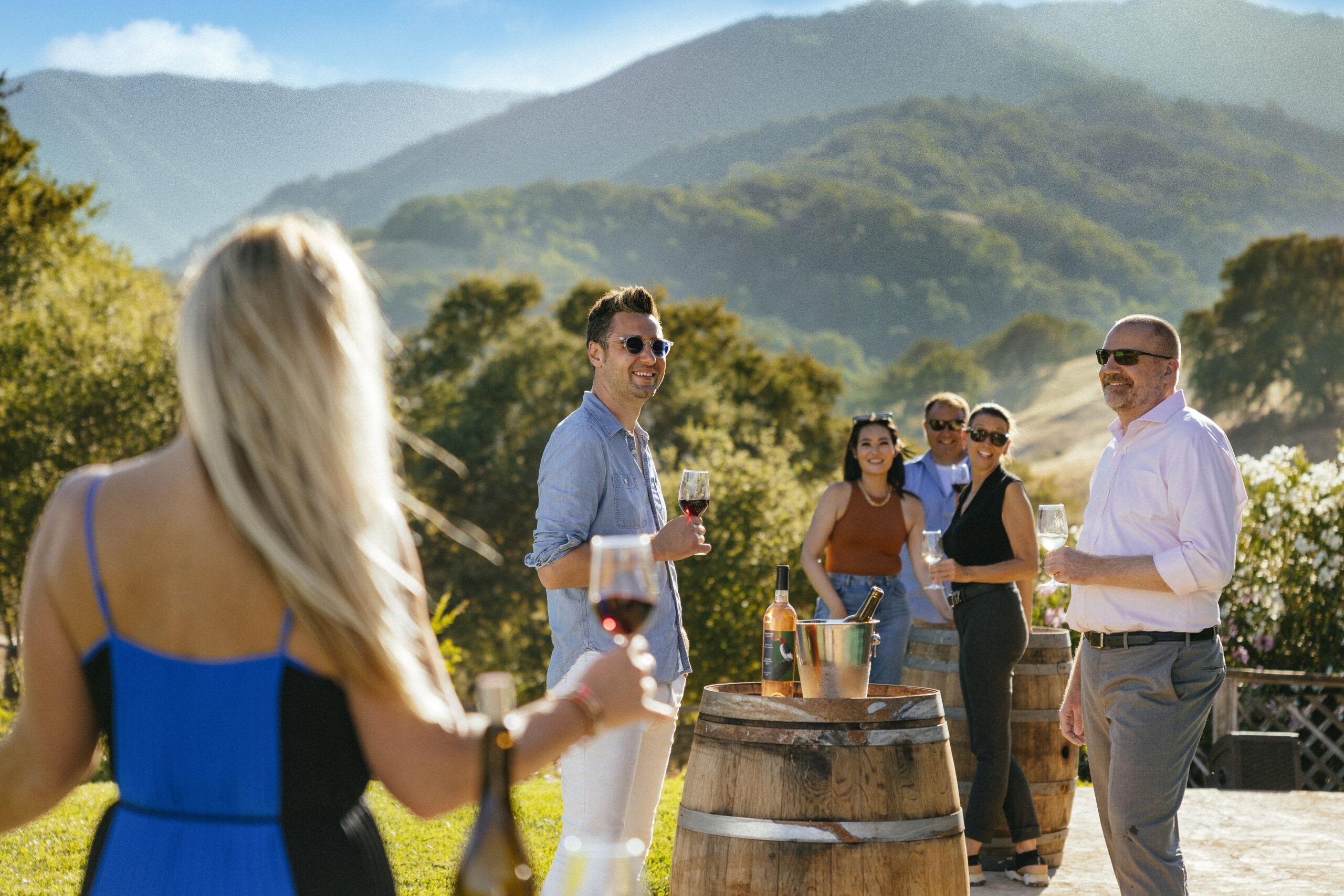
four people drinking wine in vineyard
Alamitos Vineyard

We’re appealing to many types of industries because San Jose offers much as a DMO. We have our own San Jose Mineta International Airport (SJC), two more airports within driving distance in the Bay Area, year-round sunshine, and the templated “Own the City” program where clients can turn San Jose into an extension of their meeting space with branded streets, buildings and even transportation.

San Jose makes the meeting planning experience easy with our vertical integration. Team San Jose, Visit San Jose’s parent organization, is the DMO, but also manages the convention center, four theater venues and its own F+B catering arm. We cut through the red tape planners are used to—offering a customized experience while saving time and money.

Outside the event planning experience, clients love the in-destination experiences available to attendees. As one of the most diverse cities in the U.S., we offer diverse culinary options, eighteen unique neighborhoods, access to mountain-top wineries and one-of-a-kind attractions.

As we rebuild as a destination, we aren’t just getting back to where we were. We’re leaning into innovation and making San Jose a welcoming destination for all.

Following the ever-changing trends of the event production industry

This summer marks the 30th year event and entertainment production company Empire has been putting on live events across six continents.

Founded by J.B. Miller in New York City in 1993, the company has since produced events for corporations, associations and nonprofits, among others, such as The Webby Awards, the Bill & Melinda Gates Foundation Goalkeepers, the New York Public Theater Gala, the TIME 100 Gala and The Tribeca Film Festival, among others.

With so much experience in the business of event entertainment and production, we checked in with Miller to glean some insight into how the industry has changed since he first began, what event production trends are taking shape and what the future of event production may look like.

“A lot changes every year in our industry,” Miller says. “Geographic priorities of where people will go, legislation that changes what companies are allowed to pay for meetings and events, budgets that go up and down, depending on how bullish people are on the economy and growth or in what kind of a recessionary mode they’re in.”

Present: Experience Participation

Since before the pandemic, and perhaps sped up because of it, attendee engagement has been something meeting professionals want more of. While participation from attendees isn’t necessarily a requirement of being more engaged, it can have a positive impact on the outcome of the event. This participatory format is one of the things Miller says he has seen become more requested in recent years.

“Meeting planners want people to be actively involved in, and in many cases, contributing to the creation of the content, or even co-creating the content or the experience,” he says. “I think smart meeting planners understand that when you set up an event—the date, the time, the place, the look, the field, the rooms, the brand—all you’re really doing is laying the groundwork for the potentiality of what happens when you put the human element into it.

“It’s the humans that come together, that have their human experience, that create that magical alchemy that translates into the goodwill, the feeling, the experience, the photography, the ‘I can’t believe this happened’ kind of thing. It’s both infrastructure and people. And when you put it together, that’s when you get the synthesis.”

Read MoreElevating Engagement

Asked about the reasons behind this shift, Miller had two to offer. The first: “People that are engaged in something or doing something are just more likely to learn or take things away from something than if they’re just sitting there passively,” he says, adding that this is due to a general learning of the industry. The second may slip under the radar a bit more easily, as humans fall prey to adherence to tradition and not asking questions about the value and ROI on experience, resulting in wasted time that could be spent elsewhere.

“People understand that a meeting represents a lot of investment,” Millers says, “not just on the client side of booking the venue—setting up the production or hiring the catering and staff and so on—but the time it takes out of an organization’s calendar [in place of] other profit-making activities, the time it takes for every attendee to drop everything and travel somewhere and give up a day or three days in a destination.”

This increased understanding of the value of people’s time and investment, he says, means planners are becoming more intentional about the outcome of events. “It’s not good enough to say, ‘Well, every year we do a sales meeting, so we’re just going to bring everybody together in the desert and have a good time for a couple of days, then we’re going to go away and be a better company for that.’”

Miller says more concrete pre-event questions are being asked. “People are now saying, ‘Well, what do we want to get out of this meeting? What are the actual outcomes we want? How would we state and quantify those objectives? Or the KPIs? What does success look like? Did we sell X percent more product? Did we get 50% more buy-in on a strategy? How do we express our objectives in a form of goals and metrics?’”

Future: Differentiation of Events and AI

What Oracle, Microsoft and Salesforce have in common technologically, they also have in common in the world of events. They all host annual technology user conferences. All great and good, but there is one thing Miller says is lacking, and clients are requesting: differentiation. “All these technologies companies have everybody fly in, they all try to get some knowledge of their products and services, some use cases and how they can make things better, some production to new products and so on. But they basically all accomplish the same thing.” Miller says one thing Empire is being tasked with increasingly is answering the question, “How do you differentiate one from the other?”

“How do I really know that I’m at a Salesforce meeting versus a Microsoft meeting versus an Oracle meeting?” he asks. “How does the soul and character of the brand come through in the form of experience that builds a greater affinity for me, or provides an organizing principle or North star for me to think about that company?”

Read MoreAdding AI to Your Next Meeting

“You have to establish a distinct character. If I’m at a Bravo event, I have to know I’m at a Bravo event. And everything has to extend from that, really make me feel like I’m part of that brand,” Miller says, adding that he believes in the future more companies and meeting conveners are going to put more thought and energy into how the persona of the brand comes through, focusing on how to use events to create a proprietary experience that could only be tied to its respective brand.

Miller also believes people are increasingly recognizing the power of tentpole events and cultural momets. “Things like the TIME 100, the Met Gala, the White House correspondents, the Cannes Film Festival, Fashion Week or any of these things, I think people are understanding that these are big, gravitational moments…I think there’s more and more utility to put your event alongside that, to integrate your event or convening on the shoulders of some other big tentpole event that’s happening.”

And lastly, Miller mentioned the increased use of AI and new technology, which he says requires no crystal ball to see. “We’re going to see a lot of AI working its way into events. Data analytics, ChatGPT, design through Midjourney and DALL-E and other types of generative AI visual programs.” He says he doesn’t believe it’s going to uproot and completely change the nature of things, but simply increase the speed, the quality, the field of vision of these kinds of events.

As for Empire, Miller says they’ve been using new AI technology in many creative ways. For example, in trying to figure out artists similar to Alicia Keys, Aretha Franklin and Diana Ross, artists an Empire client has had in the past, Miller used ChatGPT to quickly search for similar artists. “Here’s like 50 other names, most of which I would have thought of if I had the time to pull out a piece of paper and scratch my head. It was a very quick way to get there.”

Miller says Midjourney and DALL-E are where the company is seeing the most ROI. “We can say ‘Okay, it’s a rainbow-colored room for OutRight Action International’s gala and we want rainbow-colored centerpieces, something modern and slick.’ We give these values and then all of a sudden it’s generating three or four visions of events. Some of which are elements that we would have thought of ourselves.” For other visions the AI produced, Miller says the team were given a totally unique and different take. Although the plan isn’t to replicate exactly what DALL-E came up with, it provides a nugget of an idea.

“We’re bouncing our ideas off the technology, the technology is bouncing ideas back on us,” he says. “That’s what brainstorming is about, getting ideas going. A good idea interchanging with one idea, leading to another idea, jumping off to a third idea that you never would have had if you didn’t have those two parties. So those are ways that we’re actually using AI tools, to amplify the creative power of what we’re doing. But there’s so so much more.”

Mingling of Meetings and Experiences

Miller says when he first started in the entertainment and production industry, he didn’t really understand the meetings and corporate events world, but he believes the misunderstanding came from the other side as well. “I think both in the way that legitimate entertainment producers didn’t really understand the meeting and events business, the meetings and events business didn’t really understand how to use entertainment, storytelling, and narrative and experiential.”

Over his now 30 years operating Empire, he says he has found a coming together of the two industries. “We have found clients that value and prize greater storytelling, greater entertainment components, and understand we have to inspire and move and entertain and thrill attendees to get them to open their minds to what we’re asking them to do.”

The meetings industry has been increasingly open to allow his company, and the event production industry in general, to produce creative work, he says. “At the same time, I think we’ve benefited because we’re serving industries, we’re serving not for profits, we’re serving governments, we’re serving people with objectives. That’s better to me, using our great storytelling techniques to achieve purpose and outcomes.”

The FAA outlines the future of transportation and hiring

The arrival of flying taxis whisking travelers to and from airports got a step closer this week after the Federal Aviation Administration (FAA) released the Advanced Air Mobility (AAM) Plan. The initiative aims to document the work required to make initial AAM operations possible by identifying operational settings or “key sites” in the near future to make the innovative form of transportation a reality by 2028, if not sooner.

“The implementation plan creates a framework for companies to conduct scaled operations at one or more key sites by 2028. It does not preclude less intensive operations earlier than 2028. We will be ready for air taxi operators when they are ready to fly safely,” said an FAA spokesperson. “Safety will dictate the certification timeline, but we could see these aircraft in the skies by 2025.”

The planned use of AAMs comes during an increased need for more efficient transportation to move people and cargo amid a high demand for air travel, coupled with persistent issues and delays that have plagued airlines and carriers alike. “I love this idea, especially for groups that I would work with that maybe want to spend time in Taos, but the drive time is too long, so the activity times are limited,” said Sheli Hinds Armstrong, owner and CEO, Destination Southwest. “Or if they want to have dinner in Santa Fe, but don’t want to make the two-hour drive from Taos take longer.”

Armstrong’s optimism points to one of the program’s key goals of integrating AAMs into the nation’s airspace, which will provide adequate and accessible air transportation to underserved markets. “It would also help with groups coming in for shorter meetings and from local markets like Phoenix, Denver and Dallas,” she said. “Two-day meetings and incentive meetings could triple for me!”

New Tech in the Friendly Skies

Another core component of the implementation plan is to safely integrate new technology into the aviation ecosystem. The FAA’s main objective for safety is to ensure AAMs adhere to the highest standards of commercial aviation with the public’s safety being top of mind. The process of certifying new aircraft is fluid and allows for adjustments for pilot qualifications as the AAMs are developed.

The new aviation technology developed under the guidance of government agencies and programs such as NASA’s AAM program and the National Campaign, and collaboration with the U.S. Air Force AFWERX Prime programs, offer support for the implementation of AAMs by providing existing data and research to quicken the process.

Read MoreMarriott Shared Upcoming DEI and Technology Advances with Association Planners

The ongoing process also involves collaboration with stakeholders such as Joby Aviation, based in Santa Cruz, California, the first company to develop AAMs to clear the second stage of the FAA’s approval process. That stage, completed in February, allowed Joby to move forward to the third stage of certification after its Certification Basis was published in the Federal Register. The Joby aircraft uses six electric motors, producing zero operating emissions.


“Joby continues to lead the way on certifying eVTOL (electric vertical take-off and landing vehicle) aircraft with the FAA, and today’s news is another step towards launching commercial service in 2025,” said Didier Papadopoulos, head of aircraft OEM at Joby in a statement issued earlier this month. “We’re grateful for the FAA’s continued commitment to safely introducing next-generation aircraft into service.”

The third stage, “Certification Plans,” requires Joby to provide the FAA with the company’s expected roadmap for all “tests, analyses and design reports” Joby plans on performing to demonstrate compliance with all requirements and regulations.

Joby’s pilot production line in Marina, California, successfully rolled the company’s aircraft, earning a Special Airworthiness Certificate from the FAA, thus clearing the craft for flight tests. The craft will be delivered to Edwards Air Force Base in California as part of the $131 million contract Joby has with the U.S. military and will be the first electric air taxi used on a U.S. Air Force base.

Key Site Operations

The implementation plan also focuses on establishing the blueprint for AAM operations and guidelines, known as the Innovative28 Key Site Operations, and includes the regulations of vertical take-off and landing (VTOL), short takeoff and landing (STOL) aircraft, and descriptions of I28 AAM operations such as air traffic control services and procedures and guidance for airspace usage and routing.

“Our role is to certify the aircraft, certify the pilots, and integrate the aircraft into the national airspace system,” the FAA spokesperson said. “We will be ready for air taxi operators when they are ready to fly safely.”

The plan also paints a clear picture of what will be needed to create a feasible infrastructure for AAMs. Initially, the plan is for AAMs to use existing airports and helipads with modifications dictated by the FAA to accommodate vertical take-offs and landings, along with what’s referred to as greenfield or infill, which consists of repurposed developments for the building of vertiports to provide AAM access to specific destinations.

These steps are expected to take place within the timeframe of 2025-28. The integration of security measures will be handled through a broader effort carried out by an interagency working group led by the Department of Transportation, as AAMs pose a unique security challenge.

New Grants for Fresh Talent

Aviation Workforce Development Grants for Aircraft Pilots were announced by the FAA this month with the goal of recruiting the next generation of industry pilots. The target demographic for the next wave of air travel professionals is recent high school graduates. “The duration of education depends on the age of the participant and the field they want to enter,” the FAA said.The educational grants are a component of the FAA Reauthorization Act of 2018 signed into law by then-president Donald Trump. Section 625 of the act addresses the projected shortages of pilots within the aviation industry and allows the FAA to provide grants to help foil any potential labor gaps in the future.

The U.S. Department of Labor (DOL) projects an average of 18,100 openings for airline and commercial pilots every year over the course of the next decade. The specific reasons for the annual vacancies provided by the DOL include individuals who left the industry for different occupations or exited due to retirement.

Grants are provided to a diverse group of programs including public and private schools in rural, suburban, and urban areas. The grant program has received $5 million annually from Congress since 2020 and will expire at the end of the 2023 fiscal year. Grants are valued between $25,000 and $500,000 annually. The goal of the program is to provide a minimum of 10 grants to various programs every year. The closing date for applications is Aug. 16, 2023.

trends impacting the hospitality industry

Editor’s note: Since this popular story about hospitality industry trends was written in July 2015, Smart Meetings has updated it over the years so you can follow the trends through the ages. 

2023 Update

After a concerning dip during the pandemic years, hospitality reigns supreme as the fastest-growing industry in the U.S. economy and is expected to increase exponentially. The industry has experienced staffing challenges as hospitality professionals call for better treatment and higher pay, while inflation has led to higher prices following a post-pandemic travel boom.

Read More: The Present and Future of Event Production

    2022 Update

With the massive 8.6% hike in the price of consumer goods in May and rising travel costs, 70% of economists surveyed by Fortune believe that recession is on the horizon. Even so, hotels and flights are full. The American Hotel & Lodging Association (AHLA) predicts a 63.4% occupancy rate this year, fueled mostly by leisure travel. Be wary of volatility in the travel industry as prices continue to rise.

    2020 Update 

In January 2020, IHCL Vice President of Public Relations and Corporate Communications Rakhee Lalvani forecast on The Hotel Show blog that ecotourism, religious tourism, micro-cations and culinary travel would drive the industry for the next 12 months.

    2018 Update

In advance of the Independent Hotel Show, the authors named professionalization or leveling up of hotel management—including an increase in the number of women in senior roles and streamlined technology solutions—as a major trend. “While departments such as room service, or the concierge desk, will be pared back due to lessening demand, social skills and local knowledge will be called upon more by guests, who want to feel they’ve landed in a healthy community rich with experiences.” Smart rooms, an emphasis on public areas as a community hub also received shout-outs.

      2015 Original

The Hotel Show, which stages business to business events for the hospitality industry, identified what it believed to be the Top 10 trends impacting the hospitality industry in 2015.

1. Catering to millennials

2023 Update

Millennials, now largely established in their adulthood, continue to express a desire for experience over luxury. Millennials often will not hesitate to post about their experiences on social media, often tagging their lodging or dining locations. Travel trends rapidly change, so staying up to date with what’s popular on social media helps hospitality professionals know what their customers are seeking.

      2022 Update

Millennials have a huge amount of spending power–currently estimated at $200 billion–and an even bigger appetite for travel. They have continued to use new technology to their advantage. A majority want the ability to split the cost of travel, instant messaging-style customer service and services that recommend locations based on their interests.

     2020 Update

Millennials are now entering middle age, marrying, buying homes and settling down. A 2019 study by Berkshire Hathaway Travel Protection found that millennials spend more and travel more than any other age group—including Baby Boomers. And they say they would spend more if they had more disposable income. They tend to focus on exploring the world and getting a “local” experience—and posting it all on Instagram.

      2018 Update

Smart Meetings’ personal research found that travelers of all ages seem to enjoy easy check-in and gourmet dining at reasonable prices. Who knew? But more to the point, a 2018 Future of U.S. Millennial Travel report based on a Resonance Consultancy survey of U.S. 20 to 36-year-olds found that 85 percent put a priority on venturing out of their comfort zones and learning new things. That ranked right behind dining (91 percent) and fun attractions (90 percent).

    2015 Original

Millennials (those born between 1981 to 1994/6) are expected to represent 50% of all travelers to the USA by 2025, according to the Cornell Center for Hospitality Research. Companies need to define their strategies based on this demographic group’s personality traits and habits—they travel a lot, are early adopters of technology, enjoy personalized interactions and are spontaneous. Hotels will want to please them with easy check-in and gourmet dining experiences at reasonable prices. In return, satisfied millennials will actively promote their businesses on social media channels.

2. Tech explosion

2023 Update

The past year has seen a tech explosion like never before with the rapid advancement and implementation of artificial intelligence. There is a role for AI in every industry, hospitality included. The Hotel Show reports that AI can streamline often complicated hotel check-in and check-out processes, can handle common guest requests like room service and amenities, and can even offer personalized recommendations for services, activities and dining—all for affordable costs even to small businesses.

Read More: How Meeting Profs Can Find the Right Event Tech

    2022 Update

According to an April survey by the Bureau of Labor Statistics, only 7.7% of employees are still working remotely, indicating a decline from the May 2020 rate of 35%. The benefits of virtual meetings have not been forgotten by in-person and remote workers, however. TeamStage reported that nearly 90% of workers believe that video calls increase productivity. Employees are back to traveling, but not without the ability to check in with their teams from anywhere in the world.

    2020 Update

The sudden switch to working from home during social distancing of the coronavirus pandemic has forced planners to get on board with productivity apps and a crash course in pivoting to digital. Virtual meetings that were once seen as a threat to face-to-face events are now the savior for interactions that need to go on to support business, research and social needs.

    2018 Update

In the meeting room, planners are leveraging cloud-based digital registration and event app tools to deliver greener, more personalized experiences. From chat to VR and AR, tech has gone from gee-whiz to must-have as a tool to understand attendee preferences.

    2015 Original

The majority of guests today are self-sufficient, tech-savvy travelers who are comfortable using apps or mobile websites. Hotels need to make sure their offerings are up-to-date and user-friendly. At business meetings and conferences, travelers expect hotels and conference centers to have high quality tech equipment and a knowledgeable support staff.

3. Influx of international visitors

2023 Update

The New York Times reported in July 2023 that because the United States’ excess death statistics (the total number of Americans who die each day from any cause, that surpasses normal numbers) has dropped almost to zero, the COVID-19 pandemic can really be declared over. Recent years have seen a rise in international travel in response to the easing of pandemic-era restrictions.
airport demand

    2022 Update

The strict rules that governed international travel during COVID are slowly being removed. The Biden Administration dropped the negative COVID test requirement for United States-bound international flights, which bodes well for destinations that rely on these travelers.

    2020 Update

Associations are lobbying for streamlining of visa programs, to grow the $97 billion economic contribution from global travel. Now the industry will have to address health safety in the wake of the coronavirus pandemic.

    2018 Update

U.S. Travel Association has warned that the U.S. is not keeping pace with global long-haul travel expansion. In the United States, international inbound travel is expected to continue to grow at a rate of 2.2 percent while the same traffic worldwide is estimated at 6 percent.

    2015 Original

International leisure travel is on the rise—Dubai International Airport has become the busiest airport in the world. Hotels must be able to provide services in a multitude of languages, and tailored experiences properly suited to the culture and unique needs of their international visitors.

4. Increased emphasis on health and well-being

2023 Update

The Global Wellness Institute expects the wellness tourism market to see 20.9% average annual growth and to reach $1.1 trillion in 2025. After the turbulence of the past few years, the importance of well-being takes on increased importance, in addition to a continued desire for healthy, organic food and accessible fitness facilities and amenities.

Read More: Team Building and Well-Being

    2022 Update

As of March 2022, all major hotel groups are still practicing social distancing and enhanced cleaning. These measures make guests feel that the hotel is considering their health and safety. Masks are on their way out as more than 200 million people have been fully vaccinated in the United States.

    2020 Update

Wellness is taking on primary importance as attendees want to know that it is safe to return to large group settings. Reduced density, increased sanitation stations and pre-packaged meals could be the norm going forward. Meanwhile mindfulness exercises to reduce stress and promote mental health have become more common in agendas large and small.

    2018 Update

Wellness tourism is estimated as a $563 billion industry. From MGM Resorts and Wyndham Hotels and Resorts’ Stay Well rooms to Pullman’s focus on sleep, food, sport and spa, and Hilton’s Five Fee to Fitness program that puts the capability of a gym in the guest room, the hospitality industry has made it easier to stay healthy on the road.

    2015 Original

Guests today are taking charge of their health; hotels are responding with well-equipped fitness centers, pools and spas. Increasingly, travelers are expecting innovative wellness options. In addition to healthy food options, growing trends include lighting that energizes, air purification, yoga spaces, in-room exercise equipment and even vitamin-infused shower water.

5. Need for seamless technology

2023 Update

Contactless payment, mobile check-ins and fast, reliable wi-fi have all become increasingly common in hospitality services and fewer guests are willing to go without them. The rise of AI enables the use of service automation like chatbots to answer routine questions. More people are aware and concerned about data privacy, so strong data security is a must. Virtual reality is on the rise for lodging and location tours while augmented reality is entering the trade show floor in a meaningful way.

    2022 Update

Streaming services have taken root as the preferred way to watch TV, both at home and in hotels. While some still take advantage of the hotel’s cable services, guests spend more time watching streaming services when they’re available. Netflix reported a subscriber loss at the start of 2022 for the first time in ten years, but services like HBO Max, Disney+, and Hulu are popular alternatives.

    2020 Update

The call for being able to handle everything from hotel registration and meal ordering from the convenience of our smartphones has only grown louder. A 2020 survey found that almost three-quarters of respondents would prefer to text for help in real time compared to 42 percent who said they would like to talk to someone using video. A phone call was the number one option.

    2018 Update

Everything is smart these days. Smart rooms, smart badges and smart phones are all connected to share information and make getting what you want when you want it easier than ever. Look for facial recognition to unlock clickless access to just about everything.

    2015 Original

Seamless connectivity across platforms and devices is growing more important. Many hotel groups are offering mobile check-in and digital concierge services. At Aria Resort and Casino in Las Vegas, guests are issued high-tech cards that detect their presence and unlock the door before they even reach it.

6. Sustainability rules

2023 Update

It’s widely understood that hospitality has one of the largest environmental footprints of many industries. This means it also can make some of the most meaningful impacts. The Hotel Show narrows it down: hospitality organizations should focus on investing in efficient energy (like solar power and green design), reducing water consumption (through methods like greywater recycling) and reducing food waste (through methods like composting).

Read More: Seeking Sustainable Venues

    2022 Update

Nearly half of the United States is in a state of moderate to severe drought as of March 2022. Many guests want visible measures to be taken to limit water use. Linen reuse programs and low-flow showerheads and toilets are just some of the suggestions provided by Natura Water to limit water consumption.

    2020 Update

Attendees not only want to be assured that meeting professionals are doing everything they can to reduce the carbon footprint of the event, reduce waste and source responsibly, they want to see nature in the ballroom. Biophilic design uses the power of a connection with the earth to enhance the wellness of people. The result is renovations and new builds designed to attract the 63 percent of people who say they would like to see more plants in hotel rooms.

    2018 Update

Considering the environmental impact of everything from plastic straws to leftovers has become an essential part of an event professional’s job. Venues are making it easier than ever to track food chains, reduce waste and minimize greenhouse gas footprints.

    2015 Original

Eco-friendly practices are becoming the norm, as properties focus on renewable energy resources and water scarcity. Many hotels are installing solar panels and updating systems so that air conditioners and lights automatically switch off when guests leave their rooms.

7. New roles for staff

2023 Update

The U.S. Bureau of Labor Statistics projects the addition of 1.9 million jobs in leisure and hospitality from 2021 to 2031, the largest increases being in F&B. After a concerning drop during the pandemic, this rapid rise looks strong. Hospitality is currently the fastest growing of any sector in the U.S. economy.
    2022 Update

The current labor market is in a state of flux. Many industries are experiencing a labor shortage, including hotels and restaurants. Guests are now more open to seeing cleaning out in the open, but there are fewer people available to do so. Some hotels are offering higher wages, free training and other incentives to get people back to work.

    2020 Update

Hospitality workers have become the front lines during numerous emergency situations, opening up for victims of hurricanes and earthquakes, transforming into alternative hospitals during a pandemic and keeping the lines of communication open when the situation was changing quickly. Universities are stepping up to offer focused, advanced degrees in event planning with a risk management component embedded in the coursework.

    2018 Update

A quick search for hospitality jobs includes the titles such as social media coordinator, creative lead, events and experiences, audio-visual technician and yoga instructor. To qualify for these more specific roles, many are opting to pursue industry certification.

    2015 Original

Many travelers seem to prefer technology to human beings—they want to check-in digitally and don’t mind if a robot delivers room service. This will give staff the opportunity to focus on more personalized service, as opposed to rote tasks.

8. Destination promotion

2023 Update

The Expedia Group’s Sustainable Travel study from 2022 found that almost 3 out of 4 consumers would choose a destination clearly committed to sustainability even if it was more expensive, and that they want to see evidence of a destination’s sustainability in easy-to-understand terms, accessible on its website. Loyalty programs and influencer campaigns are integral to keeping customers engaged, and social media is an indispensable marketing tool with 87% of millennials indicating that Facebook inspired them to make a booking.

Read More: Lessons Learned from MPI WEC in Mexico

    2022 Update

More people than ever are using travel websites to choose their hotel. Booking.com, one of the leaders in their field, saw 457.7 million visitors in March 2022. Entries on travel sites put hotels on the radar, especially when meeting spaces and other amenities are highlighted.

    2020 Update

Convention and visitor bureaus (CVBs) are stepping up to perform advocacy, help with risk management planning and source for sustainable and engaging options for events in their cities. They are now playing the role of strategic advisor. Many are stepping in to find solutions for issues as diverse as homelessness and measuring impact. All the while, CVBs have gotten creative about how they talk about their value. From heartfelt messages from the CEO during a crisis to support for charities and free video conference backgrounds, they are becoming part of the larger travel experience.

    2018 Update

The #Hotelfie, augmented reality ads and room service virtual reality goggles are now “things.” Planners can visualize spaces in multiple destinations without leaving their computer.

    2015 Original

The explosion of social media is causing hotels to become more involved in destination and self-promotion. Many are featuring guests’ images and tweets on their websites; some are even using the material in their advertising campaigns.

9. Real-time damage control

2023 Update

In the aftermath of the pandemic, although hospitality is one of the fastest-growing sectors of the US economy, its workers are also some of the lowest paid. According to a 2021 survey by Joblist, many former hospitality workers chose to leave the industry for good. July 2023 saw thousands of hotel workers strike in Southern California, demanding better working conditions, higher wages, and negotiations over new contracts. Staffing is a major issue for meeting professionals and being aware of any issues in advance of bringing a group is now a best practice.

Read More: UPS Strike May Be Imminent: Here’s How Meeting Planners Can Cope

    2022 Update

In the age of digital booking, stars are everything. An Expedia study found that over 70% of guests will choose a highly-rated hotel over one attached to a brand name or offering a lower price. Offering perks for leaving a review on sites like Yelp, TripAdvisor, or Booking.com can encourage guests to write about their experience.

    2020 Update

Meeting professionals are being forced to turn themselves into social media influencers—or hire one. By engaging their communities year-round, providing thought leadership pieces, education and authentic views behind the scenes that would make a Kardashian blush, they are building a following that will be eager to attend the next event.

    2018 Update

The world witnessed TanaCon in real time when 20,000 people showed up for a YouTuber’s event at a venue that holds 5,000, leaving thousands sweltering in the Southern California sun.

    2015 Original

If a hotel guest is dissatisfied, he or she can easily complain on Facebook, Twitter, Yelp or TripAdvisior. Hoteliers must be able to quickly respond. Engaging with customers and responding to their needs through these public forums help maintain positive guest relations and drive future bookings.

10. Unique perks

2023 Update

The “experience economy” is bigger than ever post-COVID. Some hotels are reinventing what they can offer customers, from chef-led cooking classes to guided hikes, all to offer guests the memorable experiences they are seeking. Look for destinations that can offer a visitor something memorable they can’t get anywhere else.
    2022 Update

Some hotels have opted to redecorate lobbies, rooms or historical places to stand out from the crowd. An especially dramatic example is the Lafayette Hotel in San Diego, which is restoring the bar where a scene from Top Gun was filmed. Advertising new renovations is always a good way to attract business and leisure travelers.

    2020 Update

In the quest to constantly surprise and delight, some hotels have gone to great lengths. From hangover recovery concierges in New Orleans and “hotel flatterers” who provide guests with random, thoughtful remarks about how wonderful they are, the emphasis is on personalization. Also a staple now at many properties, pet-friendly policies that start in the lobby. Inspired by cat cafes and puppy therapy, hotel are offering pet packages that include poolside petting paired with Prosecco.

    2018 Update

This is the year of the public living room as hospitality properties scramble to create comfortable spaces for informal gatherings in lobbies, restaurants and entries.

    2015 Original

With so many brands to choose from, properties need to find a way to stand out. Some are offering free daily wine tastings in their lobbies or bars; some are incorporating sophisticated informational screens in bathroom mirrors; and others are giving away curated set lists of downloadable music.

Artistic New Hotels Open Across the Globe at the Intersection of Destination and Hospitality

Picture it: a luxurious hotel in a stunning destination boasting vibrant culture, mouth-watering local cuisine and all the amenities and facilities a guest could want. Seems to have it all, right?

Not quite! Meet three brand new hotels redefining what it means to authentically experience a destination and luxury hospitality together. The experience offered at these locations in Portugal, Tel Aviv or Singapore will leave you and your guests with an entirely new understanding of what hospitality can be, and just how good life can get.

Like a Castle on the Hilltop

tables are situated around a tree indoors, reflected by a gold mirror on the ceiling

Renaissance Hotels opens their newest location in the Lapa neighborhood of Porto, a vibrant, historic Portuguese city. Renaissance Porto Lapa Hotel stands in the green hills of Porto with views spanning the city skyline. Visitors are steps away from must-see landmarks like the 260-year-old Lapa Church, a hub of the city’s religious, art, and cultural history. They can enjoy the antique shops and local cafes around the neighborhood or venture a little further to visit the grapevines of Universo Carmim or Gota a Gota Winery.

The Porto Lapa team describes the hotel’s design as “theatrical.” Pastel pinks and champagne golds illuminate the space, echoing the vibrancy of the city, and a charming splash of petrol blue pays homage to the Douro River. Traditional Portuguese tiles and art created by Portuguese artists decorate the interior space. 163 guest rooms featuring a continuation of the champagne color scheme alongside walnut furnishings and floor-to-ceiling windows offer a luxurious reprieve where guests can enjoy views of the Atlantic Ocean.

Read More: Meet in Europe

Over 5,850 sq. ft. of flexible event space is made up of 6 meeting rooms, the largest accommodating about 600 guests. Alongside the latest technology, these spaces are equipped with an advanced translator system to accommodate events with guests who speak different languages.

The hotel’s all-day restaurant serves Mediterranean-influenced Portuguese cuisine. The ground floor bar serves the Renaissance brand’s signature Ritual to transition to nightfall, after which guests can enjoy live music, while the Sky Bar on the fifth floor serves locally inspired cocktails and light bites alongside city views.

Redefining, Refining and Inspiring

Lobby at The George. An art-deco design featuring blue and brown tiled pillars and a cubic chandelier with distributed seating

This October, see visitors flock to The George, Tel Aviv’s newest lifestyle destination. Right in the center of the iconic city, The George is on a mission to seamlessly integrate hospitality with destination experience across the entire hotel space, placing a particular emphasis on seven pillars of urban life: live, work, dine, relax, stay, meet and celebrate.

Read More: Incentive Travel: A New Generation

Their exclusive members club is an integral part of this mission, providing a hub for networking and connection among a membership made up of locals and visitors, as they enjoy access to amenities and experiences such as live music.

A detail-oriented, art-deco design with characteristic hues of bright turquoise and burnt orange flows through 170 guest rooms—40 of which are designed for extended stays—as well as three restaurants, leisure and relaxation spaces, open work areas and a collection of indoor and outdoor gathering spaces that can accommodate small to medium events: book an intimate private dining suite, boardroom or grand meeting room. Guests can enjoy the fresh Mediterranean air on the balcony of the loft meeting room, or a state-of-the-art bar and live music in the Jazz Hall.

The George brings a one-of-a-kind spirit to the hospitality industry. Its innovative design unites hospitality, business and the lively spirit of an urban destination, so guests have everything they need right within reach.

Where Passion is a Lifestyle

COMO Metropolitan Singapore artist rendering shows a skyscraper from the ground up, featuring an entire floor of greenery about halfway up the building

The COMO group celebrates the upcoming soft launch of its newest property, the first in the brand’s own home country. This September, COMO Metropolitan Singapore, located inside the 19-floor COMO Orchard, will open its 11 stunning floors of 156 luxury guest rooms, a rooftop pool bar, dining spaces, a wellness center and fashion retail.

The COMO brand exemplifies the luxury lifestyle, integrating hospitality with fashion, organic living and gourmet foods, wellness, dining and philanthropy—and the COMO Singapore is no exception. At the COMO Metropolitan Singapore, guests can explore two floors of fashion retail curated by multi-label boutique Club 21. Assistance from personal shoppers and direct delivery to their hotel wardrobes is certain to make a lasting impression.

The COMO Shambhala wellness center offers a 9,000-square-foot holistic wellness facility offering luxury spa treatments, fitness classes, workshops and more.

Read More: Major Wellness Trends for Meeting Planners to Know

Three dining establishments accommodate a host of different tastes and needs. Michelin-starred New York and Miami steakhouse COTE by Simon Kim goes international for the first time, with an impressive wine and cocktail list that complements its exquisite menu. COMO Cuisine will serve nutritious Singaporean favorites all day, and guests can get organic healthy eats at COMO Shambhala Cuisine. The first-floor pastry shop will feature confections by internationally acclaimed French Pastry Chef Cédric Grolet.

Events can be held at the 19th floor skybar as well as some select commercial floors. COMO is surely a space for innovators and creatives to come together and experience the COMO brand’s passionate curation of luxury.

More money for air traffic control hires in House-passed FAA bill

The House of Representatives has approved a bill to reauthorize the Federal Aviation Administration (FAA) for another five years, a move that includes provisions for the hire of more air traffic controllers and allows pilots to extend their working life—both seen as fixes for a system that has seen massive breakdowns in the form of cancellations and delays for passengers.

The measure passed in a bipartisan 351-69 vote and now heads to the Senate for approval.

The bill will allocate $4 billion a year for the Airport Improvement Program, help the agency expand the organization’s training and hiring of air traffic controllers and also includes language on refunds for passengers.

William J. McGee, senior fellow for aviation and travel at the American Economic Liberties Project, says the yet to be finalized bill is “very much a work in progress” but said there were items in the House version of the FAA reauthorization bill that are good for consumers and good for competition.

Read MoreFasten Your Seat Belts

“We’re especially pleased that the amendment from Rep. [Chris] Deluzio and Rep. [Jesus] Garcia calling for a thorough examination of the harms of airline mergers was approved,” he says. “However, the effort to roll back the DOT’s full-fare advertising rule would make airfares less transparent and hit millions of travelers with sticker shock; we hope this effort fails. We’re eager to work with members of both parties in both Houses to help protect competition and consumers.”

Airlines for America (A4A)’s President and CEO, Nicholas Calio said, “First and foremost, the bill ensures that the U.S. remains the global gold standard of aviation safety and works to enhance efficiency by supporting technological advancements and government reforms that will modernize operations.”

U.S. Travel’s President and CEO Geoff Freeman said in a release: “The United States requires a more modern, efficient and secure air travel system to meet increasing demand and grow the U.S. economy. The bipartisan House bill is a critical step in correcting years of federal underinvestment, which has left the system with 1,200 fewer air traffic controllers than a decade ago.

“The bill includes provisions to increase investments in airport infrastructure, accelerate the deployment of air traffic control technologies and address workforce shortages, relieving strain on the system and increasing our country’s global competitiveness.

“It’s what travelers and the industry demand: Over half of Americans say they would travel more for leisure if the travel experience were less of a hassle.

“The U.S. Travel Association thanks Chairman [Sam] Graves (Minnesota), Ranking Member Larsen, Chairman [Garret] Graves (Louisiana), Ranking Member [Steve] Cohen and the members of the House Transportation and Infrastructure Committee for their efforts to advance the bill. We urge the U.S. Senate to act on an FAA reauthorization bill as soon possible.”

A major provision of the bill, contested by some, was raising the mandatory retirement age of pilots from 65 to 67.

Captain Jason Ambrosi, president of Air Line Pilots Association, said in a tweet that raising retirement age for pilots would “weaken airline pilot qualification requirements, disrupt airline operations, increase risk into the U.S. aviation system and raise ticket prices.”

Delta Mergers SkyBonus with SkyMiles Program

This week, Delta announced that it would be overhauling SkyBonus, the small and mid-sized business travel rewards program.

SkyBonus will morph into SkyMiles for Business in October. Through SkyBonus, corporate members earned and redeemed points with Delta in a separate system from the mainstream SkyMiles program. Delta said this week that the new program will have business members earning SkyMiles instead of points. Employees of member companies can add miles to their personal SkyMiles accounts when traveling for work while their company earns miles.

Members need to opt in to the new program to continue to have access to their accounts once the chance is made. SkyBonus points will be accrued into the new program and be transferred into SkyMiles.

Meeting Room of the Future Trends Report offers roadmap for more climate-friendly practices

We’ve heard it before: Climate sustainability is a pressing issue. It permeates so many parts of our lives; inevitably, that includes meetings.

The International Association of Conference Centers (IACC) recently released their June 2023 Meeting Room of the Future Trends Report, which showed that meeting planners in the Americas tend to view a venue’s climate sustainability as less important than other categories of Corporate Social Responsibility (CSR).

Despite this, some sustainable venues are making huge strides in implementing more climate-friendly business practices—and it’s simpler than we think. Smart Meetings spoke with Mark Cooper, CEO of IACC, to learn more about the survey results and what planners and venues can do to make climate sustainability a higher priority.

The Survey Shows…

The survey had respondents rank four CSR categories in order of importance when considering a venue. Accessibility came in first, followed closely by human sustainability. The third-ranking category was a venue’s vitality credentials. Climate sustainability ranked last. 

chart showing the ranked importance of a venue's social responsibility credentials for respondents to IACC Meeting Room of the Future Trends Report

The report points out that the data was skewed by a large proportion of respondents from the Americas. Excluding the American responses, 40% of planners representing Europe, Africa and the Australia-Asia-Pacific region ranked it as the most important social responsibility credential a venue can have.

chart showing the ranked importance of a venue's social responsibility credentials for respondents to IACC Meeting Room of the Future Trends Report, excluding respondents from the Americas

Only 14% of American meeting planners, as opposed to 50% of European meeting planners, request a venue’s carbon footprint report in their RFPs. Of those who do request a carbon footprint report, both European and American, only 1 out of 10 receive all the information they requested every time.

Making Sense of the Results

Table from IACC showing the percentage of planners who report requesting a venue's carbon footprint report. 72% respond no, 19% respond yes, 9% respond unsure
IACC chart shows which percentage of respondents do or do not request a venue’s carbon footprint report

Cooper made it clear that the process of ranking categories of CSR may not accurately reflect a meeting planner’s values. If a planner is forced to choose, he says, “It is not necessarily that something is less important, but that when there are areas that we’re particularly focused on, we’ll place that higher.” Meeting planners in the Americas are concerned with making sure that events are accessible and open to all attendees—and they are right to be!

All social responsibility categories play a role in building ethical meetings. However, climate sustainability consistently ranking last for American planners stands out. It signals a need for American meeting planners to give some special TLC to their consideration of a venue’s climate sustainability.

Although ranking surveys can inaccurately make it appear as though climate sustainability is less important to planners than it actually is, Cooper confirmed that it still lags. “We knew from polling meeting professionals at events in 2022,” he says, “that when you asked a room of 70 planners, ‘How many of you are asking CSR-related questions within your RFPs on sustainability?’ only three or four were putting their hands up.”

Cooper explained that IACC had this in mind when they created their RFP template. “We list all the questions that you could be evaluating a venue against, in all of the areas. You don’t need to put them all into your RFP,” he advised. “Pick the ones that mean something to your organization, your culture, or even to you personally.”

Read More: Year of the Sustainable RFP

Simple Changes Go a Long Way

This is just what IACC Certified Venue Fagerudd Hotel, in Enköping, Sweden, did, when they normalized all their menus to be vegetarian. Guests request meat dishes as an exception, rather than the other way around.

A vegetarian plate by the chefs at sustainable venue Fagerudd
A vegetarian plate by the chefs at Fagerudd

 “Our chefs have had to develop food that doesn’t only taste great, but also offers a variety of flavors, colors and textures.” Fagerudd CEO Sebastian Tarkowski explained in a video. “The vast majority of our returning guests not only continue to request vegetarian meals because they appreciate the taste and the initiative. They also express that they experience a fresher feeling in the afternoon. They get better meetings, as a bonus.”

Serving vegetarian food instead of meat lowers the carbon footprint of each dish by 2 kilograms of carbon dioxide equivalence, according to Tarkowski. In 2022, they served 12,000 lunches, 80% of which were vegetarian. In total, they avoided around 19 tons of greenhouse gas emissions.

Fagerudd shows that a simple yet specific switch, along with some thoughtful investment, can make a huge difference in a venue’s climate sustainability.

So Where Do We Go from Here?

Cooper suggested sharing stories. “Every time we provide a case study, we’re inspiring someone else to be unique in what they do.”

He explained that there are growing numbers of venues investing in practices that reduce their carbon footprint and he expects those numbers to grow, “whether because the industry pushes itself or whether it accelerates because the client organizations that are running meetings require more data and assurance that a venue is operating sustainably.”

Investors around the world see climate sustainability as important, and shareholders are asking for data on an organization’s carbon footprint. When meeting planners do too, venues are increasingly inclined to establish climate-friendly practices.

Cooper added: “10 years ago, sustainability probably wasn’t even spoken about in terms of venues. We’re making great inroads.”

Read More: Sustainable Meetings Through Renewable Concepts

IACC provides tools that meeting planners can use to make climate friendly choices by choosing responsible venues through their RFP template. The Meeting Room of the Future Trends Report shows us both how far we have come, and the work we still need to do.

Yes, we do talk about sustainability a lot—that’s because it affects all of us. And it’s easier than we think to be more climate friendly and source sustainable venues. If planners make a habit of requesting a venue’s carbon footprint report, they can make a huge difference with every event they host; venues can prevent enormous amounts of pollution with a small menu shift. And there are so many other ways to make a big difference—and have healthier, happier meetings in the process.