Have you upgraded your virtual and hybrid skills? Event technology companies have spent the last 3 years introducing new features and consolidating platforms in an attempt to offer end-to-end turnkey services and robust reporting. But we want to know how you are using the Swiss army knife of online and onsite delivery tools.
Please take this short survey, and you could be included in our future-focused survey published in the March Smart Meetings magazine. You will also be entered to win a $100 Amazon gift card, but you have to respond by Jan. 9, 2023. This is your chance to tell event tech companies and the world what you think of their products.
Take the Survey
Where we spend our event budget matters, but meeting professionals already have full-time jobs. Who has time to scour a city looking for locally made products and services from minority-owned communities? That is where Laura Clise, founder and CEO of Seattle-based Intentionalist, steps in.
The executive worked with companies on everything from corporate social responsibility to external communications and was at a conference in Atlanta when she realized that the meeting professional’s role required making a basket of decisions around everything from where to eat and drink to what vendors to source and what gifts to give. “I saw it as an opportunity to connect to local businesses,” said the energetic Aspen Institute alum who can sing and/or order chocolate ice cream in Spanish, German, Italian, Chinese, Cambodian, Hebrew and Turkish.
Clise started by creating a guide to local Black, indigenous and people of color (BIPOC), veteran- and women-owned businesses and their stories. “What makes any city distinct is the people,” she said on a recent tour of Pike Place Market that required ducking around to the back of shops to meet, talk to and hear the stories of vendors who pour their passions into their family businesses.
Did you know the Market is operated by a not-for-profit that includes five social service programs and affordable housing for 450 people? A third of the 220 businesses are owned and/or operated by a woman and almost half are fully or co-owned by women. It is powered by a diverse community, many from multigenerational immigrant families so there are a lot of stories to tell.
Now Clise runs a website that acts as a directory to help shoppers find and support local small businesses. Small Business Voucher Booklets include coupons for free items from participating vendors. Her motto is that everyone needs to #SpendLikeItMatters because it does.
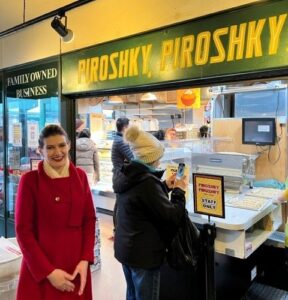
Meet Olga Sagan
Olga Sagan
The perpetual line out the door at the fragrant Piroshky Piroshky shop is a sign that the world has discovered the sweet and savory originality of Eastern European hand pies that launched 30 years ago and now operates sister locations throughout the city. Owner Olga Sagan is always looking for ways to serve her customers where they are. During the pandemic, she outfitted a food truck and started running pop-ups that have now made appearances all over the world. “Opportunity sparks creativity,” she said. The shop will soon open a walk-up retail space in Seattle Convention Center’s Summit building.
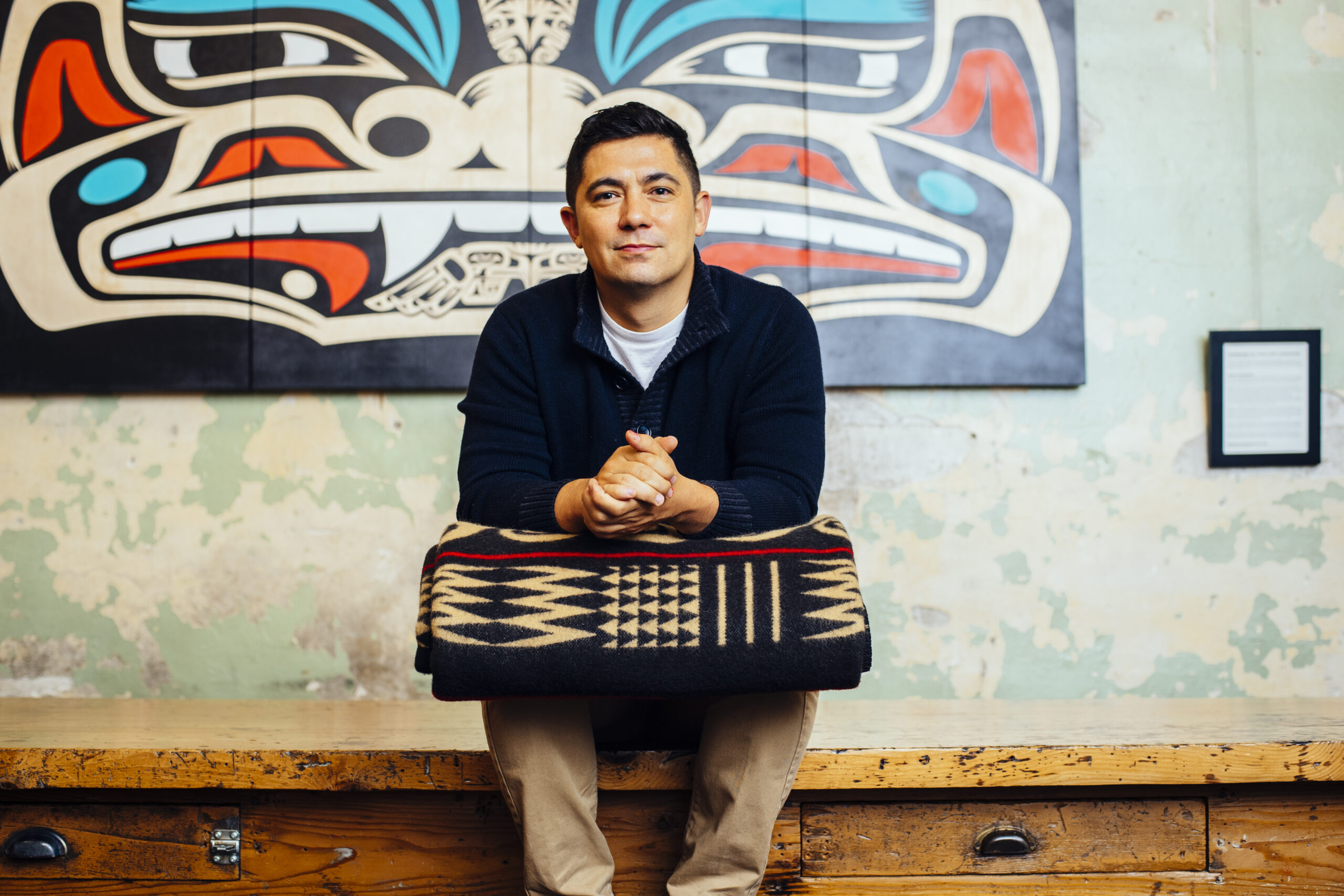
The signature blankets, jewelry and home goods featured in the bright, modern Eighth Generation showplace in Pike Place Market started when artist Louie Gong Nooksack began making shoes that combined traditional Coast Salish art with urban elements from his home. The name is a play on the intertribal value of Seven Generations, thereby embedding respect for those who came before and best intentions for the generations who come later.
Also, the pronunciation of “eight” in Cantonese, founder Louie Gong’s grandpa’s language, sounds like the word for prosperity. Now the retail and lifestyle brand owned by the Snoqualmie Tribe features products by “inspired natives” rather than “native-inspired” a nod to the importance of directly supporting the artists—and their stories.
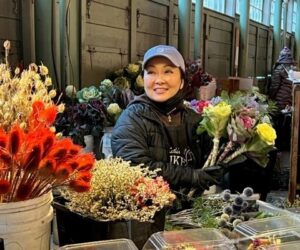
Meet Lue Eng
Lue Eng
Those big, colorful, paper-wrapped bouquets all over Instagram may have landed there by way of Thai Tao Farm, an operation that has been growing and selling at Pike Place Market since 1991. Lue Eng grew up in the business and of all the children, stepped up to be the face at the market arranging and selling fresh and dried flowers harvested by her mother and father, Bao Cha and Thai Thao.
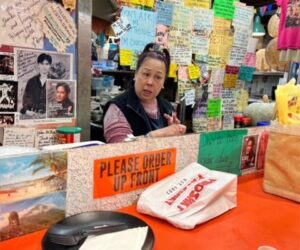
Meet Leila Rosas and Joy Mori
Leila Rosas
Tucked behind Oriental Mart, a stall, Philippine immigrant Milagros Apostol, opened in 1971 to sell ethnic groceries—spices, sauces and snacks—is a worn wooden counter with five barstools that afford front-row seats on some of the most authentic cooking this side of Manila. Third-generation Market vendor Leila Rosas doesn’t believe in menus.
She cooks what she feels like out of the shop her sister Joy runs and is known for sizing up what a visitor needs and asking, “Do you trust me?” before handing them a steaming bowl of salmon collar tamarind sour soup, flavorful longanisa sausages or spicy stewed adobo. For the holidays, she whips up oxtail stew with peanut sauce before heading out for a vacation. She snagged a James Beard Foundation America’s Classics Award for her midday culinary creations and numerous celebrities have found their way to her stand. “You can eat by yourself, but feel like family,” she said of the experience.
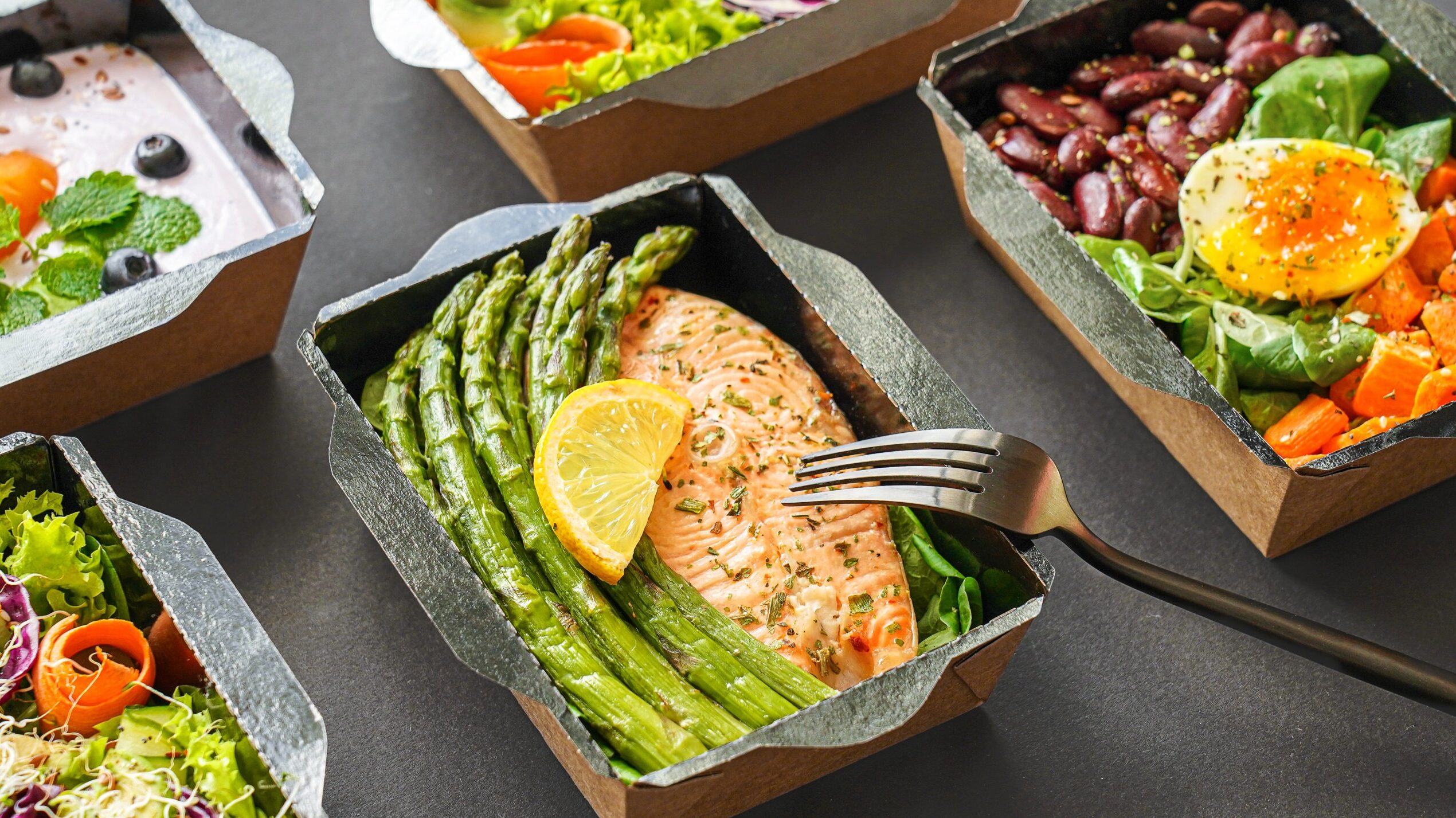
This year, hotel food and beverage departments as well as catering outlets and F&B in conference and exhibition centers struggled to catch up to post-Covid pent up demand as well as to what is now called “accommodation cuisine.” As meetings went back to in-person settings, health and safety stayed paramount.
Our May feature story on “accommodation cuisine” took many aspects of this new category into consideration: health, religious and allergen-related choices were all part of our report. Tracy Stuckrath, a meetings food advocate and consultant, said, “We’re at a meeting and we’re there to build relationships, land deals, network and learn. And then we’re left out. We are left hungry at the table because something was not presented to us as we requested. We lost out and we may lose our deal because at a critical moment, we had to leave the table.”
Our January 2022 feature on catering trends saw locally-sourced foods as a major player. Adrian Colameco, executive chef at Casa Marina-A Waldorf Astoria Resort in Key West, Florida, said this continuing trend will shift into overdrive “as there is significant difficulty in sourcing many products due to the supply-chain challenges we are facing.”
Chef Thomas Tuggle at The Harpeth Hotel, a Curio Collection by Hilton, in Franklin, Tennessee, added that going local is part of the larger embrace of community. “Involve the community into operations, showcase local products, hear what they have to say and give them what they crave,” he says.
Ravish: Pasta-licious took a deep, delicious dive into major F&B pasta dishes to die for. Pass the vino!pas
If 2022 was the year of scrambling to accommodate revenge meetings, travel industry leaders are hoping that in 2023, the industry will build on the mandate earned during the pandemic downtime and remind everyone that #MeetingsMatter. That is the theme for this year’s Global Meetings Industry Day (GMID) planned for March 30 by U.S. Travel Association.
Tell the Meeting Profs Story
“We need opinion leaders, policymakers and moms to understand what we do,” said Geoff Freeman, U.S. Travel president and CEO in an interview with Smart Meetings shortly after this year’s GMID theme was announced. He warned that even after the appreciation earned during the Covid absence, meeting budgets could still be on the chopping block if there is a recession and the industry hasn’t invested the time in educating those in power about what they do and what they need to do it effectively. That includes helping to solve problems with delayed and canceled flights due to understaffed air traffic control and cripplingly small inbound international travel as a result of “absurdly long” waits for visas.
This week, Freeman called new Covid testing requirements for those arriving from China, “reasonable and appreciated” and said he looked forward to welcoming Chinese travelers back to the United States.
As the industry prepares to come together with receptions, panel discussions and virtual celebrations on March 30, Freeman urged everyone associated with meetings and events to tell their stories. “We need to prove our value and ensure we don’t go back. GMID is one day. We have to advance the industry and be advocates all year long.”
Community Voices
Jack Johnson, chief advocacy officer with Destinations International, the association for convention and visitors bureaus, is also hyper focused on telling the industry’s story in the new year. At the 2022 Advocacy Summit in Bloomington, Minnesota, in October, he stressed the importance of maintaining relationships with communities and lawmakers. “We made sure everyone understood there was going to be no recovery without the meetings and travel industry recovering,” he said. “Local governments and states showed that message was heard” by including relief for travel in budgets. Now he would like to see the conversation evolve.
Next October, the same group will meet in Little Rock, Arkansas, to talk about expanding the organizations’ roles by “aligning with government and community organizations more intentionally to support initiatives designed to improve social issues and local quality of life; fuel priority sector development; attract outside investment and high-value talent; and elevate the overall destination brand beyond the tourism lens.”
“We need to talk the same way elected officials talk, using the language of emotions, based on values,” Johnson said. He suggested talking about the importance of tourism for economic, emotional and social good.
Even though everyone is busy again, Johnson was optimistic that the momentum built up over the last three years will continue as the memory of loss is fresh, lessons about how to advocate effectively are in place and many groups have hired people dedicated to the role. “Now we need to engage in issues on the local level that we traditionally stayed away from: violent crime; equity, diversity and inclusion; homelessness; transportation design; and accessibility,” he said.
“There is a new realization those are areas that come with the game,” he said. Sometimes he sees the industry taking a supporting role, rather than leading, but it is important to be involved so people see the value of tourism and conventions just as they see the value of schools and hospitals.
“Elected officials have always seen the value of conventions, but perhaps not the breadth and how many people it touches,” he said. The impact of an expo goes beyond the downtown and the caterers and hotels. It supports florists, rental cars and 30 different sectors. “Hopefully we can now go to city hall with new muscle to shut down a road for a parade, or bring in a new convention hotel,” he said.
Travel recovery post-Covid has been a case of two steps forward one step back. Smart Meetings has been covering the airline and hotel industry closely this year, both in our weekly travel reports designed specifically for meeting planners and in our feature coverage.
See some highlights below on the highs (and lows) of the travel scene in 2022.
Our October cover story was a deep dive into the issues that plagued meeting planners and their traveling attendees this summer: delays, cancellations and other issues that made even quick flights a challenge.
In an exclusive interview for the piece William J. McGee, senior fellow for aviation, American Economic Liberties Project, told us that Department of Transportation Secretary Pete Buttigieg was not doing everything he could to quell the chaos. “[Buttigieg] has greater authority than he is using both on the issue of fighting for consumer refunds and flight cancellations. We’ve never seen a summer like this one in terms of sheer number of delays and cancellations,” McGee said.
Even before summer flight chaos took hold, Smart Meetings was proactively advising planners and attendees how to navigate bumpy airline schedules.
“Most meetings are planned years in advance and it’s impossible to know what conditions will be like,” offered Christopher Elliott, USA Today columnist and consumer advocate. “The underlying problems are unlikely to go away anytime soon,” he said. “But as we get into fall and winter, the pressure on the system will ease. Until, of course, the busy holiday travel season comes around. And then it starts all over again.”
Our July issue covered the hottest hotel trends in the industry. Jan Freitag, national director of hospitality analytics with U.S., Costar Group told us that bleisure is a trend that will shape the way new and renovated hotels look and feel.
“Working on vacation (=bleisure) is the new norm,” he said. “Rooms need to “work” for both the leisure and the business traveler because this is often the same person, on the same trip.”
In June, we covered the myriad ways hotels were coping with the challenges of re-opening post-Covid.
Peter Caputo, Deloitte’s U.S. hospitality sector leader, explained, “During Covid-19, many hotels had to adopt policies to ensure both guest and employee safety, including reduced interactions and services and closed venues. With closures behind us in the U.S., we are seeing brands handling the restart in different ways.
“When it comes to housekeeping, for example, some brands are opting to go back to daily services, while others are only doing so by request or asking guest preference. Many of the changes that were put in place due to Covid-19 may be long-term as the labor market is changing the way hotels have to think about guest interaction, but some changes, such as plexiglass separations, where no future cost is seen will be or have been removed.”
Covid China Fears Remain After Hong Kong Lifts Mandates
After a long wait and much talk of “when will China open to meetings?” Hong Kong’s SAR Government has finally announced the lifting of “all mandatory PCR test requirements for inbound travelers on arriving in Hong Kong, as well as the lifting of the Vaccine Pass, which allowedaccess to specified premises, and other measures. Starting from Dec. 29,inbound travelers to Hong Kong are now only required to present negative results from PCR testsconducted within 48 hours or rapid antigen tests (RAT) within 24 hours.”
However, the Centers for Disease Control (CDC) has just announced that travelers coming to the U.S. from China, including foreign nationals returning home from The People’s Republic of China (PRC) and the Special Administrative Regions of Hong Kong and Macau, will be required to show a negative Covid-19 test or document of recovery “during the surge in Covid-19 cases in the PRC given the lack of adequate and transparent epidemiological and viral genomic sequence data being reported from the PRC. These data are critical to monitor the case surge effectively and decrease the chance for entry of a novel variant of concern. CDC will continue to monitor the situation and adjust our approach as necessary.”
U.S. Travel Association President and CEO Geoff Freeman issued the following statement on forthcoming policy changes for inbound visitors from China:
“We look forward to welcoming Chinese travelers back to the United States. The Biden administration’s highly targeted Covid testing approach is reasonable and appreciated.”
Officials in Italy have also ordered Covid-19 antigen swabs and virus sequencing for all travelers arriving from China. Testing began on Dec. 26. The first flight to Milan from China found that 35 passengers of 62 onboard were Covid-positive. The second flight tested with 62 out of 120.
Meeting Planners’ Takeaway: It may be too early yet to plan meetings in China. If meeting participants are arriving in the U.S. from China, even if they are U.S. nationals, put safeguards in place for possible positive Covid tests and quarantine time.
Bi-Partisan Barrage of Boos for DOT’s Secretary Pete Buttigieg in Southwestern Snafu
Both sides of the political aisle have been swift to criticize Department of Transportation (DOT) Secretary Pete Buttigieg for ineffective leadership in dealing with Southwest Airlines’ recent massive box-blocking of its air corridors throughout the holiday season.
Senator Bernie Sanders (I-VT) tweeted on Wednesday that “Southwest’s flight delays & cancellations are beyond unacceptable. This is a company that got a $7 billion taxpayer bailout & will be handing out $428 million in dividends to their wealthy shareholders.”
Sanders said that The Department of Transportation “must hold Southwest’s CEO accountable for his greed and incompetence.”
Fox News reported that Rep. Andy Biggs (R-Ariz.) tweeted, “If @USDOT is serious about addressing Southwest’s recent implosion, it should prohibit its leader @SecretaryPete from flying private. Why wasn’t he aware of these challenges beforehand? Late to the game and out of touch.”
Southwestern Airlines own Pilots Unionblamed the issue on “a systemic failure of Southwestern Airlines leaders to modernize, support, and staff its operation…For more than a decade, leadership shortcomings in adapting, innovating, and safeguarding our operations have led to repeated system disruptions, countless disappointed passengers, and millions in lost profits.”
Meeting Planners Takeaway: Do not expect airline madness to be resolved any time soon. Even if your meeting participants are flying other airlines, travel will be affected by issues such as the Southwest holiday fail because the entire U.S. flight system is involved. When travelers get bumped off a carrier, they re-book on other airlines. Give participants the option to rebook themselves at the airport if kicked off a flight and make sure they have all the communication avenues (Twitter, App-push notifications) available to them.
Kicking off the New Year for some often means new resolutions. “New Year, New You!” But for meeting planners it may sound like, “New Year, New Venue!”
WalletHub recently released a study highlighting the best cities for New Year’s Eve celebrations based on entertainment and food, costs, safety and accessibility.
A New Year in New York
Event attendees have a lot of options in-between event sessions, whether it is The Winter Village in Bryant Park which has a large winter market and an ice rink. In mid-January, attendees can treat themselves to Winter Jazz Fest featuring over 700 artists.
If meeting planners are aiming to leave attendees immersed in glamor and luxury, booking The Ritz-Carlton is always a good bet. The Ritz-Carlton New York, NoMad offers over 10,000 sq. ft. of event space and 240 hotel rooms and suites. The Ritz-Carlton caters to small or large meeting events, with a ballroom that accommodates up to 283 attendees. Michelin-starred chef José Andrés is the in-house caterer and a 24-hour fitness center features Peloton bikes.
Team Building in Florida
For meeting planners seeking spring in the winter season, Florida answers the call. The dawning of the new year is also a good time to head south if attendees want to up-close and personal time with manatees.
Only a shuttle ride from the Walt Disney World Theme Park, Hyatt Regency Grand Cypress Resort contains 102,000 sq. ft. of indoor space and 115,00 sq. ft. of outdoor event space, 779 guest rooms and 57 meeting rooms. For event planners trying to work in some team-building events, Hyatt Regency has a run/walk 5K, a nine-hole golf course, nature walks, 3-on-3 basketball competitions, tennis and volleyball tournaments.
Football and Convention Season in Las Vegas
If meeting planners want to line up their event with another big convention in Las Vegas, January is an easy choice. Consumer Technology Association’s CES mega show happens in early January. For the less techie, more sports-focused, NFL games at the new Allegiant Stadium for the Las Vegas Raiders make for popular off-site affairs.
Meeting planners who want to keep their attendees’ work and play on the Las Vegas Strip may want to consider giving the Wynn Las Vegas their business. Between Wynn and Encore, 560,000 sq. ft. of event space and 4,750 guest rooms are up for grabs. Attendees can also fill some off-time by hitting balls at Wynn Golf Club.
Hoops in The Bay
Attendees of the Modern Language Association Annual Convention meeting at the expanded Moscone Center the first week of January in San Francisco can check out a game basketball game featuring the NBA four-time Champions Golden State Warriors at Chase Center and maybe catch a famous three-pointers from Stephen Curry. Attendees may also want to visit the Chinatown district for the Lunar Near Year in January.
City View at Metreon in San Francisco lives in the heart of San Francisco downtown and is short walk from Moscone Center. The newly remodeled City View has over 31,000 sq. ft. of meeting space. Floor-to-ceiling windows offer attendees a stunning view of the downtown skyline that escapes most residents. The location is close to public transit and is within walking distance of public parking and counts six major hotels within a block’s walk.
Ale and Wine in Atlanta
If the weather is cold outside, meeting profs and attendees may want to make their way over to the Atlanta Cask Ale Tasting in late January and partake in more than 55 exclusive brews and dry hops. Or, if you prefer wine to ale, Atlanta Winter Wine Festival at City Winery is also happening. For those with a more whimsical interest, WildWoods AGLOW is a nighttime event staged in 10-acres of natural habitat that focuses on the stories of the surrounding forest told through large-scale projections and music. The production runs until early March.
Atlanta Convention Center encompasses 100,000 sq. ft. of contiguous meeting space with 47 breakout rooms, covered parking, accessible via rapid rail from the Hartsfield-Jackson International Airport (ATL), and 1,100 Westin Peachtree Plaza Hotel rooms on-property. Attendees will have access to Wi-Fi throughout the facility.
An important, often overlooked, aspect of meeting planning is accommodating those who have accessibility needs that are not detectable at first glance. Recently, the city of Visalia, California, announced it is a Certified Autism DestinationTM , a welcome addition that will help planners meet those hidden needs.
The journey to certification with the International Board of Credentialing and Continuing Education Standards (IBCCES) began with an employee of Visit Visalia who has a child with autism. Her experience opened the eyes of others to the importance of extending a wider welcome to all.
In the Business of Making Memories
“She was reflecting on the challenges their family faced when attempting to travel together,” said Suzanne Bianco, tourism and marketing director of Visit Visalia. “Usually, one parent would take some of the children on while the other parent stayed home. As a Destination Marketing Organization, we are in the business of making family travel memories and it seemed like a disconnect that we weren’t addressing the needs of these families to enable them to travel together.”
In a recent study done by Autism Travel, 87% of parents with an autistic child do not travel, but 93% stated they would if autism-certified options were available. According to Visit Visalia, 1 in 6 people have a sensory need. Not to mention, 32 million trips are taken by travelers who have special needs every year. That includes business and convention travelers.
Visit Visalia aims to provide the necessary tools to event planner and attendees to their time in Visalia is easy and stress free.
“One tool is a microsite that we create for each convention so that attendees can find all of the destination information in one place,” said Bianco, “This includes information about our designation as a Certified Autism Destination. It has links to our accessible travel page that highlights the hotels and attractions that are Certified Autism Centers. That might help attendees to make a hotel choice that best suits their needs.”
Certified Autism Centers
Visalia is home to six hotels that contain Certified Autism Centers. This includes Wyndham Visalia, which holds 22,000 sq. ft. of event space, 256 guest rooms and 14 event rooms. Wyndham Visalia is just 38 miles from the nearest airport, Fresno (FAT).
Another location to keep in mind is Visalia Convention Center, which contains 114,000 sq. ft. of meeting space, 28 meeting rooms, and 30,000 sq. ft of exhibit space. Attached to the Visalia Convention Center is Visalia Marriott Hotel, which offers 148,692 sq. ft. of meeting space, 42 event rooms and 16 breakout rooms. Also attached to Visalia Convention Center is Comfort Inn Downtown. Both hotels are Certified Autism Centers.
Lastly, the Lamp Liter Inn, offers 7,000 sq. ft. of meeting space and the Hampton Inn Visalia has 1,000 sq. ft. of meeting space. Both hotels offer CAC (Certified Autism Center) services for attendees.
The Hidden Disabilities Sunflower Program
The Hidden Disabilities Sunflower program allows attendees to self-identify as having an invisible disability so that location staff members can be discreetly informed if an individual requires special accommodations. The sunflower pin, lanyard or bracelet is provided at no charge. “Planners could ask attendees to reach out during the planning phase to let them know if any special accommodations are needed,” said Bianco.
Significant corporate events take time and resources to plan, with organizers and attendees looking forward to achieving desired outcomes. Sadly, capturing the most memorable goings-on that offers cherished memories is a real challenge, and such moments are fleeting and difficult to preserve.
Cory Hymel Gigster
If you’re interested in making your events more fascinating and appealing, non-fungible tokens (NFTs) are one way to add pleasure and value to your events. We asked NFT expert Cory Hymel of Gigster for a primer on what digital assets can offer events.
How do you define NFTs and their value proposition?
NFTs are encrypted digital assets using the kind of software that underlies cryptocurrencies. NFTs represent art, videos, music and even real-word assets, bought and sold online, usually using crypto. NFTs work by storing digital information and provide a kind of digital “deed” on public-facing digital ledgers called blockchains.
There are two types of assets in economics—fungible and non-fungible. Fungible assets include items like money that can be readily interchanged—you can swap a $100 bill for another $100 bill or two $50 bills and still retain their value. Non-fungible items are unique, like a signed baseball card isn’t the same as all the others. NFTs are non-fungible, so they’re unique and one of a kind. NFTs derive their value from the digital and physical worlds by bridging the gap between them and offering commercial worth to concepts, abstract ideas—or events.
How can meeting professionals incorporate them into their physical and virtual meetings?
NFTs can generate unique, engaging and interactive experiences for attendees of their physical and virtual meetings and offer them digital tokens of “ownership from the events” they can treasure forever. Organizers can use NFTs as event tickets with extra perks like rewards, prizes to specific seats, or exclusive virtual after-parties to build brand loyalty. Event attendees can “own” exclusive pieces of the event experience when they take home unique NFTs from events.
What is a simple first step meeting professionals can take to dip their toes in the NFT world?
First, create a synergy between the NFT and their audiences that aligns with their roadmap. Having a symbiotic relationship with your attendees provides the building blocks for designing your NFT project goals that align with your desired outcomes.
Get professional help if you must create a roadmap, a brand map showing attendees what you plan to offer and what there is for them as a part of the community. A roadmap is essential in helping prospective attendees manage their expectations, besides keeping them engaged and excited about your project.
How big of a financial commitment is required? Is there a particular size or type of event that is more appropriate to incorporate?
The financial resources required to incorporate NFTs into meetings will vary depending on the level of customization, developers’ salary, development time limits and third-party Application Programming Interface (API) integration. Depending on the complexity of the features you choose, NFT development can cost $20,000-$30,000 or can cost several hundred thousand dollars.
The costs of an actual implementation may be lower or higher than those figures depending on what features you’ll add or reduce after testing, staging and validating. While it’s possible to incorporate NFTs into any size of event, you want to be sure that you have a sufficient critical mass to recoup your investment in good time.
How can NFTs increase loyalty and engagement?
You can create brand loyalty, connection and long-term engagement with attendees by offering NFTs that unlock rewards, special giveaways or special pricing.
NFTs embedded with metadata that unlocks resources, discounts or privileges, such as a meet-and-greet with company founders or brand celebrities, can give collectors a deep sense of connection with planners, leading to increased brand loyalty.
What do you see as the future of NFTs and events?
As the world goes digital and the internet iterates from Web2 into Web3, there will be a shift in how meeting professionals interact with and relate to attendees.
This creates massive potential for organizers to create digital items of value that attendees can own via blockchain technology or leverage NFTs that unlock extra value and generate revenue. Incorporating tickets or event perks that can be minted into NFTs for marketing meetings has boatloads of rewards and additional revenue opportunities for those implementing them.
—
Cory Hymel leads all things Web3 as the Director of Blockchain at Gigster, a company dedicated to helping drive mass market adoption of blockchain. With over 600 engineers, Gigster provides Web3 strategy and development to everyone from startups to Fortune 500 companies. Follow him on YouTube, Twitter and LinkedIn and read his blog at gigster.com/blog.
Have a holiday event filled with excitement and fun with pop-up bars serving festive cocktails. Miracle Pop-Up Bar and its spin-off company Sippin’ Santa have opened several pop-up bars in popular venues around the Bay Area in Northern California. Between the private event options of the venues and the playful spirit of Miracle Pop Up Bar and Sippin’ Santa, your holiday event will be something to celebrate.
“I’m talking lights, garlands, tinsels, ornaments and extremely kitchy over the top decor from floor to ceiling,” says Joann Spiegel, general manager of Miracle Pop-Up Bar. “A variety of cheery and delicious holiday cocktails for everyone’s taste.”
Miracle Pop-Up Bar
Miracle pop-up bars create an environment at their host venues where guests can allow themselves to have fun and get into the holiday spirit. Miracle brand describes their pop-up bars as a “holiday oasis with over the top kitschy, festive decor and a themed cocktail menu.” With seasonally themed cocktails such as the Christmapolitan, Snowball Old-Fashioned and this year’s debut of Holiday Spiked Chai and Grandma Got Run Over by a T-Rex, your guests are sure to “pop-up” with holiday spirit.
Miracle at Napa Oxbow in Napa
Opened recently in August of 2022, Napa Yard Oxbowis a large gathering space originally built as part of the Copia project. With over 152,000 sq. ft. of event space, the venue offers a wide variety of options for private group events with a capacity of 12 to 2,000 people.
“There are several different areas for groups and private events,” says Chris Lehman, managing partner of Napa Yard Oxbow, “including covered trellises, garden pavilion with fireplace and pizza, a citrus orchard along the river and 50 harvest table in gardens along the river at the southern end of the property.”
Miracle Pop-Up bar is one of many pop-ups at Napa Yard Oxbow. “We have the room and facilities for pop-ups, and they help keep things interesting,” says Lehman.
Miracle at Brewsters Beer Garden in Petaluma
Brewsters Beer Gardenis available for groups of up to 400 people to semi-privately gather around the fire pit and enjoy their Miracle cocktails with live music and plenty of heat lamps.
Miracle will also be providing a pop-up food menu along with their signature cocktails. The classic American menu offers fan favorites such as the fried chicken sandwich and Texas style brisket along with a few seasonally themed items like Santa’s Sho-Burger and soft served ice cream topped with Santa’s cookie and/or candy cane.
Jillian Adams, director of events for Brewsters Beer Garden, describes the benefit of hosting Miracle Pop Up. “This is our fourth year hosting the Miracle Pop-Up Bar,” says Adams. “We love to see so many happy faces…our guests have been dazzled by the amount of holiday décor and cheer that we provide, as our ambiance is unbeatable.”
Miracle at MINIBOSS in San Jose
The retro 1980’s ambiance, classic arcade games and signature pizzas create an adult playground complete with adult beverages from Miracle at MINIBOSS in San Jose. With over 5,000 sq. ft. of space, groups can revisit their youth with Ms. Pac Man, Donkey Kong and Teenage Mutant Ninja Turtles pinball.
Sippin’ Santa
“Sippin’ Santa was born as the tropical companion to Miracle,” says Spiegel. “It’s basically picturing Santa on a surfboard instead of a sleigh, replacing the classic pine tree with palms decked with ornaments, and hanging hibiscus garlands alongside tinsel.”
The tropical spin on Christmas has been popular with over 40 locations in North America. This includes Bay Area favorites such as 55 South in San Jose and Lazeway at The Flamingo in Santa Rosa.
Merchandise and Proceeds
Along with festive cocktails, Miracle and Sippin’ Santa also sell holiday theme merchandise such as Santa Pants and glassware. 10% of all merchandise proceeds are donated to theSeva Foundation, a nonprofit organization providing eye-care to local communities around the world.