Editor’s note: This is part two of a two-part series revealing how food can be used to create unique and memorable event experiences.  You can see 12 Inspired Food Bar Ideas here.

A big chunk of most event budgets is devoted to food. Therefore, it makes sense to put extra effort into creative dining offerings. But a little creative presentation could increase the wow without budging your budget.

Here are nine interactive food stations full of sweets and treats.

1 Ice Cream Bar

Raise your hand if you like ice cream! As for those of you not raising your hands, can you please stop lying?

At a conference in May, Montreal-based caterer Agnus Dei created an interactive sorbet station that delighted all comers. Rings of raspberry, mango and coconut sorbet spun around a wheel. Guests simply had to hold up a scoop to the device to build their own cone. Pretty sweet, eh?

2 Caramel Apple Bar

Caramel apples covered in anything are fun to eat. Maybe a bit messy, but who’s gonna turn down the chance to be a kid again? Eat that apple!

3 Popcorn Bar

Candies, nuts, cheeses and butter are among the topping options you can use at your next event’s popcorn bar. Mix in some candy choices for a sweet & savory masterpiece. My personal favorite…skittles! Just try it.

4 S’mores Bar

Melting your own marshmallows over a fire is a fun experience for people ages six to 60. There are very creative options available for indoor roasting as well. Smart tip: Add Reese’s candy to the to the bar. Sooooo good.

5 Waffle Bar

A well-organized waffle bar offers guests a meal-treat hybrid, with plenty of options for toppings. What’s better than breakfast for dinner?

6 Donut Bar

I don’t know when donuts became so sexy—but they are hot, hot, hot! When it comes to toppings, the sky is the limit from M&Ms to bacon.

7 Yogurt Bar

Fill your cup with yogurt and then proceed to a colorful topping bar with unlimited tantalizing choices. Go a step healthier and make ‘em smoothies.

8 Snack Mix Bar

This food bar allows guests to specify their ratio of salty to sweet. Your attendees will feel like they’re eating something healthy while enjoying a delicious snack at the same time.

9 Candy Bar

Let’s wrap things up (see what I did there) with candy! Try a candy kabob station. A variety of gummy candies made available to design your own colorful rod of stickiness.

A candy bar with an assortment of jars is always a crowd pleaser. It can also be a branding opportunity. Offer candy choices that match your colors—or add your logo right on the candy.

Again, the secret is personalization. Allowing attendees to customize their own food to their specifications is an irresistible wat to design a memorable event experience.

Angela Skeen is a certified award-winning event professional, event blogger and the founder of Eventfully Angela LLC, a full-service event company that allows her to carry out her event nerd fantasies.

New Jersey has just passed a bill requiring hotels with 100 or more rooms to provide cleaners and employees with a panic button for emergency situations. It is the first state in the nation to do so. The move follows last year’s major Marriott worker strike that affected hotels in Las Vegas, Los Angeles, New York and numerous other major cities in the United States. Workers cited higher wages, better benefits and greater protection against harassment among their demands.

The law takes effect in January and is thought to help prevent sexual harassment. The wearable panic buttons will allow workers to immediately alert hotel security for assistance, emitting a loud noise to alert others to the employee’s location, reports KCRA Sacramento.

While New Jersey is the first state to mandate government-level protection, Marriott, Hilton, Hyatt and Wyndham Resorts hotel chains have announced that they will provide workers with a personal alert system. Other statewide laws are under consideration in Florida, Illinois and Washington state, according to NBC News.

RelatedAtlantic City: It’s ‘Game On’ in AC 2.0

“I am proud to sign panic button legislation to give hotel workers security and the ability to immediately call for help should they need it,” New Jersey Gov. Phil Murphy said while signing the bill. Hotel employees from nine major Atlantic City casinos were also in attendance.

School may be out, but anticipation is building for new master’s programs in event management being offered on both coasts. Deadlines to apply are approaching, however.

NYU Tisch Center Offers Financial Aid

tisch
Tisch Hall

The deadline for applications for Jonathan M. Tisch Center of Hospitality at NYU School of Professional Studies Master’s Degree in Event Management for the debut Fall 2019 semester is July 1. International students need to apply by October 1 to start in Spring of 2020.

The 36-credit program covers critical business skills in finance, accounting, marketing, sales, risk management and data analytics and takes one-and-a-half years to three years to complete, depending on whether attendance is full-time or part-time. Elective classes are available in business development, sport event management and event operations. A core course can be waived for relevant work experience with approval.

Last week, the school announced at its annual International Hospitality Industry Investment Conference that a new universal scholarship program will gift each incoming graduate student with a $10,000 scholarship. The school explained the reason for the program for new students this way: “Easing the burden of paying full tuition rates will allow students to graduate faster because there will be less of a need to work part-time to pay tuition costs.” The goal is also to lessen dropout rates due to financial issues and allow students to expand their career choices rather than having to focus solely on career paths that will pay off tuition-related financial debt. “It will ultimately enhance student success by allowing them to concentrate on what matters most—their studies,” according to the announcement.

SDSU Payne School Partners with MPI

The deadline for the San Diego State University L. Robert Payne School of Hospitality and Tourism Management Master’s in Meeting & Event Management Program is also July 1. GRE/GMAT scores must be received by the school before July 15.

This first of its kind curriculum is co-created by Meeting Professionals International (MPI) and is designed to elevate meeting professionals to business event strategists. The program is being billed as “a curriculum for career success” and will focus on strategic leadership, stakeholder management, finance fundamentals, business analytics, applied design thinking, demonstrating return on experience (ROE), leading change and modern marketing strategies.

A study by CWT, B2B4E travel management platform, uncovered the secret behind the creativity and productivity of many businesspeople: travel.

The research revealed that six in 10 travelers feel more productive when traveling for business, millennials the most likely among them. Of the millennials surveyed, those in the Americas were most likely to say they feel more creative and productive (77 percent, equally), followed closely by those in Asia Pacific (75 percent more creative and 73 percent productive) and Europe (58 percent and 57 percent, respectively). Earlier research revealed that most millennials even view business travel as a perk.

Generally, travelers from Asia Pacific are more likely to see an increase in creativity (65 percent) and productivity (64 percent), tailed by the Americas (58 percent and 60 percent) and Europeans (53 percent and 51 percent).

Further research showed that six in 10 travelers are most productive when working face-to-face with colleagues, as compared to working alone (30 percent) or remotely (14 percent). Asia Pacific travelers say they benefit the most from travel (61 percent), versus travelers from the Americas and Europe, both at 53 percent.

People using a ride-share service

Both Uber and Lyft drivers in at least 10 major US cities turned their apps off in an attempt to fight for not only better wages but health insurance and driver safety policies from the companies on May 8. Some cities went on strike for as long as 24 hours, while others protested for as little as one.

Regardless of the time spent on strike, the drivers of the major ride-sharing companies all had one thing in common: they wanted to be heard.

Chief executive officer of Uber Dara Khosrowshahi and Lyft co-founders Logan Green and John Zimmer wrote a rare joint opinion column in the San Francisco Chronicle that was published on June 12.

“We can make independent work better if we update century-old employment laws. Many drivers are offering ideas to improve their experience, and companies like ours have a responsibility to come to the table prepared to do our part,” Khosrowshahi, Green and Zimmer wrote in the column.

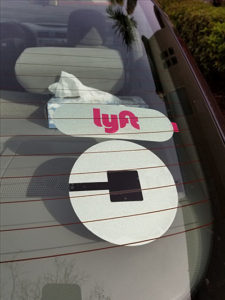
Uber and Lyft stickers on the window of a ride-share car

Uber and Lyft are faced with legislation in California that puts their business models at risk. That legislation would limit the status of the ride-share drivers from independent contractors to employees of the companies.

In the column, Khosrowshahi, Green and Zimmer said the reclassification of drivers from contractors to employees misses two major points. The first being that “most drivers prefer the freedom and flexibility” that comes with driving for the companies “to the forced schedules and rigid hourly shifts of traditional employment.” Second, many of their drivers are supplementing income from other employment.

For months, the ride-sharing gigs, along with other companies, have been trying to obtain the support of California Gov. Gavin Newsom, labor leaders and state lawmakers for a deal that would shield them from the 2018 Supreme Court ruling, Dynamex, which makes it tough for firms to claim their workers aren’t employees.

Under Dynamex, workers are considered employees and are entitled to state wage-law protections, unless they are doing work that is outside the company’s usual course of business. This makes it difficult for ride-sharing companies, whose main service is transporting customers via drivers, to claim that their drivers are all contractors.

The Alternative:

The alternative that Uber and Lyft executives propose California should embrace is to allow ride-sharing companies to keep treating their drivers as contractors but guarantee a minimum pay to the drivers from the time they are picking up and dropping off riders, create an association for drivers to push for additional improvements and to establish a company-supported benefits fund for perks, including paid time off.

“Our companies are no longer upstarts. We are public companies that tens of millions of people rely on for mobility and for work. If there ever was a time for new policies, it’s now,” said Khosrowshahi, Green and Zimmer.

The Opposition:

“Uber and Lyft drivers are struggling as they work for billion-dollar companies. These drivers are not ‘independent contractors’—they are employees who deserve rights and benefits. I stand in solidarity with them as they strike today for a dignified life,” Vermont Sen. Bernie Sanders tweeted on May 8.

Last month, Democrats in Congress sponsored a bill that would make a test similar to Dynamex’s, the standard for which workers under federal law have the right to unionize.

Yet, whatever happens in California is going to influence the national debate over the roles and rights of gig workers.

“While tomorrow will bring new and unexpected challenges, our companies are ready to provide additional protections that workers need and deserve today,” the Uber and Lyft executives wrote. “We look forward to working collaboratively to help California lead the way.”

professionals at an event

Attendees are the reason we work long hours sourcing the perfect venue, crafting agendas and testing AV setups. But sponsors keep the lights on. Cvent Sponsorship Manager Noel McWilliams and FAZEFWD founder Meg Fasy shared the secrets for attracting event investors in a special Smart Meetings webinar. Following are five suggestions that could increase your bottom line—and decrease your blood pressure.

1. Develop a Wholistic Sponsorship Strategy

Your attendees’ journey begins with understanding their behaviors so you can create a targeted experience for them. Ask, “What companies do your attendees want to know more about?”

? Smart Tip: your “partner ecosystem” could be bigger than you think it is. Even companies you might think are “nonendemic”—outside your industry—could be wildly interesting to your audience. Just ask.

Keeping a current customer is cheaper than getting a new one—and even better is leveraging that relationship to bring new sponsors to the table. Your customers could be your biggest advocates. Tap into their networks to create referral programs. Ask what other events they are attending to create a prospect list.

2. Create a Compelling Offer

Only five percent of your sponsors will buy straight from the prospectus, but a stellar one-sheeter with attendee demographics, titles and behaviors is an important reference piece. Bonus points if you can paint a complete picture of your attendees. Where do they vacation? What are their job titles? Do they participate in wellness programs?

Your sponsors want to spend quality time with your attendees. Experiential, immersive activities are one way to provide this networking benefit. The more a sponsor can be face to face with attendees, the more valuable they will see your offer. Food and drink activations are a simple way to achieve experiential interactions at your event. Your venue could help you provide culinary ‘wow’ on a budget if you know how to ask the right questions.

3. Price it Right

Three important factors of pricing include: profit margin, sponsor propensity and competitive analysis. The ideal profit margin for an event is unique to each company, but the rule of thumb is to aim for around 25 to 30 percent. Sponsor propensity relates to what the market is willing to pay. Lastly, look at similar conferences that have the same number of attendees, industry segments and attendee titles and do a cost analysis around those factors.

4. Mine Your Post-Event Metrics

This is very important because you should be able to take this data and report it back to your sponsors in the form of an ROI (return on investment) or ROE (return on equity) report. This report would include information such as session attendance, post-event surveys and attendee feedback.

5. Ride the Trends

The five biggest trends right now include: experiences, philanthropic activations, matchmaking appointment technology, health and art activities.

Experiences create positive buzz and keep people coming back for future events. Corporate Social Responsibility activities have been a trend for the past few years and giving back locally is a popular way to achieve this. Empowering attendees to schedule meetings at events is the hottest trend in the market right now because it creates a targeted experience in a non-intrusive way. Fun walks and runs, diet and meditation challenges are thoughtful ways event professionals let attendees know they care. Setting up art opportunities for attendees to participate in can even be partnered with philanthropic companies who could help make art out of recycled goods. Win-win.

Plastic bags, straws, cutlery, plates and bottles could soon be a thing of the past at events north of the border. Following in the footsteps of a global trend to reduce plastic waste, Canadian Prime Minister Justin Trudeau announced Monday that Canada will ban many single-use plastics by 2021. The plan reflects similar legislation passed in the European Union and the United Kingdom last year and comes just days after Indian President Narendra Modi pledged to eliminate all single-use plastic in the country by 2022.

The Environmental Impact

Canadians recycle less than 10 percent of their plastic, creating an environmental problem that, according to Trudeau, “we simply cannot ignore.” Unrecycled plastic ends up in landfills, rivers, on beaches and in the stomachs of animals. The 48 pounds of plastic found in the stomach of a whale that washed ashore in Italy in April provided a harsh glimpse into the real effects that plastic has on the environment, amplifying the call to global environmental action.

Related: Maine Bans Styrofoam; Key West and Hawaii Ban Sunscreen

Diminishing Dumping Grounds

Even recycled plastic is becoming a problem as countries in Asia refuse to become ‘dumping grounds’ for the waste of richer countries. Malaysia has become the latest in a series of countries refusing to accept high levels of plastic waste as an import for recycling. This May they sent 3,000 tons of plastic back to the countries it originated from when it was revealed that the trash has been imported illegally. The plastic was returned to 14 countries, including the United States and Canada. As it becomes harder for countries to dispose of waste, a focus on reducing the manufacturing of plastic becomes more appealing.

Trudeau said that his government will work with industry to “establish consistent standards for extended producer responsibility programs” and ensure that businesses become responsible for the plastics they are manufacturing and “putting out into the world.”  This will incentivize hotels, convention centers, restaurants, catering companies and various other industries to shift toward alternatives for single-use plastics.

Alternatives to Plastic

This plastic ban is likely just one in a series of legislative measures that will continue to sweep the globe. In the months leading up to 2021, companies must come up with alternatives to single-use plastic.

MoreHow the Hospitality Industry Supports Green Meetings

Switching to sustainable practices will soon be legally enforced in Canada, however in a time where sustainability is widely considered an aspect of corporate social responsibility as well as trendy, companies and events could benefit by greener branding, even if it is not legally enforced. The opportunities are endless for caterers, event spaces and hotels to replace single-use plastic with chic, conversation-starting alternatives that guests and attendees are sure to notice and appreciate.

Use These Instead!

  • paper bags
  • bamboo straws and plates
  • metal cutlery
  • glass straws
  • china plates
  • edible straws
  • reusable coffee cups
  • water jug and paper cups

Want your guests to marvel at your planning superpowers? Conjure up an agenda that grants them the ability to transform the meeting experience into something that speaks to their needs. The hospitality experts at Tampa Marriott Water Street—a destination that combines an urban conference center hotel and a luxurious waterfront resort—have some tips for meeting all your attendees’ expectations.

Get Close

No meeting is an island. That is why setting up your event headquarters with easy access to the places people need to be and things they want to see is the planning equivalent of leaping a tall building. Whether it is walking distance to the convention center or a world-class aquarium or a body of water (bonus points if the property has easy access to all three like newly reinvented Tampa Marriott Water Street), make it easy for attendees to get around by offering passes to local transportation, such as streetcars, water taxis and bike share programs. In Tampa that could include stand-up paddleboards (an activity offered by Tampa Marriott Water Street), pedal-powered water bikes, group cycleboats or a ferry equipped with lounging areas for seeing the sights. Wherever you are, go the extra step to unleash secret mobility identities.

Activate the Power of Choice

Once you have decided on a location that offers a wide variety of options—hip restaurants, boutique shopping, an ale trail—give attendees a chance to get close and personal with these magnificent attractions. This could mean a night off in the schedule to explore, extending the group block prices for a few days before or after the conference to let people discover their bleisure powers or offering tours as part of the opening day festivities. In a town like Tampa, where sports fever thrives at Amalie Arena—home of Tampa Bay Lightning—and Raymond James Stadium—home of Tampa Bay Bucs—it is worth checking the game schedule before booking. When you let people personalize the conference by picking which parts of the destination they want to explore, they are going to enjoy the experience more and remember it long after the nametag is in the recycle bin.

Release Their Inner Water Warriors

The sound of water can transform moods and bay views put everyone in a more relaxed state. Use that mind-altering power to bring your group together on a river cruise or welcome dinner on a patio overlooking sun-dappled currents. There is not better way to beat apathy—the arch-nemesis of creativity that lives in predictable spaces—than to open the group up to a sweeping liquid vista.

Software solutions company Cvent has acquired San Francisco-based DoubleDutch. Founded in 2010, the mobile event app has been named one of Deloitte’s 500 fastest-growing companies in North America and one of Forbes’ 10 Hot Companies to Work for in San Francisco.

Cvent has been on an acquisition rampage, acquiring several event technology platforms within the past year, including Wedding Spot in May (which gives the company more year-round business), Social Tables in October 2018, Quickmobile in May 2018, and Kapow in June 2018. The acquisition of DoubleDutch—and the companies acquired before it—could streamline experiences for planners and their attendees.

“We are extremely excited to add DoubleDutch to the Cvent family,” said Reggie Aggarwal, CEO and founder of Cvent. “By adding DoubleDutch’s industry expertise to Cvent, we accelerate our investment in mobile event technology.

“DoubleDutch is an innovator in the mobile event app space and both Cvent and DoubleDutch have a shared mission to unlock the business value of human connection,” said Lawrence Coburn, CEO and founder of DoubleDutch. “We are incredibly proud to join the market-leading team at Cvent. With their global reach and scale, we can fuel our passion to change the way people connect, learn, and grow at live events.”

When 120 members of the exhibitions industry showed up in Washington, D.C., for #ExhibitionsDay on Wednesday, they had a new strategy for approaching representatives. “The goal was to cover more ground,” said David DuBois, president and CEO of International Association of Exhibitions and Events (IAEE), of the approach for the sixth year of the organized lobbying effort.

More#ExhibitionsDay Advocates for Industry

Members didn’t just talk to their representative (that would have resulted in a lot of people standing around looking pretty in Maryland lawmaker offices, DuBois joked). They spread out to tell the larger economic message of the $97 billion contributed to the U.S. economy in 2018 and the $300 billion spent globally that year. Therefore, a show organizer for Association of Equipment Manufacturers who lives in Wisconsin visited a Kentucky representative because the group plans an annual event in Louisville, Kentucky.

What was the ask? Streamlining visa programs. In particular, advocates explained the importance of renaming the Visa Waiver Program as the more friendly Secure Traveler Partnership Act of 2019. “Too many people read that and think it means anyone can come in without a visa,” DuBois said.

A total of 38 countries are currently cleared to allow their citizens to travel for up to 90 days without obtaining a visa. That list hasn’t been updated since 2015, when Taiwan joined the list—a development that took the number of visitors from the Asian country from 400,000 to 1.2 million a year. Currently, nine countries are on wait list to join the program—Argentina, Brazil, Bulgaria, Cyprus, Israel, Poland, Romania, Turkey and Uruguay.

“This is a bipartisan issue and will not cost anything to implement, but it can have a significant economic impact,” DuBois said.

On the heels of that change, he would like to see Jobs Originated through Launching Travel (JOLT) Act of 2019, which is supported by U.S. Travel Association, passed this year.

Meanwhile, meetings with U.S. Department of Labor staff covered building a competency model for business events, which were previously hidden under the heading of “hospitality.” It now has its own Standard Occupational Classification (SOC), so people looking at potential careers will see it as a viable path. The group members also met with U.S. Department of Commerce staff to give them the tools to promote attendance at events when they are traveling.

A Global Message

Because advocacy is about more than lobbying, the one-day event leveraged industry members from all over the world to celebrate the impact conferences have for their companies and countries. Some 40 partners in 90 countries took to the web to show their support.

From Africa to the Middle East, receptions and CSR events highlighted the impact of the industry on communities.

In Columbus, Ohio, supporters met at Greater Columbus Convention Center to spell out “Ex = $!” in human bodies. One in every 12 jobs in the city was attributed to the hospitality industry and exhibitions, travel and tourism.

Texas Economic Development Corporation shared the impact 5,000 life science and research companies, including Texas Medical Center, have on research and care for children and cancer patients.