healthiest airports

Tens of thousands of passengers pass through international airports annually, so they’re hotbeds for catching a bug. For busy professionals, catching a cold can be quite a hindrance, so it’s important for them to remain healthy.

Online travel website Netflights.com ranked the top 25 healthiest airports in the world—airports that are making strides to make sure passengers stay healthy—physically and mentally. They were rated on a scale of 1–23, based on several factors, including access to yoga classes, gyms and outdoor spaces. Here are the top 10 airports from the list. 

10. Toronto Pearson International Airport (YYZ)

Score: 13

This is the busiest airport in Canada and second-busiest in North America. It’s set up for sleeping, as winter delays are a common occurrence. It features designated rest zones, free sleep zones and Muskoka chairs.

9. San Francisco International Airport (SFO)

Score: 13

The seventh-busiest airport in the United States, SFO is a major hub for flights throughout North America and a popular gateway for flights to Europe and Asia.

8. Haneda Airport (HND)

Score: 14

Just 30 minutes from central Tokyo, HND is Japan’s busiest airport. To combat stress-inducing busyness, the airport features plenty of places to relax, such as spas, green spaces and relaxation areas.

7. John F. Kennedy International Airport (JFK)

Score: 15

JFK is the primary international airport in New York City and busiest international air gateway in North America. In the event of a layover, wind down in one of the three relaxation spaces, spas or yoga classes. If it turns out you have more time, check out The Metropolitan Museum of Art store in Terminal 4.

6. Vancouver International Airport (YVR)

Score: 15

The second-busiest airport in Canada is surrounded by a lot of remarkable greenery. Make the most out of your layover by taking a quick trip Iona Beach or Flight Path Park.

5. Hong Kong International Airport (HKG)

Score: 16

At HKG, you can enjoy local cuisine or even grab a quick massage. If you have the time, you can take it easy at any of the many amenities, including meditation and relaxation spaces, the spa and the massage center.

4. Changi Airport (SIN)

Score: 18

Located in the most populated country in the world and serving as one of the major transport hubs in the world, SIN in Singapore is filled with plenty of entertainment, including a cinema theater, as well as gardens and several rooftop swimming pools.

3. Dubai International Airport (DXB)

Score: 19

A major gateway for travel between Europe and Asia, DXB is the busiest airport for international travelers. It has a Zen garden filled with fish ponds, shrubs and palm trees, allowing passengers to chill out before, after and in-between flights.

2. Schiphol Airport (AMS)

Score: 20
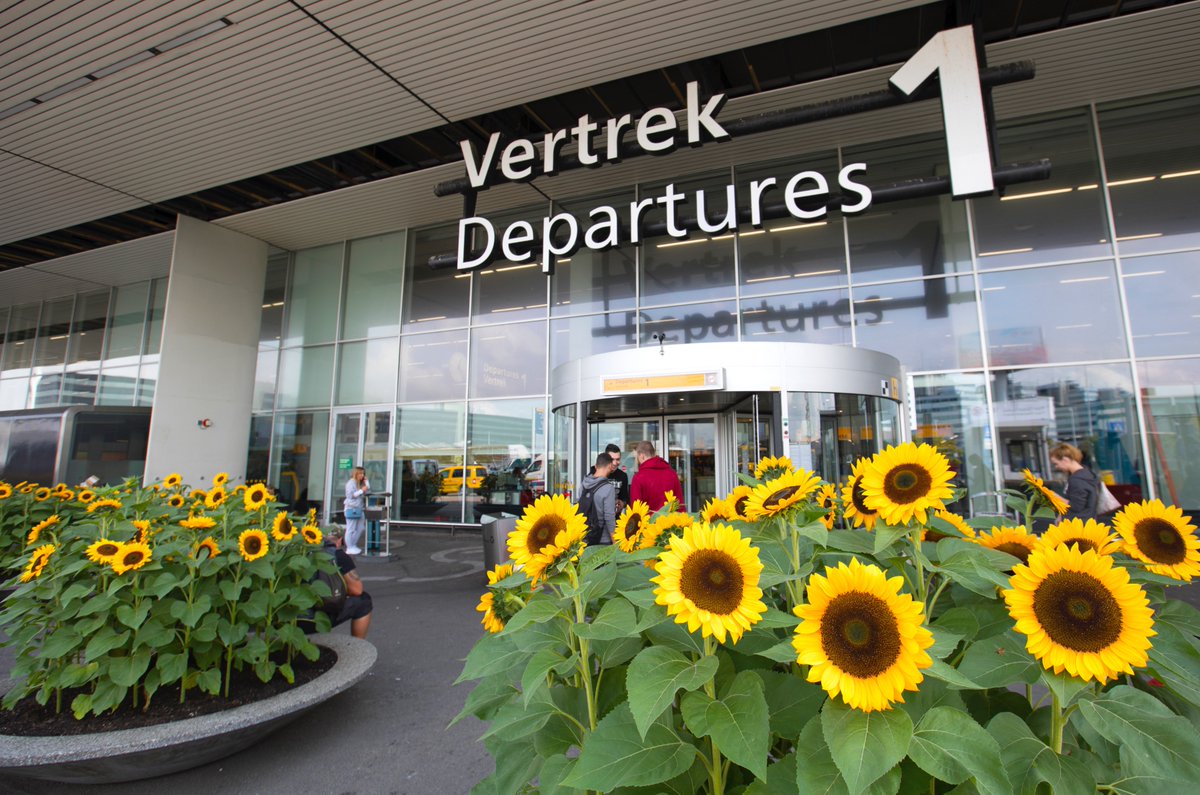
Partly due to its proximity to Amsterdam’s city center, AMS is ranked as the world’s best airport to have a layover. Add to that the many green spaces, yoga studios and spas, and you may not ever make it out of the airport.

1. Frankfurt Airport (FRA)

Score: 21

In 2017, more than 54 million people passed through. FRA is the busiest airport in Germany and the eighth-busiest in the world­—partially due to the city’s status as a major financial center—and the healthiest. It boasts relaxation spaces, yoga classes, prayer rooms and outdoor green spaces galore.

lgbtq

Thirteen hotel companies and six airlines received a perfect score on the Corporate Equality Index 2019 (CEI), and thereby were designated as Best Places to Work for LGBTQ Equality.

They were among the 572 businesses from nearly every industry and region of the United States that earned a 100 percent ranking on the survey—which was first implemented in 2002 by Human Rights Campaign Foundation. It measures concrete steps employers have taken to ensure greater equity for LGBTQ workers and their families.

MoreThe All-Inclusive Meetings Revolution

The following hotel companies received perfect scores in all nine categories (see sidebar) that were judged: Caesars Entertainment Corp., Choice Hotels International, Cosmopolitan of Las Vegas, Hilton Inc., Hyatt Hotels Corp., InterContinental Hotels Group Americas, Kimpton Hotel & Restaurant Group, Marriott International Inc., MGM Resorts International, Quaintance-Weaver Management LLC, Wyndham Destinations, Wyndham Hotels & Resorts Inc. and Wynn Resorts Ltd.

These airlines also received perfect scores: American Airlines, Southwest Airlines, United Airlines, Alaska Airlines, JetBlue Airways Corp. and Delta Air Lines Inc.

The survey is based on three pillars: nondiscrimination policies across business entities; equitable benefits for LGBTQ workers and their families; and supporting an inclusive culture and corporate social responsibility. This year’s rating criteria included ensuring full spousal and partner health care coverage parity; affirming coverage for transition-related care and eliminating all “transgender exclusions” from plans; and ensuring full LGBTQ including in diverse supply-chain programs.

HRC President Chad Griffin emphasized the significant impact that the high-scoring businesses are making.

“The top-scoring companies on this year’s CEI are not only establishing policies that affirm and include employees here in the United States—they are applying these policies to their global operations and impacting millions of people beyond our shores,” he said. “Many of these companies have also become vocal advocates for equality in the public square, including the dozens that have signed on to amicus briefs in vital Supreme Court cases and the more than 180 that have joined HRC’s Business Coalition for the Equality Act.

RelatedFrankfurt Tops List of Healthy Airports

“Time and again, leading American businesses have shown that protecting their employees and customers from discrimination isn’t just the right thing to do—it’s also good for business.”

Qualifications

Companies earned points in the CEI survey for meeting the standards listed below.

  • Prohibits discrimination based on sexual orientation for all operations
  • Prohibits discrimination based on gender identity for all operations
  • Equivalency in same- and different-sex spousal medical and soft benefits
  • Equivalency in same- and different-sex domestic partner medical and soft benefits
  • Equal health coverage for transgender individuals without exclusion for medically necessary
  • Three LGBTQ internal training and education best practices
  • Employee group or diversity council
  • Three distinct efforts of outreach or engagement to broader LGBTQ community, and if supplier diversity program is in place, must include LGBTQ suppliers
  • Contractor/supplier nondiscrimination standards and philanthropic giving guidelines

Flying first-class is like staying at a luxury hotel in the sky. Competing to be the best among the best, airlines are offering state-of-the-art amenities, comfort and privacy to provide passengers with the most incredible travel experiences possible. If you’re fortunate enough to get a first-class seat, or if you’re considering that upgrade, why not go for the gold? Here is an inside look at some of the best first-class suites (it doesn’t hurt to dream—right?).

Singapore Airlines

Singapore Airlines is known for being one of the best airlines in the world, and their new first-class A380 cabin is impressive. They are in a 1-1 layout and has six suites at the front of the upper deck crafted to provide luxury. Each suite comes with a separate full-flat bed with adjustable reclining, swivel leather chair, 32-inch HD monitor, personal wardrobe, specially designed carpet, 1,000 entertainment options and a wall with mood lighting.

Etihad Airways

Etihad was the first airline to have a single-aisle layout in their first-class section on the A380. Their cabins are called “apartments” and each of them comes with a large leather armchair, 6-foot-10 inch, fully flat bed, onboard chef, built-in shower and access to Etihad’s in-flight luxury lounge. The apartments also have doors for privacy and provide enough space for passengers to walk around.

Japan Airlines

Japan Airlines’ semi-enclosed first-class suite on its Boeing 777-300ER features a woodgrain interior and comes with fully flat beds with direct aisle access. The suites include a storage compartment, a laptop power brick, and a 23-inch personal entertainment screen. They also offer both Western and Japanese cuisines on their menu, along with Cristal champagne.

Lufthansa

Lufthansa is Europe’s largest airline and their flights feature eight first-class seats. Lufthansa’s first-class experience begins at the airport, where passengers are met by a personal assistant. First-class seats come with adjustable back and footrest. When it is time to sleep, a flight attendant will transform the seat into a flat bed with a mattress topper and temperature-regulating duvet.

Emirates

Emirates introduced a new first-class cabin on nine of their 777-300ER planes in early 2018. The 777-300ER is the first airline to introduce fully enclosed suites in first class with floor to ceiling sliding doors. The spacious suites offer a huge TV screen, comfortable beds and passenger-controlled lighting and temperature. Each suite also comes with a service window where customers can be served drinks.

Air France

Air France provides its first-class passengers with the best experience on its Boeing 777-300ER. Their cabins are in a 1-2-1 layout giving each passenger direct access to the aisle. Each suite feels like a luxury hotel room dressed in thick curtains. The suite features a seat that reclines into a bed, an ottoman that can be converted into an extra seat and a 24-inch HD touch screen.

Cathay Pacific Airways

Cathay Pacific’s first-first class cabin has been consistent for a decade now and features six seats in a 1-1-1 layout. While their seats aren’t entirely private, they are angled away from the aisle, offering passengers privacy and more space. The seats transform into fully flat-beds and the bedding comes with high-quality mattresses, duvets, pillows and cushions. The leather seats also offer manually controlled massages and comes with a 17-inch TV screen.

Qatar Airways

Qatar Airways is well known for its premium first class service. The cabins include ultra-wide seats that automatically recline into flat beds, central and aisle dividers for privacy, extendable tables that allow two people to dine together and 4000 entertainment options. Their menu includes scallops, filet mignon, and shrimp.


airplane

As the line blurs between low-cost and traditional carriers, a mix of newer planes, enhanced customer touchpoints and better ticket value has propelled overall satisfaction with airlines to its highest point.

According to a new J.D. Power 2019 North America Airline Satisfaction Study, traditional carriers are up 11 points from last year due to significant improvements, while their low-cost competitors’ satisfaction has slowed down. Technology investments within the traditional carrier segment have helped travelers feel that they are getting greater value for their money with improved reservation and check-in processes and newer planes.

More: 13 Hotels, 6 Airlines Named Best Places to Work for LGBTQ Equality

The study is now in its 15th year and measures traveler satisfaction with airline carriers in North America based on their performance in cost and fees, in-flight services, quality of aircraft, courtesy of the flight crew, convenience of check-in, reservation, boarding and deplaning. Baggage retrieval, availability of flight information and timeliness were also factored in.

“While low-cost carriers have historically had the highest levels of customer satisfaction in our study, due to a strong sense of value for money among customers, that line is starting to blur as traditional carriers improve their services and operations,” said Michael Taylor, travel intelligence lead at J.D. Power.

More: Survey: Low-cost Summer Flights to Europe Are Cheaper

Key Findings:

  • Record-high customer satisfaction: Continuing an eight-year trend, airline satisfaction has increased 11 points to 773 (on a 1,000-point scale).
  • Improvement driven by traditional carriers: Traditional carriers’ satisfaction score rose 22 points since 2018 while low-cost carriers declined by six points, merging the two segments in satisfaction.
  • Technology investments: Improvements to the reservation and check-in process have changed the airline experience the most. This is driven by investments in digital check-in technologies, self-service kiosks and an effort to improve the pre-flight process across airlines.
  • In-flight services remain lowest ranked: Services such as the variety of seatback entertainment available, food service and Wi-Fi continue to rank the lowest in air traveler experience. Fresh food, availability of seatback games and seatback live TV are specific in-flight amenities that have resulted in the greatest positive effect on air traveler satisfaction.

Study Rankings:

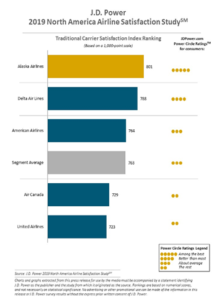
  • Traditional carriers: Alaska Airlines ranks the highest for the 12th consecutive year in a row with Delta Air Lines coming in second and American Airlines ranking third.Bar graph of low-cost airline carrier satisfaction rankingBar graph of traditional airline carrier satisfaction ranking
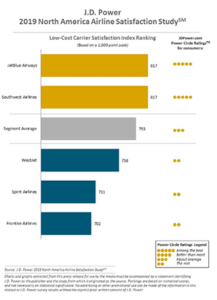
  • Low-cost carriers: JetBlue Airways and Southwest Airlines tie for the highest rank. This is the third consecutive year that Southwest Airlines has been at the top of the J.D. Power ranking.
  • Canada-based airlines: Air Canada saw a decline of five points since 2018 in its customer satisfaction score. WestJet’s score increased by 11 points but they still remain below the average score of low-cost carriers.

As flying becomes cheaper, we have seen an increase in low-cost airlines. These airlines have cropped up all over the world and while their prices may be similar, quality ranges drastically. Skytrax, an independent airline and airport consultancy, has released certified ratings of low-cost airlines around the globe on a scale of 1–5 stars. Ratings are based on several categories measuring cabin staff service, on-board product and airport services, so you can make sure your low-cost flights aren’t compromising on comfort or convenience.

  • West Air (Asia) is consistently good with between 3 1/2 and 4 stars in every category.
  • easyJet’s (Europe) highest ratings are for online check-in options and carry-on bag allowance, although their ratings are relatively even with four stars in almost every category.
  • Norwegian (Europe) has five stars for website language options, online check-in, the ‘manage booking’ function, in-flight entertainment and Wi-Fi and website information about extras. Interaction with customers from cabin staff received the lowest rating at three stars.

More:  North American Airline Satisfaction at an All-Time High

  • flydubai (Middle East) customers are happy with their checked baggage allowance but gave only 2 1/2 stars for on-board washroom amenities and transfer service assistance in the Dubai airport.
  • Spring Airlines (Asia) is average yet consistent with 2 – 3 1/2 stars in every category.
  • flybe (Europe) satisfies customers with a 4 1/2 rating for online check-in but lets them down on the flight with a three-star rating for interaction with customers and language skills of cabin staff.
  • Ryanair (Europe) has terrible (one star) ratings for over-sized cabin baggage price, delay information / service, airport check-in charge and carry on allowance. This is balanced out by good on-board products and cabin staff service.
  • fastjet (Africa) has big disparities in their categories with a 4 1/2 rating for carry-on baggage allowance but received only one for on-board comfort items.
  • JetBlue Airways’ (North America) highest ranking is for on-board Wi-Fi and connectivity at 4 1/2 stars but has relatively low ratings for cabin staff services.

  • Spirit Airlines (North America) has the lowest ratings among all 17 airlines with a one-star rating in five categories, most of which are customer service based. The highest rating is four stars for attention to cabin safety.

More: Frankfurt Tops List of Healthy Airports

To find out more view the full list of low-cost airlines here.

Employees of Eulen America, a private contractor for American Airlines and Delta, walked off their jobs yesterday.

Just ahead of July 4, known to be day in which airports receive heavy foot traffic, workers at John F. Kennedy International Airport (JFK), Miami International Airport (MIA), Fort Lauderdale-Hollywood International Airport (FLL) and Ronald Reagan Washington National Airport (DCA) protested what is claimed to be unfair and unsafe working conditions.

The ranks of striking employees includes baggage handlers, cabin cleaners and wheelchair attendants. “Many of us came from difficult countries, we came in search of the American dream,” 61- year-old Esteban Barrios told the Miami Herald. He has serviced Delta Airlines as a Eulen employee for three years.

They are protesting what they call unsafe working conditions. It’s been reported that U.S. Senator Cory Booker, also a 2020 Democratic presidential candidate, joined the protest outside of Terminal H at MIA the morning of June 26.

Eulen America has denied claims that their employees are working in unsafe conditions. “Eulen America cares deeply about our workforce and we are firmly committed to providing them with a work environment and procedures that meet or exceed industry standards,” Eulen CEO Xavier Rabell said in a statement.

Related: Uber, Lyft Drivers to Strike in 10 US Cities Thursday

If you have travel insurance and are traveling to or from an airport involved in the strike, contact your provider to see if airline/airport strikes are covered; check the policy of the credit card used as some, as some credit card policies offer travel insurance. If you’d like to stay up-to-date, Airport Strike Alert is a resource to keep alert on strike-related details.

Boeing 737 Max plane

Going to and from various locations is just part of the job of being a planner and taking flights is a big part of that. From scheduling issues to fewer flights, the grounding of Boeing 737 Max 8 and Max 9 planes could cause issues when planning your next meeting.

Background

Back in March, President Trump announced that the U.S. would be grounding Boeing 737 Max 8 and Max 9 planes; now the jets are banned worldwide.

The grounding was a result of two separate Boeing 737 Max flights crashing within months of each other; Lion Air Flight 610 plunged into the Java Sea 12 minutes after takeoff, killing all 189 passengers and crew. Ethiopian Airlines Flight 302, crashed only six minutes after takeoff, killing all 157 aboard.

What’s Going On

Both the Lion Air and Ethiopian Airline crashes stemmed from technical problems in the software of the flight control system.

The Federal Aviation Administration (FAA) disclosed another software glitch that came to light as Boeing tested a theoretical flight-control computer failure on June 26, per FAA’s request. This glitch requires an extra patch that will be included in Boeing’s final package of flight-control software to be reviewed by worldwide regulators before the plane is clear for takeoff.

More: Wanna Get Away? Skytrax Rates Low-Cost Airlines

“Under the latest scenario,” the plane may be grounded until early 2020 say sources of FAA and pilot-union leaders, according to the Wall Street Journal.

Additionally, Boeing will not offer the 737 Max 8 or Max 9 for certification by the FAA until they have met all requirements for certification of the Max and “it’s safe return to service,” the company said in a statement.

Off the Schedule

On Sunday, July 14, American Airlines Group Inc. said the planes would be kept off their schedule though Nov. 2. This is now the fifth time the airline group has adjusted their flight schedule to aid the plane’s ongoing absence.

American Airlines Group Inc. is not the only airline keeping the Boeing 737 Max’s off their schedules. United Airlines Holding Inc. has also removed the plane through early November.

U.S. airlines have said it will take several weeks to prepare the stored plane to continue commercial operations and possibly train pilots once the worldwide grounding is lifted.

There is no timeline as to when the issues will be resolved, as the situation is “fluid.”


This month has seen more protests from airline employees as they fight for better wages and affordable healthcare. At the end of June employees of Eulen America, a private contractor for American Airlines and Delta went on strike at four airports across the U.S. Workers at John F. Kennedy International Airport (JFK), Miami International Airport (MIA), Fort Lauderdale-Hollywood International Airport (FLL) and Ronald Reagan Washington National Airport (DCA) picketed with a request for what they called “safer and fairer working conditions.” Now American Airlines catering employees are fighting a similar battle as they call for better wages.

MoreWorkers to Strike at 4 U.S. Airports

The Issue

Airline catering workers, those who make and load all the food and drinks served on flights, are calling for an increase in wages to a minimum wage of $15 an hour and improved medical coverage. On August 13, protestors blocked the driveway to American Airlines headquarters in Fort Worth, Texas. The protesting employees are not employed directly by American Airlines but rather a third-party company called LSG Sky Chefs. However, protestors feel that the airline company, as LSG Sky Chefs’ largest customer, has a responsibility for the wages that the contractors receive and the power to influence LSG Sky Chefs in wage negotiations.

The Response

American Airlines has tried to stay out of the dispute, stating that they do not control the wages of contractors but that they “would like the catering vendor and the union to reach agreement as soon as possible,” according to The Boston Globe. The reported quoted LSG Sky Chef’s response, “We remain committed to negotiating in good faith, and we hope that union members will act lawfully as they exercise their right to demonstrate or protest.”

RelatedA Deep Dive into the Uber, Lyft Strike

What Now?

Permission for further strikes have been filed by Unite Here! and are awaiting approval by the National Mediation Board, an indication that protestors and their representing union have no intention of slowing down. Negotiations are ongoing between workers and their contracting company with a federal mediator, but protestors vowed to continue the strike. Testimonials from many workers, found on the Unite Here!, state that one fourth of employees are being paid less than $12 an hour and some have to choose between paying rent or medical insurance. If negotiations are not met, strikes could continue at airports across the country, grounding or delaying planes and ultimately affecting travelers everywhere.

When to Buy Airline Tickets

Buying airline tickets can sometimes feel like rolling the dice. Knowing which time periods yield the best deals and when ticket prices are bound to fluctuate the most has been a tricky formula waiting to be solved. CheapAir.com has finally cracked the question in its latest airfare study on when to purchase airline tickets.

Based on an analysis of 1.3 billion airfares, CheapAir.com identified five key booking zones across an 11 month period before the flight date to determine what kinds of discounts passengers can expect to score. On average, the best time to purchase a domestic flight is 54 days in advance.

“Fifty-four days is a good number to start with, but it’s important to know that every trip is different,” says Jeff Klee, CEO of CheapAir.com. “Generally a trip price starts off high, slowly drops and then starts to climb a few weeks before the flight. People ask all the time if it’s true that at the last minute, the airlines have unsold seats that they practically give away, but that’s rarely the case.”

Within the study, CheapAir.com identified a trip as an itinerary going from point A to point B on a specific date with a specific return date. The 1.3 billion airfares accounted for approximately 3 million trips that took place across every day of the year in 2015. CheapAir.com measured fares for each trip offered every day from 320 days in advance until 1 day in advance.

Here are five zones each traveler should know for when to purchase airline tickets:

1. First Dibs (197-335 days out): Most airlines begin selling tickets at least 335 days before a flight. Early birds get the best choice of flight times, nonstop options and seat assignments. However, they pay an average of $50 more than the optimal time for ticket purchases.

2. Peace of Mind (113-196 days out): During this travel booking period, travelers can expect a balance between flight options and prices. Tickets cost an average of $20 more than booking during the optimal window for ticket purchases.

3. Prime Booking Window (21-112 days out): Bargain hunters should be on the lookout for fare fluctuations, which can vary greatly day to day during this 90-day period. Travelers should check travel dates frequently and purchase the moment a bargain comes up.

4. Push Your Luck (14-20 days out): Bargains can still be had between two to three weeks ahead, but prices are apt to change more dramatically. Depending on how full flights are, travelers may find a great deal or they may pay significantly more. Popular flights during peak seasons are less likely to offer lower fares at this time.

5. Hail Mary (0-13 days out): Very rarely can a deal be found so close to the travel date. Rather, travelers should expect to shell out an average of $75 more than rates offered during the prime booking window. From one to six days in out, that cost shoots up to $200.

airline trends

Industry group Airlines for America has predicted that spring travel will result in a record-breaking 140 million U.S. airline passengers, equating to a 2.8 percent increase from 2015.

The lobbying association for major U.S. airlines said in a statement Wednesday that about 2.3 million people will fly daily during March and April, including more than 17 million travelers on international flights.

“The continued growth in passenger volumes can be attributed to the accessibility and affordability of air travel today,” said John Heimlich, Airlines for America’s chief economist. “To meet the extra demand, airlines are deploying new and larger aircraft on many flights.”

Growing Demand

A quick glance at airline trends will prove that expanded flights are trending, and Spring travel trends may just be the beginning. JetBlue just announced it will further  grow its presence at Fort Lauderdale-Hollywood International Airport (FLL) with plans to operate an average of 140 daily flights—a whopping 75 percent growth from the carrier’s current size at its South Florida focus city.

As part of JetBlue’s ongoing expansion, the airline is adding new nonstop service to Louis Armstrong New Orleans International Airport (MSY) and increasing the number of flights to Nassau, Bahamas’ Lynden Pindling International Airport (NAS).

United Airlines has also recently released reports that illustrate a growth in traffic. Total traffic for the Chicago-based airline during the month of February was 14.065 billion RPMs, or revenue passenger miles, an increase of 2.7 percent from 13.693 billion RPMs in February 2015.

Increased Affordability

In addition to the Southwest ads touting $69 one-way flights, many  airlines are offering “no-frills” prices that make traveling easier on any budget (as long as you don’t mind giving up the usual benefits on your flight).

American Airlines announced last October the launch of their “Basic Economy” fares, which will be available in mid-2016 and will exclude upgrades, and United Airlines, too, will offer what they’re calling entry-level fares.

When you consider the combination of increased travel options, decreasing ticket prices, and the slew of travel campaigns that are dominating TV airtime and online advertising space, it’s no mystery why we’ve all caught the travel bug.