Grand openings and major renovations refresh meeting space in famous international cities

All across the world, in some of the most sought-after international cities, come new and renovated hotels and meeting spaces, leaving the stage set for outstanding gatherings, wherever your attendees may be traveling from to get there. If you’re planning an international meeting, these new and renovated venues are calling your name.

Washington Marriott at Metro Center
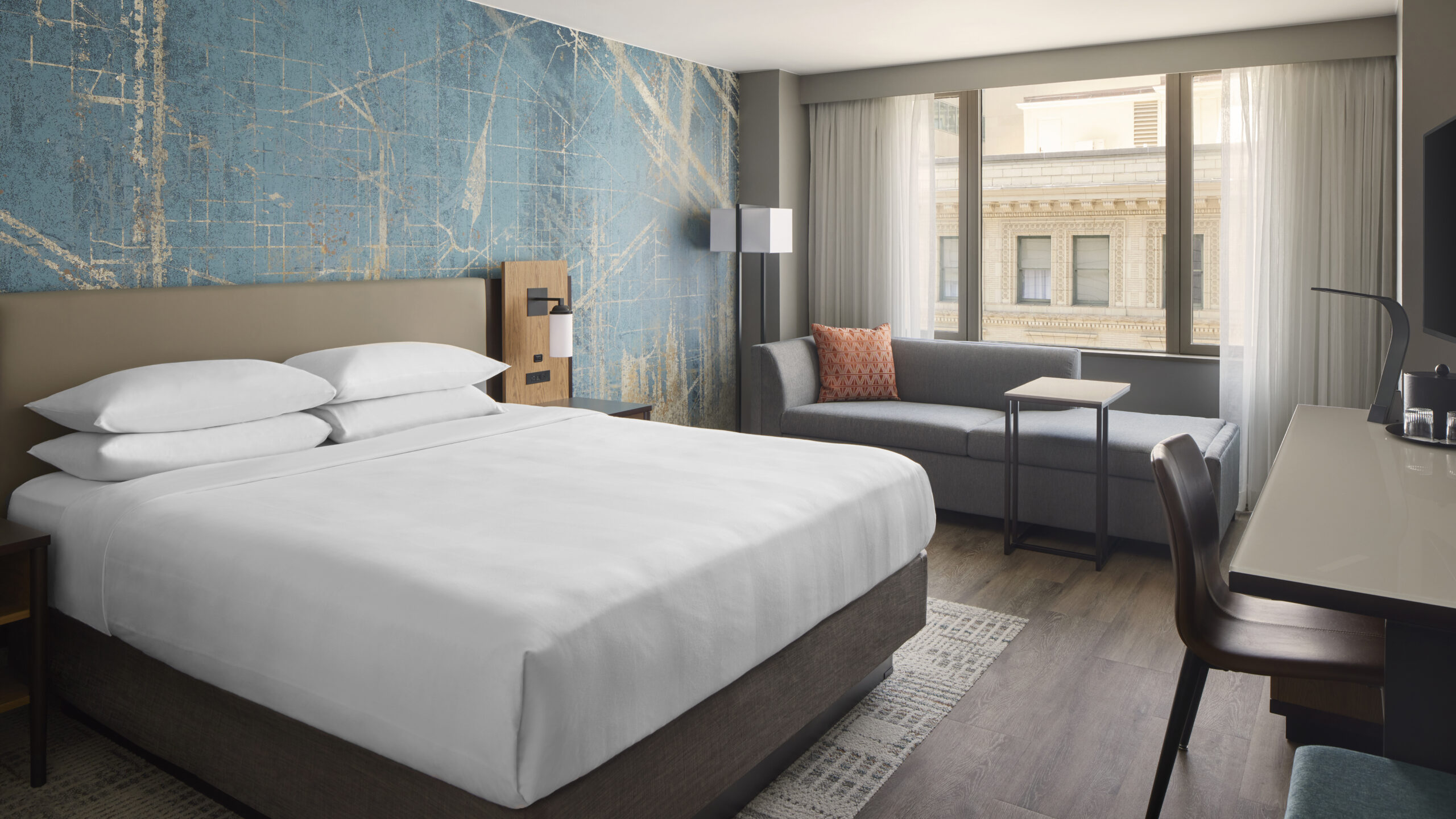
Guest room at Washington Marriott at Metro Center for new and renovated
Washington Marriott at Metro Center

After wrapping up a multi-million dollar renovation, Washington Marriott at Metro Center brings a refreshed look and feel to the United States Capital. Its convenient location, right by the city’s Metro Center Station, makes for easy exploration. Onsite, the property debuts a new signature restaurant, Spotted Zebra. The restaurant offers familiar yet elevated dishes and drinks with names recalling political lore, such as the Founding Fathers Farm Chicken and the Honest Man cocktail. The dining destination will serve everything from café-style lunch to after-work happy hours and late night bites.

Alongside the new restaurant comes an innovative enhancement across its 459 guest rooms. Multi-functional furniture and technology-enabled work surfaces meet the needs of every traveler. In addition, guests can enjoy new fitness center, complete with Peloton equipment and a refreshed indoor pool area. A spectacular Great room lobby and reimagined hotel room entrance round out the renovation. Marriott Bonvoy Elite and Club paying members can take advantage of the exclusive, modernized M Club, serving food and beverage throughout the day in a relaxed space, ideal for business travelers seeking productivity. Washington Marriott Metro Center, in addition, offers 13,462 sq. ft. of meeting and event space.

Yotel Geneva
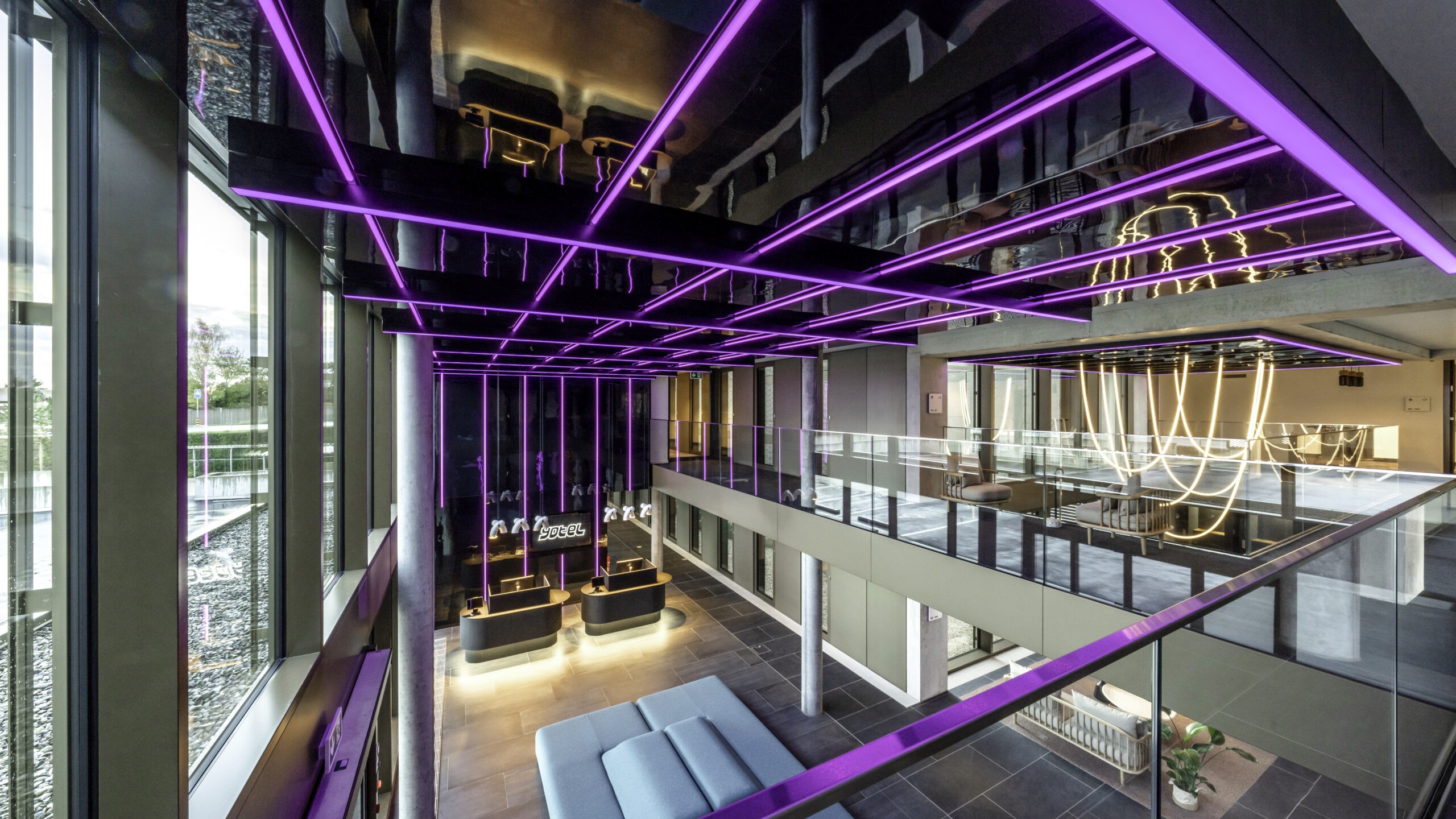
YOTEL Geneva lobby from upstairs
YOTEL Geneva

In Geneva, Switzerland, YOTEL—a global hospitality brand known and celebrated for subverting the status quo—opens its first Switzerland location and 22nd property. The grand opening of YOTEL Geneva Lake also brings the brand’s first-of-its-kind dining and entertainment hub, HVGGE Place.

YOTEL Geneva Lake is just a few minutes’ drive from Geneva Airport, in a location that provides easy access to Lake Geneva and the city center. Two interconnected glass buildings at the top of the property provide guests with incredible views of the stunning area and the famous Mont Blanc. Throughout the hotel are additional public viewpoints of the surrounding lake and mountains, and bedrooms feature floor-to-ceiling windows for even more viewing opportunities.

Throughout all 237 guest rooms is YOTEL’s signature technology and design features, such as adjustable SmartBeds™ and sensory mood lighting. HVGGE Place is a Nordic-inspired space for dining and entertainment, named after the Danish term “hygge,” which signifies celebrating life’s small joys. It spans over 21,500 sq. ft. and is easily adaptable for a variety of occasions, from dinners to large events. It includes a restaurant, seafood bar, rooftop, auditorium and a banqueting and conference center.

Read More: Meet in Europe

Convene Sancroft, St. Paul’s
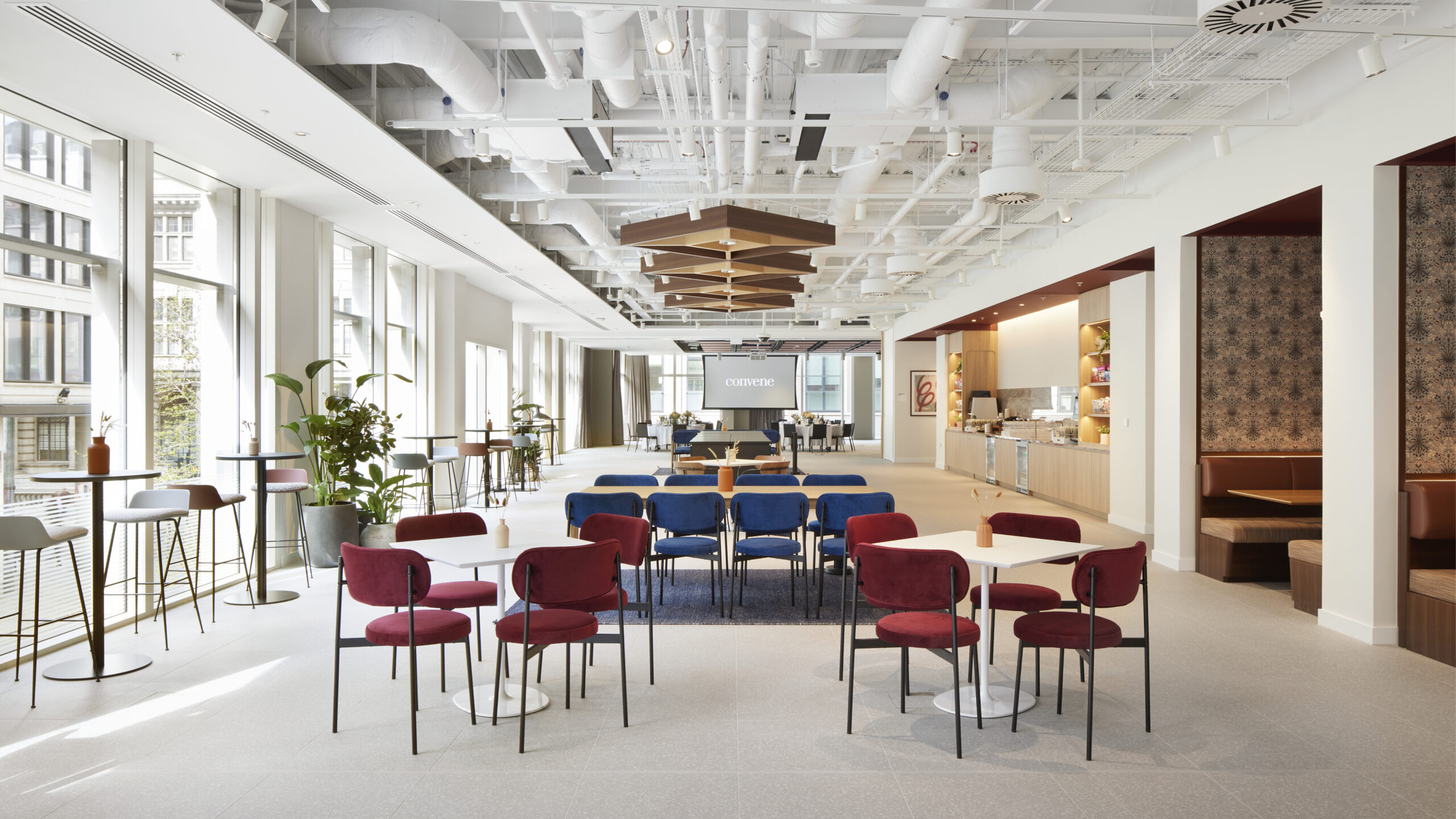
Convene Sancroft St. Paul's for New and Renovated
Convene Sancroft, St. Paul’s

London’s Paternoster Square sees Convene’s newest U.K. venue, Convene Sancroft, St. Paul’s. This opening brings 45,000 sq. ft. of meeting space across two floors. Designed in partnership with architecture and design firm Woods Bagot, an Elizabethan style permeates the space, from the strategic placement of colonnades, floating ceiling timber rafts featuring an Elizabethan diamond pattern, floral wallpapers and more.

Planners can custom configure the venue’s seven total meeting spaces to accommodate the unique needs of their meeting. The venue’s centerpiece is a 900-person-capacity grand hall. Not only is it the largest space in the Convene global portfolio, but the largest single above-ground meeting room in London.

In addition to the meeting rooms, the venue offers wide open gallery space ideal for networking and food breaks. This space includes an unlimited snack and beverage bar, serving meals prepared by a Convene executive chef, and café seating. In total, the space can accommodate up to 1,200 guests. Its easy-to-navigate space can function for conferences with room for mainstage sessions and breakouts, as well as trade shows, exhibitions and large receptions.

Read More: International Cities You Need to Know

Cvent CEO Reggie Agarwal recently stated that the event industry has reached a staggering $1.6 trillion! This stands as a testament to the global appetite for connectivity, knowledge exchange and memorable experiences. That being said, according to a McKinsey study the wellness industry has hit an even more impressive $1.8 trillion, driven by a universal shift towards holistic health and well-being.

The intersection of these two industries presents a unique opportunity for us as event professionals to enhance our offerings and maximize return on investment (ROI) by integrating wellness into event strategies.

The Synergy of Two Giants

The sheer scale of the events industry, combined with the expansive growth of the wellness sector underscores the potential for a mutually beneficial relationship. Event planners who embrace wellness not only meet the evolving demands of attendees but also create environments that foster deeper engagement and satisfaction.

Why Wellness Should Matter to Event Professionals

1. Enhanced Attendee Engagement and Satisfaction

Wellness practices at events can significantly improve the attendee experience. A holistic approach, encompassing the four pillars of wellness—movement, mindfulness, meals and meaning—can transform event outcomes. Incorporating these elements leads to energized attendees who are more likely to provide positive feedback and remain engaged throughout the event.

2. Boosted Learning and Retention

Incorporating wellness into event planning has been shown to improve memory. Movement, such as organized workouts or casual walking sessions, increases blood flow and supports neuroplasticity, making attendees more receptive to information. Nutrition also plays a crucial role; meals rich in brain-boosting nutrients enhance cognitive function and overall well-being, ensuring that attendees are physically and mentally prepared to absorb and retain information.

Read More: Leaning into Learning Styles

3. Positive Brand Association

Events that prioritize wellness not only benefit attendees but also enhance the hosting brand’s image. As consumers increasingly prioritize their health, they appreciate and remember brands that support their wellness journey. This positive association can lead to stronger brand loyalty and a more favorable perception in the market.

Practical Applications of Wellness in Events

Event planners can adopt several strategies to integrate wellness seamlessly into their programs:

Movement

Encouraging physical activity is essential. Event planners can schedule morning yoga sessions, offer fitness center access, and organize interactive activities like scavenger hunts or fun runs. Providing various seating options, such as standing desks and lounge areas, can also cater to different preferences and promote movement throughout the event.

Mindfulness

Creating opportunities for mindfulness can transform the attendee experience. But mindfulness goes beyond incorporating short meditation sessions. Designing agendas with ample breaks and offering quiet spaces for reflection can help attendees stay focused and reduce stress. Mindfulness activities should extend beyond meditation to include thoughtful scheduling and opportunities for meaningful interactions.

Meals

Nutrition should be a cornerstone of event planning. Offering diverse and nutritious meal options that cater to various dietary preferences ensures that all attendees are well-nourished and satisfied. Including brain foods like berries, nuts and fish can enhance cognitive function and energy levels, supporting overall engagement and learning.

Meaning

Incorporating elements of meaning and purpose into events can deeply resonate with attendees. Activities such as community service projects, environmental stewardship and opportunities for personal growth can create lasting impressions and foster a sense of connection and fulfillment.

The Bottom Line: ROI and Beyond

Read More: 7 Ways to Embed Wellness in Your Meetings

Integrating wellness into event planning is not just a trend but a strategic approach that yields significant returns. When attendees leave an event feeling energized and valued, they are more likely to provide positive feedback, engage in future events, and spread favorable word-of-mouth. This enhanced attendee experience translates into higher ROI, making wellness an essential component of successful event planning.

Conclusion

The fact that the wellness industry is outpacing the events industry shows just how important wellness is to our attendees. That is why we are putting on events, right? For the attendee? So why not take advantage of a golden opportunity for event professionals.

By prioritizing wellness, planners can enhance attendee engagement, improve learning outcomes and foster positive brand associations. As the demand for wellness continues to grow, those event professionals who embrace this integration will not only meet the needs of today’s health-conscious attendees but also set the standard for the future of event planning.

man in blue button up shirtDavid T. Stevens is a 20-year veteran planner and 5x Fittest Male #EventProf, an honor achieved by topping the occupational leaderboard of the annual CrossFit Games Open. He has planned meetings, events and incentives for media, live entertainment, agency, association and corporate organizations. Stevens has a Delos Wellness for Meetings and Event Certificate, he is Pandemic Meeting Event Design certified, and he has been recognized by a number of industry organizations for his contributions to improving wellness in the sector and is a SXSW 2024 Mentor.

He credits his ability to create memorable experiences for event attendees to the clarity he gleans from workouts and mental breaks. He is the co-founder of event-wellness consulting firm Olympian Meeting—where he co-authored, along with a medical doctor and nutrition coach, a white paper on the increased ROI that can result from incorporating wellness elements into a meeting. Stevens also hosts a web series called Return on Wellness.


You think planning a sales conference at a Chicago hotel ballroom is tough, try planning the 2024 Summer Olympics. The games stretch from July 26 to Aug. 11. To be closely followed by the Paralympics from Aug. 28-Sept. 8.

The Olympics opening ceremony, for the first time in the history of the summer games, will not take place in a stadium, but will see 10,500 athletes from 205 international delegations glide along Paris’ River Seine on more than 80 boats as the sun sets. The spectacle will last more than four hours. Security will be massive.

woman wearing light and dark brown patterned shirt
Catherine Chaulet

“Meeting planners can actually appreciate the organizational strengths of the Olympic Games, seeing how everything is organized in a way that ensures security measures are in place,” says Catherine Chaulet, president and CEO of Global DMC Partners, based in Washington, D.C., and serving more 500 locations worldwide.

As a group magnet or deterrent, the ripple effect of the games is enormous, Chaulet observes, with some planners and their groups avoiding Paris during the competitions “because of the logistics around them, as well as some cost elements.” She notes that the group footprint in the City of Light normally tends to be lighter at this time of the year anyway, because it’s peak tourist season.

Yet many groups are heading straight for Paris this summer, especially Olympics-sponsoring companies or partnering organizations.

Read More: 4 Lessons for Planners From the 2026 Rio Olympics

Chaulet is confident that, even if there is some disruption in the availability and pricing of airlift and hotel rooms in Western Europe due to the Games—not only in Paris but also in other destinations that might see more visitors in lieu of the French capital—the meetings options in Paris will only be better going forward.

“There has been a big investment in infrastructure development for the Games, so that allows meeting planners to have access in the future to the venues that have been built,” she says. “Also, some logistics that have been implemented that facilitate transfer, for instance, from Charles de Gaulle Airport (CDG) to the city center.”

But perhaps some of the biggest winners in France from the games’ impact on future group gatherings lie beyond Paris itself. Several Olympic events will occur in the outskirts beyond Paris and elsewhere in the country. “Just outside of Paris,” Chaulet continues, “there are opportunities meeting planners are not always looking at. And now they’ll see how easily accessible these are—you know, half an hour from Paris.”

Lesser-known French cities may benefit even more from the worldwide exposure. Marseille is hosting sailing events as well as soccer matches. Bordeaux Stadium, in the country’s wine capital, will host other soccer contests and showcase its solar panel-covered roof and system of rainwater catchment for irrigation. Nice and Lyon are also hosting soccer matches. Villeneuve-d’Ascq, about an hour from Paris, will see the handball contests.

Even French Polynesia will share in the media glare. Surfing events take place in Tahiti, at Teahupoo, where there’s a fabled surf break.

Read More: What Business Events Can Learn From the Olympic and Paralympic Games

Is it too late to plan something at the Games? “There is actually a trend right now, where some of the hotel rates are going down,” Chaulet says. “Occupancy is maybe not as high as expected. So, I would recommend to meeting planners to look at Paris, especially toward the end of the Games, and they may be able to find some interesting deals. Our industry is so last-minute now.”

Another pro tip from Chaulet: “We don’t speak enough about the Paralympic games that are after the Olympic Games. Generally, prices go down dramatically. And it’s a fantastic event.”

Oh, and Chaulet says maybe bring your bathing suit. The native Parisian grew up picnicking and relaxing on the banks of the Seine but has never dipped more than a toe in it. $1.5 billion has been spent by the government to clean it up, in hopes of staging the Games’ swimming events in its waters.

“Will it happen? I’m still waiting to see,” she says. “I mean, the mayor of Paris is saying it might be possible. But I will make sure of that before I jump in.”

It is once again the season when hospitality avatars are sporting rainbow flags for Pride Month, but the time to be considerate of those who count themselves in the LGBTQ+ community is all year long. That is why we asked Chase Brunson, CLE, an event manager with Project Management Institute, who is serving as a member of MPI’s Diversity Equity and Inclusion (DEI) Committee for tips on how to show support in ways big and small.

Bold and Proud

Chase Brunson

Penning diversity and inclusion policies is a great step, but if they are stiff, cold and hidden, they are not serving the purpose of welcoming all to events or venues. “Burying in Company Culture tabs is a big mistake,” Brunson said. “They don’t have to be long or fancy, but make it unique to you and let people know your organization is welcoming by displaying it everywhere,” he said. “We’re events, we should be fun. Make it upbeat.” That will make people who are looking for those signs more likely to spend their dollars with your organization.

Brunson’s example text:

“Respect costs us nothing. We believe if you are lucky enough to be different, that should be celebrated. We are proud to offer our services to all communities regardless of gender identity, race, social orientation, ethnicity, age, culture, religion or ability.”

More: What Meeting Profs Get Wrong About DEI—and How to Start Fixing It

Another indicator of openness: Include pronouns in your email signature line and social media profiles. (he/him/his, she/her/hers, or gender neutral they/them). If you aren’t a member of the LGBTQ+ community, you probably aren’t thinking about it, but it gives the message you are making an effort to show you are accepting. LinkedIn has made it possible to put your pronouns in your name without even typing. “It’s a small step for you, but it shows allyship,” Brunson said.

One more easy step: Google Maps offers the option for LGBT-friendly or trans-inclusive flags on venues. Similarly, a lot of hotel brands run Pride-friendly campaigns. That can attract people who make an effort to work with cities and suppliers that are accepting.

Just Ask

Giving people options is a shortcut to not offending. If your venue doesn’t have gender-neutral restrooms available, ask if you can convert some.

See alsoThe All-Inclusive Meetings Revolution

Sometimes the trick is not to ask. If you aren’t using the data about the gender of your attendee for anything meaningful, don’t collect it at registration.

If you are, give options to self-describe. In addition to male/female, ask “How would you describe your gender?”

That is much nicer than “other.”

The same, “ask only if you need the information” approach works with legal names. You may need for financial or credential purposes, but have an option for preferred name that will go on the name tag.

Ad provide a space for pronouns (see above).

Don’t Do

Brief speakers on how they address the audience in advance. “Welcome everyone” is much more inclusive than “ladies and gentlemen.”

MoreDEI Resources for Meeting Planners

If there will be a team activity, don’t separate by men and women. “Choose shirt color, glasses, anything else,” Brunson said.

Finally, don’t roommate match if possible. “You could potentially be putting people in danger and it could come back to the company. Have other options available,” he advised.

Travel with Pride

LGBTQ+ travelers can face unique challenges when traveling abroad. Many countries do not legally recognise same-sex marriage and more than 70 countries consider consensual LGBTQ+ relationships a crime.  Suzanne Sangiovese, commercial and communications director at the travel consulting company Riskline pointed to an SAP Concur study that showed 95 percent of LGBTQ+ travelers have hidden their orientation on a business trip to protect their safety. Employers need to shape their duty of care polices accordingly.

5 Steps to LGBTQ+ Traveler Safety

  1. Pre-Trip Assessment: Make sure you have relevant and up-to-date information to fully understand the traveler’s destination. Review the country’s local laws and customs—in some cases, acceptance can vary dramatically within different regions of the same country.
  2. Preparation: It is essential that each individual knows they are being taken care of when traveling on their employer’s behalf.Ensure travelers are well informed ahead of time and aware of thelaws that they will be subject to at their destinationCompanies will need to make their duty of care information available to everyone, since they can’t ask who their LGBTQ+ employees are and some may want to keep their status confidential. 
  3. Supplier Engagement: Engage your suppliers so they can help you to support staff. Enquire about their DEI policies and the measures they take for diverse travellers and guests.
  4. During Travel: Having the right technology in place means you can quickly locate and communicate with travelers at any point during their trip. 
  5. Post-Trip: Post-trip evaluation, such as a survey, will gather data which can help to evolve and refine a duty of care policy.

      When more than 500 experts in the art of using travel to motivate performance met in the Bahamas at Baha Mar for Incentive Research Foundation’s Invitational 2024, it was personal—as in attendees were surprised with celebrations of anniversaries, birthdays and special occasions gleaned from a pre-event survey and some judicious Facebook stalking.

      The annual gathering to discuss trends and connect with peers kicked off with a discussion about the power of designing incentive programs that include personalized touches. IRF President Stephanie Harris reminded attendees that these gestures don’t have to be expensive, just thoughtful. Then she demonstrated by recognizing attendees for years of attendance, including free time in the form of a Cabana Day and lots of choices to immerse in the island culture. Let’s take a look.

      A Vibrant Setting

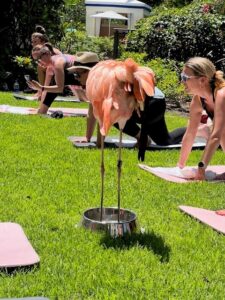
      Flamingo yoga
      Flamingo yoga

      The Bahamas, generally, is known for its vivid, aquamarine waters and welcoming culture. Baha Mar, located in Nassau, the capital and largest city located on the island of New Providence, takes service to the next level. The resort is actually a collection of three hotels—Grand Hyatt, SLS and Rosewood (the view from one of the guest rooms shown above)—fronting 15 acres of beachfront and home to the largest casino in the Bahamas.

      Read More: Meeting Professionals in the Caribbean

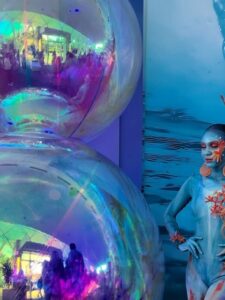
      The bright 300,000 sq. ft. convention center operated by Grand Hyatt Baha Mar offers indoor and outdoor opportunities for meeting surrounded by art and greenery. IRF embraced the beachy, seaside vibe with help from Island Destination Services and Cacique International to surround attendees in oversized bubbles, mythical sea creatures, Junkanoo dancers and Bahamian music.

      Bright Junkanoo costumes
      Junkanoo costumes in Baha Mar Convention Center

      The agenda, which gave attendees time to experience local diversions such as flamingo yoga, catamaran sailing and interactive cultural and foodie tours, demonstrated the one thing IRF studies say incentive participants want: Free time. “The good news,” Harris explained, “is that in a time of rising costs and tight budgets, free time is free.”

      Radical Possibility

      Decorative blue bubbles and woman with coral
      Into the Deep decor

      Harris also shared insights from the recent bestseller “Unreasonable Hospitality: The Remarkable Power of Giving People More Than They Expect” by Will Guidara, one of the founders behind New York’s Eleven Madison Park restaurant. It turns out that the heart of surprising and delighting is empowering teams to listen and take action. “Personalization done right is magical,” Harris said. Hyper-personalization brings more humanity into incentives on an individual basis by allowing people to feel seen,” she said.

      Read More: Bahamas/Caribbean Soak Up Paradise

      The business of exceeding expectations is a big economic engine. “Just like Taylor Swift, you have the power to impact communities when you bring an event to a destination,” she reported. IRF attendees aggregate $1.6 billion in spending.

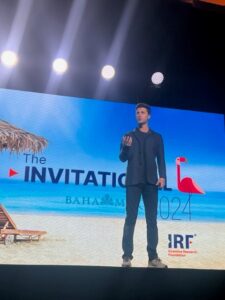
      Ben Nemtin on stage at IRF 2024
      Ben Nemtin

      A similar message about the power of the individual to make a difference came from author and co-founder of The Buried Life movement Ben Nemtin. “Planners face challenges all the time, but your sense of purpose is a powerful tool,” he shared. He added that every act of kindness has a ripple effect, touching their family and friends that can result in exponential benefits. “The work you do creates connections, culture and memories that last a lifetime,” he said.

      Learn More: Traveling Beyond the Stars with Ben Nemtin Podcast

      Nemtin encouraged attendees to do what they do best, make their own bucket lists, journal and prioritize the most important things to do the most good. “Give without expectations,” he said.

      Again, IRF demonstrated this truism by honoring the Accelerate Class of up-and-coming incentives professionals and making a grant to a Baha Mar employee through the Above and Beyond Foundation.

      IRF Invitational 2025 is scheduled for AVA Resort Cancun June 1-4.

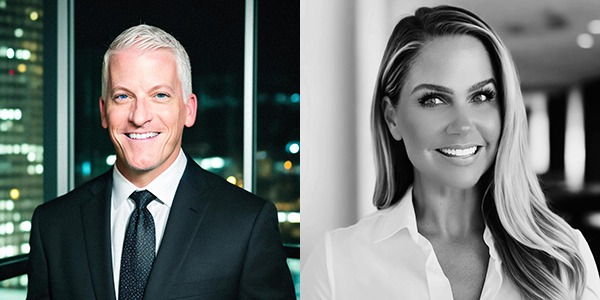
      Gary Spencer and Erika Kauffman

      Smart Moves headshots of Gary Spencer and Erika Kauffman
      Gary Spencer (left) and Erika Kauffman (right), Highgate

      Real estate and hospitality management company Highgate expands its Hawaii leadership team with two new appointments.

      Spencer is appointed as senior vice president of sales & marketing, luxury, lifestyle & Hawaii. He brings over 30 years of experience in sales, marketing and hospitality to his new role, in which he will oversee an integrated sales, marketing and communications strategy for Highgate’s Hawaii portfolio. In addition to spending 20 years at Evolution & Aimbridge Hospitality, he was also a co-founder and principal at Evolution Hospitality.

      Kauffman takes on the role of regional director of communications. Acclaimed for her results-driven strategies, partnership maximization, performance excellence and sustainable portfolio growth, she will oversee Highgate Hawaii’s strategic communications, including partnerships with TableOne Hospitality. Prior to this role, Kauffman was the founder and president of EPR+, a 17-year independent marketing, communications and public relations consultancy.

      Ashley Del Buono

      Ashley Del Buono headshot
      Ashley Del Buono, The Windsor Court

      The Windsor Court announces Ashley Del Buono as sales manager. Most recently, she served as the events and sponsorships coordinator at the Terra Bella Institute, in which she managed the coordination, budgeting and implementation of various events. She will now be responsible for driving sales initiatives, creating and maintaining client relationships and promoting The Windsor Court as a premier destination.

      Katie Kirkland

      Smart Moves headshot of Katie Kirkland
      Katie Kirkland, Chicken Ranch Casino Resort

      Kirkland joins Chicken Ranch Casino Resort as group sales manager. She brings over 14 years of experience in the hospitality, tourism and sales industry and is known for her success in designing and implementing innovative campaigns. She looks forward to serving as part of Chicken Ranch Casino Resort’s summer 2024 opening team. Kirkland will work to shape the group’s sales strategies and establish meaningful connections within the community.

      Anita Paic

      Anita Paic
      Ainta Paic, Vienna Tourist Board

      Paic is named as the head of Vienna Tourist Board’s B2B management department. An expert in strategic marketing communication, she brings many years of international corporate experience. She has served in many global tourism management positions, including at FMTG Falkensteiner Michaeler Tourism Group, Sacher Hotels and Marriott International. She will head the Vienna Convention Bureau, which is responsible for the worldwide acquisition of congresses, corporate conferences and incentives in addition to providing support to meeting planners.

      Andreas Heckmann

      Smart Moves headshot of Andreas Heckmann
      Andreas Heckmann, Cvent

      Cvent appoints Heckmann as chief customer officer. He will lead Cvent’s global, 1,500+ person client services organization, focusing on customer experience and client satisfaction. He spent nearly 25 years at SAP, most recently serving as executive vice president of customer solution support & innovation, he led a global team of over 10,000 customer services and development employees and achieved record-setting results in customer satisfaction and operating margins.

      Grant Hart

      headshot of Grant Hart
      Grant Hart, Fenway Hotel

      Hart is promoted to the role of director of sales at Fenway Hotel. She will handle training and supervision of the sales and event planning team to generate and execute meeting business for the corporate, government, sports and social market segments. She brings over a decade of hospitality experience, most recently serving as director of sales at another Mainsail Lodging & Development property, Hotel Forty Five.

      Brittany Cockrell

      Smart Moves headshot of Brittany Cockrell
      Brittany Cockrell, Atlanta Convention and Visitors Bureau

      Atlanta Convention and Visitors Bureau appoints Cockrell as director, membership and corporate events. In this role, she will manage programs and initiatives to maximize member retention while planning and executing a range of industry events. She brings over 16 years of hospitality experience, most recently serving as the director of catering and conference services at Omni Barton Creek Resort & Spa.

      Karim Ikrimah

      Karim Ikrimah
      Karim Ikrimah, Fairmont Sonoma Mission Inn & Spa

      Ikrimah takes on the role of general manager at Fairmont Sonoma Mission Inn & Spa. He brings nearly 20 years of hospitality leadership experience, most recently serving at sister hotel, Fairmont Le Manoir Richelieu in Quebec. Prior to that, he held the role of director of operations at the same property. He is also a member of Le Chaîne des Rôtisseurs, an international association of gastronomy established in over 75 countries.

      Susan Williams

      Smart Moves headshot of Susan Williams
      Susan Williams, Viceroy Los Cabos

      Williams is appointed as director of sales and marketing at Viceroy Los Cabos. She brings over two decades of sales and marketing in the luxury and lifestyle industry, most recently overseeing the sales and marketing efforts for Hyatt Hotels & Resorts Mexico lifestyle brand, Thompson Zihuantanejo. She brings innovative leadership skills and a results-oriented mindset to this new role, in which she will spearhead sales, revenue management and strategic and tactical marketing.

      Matt Durdel

      Matt Durdel
      Matt Durdel, Enchantment Resort

      Enchantment Resort appoints Durdel as director of adventure and activities. He will oversee the resort’s destination outpost, Trailhouse, after formerly serving as the outdoor adventure manager at the property. He brings a wide array of certifications, including Leave No Trace (LNT) Master Educator, Wilderness First Responder, Swift Water Rescue, and  National Association for Interpretation Certified Interpretive Guide among others.

      Read More: Smart Moves in Orlando, Anaheim and More

      Aaron Wolowiec likes to live his life by the phrase, “No day but today.” In the Broadway musical “Rent” the phrase is repeated again and again to emphasize that we have no idea if we will see tomorrow—so take advantage of the opportunities that are available right here, right now.

      “Especially when it comes to events, there are a million reasons why we could put off the implementation of a new process or technology, or the rollout of a new attendee experience…but who’s to say the next event will be any easier?” Wolowiec says. “Or maybe it’s a year away, and who wants to wait a whole year to implement something potentially impactful? Or maybe we’ll have moved on to a new organization/event by then and miss our chance altogether.

      “Whenever possible, I advocate for moving forward today rather than waiting for another opportunity that may never come. This also creates a great learning experience that we can potentially build upon the next time to make our events even better.”

      Becoming a CMP

      Wolowiec, founder and president of consulting firm Event Garde, earned his CMP in 2009. At that time, he was looking to advance his career, and when one of his colleagues was working on earning her CMP designation, he began studying and eventually sat for the exam.

      “I crave knowledge. Every chance I get, I sign up for new learning opportunities,” he says. Throughout his career, he has earned numerous credentials. In addition to being a CMP and a CMP Fellow, he is also a Certified Association Executive, Certified Learning Environment Architect, Certified Diversity Professional and Diversity Executive Leadership Program Scholar, among many other certifications.

      Years after earning his CMP, Wolowiec worked with colleagues to develop an in-person and virtual study course designed to better engage participants and help them spread their studying over a number of months.

      When it comes to studying for the exam, he says, “Definitely read the materials, create your own flashcards, participate in a study course,” he says. And importantly, he adds “Identify a mentor—particularly someone with experience that’s different from yours.”

      When he was studying for the exam, he found that, as a professional working for a state trade association, he had no experience working with convention centers. For him, he says, “Taking the opportunity to not only visit a convention center, but talk with staff and planners who were knowledgeable and experienced in how convention centers differ from, say, a hotel, was invaluable.”

      Becoming a CMP Fellow

      The CMP Fellow designation identifies CMPs who have gone above and beyond with their CMP credential. “Given my history and experience with the events industry, I thought becoming a CMP Fellow would be a nice way to signal to myself, my colleagues, my clients, and the greater industry my accomplishments and contributions while creating new opportunities to give back to the community coming up in the profession.”

      If you believe that you fit the qualifications to become a CMP Fellow, Wolowiec says, pursue it! He again emphasizes the importance of establishing mentorship relationships. “Reach out to a couple of CMP Fellows to learn more about their experience and establish a mentoring relationship with someone who can help advance your career,” he says.

      Looking Forward

      Wolowiec is incredibly committed to furthering education for planners. He is involved in ongoing work to train CMP candidates. As he looks toward the future of the credential, he says, “From more definition-based questions to more scenario-based questions requiring not just a basic understanding of key terms, but a real knowledge and confidence applying key concepts to different scenarios, means we’re not only training meeting professionals better but the measuring stick we’re evaluating them against has become more stringent and meaningful.”

      As for the CMP Fellow designation, Wolowiec says, “Becoming a CMP Fellow has signaled a new level of experience, professionalism, and achievement that I bring to both the industry and the clients with which I work.

      “Moreover, having both the CMP and CMP Fellow designations behind my name lend instant recognition and credibility that I take my work seriously, that I’ve put in the time and know a great deal about my craft, and have earned the industry’s leading recognition for meeting professionals.”

      He still refers back to his training and texts every so often to stay up to date with industry knowledge, best practices and current trends. “Studying the CMP International Standards and associated body of knowledge has certainly helped me to become a stronger and more intentional planner,” Wolowiec says.

      Read More: Get to Know Barbara Connell, CMP Fellow

      Thoughtful design aesthetics in new and renovated hotels inspire meaningful meetings

      The aesthetic of a space does far more than we often realize to determine the mood of the people in the room, how they move through the space and how they interact with each other. Color psychology comes to mind, but even the height of the ceilings, the width of the hallways, the amount of light and so much more, give a space a certain atmosphere.

      These new and renovated hotels, from Austin to New Orleans to Jekyll Island, Georgia, take this idea to heart: smartly-designed spaces fuel a meeting atmosphere like none other.

      Airy and Bright

      Hyatt Centric Congress Avenue Austin new and renovated
      The Green Room, Hyatt Centric Congress Avenue Austin

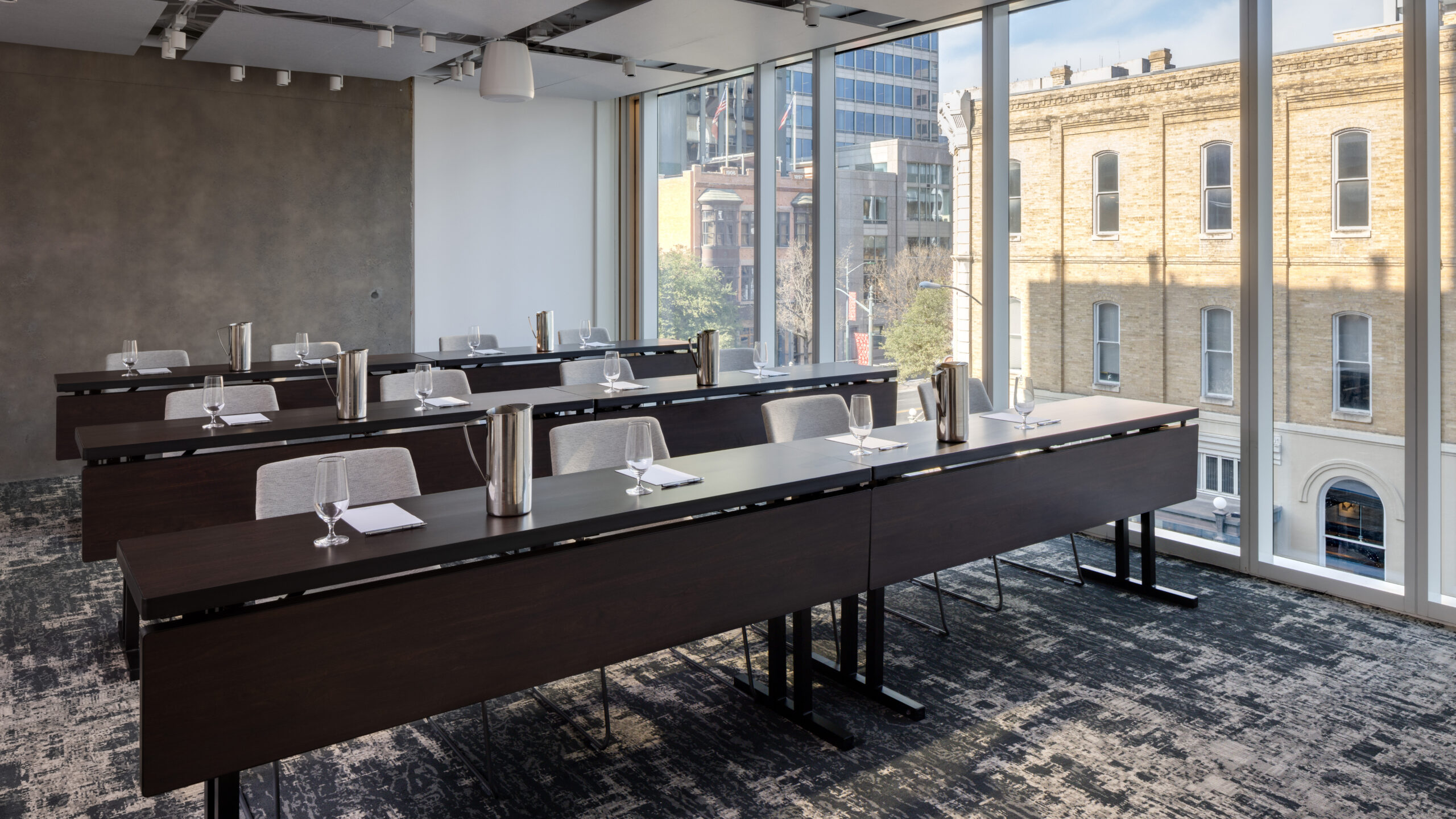
      Hyatt Centric Congress Avenue Austin debuts a renovation centered around its meeting and event spaces, broadly enhancing versatility and capabilities. The 31-story hotel offers 246 guest rooms and suites in addition to a grand total of 3,960 sq. ft. of meeting and event space. The 31st floor consolidates 1,400 sq. ft. of this space in the hotel’s penthouse, the “Artist Residence.” This suite is versatile for its ability to serve as both a relaxing stay and space for entertaining on special occasions, such as corporate happy hours. The flexible floor plan and outdoor terrace make moving through the space easy and offer fantastic views of downtown Austin.

      Further meeting and event space includes the 940-square-foot Marquee Room, with floor to ceiling windows and more great views; the 464-square-foot Green Room, with more abundant natural light and a cozy character; the modern, easy-to-access 321-square-foot Escape Artist; the 225-square-foot Recording Lounge, which pays homage to Austin’s musical history; and two versatile, socially-inclined second and eighth floor event spaces.

      Read More: San Antonio/Austin: Be Weird, Be Smart

      Dreamy Bayou

      W New Orleans guest room for New and Renovated
      Guest room, W New Orleans

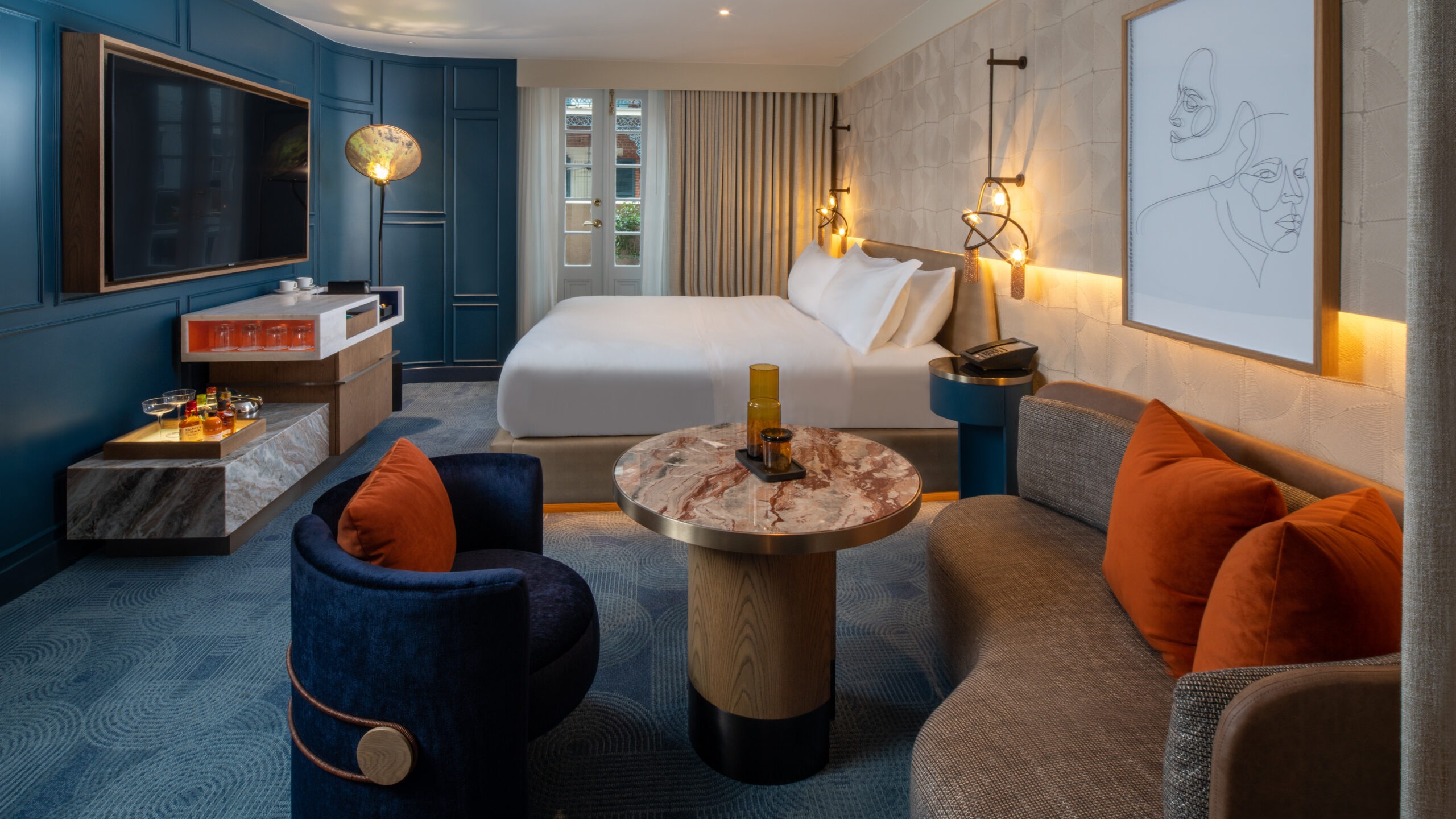
      W New Orleans – French Quarter unveils an inspiring renovation of its 97 guest rooms and carriage houses. The new design offers a relaxing refuge from the bright energy of downtown New Orleans, but doesn’t fall short on the destination’s famous character.

      Rooms emulate the alluring Bayou, with thoughtful details that bring the atmospheric swamplands to life. French-style wall moldings against a bold navy backdrop separate the bedroom from the seating areas in each open-floor-plan guest room. Gold hardware and touches of New Orleans Sazerac orange pop alongside framed black and white line drawings of Jazz singers. It doesn’t end there—Spanish Moss-inspired sconces and mini bars, with nods to a treasure chest—to celebrate a Louisiana tale about French pirate Jean Lafitte who hid his treasure in the bayou—round out a wonderfully immersive space.

      At the hotel’s signature dining outpost, 3rd Block Depot, guests can enjoy classic Cajun-creole fare. Throughout the picturesque courtyard spaces, heated pool and the surrounding historic buildings, cobblestone streets and live music, visitors will have access to a classy, classic New Orleans experience.  The hotel offers 4,616 sq. ft. of meeting and event space.

      Ambience of Excellence

      Jekyll Island Club Resort for New and Renovated
      Crane Cottage Courtyard, Jekyll Island Club Resort

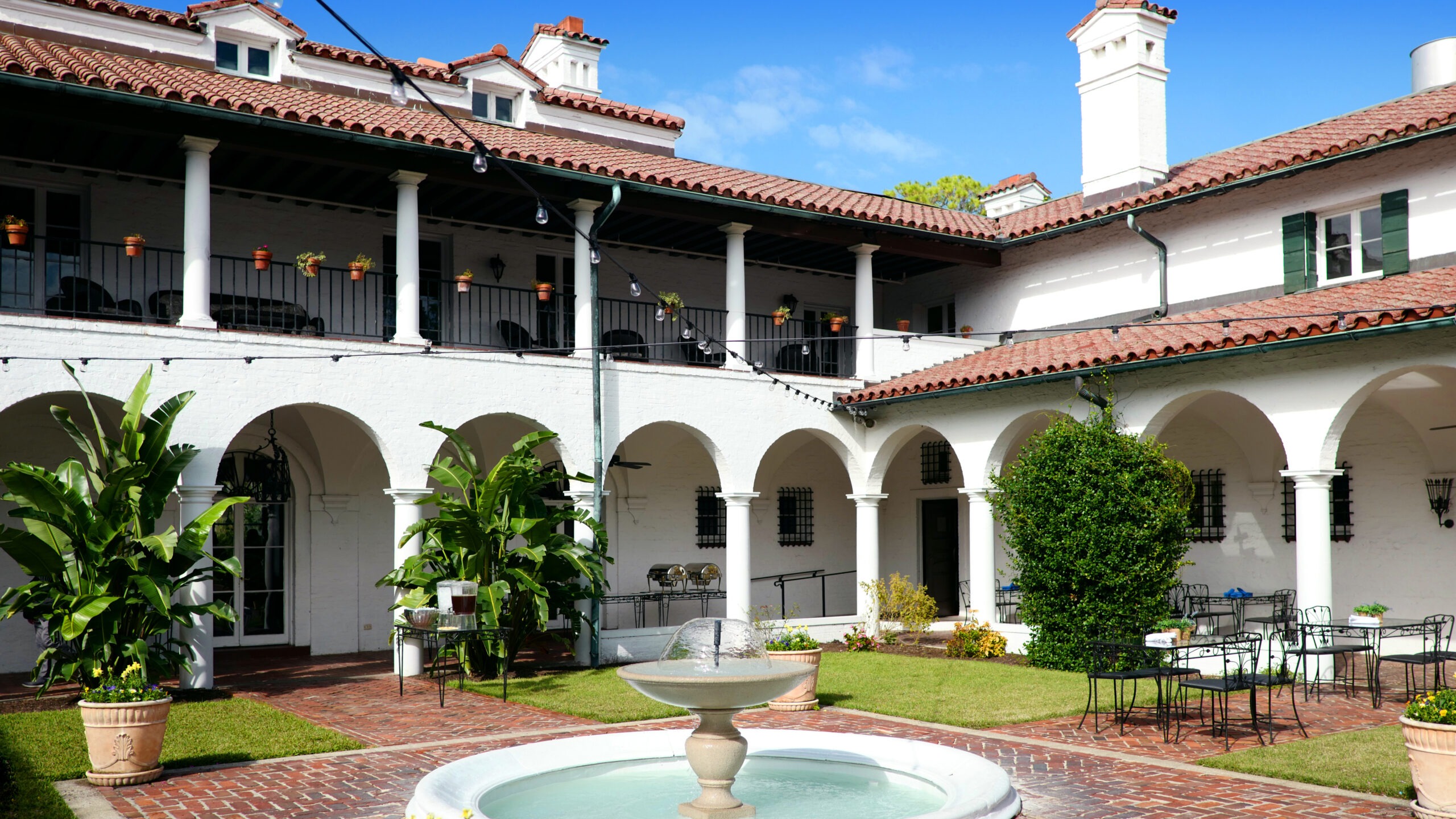
      Jekyll Island Club Resort debuts a $25 million renovation, transforming its every aspect, from outdoor spaces to accommodations to culinary establishments. The new design reflects the shining splendor of the Gilded Age and the Roaring Twenties. The resort originally opened in 1888 as the Jekyll Island Club to serve as a winter retreat destination for the nation’s elite, and saw visitors such as J.P. Morgan, William Rockefeller, Joseph Pulitzer and more. With its storied history in mind, the new design immerses visitors in the upscale feel of this era. It is a member of Historic Hotels of America and is a National Historic Landmark.

      200 guest rooms feature hallmarks of this Gilded Age aesthetic through décor such as upholstered headboards embroidered with deep purple passionflower vines. In the Grand Dining Room, everything from the wildlife patterned carpet to antique mantle clock and double chandeliers build on the distinct style. Its three historic cottages each emulate their own distinct style, inspired by their individual architectural elements; Victorian-style Sans Souci marries dark woods with earthy velvets, while the Italianate cottages, Crane and Cherokee, display bright colors reminiscent of the pink-hued roseate spoonbill crane.

      Further design initiatives will enhance the resort’s 4,280 sq. ft. of meeting and event space.

      Read More: Literary Hotels to Inspire Ingenious Meetings

      June is Gay Pride Month, and parades and other events will celebrate it in metropolitan areas around the world. For the first time, however, the U.S. State Department has issued a Worldwide Caution against the “increased potential for foreign terrorist organization-inspired violence against LGBTQI+ persons and events.”

      In light of this, how can you help keep all attendees safe, especially LGBTQI+ individuals, at a meeting or event overseas?

      For answers, Smart Meetings turned to Kevin Coffey, a meeting and travel risk trainer. Coffey worked for the Los Angeles Police Department for 25 years, where he investigated crimes against travelers at Los Angeles International Airport (LAX), hotels, and meeting and event venues.

      Although the State Department has issued many advisories and alerts in the past, this one is different, Coffey says. “What’s unique is, this is the first time a Worldwide Caution has specifically listed the LGBTQI+ population as a potential target. So, I think it’s important that people just don’t blow it off,” he says.

      Read More: Today’s Best Practices for Visas and International Travel

      Coffey notes it was just a year ago, in mid-June, that Austria’s intelligence agency thwarted an Islamist terror attack on Vienna’s annual gay pride parade. And eight years ago, in Orlando, Florida, 49 people were killed in a mass shooting at Pulse, a gay nightclub.

      Meeting profs always need to do risk due diligence, he says, but never more so than now. He recommends starting with the page on the State Department website that has guidance and tips specifically for LGBTQI+ travel. The site also highlights travel conditions in specific countries. “Go to that country page and look at local laws and special circumstances,” he continues.

      “I also want planners to look at the same advisories from Canada, the U.K. and Australia, because they will sometimes contain different information. It’s very interesting. Some of them are a bit freer with their commentary about safety. We’re sometimes more reserved,” he says, adding it’s also important to keep in mind that the risk assessment for LGBTQI+ travel in a particular city can be very different from that in other areas in the same country.

      Next, he strongly advises planners to tell their attendees to register for the State Department’s Smart Traveler Enrollment Program (STEP) to get emails and text messages for alerts. “If there’s an earthquake or a significant safety event, you’re going to get that information. And it lets them know where U.S. citizens are,” Coffey says. “If you’re a foreign citizen, you go to your own country’s equivalent.

      Read More: Coordinating International Travel: What to Look Out For

      “Now this is the interesting part. Planners can also register their attendees as a group. I don’t care if you’re going to Turks and Caicos or Jamaica for an incentive or wherever, we should always be registering with the State Department. Unfortunately, it’s hardly ever done.”

      He also urges following the State Department’s pages on Facebook and X which are updated frequently with alerts and other safety concerns.

      Coffey thinks reaching out to the CVB or DMO in your overseas destination can yield important safety information, as well. “We know they’re trying to bring in your business, but just ask if there have been any unique or recent safety concerns, especially if those have impacted members of the LGBTQI+ community.”

      The local CVB can provide guidance on specific neighborhoods or streets to avoid altogether or at certain times of the day. “We all know that when the sun goes down, risk changes in many areas of major cities around the world,” as Coffey puts it. “So, if you’re going to promote clubs or attractions in these areas, you need to consider a caution about safety and security in the nighttime, so they’re not out walking around.”

      For Maritz Chief Operating Officer Steve O’Malley, winning the MPI Foundation Industry Leader Award in front of his friends and family in the flower-draped Mellwood Art Center during World Education Congress’ President’s Dinner in Louisville, Kentucky, was a time to reflect on how he accidently found the meetings industry—and whether those same accidents of chance are available for the next generation of meeting professionals.

      In introducing O’Malley, the MPI International board of directors chair, MPI President and CEO Paul Van Deventer used the word “humility” to describe him. When Smart Meetings met with him after the lights had turned off and asked about his more than 34 years at Maritz, his roots in the hospitality industry and expansive volunteer roles with MPI and SITE, O’Malley said, “Humility is just the ability to look back and understand how lucky you are. My career was a series of fortunate events.”

      Start with Gratitude

      When O’Malley took his first job at a resort as a college student, he had the split-second choice between being a bus driver and a concierge. His friend took the bus driver role and had moved on to another industry in a matter of months. O’Malley chose concierge and eagerly opened himself up to learning other jobs while there. “That made all the difference,” he said. “Whatever role you take on first, there are so many adjacent roles, so many opportunities to learn more. Once your shift has ended, always raise your hand, find out if somebody else needs help. There’s always more you can learn,” he said.

      Read More: Leading and Learning from the Next Generation of Meeting Profs

      O’Malley ended up serving as a banquet captain, and that appetite for learning connected him with Maritz, which was putting on an event there.

      O’Malley now sees many more opportunities for people to go into hospitality intentionally. “Now there are great hospitality programs at colleges and universities across the world, and those students are being exposed to the legion of opportunities in the industry.”

      The massive entry of new meeting professionals post-Covid—and the retirement of many who ushered the industry through the hard times—is another opportunity, in O’Malley’s mind. “For young people who really want to apply themselves and want to learn, the world is theirs,” he said. “We need their good thinking, their diverse thoughts on sustainability and technology. If they can adopt AI and use it to take mundane work out of the equation, that’s going to make it even more attractive for young people to jump in. This is a golden age for young people to join our industry and quickly become leaders and make a difference,” he added.

      The Evolution of Incentive Programs

      The current focus on using generative artificial intelligence to streamline idea generation comes on top of all the changes in the practice of using incentive travel to motivate results that happened over the last 70 years at the company that popularized watch gifting to top performers.

      Read More: Why Early Registration Doesn’t Work and Other Insights from a New Maritz Study

      “We are more concerned about the individual now than ever before…and rightly so,” he said. “We had been moving in that direction for a long time, but the pandemic emphasized the point that people want agency over how they consume any experience, be that incentives or meetings.”

      Many of the clients Maritz works with are not just offering one grand European city tour, but multiple choices so that people can travel domestically if they are more comfortable with that. And once they arrive, the event offers multiple choices within the destination, with plenty of free time, as that is what people say they want most.

      “We still want to improve their performance and drive them toward becoming the best version of themselves, so offering choice is absolutely critical,” he said. “People are working very hard, and they value the time they can spend on an incentive trip with their guest. The beauty of that is, even with inflation, free time cost you nothing.”

      Learn More: Trends in Planning Travel Rewards that Motivate

      What hasn’t changed is the emphasis on the heart of hospitality. “One of the things that my team has probably heard all too often is the importance of treating each individual as though they are the most special person in the world,” he said. “That requires being in the moment, looking at the guest and finding out what it is we can do to serve them best,” he said.

      “What we do is noble work,” O’Malley said, comparing the philosophical ideal of “all beings as one” to the role of hospitality professionals. “There’s nothing that separates anyone you might meet on the street. What we get to do in the events industry is show people how similar we all are, and how special they are in the eyes of everybody else. It is important work, and that will never change.”

      What One Thing?

      When asked the one thing that made all the difference in his career, O’Malley didn’t hesitate. He quickly replied, “Taking chances.”

      He continued, “When I graduated from university, I had never really traveled at all. I found this very loosely structured volunteer program to teach high school in Kenya, and I went over there with nothing. I backpacked up to the most northwest province of Kenya, walked into the Anglican archdiocese, and the archbishop said, ‘Steve, you’re the answer to my prayers.’ He drove me out to a school that day and for a year that’s how it worked.”

      A similar trust in outcomes happened when he moved to Colorado. He didn’t know anyone and didn’t even know how to ski, but it worked out. “All throughout my career, I have been willing to say yes to unknown and as a result, I’ve gone down some blind alleys but for the most part, I’ve been able to find success.”

      O’Malley encourages his team to say yes to some scary things because “you never know what could happen.” You could even win the MPI Industry Leaders Award.