The future of events is…Zoom? For those of us stricken with “Zoom fatigue,” this forecast may lack any appeal. Between virtual birthdays, family reunions and office happy hours, Americans have spent more than enough time looking at each other through tiny square-shaped boxes at the side of their screen.

Yet, event professionals have the opportunity to create visionary events and plan meetings that replicate the vibrancy and liveliness that existed in person while enjoying the flexibility and safety that a hybrid/online event provides. Here are the best ways to maximize the potential of virtual events and meetings.

Zoom Meetings vs. Webinars vs. Events 

Propelled into the national spotlight in March 2020, Zoom quickly capitalized on the opportunity to be the frontrunner in the new era of virtual meetings and events. Now, with the options to host a regular meeting, a webinar, or a special event, it is easy to get confused about which platform is right for you. Here are the main characteristics for each platform and how to use them.. 

  • Zoom Meetings: Can host up to 1,000 interactive participants, best used for collaboration, smaller meetings, office hours
  • Zoom Webinar: Can host up to 50,000 view-only participants and 100 interactive panelists, best used for public events, panels, concerts and other single-session events.
  • Zoom Events: Can host up to 50,000 people and combines the interactive tools of Zoom Meetings with features of Zoom Webinar and is best used for multi-day events with event hubs where companies can post former and future events. 

New App Store 

A close up photo of a phone home screen, centered on the app store

Zoom Marketplace offers more than 1,500 apps meant to enhance your Zoom experience and is the next big thing to elevate the virtual world. From Kahoot! to SurveyMonkey, popular apps and websites are creating versions of their product to easily work alongside Zoom and have made them available on the marketplace. Another example is Twine for Zoom-an app working to replicate the serendipitous nature of office chatter and networking.

“We believe that good conversations between strangers online can happen if they’re well curated, there’s structure around it, a timer so you know when the conversation is going to end and you are going to get moved to the next conversation, as well as being strategic on who you pair people with,” said Anh Nguyen, the head of community engagement at Twine. 

Read more: Acquisition to Enhance Breakout Rooms Could Be First Step Toward Zoomiverse

Virtual Fatigue…Fact or Fiction?

Sleepy Employee Person Portrait In Video Conference Call

Nguyen discusses how “Zoom fatigue” is not specifically caused by Zoom at all. It is simply a problem with virtual events missing the design and production aspect of TV and video games. The best way to combat virtual fatigue is to engage your audience and create something exciting and interactive. Whether that be through virtual networking on Twine or other marketplace apps, event professionals and app developers alike are constantly discovering new ways to transform the virtual world into something energizing and stimulating. 

“Are you engaging people in different ways that they relate to versus just taking a speaker and putting them in a zoom and having them talk at you? That is what contributes more to Zoom fatigue than the actual technology,” Nguyen said. 

Read more: The Antidote for Zoom Fatigue

With the options for participants to switch between breakout rooms, use icebreaker conversation prompts, with virtual backgrounds and more, event professionals have the opportunity to get creative in a new but prospering industry. 

“I would say to the event planners, we are still in the correcting phase of finding where we are going to land on this pendulum. We went super virtual and then we are flying all the way back to the in-person side and I think the pendulum will settle somewhere in the middle. But I would advise people to not put too much into their reaction of what is happening right now,” Nguyen said. 

Zoom Alternatives

Lady talking and watching a video conference call

As the virtual world grows, other companies are attempting to rival the success that Zoom has achieved. One of these companies is Livestorm, a video engagement platform that allows people to manage their meetings and webinars. They recently announced a handful of new features to amplify engagement including breakout rooms, an extensive virtual background library, a timer app and more.

One standout feature is called Slido, which provides the opportunity for polls and questions and helps to enhance free-flowing conversation. Livestorm works to capitalize on some of the issues presented with Zoom. They have the option to limit registrations to business-only emails, automate webinars and other ways that paint them as a strong competitor.

Read more: How to Tell When You Online Meetings Are Not Engaging Enough-And What to Do About It

U.S. Travel Association has launched the Sustainable Travel Coalition, designed to bring its members together to develop and focus on strategies that will ensure a more sustainable future.

With nearly 60 members, the Sustainable Travel Coalition will act as a forum to inform U.S. Travel of members’ sustainability issues and concerns at their respective organizations and destinations. A policy committee has been created in conjunction with the coalition to aid in the coalition’s efforts.

“Seeing the world and saving the world should not be mutually exclusive,” said Tori Emerson Barnes, executive vice president of public affairs and policy for U.S. Travel. “As technology advances and consumers demand more sustainable travel options, the work of this coalition will ensure that the U.S. travel industry can meet the needs of an evolving market while also protecting our planet’s natural resources.”

Read MoreNew Collaborative Course Offers Tips for Easy Sustainable Travel

U.S. Travel Association’s sustainability goals are as follows:

  • Spotlight industry progress by showcasing innovative technologies and highlighting the ongoing actions of travel professionals in the sustainability space
  • Amplify industry goals, leadership and commitment to conservation, waste and emission reduction
  • Highlight why sustainability matters and its importance to travel
  • Actively identifying and helping the industry achieve its goals
  • Defend against harmful policies that slow progress toward sustainability goals

Governmental acts have been passed recently with the help of U.S. Travel in pursuit of it goals, including the bipartisan Infrastructure Investment and Jobs Act, which will guarantee a historic level of travel infrastructure investment, including airports, railways, highways and electric vehicle (EV) charging stations; and the National Electric Vehicle Infrastructure Formula Program, which will make $5 billion available for investments in a national EV charging network.

U.S. Travel members and Friends of Travel are eligible to join the coalition, which will meet virtually three times a year; the policy committee will meet virtually bi-monthly and once a year in person.

Gatherings come in all shapes and sizes. They might last an hour, a few days or longer. Deciding on the right window of time says a lot to your prospective attendees: We’ve got a lot of things to share, a lot of work to do, a lot of fun to be had.

Or, you’re busy. Let’s cut to the quick.

Be honest with yourself when deciding the time commitment you’ll be asking of attendees. You might think you’ve got a lot of valuable content to share that’s well worth their time, but do you really? Do they need to experience all this?

When in doubt, keep it short; leave them wanting more. Here are a few things to consider when charting your agenda:

  • Mix it up: from big sessions to small moments, intense lectures to quiet reflection. Craft a story with time that builds momentum, provides moments of curiosity and release. Make it a real page-turner
  • Leave plenty of unscheduled time. As mentioned earlier, attendees have lives on the side and likely work tasks to address while participating in your event. Plus, they might just need a break to refresh their senses.

If you want your brand to breathe, don’t suffocate your tribe.

  • Be respectful of your attendees’ time; make sure every moment has value by complementing your must-see activities with lighter moments of surprise and delight sprinkled throughout the agenda and venue.

We’ll look at how the use of space affects the journey in a later chapter. Here, let’s delve into the types of experiences you might deploy and how they’ll add to the attendees’ journey.

Arrivals

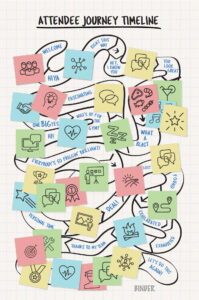
colorful illustration of a meeting attendee journey timeline

Think about how you’ve arrived at personal gatherings: walking into a vast stadium alive with 50,000 roaring fans, taking the first steps down the flower-lined aisle toward the altar, bringing a beer to your dad in his workshop out back.

Read MoreSports Arenas and Stadiums: On Game for Meeting Planners This Year

How can you translate these visceral experiences into your business event? What will be an attendee’s first interaction with your environment?

Doors, curtains, elevators or sea breezes? What will be the backdrop when they encounter their first familiar face or brand activation? When will they know they’ve officially arrived? How soon will they cheer, laugh, hug and learn?

So Many Opportunities!

Certainly, there are touchpoints well before the events: invitations, registration, know-before-you-go letters and the like. Let’s talk about the timeline of moments that will ultimately deliver attendees to your event, each one an opportunity to connect in a special way. Here are just a few to consider:

  • Arriving at the departure airport
  • The flight (or other conveyance)
  • Landing and transferring through the airport
  • Transfer to the venue or lodging
  • Porte-cochere and entrance
  • Lobby area
  • Hotel check-in
  • Transfer to room
  • Arriving in room
  • Event registration
  • First scheduled event
  • First general session

So, by the time most attendees encounter your brand and event for the first time, they’ve likely interacted with a number of third-party agents; waited in lines; confronted kiosks, chatbots and apps; been confined in small, airborne spaces for long periods; and dealt with a few frustrations and challenges along the way.

Create a Threshold Moment

At what point will they recognize they’ve stepped into your experience? And what will they find there?

Too often it’s a queue line to get a badge, or maybe just another kiosk and printer. There might be signs pointing hither and yon, trying to steer them where organizers want them to be. In the aftermath of the pandemic, first impressions will also involve a health interrogation, a thermometer to the forehead and a swab up your well-swabbed nose.

What’s the one element that might make all of these touch points more personal and valuable? I’d say, people, live humans. Position employees or leaders at every step to inject those moments with warmth, unique brand enthusiasm and an authentic, empathic touch.

Apps are practical; people are powerful.

Departures

I don’t think we give enough attention to how our business gatherings end. One might culminate with a flashy, boozy night and a morning of hungover colleagues avoiding eye contact in the lobby. I’ve seen expensive closing sessions devolve into a mad dash for the airport shuttle—don’t forget your box lunch!

How do you make the last moments valuable, and how do you keep the emotional flame of your event alive for months to come? Entire books have been written about the latter topic, maintaining a strong bond with the community you’ve gathered. As for the matter of final moments of a program, here’s some thinking.

This is an excerpt from Gather: The Business of Coming Together, which you can order on Amazon.

A gifted storyteller, writer, author and speaker, Doug Binder makes business personal for audiences and engagements of all kinds. In his three decades as a producer and creative director, Binder has staged events and campaigns around the world for globally important companies and visionary leaders across myriad industries, from high-tech and bio tech to entertainment, automotive, hospitality and shoes. Yes, shoes. Connect with Doug Binder at binderama.us and on LinkedIn, Instagram and Facebook.

A long-anticipated reckoning after the boom of investment in virtual meeting platforms during Covid and an aggressive return to in-person events has sent many streaming platform companies scrambling to position themselves in the best light for a possible looming merger and acquisition season.

For some companies such as Bizzabo and Hopin, that has resulted in substantial layoffs—30% of staff in the case of U.S. and Israel-based Bizzabo and almost the same percentage in two rounds for the more than $7 billion-valuated Hopin. Others have benefitted from a fresh approach as exemplified by today’s announcement that Zoom Ventures and others are investing in the remote-first startup twine.

Read more about mergers and acquisitions in the event tech world.

“There’s definitely going to be more M&A,” opined Smart Meetings event tech correspondent Brandt Krueger. “We saw a ton of money flow into the event tech market during the pandemic, and at some point, those investors are going to want to see a return on that investment.”

He interpreted many of the layoffs as an attempt to cut costs and give the impression of profitability in a market that was never going to continue to see the growth it saw during the last three years, most likely in the hope of attracting a buyer. “That’s the easiest way for investors to walk away happy. I also think there are quite a few founders ready to get out of the market after the peak and go spend some quality time with their family,” he concluded.

A Targeted Approach

For serial entrepreneur Lawrence Coburn, who is navigating the serendipitous networking company twine through the evolution of the virtual events space as co-founder and CEO, getting in early to a growing niche was essential. The February acquisition of Glimpse positioned twine as an embedded enhancement of the ubiquitous Zoom meeting and led to today’s announcement about increased investments from Maven Ventures, PeopleTech Angels and Zoom itself, along with additional investments from existing investors Moment Ventures, Coelius Capital, Aaron Schwarz. Twine raised $4.3 million in seed funding to start.

The company’s twine App for Zoom is now available through the Zoom App Marketplace to help drive attendee networking within Zoom Events to seamlessly add guided networking experiences, including one-to-one, small group, tag-based and spatial networking that allows users to hover over a layout of a virtual meeting room with tables and chairs before clicking to join in a conversation. The product tries to replicate in-office communication dynamics and is free for up to 25 attendees with different pricing options for larger groups.

‘We found our seam—distribution on the massive ecosystem of Zoom, and the wave of remote work that isn’t going anywhere,” said Coburn in an exclusive Smart Meetings interview.

He described the current state of events as a roller coaster. When Covid is flaring, meeting professionals want to go virtual and then when it dies down, they want to be in-person. “We are still in events, but focused more on a lot of internal events,” he explained. The twine product makes it easy for remote teams to interact in large and small groups with the click of a few buttons.

“The rocket ship growth for every event tech company with hundreds of millions of dollars of funding, those days are over,” he assessed. “Demand for virtual went to the moon when everything was shut down and it has come back down again. People are thirsty to get back face-to-face.”

Coburn is not convinced that the volatility is over. “I think we are overcorrecting right now as everyone is racing back to face-to-face because it has been gone for so long. I think the pendulum will end where virtual events are a bigger part of the pie than before Covid.”

But he is not convinced there will be enough virtual business to keep all the companies now in the space living up to their sky-high valuations. “I have to think more consolidation is coming as companies run out of cash. In a down market, if you have cash, you can lean in and start acquiring more.”

Coburn has empathy for companies going through the ups and downs of trying to stay ahead of the market. He previously founded, grew and sold DoubleDutch to Cvent through some volatile periods in the market. “Companies that are trying to grow in advance of demand and then if the business doesn’t pan out, it is heartbreaking to part with the people who bet on you,” he said.

In the meantime, he is excited to have distribution advantage on a platform that is still hosting 300 million daily participants as a small, nimble company, rather than being in receding market selling against good products with great pricing.

Read more updates about virtual and hybrid technology.

In-person Makes a Comeback

Making sense of the ups and downs of in-person and virtual events can take on the nuance of a Rorschach inkblot test with everyone bringing their own point of view to the picture. Eric Holmen, CEO of the event marketing technology company Splash, shared a picture of what the company saw in the behavior of its clients at different stages of the pandemic.

Most clients engaged his tools for registration and apps at their in-person meetings prior to March 2020, then they immediately swapped to the company’s live-streaming capabilities, and as variants moved through the populations, undulations in types of services being accessed were visible in the data. Regardless of the platform, all marketing intelligence gathered from interactions synced back to a shared CRM. Now he is seeing a consistent trend with 46% of client event in-person in June. The total number of events is also on the incline. “I think in-person events are back,” he said.
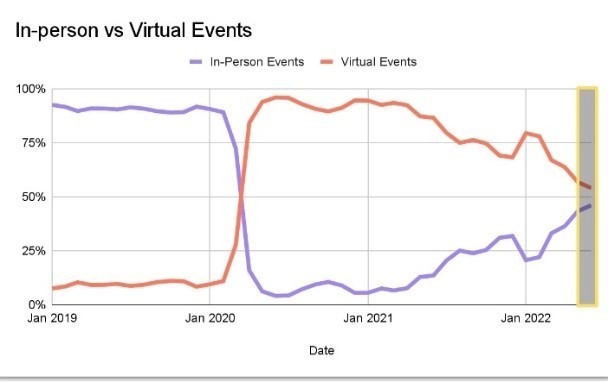
Graph of in-person vs. virtual events.

“We expect to see the ratio of virtual to in-person decline compared to the total, but they aren’t going away,” Holmen predicted based on customer surveys. Instead, he sees virtual as a targeted use case for building top-of-funnel interest and a marketing database. “In-person builds intimacy and converts deals. Virtual events tend to be six-times larger on average in registration, but the real ROI comes from in-person events where they are converting relationships into opportunities,” he said.

What he isn’t seeing is the huge number of hybrid events people were predicting a year ago, at least not simulcast.

The bottom line, he said, is that virtual companies received very high valuations from their investors and the market for virtual slowed down for companies only offering virtual. The layoffs are a visible sign of preserving capital and preparing for slower growth and lower valuations.

Holmen describes Splash as an in-person-first company with virtual capabilities and is excited about the level of experimentation he is seeing in ballrooms today. “Trade Shows may have to rethink their value proposition. This is a ripe opportunity for the industry to reinvent itself,” he said.

365 Opportunities

Another virtual meeting company that is seeing opportunity in the abstract art created by statistics from adoption of virtual and in-person tools is Ben Chodor, president of Notified. “Everyone is still interested in virtual and we are extremely bullish on 365 events,” he said in an interview with Smart Meetings following the announcement of layoffs at Bizzabo. “There is no denying that there has been a push to return in-person. It is exciting to see our teams and go to live events again. But it isn’t one or the other.”

Chodor explained that capturing content at live events and making that available to a larger audience that will fit in the convention center is just good business. Streaming content drives interest in the physical meeting, it is more environmentally sustainable than making everyone travel to the event, it is more accessible and it can help save budget at a time when inflation is rampant and the recession word is being tossed around ominously.

Perhaps most importantly, including a streaming platform as part of an in-person event strategy embeds a back-up plan in the design in case something happens and people can’t attend physically. “An event is an event and we have to start thinking about the big picture,” he said.

But even with a predicted continuation of interest in virtual, Chodor sees an inevitable collapse in the number of companies in the space. “In 2019, we had 9 or 12 competitors and now there are more than 800 and they got crazy valuations,” he observed. “Wherever there is a boom, there will be a bust and not everyone will be able to survive.”

“There will be some consolidation as some companies run out of money. Narrowing down the number of virtual companies will make the industry stronger with more end-to-end platforms and more flexibility,” he concluded.

His final prediction? “In the future the vanity matrix of how many people attended will go by the wayside and meaningful data about what they interacted with and for how long on all platforms will help us to better understand and interact with customers, so everyone gets what they want.”

Enduring Partners

Consolidation and a return to physical-first could benefit diversified event-technology companies such as Encore, the AV company-of-choice at many venues across the country and offers the hybrid platform Chime, which allows for real-time connectivity between virtual and in-person without awkward gaps of lag time. Chime’s robust audience engagement data (results are recorded every 2 minutes, rather than the industry standard of 5 minutes) gives event producers better data and could create its own modern art charts. It was built pre-Covid for in-person engagement, expanded for virtual over the last three years and is now coming back to its roots more robust than ever.

As meeting formats change, participants’ needs change and organizations look to broaden their reach with hybrid experiences, easy technology with better analytics is becoming essential to delivering ROI,” said the company in a release when improvements were announced.

“Technology will play a bigger role in experiences going forward,” said Taqi Mohiudddin, Encore vice president of product marketing in a follow-up interview.


In a bid to dominate the meetings industry, MeetingPlay and Aventri (MPAV), which merged in January, have acquired eventcore. The platform allows companies to completely optimize the digital registration experience for event attendees, especially for global companies that want every event to be new and exciting.

Mark Johnson, CEO of eventcore, is eager to combine the platform’s capabilities with MPAV’s wider reach. “We look forward to providing our valuable customers and partners with the same level of service, attention and quality that they are used to,” he said in a statement. “As part of the MPAV family, we will be investing to increase the depth and breadth of our platform.”

A Successful Merger

The MPAV merger intended to create a one-stop shop for meeting planners organizing in-person, hybrid and virtual events, Smart Meetings reported. MPAV CEO Eric Lochner said he foresaw better support and more services—Five months later, he is confident that the company has lived up to expectations.

With the combined experience of MeetingPlay, a meeting services platform, and Aventri, a software platform, MPAV was able to accommodate the rush of in-person meetings. The return to live events wasn’t anticipated until fall but changing Covid restrictions motivated event planners to convert virtual meetings to in-person affairs as fast as possible.

“We had clients literally saying, ‘I know I had this virtual event, but I want to do it in person, and it’s in two weeks,” said Lochner. He noted the fortunate timing of MPAV’s merger. Were it not for their combined in-person, hybrid and virtual services, they would not have been able to take care of the influx of clients.

Lochner credits the smooth merger of MeetingPlay and Aventri to the employees of each company. With more than 400 employees around the world, he knew it wouldn’t be an easy task, but their helpful, respectful and client-first attitudes made the process that much more efficient. Lochner said the same of eventcore’s staff—the integration of a “set of incredible people that love what they do” made for an easy transition.

Servicing New Markets

Acquiring eventcore gave MPAV the tool it needed to provide for the largest events by global companies. At the highest level, each event needs unique tools that can handle complex scheduling, data collection and communication. The customizable registration and customer support that eventcore provides is non-negotiable in large events. When it comes to eventcore’s technology, Lochner said, “We knew we had to build it, or we had to buy it.”

Eventcore isn’t the only new tool under MPAV’s belt. The company released version two of a bookable meeting space tool in collaboration with VenueBook, making communication, information and contracting easier on the event planner. Coming soon is a “data bus” service, which plans to make event information accessible from one centralized stream, as opposed to multiple companies juggling APIs with each other.

Seeking Global Expansion

MPAV has a stated goal of catering to the largest global companies and their tier one, two and three events, an industry the acquisition of eventcore allowed them to break into. Lochner said that MPAV has the most potential to grow in top-tier international meetings. With few companies competing in the space, MPAV can emphasize the customer service Lochner says the company is known for.

Currently, the majority of MPAV’s clients are based in the United States. Any meetings supported by MPAV’s international offices are mostly from American companies. Lochner wants to focus on servicing the needs of global enterprises based outside of the United States, creating steady organic growth.

In terms of inorganic growth, Lochner predicts there will definitely be more mergers and acquisitions in MPAV’s future. In collaboration with investor Sunstone Partners, MPAV will look to acquire the tools and products that will improve the event planning experience. Combined with its new event tools, MPAV wants to solidify its place as an industry leader.

An Industry in Flux

The acquisition of eventcore and sudden jump to in-person events is only part of a larger change in the meetings and events industry—especially when it comes to virtual platforms. The flurry of new virtual meeting companies with massive funding and even bigger expectations is starting to settle and consolidate.

As Smart Meetings observed last week, companies that couldn’t keep up with dwindling demand have had to lay off staff, agree to acquisition or fall behind hundreds of competitors. The virtual meetings industry is expected to shrink further, even with the highly contagious BA.5 Covid variant making its rounds.

MPAV’s diverse toolset has so far given it protection from this trend. A new name for the combined companies is still in the works and, according to Lochner, will be announced in the next few months with a large event.

Amid a heat wave sweeping through Europe and the US, everyone is looking to cool-off in a swimming pool. Meeting attendees, who are often traveling to warm and humid climates, should make the most of the amenities a hotel has to offer. Hotel pools provide refreshing temperatures and poolside service while creating amazing photo ops. Whether sitting on a lounge chair with a fruity drink in hand or swimming while surrounded by palm trees or mountains, posting a pool photo to your feed will make anyone double-tap. Here are ten hotels to host your meeting that are home to fabulous #instaworthy pools.

1. Four Seasons Resort Orlando at Walt Disney Resort


The Four Seasons Resort is as magical as the nearby theme park. Not only does it have 66,587 sq. ft. of event space but it features a lazy river, a splash pool, a family pool and a pool for adult swim. For the best Instagram photo, go down the 11,000 sq. ft. lazy river where you can find an oasis among the waterfalls and greenery.

2. Grand Wailea, A Waldorf Astoria Resort and Spa

View this post on Instagram


A post shared by Grand Wailea Maui (@grandwailea)


With the beautiful backdrop of Hawaii and a one-of-a-kind water elevator, a pool day at the Grand Wailea will make for some mesmerizing Instagram content. Whether you get an action shot on the Tarzan rope swing, or a picture laying poolside at sunset, staying at the Grand Wailea is fun for everyone, both on and off “the gram.” 

3. Hyatt Regency Scottsdale Resort and Spa at Gainey Ranch


Offering 75,000 sq. ft. of meeting space and 10 pools set against the backdrop of the McDowell Mountains, staying at the Gainey Ranch location of the Hyatt provides all of the resources for people to “work hard, play hard.” Arizona is known for having some of the prettiest sunsets in the world, so go night swimming and take pictures against the red and orange skies of the desert. 

4. Sagamore Pendry Baltimore


Located on the historic Recreation Pier, the pool deck is a memorable place to hold an event while making for Insta-worthy pictures against the backdrop of the Baltimore harbor. The rectangular pool is surrounded by white and red lounge chairs portraying a simplistic but elegant design.

5. Hyatt Regency Grand Reserve Puerto Rico


The Hyatt Regency in Puerto Rico has over 40,000 sq. ft. of meeting space and the largest lagoon-shaped pool on the island. These aesthetically-shaped pools mimic naturally occurring bodies of water while being surrounded by plants and greenery. Snap a photo laying on one of the in-pool lounge chairs while taking in the views of the El Yunque rainforest. 

6. Marriott Marquis Houston 


Not only is this venue connected directly to the George R. Brown Convention Center via a sky bridge, but it also features a one-of-a-kind Texas-shaped lazy river. Come Winter 2022, it will feature winter lights and selfie stations for guests to enjoy while floating down the 80-degree heated pool. If you have a drone or a long selfie stick, this is the perfect place for a unique shot from above. 

7. Four Seasons Resort, Punta Mita, Mexico

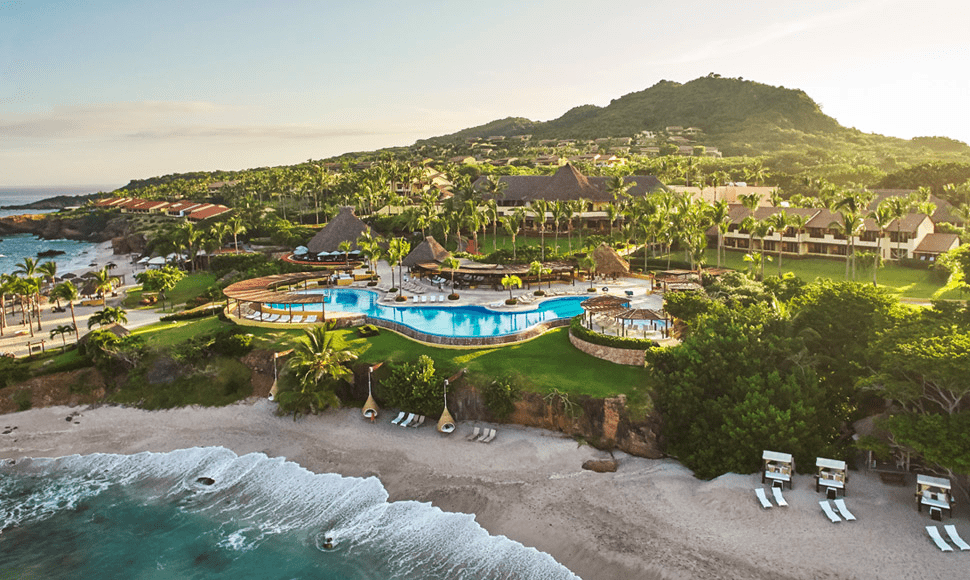
Four Seasons Punta Mita, pool overlooking the beach

With the combination of 53,973 sq. ft. of event space, and the choice between beach, lazy river or pool, this Four Seasons Resort is the ideal place to relax while listening to the nearby sounds of the pacific ocean. Enjoy the kaleidoscope shades of blue from the infinity pool to the clear skies and the ocean view. 

 8. 1 Hotel Brooklyn Bridge


More and more hotels are adding rooftop bars and pools, citing the picturesque views and photos that come atop a skyscraper. The 1 Hotel Brooklyn Bridge is no exception and features a rooftop pool with views of the Manhattan skyline. A picture for this is all about the angle, so make sure to get the enchanting background into the photo. Anyone scrolling past will have no choice but to double-tap.

Read More: 7 Hotel Rooftops with More Than a Superb View

9. Enchantment Resort 


Plan your next meeting at the Enchantment Resort and enjoy the natural beauty of the Sedona area combined with the amenities the resort offers. The pool is surrounded with a backdrop of the Boynton Canyon’s famous red rock walls, which will help you achieve the perfect desert aesthetic for your feed. 

10. Mondrian Los Angeles


Mondrian is known for its SkyBar which is a rooftop pool and social area that can accommodate up to 550 guests. The SkyBar presents incredible views of West Hollywood and the pool is surrounded by ivy and white features. The glamor of Hollywood is on full display and makes for a flawless Instagram picture.

It can be frustrating to try to keep up with all the latest Covid safety measures for the workplace. Many medical experts are warning now about another potential Covid surge, and restrictions that were recently lifted are being reconsidered.

At the same time, many people are tired of dealing with the disruption and would rather believe no further precautionary measures are necessary. But with anywhere from 10% to 30% of those who have had Covid still suffering from long-term problems, employers as a whole generally want to take a careful approach to in-person interaction. 

Many employers saw remote work and virtual events as a short-term answer to the problem of potentially contracting Covid at the start of the pandemic. But going virtual isn’t the long-term plan for many companies. CEOs rightly worry that holding purely virtual events could negatively affect engagement. After all, a quarter of virtual event attendees only watch around 10% of a given session. As a result, nearly one-third of companies intend to hold in-person events going forward. 

The need for, and benefits of, in-person corporate events are clear. Even those who prefer to attend an event virtually often come away realizing that there’s just no replacement for in-person events. Talking to someone face-to-face gives the benefit of being able to observe their non-verbal interaction, plus it makes networking a whole lot easier when you can just walk around and find people to talk to rather than being stuck behind a computer screen. 

What creative strategies can corporate event planners and HR professionals use to maximize engagement and bring back in-person attendance safely? 

A Time of Transition

While Covid seemed to be in a steady decline in a few key geographic areas, other areas are now seeing an increase once again. Some areas are dropping mask mandates and travel restrictions, while others are reinstating them. Especially in this doubtful time of transition, protecting employees, or representatives from other companies who visit your events in person, isn’t always easy or straightforward. Medical experts worry about the potential consequences of in-person attendance, and many employees question whether they can actually be safe while attending in-person events. 

For example, you may have heard about the recent event at the Sunset Towers in Los Angeles. Guests went all out to celebrate, and for the most part they didn’t worry about social distancing or masks. Around 25 people who attended the event have already tested positive for the virus, and as a result it’s being called a super-spreader event. The event stands as a reminder to businesses that there’s still risk in bringing people together without the cautionary measures recommended by the CDC. 

The main reason a super-spreader event happens has to do with how transmissible the latest Covid variants are. For example, the BA.2 omicron subvariant is up to 80% more transmissible than earlier variants of omicron. It spreads fast, and that’s why a single corporate event can result in hundreds of cases of Covid over time as attendees inadvertently bring the virus back to their families and friends. And now the BA.5 variant is even more aggressive.

Protecting In-person Attendees

businessman working on a laptop sequestered in a glass box

If the latest Omicron variants are so transmissible, how are you supposed to protect your employees and guests at corporate events? Some measures, like requiring masks and avoiding Covid hotspots, are fairly obvious. But others require additional planning and consideration. 

For example, some event organizers have chosen to require proof of vaccination from attendees. But merely knowing that someone has been vaccinated doesn’t mean they’re free and clear. What really matters is how recently they’ve been vaccinated. The CDC has made it plain that the vaccinations no longer protect individuals after the first six months, which is why they recommend booster shots

Imagine requiring proof of vaccination before an event, only to see a large portion of your employees or guests test positive shortly thereafter. It’s an unpleasant prospect. That’s why you should make sure to ask not only whether your employees have been vaccinated but also when they received their latest vaccination or booster. 

Read more about protecting attendees at events.

Another consideration is ensuring good ventilation and air quality in an indoor event environment. You should open windows, run the air conditioner continuously with fresh filters and consider using a portable air-filtration system. For example, high-efficiency particulate air (HEPA) filters can potentially provide medical-grade air filtration at an indoor event. 

You can also consider planning for point-of-care (POC) testing with new, best-in-class, and highly accurate, microfluidics testing or rapid PCR tests, which can return results in under 12 and 30 minutes. These new technologies and protocols are now affordable and effective.

By testing attendees the afternoon prior to, and on the mornings of events, and admitting those with negative results, your team is now ready to go back to holding safe events. Unfortunately, traditional home and lateral-flow antigen testing are not accurate enough to be effective at corporate events unless they are used both serially for multiple days in advance of, and at, the event.

What If? 

Now suppose you’ve taken every precaution and you test attendees right before or during an event, and unfortunately someone still tests positive. What should you do?

As long as Covid is still with us, event planners may also consider a contingency plan to allow hybrid attendance, allowing those who are uncomfortable or unable to attend because of Covid to attend virtually. So if someone does test positive, they can remain quarantined in their hotel rooms and still get the benefits of your event, at least to some extent. 

In the evolving age of Covid, it is now far easier to radically improve the safety at live events. And by taking precautionary measures you get to regain all of the advantages of in-person events including productivity, innovation, collaboration and community – while helping make sure your events don’t end up being super-spreaders. This will help you reap the benefits of in-person attendance while still keeping employees and guests safe. 

Martin Hahn, M.D., P.C. is the chief medical officer and lab director at AllClear Healthcare, a provider of mobile Covid-19 monitoring and management solutions for corporate events and other social settings. 

Do you sometimes wish you could book the most reasonably priced rental car by clicking a few buttons on your phone? The travel management company CWT just added car rental and train booking to their app and website to give travelers more independence in making their reservations at a time when travel costs are reaching historic highs. 

“This means ensuring that travelers get the same content and experience no matter how they engage with CWT,” John Pelant, executive vice president and chief technology officer with the company, said in a press release. 

This new feature is one outcome of a $100-million investment CWT made earlier this year to improve the myCWT travel management platform. CWT already had travel counselors available 24/7 to help travelers with car and train bookings. Now travelers can manage reservations themselves, while utilizing the tools and resources available through the app and website. 

Using my CWT to Combat Travel Inflation

Screenshot of CWT app with 4 sections: flights, trains, hotels, car rental s

These DIY updates come as the world is still healing from the pandemic, and prices on rental cars, flights and gas are climbing fast. The U.S. Bureau of Labor Statistics reports that transportation prices are 36.14% higher in 2022 than they were in 2016. 

The rental car supply issue dates back to the early days of the pandemic. Hertz, one of the leading rental car companies, sold nearly half of its stock to repay creditors, and is having a tough time meeting the sudden spike in demand as a computer chip shortage is slowing down the manufacturing of new cars. Resulting higher prices affect attendance at events as people and businesses have less disposable income available to travel.

One feature of myCWT is access to each client company’s corporate negotiated rates and preferred suppliers. CWT will also highlight electric and hybrid car options on its app and website to promote sustainable choices. The launch of this feature comes on the heels of Hertz making a $4.2 billion deal with Tesla to purchase 200,000 electric cars from the manufacturer by the end of 2022. 

Read More: Tracking Your Group’s Carbon Footprint Now a Reality

Rail Alternatives

Train crossing bridge on a mountain

Frustrated by the overwhelmingly high price of travel, more people are turning to trains for transportation. Not only are trains the most eco-friendly way to travel apart from bicycling and walking, but they bypass the hassle of the airport and boast the scenery of a ground-level trip. 

Read MoreRide the Rails on 7 Scenic Trains

CWT is expanding its partnership with Traline Partner Solutions, a business-to-business company helping connect people to trains throughout the UK and Europe. The deal will enable CWT to offer train booking through its app and website. “By cutting through the complexity in this way, more business travelers will get access to the rail content they want and will be able to choose a more sustainable way to travel,” Liz Emott, global distribution director for Trainline Partner Solutions, said in a press release. Train travel is especially popular in Europe and the UK as nearly every city has a station. 

Diversity, sustainability and violent crime were on the agenda for Destinations International Annual Convention 2022 in Toronto, Canada, this week along with a host of other social issues destination marketing organizations are taking on as they emerge from Covid empowered to address a larger mission of getting heads in beds.

More than 1,300 representatives from convention and visitors bureaus (CVBs) across North America and the world (600 of them first-time attendees) started arriving last week to take classes on everything from budgets and economic development to marketing and leadership as part of their Certified Destination Management Executive (CDME) training.

Much Respect

“We are at a significant time in the travel industry where we need to authentically reconnect with people and respect the places we choose to visit,” President and CEO of Destinations International Don Welsh said.

The opening ceremonies paid respect with words and dance to the native and First Nations ancestors of the Western Canadian land beneath Metro Toronto Convention Centre.

This year’s popular Global All-Stars presentation looked at programs in three destinations—Los Angeles, the Netherlands and West Virginia—that considered the needs of locals when building creative programs to appeal to post-Covid visitors. West Virginia Department of Tourism Secretary Chelsea Ruby shared success stories from a targeted message to remote workers looking for an affordable, outdoorsy lifestyle.

Los Angeles Tourism & Convention Board President and CEO Adam Burke shared his vision for a city that works for everyone and Group NAO CEO Signe Jungersted outlined steps being taken around the world that prove creative, intentional tourism management can be a source for good.

Read MoreCalifornia: A Shining Diamond

The action-oriented panels on ripped-from-the-headlines topics were in line with opening keynote speaker Chip Conley’s advice to ride the waves of trends and plant seeds during uncertain times. The founder of Joie de Vivre (now JdV by Hyatt), former Airbnb strategic adviser and now founder of Modern Elder Academy advocated for a sustained curiosity to fuel the hard work of regenerating the meetings industry.

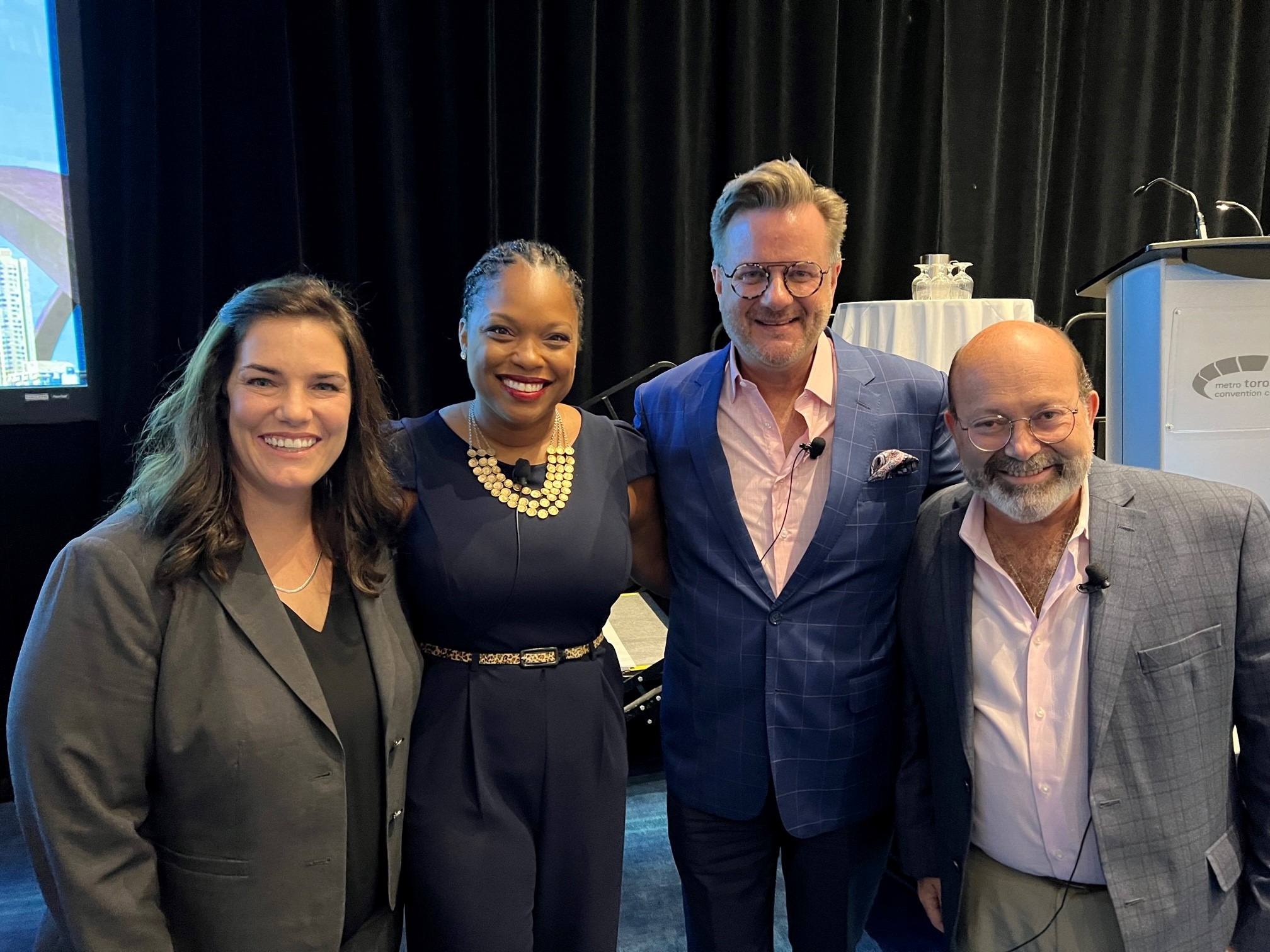
How Travel and the Weaponization of Travel are Impacting the RFP of the Future panel: Kate Kurkjian, senior manager of field and event revenue marketing, RealSelf; Jeanne Procope, vice president of conference operations and strategy, Blavity; Brad Weaber, principal, Brad Weaber Consulting Group

He suggested that destinations and hotels are actually lifestyle curators who help people refresh their identities. “You are where you stay,” he said. Catering to nomad remote workers could be the next wave fueled by sharing aspirational images and having conversations with prospective visitors about living a meaningful life.

That visionary approach was echoed in the closing keynoted from Canadian Men’s National Soccer Team Head Coach John Herdman, who said, “Too many people are too comfortable with being comfortable,” It’s time to do uncomfortable things.

All Included

Don Welsh, president and CEO, Destinations International

Sessions outlined best practices for helping everyone feel welcome at events. A new study from iolite group outlined the power of multicultural marketing to support small, minority-owned businesses and enhance visitor experiences. A new EDI Assessment tool was introduced by Destinations International Chief Diversity Officer Sophia Hyder Hock. It will help destinations create equity, diversity and inclusion goals while tracking progress. “What gets measured gets done,” Welsh said from stage.

Read MoreEastern Canada: Northern Exposure

The conversations in Toronto were not the end of the story. New 2022-2023 Board Chair Al Hutchinson, president and CEO of Visit Baltimore and Vail Ross, senior vice president of sales and marketing at STR and new Chair of the Destinations International Foundation, set some high goals during their installation and immediately delivered on one of them. “As we look forward to the year ahead, it is critical for our industry that we focus on membership engagement, workforce development, post-pandemic marketing support, and diversity, equity and inclusion,” Hutchinson said.

He then announced that Destinations International Foundation Historically Black Colleges & Universities and Hospitality Scholarship has raised $180,000 to attract underrepresented and ethnically diverse students who are seeking a degree in hospitality management or tourism management. “I truly believe that together as an organization, we can make critical and lasting impact on the state of tourism as we tackle some of the most important issues facing our industry,” he said.

A Hospitable Spirit

The pinnacle of the annual event is The Spirit of Hospitality celebration and fundraiser. This year, it took over Stackt Market, Canada’s largest shipping container market with a fun outdoor vibe featuring the Destinations International House Band. Tourism Cares, a group dedicated to ensuring tourism remains a force for good, was named the 2022 Spirit of Hospitality award winner.

“This is a critical time where destinations must balance the interests of their local communities, foster equity, diversity and inclusion principles for there to be true belonging and maintain sustainable tourism practices. The Spirit of Hospitality encompasses not only the welcoming aspect, but one of protecting a sense of place,” CEO of Tourism Cares Greg Takehara said.

Editor’s note: This Week in Travel (TWT) is your essential guide to smoothing the road from here to there for your attendees and yourself.

American Airlines Claims Return to Profitability

In its second-quarter 2022 financial statement, American Airlines reported a historic return to profit, based on a second-quarter net income of $476 million and second-quarter revenue of $13.4 billion, representing a 12.2% increase over the same period in 2019, despite flying with what American says was 8.5% less capacity.

“We are very pleased to report a quarterly profit, excluding net special items, for the first time since the start of the pandemic, driven by the strong demand environment and the hard work of our team,” said American’s CEO Robert Isom on the call to the media and public.

“The American Airlines team has stepped up to meet the surge in demand for air travel while running a reliable operation in very challenging conditions. We are encouraged by the trends we’re seeing across the business, and we remain well-positioned for the continued recovery.”

In a release after the call, American said it flew a schedule more than 25% larger than its closest competitor as measured by total departures (Delta and United are among the airlines’ top competition in the United States, although American did not specify which competitor they were citing). The airline said they (along with regional partners) operated over 500,000 flights in the reported quarter, an 8% increase over the same period last year, with an average load factor of 87%, 10 points higher than the second quarter in 2021.

The airline also reported that “despite a challenging operating environment in June, American’s on-time departure rate, on-time arrival rate and completion factor for the second quarter of 2022 were each improved versus the second quarter of 2019.” They expect to average more than 5,400 daily departures for the rest of the summer.

Read MoreTWT: Airlines Get ‘Berned,’ Biz Travel Stats Spike

Also in the report: domestic leisure travel remains strong and surpassed 2019 levels. American also saw revenue in corporate and government sales rise. Demand for international travel improved steadily and the company expects this will continue as more Covid testing requirements are dropped around the world.

Cancel Culture

image of various items on blue background: a figurine airplane, brown fedora hat, sunglasses, two passports with boarding passes in them, and a smartphone

American’s return to profitability comes as travelers across the U.S. are reeling from flight cancellations and rescheduling’s that the airline industry claims are not to be solely laid at the feet of management.

Nicholas Calio, chairman and CEO of Airlines for America, has said in an open letter to the Department of Transportation: “The industry is actively and nimbly doing everything possible to create a positive customer experience since it is in an airline’s inherent interest to keep customers happy, so they return for future business.

“However, not every air traffic variable is within an airline’s control. For instance, one of our A4A member carriers estimate that air traffic control (ATC)-related issues were a factor in at least one-third of recent cancellations.

In many instances, the weather requires the Federal Aviation Administration (FAA) to institute Ground Delay Programs (GDP) or other traffic management initiatives that slow the ATC system for many hours. However, we have also observed that FAA ATC staffing challenges have led to traffic restrictions under blue sky conditions.”

Read MoreWhat Happens When Fear Majeure Is Used to Postpone or Cancel an Event?

Bottom line for meeting and travel planners: Profits are not the same as performance. Continue to monitor participants’ air arrangements closely as experts do not think delays and cancellations will be a thing of the past even into the autumn and winter months.

United and Supersonic

United has announced a commercial agreement with the Denver-based aerospace company Boom Supersonic which will see the airline buying 15 of Boom’s “Overture” airliners with an option for an additional 35 aircraft. United and Boom said in releases that they would work together on meeting safety, operating and sustainability requirements before delivery.

Boom says, “once operational, Overture is expected to be the first large commercial aircraft to be net-zero carbon from day one, optimized to run on 100% sustainable aviation fuel (SAF).”

The aircraft is capable of flying at speeds of Mach 1.7, twice the speed of today’s commercial aircraft. Boom says potential routes for United are Newark to London in 3.5 hours, Newark to Frankfurt in four hours and San Francisco to Tokyo in six hours.

Going “Boom”

It’s notable that all these routes are primarily over water. The supersonic aviation industry has been criticized by the International Council on Clean Transportation as creating “severe environmental and health impacts” by 2035 due to landing and take-off noise along with the eponymous “boom,” as well as carbon dioxide emissions.

ICCT’s Dan Rutherford, the lead author of the study, said: “Current supersonic sales targets, paired with ongoing efforts to lift overland flight bans, imply severe environmental consequences.

“Manufacturers should commit to meeting existing standards for new subsonic jets and promise to adopt low boom technologies before further developing their aircraft.”