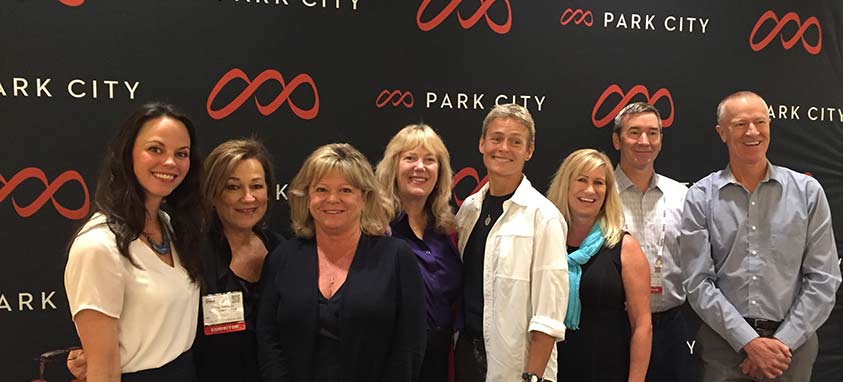
park-city-cvb-IMEX-15The Park City Chamber of Commerce/Convention & Visitors Bureau and its partners sure know how to get the party started. On Monday morning as Smart Monday was beginning and IMEX was coming to life at Sands Expo and Convention Center in Las Vegas, the CVB from Utah kicked off the forward thinking with a breakfast that featured adventurer/speaker Chris Heeter.

Heeter, a wilderness and dogsled guide, delivered the exact kind of message that will no doubt prompt meetings planners to think outside the box during IMEX. Parlaying Park City’s vast outdoor offerings, Heeter encouraged attendees to “hold wild meetings.”

“When we dare to be wild, it’s contagious,” Heeter said. “Have the courage of bringing all of what you have to all of what you do.”

Heeter possesses a unique perspective through training dogs for sledding, guiding trips for novices and speaking about it. There are more commonalities with dogsledding and meetings than one could imagine: Picking the right lead dogs; building a team; taking advantage of every dog’s strength, even the lazy ones.

Stressing the importance of making meetings wild, Heeter asked attendees to feel in the blank. When you’re feeling wild, you feel _____:

1. Authentic
2. Excited
3. Crazy
4. Energized
5. Adventurous
6. Outside the box
7. Rebellious
8. Industrious
9. Enthusiastic
10. Passionate

This dynamic exchange certainly served as a foundation for the rest of the week. Who doesn’t want passionate and authentic experiences for attendees?

“Don’t stifle wild energy,” Heeter said. “Harness it.”

Give Park City credit for creating a thought-provoking vibe on the opening morning of IMEX’s Smart Monday. In addition to the chamber of commerce/CVB other partners of the breakfast included Deer Valley Resort, Stein Eriksen Lodge Deer Valley, Hyatt Escala Lodge, Westgate Park City, Hotel Park City and Canyons Village.

Park City is now offering travel stipends for planners considering holding a meeting in this outdoor haven 30 minutes from Salt Lake City. For further information on Park City meetings, contact Carolyn Creek-McCallister, senior national sales manager, at [email protected] or visit parkcitymeetings.com.

And for those attending IMEX this year, stop by booth #515 to hear more about Park City. They promise you’ll have a wild time.

For more on #IMEX15 be sure to check out our daily updates.

Education program to encourage innovation and creativity

Deep dives, one-to-one sessions and hot topic tables will be among the education offerings for meetings and events professionals—both buyers and exhibitors—at all levels at IMEX America 2019. The highly varied program will include 180 education events that encourage participants to think afresh about how to make meetings more engaging by embracing new ways of thinking, considering the big issues, and exploring innovation and creativity.

“We recommend that attendees step away from their comfort zone and attend an education session that’s different from what they’re used to,” says Carina Bauer, CEO of IMEX Group. “All learning opportunities are free of charge and take place on the show floor, so there’s no excuse not to experiment a little.”

The education offerings will blend with the show’s Talking Point—Imagination.

“Overall, we’ll be focusing on three key areas under the overall theme of Imagination—Diversity, Sustainability and Collaboration. Throughout the show and through the educational program, you’ll see a number of sessions that invite the industry to think about these issues more broadly and imaginatively,” Bauer says.

Smart Monday

The education offerings take center-stage on Smart Monday on Sept. 9, the day before the trade-show begins. It provides an opportunity for attendees to immerse themselves in a full day of education and networking. Most of the education sessions are aligned to the CMP International Standards and are eligible for clock hours.
“We know it’s hard for event professionals to find time for professional development, so we wanted to create a dedicated day for education and a strong start to the show,” Bauer says. “Smart Monday, powered by MPI, gives us the opportunity to offer tailored and more in-depth content for industry professionals before the trade show has started. We’re able to use different spaces, immersive educational experiences, as well as certification and deep-dive sessions.”

Artist and TED Talk speaker Phil Hansen will speak on “Embrace the Shake: Transforming Limitations into Opportunities,” the first of three keynotes during IMEX America 2019.

Another highlight of Smart Monday will be the presentation, “Unleash Your Imagination—How to Ask, ‘What If’” by EventMB, an online resource for event professionals. The session will detail how to apply creativity without a limitless budget and provide planners with questions they need to ask to trigger inspiration.
The EventMB team will also deliver its popular Event Innovation Lab—an immersive training workshop on event planning that uses practical examples from the most successful conferences, trade shows and activations to show planners how to inject innovation into their events.

Also, diversity expert and stand-up comedian Jessica Pettitt will deliver an MPI session, “Inclusion: Beyond the Law for Meeting Professionals,” which will hone in on the importance of inclusivity, emphasizing how planners can make attendees feel safe and welcome at meetings and events. Pettitt will outline the tools, resources and spaces needed to encourage collaboration and foster the all-important sense of belonging.

Top Offerings for Senior Professionals

Two Smart Monday programs designed for the most senior association and corporate planners will provide them with a valuable—and often rare—chance to share best practices and experiences.

Association Leadership Forum, created by ASAE: The Center for Association Leadership, is a program for association CEOs and directors to engage thought leaders through strategic conversations and collaborative peer learning. The connections will continue at Association Evening, when they will enjoy cocktails and canapes with other association leaders and key exhibitors to celebrate the start of IMEX America.

Corporate meeting planners will discuss best-in-class meetings and events practices as well as innovations at Executive Meeting Forum. Senior planners can suggest their preferred topics for discussion—including procurement, stakeholder management and meeting design.

While the Smart Monday offerings have been very successful, Bauer says that participants are confused about one thing, in particular.

“They can’t understand why—or how—we offer our education program for free,” she says. “It’s virtually unheard of in North America. This comes down to our IMEX company values. We’re here to serve, support and advocate for the industry we love, and we benefit from having many partners, suppliers and individuals who feel the same way.

“Being a private company also means we’re free to try new things, do things our own way and not be driven only by shareholder value. So, yes, we want everyone to understand that IMEX is free for visitors to attend and our education is also free to all.”

On Tuesday, Sept. 10, the education program moves to the show floor, with shorter sessions that attendees can fit in between appointments.

Addressing the Industry’s Needs

Bauer emphasizes that there is an underlying unity among the IMEX America education components.

“What is consistent throughout all the educational offerings is that we ensure that there is best-in-class content for all levels of professional, as well as for all sectors of the industry—from association to corporate planners and from agencies to incentive travel professionals,” she says. “This allows attendees and exhibitors to tailor their education sessions to suit their professional and personal needs.

“Attendees can search our education program online and refine by topic—we offer 10 tracks, including business skills, creative learning, research and trends, sustainability, and health and well-being.”

She says that over the years, the content of education has changed to address the needs of the meetings industry.

“Our education program evolves year-on-year in line with changes and developments in the industry,” Bauer says. “Our team is in regular contact with event professionals from around the world, which helps us to keep a finger on the pulse of what’s affecting their professional lives. We know it’s hard for planners to step away from the office, so we work hard to ensure the learning opportunities at the show are relevant, timely and impactful.”

New Discovery Zone Adds Zip

The always-enticing technology offerings at IMEX America will get a big boost this year with the introduction of the lively Discovery Zone.

“It will be one space to watch in terms of our tech features,” says Carina Bauer, CEO of IMEX Group. “Planners can get hands-on with interactive, experiential technology, such as VR and AR. This new area of the show floor will deliver concepts, acts and ideas that can pump more imagination, connectivity and memorability into any event. It aims to create a space to both discover and play with some of the newest tech products available.”

Bauer says that although the Discovery Zone offerings at IMEX America 2019 can’t be disclosed yet, those featured at Discovery Zone at IMEX in Frankfurt May 21–23 offer some hints.

“Our new Discovery Zone in Frankfurt included experiential and immersive activities such as Hyatt’s extremely popular meditation pod and Painting Partys’ painting sessions, which are great for team bonding—plus they’re fun—as well as technology, including NOX’s dancing robots, holographic presentations and 360ties’ mind-bending photography, which provides depth and texture to photos that really pop,” she says.

Bauer emphasizes that rather than simply display these products in the Discovery Zone, IMEX America also helps meeting planners understand how they could fit into their events. This is also true of the Tech Pavilion, which will again include event management software company Cvent, event apps EventMobi and EvenTri, as well as Sciensio, offering artificial intelligence chatbot technology. Plenty of other companies will participate, including The Meeting Pool, which will again provide planners with opportunities to troubleshoot tech challenges and discover new solutions.

New exhibitors will include wearable technology platform Klik, networking software company Brella and remote interpretive service provider InterpreNet.

Also, Six Star Experiences—which brought Sophie, the world’s most advanced robot—to Smart Monday at IMEX America 2018, will back be this year. The group has developed the Six Star Innovation & Experience Lab, which attendees can pop into anytime throughout the day.

Shout-Outs for IMEX America 2018’s Tech Offerings

Several participants at IMEX America 2018 lauded the opportunities it provided to feature and explore tech offerings.

“Being at IMEX not only allows us to demonstrate our products and services face to face, but also helps to build long-term relationships and trust,” said David Bradfield, vice president of client success of tech exhibitor Expo Logic. “The interest in face recognition will only continue to grow as people become more and more comfortable with it.”

Sandy Hammer, co-founder of event-planning platform AllSeated, showed planners how virtual reality can boost sales and deliver a marketing edge in her presentation, “Virtual reality: An Accessible Game-Changer in the Event Industry.”

“VR will have an effect across the whole of our industry,” she said. “This innovative technology helps planners to tell the story of their venue or destination, showing the scale and space. VR really brings your offering to life and will help you win business—no question about it!”

Serena Wedlake, national account manager at Access Destination Services, enjoyed one of the daily event-tech tours, designed to give planners an overview of many innovations.

“It’s important for me to keep up to date with the latest tech so I can offer something new and relevant to my clients,” she said.
Worried about how safe it will be to check into a hotel in the age of COVID-19? Marriott International wants you to breathe easier. The world’s biggest hotel company is rolling out a “multi-pronged platform to elevate its cleanliness standards and hospitality norms and behaviors to meet the new health and safety challenges presented by the current pandemic environment.”

“We are living in a new age, with COVID-19 front and center for our guests and our associates,” said Arne Sorenson, Marriott’s president and CEO. “We want our guests to understand what we are doing today and planning for in the near future in the areas of cleanliness, hygiene and social distancing so that when they walk through the doors of one of our hotels, they know our commitment to their health and safety is our priority.”

A Global Cleanliness Council

A new Marriott Global Cleanliness Council will focus on developing “the next level of global hospitality cleanliness standards, norms and behaviors that are designed to minimize risk and enhance safety” for hotel guests and staff.

The council will seek input from in-house and outside experts, including senior Marriott leaders in charge of housekeeping, engineering, food safety, occupational health and associate well-being. Advisory members include a scientist from a corporate provider of water, hygiene and infection prevention solutions; an infectious disease specialist; a hospitality school leader; and a professor of food microbiology.

Enhanced Technology

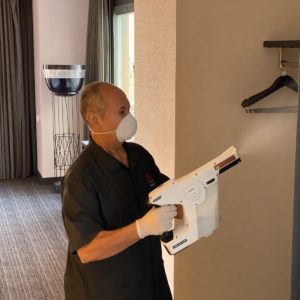
covid-19Marriott is also rolling out use of electrostatic sprayers with hospital-grade disinfectant to sanitize surfaces throughout its hotels. The technology uses the highest classification of disinfectants recommended by the Centers for Disease Control and Prevention and World Health Organization to treat known pathogens.
The sprayers are said to rapidly clean and disinfect and can be used in guest rooms, lobbies, gyms and other public areas. In addition, the company is testing ultraviolet light technology for sanitizing keys for guests and devices shared by associates.

Cleanliness Plus

Marriott says its enhanced cleaning regimen will include:

  • Surface Areas: Public areas will be treated with hospital-grade disinfectants, with cleaning done more frequently. In guest rooms, all surfaces will also be cleaned with hospital-grade disinfectants. Marriott will also be placing disinfecting wipes in each room for guests’ personal use.
  • Guest Contact: To help alleviate risk of person-to-person transmission of the virus, the company will be using signage in its lobbies to remind guests to maintain social distancing, and it will remove or rearrange furniture to allow more space for distancing. Marriott is also evaluating adding partitions at front desks to provide an extra level of precaution for guests and staff, and it will supply staff with masks and gloves. The company is installing more hand sanitizing stations at the entrances to its hotels, near the front desk, elevator banks and fitness and meeting spaces. At over 3,200 of Marriott’s hotels, guests can choose to use their phones to check in, access their rooms, make special requests and order room service that will be specially packaged and delivered without contact.
  • Food Safety: Enhanced food safety guidelines and training videos for staff will feature hygiene and disinfecting practices. In addition, the company is modifying its operational practices for in-room dining and designing new approaches to buffets.

“We want our guests to know that we are doing everything we can to welcome them back to a safe and clean hotel environment when they start traveling again,” said Ray Bennett, chief global officer for Marriott Global Operations, who is heading up the new Marriott Global Cleanliness Council.

Wynn Calls for Nevada Reopen, Followed by the Strip

Matt Maddox, CEO of Wynn Resorts Ltd., is calling a reopening of Nevada’s economy, beginning in early May, followed by the Las Vegas Strip in the middle or late May.

In an op-ed, accompanied by a 23-page proposal stating how it’s managing to keep its property clean and safe, Maddox stated, “I understand that if we incrementally reopen we might have to pull back if a spike in cases occurs that jeopardizes our health care system capacity. However, the only way to cross this river is one stone at a time, and we need to put our feet in the water before it is too late.”

Safeguards that were proposed include:

• Reopening with reduced occupancy, physical distancing measures, temperature checks and no large gatherings
• The need to wear masks
• An increase in coronavirus tests in the state
• Ensure hospitalizations and deaths relative to the population aren’t exceeding the national average
• Hospital critical care availability should increase
• Limiting the number of guests in elevators and limos
• Removing guest rooms with presumptive positives from service and quarantined
• Security officers to greet visitors, who will be screened and asked to use hand sanitizer and wear a mask

Wynn was the first casino in Nevada to close its doors amid the coronavirus pandemic and will continue to pay its employees through May 15.

2020 is the year of the Zoom meeting. People are meeting virtually at an astronomical rate, and as long as “shelter in place” orders remain, this is likely to remain the norm for some time.

Making video conferencing work is not a slam dunk, however. It takes much more effort to keep people engaged. Here are tips for making your next Zoom meeting the best one yet.

Get Everyone Excited

Judi Holler, event speaker and author, suggests several ways to spur motivation and excitement during a video call. “Have music playing with the video off when they arrive. Then come in and dance it out. Start with music and movement,” Holler says, who then adds, “And dress like you mean it!”

People tend to let their minds wander when the information presented is chock-full of data and bullet points. Instead, Holler recommends using images and elements of storytelling, as well as other forms of communication and gamification.

“Use the chat box, run a contest. Give away something,” she says. “Ask them where they are calling in from. Ask them to share emoji that fit their mood.” She recommends doing a dress rehearsal to learn the Zoom platform. “You will feel more comfortable and brave.”

Nourish Your Attendees

There’s been an overwhelming surge in demand for food-delivery services for households, and so it’s no surprise demand for workplace-based food service has also spiked.

Nybll, a health-focused catering company, recently launched Nybll Connect, an at-home catering option for work-from-home meetings and conferences. While it typically serves food to the meeting rooms of companies, Nybll Connect is now delivering plant-based food options to people’s homes so those in virtual conversations can dine together.

With more than 4 million meals served, Nybll Connect makes virtual meetings feel more connected through healthy food. The company currently offers three packages, based on the length of the meeting: Connect, Align and Collaborate.

You can also customize an order for your group. Gifts can be tucked in with packaged meals, including a “quarantini” shirt, a seasonal fruit basket, a branded cookie, a jump rope and a stress ball.

Make it Engaging

Kim Marshall, host of Global Wellness Summit Podcast and cofounder of S’Well Public Relations, suggests more ways to increase engagement during video meetings. Chief among these are making sure the message is clear and using tools that stimulate the senses.

She also suggests using a moderator. “[This] doesn’t mean the moderator is the boss of the meeting,” she says. “Instead, they act as a respectful, objective ‘control tower’ who watches the time and agenda, moves things forward—if participants start going in circles—and spots unresolved issues, rephrases questions, smoothly segues from one agenda item to the next and confirms action items and their owners.”

If you don’t use a moderator, try something more sensory-oriented. Marshall likes live music, live scribing, and mindfulness or movement breaks. “Science shows this will help enhance engagement, support clear-headed thinking and thus result in more effective teamwork and better decision-making for both virtual and in-person meetings,” she says.

As COVID-19 wanes and people begin meeting again, what should planners know about precautions venues must take to ensure clean, safe spaces? With many convention centers serving as temporary field hospitals, what disinfection standards should planners insist on?

Kenneth Bickerton is vice president of industrial hygiene and safety for Phase Associates LLC, a New Jersey-based consultancy for environmental, occupational health and safety challenges. He offered insight into how venues can make sure their spaces are ready for meetings.

What is the Cleaning and Disinfection Process?

Bickerton identified three levels of potential concern:

  • Class 1: No one in the venue has been infected with COVID-19, and no one who has visited has been exposed to anyone who is ill.
  • Class 2: Someone in the venue has had recent contact with an infected person.
  • Class 3: An infected person has recently been in the building.

Class 1 requires only typical cleaning procedures, but for added protection, high-touch surfaces should receive special attention. In the event of Class 2 or 3, the protocol is to pinpoint exactly where the infected person(s) might have been in the venue, so those areas can be flagged for stepped-up cleaning and disinfection.

Disinfecting requires an EPA-approved product. Although it is not coronavirus specific, the most commonly used disinfectant has been used on SARS and MERZ viruses in the past.

“Surfaces need to be wet with that agent for a specific amount of time for it to fully disinfect. That could run from a minute to several minutes,” Bickerton said.

The procedure for cleaning electronics is different in that damage can occur if the wrong agents are used. The CDC suggests using ethanol- or isopropyl-based alcohol with a concentration of more than 70 percent. Diluted bleach is also an option, but it must be used immediately, as it loses effectiveness with exposure to air.

What Does Disinfection Entail?

Each class requires a different level of cleaning and disinfection. The higher the class, the more protective measures are needed.

  • Class 1: Clean all high-touch surfaces while wearing an N95 mask and disposable gloves.
  • Class 2: Clean all high-touch surfaces and areas where an infected person(s) had recently been, while wearing an N95 mask, coveralls, booties and two pairs of disposable gloves; decontaminate any tools used (e.g., buckets, mops, brooms).
  • Class 3: Same as Class 2, plus open windows and doors for 24 hours, if possible.

See alsoHow to Protect Your Attendees from Coronavirus

For Class 1 cases, Bickerton says an in-house janitorial crew will suffice. In Class 2 and 3 cases, where the chances of contracting the virus are much higher, Bickerton recommends a professional experienced in bioremediation and the elimination of biohazards, such as bloodborne and coronavirus-specific pathogens.

An important point to remember: Even the coronavirus does not live forever. If it’s been more than seven days since the person who was infected visited the facility, Bickerton says Class 2 or 3 cleaning and disinfection is not necessary.

How Should Planners Prepare?

Asking the right questions is the key to reassuring yourself and attendees that venues are taking the appropriate measures to provide a clean and safe meeting space.

MoreKeep Calm and Plan On: How to Prepare for a Post-pandemic World

“For instance, what practices, based on local and federal guidance around cleanliness, has the venue put in place?” asks Tina McLaughlin, CMP, senior director of operations for American Express Meetings & Events. “Is the venue practicing deep cleaning of rooms and public spaces? What is their approach to food and beverage accommodations? Will they be offering less populated dining spaces? Will they be offering plated or buffet meals? These are all very important considerations that impact the safety and health of event attendees.

“As resilient as our industry is, we do need to be prepared for a number of new meetings options and configurations borne from this pandemic,” she continued. “This includes more virtual and hybrid meetings, small event sizes, and a reconsideration of regional and national meetings.”

Mutual support and optimism was trending during a joint #MeetingsChat Twitter Chat discussion on Thursday moderated by Smart Meetings and Meetings Mean Business. Industry professionals showed the true definition of #HospitalityStrong in 280 characters or less to continue the #GMID20 conversation started on Tuesday. Here are the highlights.

#GivingBack

You’d be hard pressed to find a community within the hospitality industry that hasn’t been impacted by the virus in some form, but organizations are stepping up in creative ways to help. When asked if they are taking action to support communities impacted by COVID-19, the response was a resounding “yes.” Some are putting their diverse skills to use, such as those at Conference Care Package, who have been planting tomatoes to give to those in need.

Others donated unused supplies. “Early on, as events canceled last minute, we donated food and centerpieces to places that could use them. We also donated a ball pit to a local animal shelter to give the fun a second life to a completely new group! #meetingschat,” said Courtney Lohmann, CMP.

NYC & Company said all five of New York’s boroughs are benefiting from “donation of supplies, logistical talent & space by the meeting community.” And the city is giving back.

#KeepTheHopeAlive

A proper resource is vital in times like this, whether it’s being there for clients or looking for resources yourself. Lohmann said she’s been “flipping to virtual for clients’ needs. But then also the team internally and those externally to brainstorm on what we need to do next to help events come back to face-to-face and what it will look like when we do.”

Shannon Byck, CMP, regional director for Meeting Encore and managing partner for Intuitive CE, says her focus is two-fold. “[Our company is] staying educated on pivoting events to virtual for our clients that are shifting to on-line and staying connected with clients and industry partners, as we are all in this together!”

One word has been used repeatedly through this pandemic: unprecedented. The extent of this crisis is beyond what most could have imagined. But the response has been just as emphatic. “You’ve got this,” was echoed in a number of posts. “There is no event scenario or project plan to help anyone navigate through this so it is OK to not have all the answers or know what to do next.  It is important to stay connected and surround yourself with things that are positive,” Byck said.

Those at Chatham County CVB counseled: “try not to get bogged down.”

#AfterTheStorm

The light at the end of the tunnel will reveal a meetings industry that looks much different than before, with an emphasis on safety, food servicing and contract clauses. Byck remains optimistic. “I am hopeful that #recovery will mean that we are back to face-to-face this fall, but only if safe. I think how we meet will change—changes in food service/hybrid events/contract clauses/venues and cleaning parameters…” she tweeted.

Chatham County CVB believes there will be “more in-depth inquiries about behind-the-scenes before booking in regards to cleaning/sanitizing practices. More boxed instead of buffet meals. Closer to home, smaller mtgs. 2021: New and improved practices.”

Editor’s Note: This article was updated on 4/20/2020.

Are you liable if an attendee gets high at your event? Is recreational marijuana legal in your state? Are you perhaps considering offering marijuana products at your next gathering? We’ve updated this article in order to answer your most pressing pot planner questions to date.

The reality is, in 2020, policies around marijuana can no longer be ignored. As many states have legalized it for recreational use, new policies are leading to major change in our country—cannabis dispensaries are even considered essential business during the coronavirus (COVID-19) lockdown. Even in states that haven’t legalized it, marijuana’s growing presence and acceptance among the general public is undeniable. Plus, younger generations are entering the workforce every day, and many of these people have grown up with very accepting attitudes toward marijuana.

So what precautions should planners take? How should strategies vary by state? Chill out while we give you the lowdown on marijuana and meetings.

Be Aware of State-by-State Rules

Despite federal restrictions, each state also has its own policies about marijuana use, and these discrepancies can pose issues. If an attendee is from a state in which marijuana is legal but the event is in one with stricter laws, then the attendee must comply with in-state laws— even for medicinal use. If your event is in a state where it’s completely illegal, then you’re responsible for notifying attendees—especially the out-of-towners.

Attendees coming from states where it’s illegal to states where it is legal need to be informed about specific restrictions. For instance, many venue properties still prohibit indoor or public smoking due to federal laws, so be sure to review the particular rules prior to an event. Other rules that always apply, even for recreational use, are: the minimum age requirement is 21 years old, driving under the influence is illegal and marijuana must be purchased from an authorized dealer.

Much Ado About Edibles

To get around smoking laws, an attendee might indulge in an edible. Each state that permits edibles has its own policy. For example, Alaska and Washington are very particular about edibles. In Alaska, the single serving size is defined as 5 mg of THC and a package sold cannot contain more than 10 servings (or 50 mg). Additionally, public consumption is illegal. In Washington, it’s also illegal to “consume marijuana in view of the public,” and limitations on purchase are as follows: 16 oz. of marijuana-infused edibles in solid form, 72 oz. in liquid form and 7 gm of marijuana concentrates.

It’s also worth noting that edible’s effects vary greatly by individual, which has made it difficult for states to determine proper dosing standards. If someone is surpassing the legal amount at your event, that always warrants the boot. Finally, even if the state allows edibles, you or your venue can still choose to prohibit them. Just make sure you communicate that clearly to attendees before the event.

Are You Liable?

It should be thought of like alcohol. Planners shouldn’t be liable for how intoxicated an attendee gets and what that person chooses do during this time. However, it could easily become a concern if a guest got injured and a lawsuit arose. If your event has on-site security, make sure they are aware of the rules and looking out for attendees who have overindulged. Your policy will also need to be clearly stated and communicated to attendees.

If you decide to offer marijuana, you’re going to need a policy in place. This might sound unusual, but there are actually more and more events using “marijuana concierges,” or onsite services offering trusted and certified marijuana products. They are quickly gaining popularity at social events. Before you decide to provide one of these services, discuss your liability with the vendor. Will attendees be signing a waiver? If so, what are you still responsible for? Prepare similar questions about personal liability before you hire the service.

Refresher on Marijuana Laws by State

The states which are not listed have no broadly recognized laws on the matter.

Marijuana Legalized for Recreational Use

  • Alaska
  • California
  • Colorado
  • Illinois (Recreational sales beginning Jan. 1, 2020)
  • Maine
  • Massachusetts
  • Michigan
  • Nevada
  • Oregon
  • Vermont
  • Washington state
  • Washington, D.C.

Medical Use Legalized

  • Arizona
  • Arkansas
  • Connecticut
  • Delaware
  • Florida
  • Hawaii
  • Louisiana
  • Maryland
  • Minnesota
  • Missouri
  • Montana
  • New Hampshire
  • New Jersey
  • New Mexico
  • New York
  • North Dakota
  • Ohio
  • Oklahoma
  • Pennsylvania
  • Rhode Island
  • Utah
  • West Virginia
  • Wisconsin

Completely Illegal with Penalties and Incarceration

  • Idaho
  • Indiana
  • Kansas
  • South Dakota

The COVID-19 pandemic’s fallout has been felt around the world, but business demands require many organizations continue with as normal of operations as possible.

That often means holding meetings and events to engage your employees, customers and partners. Because of travel restrictions and teams working remotely, many organizations have converted in-person events to live webcasting and video streams as part of their approach to sustain operations and maintain progress.

Based on our data, we anticipate a majority of internal (town halls, sales conferences) and external meetings will at least partially be virtual for at least the next six months. Since the outbreak, we’ve seen a 320 percent increase in demand for virtual events.

Virtual events are a powerful means to interact with audiences in organizations with many benefits, including the ability to host a larger audience than their venue for an in-person event might allow.

As the world shifts to this new approach, some critical lessons remain for businesses taking their events online. To help, here are a few best practices.

1. Be clear and concise

Because people are working from home, they may be juggling various obligations, including educating and caring for their children during work hours. Be clear and concise about expectations—even more so than for an in-person meeting. And, be sure to use video if you can to keep people engaged. It’s highly suggested you pre-record sessions to make sure the content is sharp, relevant and engaging.

2. Be personal

Just like an in-person meeting, success is often the result of a connection between participants. Engage people on a personal level. Don’t limit a virtual meeting to business; host a live virtual happy hour and invite your pets or share a video of your meeting location to increase human interaction and make sure you’re connecting with your audience.

3. Practice makes perfect

For organizations that have never produced a virtual meeting, the process takes more than plugging in a camera and hoping for the best. For example, it requires distributing an agenda, pre-reading materials and expectations in advance of any meeting. Keep in mind there will be a whole audience who’s experiencing this type of communication for the first time. Be sure to test everything in advance to make sure the actual event goes off without a hitch.

4. Stay safe

There has been an ongoing discussion surrounding the potential security concerns of virtual events. Organizations wouldn’t let just anybody attend their sales meeting, and they shouldn’t expect it to happen with an online event. Security concerns can be mitigated with a proven approach, including password-protected access for pre-recorded presentations and live meetings.

5. Make post-event follow-up a priority

Virtual events can provide rich insights that in-person events cannot. After an event wraps, drill down into the analytics to understand engagement levels. Gain even more feedback by conducting a post-event survey immediately after the meeting by prompting users to complete a questionnaire, an approach that will help improve your survey response rate too.

Ultimately, the shift to virtual meetings has been occurring more frequently prior to the pandemic. Many organizations come to the realization that if they haven’t already, streaming video is an effective way to reach large groups quickly, safely and cost-effectively.

Collaboration and productivity is a state of mind, not a physical location.

Mark Roberts serves as PGi’s CMO and is responsible for all marketing operations worldwide. A proven marketing leader, he has more than 25 years of experience in the technology industry building brands, driving demand and transforming high-tech companies.

One-third of all jobs lost in the United States from the coronavirus pandemic have been in the travel industry—an impact that is nine times greater than after the 9/11 attacks. That stunning assessment comes from the latest data compiled for U.S. Travel Association.

According to the analysis, of some 24 million jobs in the U.S. forecast to be lost by the end of April, 8 million are in travel.

The dire statistics were accompanied by a plea for increased federal assistance.

“The CARES Act was a good start, but the data shows there is still extreme and mounting pain in the American travel industry,” said U.S. Travel Association President and CEO Roger Dow. “We’re appealing for fixes, the addition of more relief, faster rules and greater flexibility.”

In particular, Dow appealed for replenishment of the Paycheck Protection Program (PPP), which has been depleted. “The relief program needs to fit the crisis, and we’re still learning the magnitude and intricacies of this particular crisis,” Dow said.

To address other issues with the CARES Act, U.S. Travel has urged Congress to:

  • Expand eligibility for the PPP to DMOs classified as 501(c)(6) nonprofits or “political subdivisions” of their local governments, as well as to small businesses that operate multiple locations (with fewer than 500 employees per location).
  • Appropriate an additional $600 billion for the PPP and extend the coverage period through December 2020. The PPP is currently slated to expire on June 30.
  • Revise the PPP maximum loan calculation to 8x a business’ monthly outlays, and allow it to cover both payroll and nonpayroll expenses. Currently the formula is 2.5x and covers payroll only, not other expenses—which U.S. Travel says is inadequate for immediate needs.

Other data released by U.S. Travel reveals that overall travel spending last week plunged to $2.9 billion—an 85 percent drop since the first week of March and 87 percent lower than the same week in 2019. Ninety percent of travelers surveyed had some type of travel or travel-related activity planned prior to the COVID-19 outbreak, and 80 percent of those either canceled or postponed those plans.

For the last 10 years, every Friday morning, I scroll through my list of academic websites and collate the very best psychological research on face-to-face human interaction. The insights are always fascinating and provide me with the content to speak, train and write on how humans can better connect, interact and communicate with each other. It’s a subject I call Meetology.

However, I come across other insights too.

Invariably I’ll stumble across articles that contain ‘evidence-based self-improvement strategies’ and I’m pleased to share a few of the strategies behavioral science suggests may help you through this unsettling period—especially if you are one of the millions working from home.

1. Dress for success

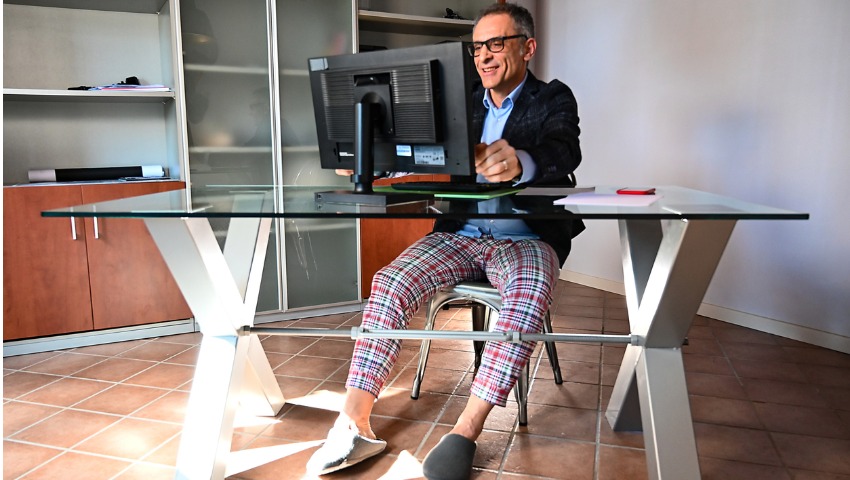
Avoid lounging around in your PJs or overly casual clothing. Research into “enclothed cognition” is fascinating and suggests wearing the same type of clothes that you would in the office could put you in a more productive mindset.

2. Create a (familiar) routine

Create a structure to your day. Get up at the same time you normally would and, if possible, try to replicate your office schedule at home—for example, have your mid-morning coffee and lunch at the same time. Scheduling regular meetings (via video) at the same time as you’d generally have them in the office may prove useful, too.

See also5 Resources for At Home Wellness Routines

3. Create deadlines

Deadlines can serve a positive psychological function when it comes to getting things done. One of them has to do with what psychologists refer to as “goal gradients”—the motivating fact that the nearer you get to completing a task, the greater the proportional impact your effort has on completing the task.

Starting a project can lead to the “Zeigarnik effect” which can aid against procrastination. It links to the human desire to finish something we’ve already begun and explains why when buying a coffee, you often get a card with two or three of the ten stamps already in place that you need to claim your free one. These few stamps drive us to obtain more in order to complete the card, showing that these types of motivations really do work.

4. Design your environment

While not possible for everyone, having a specific room from which to work may help. Research suggests that going through a doorway can trigger memory loss and disassociation with current thoughts. It’s a phenomenon called an “event boundary”—look it up, it is fascinating.

More6 Virtual Meeting Tools to Facilitate Working from Home

5. Switch off

Once finished for the day, avoid logging back on and checking emails later. Now more than ever, you’ll need to be able to mentally switch-off from work. (My dad used to have a sticker of a light-switch in the brief-case which reminded him that when he shut the case and left work, he needed to switch off mentally too.)

6. Exercise

The physical and mental benefits of “regular to you” exercise are huge. Finding time for a walk or run can have a hugely positive impact. With this in mind, I created an #ActiveApril program on Twitter and am also training for the fantastic #imexstillrunning initiative in May.

I hope these prove of use and wish everyone the very best at this difficult time.

Jonathan Bradshaw speaks, trains and writes on Meetology®—the behavioral science powering human interaction. Find him on Twitter: @Meetology.