There I was, like you, in a home office. Just like yesterday and the day before and the day before that and…yes, I was feeling a bit cabin feverish. Longing for the good old days, when I’d hop on a plane to go check out some meetings destination without a care except whether all my carry-on toiletries would make it through TSA. In short, I was missing the FAM.

So, today, I went to Rockford, Illinois. From my home office in California. In my pajamas.

The idea of virtual FAMs has been out there for a few years now, but nearly all have been pre-packaged video tours of destinations, and they’ve been offered in the name of convenience, not necessity. An increasing number of DMOs also offer livestream and video tours of neighborhoods or specific venues on their websites—LA Tourism, for example.

But when Smart Meetings got an invite a few days ago for “Home with the FAM,” a live virtual familiarization visit to Rockford, a city of about 150,000 residents a 1.5-hour drive west of Chicago, the lure of travel and human interaction, even online, seemed…irresistible. I jumped at the chance. Suddenly, Rockford loomed as large in my imagination as Paris (Illinois) or Vienna (Ohio).

Apparently, I was not alone.
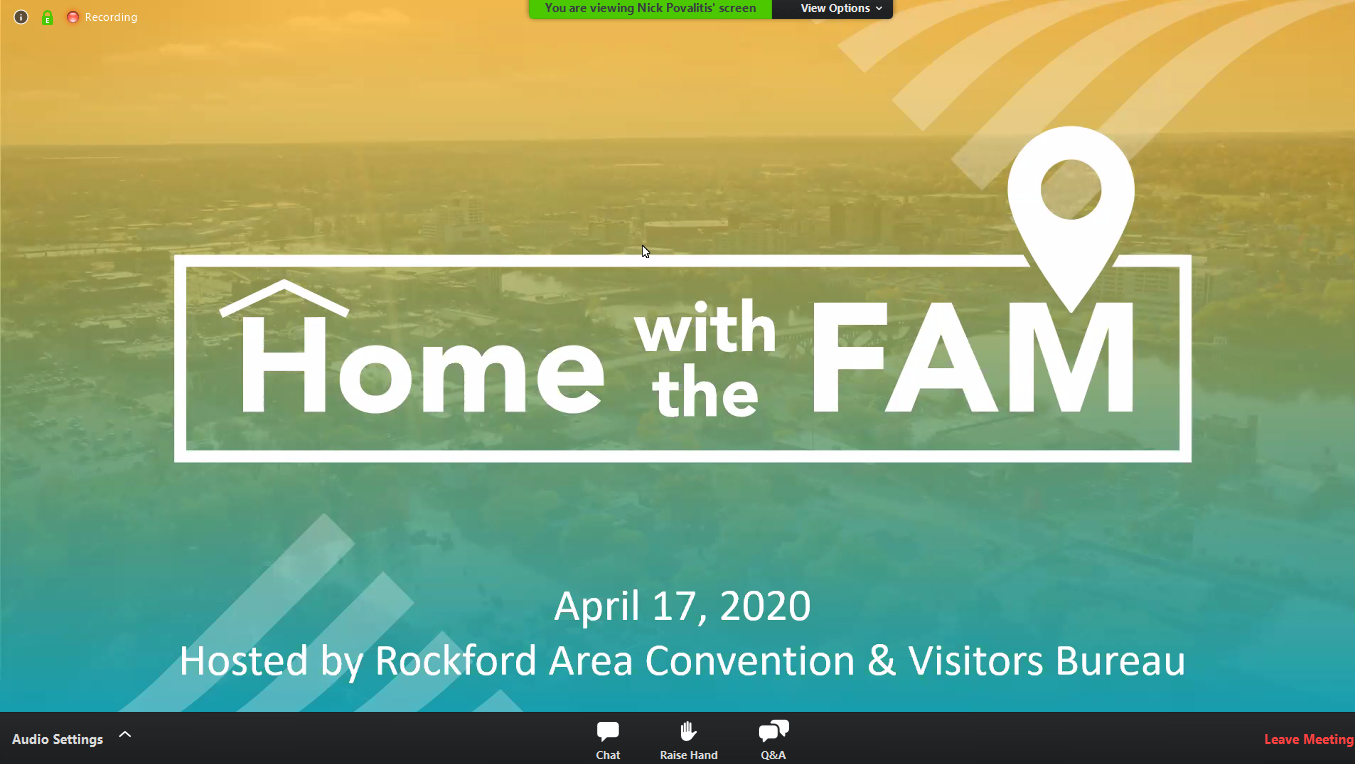
Some 85 people clicked on the Zoom link sent to invitees, one from as far away as Germany. Others tuned in from Los Angeles, the Pacific Northwest, Phoenix, Tennessee, Boston, Florida and Virginia. They were planners, event organizers, meetings media and, significantly, a dozen or so CVBs from elsewhere, presumably checking out how it all went.

“Like all CVBs, all our usual activities have been eliminated for now, so we asked ourselves how could we stay in touch with our customers?” said an obviously pleased Lindsey Arellano, vice president of sales and services for Rockford Area Convention & Visitors Bureau (RACVB), afterwards.

The hour-long “visit” kicked off with a welcome from RACVB CEO John Groh and Rockford Mayor Tom McNamara, who said, “This is a unique way to share all the things that make the city of Rockford a unique place.” Then “site inspections” were led by representatives streaming from several venues, including BMO Harris Bank CenterCoronado Performing Arts Center, sports venues and brand-new Embassy Suites by Hilton Rockford Riverfront and Rockford Conference Center, which plans to open by July 1.
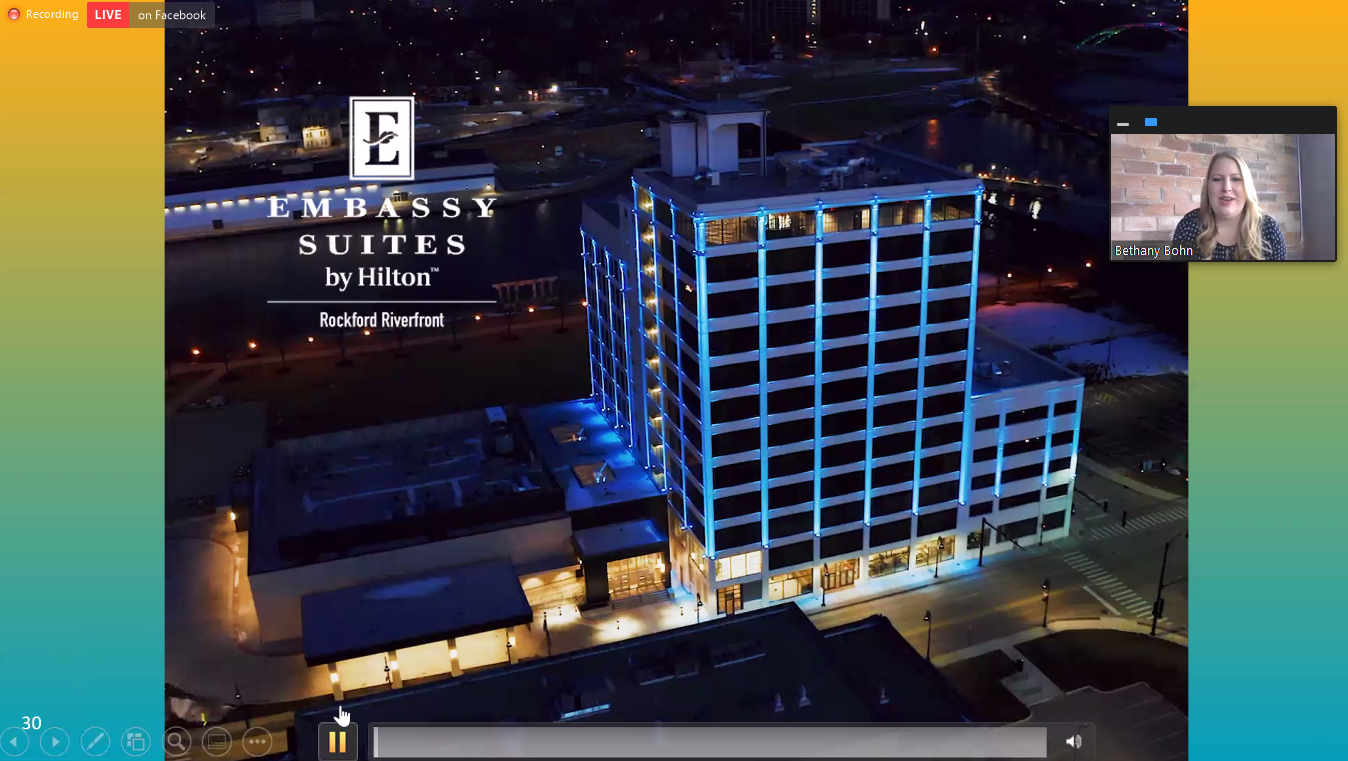
“It was a lot simpler to do than you think,” Arellano said, who added that the production came together in less than two weeks and, not counting staff time, cost $150—for three gift cards for viewers whose names were pulled from a basket at the end of the FAM.

RACVB also offered FAM participants $3 per actualized hotel room overnight as an incentive for new business at any of the featured venues.

I learned a lot about Rockford during my visit. And the way this pandemic is going, I may learn more.

“We’ve already had a call from another Rockford venue, asking how it can be in the next one,” Arellano said. “I think we’ll do one on micro meetings and unique spaces.”

Destinations International Foundation, the global trade association for CVBs and tourism boards, announced its 10th annual 30 Under 30 class. The program is designed to highlight the work of young professionals in the destination and tourism industry.

The program focuses on year-round professional development, which includes interactive webinars and an online community, in which these 30 individuals can share ideas. Through the program, they will have the opportunity to engage in opportunities to progress through 2020 and the years to come.

The 2020 30 under 30 class includes:

“We’re proud to be the founding partner for this program, now in its 10th year,” said Mike Gamble, president and CEO of SearchWide Global. “This year we celebrate these rising stars who one day will lead our industry with the experience of our current challenges. The recipients will bring us just as much insight as we will provide them mentorship and opportunity throughout the year.”

Association for Women in Events (AWE), the group behind the Elevate! Conference at Caesars Palace in Las Vegas in March, is moving from a dues-paying association model to a community model in light of the state of the events industry in the wake of shut downs from COVID-19.

AWE President Marie-Claire Andrews said the mission established five years ago remains the same: to be “a beacon in the events community—a groundbreaking movement designed to elevate and celebrate the role of anyone who identifies as a woman in the events industry.” The group was formed to shed light on disparities, effect the necessary change, have the tough conversations and be fearless to achieve their purpose on behalf of all women in events. “We are very proud of our many achievements fueled by the hard work and tireless commitments of every one of the selfless volunteers who have been integral to AWE’s success.”

Andrews positioned the change as an opportunity to create a new community model to better align with our industry’s new normal. “Many of our members have been laid off, furloughed, terminated or have taken a salary reduction. The loss of live event revenues has financially devastated our partners and sponsors. We believe it would be irresponsible for AWE to hold our community to their financial commitments when the current unprecedented circumstances would not permit us to deliver on their expected AWE’s value proposition,” she said in a letter to members.

Instead, leadership plans to “proactively shift our energies towards our active online community.” Through social media channels, AWE will continue to support women, men and organizations with a vision of an inclusive community that empowers, elevates and advocates for all those who identify as women in the events industry.

AWE will refund membership dues paid after January 1, 2020, pro-rated based on May 1 end-date when the group is eliminating overhead expenses and dissolving the formal infrastructure.

“We hope that once the COVID-19 restrictions are lifted, we will once again be able to meet face-to-face in 2021 and celebrate in new and unexpected ways, just as we did on March 5 this year,” Andrews concluded.

Hamilton Hotel, Washington, D.C.

Located just blocks from the White House and adjacent to Hamilton Hotel is its new luxury event space, The Schuyler, set to open November 2020. Housed in the former Almas Temple masonic building, it was named for the surname of Alexander Hamilton’s wife, Eliza. The 12,000-square-foot luxury venue can handle up to 700 guests, reception style. The elegant hotel offers access to The Schuyler via a downstairs passageway; it also has its own 15,000 sq. ft. of space for gatherings.

Hotel Drover, Ft. Worth, Texas

Slated to open October 2020, this 200-room Marriott Autograph Collection property will celebrate Western spirit, especially the cattle drivers whose rugged industry shaped the plains. Making use of event locations within the hotel and throughout the famed Ft. Worth Stockyards, it will offer 55,000 sq. ft. of indoor, rustic-luxe meeting space. The lobby bar will feature cerulean velvet benching, cowhide armchairs, a bevy of spirited cocktails and elevated southwestern fare from Top Chef winner Jenna Kinard.

The Roundtree Amagansett, New York

An intimate property with just 15 rooms among its historic, renovated cottages, The Roundtree brings country elegance to its guests in its own little slice of the Hamptons. Interior design awash in natural light and soft textures reflects the farmsteading origins of the area. Two acres of landscaped gardens provide event space for 250 guests. Request a chef for a barbecue on the resplendent grounds, arrange for morning yoga sessions or take beach cruisers to the water, where a beach shack awaits, stocked with all your needs.

The Plaza Pioneer Park, El Paso, Texas

This art-deco high-rise in El Paso’s vibrant arts district has been a standout on the skyline since the 1930s. Scheduled to open this year, the hotel will have 7,967 sq. ft. of places to meet, the most impressive of which will be the 2nd-floor ballroom and mezzanine. The revitalized historic space features southwestern motifs, hanging lanterns and expansive windows. Dine with a view spanning two countries at the 17th-floor restaurant, La Perla, where patios and terraces add up to 4,000 sq. ft. of event space.

In not-so-shocking news, a new survey by APCO Insight—the research division of global public affairs consulting company APCO Worldwide—found that 83 percent of Americans working remotely due to coronavirus (COVID-19) say they miss in-person meetings and conventions. With recent estimates from U.S. Travel Association predicting an unprecedented $400 billion decline in the meetings and travel industry, it’s safe to assume the feeling is mutual.

The good news: Most respondents (78 percent) said that they are eager to return to face-to-face meetings and business events once restrictions are lifted and the virus threat is contained.

More: Business Leaders Overwhelmingly Want Live Events Again

This consumer confidence sends a strong message to federal legislators considering ways to bring economic relief to the industry and its 5.9 million workers, said Fred Dixon, president and CEO of NYC & Company and co-chair of the Meetings Mean Business Coalition (MMBC). According to the survey, 49 percent of Americans agreed that convention centers and event venues should be eligible for federal support and funding (compared to 53 percent support for the restaurant industry and 43 percent support for grocery stores).

“Even as meetings are being cancelled and business travel is postponed…our collective experience of physical distancing has us craving the day that we can all come together again and meet in person,” said Trina Camacho-London, MMBC co-chair and vice president of global group sales at Hyatt Hotels Corporation. “That’s a strong indicator of not only consumer intent, but also of our industry’s value to people, businesses and communities.”

Meanwhile the industry has been making headlines for its strong support initiatives for furloughed hospitality workers, healthcare workers and local and global communities during the pandemic.

See also: Destinations Lend Support During Coronavirus Slowdown

The survey, conducted on April 3, 2020, is based off the responses of 1,000 American adults on the social impact of COVID-19. For further details, click here.

Sheltering in place to slow the spread of COVID-19 made coming together to celebrate Global Meetings Industry Day (GMID) 2020 impossible, but meeting professionals got creative. An attempt to break the Guinness World Records title for largest audience for a virtual conference by #GMIDGoesVirtual brought an unofficial 12,500 at peak on Tuesday for a half-hour presentation that included Meetings Mean Business Coalition (MMBC) leadership from the United States, Canada, India and Mexico.

U.S. MMBC Co-chair and NYC & Company President and CEO Fred Dixon, whose city has taken a hard hit during the pandemic, thanked the industry for its support. “My heart is warmed by the stories of the industry stepping up to help,” he said.

The presentation, which was hosted by Clean Slate Strategies President Jennifer Spear and Social Strategist Miguel Neves, was labeled “the most interactive event in Slido history.” More than 8,800 people participated in the question-and-answer portion of the event, and registered a total of 46,790 votes.

Attendees said the thing they would do first when shelter-in-place orders are lifted was “travel,” followed by family, friends and hugs.

When the question of how you feel right now came up, Spear echoed those of respondents, saying she was “inspired.” Other responses reflected the uncertainty of a time when many planners are out of work: Hopeful, anxious and optimistic were also near the top of the list.

Anh Nguyen, founder of Spark Event Management in Calgary, Alberta, who suggested the virtual meeting in a tweet a month earlier, credited the volunteer efforts of a team that hustled to get the word out and collaborated with all parts of the industry.

Those collaborators included Snoball Influencer Marketing, Event Industry Council, International Live Event Association, Professional Convention Management Association, International Congress and Convention Association, International Association of Professional Congress Organisers, Society for Incentive Travel Excellence Global and International Association of Exhibitions and Events.

“We will come back better and stronger than ever,” Nguyen said.

The group is still awaits official word from Guinness World Records as to whether it won the title.

MPI’s Virtual Day of Learning

One way meeting professionals are regrouping to prepare for lifting of travel bans is by bingeing on education sessions. Meeting Professionals International offered a full day of virtual education starting at 6 a.m. with a closer look at event design. Other sessions included tips on sustainability, pivoting to virtual meetings, legal issues to consider in contracts and crisis communications.

In a state-of-the-industry leadership panel that featured ASAE President and CEO Susan Robertson, Events Industry Council CEO Amy Calvert, Cincinnati USA Group Vice President for Diversity Sales and Inclusion Jason Dunn, Maritz Travel Company Division President Steve O’Malley and MPI President and CEO Paul Van Deventer, U.S. Travel Association President and CEO Roger Dow estimated that more than 5.9 million hospitality jobs and $400 billion in revenue has been lost as a result of the pandemic. “We have to take control of our destiny,” he said.

Dow warned that when events come back, there will be limitations put on how they are structured. “We have to come together as an industry and be involved in defining the standards, rather than letting others define them for us,” he said.

Ernest Wooden Jr., president and CEO of Los Angeles Tourism & Convention Board (LATCB), announced today that he will retire June 30, 2020.

Ernest Wooden Jr.

Wooden began working with the company in 2013. Under his leadership, tourism in Los Angeles grew into a $37 billion industry, accounting for 534,000 jobs countywide—the highest on record. Los Angeles Tourism’s goal of welcoming 50 million visitors by 2020 was reached two years early, exemplifying just how far Wooden’s efforts have taken the organization.

He strengthened the organization’s presence in other locations, especially in China, where LATCB opened full-time offices in Shanghai, Guangzhou, Chengdu and Beijing, making Los Angeles the No. 1 U.S. city for Chinese travelers.

Starting out in the hospitality industry as a bellman, Wooden rose through the ranks to hold leadership positions at Omni, Sheraton and Hilton Hotels properties. At Hilton, Wooden was the senior vice president of operations and later became executive vice president of global brands. In 2015, Wooden was named to Ebony Magazine’s Power 100 list and has also been a four-time honoree on Los Angeles Business Journal’s LA 500.

Wooden has been active in both the industry and his community, serving on numerous boards, including the U.S. Travel and Tourism Advisory Board for the U.S. Department of Commerce and U.S. Travel’s Executive Committee. His involvement in the community includes sitting on the boards of the Organizing Committee, Executive Committee and Conflicts Committee for the LA 2028 Olympics and Paralympic Games.

Adam Burke, the organization’s chief operating officer for Los Angeles Tourism, will assume the role as the interim CEO upon Wooden’s leave.

David Peckinpaugh is over virtual meetings. As he witnesses the toll the current but necessary recess from gathering is having, the Maritz Global Events president and original co-chair of Meetings Mean Business Coalition (MMB)’s lobbying efforts has a renewed sense of urgency about the industry he loves.

“The speed and scale at which this crisis has halted our industry is surreal and unlike anything we’ve ever seen,” he says. “If you think about it, many of us in the events industry have lost—at a minimum—a quarter of the year in business. The biggest challenge is that no one can accurately pinpoint the end of this—we know there will be an end, we just don’t know when it will be.”

A Lobbying Legacy

MMB was born in 2009 as a response to a threat to the meetings industry from government officials who labeled meetings as boondoggles. That comment brought planners and suppliers together as a united voice under U.S. Travel Association to share the vital economic, scientific and social role gatherings have in the world.

To that end, one of the first orders of business was to survey how many dollars and jobs events generate annually. The result shocked even some in the industry. Meetings had a $1.07 trillion impact in 2017 alone—more than the consumer electronics or automotive industries. Revenue from planning, producing, traveling to, attending and hosting meetings, conferences and incentive travel for 1.5 billion people is one of the world’s largest drivers of growth, according to a study by Oxford Economics that was sponsored by MMB and Events Industry Council.

Five years ago, the group reserved one day a year in April to celebrate that stunning impact—and as a visual representation of the power of planning. Global Meetings Industry Day was marked by holding events around the world.

In January, co-chairs Trina Camacho-London, vice president of global group sales at Hyatt Hotels Corporation and Fred Dixon, president and CEO of NYC & Company, announced they would be focusing on demonstrating to mayors and elected officials the importance of smoothing the way for travel in the form of visas, as well as about the dangers of the weaponization of meetings.

A New Threat

 A lot has changed in three months. Now the group that Roger Dow, president and CEO of U.S. Travel Association, called “an insurance policy for industry’s continued success” is busy advocating with the federal government for relief to keep some parts of the industry alive.

GMID will be held virtually on Tuesday as a series of streamed sessions from Meeting Professionals International and a half-hour-long attempt to break the Guinness World Record for largest audience for a virtual conference.

Peckinpaugh put the state of the industry today in perspective: “Many times, the business community is thought of as the economic safety net, but this crisis is showing us that businesses alone cannot shoulder the full weight of that responsibility. Therefore, it is the duty of the government to act as the safety net for our society and our economy, which is why the CARES Act—and any additional stimulus and recovery plans in the works—are vitally important for all of us. Thanks to U.S. Travel, the CARES Act has many provisions that will help our businesses and our people get through this very difficult time.”

Back to Business, with a Twist

This year, Peckinpaugh plans to celebrate GMID actively and responsibly. When it is safe, he looks forward to gathering again. “We are social creatures, and we crave a personal connection. While I think there will be a healthy balance of virtual and face-to-face meetings once the recovery is back, I really think people will be ready to get back into the office or get back to events to see our colleagues and friends…with all the requisite precautions, of course.”

Vicki Dennehy

Dennehy is director of catering for Palm Beach Marriott Singer Island Beach Resort & Spa. Before joining the team, Dennehy worked as a meeting planner for LRP Media Group in Palm Beach Gardens, Florida, for the last 14 years. She’s held roles at Marriott in Palm Beach Gardens and American Express in Golden Valley, Minnesota.

Jade Hammond

OLS Hotels & Resorts appointed Hammond director of sales and marketing in the Hawaiian region, which consists of nine properties. Before joining OLS, Hammond was the Hawaii senior market manager for Hotelbeds.

Chris Collins

Collins is general manager for The Driskill in Austin, Texas. Collins recently worked as regional vice president for Hyatt Hotels in Orlando, and as director of sales and marketing for Hyatt Regency Orlando. Collins has held leadership positions at various Hyatt properties in the United States, including New Jersey and Washington state.

Michaelene Sullivan

Sullivan has been promoted to director of sales and marketing for Manchester Grand Hyatt San Diego. The 15-year hospitality veteran previously worked as director of group sales. Sullivan is heavily involved in aiding the growth of female leadership; she is the chair of the San Diego Women@Hyatt San Diego. She was also named an Elite Performer in 2018, which is only given to 1 percent of sales team members globally.

Andre Kretschmann

Kretschmann will be opening general manager for The Chedi Kudavillingili in the Maldives.  He is a member of London’s Institute of Hospitality. Before landing at The Chedi, Kretschmann was director of openings for LVMH – Hotel Management, Maison Cheval Blanc, where he managed the openings of properties in the Maldives, Oman and Egypt.

Douglas Rucker

Rucker is general manager of San Diego Mission Bay Resort. Before this, Rucker led his own firm, Human Hospitality Advisors Group, LLC, where he worked as hospitality managing director. He’s worked at various general manager roles at properties in Hawaii and Florida, including The Modern Honolulu; Ocean Reef Club in Key Largo; Aston Hotels & Resorts in Maui, Hawaii; and Hawks Cay Resort in Duck Key, Florida.

Stephanie Torres

Torres is associate director of sales for Omni Rancho Las Palmas Resort & Spa in Rancho Mirage, California. Her career began with the property in 2012 at the bluEmber restaurant, where she served as general manager. Through the years, she worked as express sales manager and was later promoted to national sales manager. Torres has been awarded Omni’s President Circle award in 2018 and 2019.

One of the serious side effects of the wave of coronavirus (COVID-19) cases across the world was a sudden rush to learn a foreign language—or at least two words that had largely passed under many meeting professionals’ radar for years: force majeure.

As news spread about socially distancing to save lives, planners and hoteliers experienced an evolving understanding of whether coronavirus could be called an “act of God,” which would allow contracted meetings to be called off without liability. Most cancellations and postponements are being handled on a case-by-case basis—and with varying results—according to first-person accounts in The Smart Connection.

Yet, once the dust settles, everyone will be looking for language that will cover extreme black-swan events.

4 ‘Ability to Terminate’ Scenarios

John Foster

Smart Meetings asked veteran attorney John Foster, Esq., from Foster, Jensen & Gulley, for tips on crafting force majeure clauses to protect meeting planners if there’s another coronavirus-type situation. He has been drafting ever-more exacting legal language for just such an occasion since 2003, when the SARS epidemic sidetracked numerous events, and says a thorough clause takes at least a page to list all potential occurrences. “You have to cover all legal aspects available,” he says.

See also4 Contingency Planning Scenarios You Need to Prepare For Today

“Next to attrition and cancellation-performance clauses, force majeure clauses are the most contentious parts of a contract to negotiate,” he says. “Don’t just agree with what the hotel proposes.” Both sides need to have realistic, comprehensive language that covers the realities of a post-coronavirus world.

Foster stresses the importance of covering all the bases by using language that protects the ability to terminate in the event of “impossibility of performance,” “illegality of performance,” “commercially impracticable performance” and “frustration of purpose” of a meeting due to a supervening occurrence (such as a global pandemic that requires most of the population to shelter in place).

Foster said the “illegality of performance” reference has become particularly important in today’s coronavirus climate because of state, city and county travel bans or stay-at-home orders, making meeting illegal.

To be enforceable, “frustration of purpose” must be spelled out, i.e.: the goal of the event is to attract members from all over the world to discuss x; if something outside the party’s control negatively affects the ability to perform, the party can terminate without incurring damages.

A comprehensive clause would cover all types of foreseeable, known and unknown catastrophes, including epidemics and diseases in the city of the event or in one or more cities attendees would be traveling from or through. Other possibilities: military conflict, material changes at the property, extreme weather events, earthquakes, labor disputes or any other act or occurrence creating a potentially significant risk to the health or safety of anticipated attendees—in short, anything that could affect your ability to meet.

Cancel vs. Terminate

Another key word in Foster’s suggested text is “terminate,” which is substantively different from “cancel.” The former is due to a contingency spelled out in the contract and therefore triggers no damages. The latter could be because the CEO had a change of heart. If the property can’t rebook the space after a cancellation, the company could have to pay monetary damages.