Photo credit: Jacob Slaton

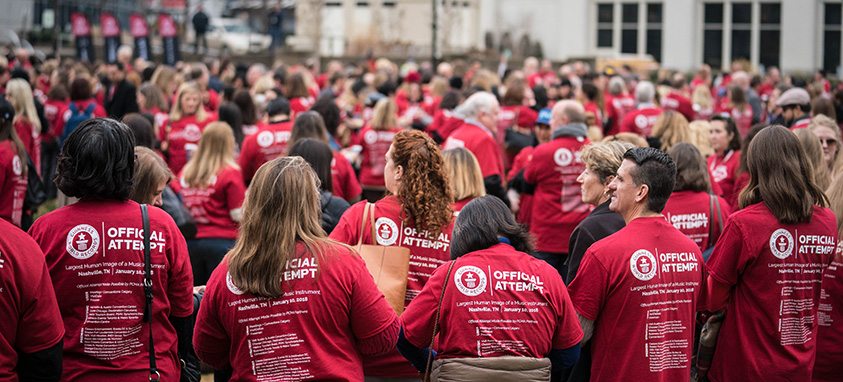
By the time longtime PCMA CEO and President Deborah Sexton passed the leadership baton to Sherrif Karamat during the closing session on Jan. 10 in Nashville, some important milestones had been met. The attempt to break the Guinness World Record for most people gathered to form a musical instrument may have just missed the mark, but the numbers added up for the things that really mattered—engagement, scholarships and impact.

Here are some of the impressive statistics:

13: Number of years Deborah Sexton served PCMA members. During that time, membership increased from 2,400 in 2005 to more than 7,000 today. Partnership revenue quadrupled in the last decade to almost $7 million.

1,500: Number of celebrators at Party with a Purpose on Cannery Row, to help PCMA Foundation raise $25,000 for W.O. Smith Music School. The Foundation, led by new chair David Peckinpaugh, awarded 104 scholarships to attend the event, the most ever funded. Peckinpaugh stressed the importance of highlighting the human element of the industry by the telling of compelling stories of lives improved thanks to the hard work of event professionals—and the lives of event professionals improved, thanks to PCMA.

Almost 2,000: Number of people accessing 2018 Convening Leaders content virtually. In addition to the availability of on-demand conference recordings, the broadcast was delayed to play in prime time in Asian markets. A watch party in Singapore brought 200 people together in an area where the 2017 acquisition of Conference & Event Society Asia Pacific (ICESAP) helped PCMA expand its presence. The organization’s vision was reflected in the event tagline “amplifying engagement.” Connecting with more people by having meaningful conversations globally on all platforms (including face to face and over social media) will continue to be a focus.

More than 4,500: Attendees, over three days of education, inspiration and networking at Music City Center in Nashville. Innovative additions to the traditional education focus included Living 360 Studio, an area devoted to tips on healthy events and f2f, a tech area anchored by a wall of video that injected content and energy into a space devoted to the latest and greatest in event tech. Next year, Pittsburgh.

50,000: Number of event professionals now engaging with the organization globally. New PCMA Board of Directors Chair Claire Smith has set a goal of increasing that audience to more than 500,000 by including people who may not identify as planners, but who can still benefit from the education offered. An emphasis on data analysis will help to create personas and personalize experiences.

75 million: Or 1 percent of the global population. Karamat estimates this is the true size of the event industry. While he doubts that PCMA membership will ever grow that large, the vision is to make resources available a la carte as well for those who want to engage with one piece of the organization at a time. “It helps get the message out to a larger audience, and it is the reality of the world today,” he says.

$330 billion: Amount of direct spending on meetings in 2016, according to Events Industry Council’s new Economic Significance Study, which counted 250 million participants at 1.9 million meetings.

wwc

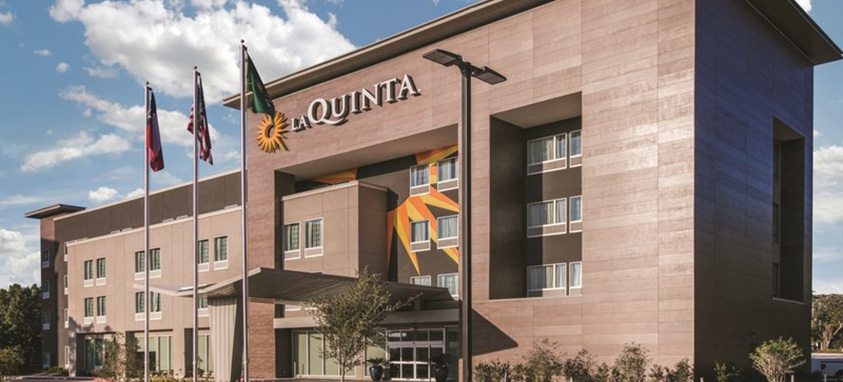
La Quinta Inn & Suites Dallas – Richardson, Texas 

Wyndham Worldwide Corporation (WWC) has announced that it will acquire La Quinta Holdings’ hotel franchise and management businesses for $1.95 billion in cash. The deal is expected to close within the second quarter of 2018.

“We are excited to announce the addition of the La Quinta franchise and management businesses to Wyndham Hotel Group’s portfolio,” says Keith Cline, resident and chief executive officer of La Quinta. “We believe that, under the management of Wyndham’s seasoned team of executives, the La Quinta portfolio will grow and thrive, yielding long-term benefits to the stakeholders of both companies.”

In addition to its signature properties, Wyndham Hotel Group owns Ramada, Days Inn, and Super 8 locations. The acquisition, WWC will add another 900 locations to the company, bringing the total number of brands to 21 and total number of hotels to more than 9,000 in more than 75 countries. By acquiring La Quinta’s locations, Wyndham Hotel Group will broaden midscale presence and expand its upper-midscale segment.

“La Quinta will immediately become one of our flagship brands,” says Geoff Ballotti, CEO of Wyndham Hotel Group. “It is an exceptionally strong brand that is led by service-minded associates who deliver some of the highest customer engagement levels in our industry.”

Prior to the acquisition, La Quinta will spin off its real estate into a publicly-traded real estate investment trust, CorePoint Lodging. WWC will set aside a reserve of $240 million for taxes related to the spin-off. Stockholders will receive $8.40 per share in cash, and WWC will also repay an estimated $715 million of La Quinta debt net of cash.

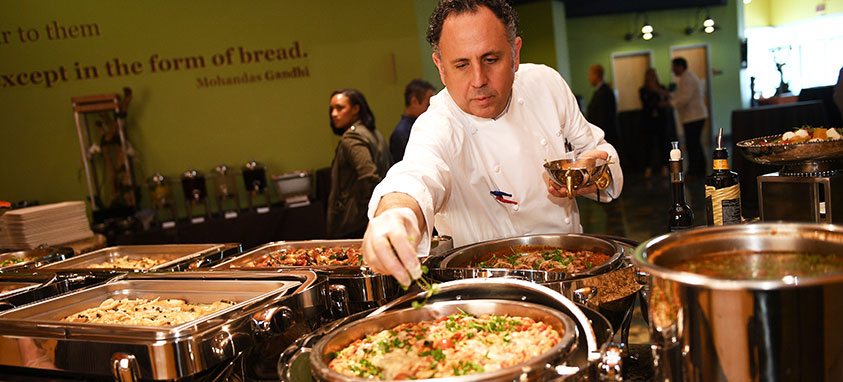
Carlos Guia, executive chef of banquets and conventions for ARIA Resort & Casino puts finishing touches on a buffet lunch served at Three Square Food Bank.

MGM Resorts International’s hotels are already a go-to destination for planners and attendees of events. However, the benefits of staying at one of the 12 properties in Las Vegas have expanded from convenience and relaxation to including a clear conscience.

On Jan. 17, MGM Resorts announced that the property will be donating surplus hot meals to Three Square, a southern Nevada food bank the hospitality company founded in 2007. The non-profit will serve 800,000 meals over the next two years.

Food insecurity is an issue that means a lot to me, and to the 55,000 MGM Resorts employees who live and work in Southern Nevada,” says Phyllis A. James, chief diversity and corporate responsibility officer of MGM Resorts. “Those who struggle with hunger in this community are our friends and our neighbors. We care about them.”

So, How Does This all Work?

Simple. After receiving the surplus of food from MGM Resorts, Three Square will freeze the prepared meals until a need within the community arises. This is an efficient way of giving meals to those suffering from hunger.

MGM Resorts also presented Three Square with a grant of $768,000. This model will also be expanded to the company’s other resorts, including Bellagio Hotel & Casino, MGM Grand Las Vegas, The Mirage and Mandalay Bay. The program was implemented in ARIA Resort & Casino in 2016.

MGM Resorts has been around this hunger block before—they’ve been consciously introducing food waste-reduction for years. Employees are heavily involved; they have collectively donated over 3.3 million pounds of canned food since 2010, as well as 47,000 hours to Three Square since its founding. MGM Resorts also offers aid for childhood hunger during weekends and summer months, gifting grants of $50,000 each of the last two years for Three Square’s BackPack for Kids program.

Why Does it Matter?

“We are often asked what Las Vegas hotels do with their leftover food,” says Brian Burton, president and CEO of Three Square Food Bank. “Today, we have a consistent, scalable answer to that question, one that will feed more food insecure people in Southern Nevada.”

“I believe those in privileged positions have a moral obligation to lend a helping hand to help pull up those in need,” James adds. “This new development gives us another tool in our collective community arsenal against hunger.”

Do you have an announcement about a new executive-level job appointment? Email us the good news at [email protected].

Photo credit: U.S. Travel Association 

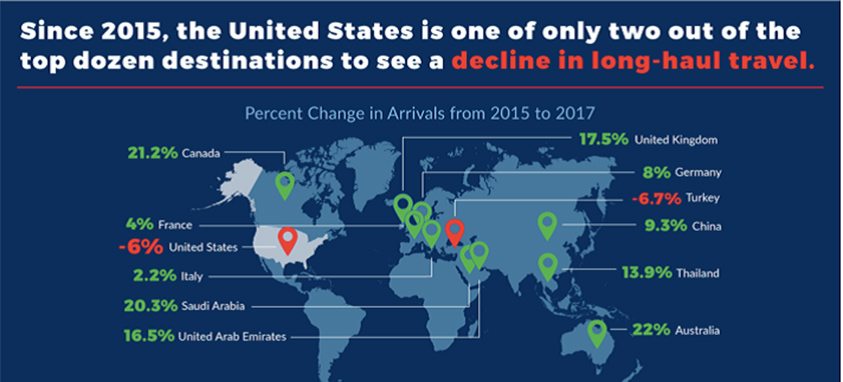
The United States is lagging behind in international visitors, and a new group vows to change that. As the rest of the world welcomed more than 7 percent more international visitors in 2017, trips across the United States border fell by 4 percent, according to UN World Tourism Organization statistics. The meetings industry this week joined numerous other travel-related groups to launch a Visit U.S. Coalition, setting a goal of reversing a decline in U.S. competitiveness for international travel business.

The coalition, which includes American Society of Association Executives, American Gaming Association, International Association of Exhibitions and Events, and Society of Independent Show Organizers, pledged to advance policy recommendations that will help the economy.

Photo credit: U.S. Travel Association 

America is the best country in the world to visit, but we’re losing the competition for international travelers and the dollars they spend when they come here,” said U.S. Travel Association President and CEO Roger Dow, whose organization is a founding member of Visit U.S. In the past, Dow has attributed declines in international visitors to travel restrictions, confusion about security policies and the changing political environment. “These factors created a growing perception abroad that the U.S. is no longer as welcoming to international visitors,” he said in a Dec. 19 statement.

The new group has positioned itself as helping President Donald Trump reach his economic goal of sustained 3 percent GDP growth. “The Visit U.S. Coalition is founded on the principle that we can have strong security, but at the same time welcome robust numbers of international business and leisure travelers. We can do both,” Dow said when the group launched on Jan. 16.

How Big of a Problem is the Decline in Tourism?

Between 2015 and 2017, the U.S. share of increased travel fell almost 2 percent, according to U.S. Travel Association. That represents a loss of 7.4 million international visitors, $32.2 billion in spending and 100,000 jobs that would have been supported by tourism.

Photo credit: U.S. Travel Association 

American Gaming Association President and CEO Geoff Freeman called international visitors of vital importance to the gaming industry and the national economy.

American Hotel & Lodging Association President and CEO Katherine Lugar explained the trickle-down impact. “Fewer visitors means fewer hotel stays, fewer meals eaten in our restaurants, fewer goods purchased in our retail stores, and fewer visits to our national attractions. It also means fewer American jobs and a loss to our economy. We are committed to working together with the administration to balance a welcome message with strong security to ensure we don’t fall behind to other countries.”

Learn more at visituscoalition.com

Two months before the reopening of Los Cabos International Convention Center, Rodrigo Esponda, managing director of Los Cabos Tourism Board, is welcoming a new travel advisory system and related map released by the U.S. State Department. The new four-tier rating is designed to be easier to understand, and more nuanced.

Countries rated Level 1 are places to “exercise normal precautions” and Level 4 as “do not travel.”

Reasons for advisories can be as diverse as widespread violence to terrorism, natural disasters or health risks. Esponda points out that the Level 2 Travel Advisory issued for most of Mexico calls for exercise of increased caution and contains no restrictions for travel in Baja California Sur, which includes the tourist areas of Cabo San Lucas, San Jose del Cabo and La Paz.

The classification comes five months after a travel warning was issued last August for those vacation destinations in the aftermath of a gang shooting, a warning that did not seem to impact decisions to visit—the destination posted an 18 percent increases in hotel occupancy. Over the same period, Los Cabos added 550 new rooms and continued to host massive events, including Los Cabos Open of Tennis ATP 250 and the Los Cabos Film Festival.

Los Cabos is the fastest-growing area in Mexico, and 1.8 million of its 2.4 million visitors a year come from its neighbor to the north. Thus, reassuring U.S. planners that their attendees will be safe is a priority for Esponda. This is particularly true now that the 72,000-square-foot convention center is scheduled for a March opening, after being cleaned up and updated in the wake of a 2013 hurricane. Also set for ribbon cuttings in 2018 are a new 122-guest room Montage Los Cabos, a 115-guest room Zadun, a Ritz-Carlton Reserve property, a 1,000-acre Four Seasons Resort and Residences Los Cabos at Costa Palmas, a 200-guest room Nobu Hotel Los Cabos and a 639-room Hard Rock Hotel Los Cabos. In total, 3,800 new rooms are expected between 2017 and 2021, and Los Cabos International Airport (SJD) will open a new terminal this year.

Esponda calls the decision by the U.S. to issue a Level 2 Advisory “a recognition of the work the public and private sector has done to keep people safe.” A five-point security action plan developed in 2017 for Los Cabos includes formation of a rapid-response network for hotels, airports, transportation and the government. It also features an expanded surveillance system, with more than 200 cameras in tourist areas, including downtown, and plans for a Mexican Marine Corps base nearby. More than $47 million was invested last year to increase security.

Five other Mexican states—Colima, Guerrero, Michoacan, Sinaloa and Tamaulipas—are listed as “do not travel” areas, due to organized crime activity.

All advisory levels warn there is risk in any international travel, and that conditions can change at any time. To stay up to date or search the advisory listings for specific countries, planners can receive updated travel advisories through the Smart Traveler Enrollment Program (STEP).

Recommended Security Precautions in Mexico

  • Use toll roads when possible and avoid driving at night
  • Exercise increased caution when visiting local bars, nightclub and casinos
  • Do not display signs of wealth, such as expensive watches or jewelry
  • Be extra vigilant when visiting banks or ATMs

It’s time to get techy, planners. The International Consumer Electronics Show (CES) introduces jaw-dropping innovations to the global marketplace every year. As the conference wraps-up today, it’s time to reflect on the full-scope of innovations we can expect over the next 12 months. Consumer technology will certainly thrive this year. And when the tech-world gets a boost, the events industry gets busy. Here are key event planner takeaways from CES 2018.

Watch it on the BIG Screen

Aptly called The Wall, the mega-screen is a whopping 146 inches wide. The size is far from the only selling point. The visuals are crisp, fine-tuned with MicroLED display. Although the price is expected to be quite astonishing, the product is set to roll out in 2018. Event planners can look forward to seeing The Wall in venues in the years to come so now might be the time to start thinking about how to use that colorful space wisely.

Redefine Connectivity

The Sgnl wristband redefines staying connected. The band connects to your phone using Bluetooth, transmitting sound whenever you touch your ear with your finger. So, forget the physical need for receivers in general. The product works by transporting the audio vibrations up your wrist to your finger. Perhaps most importantly, attendees at CES have reported pretty good sound quality.

How will this support the future of event planning? When an event is in full swing, you need to stay connected. Your handy-dandy hand will allow you to do just that. Farewell headsets!

Develop a New Perspective

Rokid’s AR Glasses are just another instance of the push for Augmented over Virtual Reality. Although the clunky design leaves much to be desired, the functionality is remarkable. Running on Wi-Fi, the glasses allow you to look at a person and see all of their social media profile and contact information. The product is expected to be available for purchase in late 2018. Price predictions are around $400, similar to other virtual headsets such as Oculus. No more fumbling introductions while you try to remember a name at a cocktail party.

Watch as Drones Light up the Sky

Are drones the new fireworks? The light-up display over the Fountains at Bellagio on Thursday has us thinking yes. The Intel Corp. display of semiconductors flew 250 light-emitting drones. These light-weight devices, no more than a few pounds, are called “Shooting Stars.” The drone display was featured at the 2017 Super Bowl during Lady Gaga’s performance. It’s also set to light up the 2018 Winter Olympics in South Korea.

It may be some time before spectacular displays are in the mainstream. But look at the rapid popularization of drones in general. You can purchase one at your local Walmart now.

Roll out the Screens

Can you think of anything cooler than poster-screens? Add in 4K resolution and you have something extremely elegant and practical. Seriously, it can roll up like a poster and roll out as a flat panel TV. The OLED panel, LG Display is the most advanced of its kind.

Order from the Robomart

It’s just the right climate for Robomart. The perfect storm of delivery at its peak mixed with the emergence of self-driving cars made this progression inevitable. Not to mention, the great potential for all types of goods should the product team up with the likes of Amazon and Postmates.

Planners wouldn’t just benefit in their everyday lives. This delivery of goods could be an excellent feature when orchestrating event components. Need an extra cable? The Robomart is on its way.

Let’s Get Over the ‘Booth Babe’

If you’ve been to any tradeshow, you’ve seen them. They’re everywhere. The “booth babe” is the term for an attractive woman whose job is to lure attendees to a booth. Given the current social climate, it’s time to get more creative.

“The booth babe thing is unfortunate and it would be ideal for CES to get rid of all of that—it’s totally unnecessary and people are here to do business,” Lorraine Twohill, Google’s CMO told AdWeek. “I think there’s still a lot of work to be done to make CES feel inclusive of women. If CES genuinely wants to have an event that feels welcoming to women, then you can’t have [booth babes.]”

A major blackout occurred this week—and we’re not talking about the Golden Globes outfits. On Wednesday, the Consumer Electronics Show (CES) experienced a 2-hour long power outage at the Las Vegas Convention Center. This was the second day of the annual trade show, which hosts around 180,000 attendees. The outage was more than an inconvenience. Thousands were ushered off grounds and companies (big and small) lost money through missed opportunities. And what’s the big bad culprit? About an inch of rain.

The irony here is unavoidable. A power outage occurred amongst a crowd of the most skilled techies in the world. This is proof that power outages can happen anywhere. Consider the blackout at Atlanta’s Hartsfield-Jackson International Airport (ATL) just a month ago.

Power outages can put a tremendous damper on the event, if not end it entirely. That is why planners have come up with a toolkit of precautions and processes to mitigate associated risks. Here’s how you can gear-up in case the lights go out at your event.

Prepare Extensively  

Maria Cruz, Smart Meetings’ meeting planner, emphasizes preparation when it comes to electricity. She asserts, “The most important thing is the preplanning. You have no control over Mother Nature or out of the ordinary occurrences.” Cruz also urges planners to ask the venue about power sources and back-ups, along with their past emergencies and issues.  “I want to know the scope and how they have been handled,” says Cruz.

These matters should all be considered early on. Cruz suggests holding off on booking unless the venue demonstrates it can handle your current needs, as well as includes assurances for how they would adjust if the program grows larger than anticipated. Cruz stresses, “Ask questions and never assume anything is common knowledge.”

Considering the particulars of CES is also useful. Even though the convention center’s Central Hall was one of the first areas to report the blackout, Samsung’s booth offered limited electricity through its private backup power. So even if your risk is low, it might be worth investing in a small backup source. If anything, this can facilitate organizing attendees when an unexpected outage hits.

Ensure Safety First

A big dark room full of confused people can be dangerous. As always, remember to address any safety concerns immediately. The venue should have a protocol listed under emergency procedures. Additionally, an internal plan will ideally keep attendees safely accounted for at all times. If the decision is to evacuate, the exit route must be safe, clear and accommodating.

Communicate Clearly

What comes after safety? Developing a communication strategy. Social media is the best way to reach both attendees and the press quickly. But before getting ahead of yourself, collaborate with the venue. Cruz advises partnering to present a unified front and gain control over the message that will circulate. Once a plan is established, respond quickly. Your brand needs to be protected, which requires minimizing any over-reactions and correcting false information immediately.

Apply Creative Solutions

If dealt with properly, a power outage may only be a small hiccup in an otherwise stellar event. Try to divert the attention and keep the fun going while the problem gets solved. The show must go on, right?

Photo credit: Starwood 

The hospitality industry is constantly subject to the revolving door of changing tastes, design developments and technological advancements that have become the norm. In the Internet of Things (IoT) world in which we live, businesses themselves must be connected, proactive and forever evolving.

Here are some of our hospitality technology trend predictions for 2018 to make sure that you’re one step ahead of the game.

CRM

Customer Relationship Management (CRM) technology is an excellent solution for generating new business and staying connected to current customers. CRM technology works by gathering all guest profiles into a single database, providing easy access to useful information for all end-users. By using CRM technology, data from various sources, including sales, marketing and social media channels, can be viewed and updated in one place. Technology such as this makes for a more streamlined approach to stay in touch with your customers and your business.

The Cloud

In 2018 we predict a notable shift towards cloud-based solutions. Cloud CRM allows data, software and tools to be stored in a secure online environment, eliminating the need for on-site solutions. Cloud-based applications, such as Salesforce, allow your business the option of creating a customized experience, according to your budget, required features, number of users and more.

Smart TV

Samsung’s 694 Series Hospitality TV has made Smart TV capabilities more easily accessible to hotels. Its embedded cable modem enables hotels with coaxial cable, rather than Ethernet cable, to be Smart TV ready. In addition, Samsung Lynk Reach allows hoteliers to personalize the Smart TV experience, allowing guests to feel right at home. This service allows guests to stream music, movies, TV shows and more from the comfort of their hotel room, as well as informs them about in-room dining options, spa offerings, events and promotions.

Digital Key

Digital Key has already been rolled out by Hilton, and to a lesser degree by big-name brands such as Marriott and InterContinental Hotels Group. The idea is that guests download the smartphone app, book directly through the brand’s website and use the app as their key for the duration of their stay. Other app features include the ability to select early check-in and choose a preferred room. One of the definite plus points for the hotelier of bookings made directly with the brand is that the hotel pays fewer fees to OTA sites. On the other hand, cyber security breaches are still a real concern for many—but keep an eye out for Digital Key in 2018.

Robotic Butler

In 2014, California-based start-up Savioke piloted the robotic butler for the service and hospitality industry. The robotic butler can take the elevator and make deliveries to guest rooms, freeing up time for hotel staff and lending originality to brands adopting this unique technology. At Aloft Cupertino in California, the Botlr concept is in its second wave with ChatBotlr allowing guests to send service and hotel information requests by text message. Impressive, isn’t it? You could say that the future is now.

The red carpet rolled out at the top of the New Year on Jan. 2 at the Palm Springs International Film Festival (PSIFF) Film Awards Gala. Five days later, The Golden Globe Awards followed in Beverly Hills, California, and the ceremonies will keep on coming, leaving event planners and hotels mighty busy straight out of the gate.

Staging an awards gala requires substantial planning, and in many ways it is similar to planning a meeting or an event. Here are six similarities to help inspire meeting professionals.

1. Meeting Spaces

Photo credit: The Beverly Hilton 

The magnificent state-of-the-art International Ballroom at The Beverly Hilton is the longtime home of the  Golden Globe Awards. The 16,000-square-foot space features a sunken seating area or dance floor, and a stage that can fit up to 1,400 guests. In spring 2017, the hotel premiered additional garden meeting spaces—Wilshire Garden, Secret Garden and California Terrace—which were utilized by the Hollywood Foreign Press Association, the organization behind the awards show, and 1,200 members of the press during the Golden Globes.

Located across the street from Dolby Theatre, where the Academy Awards will take place March 4, the historic The Hollywood Roosevelt is very much part of the conversation, as well.

“With awards season each year, one of the requests we receive for incentive groups when they want to do a rewards program for their clients and employees is to recreate the glamour of the Oscars,” says Don Jacinto, the hotel’s managing director. “As the birthplace of the first Oscars in 1929, which was held in our very own Blossom Ballroom, planners can offer attendees an authentic Hollywood experience in more than 25,000 sq. ft. of indoor and outdoor event space on-site that is outfitted with today’s modern necessities.”

Planners can also host meetings at the venues being used for other upcoming awards shows and celebrations—Screen Actors Guild Awards (Jan. 21) at the Shrine Auditorium in Los Angeles, Clive Davis’ and the Recording Academy’s Pre-Grammy Gala (Jan. 27) at Sheraton New York Times Square in New York City and the Grammys (Jan. 28) at Madison Square Garden. Davis’ soiree has often taken place at The Beverly Hilton.

2. Food & Beverage

What’s the trick to serving food hot during a massive sit-down dinner, while keeping a steady flow? That’s the million-dollar question! Planners can take a page out of PSIFF Film Awards Gala’s book. The salad and dessert were pre-set at the reception and only the entree was served live during the event to its 2,600 guests. Paying homage to the film industry, the assorted dessert plate featured a reel made of chocolate.

“The menu selection has an interesting history,” says James “Jamey” Canfield, executive director of Palm Springs Convention Center and Bureau of Tourism. “Local philanthropists who are famous for large special events that they have hosted took a lead role on the decor and menu selection for the gala. Because of their experience hosting large functions, they wanted to make sure that the meals were high quality and consistent, something that could be served to large groups. Their selection was, and always is, boneless short ribs.”

The culinary team of The Beverly Hilton uses the Golden Globes as an annual opportunity to showcase the extent to which it is capable of executing.  “What we’re most proud of is the Golden Globes menu for the actual ceremony,” says Michael Robertson, the hotel manager. “We’ve finally been able to go to a restaurant-quality presentation.”

Photo credit:  The Beverly Hilton

This past Sunday, 11 chefs, 120 culinary staff members, 50 bartenders, 160 stewards and 250 servers were led by executive chef Alberico Nunziata and executive pastry chef Thomas Henzi to feed between 3,000 and 4,000 mouths throughout the day.  Awards show attendees were served three courses—a Delicata appetizer made from burrata cheese, opal basil, teardrop tomatoes, Taggiasca olives, golden frisee, garlic flowers, roasted butternut squash, and purple sweet potatoes with extra virgin olive oil and balsamic vinegar; an entree with Mediterranean Chilean sea bass, with red beet parmesan risotto; and an Efendi dessert made with white chocolate coffee cream, coffee liqueur biscuit, Frangelico mascarpone and crunchy praline.

Photo credit:  The Beverly Hilton

But, that’s not all. The bubbly was flowing all night, too. The Beverly Hilton popped the cork on more than 1,500 Moet & Chandon Imperial minis, and 125 cases of Moet & Chandon Grand Vintage 2006 and Moet Rose Imperial magnums. The champagne was also used to mix a signature cocktail created by Jamie Chung, an actress, fashion influencer and lifestyle expert.

“The Moet 75 cocktail embodies the effervescence, glamour and magic of cinema, celebrating over 7 1/2 decades of the Golden Globes,” the hotel says in a press release. “Chung playfully captures the boldness and creativity that shines on Hollywood’s biggest night with a cocktail that mixes sweet and tart notes, and beautifully sparkles with a candied, blood-orange slice garnish. The Moët 75 plays to the senses with the aroma of honeyed citrus, paired beautifully with the bright fruitiness and elegant maturity of Moet’s iconic champagne, Moet & Chandon Imperial.

The Hollywood Roosevelt also prides itself in concocting unique catering options to go hand-in-hand with the films up for awards. “Following the nomination announcement each year, our culinary team at The Hollywood Roosevelt creates specialty menu items that are based off films or characters in films that are incorporated at the various dining venues we have on-site,” says Jacinto.

“For instance, our 24-hour burger joint, 25 Degrees, will come up with a specialty cheeseburger and our well-known Library Bar will develop some delicious cocktails using fresh fruits, and seasonal vegetables and herbs.”

While the action is taking place across the street at Dolby Theatre, The Hollywood Roosevelt is very much bustling with a viewing party for the public, which is encouraged to dress to the nines. They’re served fresh crab and seafood at various food stations, and last year, the hotel partnered with Piper-Heidsieck Champagne, the exclusive champagne served during the Academy Awards.

3. Floral Arrangements

The focal point of any table-scape is without a doubt the centerpiece. It offers planners the opportunity to really define the event’s theme. This year, the centerpiece at the Golden Globes was a gold container with a band of diamonds and more than 15,000 roses, created by celebrity florist Mark Held, co-founder of Mark’s Garden.

At PSIFF, decorators went with ocean-themed centerpieces by placing sea glass, a seahorse, shells, lily grass, coral and white orchids flown in from Holland in a 20-inch glass bowl that was lit from beneath. Each place setting also had a LED-lit blue crystal Buddha figurine.

“The florals are extensive each year, with themed center pieces consisting of decor, lighting and florals,” Canfield says. “Each table was also pin-spotted, so the colorful decor really popped.”

4. Transportation

While it is a nice treat to roll up in a glamorous stretch limo, it is not always the most efficient way to bring a large group of people to an event. Planners could confront a limo shortage in an awards show city because they are in such high demand, just as they are for proms during the spring.

Also, if you are relying on multiple limos to transport your group, it is difficult to coordinate arrival time, and the more vehicles on the street, the more congestion. At PSIFF, a group of planners and journalists were instead taken from their hotel to the convention center in a trolley. What a way to make a grand entrance!

Arranging an off-site lot to accommodate overflow parking is also an option for guests driving themselves. A shuttle can then be used to bring attendees on the final leg of their journey to the event venue. This parking and transportation model was used by the Golden Globes at The Beverly Hilton. There had been more on-site parking years ago by utilizing the old Robinsons-May department store’s parking structure, but it was demolished to build the new Waldorf-Astoria hotel.

5. Signage

Meeting professionals can work with the local CVB to create a citywide event to bring widespread awareness of their function. This can include banners at transportation hubs and on light posts in dining and shopping districts. Let it be known that your festival or convention is in town. One of the perks of the Palm Springs Promise is “welcome signage at the airport and in our downtown,” Canfield says.

6. Learn from Flubs

No matter how much planners try to avoid mistakes and oversights, whoopsy-daisy moments will occur, often beyond anyone’s control. A fire could break out in the kitchen or the linen delivery may get delayed, for instance. What separates the pros from the amateurs is how they react to rectify and cover up blunders.

Robertson knows from experience how to stay calm and level-headed while in crisis-mode. At the 2014 Golden Globes, a hot light accidentally set off a fire sprinkler over the red carpet, causing a flood. The Beverly Hilton’s staff and Beverly Hills Fire Department quickly leapt into action to dry the wet mess. “Never derail and get catastrophic,” Robertson advises.

You can be a “gladiator in a suit,” like Golden Globe, Emmy and SAG-nominated Scandal actress Kerry Washington, by handling any curveballs thrown your way. The show (and meeting) must go on. Break a leg!