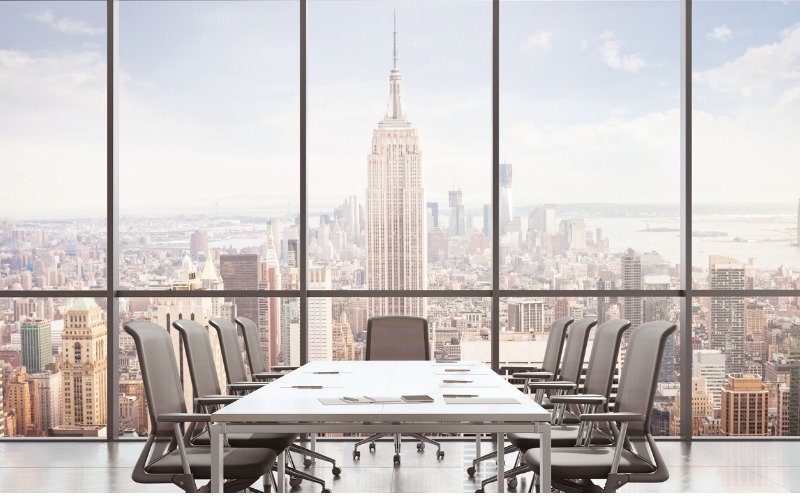
New York was ranked as the top North American city for meetings, rising from the No. 2 spot last year, by CWT M&E, the division in charge of global events for CWT.
Cities were ranked based on proprietary and industry data featured in CWT 2020 Meetings & Events Future Trends Report. Each of the cities offers some exciting options for meeting planners.
San Francisco was ranked as the No. 2 city, followed by Chicago, Atlanta and Toronto and San Diego. The latter three cities did not make the list last year.
Atlanta is home to many historical places, and offers behind-the-scenes studio tours of CNN Headquarters and World of Coca-Cola museum. Toronto features CN Tower and a variety of other places for outdoor photo opportunities, along with Royal Ontario Museum and other must-see places.
San Diego is surrounded by beaches and has warm weather most of the year. San Diego Convention Center is 10 minutes away the airport and close to popular spots such as Gaslamp Quarter and Petco Park, home of MLB’s Padres.
CWT stated that overall, the number of meetings is increasing in cities. Fluctuations in cities’ popularity is partly due to their political climate, says Tony Wagner, vice president of the American and South Pacific regions for CWT Meetings & Events.
“Political events have a direct impact more than ever on companies’ quarterly and annual outlooks,” he said.
IMEX America 2019 participants will be able to enjoy plenty of exciting new features at the host venues—Sands Expo and Convention Center, and The Venetian Resort Las Vegas.
“Throughout the years, Sands Expo has continuously engaged in facility upgrades,” says Kirsten Dimond, vice president and general manager of the venue. “Most recently, our focus has been on strengthening our wireless Internet capabilities to ensure consistent service levels throughout our meeting and exhibit space.”
Dimond says that this year, IMEX America participants also will be in for some culinary surprises.
“The new food-and-beverage menu will feature several new plant-based entrees, and there will be coffee bikes on the show floor where participants may purchase nitro cold brews,” she says. “In addition, our show cleaning team has created a VIP porter package, and efforts supporting our donation program will continue to grow.”
The Venetian Resort Las Vegas, which houses both The Venetian and The Palazzo, added new restaurants and entertainment options this year, including Mott 32 (Chinese fine dining), The Factory Kitchen (traditional Italian) and a new bar, Electra Cocktail Club, which completes The Cocktail Collective, with three venues featuring crafted cocktails and visionary decor.
“This summer, we also completed a total renovation of the Venetian pool deck, which is now an exciting, new space for groups to host gatherings,” says Chandra Allison, senior vice president of sales at The Venetian. “We also recently completed a refresh of The Palazzo tower—everything from the guest suites to the casino floor. The redesigned Palazzo tower suites offer opulent accommodations with earth-friendly nods, setting the bar for luxury in Las Vegas.”
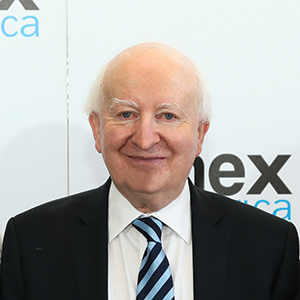
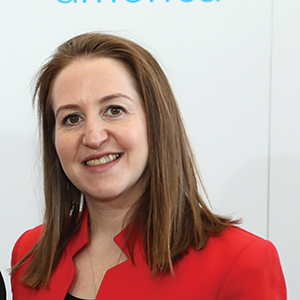
Sands Expo and The Venetian Resort Las Vegas have hosted IMEX America since its inception in 2011. Carina Bauer, CEO of IMEX Group, says that they’ve been ideal partners.
“They’ve been outstanding hosts,” she says. “As partners, they and their teams have supported our growth, and work with us each year to innovate. Of course, from a purely logistical standpoint, the properties offer us ample space for the trade show and our educational and collocated programs, as well as having been able to continue to accommodate us through our growth.”
Dimond also lauds the relationship between the venues and IMEX America.
“Having been the long-standing home to IMEX America, our teams have established a strong foundation upon which to prepare for each year’s program,” she says. “Several of the innovations that were originally created for IMEX are now part of our standard operations. As a result, we’ve been able to shorten lead times, strengthen existing practices and find new ways to engage event participants.”
The new initiatives include special menus that emphasize healthy, vegetarian and sustainable options; a trash-sorting program that achieves zero waste; digital signage that highlights sustainability messaging; and communications to participate in its donation program.
Bauer says that IMEX Group has also collaborated with Sands Expo on sustainability practices for the past 10 years.
“It’s one of the things that isn’t ‘seen,’” she says. “Each year, they have changed the way they are working back-of-house to help us deliver a more sustainable show, and they continue to offer those improvements to other clients. We also work closely with the Sands Foundation, which supported the IMEX Challenge in 2014—together, we rebuilt a garden for The Shade Tree, a home for abused women and children.”
Ray Bloom, founder and chairman of IMEX, points to some specific ways that IMEX America has become more sustainable.
“Our host venues have evolved over the years by working with us to improve the sustainability of the venues and the shows—from developing waste separation and diversion to introducing compostable service-ware, eliminating plastic straws and sourcing water-wise and local food options,” he says.
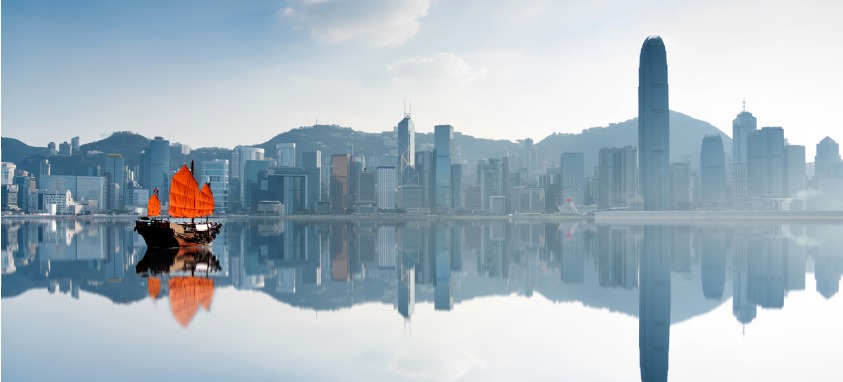
As protests in Hong Kong enter their 15th week, tourism in the city has plummeted to a level not seen since the SARS epidemic in 2003, when the rate of visitors declined by almost 70 percent and claimed hundreds of lives.
The number of visitors in August saw a 40 percent decline, compared to one year ago; according to August figures, that’s a drop of roughly 3.5 million visitors, reaching it’s lowest numbers in seven years, reports Bloomberg. This is in stark contrast to last year, when the city was one of the world’s most visited destinations, receiving 30 million visitors.
The city’s economy has dropped 0.4 percent in its second quarter from the previous period, resulting in declines in other industries, as well, such as retail, hospitality and housing. Retail sales by value was down 11.4 percent in July, while overall sentiment for small businesses has reached an all-time low. Hotel occupancy rates have fallen more than half, and hotel rooms rates have plummeted to 40–70 percent. Home prices have also sunk by up to 70 percent.
In August, protesters caused the Hong Kong International Airport (HKG), one of the world’s busiest airports, to cease operations for several days, during which hundreds of flights had to be cancelled.
Protests show no signs of ceasing, despite Chief Executive Carrie Lam withdrawing the extradition bill that started the protests in the first place. Financial Secretary Paul Chan lamented the city’s state of crisis in a blog on Sunday. “Social issues in the past few months, especially the continued violent clashes and blockading of airport and roads, have seriously impacted Hong Kong’s international image as a safe city,” he wrote.
How have IMEX America’s offerings, in general, evolved over the years?
IMEX America has grown and evolved considerably since its inception in 2011. Every sector of the show has grown, in particular participation from Asia, the Middle East and Africa, Europe and South America. Some of the largest growth has also come from North American exhibitors, hotel groups, technology providers and incentive products.
An important evolution has been the educational offerings, which have grown not only in terms of number of sessions, but also in terms of scope, with a focus on delivering sessions in new learning formats that focus on interactive, fun and immersive learning. Over the years, we’ve also developed our wellness offerings in the form of our Be Well Lounge and IMEXrun—both of which now provide enormously important elements of the show.
Finally, we have worked hard to evolve and improve our sustainability credentials—last year diverting 93 percent of our waste from landfill.
How have the educational offerings developed?
Over and above pure numbers, education has evolved in a number of ways. For a start, Smart Monday, which is powered by MPI, now also includes a vast of array of sessions from partner associations representing all corners of the industry. We’ve also focused on offering certification programs, deep-dive immersive sessions, interactive workshops, back-of-house tours, as well as fun activities such as the Play Room and puppy cuddling.
Through the wider education program, a number of new tracks have been added to ensure that broader business skills are incorporated into more industry-specific topics. A focus on research was introduced successfully to the program a few years ago through the Research Pod. We’ve also been focused on evaluating learning styles and adapted our learning formats accordingly so that people can attend traditional lectures and keynotes, through to campfires and chat bar sessions.
Finally, over the past few years we have also made a concerted effort to increase the number of sessions that qualify for CMP points, as well as reviewing the gender balance of our speakers, aiming for a 50:50 balance.
How have efforts to assure the safety and security of participants evolved?
The Sands has an outstanding security team and processes, and we work closely with them and the LVCVA [Las Vegas Convention and Visitors Authority] to ensure that our guests are as safe as possible and to adapt to new security challenges. Over the years, we’ve introduced bag searches, sniffer dogs and plain-clothes officers to ensure the safety and security of the event.
What have been IMEX America’s greatest successes, and what are the main challenges that remain?
I think what I am most proud of is IMEX America’s ability to bring the industry together; to support the industry trade associations in raising funds for their foundations and in assisting the industry to develop business opportunities; to move forward on key issues such as sustainability and diversity; and to serve as a platform for growth and development.
Looking ahead, what are some of the major plans for IMEX America?
We remain focused on our mission to unite and advance the meetings industry, and will continue to develop both IMEX America and IMEX in Frankfurt in creative ways to support this mission. In the medium term, we’re also looking forward and already planning for our IMEX America 10-year anniversary next year (2020) as well as our subsequent move to Mandalay Bay in 2021.
Carina Bauer, CEO of IMEX Group
What exciting things are planned for IMEX America 2019?
With IMEX in Frankfurt always preceding our America show, we get the chance to experiment in Frankfurt and then bring many of those lessons to Las Vegas. So, we’re aiming to bring some of the activations and installations that were successful in Frankfurt to America if we possibly can.
One example is the Nook meeting pods. While people are focused on getting the most from business and networking, we know that most attendees need—and want—to take a break to do some work close to the show floor, whether to call into the office, review a document or simply check on emails, all while using outlets to recharge their devices. The branded Nooks—three-quarter enclosed booths with a desk—provide an escape from nonstop business activity and are an example of how we are now curating spaces at the show with a new, more imaginative mindset. These little pockets act as space for quiet and concentration, and we know that attendees want that experience as much as the buzz—or is it a roar?—of the show floor.
We also created two small showcases in Frankfurt that we’re going to bring to America, and we’re going to make them bigger and even better. “What we are made of” featured samples of all the sustainable products that we now use at the show. Be it a piece of carpet, some paper or a signage board, we’ll show people precisely what the product looks like and what it’s called. In this way, planners can take a quick photo or make some notes, effectively giving themselves their very own green checklist for their next event.
Will IMEX America focus on themes this year, as it did last year, and if so, what are they?
I think the best way to describe the show is that there are some fundamental threads that will always be there. Many of these are addressed through our free education program, while others come to life in experiential or other ways. These fundamentals are what meeting and events planners tell us time and again are the subjects—or objects—they want to know more about.
Health and well-being is one, and this is bigger now than ever. CSR and sustainability is another. Quite simply, this is because we’re about to hit a tipping point on the planet because of the environmental impact caused by humans. Some planners know this. Some parts of our industry know this. It’s time for us all to wake up and start to think and act differently, and that starts with waste reduction, be that plastics, food or water.
Technology is an important third. We’re living in a world that’s changing faster than ever. Just think about it: You can look at a movie from the 1970s or 1980s, and except for the hairstyles and clothes, life didn’t seem that different. But if you look at a movie from 10 years ago, it’s the technology that looks out of date. Technology is changing our experiences in health, infrastructure and travel, and beyond. What used to be imagination is now for-real or on the cusp, such as smart homes, driverless cars and holograms.
The power of “experiential” is also key. Remember, this word barely existed in our industry three or four years ago. However, demand has sky-rocketed recently as we’ve come to acknowledge the gap between awe-inspiring and memorable consumer events—big brands, big stadiums, big experiences—and business events. That gap is not tenable anymore and planners are eager to know how to close it and to deliver more “‘wow” to their portfolios.
Why does the educational component at IMEX America receive such strong emphasis?
It’s true that we put a lot of focus on giving our attendees professional learning and development opportunities. For a trade show, that’s extremely unusual, but it’s part of our USP [unique selling point] and our mission to help unite and advance the meetings and events industry globally.
The reason for Smart Monday, powered by MPI, is that everyone who is engaged in their career wants to learn, grow, improve their skills and prospects, and become better at their jobs. By providing a whole day of education and networking prior to the exhibition, we’re giving everyone the chance to focus wholeheartedly on their professional development. Once the show starts, we switch to shorter-format learning and we place education right on the show floor, close to where business is being done.
Our attendees want networking and they also want structured time to learn, whether through practical workshops, keynotes or deep-dive sessions.
Tell me about new CSR and sustainability additions this year.
Sustainability continues to be a very important area of focus for us. For the first time at IMEX America, we’ll be encouraging exhibitors to sign a Sustainable Exhibiting Pledge, in which we ask them to undertake a minimum of three sustainable practices to help us achieve a more sustainable event. This includes initiatives like hosting water-refill stations to encourage delegates to use reusable bottles and reduce single-use plastics at their booths.
We’ll also be eliminating the use of delegate bags and our lanyards will be fully sustainable and recyclable—made of material derived from bamboo.
Building on previous years, we’ll be eliminating straws from catering outlets; encouraging better waste diversion by giving each exhibitor a recycling bin at their booth; using recycled carpet; and adapting our menus to include water-wise options.
What new wellness features will be included?
The Be Well Lounge, powered by Lee Papa, Mindful Makeovers and Imprint Events, is a space for meditation, yoga or simply quiet reflection from the bustle of the show floor. The continual increase in attendees using this space shows that it is increasingly relevant.
Is there anything else you would like to say about IMEX America 2019?
Although I can’t disclose the full round-up of activities for this year’s show, I can say we’ve introduced lots of new moments of surprise, delight and laughter that I know will charm and excite our attendees. The American market is particularly receptive to these and, of course, Las Vegas almost demands more showbiz and razzmatazz by dint of its own attractions and reputation for world-class entertainment.
It will be featured as the Talking Point throughout the show
IMEX America has been widely praised for its trailblazing—and often unconventional—experiential offerings, but this year’s event—to be held Sept. 10–12 at Sands Expo and Convention Center in Las Vegas—will take them to a new level as it zeroes in on imagination as its Talking Point.
“Attendees increasingly look for and remember interesting experiential elements—they make it imperative to be on-site at an event, rather than just sitting in front of a computer or watching it virtually from their desks,” says Carina Bauer, CEO of IMEX Group. “So, delivering memorable experiences is part of the plan, especially since our Talking Point is Imagination.”
IMEX Group is encouraging meeting and event professionals to consider how they can imaginatively collaborate with other organizations and the benefits this can bring.
“We’re working to bring the power of imagination to everything we’re doing at IMEX America,” Bauer says. “Absolutely everything—and everyone—is connected or capable of becoming connected, and the driving force behind all the positive changes we’re witnessing is the power of the human imagination—a uniquely human quality. So, we’re exploring and celebrating this aspect of being human—one that we frequently take for granted. Think of it as a human superpower; our instinct to ask, without judgment or limitation, ‘What if…’”
IMEX America 2019 will focus on three facets of the Imagination Talking Point—transformation and collaboration, diversity and inclusion, and sustainability. They will be included in IMEX Group’s industry white paper, which is being produced by EventMB.com and supported by PSAV. The white paper will be launched during Smart Monday (Sept. 8) and its author, Julius Solaris, will lead attendees in a 2 1/2-hour deep dive into its main findings.
“He’ll share stories gathered from several hundred events all over the globe, all of which achieved some truly inspiring and imaginative outcomes,” Bauer says.
Smart Monday, which is powered each year by Meeting Professionals International, will include other sessions—such as deep dives and workshops—that focus on imagination. Artist Phil Hansen will deliver the Smart Monday keynote, “Embrace the Shake: Transforming Limitations into Opportunities,” in which he discusses how he overcame a career-ending tremor in his right hand. Hansen will describe how such setbacks can be used as an impetus for creativity and imagination, including how planners can embrace their own limitations—reduced budgets, limited resources and rushed timelines—to create positive outcomes.
The ever-lively trade show begins on Tuesday, and will bring together some 3,500 suppliers and 4,000 buyers to plan and book everything from high-level incentives to large association gatherings. The trade-show floor also enables participants to forge new relationships and strengthen existing ties.
IMEX America 2018 attracted 13,588 total participants, including exhibitors, buyers, faculty, students and media. There were 3,500 exhibitors from 150 countries, 3,327 hosted buyers from 63 countries and 1,102 buyer attendees from 37 countries. Some 74,000 total appointments took place, including 64,500 individual (as opposed to group) appointments.
The event is about much more than the trade show, though. Keynotes, educational sessions, forums and foodie tours will be included, along with offerings such as Events Industry Council’s Hall of Leaders & Pacesetter Awards on Tuesday, and IMEXrun and MPI Foundation Rendezvous Night on Wednesday.
“The show has become the annual meeting place for the whole industry,” Bauer says. “The major industry associations, the big hotels, the corporations…they all use IMEX as a hub, knowing that anyone who’s anyone is likely to be in Vegas that same week. Now that I find enormously satisfying.”
Next year’s IMEX America will be the last held at Sands Expo. IMEX Group leaders announced last year that after 10 years of hosting the event there, it will move to Mandalay Bay Convention Center in Las Vegas. IMEX Group couldn’t lock in space at Sands Expo from 2021 onward, said IMEX Group Chairman Ray Bloom.
IMEX America fosters healthy minds, bodies and spirits
Self-care is any activity done deliberately to take care of our mental, emotional and physical health. It seems like a simple concept, but it’s often one we tend to overlook. Meeting planners know this all too well. Packed schedules, demanding deadlines, long hours and frequent travel often take precedence over—and a toll on—health and well-being, and burnout is common.
That’s why self-care is so important. It is the key to preventing health issues and managing stress, as it can improve our moods, and reduce anxiety and depression. It’s not a selfish act: It’s a self-love act that enables us to see beyond our own experience, to be in the present and to care for others—and it spills over into our communities and the world.
But it’s not always easy to take time for self-care. We have to actively choose to make the time for it—to plan for it. There are myriad opportunities to incorporate self-care into our lives, if we know where to find them. IMEX America 2019 is one such place. IMEX Group has been incorporating wellness programs into its shows for the last five years, and with the increasing emphasis on wellness in the industry, the focus will only grow over time.
“I believe that well-being is enormously important to the meetings industry,” says Dale Hudson, knowledge and events director for IMEX Group. “Having held other meeting industry roles over the past 30 years, I know how incredibly stressful a planner’s life can be. I’ve thought that if IMEX can help just a little in getting the message out on how important it is to manage stress, this would be a good thing for our industry.”
Take Time Out for No. 1
IMEX helps its attendees to recharge through several programs and initiatives designed for relaxation, rest and rejuvenation. In the first few years, IMEX America incorporated a meditation area, which evolved into the Be Well Lounge, run by IMEX Group health-and-wellness consultant Lee Papa. Inspired by Mindful Makeovers, Papa’s rejuvenation program, Be Well Lounge, gives IMEX attendees the chance to meditate, receive mindfulness training, get a massage or simply pause for a few moments of relaxation. The Be Well Lounge will be offered all four days this year.
“Initially, it was almost something [people] did not want to be seen going to,”Hudson says. “However, as times have changed, people do not seem to worry about using these types of facilities. Now, people come back each year, saying how visiting the Be Well Lounge has had an impact on their lives—long-term, with many practicing meditation year-round and using it in stressful situations.”
This year, IMEX America will launch Laughter Yoga, a program by Sarah Routman, IMEX’s presenter from Laugh for the Health of It.
Fall into Puppy Love
One of the more popular wellness programs at IMEX America comes in the form of puppies. It’s well-documented that petting animals relieves stress, lowers blood pressure, boosts mood, facilitates relaxation and reduces the risk of heart disease and stroke.
With that in mind, IMEX and its partner, MPI, have been offering puppy-cuddling breaks since 2016 for IMEX America attendees who feel overwhelmed by the sensory overload of back-to-back appointments and education sessions while navigating the floor and the crowd. The puppy breaks have become a welcome respite from the noise and activity. They’re also a good way to socialize the puppies while they acclimate to busy, noisy environments in a safe and welcoming place.
Put Your Best Foot Forward
Of course, a healthy mind works best with a healthy body, and IMEX America offers several options for fitness. A favorite among IMEX attendees is IMEXrun, “an energetic start to a day where participants can run, jog or walk down the iconic Las Vegas Strip,” according to Hudson. The 5K run will begin at dawn on Wednesday, Sept. 11. The event is open to all IMEX America participants who want to add fitness to their IMEX wellness experience.
Event attendees are often surprised at how many steps they put in during a day at an event the size of IMEX America. To help keep attendees moving, last year IMEX launched Caesars Forum Walking Challenge by Heka Health, in which participants compete for prizes for meeting daily step goals.
More than 400 people participated in the challenge last year, adding up to more than 5.7 million total steps over a three-day period. Steps are tracked through a downloadable app and presented on a leaderboard at the challenge booth. IMEX Group encourages attendees to step up to the challenge again this year.
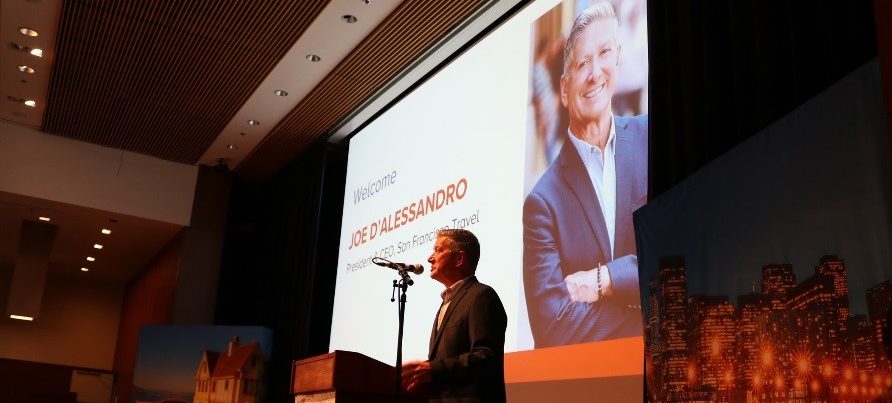
Despite controversy about a trade war with China, the three-year long conversation regarding Brexit and an inverted yield curve—which may or may not signal an impending recession, the tourism industry in San Francisco’s Bay Area is officially still booming.
San Francisco Occupancy Remains Elevated
Joe D’Alessandro. Photo credit: Dynasty Photography
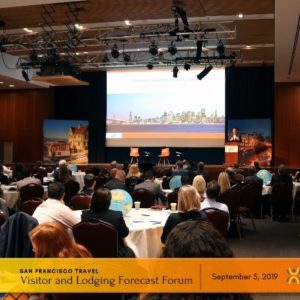
At a recent San Francisco Travel Visitor and Lodging Forecast Forum, Oxford Economics placed the odds of a recession in 2019 at 15-25 percent, while in 2020 the probability is projected to rise to 40 percent. Although this may give some reason to be alarmed, the travel sector will likely be unphased, according to the report, as historically the sector continues untouched during financial tribulations.
San Francisco has seen a constant rise in ADR, and it’s still going strong. This high ADR is what’s keeping the city’s RevPAR in such a great state, which is said to be in “record territory,” resting at $86 in the second quarter of 2019.
Demand for guest rooms has almost always surpassed supply in the city. While this was projected to remain true into the future, the supply for rooms in San Francisco could see a slow but steady increase in upcoming years, with 627 new rooms opening in the beginning of the year, 1,113 currently under construction and 1,701 more in the pipeline.
Airport Traction in the Bay is Unprecedented
The number of airline passengers has nearly doubled since 2003 and San Francisco International Airport (SFO)—the 7th busiest airport in the United States—has seen a bulk of that traffic. The city currently serves an average daily passenger rate of 97,270 and that number was recently surpassed when, on August 30, the airport saw more than 100,000 passengers running to and from terminals.
The future of SFO will include a decrease in aircraft size and a rise in smaller, more fuel-efficient aircrafts. Of course, this will mean a need for more terminals even beyond the recently-opened Harvey Milk Terminal 1.
The Esports Effect
Photo credit: Dynasty Photography
The newest competitive experience, esports, is giving traditional sports a run for its money, to the benefit of the hospitality industry. This growing industry is projected to surpass $1 billion in revenue for the first time in 2019, a year-over-year (YoY) growth of 27 percent.
On esports event days, hotels often see an occupancy rate of 90 percent and above. TwitchCon, an annual esports conference, was held at San Jose’s McEnery Convention Center in 2018. During this time, hotels saw a dramatic increase in room demand premiums on the convention’s event days, from an average of 600 to roughly 2,400.
The United States is the Most Desired Destination
The United States remains one of the most sought-after destinations for international travel. In a study of 11,148 travelers by Destination Analysts, 33.5 percent of travelers from several countries, including Mexico, Brazil, Spain and Canada, listed the United States as their most desired global destination. Spain came second, at 17.8 percent.
Despite the United States being the most coveted destination, there were several deterrents preventing some from making that trip a reality, such as expensive airfare, expensive cost of living, distance and an unfavorable currency exchange rate. The political climate also played a role in impacting travelers’ reluctance to visit the States, with 61.1 percent of Chinese travelers admitting that the political climate has made an impact on their desire to visit, as well as Mexico and Canada, 60.8 and 58 percent, respectively.
In the age of personalization, customization and bespoke products of all kinds, it’s tougher than ever to wow attendees. A new trend or craze rears its head every day, which attendees are constantly exposed to via Instagram posts and Twitter feeds, revealing the latest in ‘cool.’
How do you keep up? Where do you start? These are the questions that Lisa Russi, senior director of catering and event sales operations for the Americas at Hilton, answered in the latest Smart Meetings webinar: “Trends to Table: Curate Events That Allow Attendees to Taste, Toast, Engage and Explore.” Creating personalized experiences for attendees is no simple feat, but it can be made easier by designing your event to suit the palates of each attendee. Russi shared some tips that you can introduce into your next event.
According to Russi, there are six elements to a curated event. The implementation of which will make your upcoming events both memorable and Insta-worthy.
Personalize and Customize
Technology and on-demand services have created a culture that is accustomed to getting what they want, when they want it. The event planning world is not immune to these expectations. Russi noted several ways to make the food and beverage experience personal.
• Analyze:
– Profile top-10 attendees demographics for food and beverage preferences
– Focus on key meal periods—breakfast is of the utmost importance
– Request past event allergen and dietary information
– Request post-event information on what was most popular and what was left behind
• Research:
– Food and beverage, event marketing publications (such as Smart Meetings)
– Regional, food and beverage-specific websites and blogs
– Restaurant trends
– Travel, food and beverage inspirations websites and blogs, Instagram
• Allow attendees an array of choices
– Creative carts
– Family-style meals
– Flexible menus
– Multiple food options from one main ingredient
• Create food and beverage messaging
– Foam art in coffee
– Ice graphics
– Experiential messaging
– Food designs
– Couture cocktails
Culinary Engagement
“The chefs are the star of the show,” Russi said. She believes that planners should learn about the people who are creating the food their attendees will eat. Learning about the chef will allow you to create a culinary story around the food being made, giving the meal enhanced meaning. This can be done in a few ways.
• Reflect the location by using local ingredients and flavors
• Highlight cultural influences and trends in flavor profiles
• Add action and flair to your event
Russi doubled-down on the importance of showcasing the location in which the event takes place. Your attendees should know where they are, she said. “If they walk into a ballroom and they look at the buffet and stations, and it’s just a regular sandwich deli buffet, that could be anywhere in the world. You picked that location for a reason, showcase it.”
Beyond Healthy
“[Being] healthy is not only food and beverage, and what you’re consuming,” Russi said, “it’s also about movement and mental health.” She share a few creative ways to incorporate and promote healthy living in your events where attendees can get moving and eat healthy, such as boot-camp power bowls, where attendees can get in a workout and eat a fruit bowl before the event; yoga and yogurt; smarty plants, where the host introduces plants and teaches attendees about their many benefits.
The importance of labeling items cannot be overstated. Spelling out entrees and ingredients can inform and inspire. Subtle wording, for example, “gluten-free” and “no gluten added” are different, but have the potential to be mistaken as synonymous. Many companies use labeling to share the story of their conception and their cultural background. Tell the story.
Drink it Up
The beverage scene is something that has seen a boom in recent years, from teas and coffees, to craft beers and wines, there seems to be something for everyone. About 70 percent of food and beverage trends to come out in the past 18 months have been geared toward beverages, Russi said. There are several ways to incorporate beverages and make it fun for all involved.
• Focus on a variety of beverage options
• Source local coffees, craft beers, spirits and wines
• Incorporate low- and non-alcoholic options
• Mix it up with a creative cocktail experience
Bring the “ITY” to Life
The “ITY” is a huge part of the event planning world. There are four pillars of “ITY”: sustainability, community, corporate responsibility and creativity. As a planner, there lies plenty of opportunity to introduce and foster these small acts.
• Sustainability:
– No need to throw away that not-so-perfect fruit, it can be used elsewhere
– Zero food waste
– Get rid of plastic
– As seasons change, allow hotel flexibility in choosing food
• Community: Give-back activities • Corporate Responsibility: Focus on culture • Creativity: Bring the “ITY” to life
Trends to Table
Russi has seen plenty of exciting food trends be brought to life at events. She suggested numerous food and beverage ideas to consider when piecing together the next event.
• Fruit-infused sparkling water with fruit herb ice cubes
• Mezcal and a movie
• Engaging food stations
• Blind “burger” challenge
• Raw vegan lunch and learn
There’s even more customization to discover, listen to the webinar in its entirety here.
Megan Finnell
Smart Meetings2019 Planner of the Year Megan Finnell, CMP, stumbled upon the insight that led to creating more effective meetings. As director of meetings and conferences at Medical Group Management Association (MGMA), she was trying to identify pain points for her 4,500 attendees and stakeholders. That forced her to think about each moment of the show in strategic ways.
“I began taking moments of the show schedule and asking myself: In this moment, what does an attendee want? What does an exhibitor/sponsor want? What do we want as an organization? What do our additional stakeholders want?”
What she realized is that at a number of points in the program, no one was getting what they needed. During the 15-minute break, for instance, the attendees wanted to get coffee, use the restroom and get settled in the next session. But refreshments were a 10-minute walk each way with lots of distractions between the two points. Meanwhile, sponsors wanted attendees to stop and talk. MGMA wanted attendees to talk to sponsors and get to the session early to be scanned and ready to go. “We weren’t really giving them a break, but we called it that,” she said.
Something had to change.
A New Year
These wasn’t a lot she could do that year, but for the annual conference up this October, Finnell created a spreadsheet that listed each step in the attendee journey over the duration of the event with a column for each stakeholder—attendee, sponsor, event owner—to note what they needed in that moment and a column for what could be done to accommodate that. She called the process Empathetic Design.
“It forced me to slow down and consider the competing factors in each moment and identify how to change them in the future,” she said. The team realized they needed to change things up. “It allowed us the structure and accountability to move outside of ‘what we’ve always done’ and really focus on what our entire audience wanted and needed in any given moment,” she said.
The team moved intensive learning sessions to early in the day when people are more engaged and scheduled longer exhibit hall hours over lunch with intentional activities and peer-to-peer learning on the trade show floor. They even created a video about how to talk to exhibitors to get the most out of the experience.
The focus was making sure that everything that happens on stage “ignites excellence” and if it is not doing that, eliminating it. “That goes for trooping the board on stage to be recognized,” Finnell said. “We had to ask: ‘Is there a better way and what does it mean to the audience?’” A lot of times associations see the annual meeting as a celebration of the organization, but to gain more audience, organizers have to think about audience needs at all times. “They are paying to be there and it has to be relevant to them; it is not about us,” she said.
That audience-first thinking led to some painful conclusions. “We took a lot of risks this year and hope it will resonate with attendees,” she said.
Success will be measured based on attendance, engagement, surveys and evaluations.
Stage Set
The change did not happen overnight. As an organization, MGMA had been trained in experience design thinking starting in 20a5. That common language helped to get buy-in from all levels of the team. “When business development understands the ‘why,’ they are still worried, but they are aligned,” Finnell said.
She is quick to stress that big changes don’t happen overnight and they don’t all have to be done at once. As a trained musician who used to play in a rock band, Finnell suggests focusing on the transitions. Practice as much on transitions between songs as the songs themselves. Just as a band might start with a rock anthem, and with the same intensity move to a ballad with one person on the piano, a conference has to manage the energy of the program to keep people engaged. “You have to be able to take them on that journey. We can’t plan just the pieces, but minute-by-minute what the attendee is experiencing at any given moment. The result is a transformative experience that flows,” she said.
Jim McSwigan
McSwigan is the new general manager of The Notary Hotel, Autograph Collection in Philadelphia. Before joining The Notary, McSwigan was general manager of Courtyard Philadelphia Downtown and Atlanta Marriott Perimeter Center. In 2006, McSwigan was named Residence Inn’s General Manager of the Year; he was later promoted to area director for select service and extended stay in the Tennessee and Alabama region.
Ron Warren
Coast Hilltop Inn in Pullman, Washington, appointed Warren as its general manager. He spent the past five years as director of sales for Coast Wenatchee Center Hotel in Washington; prior to that, he was sales manager at the Red Lion Hotel, also in Wenatchee, Washington. Warren was once a real estate broker and has owned several businesses.
Kimberly Elder
Elder is director of sales for The Harpeth Hotel in Franklin, Tennessee. She previously served for nearly five years as director of sales at Hyatt Place Nashville/Franklin. Elder has held leadership roles in catering and sales positions at various properties, including The Hermitage Hotel in Nashville, Grand Hyatt Atlanta and The Westin Peachtree Plaza, Atlanta.
Sadira Baetens
Baetens has been promoted to director of catering and convention services for Santa Barbara Beach & Golf Resort in Nieuwpoort, Curacao. A member of the team for six years, she previously served as associate director of catering and convention services. Before joining Santa Barbara Resort, Baetens was catering sales manager for Renaissance Resort & Casino in Willemstad, Curacao.
Ryan Wollman
Wollman is now director of group sales for LAX Marriott in Los Angeles. His career began when he joined Hilton’s Management Development Program, and he later joined Hilton in Washington, D.C., where he sold multiple hotels for large groups and events. Wollman subsequently joined Marriott, where he served as senior sales executive at the flagship hotel JW Marriott Washington.
Haleigh Wright
Hyatt Place Grand Rapids/Downtown in Michigan appointed Wright assistant general manager. She most recently served as rooms division manager of housekeeping for Amway Grand Plaza, a Curio Collection by Hilton, where she managed a staff of 150.
Jacob Gonzalez
Gonzalez is hotel manager of Hotel Sorella CITYCENTRE in Houston. Before joining Hotel Sorella, Gonzalez was hotel manager for Cavalry Court in College Station, Texas. Gonzalez’s career began at Hotel Valencia Riverwalk in San Antonio, where he started out as restaurant supervisor and climbed the ranks to a list of management roles, including guest service housekeeping and front office.