You’re designing an event for a company that just went through something big. Maybe they doubled in size in eighteen months. Maybe they cut 30% of the workforce on a Tuesday.
The brief probably says something like “help our people embrace the new direction” or “build alignment around our evolving culture.” But here’s the thing nobody tells you in the brief: The reason this event matters is a phenomenon called Path Dependency.
Inside every organization, people build paths over time. The paths that tell you how to succeed, who to trust, how to belong and what “doing well” actually looks like. People build them because the paths lead to more of what matters most to them; more of what they value.
Then suddenly, the org chart is obsolete. People are trying to figure out how to reach the same destination through a landscape that has changed completely.
That’s Path Dependency. And that, more than anything on the brief, is what your event is actually about. Once you see it this way, the job of event design changes completely.
You’re not there to generate enthusiasm for a new direction. You’re there to help people see that the things they value most can still be reached, even though the path looks different now.
Read More: What One Thing?: Finding Common Ground and Shared Values with David Allison
What the Data Says
Our research division conducted a study of 3,121 white-collar workers across the United States and Canada, spanning sectors and seniority levels.
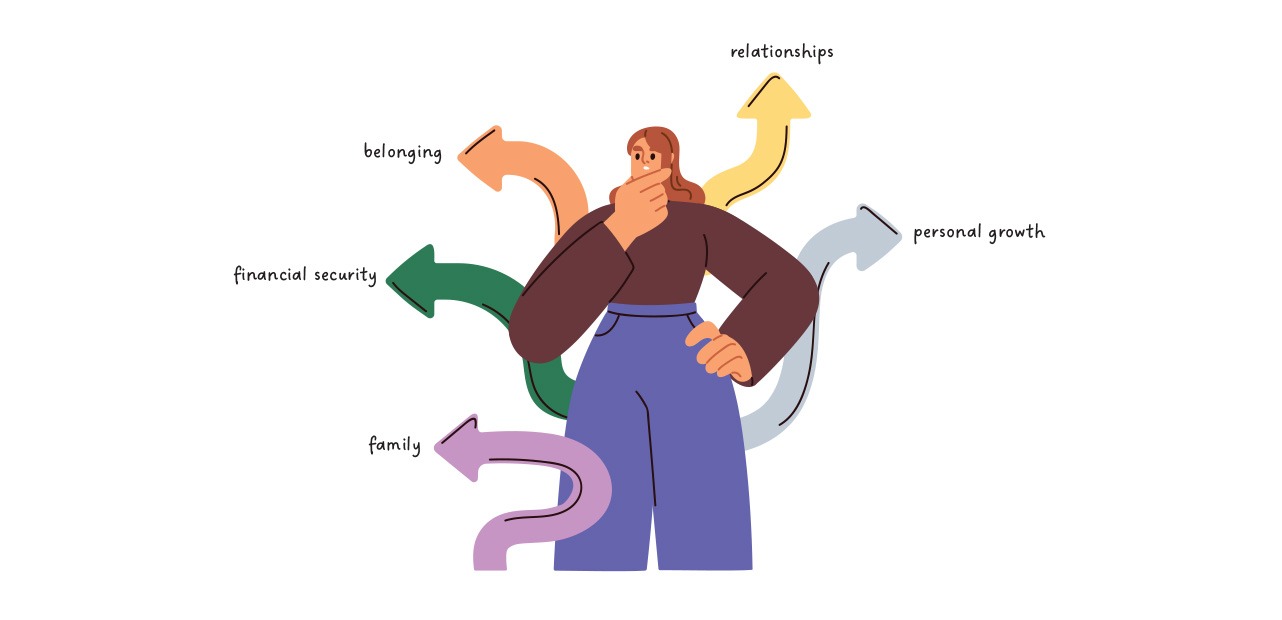
The study identified 15 values that matter most to this audience. The top five are relationships (82%), belonging (80%), financial security (80%), personal growth (79%) and family (78%). Health and well-being, personal responsibility, loyalty, experiences and positive environments round out the top 10.
But three of those values—financial security, personal responsibility and loyalty—stand out as “power values” because they’re far more motivating for this audience than for the general population. These are the ones worth paying close attention to. Think about what happens to each of those power values during a merger, a restructuring or a round of layoffs.
Financial security gets threatened directly. The question becomes “Is my job safe?” and every single announcement from that point forward gets filtered through that lens.
Personal responsibility gets scrambled. The people who pride themselves on being the reliable ones suddenly can’t be reliable, because nobody’s told them what reliability even looks like anymore.
Loyalty gets shattered. The people they showed up for are gone. The trust they built over the years has been disrupted.
This is the crux of your path dependency crisis. Every path these workers built has been interrupted, rerouted or destroyed.
Once you can see the path dependency crisis for what it is, the question becomes: What do you actually program?
I’m writing this for an audience of event professionals, so now that you know what buttons to push, you can take it from here. But just in case you want some thought-starters, I’ve put together a companion guide to this article called “Rebuilding Paths: Six Event Programming Ideas Grounded in Values Data” that gives you specific, ready-to-adapt session designs built directly from this study.
Leadership panels structured around Financial Security. Recognition moments that are designed for personal responsibility. Breakout sessions that protect what loyalty needs. Networking formats that create real belonging through shared experiences instead of awkward mingling. Facilitated conversations that give personal growth a foothold. And a closing ritual that activates all three power values at once and gives people something concrete to carry out the door.

—
David Allison is a keynote speaker, author and CEO of a research firm.
His interviews are based on the results of the Values Identifier, a product of Valuegraphics.
This article appears in the March/April 2026 issue. You can subscribe to the magazine here.