What does it really mean to be original?
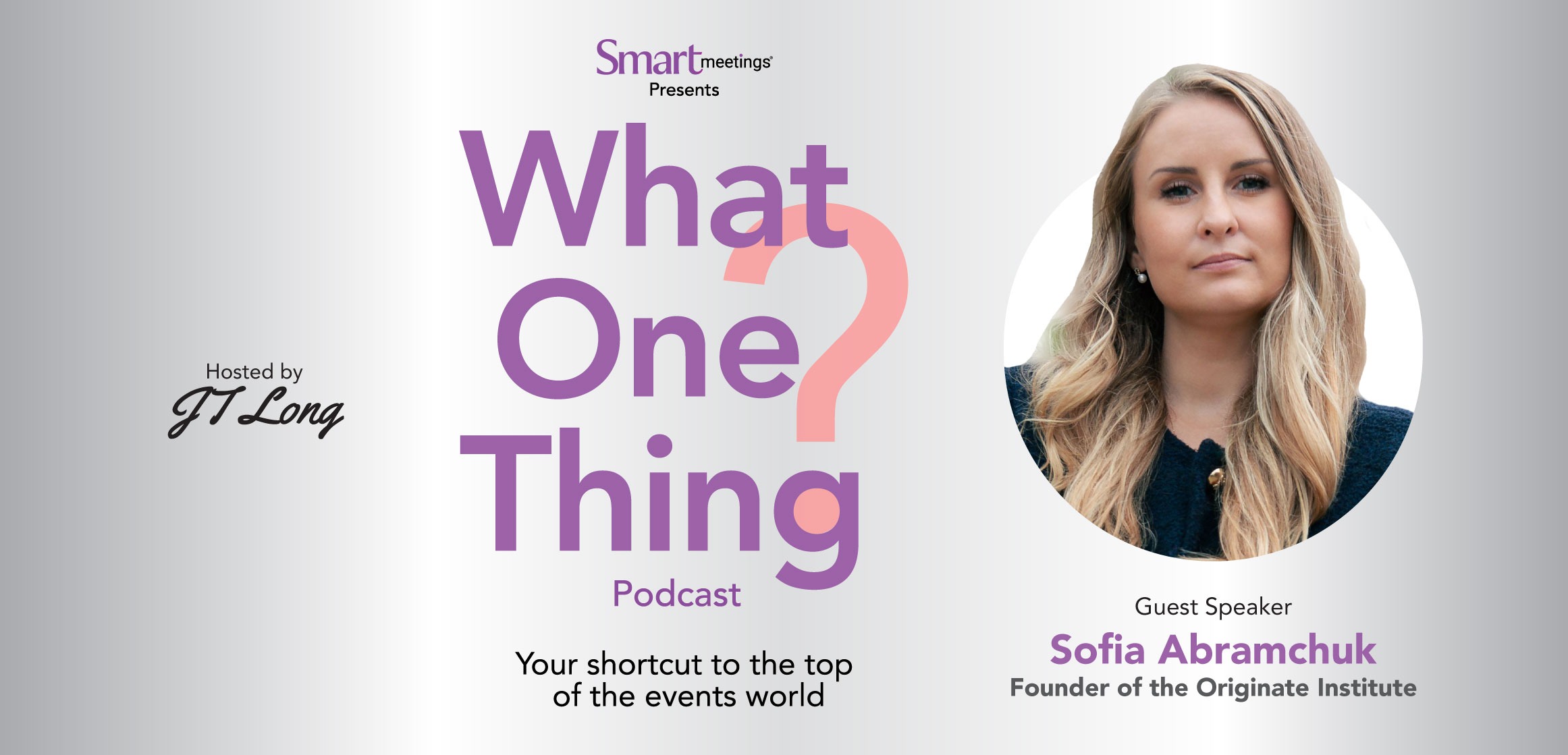
In this episode of What One Thing?, Sophia Abramchuk, founder of the Originate Institute, shares why the most powerful ideas are not created from scratch; they are uncovered. Inspired by the work of Antoni Gaudí, she explores how returning to the problem’s origins can unlock more meaningful, human-centered solutions.
From rethinking event networking to designing deeper connections, this conversation offers a practical framework for planners who want to move beyond surface-level experiences and create something that truly resonates.
JT Long (JL)
Hey, welcome back to the What One Thing podcast, where we ask successful people what made the difference in their lives and careers. Today, we are exploring the art of authenticity with Sophia Abramchuk, founder of the Originate Institute. She speaks Russian, English and Spanish.
We met in line at a hosted bar in Barcelona, where she introduced me to Spanish vermouth on the rocks with a squeeze of orange, which changed my life.
Sophia, did you know in kindergarten that you were going to be an originator? What is your personal origin story?
Sophia Abramchuk (SA)
Thank you so much for having me.
When I was a kid, I wanted to do everything. I thought about being a psychologist, a president, many different things. I was lucky to study a wide range of subjects, including business, art, product design and math, which gave me freedom to explore.
My defining moment came when I was 17 and visited Sagrada Família in Barcelona. It brought together engineering, biology, art, spirituality and structure in one place. That experience inspired me to study architecture.
Later, I dropped out because the work I studied felt lifeless. But years later, I came full circle and worked at the Gaudí Foundation. That is where I realized that many of the answers I was searching for already existed.
That idea led to a core belief: originality is going back to the origins. That became the foundation of the Originate Institute.
JL
For those who have not experienced it, explain what makes the Sagrada Família so unique and why it is still unfinished.
SA
The project began more than 150 years ago. When Antoni Gaudí took over, he expanded the vision significantly.
Instead of building horizontally like traditional architecture, he built vertically. He created part of the structure early to show people what it would become, which inspired ongoing support.
The building continues today because of that vision. It represents not just a place of worship, but a connection to nature. Inside, it feels like a forest made of stone and light.
It may never be fully completed due to how the city has developed around it, but what exists already is a powerful example of human creativity and long-term thinking.
JL
You have applied this philosophy in your own life, including time spent in Asia. How has that influenced your work?
SA
In many Asian cultures, there is a strong connection to tradition, nature and history. That aligns closely with Gaudí’s philosophy.
Through partnerships and exhibitions in places like Tokyo and Seoul, we have seen how deeply people connect with the idea of returning to origins. It resonates across cultures.
JL
Let’s bring this into events. How can planners apply this thinking in a practical way?
SA
One challenge we explored was networking. Only about 15% of organizers feel it is truly effective.
Using our method, we asked participants to look at nature, culture and history for inspiration. One idea was silent networking, where people connect by solving a physical challenge together instead of talking.
Another idea was recreating environments like bus stops, where people naturally connect while waiting.
The goal is not to think harder, but to think more deeply and intentionally.
JL
How does AI fit into this approach?
SA
AI should be used as a tool, not a replacement for human thinking.
It can help us research faster and ask better questions, but the creative direction still needs to come from us. Like Gaudí, we should use tools intentionally to solve specific problems.
JL
So what is the one thing our audience can take away from this?
SA
When facing a challenge, go back to the origins.
One practical exercise is to imagine your event as a building. Draw it out. Think about the foundation, the doors, the windows.
Are people welcomed in? Is the space open or closed? Where are the gaps?
This approach helps you understand the problem more clearly and unlock new solutions.
JL
That ties perfectly to hospitality. We are creating spaces where people feel welcome, safe and connected.
SA
Exactly. That is the essence of it.
JL
Thank you for sharing this perspective with the Smart Meetings community.
SA
Thank you for having me.