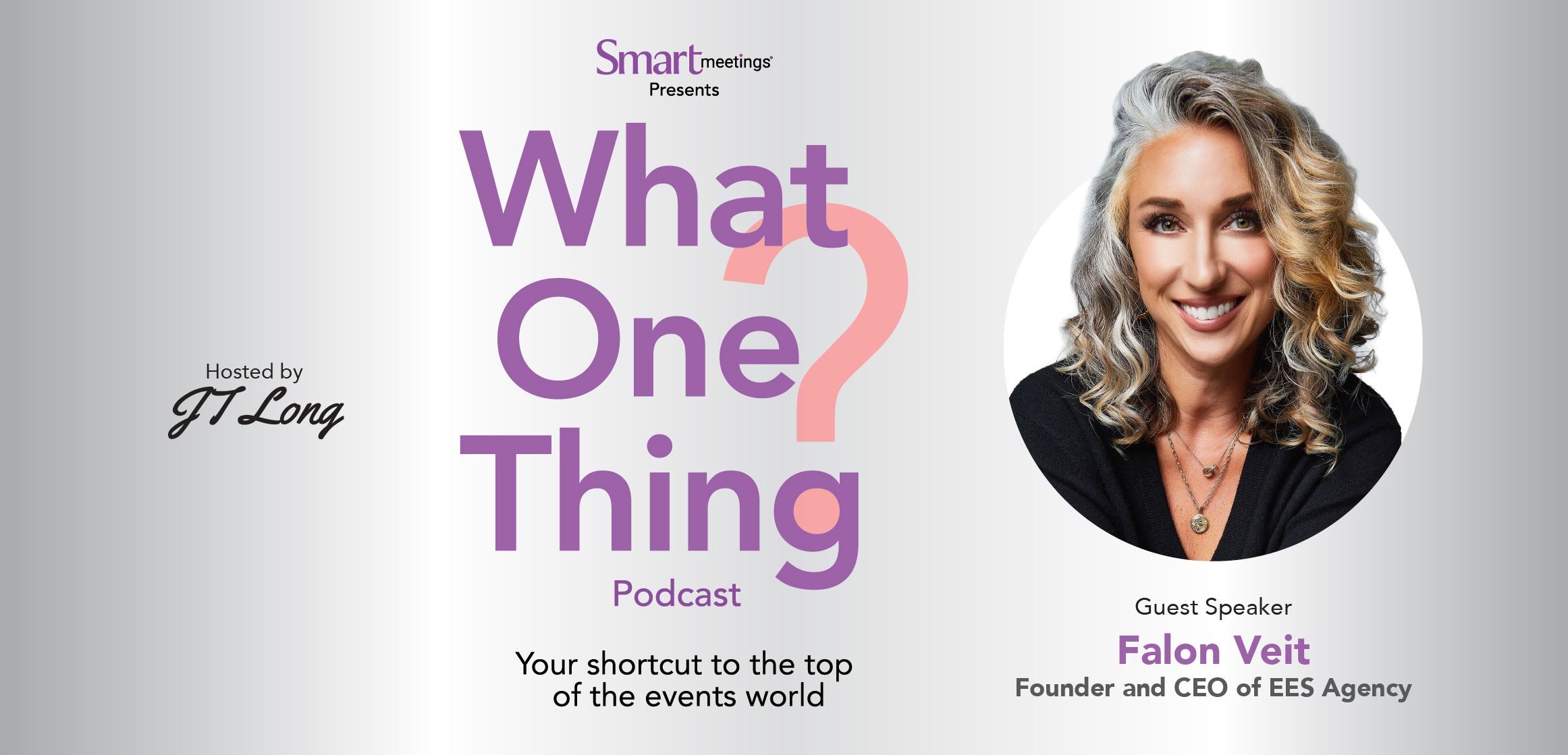
In this episode of What One Thing?, JT Long speaks with Falon Veit, founder and CEO of EES Agency, about why extraordinary event strategy begins with human connection. Veit reflects on her 26-year career in live events, the skills emerging professionals need beyond logistics and the role psychological safety plays in creating stronger employee, client and attendee experiences. Her one thing: Business only moves at the speed of human connection.
JT Long
Welcome back to What One Thing?, a Smart Meetings podcast that provides you with a shortcut to the top of the events world by asking successful people what made the difference in their careers and lives.
I’m JT Long, vice president and content director of Smart Meetings. This conversation could be the start of something completely different in your life because I am joined by Falon Veit. She is the founder and CEO of EES Agency and a former Smart Meetings Meeting Professional of the Year. She is a global event guru.
Falon, welcome.
Falon Veit
Thank you, JT. It’s so great to be here.
JL
It’s wonderful to connect. Our company was founded by an amazing woman, Marin Bright. She truly believed that in an industry where more than 75% of professionals are women, yet so many men still hold top roles at hotels and event agencies, it is important to give future and current leaders a platform by telling their fabulous stories. Then, we inspire more of it.
We’re excited you’re here. First, what is a global event guru? Did you travel around the world telling people where to sit when you were a little girl?
FV
I should have. I technically started in events when I was 17, so I guess I was kind of a little girl.
I’m a global event guru, and my whole team is as well. We have been traveling the world since EES Agency’s inception in 2012. I am in year 26 of a live event career, with a couple more countries and a few more gray hairs.
It’s interesting. I never knew events were a thing. I’m an ’80s baby, and when I was a little girl, I thought I wanted to be a NASCAR driver. No joke. I raced go-karts as a child. When I got a little older, I thought I would do something responsible and good for the greater good of mankind, so I wanted to be a pediatrician.
I went to college, immediately got out of pre-med and went straight into marketing, communications, public relations and international business. I fell backward into this career, and I never looked back. It is the most amazing thing I have ever done.
I’m 44 years old now. I think I can say that out loud. I talk to new people all the time, and they say, “You have so much energy about what you do,” just like the energy you have right now, JT. It feels so good to know that I’ve been doing something for a quarter of a century and still love doing it every single day.
JL
We are so lucky. The comment you made about falling into the industry is so common. When there is career day at school, so many people do not even know this is a choice. They may start in restaurants or with fun tasks, and then they realize it is such a diverse industry.
I also see that you are a professor. Is the next generation becoming more intentional about choosing this as a career? What can we do to help them see it as an option?
FV
Great question. I am in the thick of this right now.
I taught a senior event management class at Lipscomb University, and I actually found some employees there, which was great. Our company is headquartered in Nashville, Tennessee, and we recently opened a second office in South Florida, in the Miami market. We are closely connected with Florida International University, which has one of the top hospitality schools in the country.
Now, thank goodness, you can go to school and earn a master’s degree in this field. You can learn it from the ground up, which is amazing. We are putting some of our team members through their master’s program to make sure they have not only the event know-how, which they already have, but also the business knowledge behind events and the strategic side of the work.
The country finally figured out that people need to be trained in this rather than simply thrown into the deep end of the pool. It’s great.
JL
It is so important because that is how we counter the whole, “Oh, you’re a party planner,” argument. Our families may not even know what we do, but executives and policymakers need to know because we are an important economic, social and scientific force. Yet, we do not always get the support we need.
I’m a little older than you, and I went to journalism school a long time ago. The things I learned about inverted pyramid style and using a proportion wheel do not necessarily apply anymore. Of course, after doing the work for 30 years, I have learned a lot and constantly iterated.
What are they teaching in school right now? Is it the storytelling you do? Is it some of the more advanced knowledge event planners need?
FV
The class I led approached the material from a midlevel manager’s perspective. Because they were college seniors, I did not want to teach an entry-level event class.
I wanted to teach them what to do when a client is yelling and screaming in the corner of a ballroom, and they do not know why, but they have to go over, talk to the client and calm them down. What happens when a vendor does not show up and you cannot reach them? I focused on what we do when we are dealing with the fires that occur.
You can teach almost anyone how to write and read a banquet event order, negotiate a hotel contract or load a bus. That is not to say the people in the events industry are not smart. But it is what I call the squishy factor of dealing with people in the industry, usually clients and sometimes team members, and making sure professionals can handle what is happening.
That is how I developed my curriculum. FIU does it completely differently and takes a more comprehensive approach. I thought it was most important to teach managerial skills. When you become a director in my company, you begin managing people. Having that training and knowing how to work with people every day helps you grow their careers and set them up for success in sticky situations.
As event and meeting planners, we are personal concierges. We are therapists. We run all the errands. And, by the way, we plan the meeting, event, conference, travel and everything else. The ability to create psychological safety for our clients and team members is probably one of the most important skills.
JL
It has to be both. First, you have to make sure your team feels supported and knows they can go out there and sometimes make mistakes. It is a live event. Things happen.
I love that you are helping people not only learn from their own mistakes but also learn through authentic stories. We believe in that. We publish case studies about what happened when an event was rained out and how the team responded.
I recently wrote a story about a bartender who pulled a plug in the middle of a major sponsor’s speech. The entire ballroom went black, and there was one disco ball glinting at the top of the room. It happens, and you have to be able to recover.
FV
It’s going to happen. We are in the people business any way you look at it. Humans are human, and we make mistakes. That’s OK.
I tell my team all the time that if our clients were perfect, they would not need us. We would not have a job because they would have already figured it out and done it better than us a long time ago. We have to lean into and embrace the chaos of event and meeting planning. I agree with you 100%.
JL
In a way, you can teach almost anyone how to do this, but they also have to have that spark. Some might call it a disease, an addiction to the stress, the joy and the entire roller coaster of putting on an event.
FV
One hundred percent. My chief operating officer has been in the event industry for, I think, 38 years. I have been in it for 26 years. We finish each other’s sentences. Together, we are the perfect brain.
Sometimes, we look at each other, and he says, “We’re crazy.” I say, “I know.” We bought into this level of crazy and became event planners at a very young age. Running an event company is even crazier.
I do not know what I would do without the roller coaster of ups and downs. It teaches adaptability. You learn to roll with the punches, and I think that is a great mindset and skill set to have in life generally.
Because I entered events at a very young age, I learned that early. I love bringing younger people onto the team, throwing them in a little while also protecting them so they can see what the work is like. It is a roller coaster. It is a lot.
JL
You either love it, or you run fast.
FV
Exactly.
JL
We also joke that we are sometimes our own worst public relations people. We complain about the early flights, long hours, inability to eat and lack of work-life balance. Yet, we love our jobs. Why don’t we talk about the things we love so more people will want to do it?
FV
Absolutely. We really do.
This is the only industry I have ever truly worked in. I’m a meeting planner by trade. I just happen to run a company now. That is how I look at it.
I remember being in my 20s, and the story was, “I haven’t slept in three days. I think I washed my hair on Tuesday. I haven’t bought clothes or gone out with friends in a month. I have racked up 75,000 airline miles in the past 30 days.” That was how we talked about it.
For me, the shift happened around age 28, when I began doing more than event logistics and focused on business strategy. I started thinking about what I, as a 20-something-year-old, was bringing to the table for massive global corporations around the world.
You do not think about that when you are in the weeds, have not slept, have not shopped and no longer have friends. Then, a lightbulb went off. A couple of years later, I started my own company with that strategic mindset at its heart.
Flawless event logistics are the foundation of great meeting and event planning. But you also have to create human connection because that is what makes the logistics remarkable. It takes the work to the next level.
I was happy when that shift happened because it opened a whole new world for me. I started a business, worked on strategy, went to Vanderbilt and earned my MBA, and built a team of women and men. We started hiring men in 2021.
JL
Poor men.
FV
We have four of them now, and they are incredible. They are rock stars. I love those guys. I always enjoy saying that on women-led podcasts.
We put strategy at the forefront. It is not only my C-suite team members making business decisions. It is also the people with boots on the ground, the men and women who work every day and travel 250 days a year.
I tell them, “You may have flawlessly executed this meeting, but you also sent 250 salespeople out to make a billion dollars this year. That is awesome.” Not many people can say that.
That is how I think about the positive shift. In most careers, there is a shift at some point.
JL
You make a very good point. There are logistics, contracts, videos and everything else. Then there is the human side.
Humans need purpose and meaning. They need something you do really well, which is storytelling, and the emotional journey you take them on. How do you help people fulfill those needs?
FV
We have various roles on my team that focus on this internally first, then move it to the client experience, or CX, and the attendee experience, or AX.
A little over a year ago, I created a director of experience role. We also have creative and marketing teams that come together and dream things up. It is amazing.
The director of experience develops standard operating procedures so the experience remains consistent across the company, including how we treat our internal team and external clients. Then, the creative and marketing teams bring things to life.
What I personally love, especially when I step in to work with some of our top clients, is sitting in a space with four to six people from my team. We each have our own lane in a beautiful way. We have the experience lane, production lane, marketing lane and general creative lane. I usually sit in the strategy seat for some of those meetings.
We all take notes and ask our own questions. Then, we get together for a debrief. It is as if we sat in six different meetings because our brains operate differently.
The depth of knowledge on our team and the backgrounds of our team members create a full circle, or a complete pie, when it comes to creating the experience.
Experiential events are a relatively new term, at least in Nashville. The term has been around there for probably three or four years. We travel the world and see and produce these experiences elsewhere, but we still have to educate clients and others in the community about what it means.
People think it means having color-coordinated signs in the ballroom that match the company logo. They think it is only visual and tied back to the brand.
It is much more than that. It is knowing someone’s name when they walk through registration. It is making sure they have their preferred type of water in their hotel room, which is a real thing now. It extends all the way to how they are announced on stage, the song they walk out to, the aromatics in the space, and the touch and feel of the invitations.
That entire immersive feeling is what the different minds on my team develop in different ways. Then, the creative ideas go back to the strategy, and it continues in a circle. It is a beautiful process. It is absolutely amazing, and it has worked for us for a while.
JL
The people you are designing for may be in pain right now. They are lonely, scared and rattled because things change so quickly.
How do you help attendees feel they can still be surprised and delighted without being shocked and awed?
FV
For the past six months, I have been rolling something out to my team. We have a theme for the year centered on psychological safety. I do not know whether you have heard that phrase. There is a Harvard Business Review article I pulled up and made my management team read.
I needed to make sure we were creating psychological safety internally first. Then, that moves out to clients and attendees.
Maybe I’m jaded, but I do not really care whether there is a big-name musical act on stage. Maybe that is because I’m from Nashville and we know everybody. Some of the things I would call Instagram moments do not mean much to most people in the business world.
The way we try to transfer the idea to the attendee experience is through small touches that help people feel seen and heard.
It could be as simple as designing a meeting agenda when you know an issue has been bubbling up in a company for a while. You need to bring the director-level team together, but you have not been able to do that for whatever reason.
Do not simply put them in a breakout room and let them hash it out. Bring in a facilitator. Make sure they have lunch. Think about those small details. You have 10 people in a room, and you want to make sure they are heard and that their participation matters.
Then, work with the client to create an engagement plan after the meeting. We often come together at conferences, meetings or special events and want continuous engagement that moves things forward, but we do not follow through.
Making people feel seen and heard, even at a small level, does much more, in my opinion, than spending $2.5 million to bring someone in to sing on stage.
The performance creates a wow moment, but attendees cannot necessarily carry that emotion forward in the same way they can carry the knowledge that their company cares about them, their team supports them or their boss heard them.
Maybe they have been raising a problem for six months, and now they are sitting in a room talking about it. Then, the following week, they receive a follow-up newsletter or another communication that continues the conversation and moves it forward.
Those small actions matter, especially because budgets are being squeezed from all sides. Making sure engagement and communication continue between annual conferences, quarterly meetings or monthly board meetings is a big part of psychological safety. It also helps ensure the actions discussed during the meeting are carried out afterward.
JL
That is real, and it affects lives. It does not necessarily cost more.
One thing we often talk about is that if your budget stays the same year over year while inflation rises, especially the price of beef and the cost of getting people to the event, your budget is actually shrinking.
FV
It is, and people do not understand that.
It is difficult when someone says, “We did this last year, and I need to make it better this year.” I say, “Then I need at least 15% more.” They say, “We don’t have that.” Then, we have to figure it out.
Coming out of Covid was amazing for us and, I’m sure, for many others in Nashville. It was as if someone turned on the faucet in 2021. Our revenue seemed to quadruple in 24 hours.
One beautiful result of having to think differently about money during that period, which has carried forward, is that we learned to come up with different approaches.
When I train my team and bring them further into the experiential side of the market, we do things differently. As I said, it is not about Instagram moments. It is about things that do not cost much but make someone feel that another person cares about them.
We produce many internal meetings, such as sales kickoffs, trainings and educational sessions for global corporations. Sometimes, a client brings in an act or a top keynote speaker. Sometimes they are good, and sometimes they are not.
When we make small, thoughtful choices, from the way attendees are communicated with in email blasts to the registration process, which may be the most important part of the meeting, we make sure they do not feel hectic or harassed throughout the process.
The people who lead meetings with those small touches go out and accomplish much more than the people who do not. We learned a lot, and we continue pushing that forward.
JL
So smart. I love what you have done to bring your attendees, customers and team together.
What is the one thing? That is the name of this podcast. What is the one thing our community can learn from you and apply to improve their careers and lives?
FV
I thought a lot about this, and I have about 17 things. I’m going to pick one on the fly based on what we have been discussing, although they were all well thought out.
At the end of the day, business only moves at the speed of human connection. I think we have to remember that.
If people do not believe it, feel it, hear it and see it, then the strategy you are putting into it does not matter. That applies personally and professionally, whether you are thinking as a company, working as a doctor or working as an event planner.
Since Covid, we have taken a step back and looked closely at the people we work with, why they do business the way they do, what problems they have coming down the pipeline and how we can solve those problems with them from an event strategy standpoint. Then, we make sure people feel it.
That is a game changer. I know this is Smart Meetings and we are all event professionals in some way, shape or form, but it applies to anybody. Business moving at the speed of human connection is real. If people are not connecting, business is not moving.
JL
It has to be real connection. You keep the why at the center and remain honest and transparent. That is how you move everyone forward.
FV
We have all sat in meetings before, not meetings we produced, of course, but meetings where someone is standing with a clicker, running through statistics on a PowerPoint deck.
You are being talked at, not talked to or with. Everyone is looking around. Nobody is paying attention. They are on their phones, which is a real issue now.
We have clients who do not allow internet access in their ballrooms, which I think is genius.
JL
Wow. How do they keep people from rebelling?
FV
You walk into the room and cannot get on your email.
When people are being talked at and simply informed, there is no feedback. The slides may be too cumbersome. The lighting may be wrong. The chair may be uncomfortable. It could be anything.
If you are going to announce something that changes the trajectory of the business, ask salespeople to double their quotas or change the executive committee, you have to make the space feel comfortable. You have to talk with people, not only from the stage.
Go into the audience. Talk to them during the coffee break. Be strategic about where people sit at dinner and who rides on which bus. There are so many ways to build connection beyond a presentation.
Otherwise, people are simply looking at information that is not hitting home. Someone says, “We’ll send the deck out later.” Nobody is going to open that deck and read it. Even if they do, they may not understand it because they did not connect with it in person.
Take that extra step. As hard as it can be, try to be fully present on-site as a leader. That is my note to clients: Please do that.
Put family matters aside for a moment. Put aside whatever conflict you may have with team members. When you are on-site, connect with the people who are there in person because that is where things move and where business happens.
JL
We know that in real life. If you are only giving people a passive presentation, you may as well do it in a virtual session because there is no interaction.
We do what we call a sunrise rave to begin our events. We bring in a DJ, and we do square dancing. Our president, Luc Troussieux, is right there dancing with everyone else. That helps everyone feel that it is OK to participate.
As soon as attendees move, the activity activates their endorphins. They are awake and engaged, and they have done something together. When they sit down for their one-on-one meetings, they have already experienced something together and feel part of the group.
FV
If you can find a way, within your time and budget, for attendees to experience something together for the first time as a group, it moves mountains.
We recently did this with my team. I have about 35 people, and we took them to a retreat outside Nashville. We went zip-lining and did archery and axe throwing. I do not think any of us had ever done those things together.
When we left those activities a few hours later and returned to the meeting room, there was a different buzz. It was so much fun.
None of what we are talking about is rocket science. I think that is where people get caught up. None of it is hard to do. It simply requires sitting down and thinking, “This is the agenda I have written for this meeting for the past decade. How can I make it 1% better?”
It is like “Atomic Habits.” How can I make it 1% better? How can I make sure human connection is happening?
You can move money around in a budget and make it work. You just have to have the intention to do it. That is the difference. You have to have the intention.
JL
That sounds like a wonderful one thing.
Thank you, Falon, for joining us, for being a dynamic part of the Smart Meetings community, for everything you do to serve as a role model for the people coming up and for helping make this the brilliant industry it is.
FV
Absolutely. Thank you.
JL
Smart Meetings’ What One Thing? was produced by Bright Business Media. Visit SmartMeetings.com to subscribe to your daily dose of inspiration.