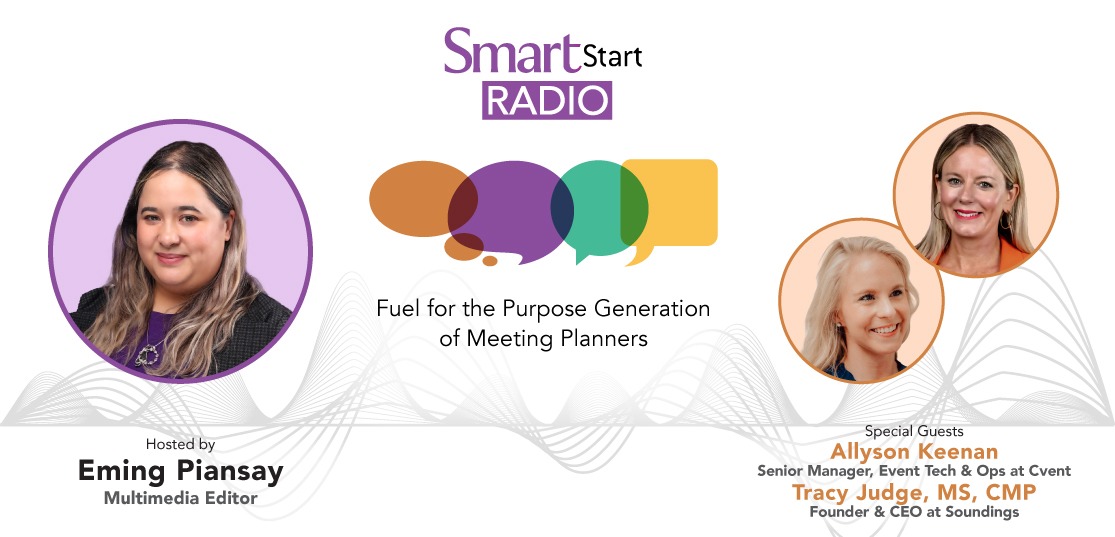
AI is already changing how events are planned, marketed and experienced, but using more tools does not automatically lead to greater productivity. In this episode of Smart Start Radio, Smart Meetings Multimedia Editor Eming Piansay speaks with Tracy Judge, founder and CEO of Soundings, and Allyson Keenan, senior manager of event technology and operations at Cvent, about how planners can move beyond experimentation and apply AI strategically.
They discuss responsible data use, event-specific applications including attendee matchmaking and room assignments, why AI is not always the right solution and the skills emerging professionals will need to guide change. The conversation also explores how organizations can protect proprietary information, build useful workflows and keep people at the center of AI adoption.
Further Resources
Cruising Into an AI-Plus Event Future
AI Is Here. Are Event Teams Ready?
Eming Piansay
What if the most productive part of your next event was not another breakout session, but a conversation about whether you are using AI the right way or accidentally giving away your competitive advantage? AI is reshaping how we plan events, from chatbots and content creation to attendee matchmaking and room assignments. The technology is here. Safety is moving beyond a nice-to-have policy and becoming part of how smart organizations use AI. From knowing what data to protect and what to share to understanding when AI is the solution and when it is not, responsible AI is becoming a competitive edge.
Welcome back, Smart Start Radio family. Today I am speaking with Tracy Judge, founder and CEO of Soundings, and Allyson Keenan, senior manager of event technology and operations at Cvent, about what AI adoption can look like when planners think strategically about the whole picture, not just the tools.
AI still feels like the Wild West. In your opinion, where are event professionals using it well and where are they missing opportunities?
Tracy Judge
We first have to define what proper use means. There is the ethical use of AI, and then there is using AI in the right way to make events more efficient. I think about those as two different things.
We conducted research over four quarters and combined the data from the full year. AI adoption increased from 59% to 77% of respondents, which is great, but we did not see a comparable increase in reported productivity. People are starting to use and experiment with AI, but they are not necessarily using it in the ways that have the most impact on events.
Allyson and I spoke many months ago about how her team was using AI. She asked for feedback and data from our survey, but I told her she was already far ahead of where most people were.
Allyson Keenan
We are still experimenting. I like the distinction between the ethical piece and practical applications. The results from the Soundings research make sense. At a minimum, people are using AI to draft emails or produce Zoom takeaways.
There are two ways to raise the productivity number. The first is to use AI for things you are not doing now that would add value. Before a one-on-one, for example, AI could review my Slack messages and emails, then flag what I should discuss with that person to make the conversation more meaningful and productive. It could ingest candidate resumes, understand the role I am hiring for and generate interview questions. It could also turn a large amount of data into a digestible infographic instead of sending stakeholders a table full of numbers.
We are also trying to use post-conference presentations and transcripts to generate executive summaries. The current state is often, “Here is a 30-minute Zoom recording and a 60-page slide deck. Please use them to make an investment decision because you missed the meeting.” An executive summary makes that information much easier to use.
The second opportunity is impactful productivity at scale: looking at existing workflows and determining where AI could save time. I recently asked Microsoft Copilot to review my email from the past year and identify the things I was most frequently asked to produce. It created a summary of where my time was going. That gave me a clear indication of where AI might save time at an individual level.
EP
Should teams be trained to use AI ethically? When they are working with sensitive information, how can they avoid causing harm by accident?
AK
The first rule of thumb is to check whether your organization has an approved AI policy. Many organizations now have policies that outline the dos and don’ts, which tools employees can use and what information they should or should not enter.
Anything you would not put in a public forum should not go into a public generative AI tool. You also need to ask vendors how they use your data and whether it is used to train their models.
I have wondered whether using my information for training is always bad, because it can produce more customized results. The other side is that you may have a proprietary process or something unique that gives your company an advantage. You do not want it shared in a way that lets competitors recreate it. Teams need to think beyond the immediate result and consider downstream consequences that we did not have to weigh before.
TJ
In many cases, you do not need to give AI proprietary data to get the result you want. If you are analyzing contracts, for example, you can remove identifying information first. Replace attendee names with numbers and reconnect the information later. You can still get value without entering all of the original data.
I think about the risk of sharing my own processes and business ideas because AI is helpful for brainstorming, organizing strategy and providing feedback. I am not giving away someone else’s information, but I still ask myself whether I will fall behind if I do not use it. What is the likelihood that someone else will think the way I do and ask the right questions to retrieve something similar? These are new considerations for anyone building a business today.
EP
We understand how office teams might use AI internally, but where is it showing up in events themselves?
TJ
Our study found that content creation remains high, with about 65% of respondents saying they use AI for it. Other marketing applications and chatbots also ranked highly. Two of those three areas are marketing-related rather than operational.
When we look at strengths across the industry, about 70% are relationship and execution strengths, while roughly 30% are strategic and influence strengths. AI can help a planner with content creation or marketing even if that is not an innate strength. It adds skills to the toolbox and can make that work more efficient and accurate.
Where we see less traction is in workflows and operational uses that could increase productivity. AI may allow people to manage more of an event’s life cycle, but a specialist with deep expertise and AI will probably still outperform someone whose natural strength is elsewhere. The technology levels the playing field in some ways, but specialists still have an important role.
As we move toward workflows and agents, people will also need to know how to lead those agents from a place of competence. Specialty expertise will be essential to defining the rules, nuances and steps behind an AI skill.
AK
A subject matter expert in production, for example, would be the brain behind defining what an AV production skill should do.
Our team has used AI on the production side to generate run-of-shows. We have also combined conference room contracts, registration reports and capacity data to see where rooms may need to change or to help make the assignments. Work that once required many manual hours and multiple spreadsheets can sometimes go from days to hours or even minutes.
Because we use Cvent’s own technology, our team can also use built-in features for transcriptions, attendee matchmaking, snapshots, takeaways and chatbots. A low-barrier way for planners to begin is to examine the tools they already use, identify the AI functionality already available and try an out-of-the-box feature before building something from scratch.
TJ
I used attendee matching at Cvent CONNECT for the first time last week, and it was fun. The app did not only recommend people; it explained why it made each recommendation and drafted a message I could send. I kept looking at who it connected me with, why and what message it suggested.
AK
I do not know the exact technical logic, but it can look at interests, session attendance, exhibitor interactions and other micro-interactions to build an attendee profile and identify relevant matches.
TJ
Conceptually, it is similar to a dating app, but it is very useful at a conference. The better the information you provide, the better it can help. At industry events, we naturally catch up with people we already know, and it can become difficult to meet someone new. Matchmaking can make that easier when it connects you with the right people.
EP
I attended an AI session about a year ago that was packed. When the speaker asked who had used AI, almost everyone said no. Many said they were nervous about it. What are you hearing from planners who do not know how to approach it?
AK
At Cvent CONNECT, we ran audience polls during several AI sessions to understand current use and what was preventing adoption. The resounding themes were, “I do not know where to start,” and, “I do not have time to learn a whole new thing and fit it into my existing process.” People want someone to tell them what steps to take and which tools to use.
That is easier said than done because the right tool depends on what you are trying to accomplish. What problem are you solving? What outcome do you want? You have to answer those preliminary questions before you can match the work with the right tool.
TJ
The sheer number of tools can also scare people. I do not love hearing that someone has no time to learn AI. We gave Nikki on our team a project and asked her to use AI to make the work more efficient. She saved about 40% of the time it previously took while she was learning the technology. It can improve productivity quickly enough that learning does not necessarily add time overall.
The starting point is still hard. A general tool such as ChatGPT or Claude can help because you can describe what you are trying to do and ask it to recommend an approach. Then you can follow along. You first have to learn the language, understand how it works and learn how to interact with it.
AI is very personal. I will not use it in the same way Allyson does. We may pursue the same result, but how we get there will be rooted in how each of us thinks about the process. A company can build workflows that others can follow, but learning it for yourself is a personal journey.
AK
Different people can get very different results. A colleague may ask how I generated something, then I will show them my prompt and realize they asked only for the final output. That did not give the tool enough information, so it filled in the blanks.
Prompting is a skill. You need to know the work you are doing, the objective and what you are trying to achieve. Adding that context produces a very different result from going in blind.
TJ
Delegation can become complicated because someone else may use the same source information and the same tool but produce a very different output. Sometimes it is easier for me to begin again and guide the tool myself than to start with someone else’s work.
AK
During companywide AI training, our IT team told us to treat AI like an intern. What would you ask an intern to do? How would you review what they gave you? You would probably need to provide more context and go back with feedback. There are also tasks you might not delegate to an intern because it is easier to do them yourself. AI requires the same judgment.
TJ
I sometimes find myself fighting with AI. One day it gives me something great with only one small change; the next day I may keep asking why it does not understand me. Some days it is on and some days it is off. That also depends on whether I am being a good teacher that day.
I give positive feedback when it gets something right because I want to teach it what I like. At the same time, ChatGPT can be so supportive that you have to make sure it is still telling you what you need to know, not simply validating you.
AK
I tend to use ChatGPT more for personal questions and Claude more for professional work. In the future, different tools may become the natural choice for different use cases. Organizational contracts will also influence that. If a company has an approved agreement with Anthropic, for example, employees may be able to give Claude more information securely, which will shape adoption.
TJ
AI models can also sit behind other products. You could be using Claude, ChatGPT or Gemini through an overlay without realizing it because you are interacting with the product, not directly with the underlying model.
EP
I am also working on a Smart Meetings feature about hospitality education and how people entering the industry are learning to work with AI. What should students consider while they are in school and as they begin their careers?
TJ
I sit on the California State University AI Workforce Acceleration Board, which brings together the university system and major technology companies. Universities are still working through questions such as when AI becomes cheating. At the same time, if students do not learn to use AI, we are not preparing them for the future.
Students still need industry knowledge. You need to understand the problem you are solving and what the work looks like in real life before you can use AI to make it more efficient.
There is a great internship opportunity here. A company can teach a student the industry context, describe the problem and let that student use AI to explore solutions. The organization gets help building work it may not otherwise have time to develop, while the student gains business context. When those students enter the workforce, they can support team members who are less comfortable with technology or simply do not have time to do that work.
AK
I read about a professor who leaned into AI instead of running every paper through an AI detector. The professor asked students to have AI generate a report on a topic, then research the topic themselves and identify inaccuracies, missing context and misinterpretations. That teaches students what AI can and cannot do without pretending it will disappear.
Some transferable skills are AI readiness and understanding how data, processes and systems work together. People should know what AI can do versus what an automation or integration can do. In some of our use cases, AI was not the answer. The process needed to be redesigned, an integration needed to be tightened or an automation needed to be developed. AI might be layered into the final solution, but simply putting AI on top of the problem would not solve it.
Process engineering is useful across roles and industries: understanding how a process works, how to redesign it and how to build the right solution.
Change management is also critical, even if it does not sound exciting. You need adoption, buy-in and advocates who will use what you built. You also need a plan to govern and maintain it. Leaders have to communicate the vision for the change, explain why it matters and show people why it is important to them.
TJ
My team loves to build things. We see a problem, understand our systems and know how technology connects, so we build a solution and move on. We sometimes forget change management. If no one consistently guides adoption, the system provides no return on investment and the time spent building it is wasted.
Young professionals can develop those skills by volunteering with local associations and gaining experience with projects that require change. The emotional intelligence component also matters because people have very different feelings about AI. Some are excited and others are worried. To bring someone along, you need to understand the path that person needs.
AK
Emotional intelligence is essential to understanding how a change will be interpreted and gaining buy-in. Over the next six to 12 months, organizations will need people who can help define the future state of work.
Leaders should identify roles that may be heavily affected, especially those centered on data manipulation and reporting, and determine how AI could support them. Those people will still be needed to manage agents and provide the human touch point, but they will need the skills to oversee AI as it takes on monotonous or repetitive tasks. Organizations should identify the trajectory of each role and begin preparing people for it now.
TJ
Careers will become less linear, and skills that may have been called “soft skills” or “people skills” will become increasingly important.
Learning an event platform is not only about adding a product name to your resume. Think about the business knowledge you can gain by using that technology. What information do you need? How should the system be built to collect it? How will you present it? Event technology can give you data to share with leadership, and AI can help analyze that information, create an executive summary and support you in presenting to the C-suite. The important question is not only whether you know the technology, but whether you understand why it was built and how it contributes to the business.
EP
Before we wrap up, what should the Smart Meetings community know about AI safety and education that we have not covered?
TJ
Our industry has many Type A planners who want clear rules and guardrails. It will remain difficult to tell everyone exactly how to use AI or declare what is always right and wrong. The technology is evolving faster than organizations can create policy.
Use common sense. Think through how you are using AI, make sure that use aligns with your values and consider the risk. You will not always be told that something is definitively right or wrong. We have to learn along the way and use our best judgment.
AK
AI is part of the future, so we have to lean in together, use these platforms and share knowledge as an industry. I think of it like the early internet. The events industry once shifted from paper invitations to online invitations, and people had to learn a new process. Ten years from now, AI will likely be something we use every day.
We should be smart about it. This is not about throwing AI on top of everything that already exists. It is a chance to reimagine how work is done, eliminate tasks that no longer bring value and challenge the current state. That is exciting.
TJ
It is exciting, and it can also be scary because the future is not clear. We do not know exactly what roles or teams will look like or how quickly AI will catch up with products and businesses people have spent years building. But it is here, so we need to move forward.
EP
You have been listening to Smart Start Radio, a Smart Meetings production. Interested in being our next guest? Connect with us at [email protected].