In recent years, many event organizers have observed a notable trend: despite offering enticing early bird registration discounts, many attendees are hesitant to commit to conferences well in advance. Let’s delve into the reasons behind this hesitancy and what event professionals can do about it.
What’s Behind Attendee Hesitancy
1. Ongoing Uncertainties Due to Covid-19
The ramifications of the Covid-19 pandemic are still out there. Although vaccines have been distributed widely and many countries have experienced a decrease in cases, uncertainties remain. While cases are not as high as they were at the end of this summer, a newer variant is spreading, and experts predict that the patterns often seen over the last three years of the pandemic—the temperature drops, people cluster indoors, cases rise—will play out again this fall and winter.
Post-pandemic economic recovery has been uneven, leading to financial uncertainties for both businesses and individuals. As a result, many are cautious about allocating funds to nonessential activities like conferences.
For example, once a stalwart of conference engagements, the tech industry saw a 15% decrease in early registrations in 2023 compared to pre-pandemic levels.
3. The Rise of Virtual Alternatives
The pandemic propelled the world into the digital age faster than anyone could have predicted. As face-to-face meetings became challenging, virtual conferences and webinars became the norm. Even as physical conferences return, the convenience and lower cost of virtual events continue to appeal to many.
4. Flexible Work Cultures
The concept of work has evolved. Remote work and flexible hours mean many professionals no longer need to be tied to a specific location. This flexibility makes it harder for them to commit to a fixed date months in advance.
5. Overwhelming Choices
The sheer volume of conferences, seminars, online learning videos, webinars, and podcasts available to professionals is staggering. Attendees often prefer to wait and weigh their options closer to the date to ensure they’re making the best choice for their personal and professional development. Or worse…they won’t decide at all.
6. Trust in Last-minute Availability
With technology streamlining ticketing and registration processes, many attendees trust that they can snag a spot even at the last minute, especially if the conference is within driving distance from their home. This comfort, combined with the factors mentioned above, diminishes the allure of early bird discounts.
Strategies for Event Professionals to Secure Early Commitments
In light of the challenges mentioned above, meeting planners need to think outside the box to incentivize early conference commitments. Here are several strategies that can help:
1. Value Added Exclusives
Beyond financial discounts, consider offering early registrants exclusive benefits:
Exclusive Workshops: Special sessions only for early bird registrants.
Networking Opportunities: Early access to networking events or one-on-one sessions with keynote speakers.
Premium Swag: Unique conference merchandise that isn’t available to later registrants.
2. Flexible Cancellation Policies
Given the uncertainties, attendees want reassurance that they won’t lose out if they can’t attend.
Offer full or partial refunds for cancellations up to a specific date.
Provide an option to transfer the ticket to another person or defer to a future event.
3. Hybrid Event Models
Marry the best of both worlds by offering in-person and virtual attendance options.
Instead of a single early bird discount, consider multiple discount tiers. The earliest registrants get the steepest discount, and the discount rate decreases as the event date approaches.
5. Engaging Content Teasers
Release engaging content previews, such as snippets from keynote speakers or highlights from previous events, to generate excitement.
6. Loyalty Programs
Reward repeat attendees with loyalty benefits. Offer them:
Exclusive rates
Priority seating
Special recognition during the event
7. Collaborative Planning
Engage potential attendees in the event planning process. This can be done through:
Surveys asking for topic or speaker suggestions.
Online polls for theming or event logistics.
When attendees feel they’ve played a part in shaping the conference, they’re more likely to commit early.
8. Clear Communication
Ensure all communications clearly articulate the value of the event. This includes:
Detailed agendas
Speaker bios
Testimonials from past attendees.
9. Early Access to Hotel and Travel Deals
Partner with hotels, airlines and transportation companies to provide exclusive deals or packages for early registrants.
10. Collaborations with Industry Influencers
Engage thought leaders or industry influencers to promote the event. Their endorsement can motivate early registrations.
Conclusion
In the dynamic landscape of event planning, understanding the evolving needs and concerns of attendees is crucial. By adopting a mix of these strategies, event professionals can appeal to potential attendees and encourage them to commit earlier, ensuring a successful conference experience for all.
—
De-de Mulligan is a seasoned writer, digital marketing strategist and former event planner. De-de is a regular contributor to Smart Meetings and blogs frequently for rentacomputer.com. When she isn’t crafting compelling articles, you can find her hiking/biking the local trails or playing with her grandkids and granddogs. For collaboration inquiries or to just say hello, you can reach De-de at [email protected] or connect with her on LinkedIn.
Meetings from quintessential Virginia, to the mountains, to Capitol Hill
Make your way to the places where the fall foliage turns the red, orange and gold of everyone’s favorite autumn movies and art: New England.
Not only will you be front and center to some of the country’s most historic locations; you’ll have no shortage of convenient meeting space in a wealth of diverse locations. Whether you’re seeking a mountain retreat or the grandeur of the U.S. Capitol building, there’s a newly renovated hotel to host your next New England or Greater D.C. meeting.
Virginia Classic
Hotel AKA Alexandria
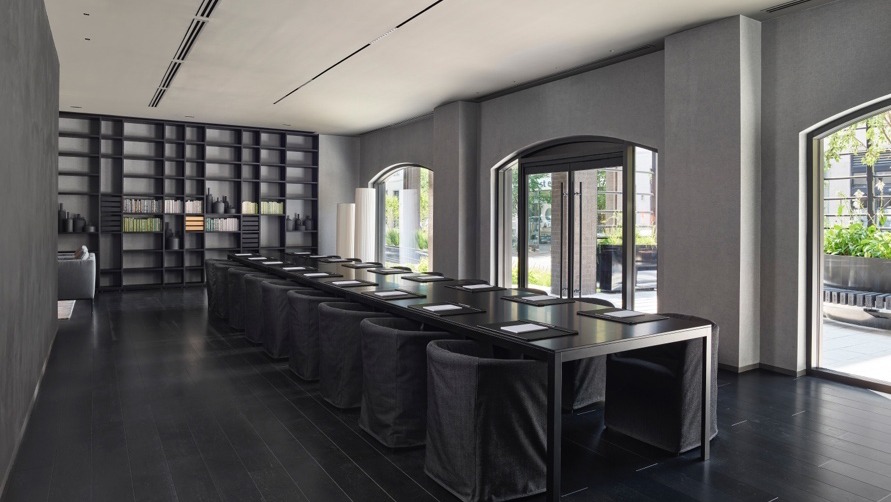
Old Town Alexandria sees the debut of its newest luxury hotel, just a 20-minute drive from the nation’s Capital, Hotel AKA Alexandria. Distinguished Italian architect Piero Lissoni of Lissoni New York oversaw the hotel’s design, which blends modern minimalism with mid-century elements against a charming brick-lined backdrop. Hotel spaces, from the lobby to 180 spacious guestrooms, are filled with an extensive art collection. The expansive meeting and event space, including a 2,200 sq. ft. ballroom and 900 sq. ft. pre-function space, also incorporates numerous art pieces.
The hotel offers a tranquil outdoor oasis, garden views and firepits at its a.terrace. Its a.lounge is sleek, modern party and celebration venue. A 1,200 sq. ft. executive boardroom with floor-to-ceiling windows is available at its a.conference. The hotel also offers a dedicated events team that will work closely with you to coordinate your perfect event, on-site catering and visual equipment setup.
Following a $150 million renovation, The Omni Homestead Resort, in the Allegheny Mountains of Southwestern Virginia, has reopened to guests. The hotel has been a staple for 250 years, housing 23 U.S. presidents throughout its history. Its design celebrates its past while putting forward a contemporary look and feel.
483 guest rooms now feature a distinct color palette of pink, blue, lavender and green alongside lovely floral patterns. 72,000 sq. ft. of meeting space made up of 28 meeting rooms includes the Theater, built in 1923, the Crystal Room, featuring sparkling chandeliers, the historic Empire Room and the renowned Grand Hall, now upgraded with timeless embellishments, custom carpet lined with classic hardwood flooring and elegant lighting. The renovation also saw the construction of a brand new 4,000 sq. ft. Old Course Pavilion which offers sweeping views of the iconic Tower and East and West Wings, charming brick pathways.
$4.6 million went into the rehabilitation of the iconic Warm Springs pool, the resort’s crown jewel, which is fed by four natural warm springs and has been an integral part of Bath County and Virginia history for centuries.
In the Heart of the Nation
Washington Capitol Hill/Navy Yard
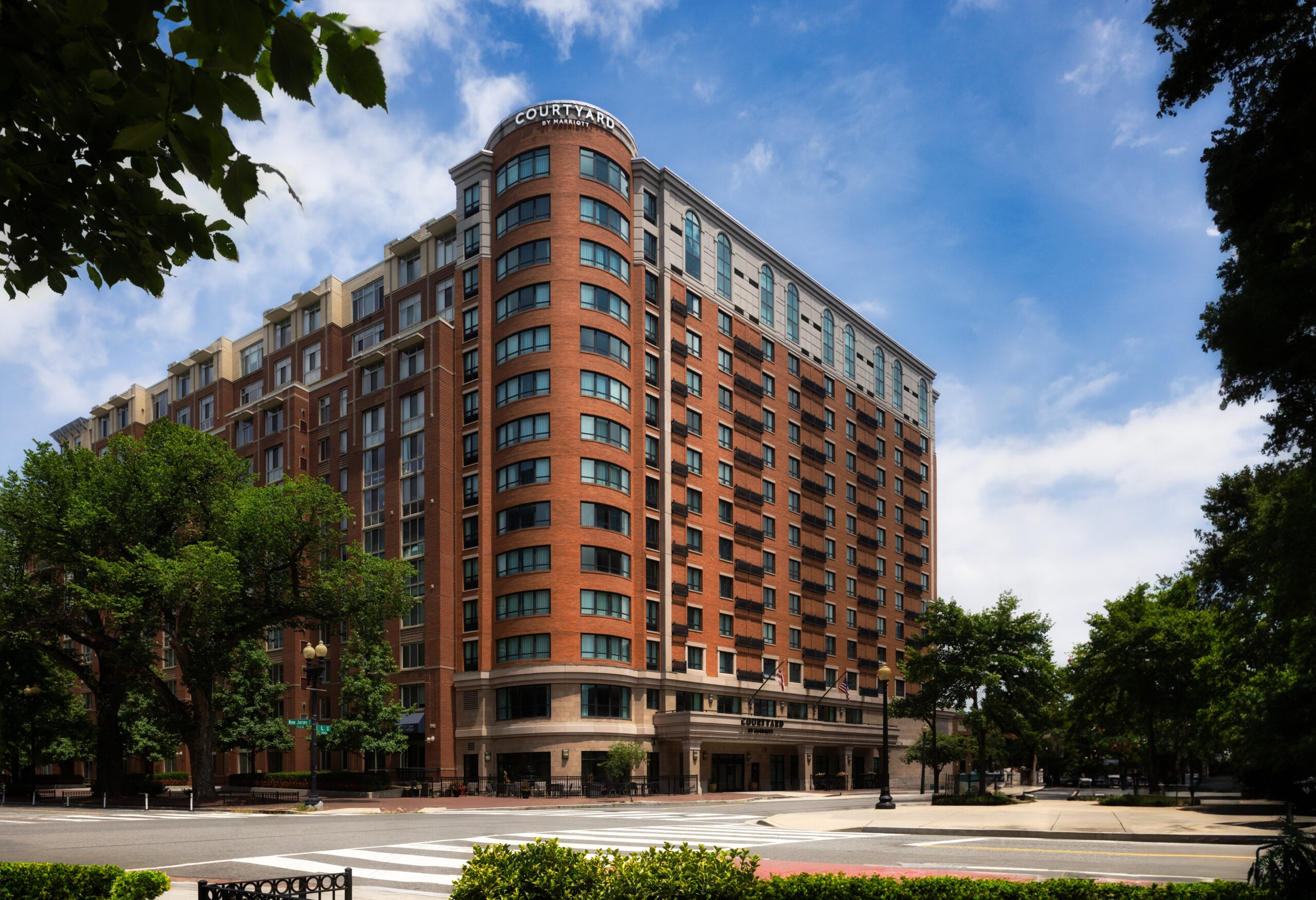
The Courtyard by Marriott Washington Capitol Hill/Navy Yard unveiled a comprehensive refresh that added an invigorating aesthetic, new, upgraded amenities and upgraded meeting space capabilities. Interior public spaces now feature vibrant murals celebrating the city’s history. Rich woods, deep blues and bright pops of color create an engaging, ambient atmosphere. Guests can relax with approachable food and beverage offerings enjoyed on a communal lounge space and adjacent outdoor patio.
All 204 guest rooms have residential-style comfort at the top of the charts and are perfect for unwinding as well as working. Stately wood and leather furniture, geometric accents and modern artwork stand out against a neutral backdrop. Guests can also enjoy the unparalleled convenience of mobile check-in.
The hotel offers 3,762 sq. ft. of versatile event space, all with floor-to-ceiling windows, ergonomic seating, upgraded LED monitors and sound systems and customizable table configurations. Each meeting room also offers a private balcony perfect for receptions and breakouts.
Experts weigh in on what needs to change to work together better
Editor’s Note: Hospitality sales consultant Steve Steinhart will be speaking at Smart Meetings Extraordinary Experience in Monterey, California, Nov. 5-7. Register here to hear him in person.
Steve Steinhart
Both planners and sellers will have to make paradigm shifts if 2024 is to become the new high watermark for group attendance and revenue.
Having interviewed experts from both sides of the equation, this paper will offer advice on what those shifts are and how you can benefit from them.
Calendar year 2024 is already forecasted to show a healthy increase in group rooms nationwide, largely due to the number of meetings that had been on the books in 2021, 2022 and 2023 that were postponed or re-scheduled into 2024.
A Renewed Group Focus
“Just hold the contracted meetings that are on the books and minimize the cancellations that have occurred in prior years due to the pandemic, economic uncertainty and a general reluctance to hold in-person meetings,” said Dan Piotrowski, senior vice president of operations for Omni Hotels. “If all the meetings that we have re-scheduled for 2024 come through, we will show a very nice gain in the group market.”
Piotrowski says that his global sales teams are making every effort to execute their “multicity-multiyear” program. If a group is looking to book in 2024, Omni may negotiate contracted rates and concessions if they will book more of their meetings with a sister Omni hotel in future years.
Piotrowski says, “2024 is looking good for group business and we are focusing our efforts on future bookings, especially for some of our hotel’s off-peak times. We know if the leisure sector demand remains softer than anticipated, and with the corporate business travel segment still slowly returning to pre-pandemic levels, groups must continue to be a large focus for the brand.”
Cost Conscious
A major component of the paradigm shift that will need to be addressed is that hotels enjoyed healthy rate increases as a direct result of Covid. Inflated rates were accepted by the leisure market traveling in distressed times. But those rates will not work for planners seeking value for their attendees.
“Group rates must come back down to Earth,” says Lynn Edwards, founder of Proper Planning. “Even in high-occupancy months we simply cannot afford these new post-Covid rate patterns and that is forcing us to abandon some of the more popular destinations and explore secondary and tertiary cities.”
“I understand hotel costs have risen.” Edwards says, “But I’m not at all sure it is fair that groups be the resource that helps them recover their losses by charging us higher rates with unreasonable contract terms.”
Bonnie Taylor, director of sales and marketing at Hilton Tampa Airport Westshore, agrees and has forecasted lower group average rates for 2024. “The window for raising group rates has closed and we are simply attempting to move groups into time frames that work best for both parties.”
The Restaffing Struggle
Hotels that had to furlough significant percentages of their sales, catering and servicing teams during the pandemic have not yet replaced them. Too often hotels do not reply to RFP inquiries. Or worse, the salesperson you connect with is inexperienced and unauthorized to quote rates or prices, needing to ascertain permission and “run it through the system.”
“There are some interesting dynamics currently, “said Lovell Casiero, senior vice president of commercial strategies with PM Hotel Group. “The tenure and experience level of both the planners and the salespeople are not what they were pre-pandemic. So, you have inexperienced buyers working with inexperienced sellers. We really must strive for a greater level of detail in the RFPs. Perhaps to include more than just the meeting specs.”
When hotels do respond, they often omit information in their proposals and contracts that had been discussed, information that is critical in the buyer’s decision-making process. Worse, the detail in the proposal is not what had been discussed and suddenly the prices have risen.
An important shift will need to be “hotels need to re-staff,” Edwards states. “If I can get budget approved for a memorable, fun event, I can create a memory. If I can create a memory, I can get more attendees excited about attending future events. I must increase attendance not only to hit my numbers but also to satisfy my exhibitors. My exhibitor count is down and the booth size they are requesting is shrinking. I need to get more people in the aisles but if the hotel doesn’t have the staff to decorate the general session room for an Arabian night’s theme party, I lose this opportunity. At a minimum, the hotel should know a local event planner who can fulfill our vision.”
A Needed Partnership
Shawn Anderson, divisional vice president of sales and marketing with Remington Hospitality, agrees, “There is great opportunity to collaborate with local businesses, sponsors and vendors to create mutually beneficial relationships that enhance attendees’ experiences.”
Planners are alarmed when they receive a response to an RFP that contains too much generic hotel or destination information or doesn’t address many of the specific requests. Rarely are they customized to their group. The RFP responses appear to be from templates that imply little, or no research has been conducted and the salesperson has done nothing to distinguish the hotel or destination. The proposal has not delivered any creative new ideas, no understanding of the scope of attendees and no feel for the program.
On the flip side, Taylor states, “I wish planners would answer their phones more often. I know they’re busy, but I do a lot of homework on a lead, and I want to speak to the planner to share the exciting ideas I have.”
Taylor continues, “I also wish planners would involve destination marketing organizations more. We can put forth a much better presentation and save the planner so many steps if they allow us to partner with our destination’s experts.”
Deb Sanders, director of California association groups with Remington Hospitality mentions, “While I see an equal number of buyers and sellers at the trade shows, I attend I rarely see any sellers in the actual meetings or breakout sessions. What a missed opportunity to understand a planner’s angsts if they don’t spend this valuable time with them.”
The Hybrid Problem
“The White Elephant in the room are hybrid meetings,” said Edwards. Some analytics show people taking advantage of “attending a conference” from home is no longer due to their fear of Covid but because it saves them travel time and costs.
The planner loses the guest room commission, the hotel loses all the room and F&B revenue, the attrition clause suddenly comes into play and the audio-visual charges skyrocket. The “home” attendee has no social interaction with the live attendees, thus stifling creativity.
Edwards argues conversely that while the hybrid model is not for every event, it offers accessibility and opportunity to increase your audience as well as access to virtual experts and presenters who might not otherwise be able to add value to your program.
A cost analysis must be done to weigh the hybrid investment against the return, but oftentimes virtual attendees receive more value by being able to attend every session versus being onsite and having to choose which sessions to attend.
Edwards relates, “One of our clients had secured an audience of 1,000 people consistently for an in-person event for eight years. When they went hybrid, they increased their audience to 15,000. This client will not want to give up that market share by going back to only in-person.”
Edwards c0ntinues, “A keynote or breakout speaker’s content expires once delivered. If you convert that content into videos or podcasts, you can re-package it and monetize it so many ways.”
Anderson agrees, “One of the most common comments on post-hybrid event evaluations is the value of one-on-one networking and collaboration.”
Shared Pain
Steve Tremewan, senior director of sales with Delaware North, says, “Suppliers have had bumpy years, but we must remember that planners are trying to bounce back from tough times also. We need to do everything we can to help them boost their number of events, attendees and budgets.”
Anderson continues, “We can help the planner by maximizing social media, influencer marketing and other digital strategies to reach a wider audience and generate excitement for upcoming events that will help drive attendance and capture feedback for future planning.”
Indeed, 2024 will have its’ challenges but could also be a year in which group business thrives. Suppliers must strive to provide better service, more and better-trained staff, lower rates, improve contract terms and be able to help planners create productive and memorable events.
Planners must consider whether the conference is best served live only or live with hybrid, bring new ideas with them and partner with suppliers to make them come to life. Helping suppliers understand the group’s goals will boost attendance, create a memorable event and aid them in generating more meetings.
AI, inclusive travel and an engaged workforce were top of mind in Lake Tahoe
DMA West took to the new Tahoe Blue Event Center in Stateline, Nevada, this October for its 2023 Education Summit & Vendor Showcase.
The event brought together 42 DMOs and 19 vendors, including Smart Meetings. The following three days included early morning experiential sessions, such as kayaking and horseback riding designed to showcase the city; thoughtful general sessions; engaging workshops; and opportunities to network. The general sessions consisted of several ideas worth pondering. We’ve recapped them below.
Don’t Neglect AI
In DMA West’s first general session, “Your Introduction to AI for Tourism & Hospitality,” Brian Matson, senior director of strategy and education of full-service tourism marketing agency TwoSix Digital, began with a story about the discovery of the early internet’s ability to connect people. “I graduated [high school] in 1997,” he said. “I had my 10-year class reunion coming up. I was the class president.”
As class president, he took on the responsibility of wrangling all his former classmates for the 10-year gathering. His reunion came shortly after the public introduction of Facebook, which launched in 2005. Matson said the platform was a game changer for him.
Through Facebook Matson managed to get ahold of just under half of his graduating class. “Thirty of the 70 people in our class were on Facebook and they were the only ones who showed up to the 10-year reunion because we had no idea how the hell to get ahold of anybody else aside from running into their mom at the grocery store or something like that,” he said.
This is when things became clear for Matson. Everyone who wasn’t on Facebook during this search for old classmates essentially disappeared from his world.
Post-Facebook, the internet was like the Wild Wild West, Matson said, but now in 2023, with copyrights, data privacy concerns and Google’s analytic tool Google Analytics 4, the way to approach events and event marketing is changing. “All of this new stuff, all of our metrics have to change. We’re having to adapt really, really fast,” he said.
He said a tactic he has seen many try is to produce more content but that isn’t the way. That is a recipe for disaster,” he said. “It’s also completely unattainable to be able to keep that frequency.”
This is where Matson said AI can be beneficial.
Matson was indifferent to AI a year ago, but after being approached repeatedly about it by colleagues, he began begrudgingly to use it, and his mind was blown with how he was able to streamline his day and he encourages everyone to use it. “We’re not putting it back in the box,” he said. “If you have been resistant to it at all, I encourage you to get on board. Don’t be like that half of my class in high school who I have no idea what happened to.”
Beyond creating creative email subject lines, populating topic-relevant hashtags and making video subtitles, AI can find zip codes in any given radius, convert Word Docs into PowerPoints in under a minute, cut up YouTube videos and creatr 30-second snippets with or without subtitles. The potential is seemingly infinite.
Matson emphasized that these tools are designed to open up bandwidth and not an excuse to do nothing. “These aren’t tools that will allow you to be lazy. It’s going to allow you to put energy in places where you haven’t had the time before,” he said.
He ended by encouraging those who’ve been on the fence to try it. “This stuff ain’t going anywhere,” he said. “It’s only going to get better and it’s only going to empower us. We should be encouraging everyone to use this stuff. Get on it.”
How You Can Be More Inclusive
Camilo Navarro
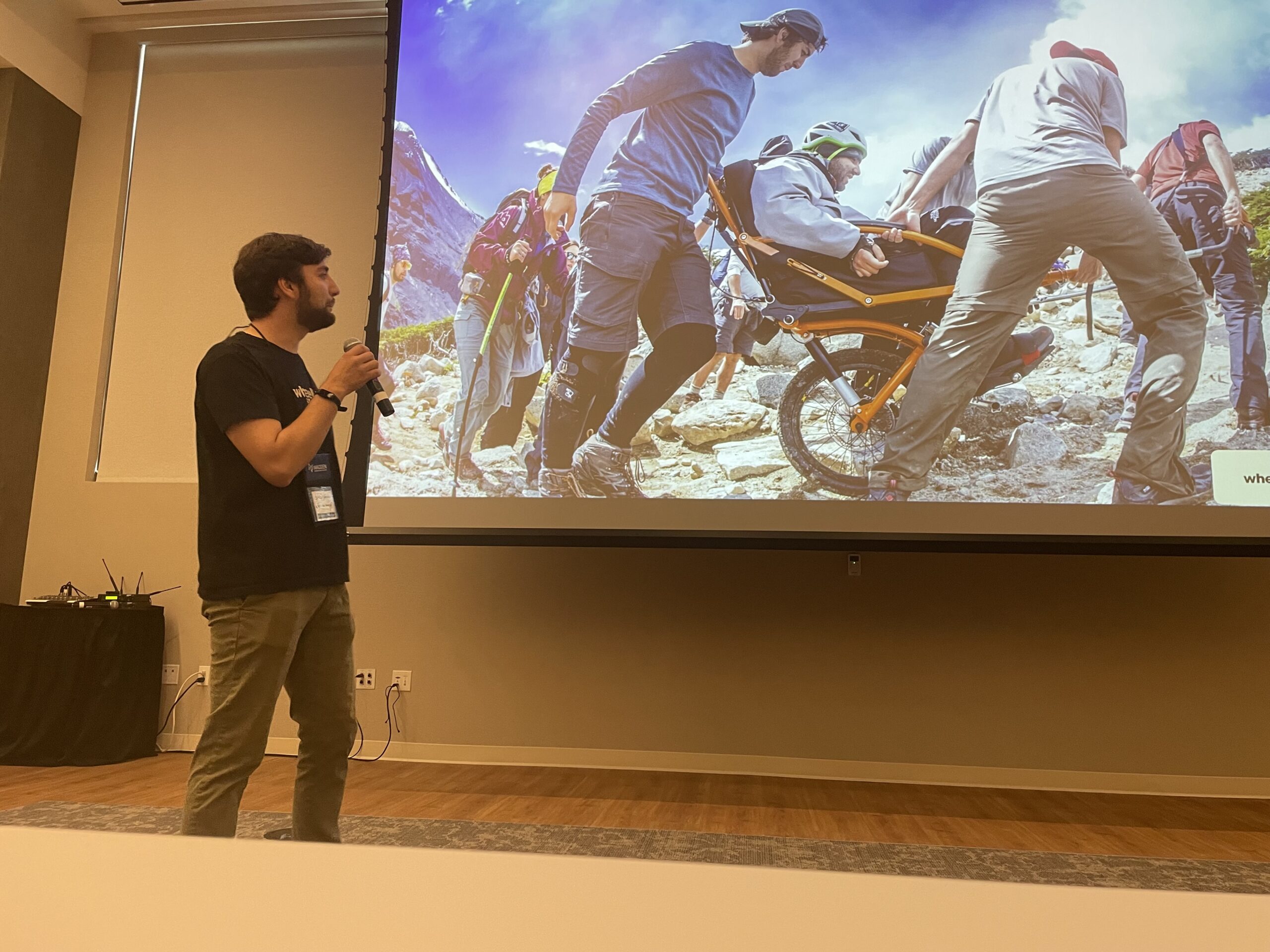
“Planning this trip was crazy, everyone told us we were nuts,” said Camilo Navarro, co-founder and chief operations officer for Wheel the World, an online guide for those with accessibility needs, when recalling his trip around Patagonia in Chile. What made this trip different from others was his close friend’s disability and the accompanying needs his friend required during their trip.
“It was very hard to find information,” he said. “For example, we couldn’t find where to stay, how accessible the hotel room was, how we could transport, what type of activities we could do. We also needed a special tracking wheelchair.”
After figuring out all these things on their own, Navarro said a local hotel reached out, and this is when the idea to create the guide was born. He and Alvaro Silberstein, co-founder and CEO of the company, had no expectations. They only wanted to provide information so others with accessibility needs could repeat their trip.
“It happened that we did the trip and the story went viral,” Navarro said. “Hundreds of people with disabilities are reaching out and asking us for help to repeat the trip we did. Hundreds of hotels and tour operators thought the online guide we did in Patagonia could be done in their destination—New York, Washington, Barcelona, Tokyo, essentially everywhere. We realized that maybe there was a bigger opportunity here.”
Navarro said he and Silberstein found that there are three main problems when it comes to traveling with a disability:
Accessibility information is not online: Information about wow accessible or inaccessible things are is not given in a granular way.
Information that is available is not specific: “People with disabilities need specific information to make an informed decision about whether a property can satisfy their accessibility needs. “You cannot infer that someone with disabilities has the same type of needs as another person with disabilities,” Navarro said.
Not enough is being done for those with accessibility needs: Navarro said when asking destinations, hotels and tour operators how accessible or inaccessible they are, the best answers he gets is that they’re ADA compliant but he said this isn’t enough.
There are roughly 1 billion people in the world with disabilities, and another 1 billion who are traveling with them. Wheel the World caters to those people, collecting more than 200 data points, including physical, cognitive and neurological-related disability needs captured by mappers who are sent out to properties to verify each hotel’s measure of accessibility.
After being reviewed by a mapper, a destination can then be granted a seal of approval, dubbed Destination Verified, showcasing that a destination is accessibility friendly. Visit Mesa was the first property to be given this designation.
The program has been in operation for eight months and they’ve partnered with more than 30 destinations, mostly in the United States. “We’re very proud of the destinations,” Navarro said. He added that the cool thing about working with so many destinations is that they’re constantly learning and improving the product.
Questions to Ask a Disengaged Workplace
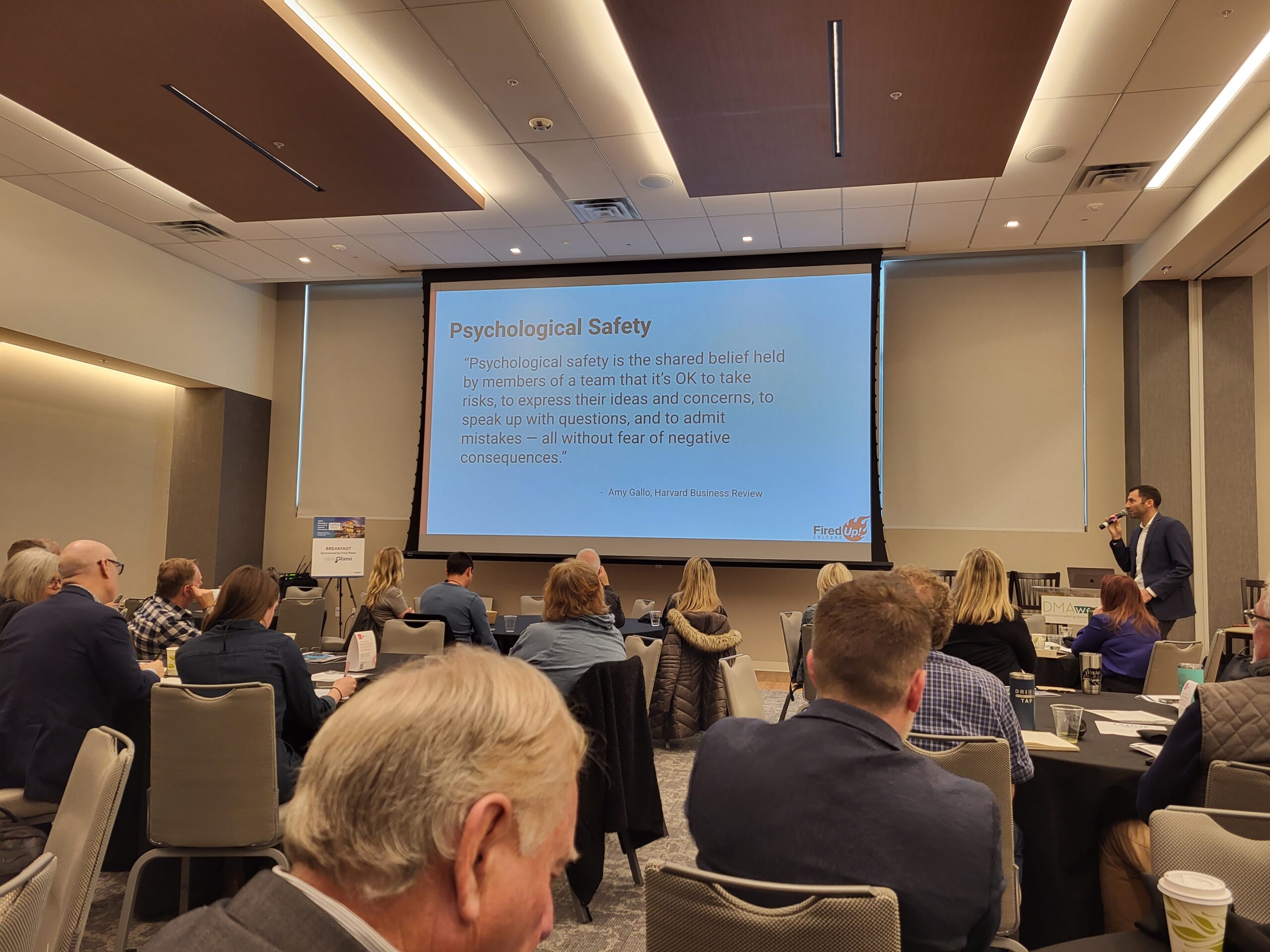
Chad Kearns speaking, Photo: Scott Flanagan
Chad Kearns, founder of Fired Up! Culture, opened his general session with an upsetting statistic: Only 31% of employees are actively engaged in their work. The destination industry’s percentage may be a little higher. Kearns believes the number could be closer to 50%.
“I think that’s still a bummer,” he said. “What we know about actively engaged team members is that they’re the people who drive forward, they’re the people building culture and the right culture in a really, really positive way.”
Kearns said to think about those in your organization who are engaged. “Actively engaged employees show up every day and they’re reliable,” he said. “Actively engaged team members are strategically committed. They know what the plan is, they know what the vision is, they’re on board, move forward and execute. They’re emotionally invested. They care. They’re building meaningful relationships with the folks they work with in the destination.”
While Kearns said engaged workforces have several things in common, there is one Kearns said isn’t given enough attention. “Psychological safety needs a better PR firm,” he said. “About 20 years ago, Amy Edmondson at Harvard found that the most influential factor in high-performing teams was psychological safety.”
Psychological safety can be defined as the shared belief held by members of a team that it’s okay to take risks, express ideas or concerns, to speak up with questions and to admit mistakes—all without fear of negative consequences. Kearns doesn’t believe it’s talked about enough.
“Here’s what we know about psychologically safe teams: They hold uncomfortable conversations about issues and problems. Anyone heard of healthy conflict? It doesn’t happen enough. Healthy conflict is how things get done. It should happen way more, but we avoid it because we don’t have psychological safety.”
Kearns said psychologically safe teams take ownership of their mistakes and move forward without casting blame. Kearns talks to a lot of people in middle management about this. “They have great ideas,” he said. Yet when he asks them who they talk to about their ideas, the response he gets is that they don’t believe their ideas matter and don’t feel comfortable sharing or raising issues.
Altogether, there are six practices of a psychologically safe team. In addition to having uncomfortable conversations and taking ownership of mistakes, they:
Raise concerns freely and openly
Ask for help
Directly challenge the status quo with new ideas and solutions
Celebrate failure and learn from it
According to Kearns, the national average in the United States of organizations that are psychologically safe is around 26%. He said the fix to this is setting up an “organizational culture of feedback.” “Culture is all about shared norms. It’s about the expectations that an organization has for everybody in it,” he said. “It’s the priorities of an organization. It’s the norms of an organization. Changing culture does not happen in a week.”
Building a culture of feedback is a four-step process, he said. “It all starts with asking for feedback, setting the example. I don’t care if you’re the CEO, I don’t care if you’re the intern. Every single person in the organization can ask for feedback, they can solicit feedback, set the example and start making the changes that you want to see.” After asking, the remaining three steps are:
Being proactive: When wanting feedback, go out and seek it
Establish routine: Make asking for feedback a recurring norm
Provide multiple feedback outlets: Find different ways to collect feedback
Regarding the last, Kearns said outlets could take the form of something as familiar as picking a topic and throwing all ideas on the whiteboard to get information flowing. “It’s all about getting people used to sharing their thoughts and ideas in ways that don’t get shut down,” he said.
Or hold a post-mortem session. “Get every single person in the room who was a part of that project. Maybe the leader of that project shouldn’t be there. Talk about what didn’t go well and what went really well.”
While asking for feedback about personal performance is encouraged, Kearns said there are even more ways to ask about feedback. “We can ask about so many different things within our organization. People have ideas. They want to be a part of it. Ask about processes. Ask about operational bottlenecks. Ask about leadership impact in the organization or team member well-being, collaboration, role expectations.”
Following feedback reception is how you respond to it, that determines if people will continue to give it. Kearns said reacting poorly to feedback shuts down communication and causes others to lose trust in you. “Be open-minded. Ask questions to clarify. Avoid gut reactions and quick responses, and express gratitude.”
The Events Industry Council (EIC) invites meeting and event professionals to participate in a survey that will help inform the next stage of the Certified Meeting Professional (CMP) standards and exam.
CMP accreditation has played a huge part in the lives of meeting professionals, with more than 12,000 CMPs to date. To keep up standards EIC conducts a competency profile project every five to seven years that uses feedback and expertise from industry professionals through focus groups, a task force and a survey. In 2024-2025, an updated exam and study materials will be available as a result.
The 30-minute survey is open through Nov. 12. Current CMPs receive 1 CE for completing the survey. Event professionals who are not CMPs can receive a 5% discount on the Sustainable Event Professional Certificate program offered by EIC.
“As our sector continues evolve, adapt and innovate, the CMP program is evolving to ensure its relevance now and into the future,” said EIC CEO Amy Calvert. “The CMP Competency Profile project is critical to identifying the knowledge, skills and abilities needed for global event professionals to maximize their strategic value to their organizations in support of a relevant, equitable and sustainable industry.”
Smart Meetings highlights many of these CMPs as part of the ongoing CMP Spotlights series. In the series, we learn about how they got their start, what they did to study for the CMP exam and where it has taken them.
Create one-of-a-kind, unforgettable group experiences
As we near the end of 2023, planners looking to finish their year with a bang may want to consider some interesting and different team-building activities to bring the year to a close. Check out these experiences available for your next group meeting.
Cabaret in Seattle
If you find yourself in Seattle, you may want to check out Teatro ZinZanni, the legendary theatrical cirque that is part circus, part cabaret experience that recently started its residency at Lotte Hotel Seattle. Teatro ZinZanni’s residency will run from October until March 2024. Guests get to experience improv, dance, music and so much more, paired with a multicourse meal. Group deals are also available, along with the option to choose from private events and pre-show rental space.
Elena Gatilova in Teatro ZinZanni Residency at Lotte Hotel Seattle
Lotte Hotel Seattle, located on 5th and Marion, offers a stylish 23,350 sq. ft. of meeting space across 15 meeting spaces, 189 guest rooms, expert meeting planners, advanced A/V services, high-speed Wi-Fi and gourmet catering. Lotte Hotel Seattle was named winner of Travel + Leisure’s World Best Awards in 2023.
On the 40-yard Line in Tennessee
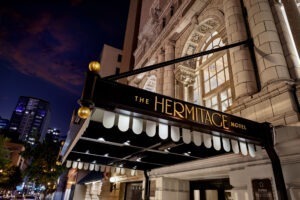
Ever wanted to sit on the 40-yard line of a football game? The Hermitage Hotel in Nashville, Tennessee, can make that happen. The Hermitage Hotel’s exclusive luxury box on the 40-yard line gives guests a grand experience of any football or concert event.
If you’d rather send your group out to explore all that Music City has to offer, groups can pick six attractions and then get six exclusive deals to hit the ground running. This can include Adventure Science Center, Belle Meade Historic Site & Winery, Country Music Hall of Fame and Museum, or an escape room. Planners can craft a one-of-a-kind experience for their guests to leave with.
Since you’re in Nashville, it’s almost no surprise that The Hermitage also offers the chance for guests to get behind the mic and laydown some tracks. Guests can choose between a two-hour one-on-one songwriting lesson or two-hour in-studio lesson. No better way to feel like a rockstar in Music City.
Hermitage Hotel Exterior Signage Courtesy of Forrest Perkins
The Hermitage Hotel offers meeting planners 5,427 sq. ft. of meeting space, five meeting rooms and 122 guest rooms.
Row the Boston’s Charles River
Ever rowed before? Hotel Commonwealth has partnered with Community Rowing Inc. to give guests the chance to row on Boston’s Charles River. Up to 48 people in a group can row on 12-person barges in a two-hour session. Groups will receive private indoor instructions, and then move on to an on-water experience facilitated by a trained coaching team.
Credit: Community Rowing Inc
Hotel Commonwealth has 12,500 sq. ft. of event space, 10 meeting rooms and 245 guest rooms.
Stay Retro in Denver
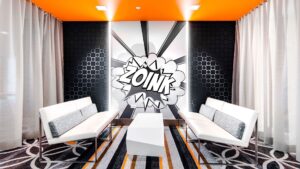
Sometimes, the experience is the experience. For planners wanting attendees to have a memorable experience from the time they check into their hotel, The Curtis Hotel is a great place to check out. The Curtis has 13 hyper-themed guest rooms ranging from video games to Star Trek and Barbie. The hotel also features a 42-foot-high sculpture by artists Roberto Behar and Rosario Marquardt that consists of a stack of steel three-dimensional building blocks of various colors that spell out “All Together Now,” inspired by The Beatles song of same name.
The Curtis Hotel comic book themed seating area.
The Curtis Hotel has 28,000 sq. ft., 20 meeting rooms and 336 guest rooms.
72 hours of updates from the largest meetings industry conference in the world
Editor’s note: The following was written in real-time from interviews conducted on the tradeshow floor at IMEX America 2023 each day with the most recent at the top.
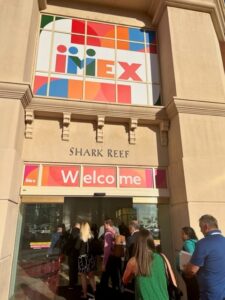
Thursday marked the close of the 12th IMEX America in Las Vegas with a press conference and a unifying ceremony from Rev. Maya Jaguar. First, the press conference. We learned from IMEX Group CEO Carina Bauer that almost 15,000 people were on the show floor at Mandalay Bay Convention Center. More than 5,000 were buyers (more than 4,000 hosted buyers). She extrapolated that the all-time-record number of attendees—up from 12,800 last year and a similar number in Frankfurt, Germany earlier in the year—was a sign that the meetings sector has made a fast, robust comeback. She included short and long-lead business, incentive trips and citywides in that category. The insights are based on feedback from more than 80,000 pre-scheduled meetings in three days and 3,000 meetings on the fly.
MPI Foundation Rendezvous at IMEX America
Drew Holmgreen, chief brand officer at Meeting Professionals International (MPI), reported that 1,000 unique attendees attended 30 Smart Monday sessions, a number he called “a big increase” from last year. More than 2,000 people attended education sessions in the Inspiration Hub, some of which were standing-room only.
Steve Hill, president and CEO of Las Vegas Convention and Visitors Authority, pointed out that the success of the event went beyond the numbers. “It’s not just size, but quality and that is the result of the conference taking place where business and fun happen. We think it is better when the two happen together,” he said.
Holmgreen testified to the truth of that marriage when he reported that for the second year in a row, MPI Foundation’s fundraiser, Rendezvous at Drai’s Nightclub in Cromwell sold out at 2,500 people and raised $320,000 for scholarships, grants and funds for local chapters.
Behavior Tracking and Accessibility Improvements
A new technology stack and app by Expoplatform, an AI-powered smart event platform implemented in Frankfurt and tweaked for the Las Vegas event, tracked where attendees went and who they met with so the trade show floor can be improved based on behavior analytics in the future, according to Bauer. She anticipates more personalized location-based messaging for a start.
One area of focus was on improving inclusion with an accessibility guide published pre-event. Bauer explained that with the “human nature talking point,” content was designed to mobilize around positive change.
Investing in the Future
Stephanie Glanzer, chief sales officer and senior vice president at MGM Resorts International, pointed to the energy on the tradeshow floor and the excitement happening all over the city as proof that the intention to be face-to-face is there.
Las Vegas is making room to welcome everyone back. Over $100 million was spent over the last year at Mandalay Bay Convention Center for improved technology and video walls. Similar investments are happening all over the city in updating spaces and infrastructure.
Glanzer was adamant that technology be focused on how it affects the attendee and makes their lives better—whether it is the ability to order a margarita or access the information they need quickly—not just technology for technology’s sake. She also attested to the fact that after a painful security breach a month before IMEX that led to shutting down MGM Resorts International’s email communication, those systems have been built back more secure than ever.
“We need to keep adding and refreshing ourselves to keep things fresh and new and you will see that in Las Vegas,” she said. That includes new entertainment, such as a Swingers golf experience opening at Mandalay Bay next year and improved sustainability, including a solar array that powers all of MGM’s daytime needs and signing onto the CEO Water Mandate—a UN Global Compact initiative encouraging business leaders to advance water stewardship.
Day two of IMEX America started with the traditional IMEXrun at 7:00 a.m., a 5K dawn trek through town that complements the IMEX Wellbeing Challenge designed by Maritz and sponsored by Harrah’s Reimagined and powered by Heka Health. Participants counted steps and participated in bonus activities to win prizes. But attendees were just catching their breath for the next phase of the marathon that is the IMEX hosted buyer and trade show event.
9:30 a.m.: Future Leaders. An invitation-only forum for senior hospitality students considering a career in the meetings industry was a platform for veterans to learn what the next generation is looking for and future students to get a better understanding of the diversity of opportunities available in events and tourism management. Gatherings such as this offer hope that the industry will continue to thrive with fresh ideas and energetic teams.
11:00 a.m.: Future Placemakers. On a related note, NYU School of Professional Studies (NYU SPS) Jonathan M. Tisch Center of Hospitality and Destinations International (DI), announced a collaboration to offer a Professional in Destination Management certificate and give students a chance to participate in DI events. Students can pursue PDM certification as part of the NYU SPS Tisch Center’s Placemaking and Destination Branding Course in the Spring, 2024 semester. More hope that well-trained voices will be on the other end of the line when meeting professionals call to ask about bringing a citywide to town. The announcement was one of six tools rolled out by DI’s Chief Operating Officer Gretchen Hall as part of what she called, “futureproofing.”
11:30 a.m.: Grand Opportunities. Attendees making their way through the cones in Ubers, taxis and shuttles had a front row seat on the construction going on to create grandstands and lighting for the Formula 1 night race that will run at speeds of up to 212 mph Nov. 16-18 on a 3.8-mile track through the heart of Las Vegas Boulevard. Most also heard comments from drivers struggling to deliver passengers around the obstacles of lane closures and delays. Lisa Messina, Las Vegas Convention & Visitors Authority Chief Sales Officer, shared the upside of the newest sporting event to come to town.
When the cars leave the city in a month, the $700 million in improvements made by F1, including paddocks that can double as unique meeting venues, will be available for groups—at least until they return the following year. Sleek racecars will be followed by the sound of hoofbeats when Rodeo World comes to town in December, high-tech wonders at CES and massive tractors at the 50th running of World of Concrete, both in January. Then Super Bowl LVIII arrives in February. This cornucopia of events will showcase the city to new audiences and, in the case of F1, at a time when the city is normally slower than usual.
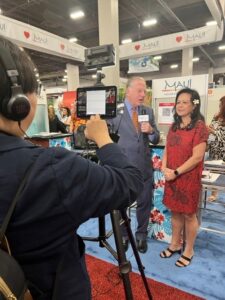
11:45 a.m.: A Controlled Rebound. A quick check-in with John Reyes, senior vice president of Hawai’i Visitors & Convention Bureau (HVCB) and chief MCI sales officer for Meet Hawai’i and Sherry Duong, executive director of Maui Visitors & Convention Bureau, confirmed that groups are returning to Maui after devastating fires in the historic whaling town of Lahaina two months ago. Some are even modifying their programs to include meaningful CSR in the agenda. The reopening is being managed in phases so residents can transition while damage is being repaired.
Noon: Net Zero Progress. A press conference for Net Zero Carbon Events revealed that after the first phase of the program, recruiting signatories to sign a net zero by 2050 pledge, the group is now focusing on fine tuning methodologies.
Elizabeth Fretheim, vice president for sustainability with Freeman Company reported that for many companies, sustainability is now more than a checkbox. “It is part of the decision making because it matters to attendees, customers, employees, communities and the bottom line,” she said. One reason, Millennials and Gen Z attendees expect events to be both sustainable and regenerative. They want companies to fix problems when they meet.
3:30 p.m.: Event Consolidation. At a press conference, Meeting Professionals International (MPI) announced that it is acquiring the EVENT, a Canadian conference that MPI Chief Brand Officer Drew Holmgren said would make the association an even stronger global presence for face-to-face professional development. Working alongside the MPI Toronto, Ottawa and Montreal/Quebec Volunteer Chapter Leaders, and Ryan Young, Tim Whalen and Marie-France Watson, the original three co-founders of the EVENT, Holmgren said MPI currently plans to host the experience in the fall of 2024.
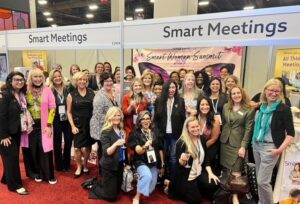
4:00 p.m.: Smart Women Unite. What happens when Smart Women in Meetings Award winners and allies gather to toast a growing, dynamic community of leaders? Hugs happen. At what has become an annual event, winners gathered in the Smart Meetings booth to catch up, celebrate each other and look to the future. Cheers.
At 8:30 a.m. on Tuesday, Oct. 17, the switch flipped on 150 education sessions and thousands of one-on-one meetings at IMEX America 2023 at Mandalay Bay Convention Center in Las Vegas as Nick Santonastasso, CEO of Victorious International, took the stage to help everyone rewrite their stories with themselves as the narrative hero. His message: “Focus on what you can control instead of what you are lacking.”
We walked the floor and kept this running journal of insights gleaned.
Nick Santonastasso
7 a.m.: Rise and shine. Thank you Visit California for the hearty breakfast and the coffee—especially the coffee after a nostalgia-drenched ’70s-themed SITE Night at Palms Casino Resort the evening before. We loved all the orange vests and smiling faces. Restaurant Row between Mandalay Bay Convention Center and Mandalay Bay Casino was buzzing with early morning networkers.
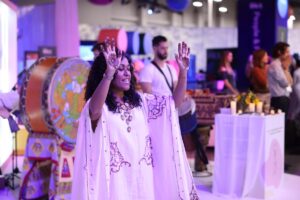
9 a.m.: Opening ceremony. Rev. Maya Jaguar, a transformation coach and interfaith human, led a shared ritual at Google’s Xi CoLaboratory in the Innovation Hub that featured Cirque drummers to get everyone excited and energized. Jaguar called rituals a gateway to the creative side of the mind as they fire up all the senses. On Thursday, Jaguar will return for a closing ritual to seal the community.
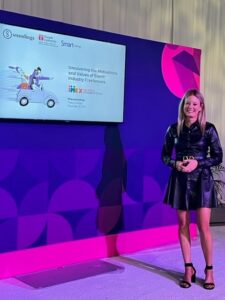
10:00 a.m.:Future staffing. Tracy Judge, CEO of Soundings, announced a study focused on the motivations and values of freelancers as part of a Future of Work initiative. It is a partnership with Temple University and San Diego State University.
Freelance gig workers can solve a lot of the problems of a diminished, untrained workforce with fluctuating staffing needs if companies can learn to adapt to support them appropriately. Look for the survey at the end of October to share your experiences.
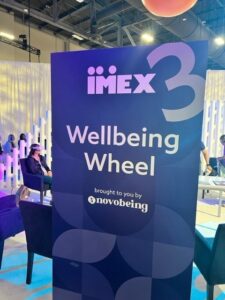
10:30 a.m.: Well-being Wheel. IMEX partnered with Novobeing in the Inspiration Hub to harness the power of virtual reality to help attendees practice meditation and relaxation.
Noon: Time for lunch. Options on the floor were diverse with everything from made-to-order pizza and vegan rice and vegetable dishes to snacks and wings. Smart Tip: break for lunch early to avoid the rush.
2:00 p.m.:Take a breather with Well-X: After two more hours of meeting and networking with event profs, you could take a quick break. The France-based hospitality company Accor partnered with Well-X, a wellness company that brings their program to you, to give attendees a moment to relax.
Operated by Magdaleena Nikolov, former general manager of spa, wellness and retail at Fairmont Century Plaza in Los Angeles, and Patricija Miklusiene, spa, beauty and wellness consultant and coach, the experience includes a leg and shoulder massage, and scented, purified oxygen that induces a sense of calm. According to Nikolov, 20 minutes of breathing in this purified oxygen amounts to a two- or three-hour nap.
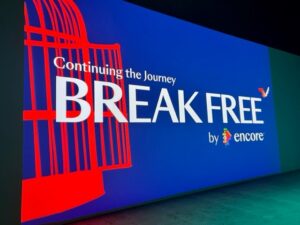
3:00 p.m.:Break Free. Event technology company Encore’s Break Free: Continuing the Journey VIP experience was a graphic storytelling session driving home the importance of the power of using empathy to design more accommodating events. Attendees were asked to sign a wall pledging to design gatherings everyone could enjoy.
3:30 p.m.: Project Spark.PCMA announced new AI meeting planner tools launching Monday that range from free to almost $700 for a training. The resource and consulting ecosystem is half owned by PCMA with Gevme, a Singapore company, owning the other half. PCMA President and CEO Sherrif Karamat praised the ability of the tool armed with current aggregated data from thousands of users to help with marketing and data analytics while promising that information will be protected. He called it, “a once in a generation opportunity for meeting professionals to understand and define how a disruptive technology will shape the industry.”
4:00 p.m.: Networking time. Mingling started early as treats of all kinds start coming out on the floor and attendees broke for their various events all over the city (shout out to our Regional Sales Manager Jeff Posner shown left, who kicked up his heels with Marriott International at The Chelsea at Cosmopolitan Las Vegas).
Lesson learned from Encore CEO Ben Erwin: Let’s agree to give each other grace as we are all booked back-to-back and will probably be a little late trekking from the Technology Innovation Hub through North America, Canada and Japan to get to the Inspiration Hub on the opposite side of the building. On a related note, thank you to my this morning self for deciding to wear the On running shoes with the dress pants since I clocked almost 15,000 steps.
Editor’s note: Bookmark this page and check back over the next three days as we update with more insights from the IMEX America floor at Mandalay Bay Convention Center in Las Vegas.
Achieving longevity and consistent success is a challenge every event planner faces
Events are not merely one-time occurrences; they should be a strategic investment that yields returns over time. But oftentimes, the importance of a specific event can be questioned every year, to the point that leadership may only see the event as a line item on the budget. So, what can you do to make sure your event is seen as a necessary strategic tool every year?
Let’s explore five key strategies to make your event plan resilient and ensure that your corporate gatherings thrive year after year.
1. Establish Clear Objectives and Communicate Them Internally
The foundation of a resilient event plan begins with discovering the “why” and setting clear objectives. Before you even think about the logistics and finer details, ensure that you, your team and all internal stakeholders have a crystal-clear understanding of why you’re hosting the event. This isn’t just about having a broad goal like “increase brand visibility.” Do you know the real reason why your event is being hosted? Get specific here and set clear KPIs around the event.
For instance, your “why” statement for your incentive trip for your top sales performers “why” could look like this: “We host our annual incentive trip to bring together top sales performers in the company to connect with leadership, engage with each other and drive motivation for the year ahead. Our goal with this program is to retain 100% of our top performers and help increase sales by 20% year-over-year.”
2. Track and Measure Event Value Continuously
One of the biggest mistakes in event planning is assuming that your job ends when the event concludes. To ensure long-term success, make it a habit to track and measure the value of your event. This includes both quantitative and qualitative metrics. Quantitative metrics may include data such as the number of leads generated, revenue generated or customer satisfaction scores. Qualitative metrics, on the other hand, can involve gathering feedback from attendees to gauge the overall experience and identify areas for improvement.
Once you have this data, it’s also important to be able to clearly communicate outcomes to your leadership team. How does the outcome of the event impact the business? What benefits does the event provides? Framing these metrics in a way that can help leadership see the wider impact of your event will help set you up for long-term success.
3. Foster Lasting Relationships
Events are really all about relationships, so your event plan should prioritize fostering lasting connections with attendees, sponsors and partners. After all, it’s these relationships that often lead to repeat attendance and long-term support. This includes opportunities for networking and engagement within the event, but also connections outside the event that will drive higher attendance year after year. Providing a platform for ongoing communication, such as a dedicated online community or newsletter, can help keep the event relevant throughout the year.
This also includes nurturing your relationships with sponsors and partners. Showing up once a year to ask for money isn’t the best way to ensure you have valuable sponsors each year. Show them the value of being associated with your event not only during the event but also throughout the year. You can take a similar approach here with roundtables, online communities, newsletters and more.
4. Embrace Innovation and Adaptation
The world is constantly evolving and so should your event plan. Resilience in event planning means being open to innovation and adaptation. Don’t stick to the same formula year after year simply because it worked in the past. Attendees’ expectations, industry trends and technology are continually changing. Stay updated with the latest event technologies and trends.
Experiment with new formats, content delivery methods and engagement techniques. Be willing to pivot and make necessary adjustments based on attendee feedback and emerging opportunities. With that said, don’t just change for change’s sake. Make sure the new technologies or formats you add make sense for your audience and event. Consult your event management partners to think through these changes strategically.
5. Seek and Act on Feedback
Feedback is key for event growth and resilience. Actively seek feedback from attendees, sponsors and your team after each event. Be open to constructive criticism and use it to refine your future plans. Create post-event surveys that are concise and relevant. Analyze the feedback received and prioritize improvements based on the most common and critical suggestions.
Sharing how you’ve implemented feedback from previous events can also demonstrate your commitment to improvement and foster trust among stakeholders. Also make sure you continue to communicate feedback and the actions you’re taking to leadership so they can understand why the event may evolve each year and how those changes lead to a more effective event. Try to connect these changes to real KPIs as much as possible.
Building a resilient event plan can help you ensure your event lasts beyond 2024. Especially as budgets come under scrutiny and priorities evolve over the next few years, having a plan in place will help ensure your events continue to occur and succeed well into the future.
—
Brian Kellerman is the CEO and partner of GoGather, an event management company. Prior to founding GoGather, Kellerman was executive vice president of Vision Event Productions and executive producer of Premier Productions. Kellerman is an expert in audiovisual technologies and has a Strategic Meetings Management certificate.
Kellerman has a degree from San Diego State University and has also served on the Board of the San Diego American Marketing Association. Check the blog for more insights on the industry.
Accor Survey: “Meeting Expectations: The Future of Meetings & Events”
World-leading hospitality group Accor operates a diverse hospitality group of over 40 hotel brands, from luxury to economy. They offer experiences in over 110 countries with 5,500 properties, 10,000 food and beverage venues, wellness facilities and workspaces.
Recently, the Accor survey titled, “Meeting Expectations: The Future of Meetings & Events” polled members of the meetings and events industry in a diverse array of roles. They aimed to assess the industry’s transformation over recent years and analyze major shifts in its evolution.
The conclusions evoked a need to focus on balance and belonging in order to drive the industry’s strategic growth through 2024 and beyond, as well as to comprehensively recover from the effects of the Covid-19 pandemic.
Breaking Down the Accor Survey Results
The results showed an overwhelmingly positive outlook for the industry.
Seventy-eight percent of respondents say that their or their clients’ expenditures have increased since 2022. Over one-third of respondents report increases of over 25%, and 80% of respondents expect further spending increases in 2024. Of that 80% group, 30% agree spending would again rise by over 25%.
These results can dissuade fears that the industry may struggle to thrive following the pandemic. In fact, the industry’s audience is expected to surpass even 2019 levels in the coming years. Sophie Hulgard, Chief Sales Officer at Accor, says, “The total global meetings industry worldwide is forecast to be worth $1.78 billion by 2030.”
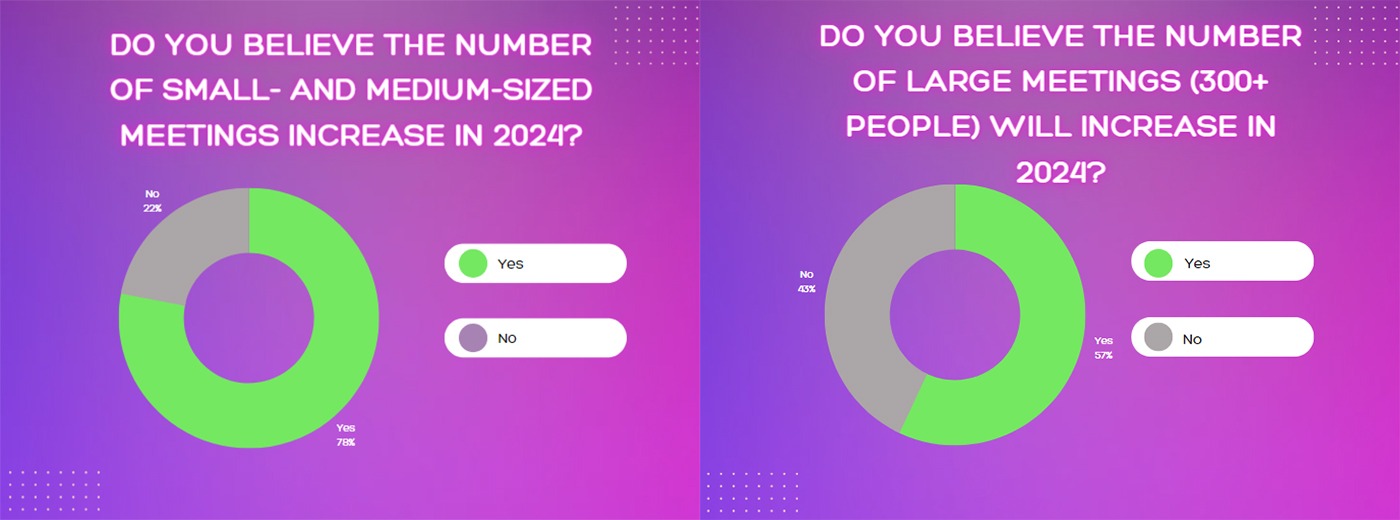
At a rate of 78%, respondents agree that the number of both small and medium-sized meetings (50-100 delegates), as well as meetings of over 100 delegates, would increase in 2024. At 57%, over half of the respondents surveyed also expect a rise in the number of meetings hosting over 300 delegates.
This growth brings both ample opportunities and new challenges as planners work to accommodate an influx of attendees while booking, planning and executing events.
Respondents also confirm the importance of trade shows, exhibitions and conferences. Seventy-eight percent agree that attendance at these events is important for their industry.
The Accor survey found that face-to-face meetings continue to prove invaluable. Thirty-three percent of respondents report seeing 40% more revenue generated from in-person meetings and events versus virtual events. 80% state that they would be unhappy closing deals via video conference in 2024.
“The pandemic was a defining moment for the industry. We were thrust into a world of virtual gatherings, with in-person events grinding to a halt. Yet, we adapted and evolved,” says Hulgard. “That evolution continues today and the one thread that connects all the trends we forecast is the human connection. Today, more than ever, it is about the human need to meet, share and thrive.”
The Accor survey report highlighted five major trends expected to be leading factors in the industry’s continuing evolution.
Softer Productivity
In recent years, wellness has become the star of the show. Beyond integrating more nourishing food and well-being activities, events reflect a growing awareness of participants’ needs for rest. It’s important to curate schedules to work in more flexibility and downtime to allow participants to avoid burnout and have enough energy to actively engage with their meetings and activities when it’s most important.
They’ve termed this concept Softer Productivity.
“Nobody wants to be pushed to their limits anymore,” says Meenaz Diamond, Senior Vice President of Meetings and Events at Accor. “There is a space for a much softer productivity that still allows you to deliver, but to do it in your own time and in your own way.”
In the report, Accor suggested that it is beneficial to work in active breaks, such as a stretching session in between discussions. Providing healthy menus and catering to dietary preferences is essential. Wellness lounges or refreshment stations, along with team building activities like outdoor adventures or cooking classes, do wonders to make a meeting more enjoyable and refreshing. Technology solutions like wellness apps or gamification elements can help attendees stay aware of their wellness at a meeting.
Selling Belonging
Despite the success of virtual events through the pandemic, people recognize that the quality of connection they make face-to-face with others is unmatched. Along with a quantifiable ROI, companies seek an ROX—Return On Experience. Selling Belonging is all about creating quality human connections.
Diversity, equity and inclusion (DEI) is essential. Participants of all backgrounds have a right to feel safe and supported in sharing their ideas. This contributes to a more collaborative and productive meeting environment. Planners should get familiar with cultural, economic and social differences amongst a diverse group of attendees and assess how to facilitate the process of sharing ideas to be the most productive.
Close in line with ROX is Designing Experiences. Planners are reimagining how they can structure events and deliver content in memorable spaces. Events that take place beyond meeting rooms, such as in venues that provide immersive experiences, help to make ideas stick and encourage more creative ways of thinking.
Kishan Chandnani, Global Senior Vice President of Premium Brands at Accor, says “The MICE customer of tomorrow is looking for an experience-led but also purpose-driven brand, a brand that cares about the needs of the individual and the community.”
Montreal-based creative studio C2 found from their own survey that 71% of attendees expect some form of personalization. Utilize natural light or strategic artificial light; incorporate plant life—the UK Green Buildings Council found that office workers who work in spaces with plants are 15% more productive on average. Transform a ballroom into breakout spaces and allow people to mill about freely and challenge expectations of what a large event can look like.
Green Gatherings
Sustainability is at the front of both planners’ and attendees’ minds, as Green Gatherings takes center stage. People are concerned about the carbon impact of the events they plan and attend. Recycling, limiting food waste and managing temperature in eco-friendly ways make positive impacts. Sustainability isn’t only about reducing emissions. It also means meaningfully engaging with local communities, raising attendees’ awareness of local culture and not harming—and actively working to preserve—local ecosystems.
Global market research company Ipsos conducted a survey that found 81% of European and 74% of American travelers would consciously avoid activities they knew to be not socially responsible; in addition, a respective 77% and 68% would choose an accommodation with a green certificate over one without. Accor aims to reduce its own carbon emissions by 46% by 2030, and 5,500 Accor hotels have earned or are currently earning an external sustainability certification.
The Accor survey sees wave after wave of all kinds of Disruptive Technology. AI transforms the way planners can design events. Planners can use AI to crunch data and produce relevant analyses at rapid speed. This saves time and helps them to design events tailored to attendees’ needs. For example, how do we design a schedule that benefits each participant’s availability? Planners can use AI to rapidly assess all the participants’ schedules and reveal the most strategic times to hold a talk or a seminar that most people, if not everyone, can attend. As we continue to learn to use AI, the possibilities available expand exponentially.
Virtual reality is on the rise as well, offering a whole new world to event planners. Bloomberg anticipates that the metaverse market may reach $783.3 billion in 2024.
The Accor survey concludes that the trends we are familiar with continue to rise. Planners and attendees are engaged with changes to increase wellness and sustainability. Planners can use event design and AI in their efforts to create memorable experiences and people are enthusiastic about the return to face-to-face meetings. The revenue generated from these in-person events and meetings has already risen and is expected to continue to.
The future of the meetings and events industry is bright. These trends reveal how planners can tailor their events to change with the times and be as successful as ever in terms of both ROI and attendee satisfaction.
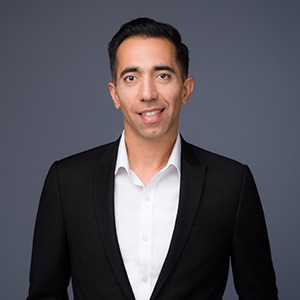
Ali Amin
Ali Amin, One10
Leading travel, events, incentives and marketing services company One10 has appointed Amin EVP, Product Management and leader in SaaS product. He will oversee product management, engineering, design and data strategy for PerformX, a SaaS-based incentive and recognition technology that helps to amplify business results. He will also oversee Rewarding You, One10’s global rewards catalog. Amin has spent over 15 years offering strategic insight and technological acumen to propel revenue growth and drive consumer experiences.
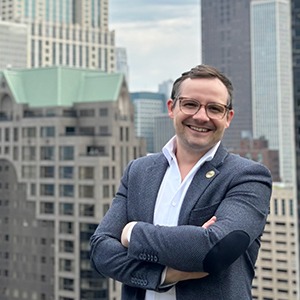
Patrick Lacassagne
Patrick Lacassagne, Viceroy Chicago
Lacassagne joins Viceroy Chicago as General Manager. He will oversee hotel strategy to maximize guest and colleague satisfaction, service standards and financial performance. Lacassagne began his career as an assistant food & beverage manager at Hotel Concorde Montparnasse in France and continued to work in various F&B roles through Egypt, Morocco and the Caribbean. He later transitioned to general manager roles, having most recently served as General Manager of the NoMo Soho.
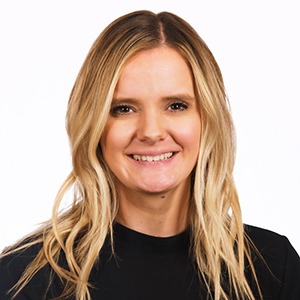
Kate Yordi
Kate Yordi, Visit Mesa
Visit Mesa, the regional destination marketing organization for Mesa, Arizona, has expanded its team with the promotion of Yordi. She will now serve as director, marketing following her earlier role as associate director, research and analytics. She has worked in a variety of other marketing roles for over a decade, including as a marketing analyst at MMGY Global and as associate director, data & research at Madden Media.
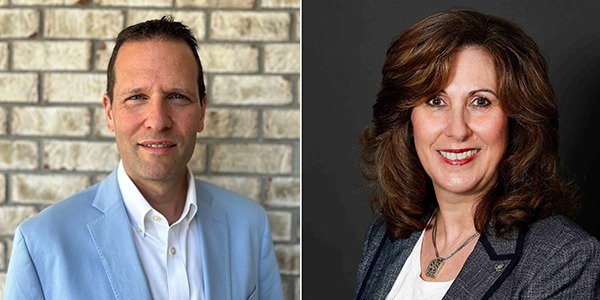
Rick Schatz and Ronni Anderson
Rick Schatz (left) and Ronni Anderson (right), Tempo by Hilton Nashville Downtown
HRI Hospitality announces two appointments to lead the opening of Tempo by Hilton Nashville Downtown. Schatz will serve as general manager. He will draw on nearly 25 years of experience managing and operating hotels across the U.S. He most recently served as general manager at dual-branded Hyatt Place Hyatt House Indianapolis Downtown, and earlier as resort manager and director of operations at lifestyle properties in Cape Cod and New Orleans.
Anderson will take on the role of director of sales and marketing. She brings over two decades of experience in sales in the Greater Nashville market and has held director of sales and marketing roles across several Nashville hotels. She has worked in boutique lifestyle properties as well as at large convention facilities. Currently, she serves as vice president of the Global Business Travel Association Tennessee Chapter and on the global association’s Government Relations Committee.
Rhonda Crittle
Rhonda Crittle, Islamadora Resort Collection
As complex director of revenue management at Islamorada Resort Collection, Crittle will oversee the total revenue optimization for each resort within the collection. She worked as area director and director of revenue management for Kimpton Hotels & Restaurants before working with Davidson Hospitality Group to oversee the topline revenue management strategies for numerous hotels, from Washington, D.C. to Kansas City.
Matthew McGuigan
Matthew McGuigan, Romer Waikiki at The Ambassador
McGuigan joins Romer Waikiki at The Ambassador as general manager. He will guide the property through its October opening and beyond as well as oversee all daily operations and management. He has worked in the industry for over 25 years, most recently as hotel manager at the Ala Moana Hotel by Mantra. Earlier, he served as hotel manager at the Roosevelt Hotel Seattle.
Louise Bang
Louise Bang, Marriott International
Marriott International has appointed Louise Bang as their new chief sales and marketing officer for the Caribbean and Latin America. In this role, she will drive growth and revenue for the region by leading consumer-facing strategies through sales, marketing, public relations, brand management and the Marriott Bonvoy loyalty program divisions. She most recently serves as Marriott International’s regional vice president of sales and distribution for the Caribbean and Latin America.
Justin Rodriguez
Justin Rodriguez, Shashi Hotel Mountain View
Rodriguez joins Shashi Hotel Mountain View as general manager. He has worked with the Shashi Group since 2019, first as director of food and beverage. He earlier held management roles at some of the Bay Area’s leading restaurants. In this new role, he will oversee the property’s daily operations, sales and marketing to maintain Shashi Hotel’s immaculate guest experience.
John D’Angelo
John D’Angelo, The Sebastian – Vail
D’Angelo assumes the role of general manager at luxury mountainside resort and private residence club The Sebastian – Vail. He will oversee all day-to-day operations of the property to ensure it continues to deliver a leading guest and owner experience. Through over two decades in the industry, D’Angelo has served in various management positions at esteemed properties, most recently as general manager for Grand Hyatt Vail and Residences at Cascade Village.
Ulrich Samietz
Ulrich Samietz, Carmel Valley Ranch
In California’s central coast, Carmel Valley Ranch appoints Samietz as managing director. He has spent nearly 40 years in hospitality at various Hyatt properties around the globe, from Vancouver to Baha Mar. At Park Hyatt Carmel-Highlands Inn, he helped lead the world-renowned epicurean celebration, Masters of Food and Wine, alongside Julia Child, Gordan Ramsay and more. He has been continually recognized for his empowering leadership philosophy and ability to create a culture of teamwork, innovation and personalized service.


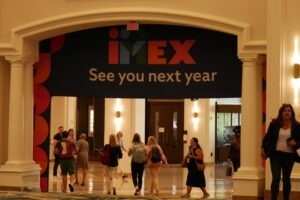 Thursday marked the close of the 12th IMEX America in Las Vegas with a press conference and a unifying ceremony from Rev. Maya Jaguar. First, the press conference. We learned from IMEX Group CEO Carina Bauer that almost 15,000 people were on the show floor at Mandalay Bay Convention Center. More than 5,000 were buyers (more than 4,000 hosted buyers). She extrapolated that the all-time-record number of attendees—up from 12,800 last year and a similar number in Frankfurt, Germany earlier in the year—was a sign that the meetings sector has made a fast, robust comeback. She included short and long-lead business, incentive trips and citywides in that category. The insights are based on feedback from more than 80,000 pre-scheduled meetings in three days and 3,000 meetings on the fly.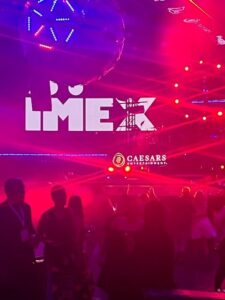



 At 8:30 a.m. on Tuesday, Oct. 17, the switch flipped on
 3:00 p.m.: Break Free. Event technology company Encore’s
 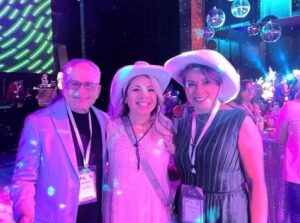 4:00 p.m.: Networking time. Mingling started early as treats of all kinds start coming out on the floor and attendees broke for their various events all over the city (shout out to our Regional Sales Manager Jeff Posner shown left, who kicked up his heels with Marriott International at The Chelsea at Cosmopolitan Las Vegas).
 Brian Kellerman is the CEO and partner of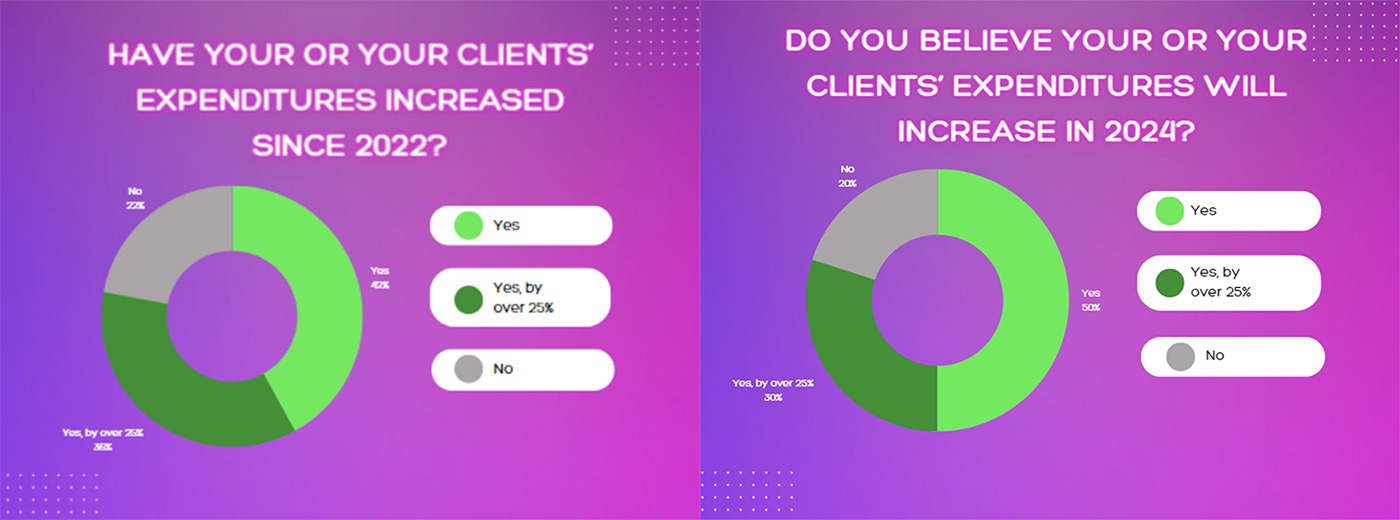
 “Nobody wants to be pushed to their limits anymore,” says Meenaz Diamond, Senior Vice President of Meetings and Events at Accor. “There is a space for a much softer productivity that still allows you to deliver, but to do it in your own time and in your own way.”
 Sustainability is at the front of both planners’ and attendees’ minds, as Green Gatherings takes center stage. People are concerned about the carbon impact of the events they plan and attend. Recycling, limiting food waste and managing temperature in eco-friendly ways make positive impacts. Sustainability isn’t only about reducing emissions. It also means meaningfully engaging with local communities, raising attendees’ awareness of local culture and not harming—and actively working to preserve—local ecosystems.