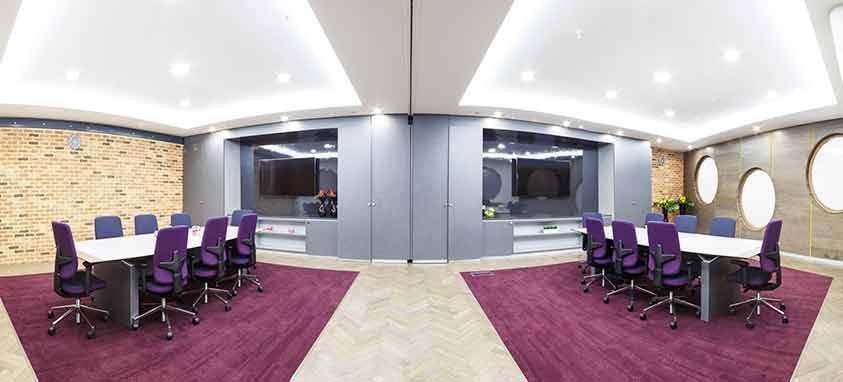
 Despite advances in technology and increasing demands for collaboration in today’s global business environment, typical meeting space has changed very little over the past few decades. Most meeting rooms still consist of the same traditional setup: a conference phone, a screen, a whiteboard and maybe some video conferencing capability.
However, new technology is emerging that will help make meeting rooms more immersive and interactive, allowing participants to stay engaged and productive for longer. Individual devices such as tablets, smartphones and laptops will easily connect together into one shared digital workspace. Cords will disappear and sharing content wirelessly amongst participants in one room and across offices will be hassle free, allowing the conversation and content to adapt in real time.
Here are seven things your current office or convention meeting space should be employing and will likely implement in the near future:
1. Collaborate Without Constraints
It can be difficult to connect with team members in today’s mobile and global workforce. For example, you could be at the home office while one team member is at the airport, another at the field office and still another at a trade show, yet somehow you all need to connect and review urgent information. New conferencing technology will make it simpler for everyone, even remote and on-the-go participants, to connect into a shared workspace from their individual devices. Everyone will be able to share and view content, whether it be field notes, an Excel spreadsheet or a video, in real time.
2. Make Data Informed Decisions
The purpose of almost any meeting is to share knowledge between people. But this can only happen effectively and efficiently when everyone and their devices can connect and share content. Meeting spaces in the future will allow all attendees to have equal access to real-time information in context, so more informed decisions can be made faster.
3. Offer More Screen Real Estate to Collaborate
Think about how much time is wasted in meetings simply swapping cables and presentation control or even just emailing content back and forth between members. Yet almost every meeting requires documents, data or visuals to be shared often by numerous attendees. Having multiple screens that participants can connect to wirelessly allows the workspace and conversation to grow to the needs of the team. Abundant screen real estate and inputs allows the weekly agenda to be on one screen for reference, visuals and data to be displayed side by side on others.
4. Drive a Project Forward
Today’s global business environment demands employees work together as easily across distance as they do from the same room. Video conferencing and wireless technology are making it easier than ever for employees to connect and pool their content together into a shared digital workspace. Teams can work on projects together in real time instead of constantly emailing documents back and forth or using potentially unsecure web-based solutions. The conversation and work can adapt as new ideas come up in real-time.
5. Pull Your Audience In
Traditionally, conference rooms have just one big screen that one member can plug into to share content. However, with large high-definition screens becoming more affordable, conference rooms will soon have multiple screens on multiple walls. This additional screen space not only allows for more impressive visuals to be shared, but also provides the space needed to spread out and collaborate. Presenters and other meeting participants will be able to move and manipulate content using their phone, tablet, laptop, or even by gesturing with their hands.
6. Tell a Story
Today’s popular presentation tools, such as PowerPoint, allow presenters to share visuals and organize their presentation, but they still create mostly rigid and static presentations. However, technology is allowing presenters to resize, layer and move multiple pieces of content across multiple screens. This gives speakers more flexibility in the way they present while also helping them tell their story more dynamically. “Death by presentation” will soon be a thing of the past.
7. Pick up next week where you left off
In the future, conferencing technology will automatically save all content from the meeting into one place. All files, web links, photos, iPhone contributions, etc. accessed or shared in the meeting will be saved into a digital meeting portfolio that participants can go back into. Cameras in the room will automatically capture images of notes written on the room’s white boards. Not only does this ensure all ideas are captured, but it also alleviates the hassle of sharing notes. If you can’t quite remember the article your team member shared, you can simply dive back into the meeting portfolio and pull up the link. Teams can start next week’s meeting right where they left.
The days of the “bored room” will soon be a thing of the past. The traditional meeting and presentation room is finally transitioning from static and stifling to a dynamic and immersive space that fosters collaboration and innovation.
David Kung is vice president of business development at Oblong Industries, makers of Mezzanine, a next-generation conferencing and collaboration solution. Prior to Oblong, David served as VP and Creative Director at Walt Disney Parks and Resorts Online. At Creative Artists Agency, David specialized in emerging technology for clients, including Coca-Cola, Sprint and Hasbro. Previously, David developed enhanced television programs as a Disney Imagineer and was a design lead with Art Technology Group. He holds degrees from MIT’s School of Architecture and MIT Media Lab.


 Marriott Marquis, Washington, D.C.
 Airports are becoming increasingly tech-friendly.
 For the second consecutive year, Marin Bright, CEO and founder of Smart Meetings, has been named one of Folio’s Top Women in Media, in the Corporate Visionaries category. The awards honor “the most influential women in media—the ones driving the agenda for the industry and in their companies—women who are innovating in new ways and guiding their businesses into new markets,” as noted in Folio’s announcement.