2017-presidential-inauguration

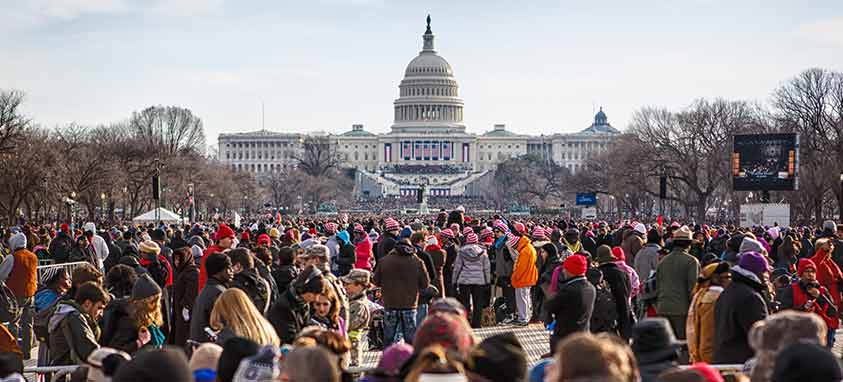
What could be one of the most controversial presidential inaugurations in U.S history is happening in just a few days. On Jan. 20, president-elect Donald Trump will be sworn into office, and nearly one million Americans are expected to travel to Washington, DC, to either attend the inauguration or protest it. People will be buzzing about this event for years to come, which means it surely offers some important lessons that meeting planners will appreciate. These are a few of the pointers you can take from the 2017 presidential inauguration.

1. Book early

If you want to keep your event under budget and book rooms at the best hotels, be sure to book early. It’s an obvious and often-used tip, but sometimes procrastination can get the best of us.

The presidential inauguration illustrates clearly why booking early is so important. In December, just 15 percent of hotels in the Washington, DC, metropolitan area had vacancies for inauguration weekend—and prices had risen by more than three times the usual rate, to around $500 a night. The president-elect’s own hotel, Trump International Hotel Washington DC, has long been fully booked.

Even Airbnb, which generally has cheaper alternatives to hotels and resorts, offers no relief. Last month, a one-guest rental during the inauguration cost travelers nearly $700, on average. Just 9 percent of listings were available at that time.

2. Make security a priority

With hundreds of VIPs in attendance, security is one of the focal points of this inauguration. The Secret Service has rolled out an elaborate security plan which involves closing more than 100 square blocks of Washington, DC, and deploying 28,000 trained personnel from the U.S. Secret Service, Transportation Security Administration, Federal Bureau of Investigation and several other agencies. The entire operation is expected to cost north of $100 million.

Meeting and event planners probably don’t need a strategy that elaborate, but having a plan in place is paramount. Attendee safety should be a top priority for every planner. On site visits, planners should ask hotels and venues about their crisis management plans. Are the hospitality staff informed, trained and well-practiced in case of an emergency? Are there staff available on-site who can perform first aid if necessary? These are just a few of the questions planners should keep in mind.

3. Embrace the latest technology

Technology is often touted as a tool to make events instantly better. It’s not usually as simple as that, but innovative tech can certainly enhance events, boost attendee enjoyment and provide valuable analytical data.

In order to streamline visitors’ experiences during president-elect Donald Trump’s inauguration, nearly 40 government agencies worked together to create an interactive map that displays important information such as street closures, locations of medical aid stations, public transit stations, the parade route and much more. Computerworld reported that the map uses Esri’s ArcGIS technology, a powerful geographic information system used by the Department of Transportation of Washington, DC. The inauguration map can be used on any web browser, through desktop and mobile devices.

4. Create a transportation strategy

Transportation for massive events such as a citywide convention or presidential inauguration is always a huge task. According to Allianz Global Assistance, Washington, DC, will see a 222 percent increase of travelers during and around the inauguration. The surge of traffic will cause backups in airports, train and bus stations and roads in the area. However, this is nothing compared to the impact that road closures will have on local travel. More than 100 blocks, or 2.7 square miles, will be closed due to security concerns.

When planning a big event, don’t forget to consider transportation during the site selection process. A city with a great public transportation system can be a boon for any event. Attendees at the world’s largest technology convention, CES 2017, benefited greatly from host city Las Vegas’s efficient and easy-to-use monorail system. The monorail operator partnered with a technology company to allow attendees to use their convention badges as tickets, creating a seamless way for guests to travel around the city.

5. Have a backup plan for speakers and entertainment

Speaker mishaps are common in events, and a poorly handled one can mean the difference between a fabulous event and a forgettable dud. It is vital to have a plan in case a keynote speaker or performer cancels or comes down with an illness at the last minute.

Antwone Stigall, CMP, president of West Wing Events in Memphis, Tennessee, suggests that meeting planners include this clause in their contracts with speakers: They must have another person accompany them to the meeting who could give the presentation in their place if necessary. If you are using a speaker who is part of a network of colleagues, it is also possible to include a condition that requires the contracted speaker to provide an alternate if he is unable to perform.
downtown-tempe-arizona-postinos-843x382

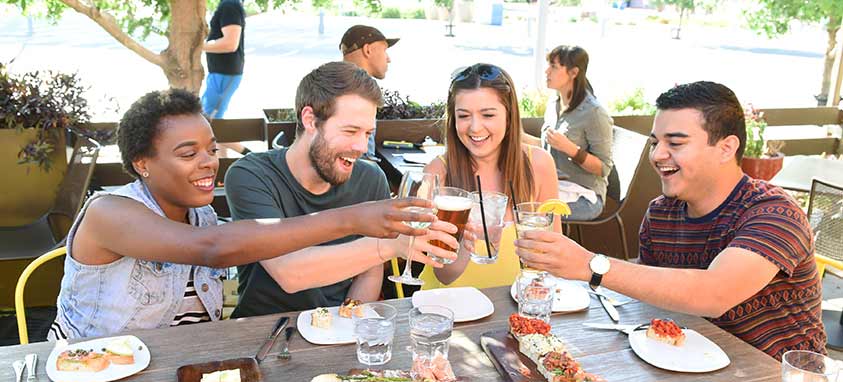
Who says there is no life in the desert?  If you have not been to Arizona lately, then you might be surprised.  Tempe is located in the heart of the Phoenix Metropolitan area which is surrounded by the incredibly serene Sonoran Desert, one of the world’s most diverse desert environments.  And you may be surprised to know that Phoenix Sky Harbor International Airport is one of the country’s busiest with non-stop flights to more than 100 destinations in the US, Canada, Mexico and the UK.  With a quick 10 minute connection from the airport on the Valley Metro Light Rail, you arrive to Downtown Tempe’s bustling Mill Avenue. With more than 70 shops and restaurants in a 7 block, historic and pedestrian friendly district, Downtown Tempe is teeming with life and plenty of options to soak up the sun on an outdoor patio or sample a brew or two from one of several brew pubs that call Tempe home.  All of this sits adjacent to the Arizona State University Tempe Campus, one of the largest universities in the country.  With more than 70,000 students, ASU is a center of knowledge, research, sports and the arts.  In fact, one of the crown jewels of architecture in Arizona is the Frank Lloyd Wright designed ASU Gammage, a 3,000 seat theater that annually hosts Broadway shows on its mainstage.

Of course, you need a place to actually hold your meeting, right?  Tempe’s hotels are perfect for meetings for groups of 10 to 500 and are located near the airport or in our Downtown area.  In 2017, Tempe will add more than 600 new rooms with brands like Homewood Suites, Hampton Inn & Suites, Home 2 Suites by Hilton and two Hilton Garden Inn properties.  Beyond our hotel partners, you can also find some interesting off-site venues including the modern and sleek Tempe Center for the Arts and the beautifully lush Desert Botanical Garden.

Your attendees will be happy with Tempe as well.  Here they can get their exercise in to gear up for their meetings with options like hiking A Mountain in Downtown Tempe, paddle boarding on Tempe Town Lake, biking on the miles of paths in Papago Park or taking a jog through Tempe Beach Park.  If retail therapy is needed after a long day, then Tempe fits the bill. Arizona Mills offers more than 170 outlet and value oriented shops, restaurants and attractions such as Harking IMAX Theater, SEA LIFE Arizona Aquarium and LEGO Discovery Center Arizona.  Another great option is Tempe Marketplace.  This shopping district offers more than 1 million square feet of shops, restaurants and theaters in an outdoor setting with patios, fireplaces and areas to relax and enjoy the sunshine.

Are you tempted to see Tempe for yourself?  Our staff are happy to assist you in planning your next event in Tempe and we offer opportunities throughout the year for personalized site visits so that you can see how Tempe satisfies your check list.  Apply today at www.TempeMeetings.com

2017 incentive travel trends

The economy is booming and the incentive and recognition industry is following suit. Incentive Research Foundation released its 2017 Trend Study, and we’ve condensed their assessment into this quick-hit list.

Everyone wants non-cash rewards.

Business has changed a lot in the past twenty years—77 percent of U.S. jobs are now service-focused—and companies have had to adapt. With the rise of service jobs has come the rise of incentive programs. The number of U.S. businesses using non-cash rewards has risen from 26 percent in 1996 to 84 percent in 2016. Traditional compensation systems don’t properly account for the millions of other hats employees wear outside the paper job description, so incentive programs have filled that gap. With 70 percent of companies now including an HR representation on their Board of Directors, it’s a trend that is expected to continue and evolve.

Government regulation means there are a few more hoops to jump through.

There’s been a rapid succession of changing government regulations on incentive program design and execution, which makes it tricky to organize them. Almost 60 percent of respondents in the latest IRF Pulse Study said they agree or strongly agree that government regulations are making it more difficult to design reward and recognition programs. Whether it’s the 2016 Conflict of Interest rule instated by the U.S. Department of Labor or newly proposed non-exempt overtime regulations, it can slow down the process of building a rewards program and limit what the program can actually do.

Businesses are using incentive travel to award their top-performing employees.

Nearly 40 percent of U.S. businesses now use incentive travel to reward and recognize their top performing employees, salespeople, and channel partners. Most of the travel remains within the United States, but Mexico and the Caribbean also remain top destinations. As budgets continue to grow—one third of planners now have a budget of $3000-$4000 per person—and more luxury hotels and properties with ample meeting space are coming online, it seems this segment of the industry is going gangbusters.

Gift card programs are booming.

Annually, U.S. businesses now spend almost $23 billion on name-brand and branded merchandise for reward programs and over $24 billion annually on gift cards. The growth for these reward programs is mostly in sales and predominantly in middle market businesses. This is good news for small businesses, as it’s a lot easier and more accessible to install a gift card program than incentive travel.

The threat of disaster looms large.

Zika. Terrorism. Hurricanes. There’s a lot to be wary of in today’s world and planners are well aware of how these disruptors can derail their event. Almost 60 percent of planners have experienced some form of disruption in their events, estimating that almost a quarter of their events have been affected in some way. But not all of those disruptions were newsworthy—it’s mostly weather- or vendor-related. In truth, a lot more time is being dedicated to managing disruptions, both working to ensure they don’t happen and having a plan in place in case they do.

Everyone wants a unique experience.

Tapping emotional engagement through a strategic choice of rewards and incentives is a powerful way for businesses to motivate their stakeholders. According to the most recent IRF Pulse Study, 25 percent of program owners are increasing individual travel in their programs in 2017, with 12 percent saying they are adding budget to do so. Likewise, 42 percent of program owners are increasing the number of “experiential rewards” in their portfolio (e.g. spa days, concert tickets, expensive dinners, sporting events, etc.). Bottom line is that everyone is looking for individualized experiences and companies should keep things as unique and original as possible.

Think of technology as your tool kit.

It should come as no surprise that technology has been a game changer in this industry. Almost 90 percent of large businesses report having technology in place to support their incentives and reward programs. Mobile device integration is now a standard expectation for incentive programs. So look to technology as your box of tools to further engage with the audience through mobile, social, wearable, predictive and view-altering tech.

Let your program evolve organically.

Twenty years ago, there were only four reasons for non-cash reward programs: safety, service, sales and quality. Today, the Incentive Federation measures over 12 different reasons. U.S. businesses now invest over $28 billion annually in points programs. But the ways in which those programs are implemented are unique. Some companies have created reward programs that donate money to charities in an employee’s name. Others have taken a personalized approach. But the most important takeaway is that companies should build programs that are reflective of their own ethos.

Reward industries are consolidating.

During the recession, many incentive programs merged and consolidated, and the practice hasn’t declined since the economy bounced back. If the trend continues or accelerates, there may be reason to fear higher costs or disruption. A seamless transition is the goal.

The reach of globalization has stretched even further.

Once thought of as only affecting the incentive travel side of the market, globalization now influences all types of reward and recognition programs—merchandise and gift cards included. Over three-quarters of incentive travel program owners will run at least one program outside U.S. borders in 2017. Furthermore, three-quarters of the incentives industry includes international participants in their non-cash rewards programs. Incentives and recognition make up a global industry; politics therefore influences the way it operates. Expect to see a little bit of turbulence and uncertainty with major elections coming up in Germany, France and the Netherlands.

Chefs-of-the-Cayman-Cookout-2017

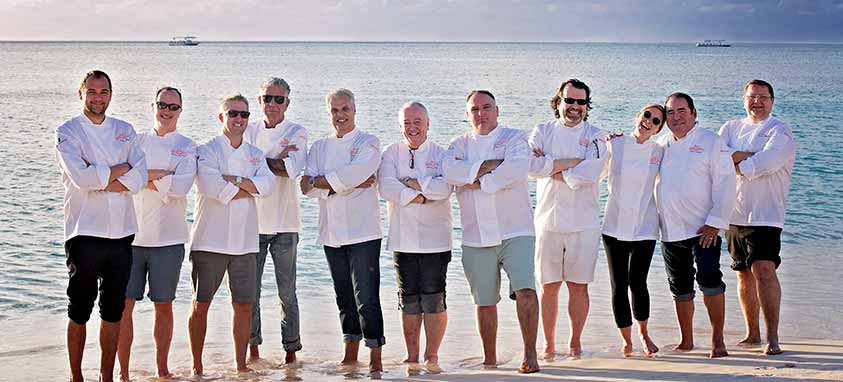
In what has become a top annual Caribbean event, several of the world’s leading chefs gathered in the Cayman Islands this month for the Cayman Cookout.

Anthony Bourdain (see cover profile in our February issue), Emeril Legasse, Jose Andres and Christina Tosi and were among the chefs who participated in the event, held Jan. 12–15 at The Ritz-Carlton, Grand Cayman. Eric Ripert, chef and co-owner of Le Bernardin in New York City, hosted the event.

cayman_cookout-food

The chefs delivered presentations and prepared sumptuous dishes for the approximately 7,000 attendees from throughout the world. The chefs joined attendees in other activities, including a wine fair and auction, and parties. One of the highlights was a private jet getaway to the exclusive Le Soleil d’Or Resort in Cayman Brac, Grand Cayman’s sister island, where participants sampled the wines of world-famous New Zealand’s  Craggy Range winery at 40,000 ft.

cayman_cookout_2017-8334-bev

Other high points included Bourdain leading a tour of food from around the world, sampling dishes at market-style stalls from local chefs; Legasse showcasing his passion for and mastery of Creole and Cajun Cuisine; Andres telling his spirited stories while making his famous paella; and Tosi putting a playful spin on home-style desserts using quality ingredients.

cayman_cookout_2017-7768

The cookout was sponsored by the Cayman Islands Department of Tourism, Food & Wine Magazine and The Ritz-Carlton, Grand Cayman.

The Ritz-Carlton Hotel is a luxury property located along the famous Seven Mile Beach. All 375 guest rooms boast a private balcony and either ocean, resort or garden views. The hotel features six restaurants and lounges, including Blue by Eric Ripert, the Caribbean’s only AAA Five Diamond dining experience, featuring exquisite seafood dishes and more than 700 fine wines from around the world. The hotel has more than 13,000 sq. ft. of meeting space, including a 9,000-square-foot ballroom.

trump's impact on travel industry

It would be an understatement to say that change is in the air. Last week Donald Trump was inaugurated as the 45th president of the United States. While the Trump administration begins to take action, businesses are hopeful that he will keep their industries in mind.

The travel industry is a major player in the U.S. economy, contributing more than $148 billion in tax revenue and more than 15 million jobs. Without it, every U.S. household would pay an extra $1,192 in taxes per year. Tax revenue, job creation and related services are all partially contingent on the travel industry. Therefore, the future of U.S. travel is a pressing concern right now.

The U.S. Travel Association (USTA) has released a list of priorities for this year, including:

1. Creating policy recommendations for what UTSA calls an “air travel blueprint”
2. Developing a Secure Travel initiative, which emphasizes emergency readiness and response
3. Assisting in secure and proficient travel
4. Modernizing national airports

President Trump has extensive experience with the hospitality sector under his belt. Since he is likely acutely aware of how the travel industry impacts adjoining economic environments, some travel companies are cautiously optimistic.

Consumer Concerns

Under this administration, federal regulations, including those designed to protect consumers, will likely be subject to new limitations. Trump has vowed that for every new federal regulation implemented, two existing ones will be scrapped. Federal regulations impact and shape every sector of the travel industry, so these changes could create an important chain reaction.

In December, a report by the National Economic Council indicated a growing trend of hidden fees which weigh on travelers, and in turn, the economy.

“The real prices of things are now being hidden or muddied by the addition of mandatory fees,” noted Charlie Anderson, senior adviser to the director of the National Economic Council, in a blog post on the White House website. “Quoted prices don’t reflect what things actually cost—the real prices are hidden by fees.”

During the Obama administration, government officials made numerous calls for increased traveler protection. Key travel initiatives took place during this time, including the eradication of hotel and resort fees and clearer price disclosures on airline tickets. It’s possible that the creation of such of policies may slow down in the future—and existing laws may be subject to revision or repeal.

“For a Republican administration—Trump’s included—regulation is a dirty word,” Said Anthony DeMaio, a former airline lobbyist who now works for the Washington, DC, according to a report in The Washing Post. “The increasingly powerful airline industry will not accept more fare-transparency regulation.”

The Impact on Hotels

In several public statements, Arne Sorenson, president and CEO of Marriott International, has expressed concerns about policies that could be damaging to the travel industry.

In an interview at World Economic Forum in Devos, Switzerland, Sorenson discussed the future of travel in 2017. “We had more than 75 million visitors from abroad to the United States last year. That supported… 2.5 million jobs. If you see all of that business disappear overnight that would be detrimental to our business, to our industry and to the economy as well.”

Improvements in Transportation

If Trump follows through on his promise to oversee crucial infrastructure improvements, then the new administration could provide a big boost for transportation. Likewise, travelers would gain a more enjoyable experience.

Additions, repairs and upgrades to transportation resources would be monumental for the travel industry. However, extensive infrastructure projects require a lot of funding. Money would need to be derived from either increased taxes or additional fees and tolls for privatized projects. Initially, these expenses are potentially negative for transportation services.

Meanwhile, Trump’s stance on countries such as Cuba has prompted questions about travel to these areas. Although immigration and trade policies between the United States and Cuba continue to be restricted, tourism between the two countries is skyrocketing. Last year a record four million people visited the country, making it a rapid-growth market for airlines. New airline routes and cruises have made travel to Cuba much more accessible as well. Consequently, Cuba anticipates at least 100,000 U.S. visitors this year.

cuba-travel

Growing American tourism has had a very positive effect on Cuba.  For instance, privately-owned restaurants are thriving because of American patrons. Restaurant owners have used this prosperity to reinvest in their communities and refurbish buildings.

Gary Kelly, Southwest Airlines CEO, discussed potential Cuban complications.

“Those flights have high demand both from the United States and from Cuba and obviously we’re hopeful that we can continue to operate them,” Kelly said in a report to the Tampa Bay Times.  “If the government… decides that that’s not possible, obviously we’ll obey the law but we’re hoping that’s not the case.”

It seems that Trump favors stricter policies with Cuba, as well as with other Central and South American countries. Trump has threatened to abolish the normalization of U.S.-Cuba relations that Obama started in Dec. 2014, unless the United States gets a “better deal.”

trump29n-2-web

Southwest is one of five U.S.-based airlines that began flying to Cuba through a Havana-Tampa route enabled by the Obama Administration last month.

Looking Forward

It’s very possible that President Trump will translate his hospitality experience into constructive travel policies. Genial border experiences, services which provide assistance with visa insurance and potential regulation changes are a few of the ways that Trump can boost the industry.

planning-an-international-meeting

Planning an international event can be complex, but not overwhelming if you do your homework. Whether it’s navigating cultural differences or reviewing shipping manifests, the event planner must manage unique policies, develop local partnerships and spend time understanding the local culture in order to produce a successful international meeting. Here are four tips for planning an event outside of the United States.

1. Leverage Local Contacts

The relationships established with local contacts heavily influence the success of the event. Whether it involves hiring entertainment in China or retaining local security anywhere in the world, your local contact can help you navigate language and cultural gaps where even the simplest request can be misconstrued. Mutually beneficial partnerships enable a smoother planning process and a better understanding of the local business climate. Your contacts are invaluable in understanding important cultural nuances.

2. Give Your Written Word

Understanding nonverbal cues and local idioms is important to reaching consensus while arranging your event.  In many cases, the same words can hold different meanings in another culture.  Does “OK” mean “I heard you” or does it actually mean “I agree?” To ensure your event runs smoothly, miscommunication must be avoided. Don’t just verbally agree on a negotiating point. Instead, put it in writing. Add pictures and detailed photo diagrams for even more clarity.

3. Do Your Homework

Research, research, research.  Do your homework to identify local practices and procedures that might affect your event. Differing customs such as the standard workweek and standard work hours can impact your meeting. For example, while the typical U.S. workweek is Monday through Friday, Middle Eastern countries often work Sunday through Thursday.  Public holidays are frequent in places such as Colombia and India, which lead the way with 18 public holidays per year. Also, keep religious and cultural holidays top of mind; they can impact what is open and available for your attendees.

4. Plan for Surprises

Be prepared for the unexpected. Be flexible and come ready to deal with whatever curveball comes your way. There will always be last-minute changes and surprises when dealing with the logistics of an international event, so don’t let it overwhelm or unnecessarily distract you. When your hard work comes together in a successful event, you will find it both personally and professionally fulfilling, as well as delivering positive outcomes for your organization and attendees.


Cynthia Cortis is a director in Event Services at SmithBucklin. You can reach Cynthia at [email protected].


real-id-act

Soon, the routine act of presenting a boarding pass and driver’s license at a TSA checkpoint will not be so straightforward, due to impending deadlines associated with the Real ID Act. The act, passed by Congress in 2005, established minimum security standards for state-issued driver’s licenses and identification cards.

Effective Jan. 22, 2018, TSA will only accept identification from Real ID-compliant states, or noncompliant states that have been granted an extension, as proof of identification for domestic air travel. The Department of Homeland Security (DHS) estimates that 90 percent of U.S. drivers hold licenses from jurisdictions that meet these conditions, and therefore may continue to use their state-issued identification.

The remaining 10 percent, including residents of Kentucky, Maine, Minnesota, Missouri, Montana, Pennsylvania, South Carolina and Washington, will need to present an alternate form of identification in order to fly.

Oklahoma’s request for an extension was recently denied, but the state received a grace period that will end on Jan. 29. If its identification cards are not updated to meet Real ID standards by that date, Oklahoma’s ID cards will no longer be accepted.

Acceptable alternate forms of identification include a passport, U.S. military ID and permanent resident card. Find the full list at tsa.gov.

With the Real ID enforcement deadline roughly a year away, TSA has intensified efforts to educate travelers about the upcoming changes. At airports, newly posted TSA signage explains the impending ID policy shift, and the agency’s website features prominent links to Real ID information, FAQs, a fact sheet and a DHS web page offering a state-by-state status breakdown.

To achieve Real ID Act compliance, states must verify the identity of each individual who applies for state-issued identification, utilize anti-counterfeit technology to produce state-issued IDs, and conduct background checks on workers who issue driver’s licenses. So far, barriers to full-scale implementation have included limited legislative sessions, funding issues and, in states such as Montana, opposition based on privacy concerns.

Travelers can expect to hear more about Real ID in the years to come. Beginning October 1, 2020, Real ID-compliant identification will be required for all domestic air travel.

casual-meeting-setup

A new year brings a fresh start and much to look forward to, an outlook that extends to the meetings and events industry. Here’s what we think will be trending in 2017:

Event Intelligence

Mobile event apps will take another leap beyond simply allowing groups to go paperless, take surveys and poll attendees. Added functionality will track attendee behavior and preferences at conferences through the collection of data from various technologies. This information will provide meeting and event organizers with valuable information about how and where attendees spend their time at meetings, as well as attendee patterns and behaviors, making it easier to implement improvements and changes.

In-Room Voice-Activated Assistants

How many times have you fumbled around a hotel room trying to figure out how to turn on the lights, adjust the temperature or turn on the television? Wynn Las Vegas is adding Amazon’s Alexa to all hotel rooms in 2017. From welcoming you to your room to providing weather information and making that all-important wake up call, voice-activated assistants are a glimpse at what’s to come in our homes and on the road.

A Fair Share

Look for the sharing economy that many are currently enjoying in other industries to begin making its way into the meetings and events industry, with planners and venues co-oping menus, decor, equipment and more. Sharing reduces costs and limits an event’s carbon footprint.

Switch-Ups in Setups

These days, business is more casual and so are meeting setups. Groups are asking for venues to change layouts and replace furniture to meet their needs. Hotels should expect increased pressure to provide unique seating arrangements that may include couches, a mix of seating and decor styles and more interesting room configurations.

RFP Evolution

It’s easy for planners to fire off one RFP to a number of meeting and event venues, and then start the process of fielding calls and emails with rates, dates and concessions. However, more planners will soon expect to be able to book online without even talking to a salesperson. Individual venues and portals will need to provide groups and planners with all of the tools they need to book online.


Michele Nichols is founder and CEO of Unique Venues, a marketing and membership organization that connects meeting planners with nontraditional meeting and event spaces in the United States and Canada.

loyalty-programs-business-travelers

If you travel often then enrolling in reward programs is definitely a good idea. Here are the best programs for business travelers. Make sure you’re getting the most bang for your buck, not to mention awesome reward benefits, with the following programs. We’ve highlighted features of the top programs.

Hotel: Marriott Rewards

Member

  • Rewards points earned for meetings and events
  • No blackout dates
  • Free in-room Wi-Fi

Silver Elite (10+ qualifying nights)

  • Member benefits
  • 20% additional bonus points

Gold Elite (50+ qualifying nights)

  • Silver Elite benefits
  • 25% additional bonus points
  • Guaranteed room type
  • Guaranteed late checkout (4pm)
  • Guaranteed lounge access and breakfast for 2

Platinum Elite (75+ qualifying nights)

  • Gold Elite benefits
  • 50% additional bonus points
  • 48-hour room availability guaranteed
  • Arrival gift of bonus points, a food & drink amenity or air miles

National airline program: JetBlue TrueBlue

TrueBlue member

  • No blackout dates
  • Earn at least 6 points per dollar when booking on jetblue.com
  • Purchase extra space for +200 points and pet travel companion for +300 points
  • Points do not expire
  • Option to donate TrueBlue points to charity organization

Mosaic Status

  • Membership benefits
  • Change and cancellation fees waves
  • More Space seats at much lower prices
  • You and others on your itinerary can check 1st and 2nd bags free
  • Expedited security line services
  • Early boarding
  • Complimentary alcoholic beverages onboard

International airline program: American Airlines AAdvantage

Gold

  • Unlimited, auto-requested complimentary upgrades (flights less than 500miles)
  • Priority check-in
  • 1 free checked bag
  • Complimentary same-day standby
  • Complimentary preferred seats

Platinum

  • Gold benefits
  • Business class and frequent flyer lounges
  • 2 free checked bags
  • Priority baggage delivery

Platinum Pro

  • Platinum benefits
  • Upgrades confirmed before departure as early as 72 hours

Executive Platinum

  • Platinum Pro benefits
  • 3 free checked bags
  • Complimentary same-day flight change
  • Complimentary alcoholic beverage and snack in the Main Cabin

Travel site: Expedia+

+Blue

  • Use your points to book award travel for others
  • No blackout dates
  • Get $25 off your next hotel with as few as 3,500 Expedia+ points

+Silver

  • +Blue benefits
  • Free amenities like spa discounts and free drinks at select +VIP Access hotels
  • Exclusive travel offers

+Gold

  • +Silver benefits
  • Room upgrades and flexible check-in and check-out at +VIP Access hotels (subject to availability)

Car rental: National Emerald Club

Club Member

  • Choose any car on the Emerald Aisle for only the midsize rate
  • Never pay for extra drivers
  • Earn 1 rental credit for every qualified car rental, get a free rental day after 7 points
  • Email receipts allow for a quick drop-off return
  • Receive exclusive members-only discounts and offers

Executive

  • Club membership benefits
  • Choose any car in the Executive Area and for only the Midsize rate (U.S. & Canada)
  • Free rental day after only 6 credits

Executive Elite

  • Executive membership benefits
  • Guaranteed car rental
  • Private airport delivery
  • Free rental day after only 5 credits (any class, no blackout dates)

Glamorous los angeles hotels la la land
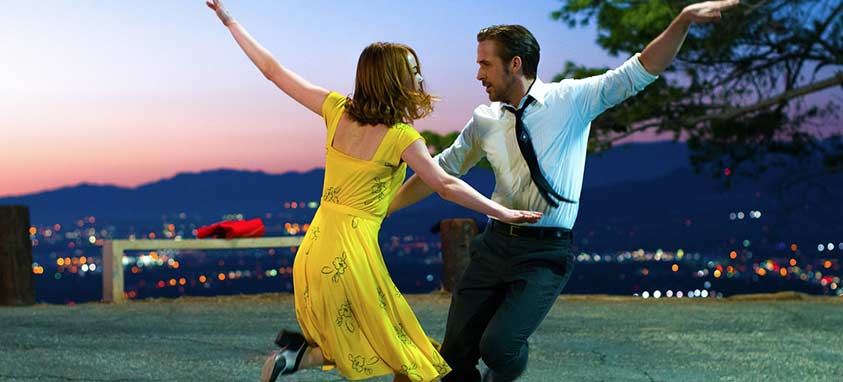
La La Land photo by Dale Robinette

Los Angeles’ exceptional cityscape seems to have it all: rich art and culture, Hollywood stars, grand hotels, the magic of Disneyland and a lively night life.

La La Land took the Golden Globes by storm on Sunday, winning all 7 of its nominations, including Best Motion Picture (Musical or Comedy). The recently released film features Emma Stone and Ryan Gosling as star-crossed lovers struggling to make it in LA as an actress and jazz pianist. La La Land is a captivating homage to classic MGM musicals, evoking nostalgia for old Hollywood style in a powerful way.

Planners looking to design an event full of retro glam should head to these Los Angeles-area hotels for a dreamy escape.

The Hollywood Roosevelt

Glamour Hollywood Hotels

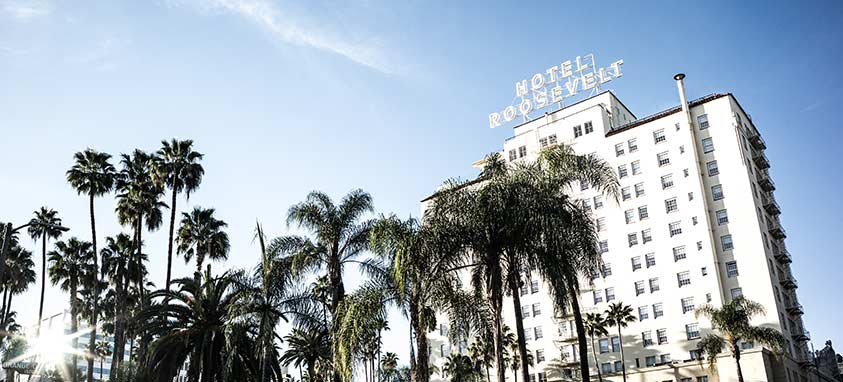
Shortly after opening, The Hollywood Roosevelt Hotel established its legendary reputation in 1929, when it hosted the first Academy Awards. Celebrating its 90th anniversary this year, The Hollywood Roosevelt has welcomed illustrious icons such as Prince and Angelina Jolie. It has also hosted megastars such as Clark Gable, Shirley Temple, Charlie Chaplin and Marilyn Monroe.

Today, the hotel still buzzes with industry executives and talent, standing as a landmark attraction and popular destination for people from all over the world. The Hollywood Roosevelt offers 300 newly refreshed guest rooms and suites. The hotel also contains over 25,000 sq. ft. of flexible venue space.

Hotel guests can choose from top-notch accommodations like poolside cabanas and tower rooms with stunning views. The hotel’s heated outdoor pool remains the only one in the world containing a million-dollar work of art, painted by acclaimed artist David Hockney.

The Beverly Hilton

Glamour Hollywood Hotels

The Beverly Hilton has a glamorous, star-studded history, combining Hollywood thrills with the prestige of Beverly Hills. Since its opening in 1955, the hotel has welcomed countless renowned historic figures, including Hollywood celebrities Frank Sinatra, Judy Garland, Cary Grant and Burt Lancaster; United States Presidents John F. Kennedy and Ronald Reagan; as well as royal Duke and Duchess of Cambridge and Princess Grace Kelly.

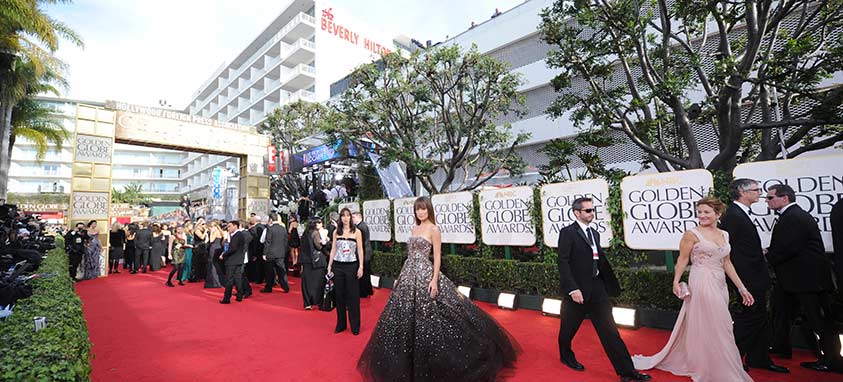
The hotel has sustained its trendy image to this day, hosting over 200 red carpet events each year, including the annual Golden Globe Awards and Oscar Nominee Luncheon. The Beverly Hilton offers 569 rooms and suites along with over 60,000 sq. ft. of event space on the lobby level. The famed Aqua Star Pool is the setting for several easily recognizable photo and film shoots. Currently, The Beverly Hilton remains an iconic place to see and be seen.

The Peninsula Beverly Hills

Glamour Hollywood Hotels

Known for its covert location, The Peninsula Beverly Hills is nestled among lush tropical gardens and located within walking distance of Rodeo Drive. The hotel offers 195 guest rooms, including 38 suites and 17 private villas. Additionally, The Peninsula Beverly Hills contains 3,398 sq. ft. of space designed for versatile meetings and events.

Guests can take advantage of one of the hotel’s most unique amenities, the “Hollywood Piano Legend: A Private Lesson, Lunch and Cocktails” experience. This involves a private 90-minute piano lesson and subsequent lunch in the property’s Belvedere restaurant, both accompanied by Antonio Castillo de la Gala, the historic hotel’s resident pianist. Throughout the experience, Antonio Castillo de la Gala shares his knowledge of music history and personal recollections of performing for Hollywood legends.

Shutters on the Beach & Hotel Casa del Mar

Shutters-on-the-Beach---Pool-Chairs

Casual yet elegant Shutters on the Beach serves as Santa Monica’s prime retreat for Hollywood’s elite. Guests such as Gwyneth Paltrow and Jennifer Aniston have enjoyed its new, relaxed Hollywood charm. Overall, Shutters on the Beach presents a thoughtful blend of indulgence and serenity. Just steps from the sand, the resort features interiors by Michael S. Smith, who has designed the White House’s interiors since 2008, amid unrivaled views of the Pacific Ocean. The hotel contains the luxurious ONE Spa, two signature restaurants, 198 stunning rooms and a venue that can host up to 400 guests. A Tesla house car offers guests on-demand rides with eco-minded style.

For those seeking older Hollywood appeal, Shutters on the Beach’s sister property, Hotel Casa del Mar, is very close by. The coastal escape is slightly smaller than its sister hotel, with 129 rooms, including 17 suites. However, it also offers an event space capable of accommodating 400 attendees. It offers a storied history and a lively lobby containing floor-to-ceiling windows, cozy nooks and indoor cabanas. Hotel Casa del Mar is sure to evoke stylish wonder and grandeur.