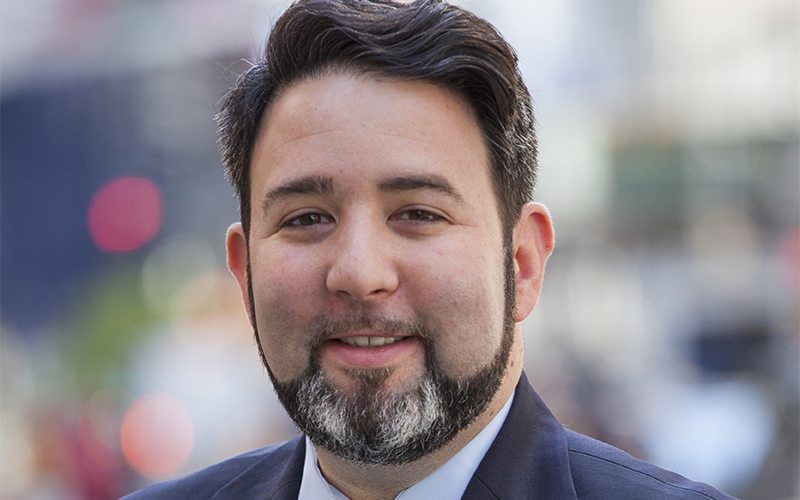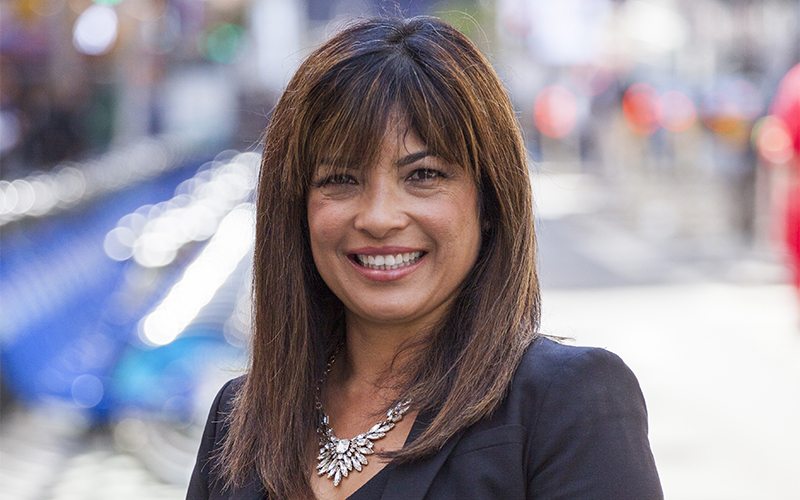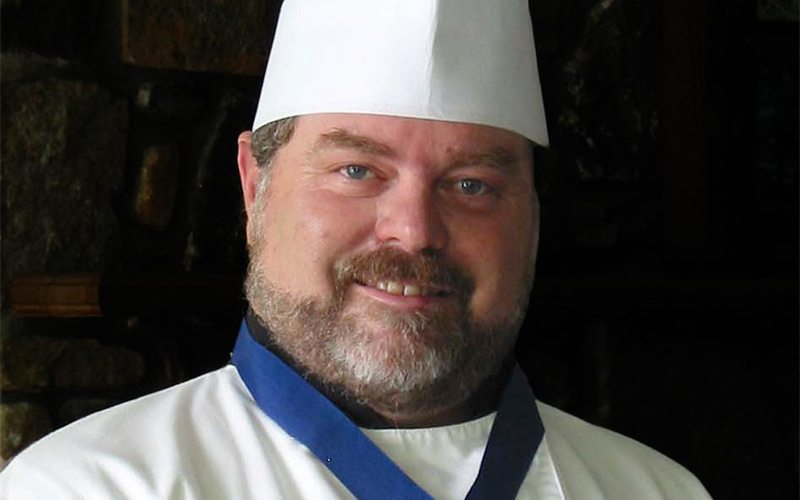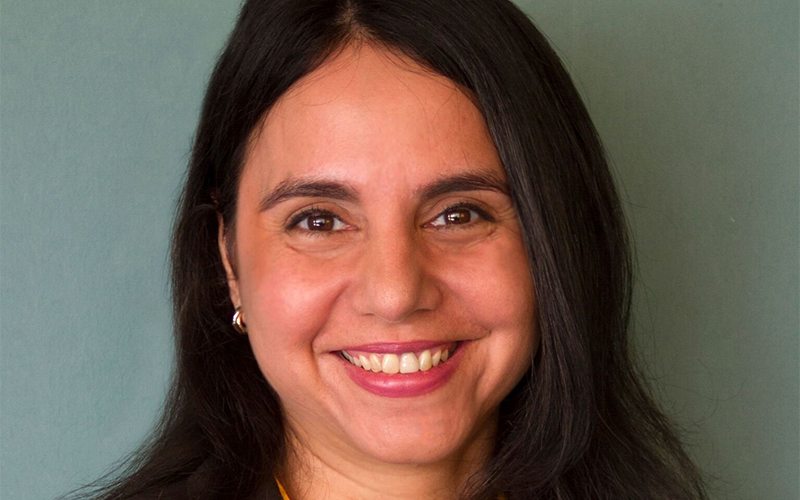
Mickey, Minnie, Donald, Daisy, Goofy and Pluto aren’t the only characters in Anaheim. Get ready to discover Disneyland’s hometown through a new set of ears and eyes. Last week, Visit Anaheim launched a new tourism campaign with a cast of uncommon characters that showcase to meeting professionals all the city has to offer. Wait until the ride has come to a complete stop before stepping off and exploring the rest of the city.

“The personas we created for the Uncommon Character campaign embody locals and visitors who represent different aspects of Anaheim’s spirit. We wanted to catch the attention of meetings and convention planners as they were flipping through trade publications that showcase traditional destination ads,” says Charles Harris, senior vice president of marketing for Visit Anaheim.

Gettin’ To Know Ya

Two of the six characters are specific to the meetings and convention industry.

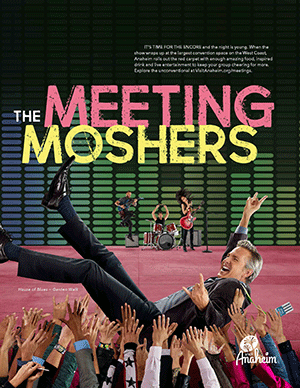
The Meeting Moshers
Credit: Visit Anaheim

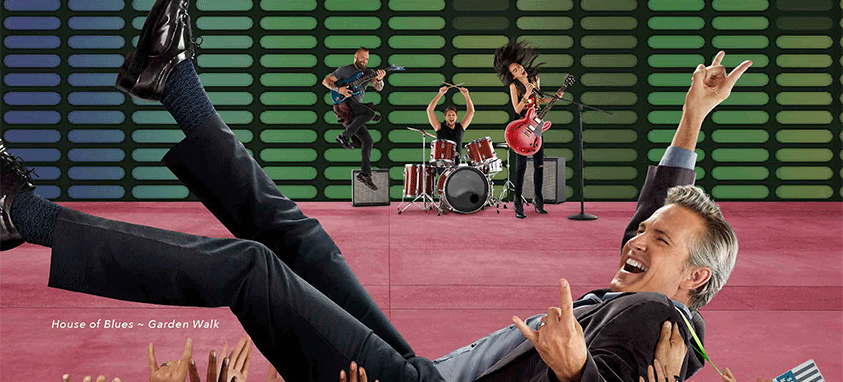
Once the meeting day has come to a close, it doesn’t mean the fun has to end. Your group can get its rave on and go crowd surfing at Anaheim’s various concert venues, which are also available to rent for private events.

“The backdrop of the Meeting Mosher ad is the new House of Blues in Anaheim. The House of Blues has expanded its footprint by doubling in size at its new home at the Anaheim GardenWalk. This is great for planners; there’s buyout capabilities and space for four separate and simultaneous concerts to take place,” Harris says. “Meeting planners can be rock stars to their attendees.”

Groups can also jump in the mosh pits at Honda Center, City National Grove of Anaheim and Angel Stadium.

The Crushers of Convention
Credit: Visit Anaheim

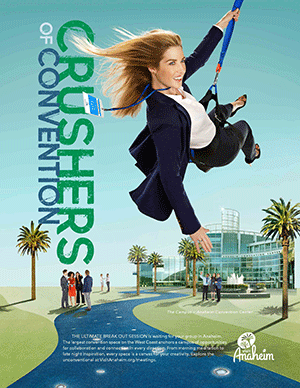
You’ve heard of wedding crashers. Now meet the convention crushers. Meeting professionals all seek to crush it—to impress attendees. Follow the lead of the Crushers of Convention, and you’ll surely accomplish that.

“The Crushers of Convention cinemographs depict the ability for meeting planners to think out-of-the-box and create memorable and unique experiences for attendees utilizing the Anaheim Convention Center’s new flexible spaces,” Harris explains.

Last year, Anaheim Convention Center debuted 200,000 sq. ft. of additional exhibit space with the opening of ACC North. This expansion boosted the facility into the exclusive 1 million-square-foot club and made it the 11th-largest convention center in the country. “There are two outdoor plazas groups can use as well, totaling 100,000 sq. ft. for al fresco events during the day or under the stars,” Harris says.

Visit Anaheim estimates that meetings and events at ACC North will attract an additional 1 million visitors annually. The city experienced its fifth consecutive record-breaking year in tourism in 2017, welcoming 24.2 million visitors. The record attendance of conventions, including NAMM, Natural Products Expo West, VidCon, California Dental Association, OC Auto Show and LuLaRoe contributed to that impressive figure.

“As home to the West Coast’s largest convention center, the meetings and convention industry is very important to Anaheim. [It] provides the economic engine that helps the city of Anaheim flourish, provides local jobs and helps support the police and fire department,” Harris says. “Many meetings and conventions that come to Anaheim incorporate a giveback program that directly and positively impacts the residents of the community.”

Uncommon Meeting Places
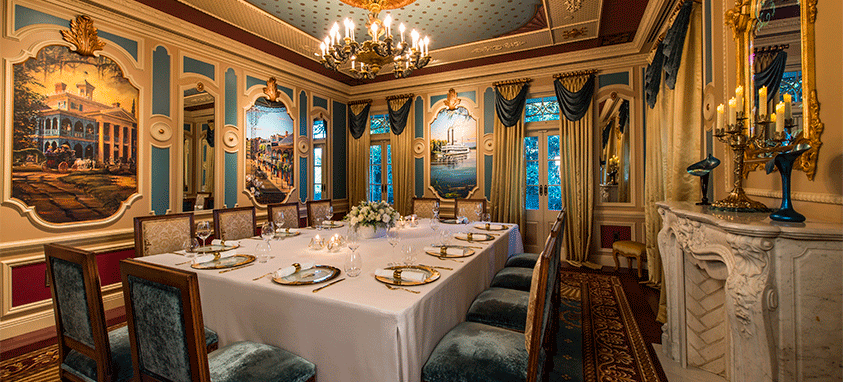
The characters are far from the only thing that’s uncommon about Anaheim. The city also has many smart spaces that set the tone for curiosity and exploration. In addition to the Dumbo and Peter Pan rides at Disneyland, groups can learn to fly during a corporate or team-building event at Flightdeck Flight Simulation Center.

“It’s the only place in the world where guests can experience a fighter jet pilot simulation experience,” Harris says.

From Anaheim Packing House food hall to the emerging brewery scene, the city is becoming a mecca for dining. The comic book-themed Unsung Brewing Co. pairs beer with cheese. “Planners can also host a once-in-a-lifetime dinner for 12 guests at Disneyland Park’s 21 Royal, which was a private residence envisioned by Walt and Lillian Disney,” Harris suggests.

Captain Brew Beard, Libation Sensation, Pho Fan Girl and Virtual Ace were also cast to represent the leisure travel market.

We celebrate Earth Day each year. But how did it become a universal celebration of our world? Who was the mastermind behind this? Smart Meetings delves into the history of the international event.

The Roots of Earth Day

Many origin stories have been birthed regarding Earth Day, perhaps demonstrating how important this yearly observance has become to so many around the world.

Morton S. Hilbert, who, with the U.S. Public Health Service, organized the Human Ecology Symposium, a 1968 conference that informed students of environmental degradation’s impact on human health, is credited by some accounts as the originator of an Earth Day idea that seeped into the public consciousness.

Other accounts focus on tragedy in California in 1969: the Santa Barbara Oil Blowout. When an offshore well erupted in a massive spill, more than three million gallons of oil killed more than 10,000 animals, including dolphins, birds and seals. This evoked strong responses from many, and got activists thinking about a public education campaign to save the Earth from human despoliation.

Airlie, a bucolic resort located 45 miles from Washington D.C., claims that the idea of Earth Day was first announced in its meeting space. Then-Wisconsin Senator Gaylord Nelson, who is often credited as founder of Earth Day, introduced a plan to medical and law students at a conference there in 1970.

Or perhaps it all began in the winter of 1969-1970, when a group of students got together at Columbia University, where Denis Hayes, an environmental advocate, spoke of his plans for an Earth Day; inspired, these students took on a New York City observance themselves. Mayor John Lindsay shut down Fifth Avenue and opened Central Park for the festivities, where an estimated 100,000 people visited throughout the day.

EarthDay.org, when recounting the history, ties these stories together. It says that Nelson, seeing the outrage over the oil spill and inspired by student demonstrations to raise awareness about the environment, started working to make the first Earth Day a national reality. By recruiting another U.S. Senator, Republican Pete McCloskey, to serve as co-chair for a “national teach-in for the environment,” and Denis Hayes as national coordinator, Senator Nelson won the broad-based support that resulted in 20 million American taking to the streets, parks and auditoriums of the nation on April 22, 1970.

Growing Around the World

Earth Day in 1990 was especially notable, as it boosted recycling efforts worldwide. The 20th anniversary was highly publicized, with a large marketing campaign, television and radio promotion, and budgets in the multimillions. Many separate environmental groups partnered to sponsor events throughout the world. Earth Day in 2000 reached an even larger audience via the internet. The celebration was a global success, with groups around the world participating in sustainability efforts.

Celebrating the Earth in Today’s World

Now, Earth Day is the world’s largest environmental movement, and is overseen by a nonprofit organization, Earth Day Network. According to its website, the organization works with more than 50,000 partners in nearly 195 countries. More than 1 billion people now participate in Earth Day activities each year.

In fact, in many communities Earth Day has expanded to Earth Week. From environmental organizations to universities to hotels, organizations promote sustainability in many aspects. Reducing food waste, recycling water and energy conservation are only the tip of the sustainable iceberg. Earth Week is also the perfect time for environmental activists to educate the public on the critical importance of being eco-friendly, in small ways and large.

Earth Day 2018 is dedicated to “providing the information and inspiration needed to fundamentally change human attitude and behavior about plastics,” according to earthday.org.

For more information on celebrations for Earth Day, Smart Meetings has gathered a list of celebrations around the U.S. We have also compiled a list of hotels that are working to increase sustainability.

Matt Mayberry

What’s the secret to reaching your goals even if everyone—including your high school guidance counselor—is predicting your incarceration? Or, worse, your death?

Attendees at Smart Meeting Midwest at Wyndham Grand Chicago Riverfront learned the turnaround tips required for winning from ex-drug addict, former pro football player and now executive coach and author Matt Mayberry.

The Power of Goals

“Most people don’t know the power of goals or how to achieve them,” Mayberry said, who noted that people spend more time planning a vacation than thinking about what kind of person, mother, father or employee they want to be, or career they want to have. Silhouetted in the penthouse view of the Windy City that was featured in the movie Batman: The Dark Knight, he advised the meeting planners and suppliers preparing to go into their one-on-one appointments that they needed to write down actionable strategies.

Having a plan is more important than motivation,” he said.

But where to start? Mayberry offered a five-part plan.

  1. Set a stop watch for 3 minutes.
  2. Write 8-10 goals you want to achieve by next year (mix it up: some health goals, some personal development, some leisure and a lot of professional goals).
  3. Ask yourself, “If I could achieve one goal, which one would drastically change my life?” That is the game changer; the rest will follow.
  4. Write down 24-50 things you must do to achieve that goal.
  5. Incorporate one to two of these action items into your calendar every day—so you know they will get done.

“The important thing is to set massive goals. The process of working toward those goals makes you a better person,” he said.

Keep It Short, Sweet and Funny

Sugarwish

While much of the day was devoted to productive networking, attendees were also treated to a customized candy experience provided by Sugarwish, a fulfillment company that lives by the motto, “Sweet. Happiness. Delivered.”

The action-packed day ended on a humorous note, with observational speaker Matt Havens helping his audience members laugh at themselves while also learning how to communicate with those of different ages who grew up experiencing their own generational fashion faux paus. His insightful “Stop Acting Your Age” tips were a reminder to recognize our similarities instead of labeling others with exaggerated cliches.

waiting

Sleep is extremely important for event planners, but with the stress of planning, the need for constant communication and the pressure to execute a flawless event, it can be difficult to find eight hours of shut-eye. In fact, National Sleep Foundation recently released a study that found only 27 percent of adults in the United States get seven to nine hours of sleep.

This is made even more difficult when adding in the extra variable of traveling. Cramped seats, crying babies and extreme turbulence can make the idea of sleeping on a flight seem impossible. But this is beginning to change—from the airport terminal to the flight itself, to the hotel post-landing, sleep is becoming available everywhere.

Snoozing in the Terminal

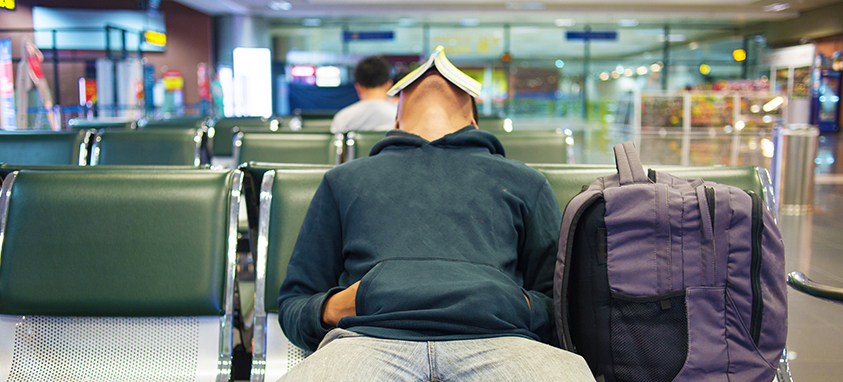
Plenty of times, you want to rest at the airport because you arrived early, flew in late or have a long layover. But nodding off in uncomfortable terminal seats can feel impossible with the hustle and bustle of the airport. Some airports are beginning to implement pods and rooms that can be booked by the hour, though.

If you’re flying from England’s Gatwick Airport (LGW) or Heathrow Airport (LHR), Amsterdam Airport Schiphol (MAS) or France’s Charles de Gaulle Airport (CDG), you can book a room with Yotelair. These rooms can be booked for a full night of sleep or a quick hour-long nap in between flights. The rooms come equipped with adjustable SmartBeds that include memory-foam gel mattresses and extra pillows, and duvets by request. And if you’ll be flying from Singapore Changi Airport (SIN), starting in 2019, you’ll have the option to rent a cabin there, too.

GoSleep is another option for those wanting to take a second to re-energize. These Finnish pods convert into beds, and a moveable, breathing shade hides passengers from noise, light and unwanted attention from other passersby. GoSleep Pods are available in 16 airports so far, including Beijing Capital International Airport (PEK), Tokyo International Airport (HND), Abu Dhabi International Airport (AUH) in the United Arab Emirates and Hamburg Airport (HAM).

For those wanting their own private suite in the United States, Minute Suites is the perfect nap station. Located in Hartsfield-Jackson Atlanta International Airport (ATL), Dallas/Fort Worth International Airport (DFW) and Philadelphia International Airport (PHL), the company considers itself “The Traveler’s Retreat”—for good reason. Each room comes with a portable daybed sofa, a pillow and fresh blankets. A sound-masking system offers to “neutralize noise to help deliver a refreshing power nap,” making it the perfect area for those with a longer layover.

Sleeping 36,000 Feet Above Ground

sleeping

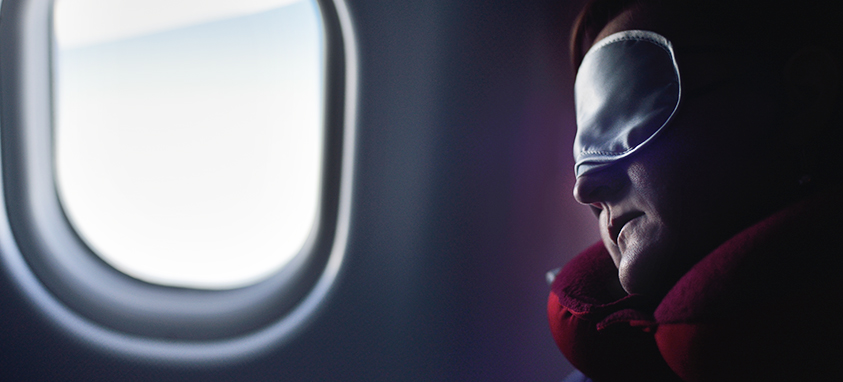
Every traveler’s dream is to get on a plane, slip an eye-mask on, put on headphones and doze off for the long flight. But unless you’re one of the lucky few who can sleep through everything, the situation is a dream. Some airlines, however, are looking to change this by adding features and portable seats for those looking to doze off.

JetBlue has begun offering JetBlue Mint, suites for those traveling cross-country on certain flights and occasionally to the Caribbean. With seats that recline to a full 180 degrees, with a comforter and pillow, you’ll be able to doze off easily. If that’s not enough, the cushions offer a massage feature and the suite has its own door, so you won’t be interrupted as you’re lulled to sleep.

If you’re traveling in the new business cabin of Air France, you’re in for a treat. With a seat that molds to your body, you’ll feel as though you’re sleeping on memory foam as the seat extends to more than 6 feet. Aside from the usual feather pillow and soft duvet, Air France also offers a “comfort and well-being kit” that contains toiletries and Clarins skin treatment. Say “ahh” as you recline.

Hawaiian Airlines is also getting in on the sleep trend. In May, the airline will roll out its first aircraft featuring lie-flat seats in its premium cabin. To help you prepare for bedtime, the company has an array of amenities for those getting ready to kick back. From socks reading E Hiamoe Maikal (meaning “sleep well”) to toiletries featuring tropical scents of the islands, Hawaiian Airlines is pulling out all the stops.

Hotel Dozing

You’ve made it to your destination, and you’re absolutely exhausted. Luckily, there are plenty of hotels that offer special perks for those dedicated to their sleep. National Sleep Foundation also found in its study that only 10 percent prioritize sleep over other activities—but with hotels dedicated to resting, that 10 percent is bound to raise.

If you’re looking for rest inside the airport, Hilton Chicago O’Hare (ORD) offers silent rooms with blackout curtains, soundproof windows and extremely comfortable beds. You’ll forget that you’re situated in one of the busiest airports in the United States.

For those who are serious about their sleep but require special pillow firmness, look no further than Conrad Miami. Its Pillow Menu offers six selections: the L-shape Pillow, Tri-Core Pillow and Mediflow Water Pillow are a few of their options. Each pillow offers its own perk, from antisnore assistance for those who wake themselves up from their zzz’s to cold relief for those who caught the traveler’s cold.

Hoping to relax into the perfect siesta following a day of travel on barely any sleep? Consider The Westin La Paloma. It contains its own unique amenities, including the Sleep Well Menu, which offers food packed with amino acids, vitamins and minerals to aid in your best sleep yet.

concert

An apple a day keeps the doctor away, but what about a concert? Is drinking a tall glass of music the real fountain of youth? A recent study shows that frequently attending concerts can extend your life by as many as nine years.

Heading to the box office may be bad for your wallet, but excellent news for your health. Results from a scientific study conducted by O2 and Patrick Fagan, behavioral science expert and associate lecturer at Goldsmiths, University of London, claims that a concert-goer’s life expectancy can be extended by almost a decade by jamming out at gigs every other week.

“Our research showcases the profound impact gigs have on feelings of health, happiness and wellbeing—with fortnightly or regular attendance being the key,” Fagan says. “Combining all of our findings with O2’s research, we arrive at a prescription of a gig a fortnight, which could pave the way for almost a decade more years of life.”

Researchers measured psychometrics and heart rates of people attending concerts, doing yoga and walking dogs. Concert-goers exhibited a 21 percent increase in feelings of wellbeing, as well as an increase in self-worth, closeness to others and mental stimulation.

The Magic of Concerts

It has become commonplace to secure a headlining musical act at major conferences. The memorable moments provided are shared on social media and can get your event trending. Also, convention and visitors bureaus and host hotels incorporate concerts into fam trip itineraries. These excursions are seemingly for the entertainment appeal, but can serve a dual purpose.

On a recent fam trip attended by Smart Meetings to Myrtle Beach, a special, VIP Hootie and the Blowfish performance at the House of Blues was part of the agenda. And, in conjunction with Global Meetings Industry Day, Smart Meetings also attended Jennifer Lopez and Justin Timberlake concerts in Las Vegas, hosted as guests of Caesars and MGM, respectively.

The report by O2 and Fagan has been received with some skepticism on the internet after being released last month. A Newsweek article notes that the study was commissioned by O2, a major concert venue in the United Kingdom, and the press release is used as an opportunity to encourage people to purchase tickets to shows it is hosting.

Hazards of Cranking Up the Volume

Evans Vestal Ward NBCUniversal/One Voice Somos Live!/Getty Images

Many people experience hearing loss as they age, and exposure to high decibel levels at concerts can potentially cause an early onset of deterioration of ear drums. In 2015, the World Health Organization released a brochure, Make Listening Safe, which raises awareness of the hazards of noise-induced hearing loss, and that concert-goers are among the most susceptible. There’s a simple way meeting planner can help attendees: Include ear plugs in a swag bag.

Consistently getting a good night’s rest after concerts also helps. Concerts and music festivals, such as Coachella, typically last into the late hours of the night or even the wee hours of the morning. Remember to pace your group and try to budget time to allow everyone to sleep late the following day to recover.

From Stage to Green

Concert attendance is not the only activity that alleges to extend life. As part of World Golf Foundation’s Golf & Health Project, University of Edinburgh researchers published a 2016 study in the British Journal of Sports Medicine that used scientific findings to back the benefits of teeing off.

“We know that the moderate physical activity that golf provides increases life expectancy, has mental health benefits, and can help prevent and treat more than 40 major chronic diseases, such as heart attacks, stroke, diabetes, breast and colon cancer,” lead researcher Dr. Andrew Murray says. “Evidence suggests golfers live longer than nongolfers, enjoying improvements in cholesterol levels, body composition, wellness, self-esteem and self-worth.”

In a January 2016 blog post, he added, “A little known fact is that a study from Sweden showed that the average golfer lives five years longer than those that don’t play, regardless of age, gender and earnings.”

A morning round of golf or an afternoon at Topgolf is often used as a fun, bonding activity at meetings or on fam trips. Golfers exercise and burn calories by carrying clubs and walking the course. Fresh air and a healthy dose of vitamin D also help, as do socialization and stress relief.

Creating Personal Connections

Hootie

Both golf and concerts also create a sense of community among people with common interests.

“Social connections are really good for us, and loneliness kills. It turns out that people who are more socially connected to family, to friends, to community, are happier, they’re physically healthier and they live longer than people who are less well-connected,” says Robert Waldinger, Harvard Medical School psychiatrist and professor, in his 2015 TED Talk. He is also the director of Harvard Study of Adult Development, one of the world’s longest running studies of adult life, which started in 1938, during the Great Depression.

If golf, or any outdoor activity, is part of your meeting’s itinerary, remember to drop a bottle of sunscreen into the swag bag to protect participants from the sun’s harmful rays. According to the Centers for Disease Control and Prevention, skin cancer is the most common form of cancer in the United States, and it can cause premature death.

Marriott loyalty card

As expected, Marriott International is unifying its rewards program across its brands. Starting in August, members will be able to book stays and earn or redeem points among 29 global brands, comprising 6,500 hotels in 127 countries and territories.

This move brings members of The Ritz-Carlton Rewards and Starwood Preferred Guest (SPG) program under the Marriott Rewards umbrella. Benefits will be enhanced under the new program, the company says, giving members 20 percent more points for every dollar spent, on average.

“We set our sights on unlocking the full potential of our loyalty programs,” says David Flueck, senior vice president of Global Loyalty for Marriott. “We hope to inspire our members whatever their travel passion, whether it is resorts featuring overwater bungalows, peaceful secluded island settings, ski-in/ski-out mountain resorts, towering hotels with picture-worthy views or even former palaces converted into hotels.”

The separate rewards programs will continue to live on under the new set of unified benefits until a new program name is introduced in 2019.

In August, SPG members will see their points balance triple. SPG, Marriott Rewards and The Ritz-Carlton Rewards members will all earn 10 points for every dollar spent at all brands except for Residence Inn, TownePlace Suites and Element, which will offer five points per every dollar spent. All members will also begin earning points for food and beverage, and qualifying incidentals during their hotel stays, rather than just the room rate.

All hotels throughout the Marriott loyalty portfolio will have no blackout dates for points redemptions.

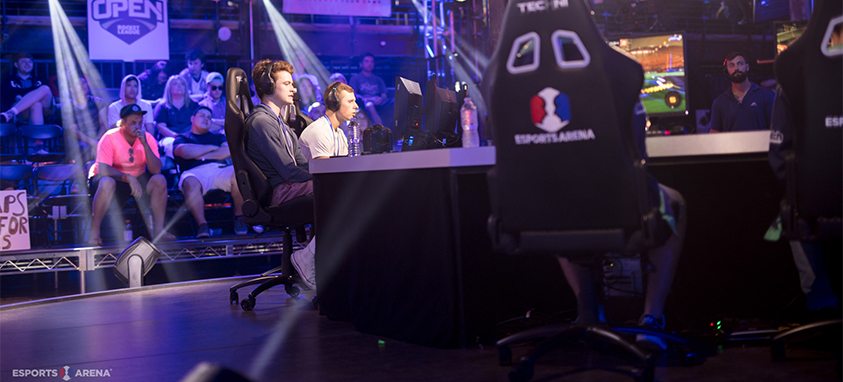
Video games have become much more than a fun activity to pass the time. It can be a career choice—and not just on the production side, but on the player side, too. Explosive growth of video game conventions and tournaments, particularly in eSport games, could be good news for event planners.

According to Statista, an online market research firm, 162 million people frequently watch eSport events, while another 131 million are occasional viewers of the hundreds of games that rise and fall in popularity with many players achieving celebrity status with their following. And more are joining fan ranks each year. The number of at least occasional spectators is expected to rise to 303 million by 2020. South by Southwest added a whole convention on gaming for 2018.

“[ESports] already exceeds the audience of the NBA and NFL put together,” says Robert Rippee, director of eSports Lab at University of Nevada, Las Vegas. He asks his audiences when they started using computers in classrooms. Most say around second grade. Then he asks what they used them for. After a bit of thought, they inevitably say they played video games. “We have an entire generation that grew up playing games. Now granted they are for learning, but they are still playing and there is still the idea that the more you play, the better you get,” he said. That can be a powerful instinct to leverage in delivering content.

Room for Play

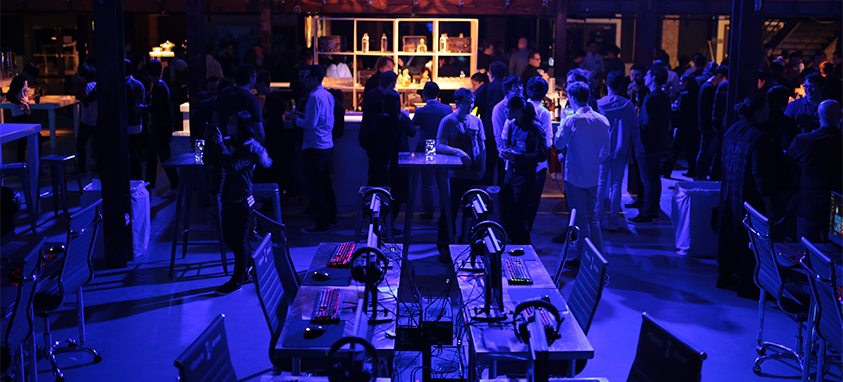
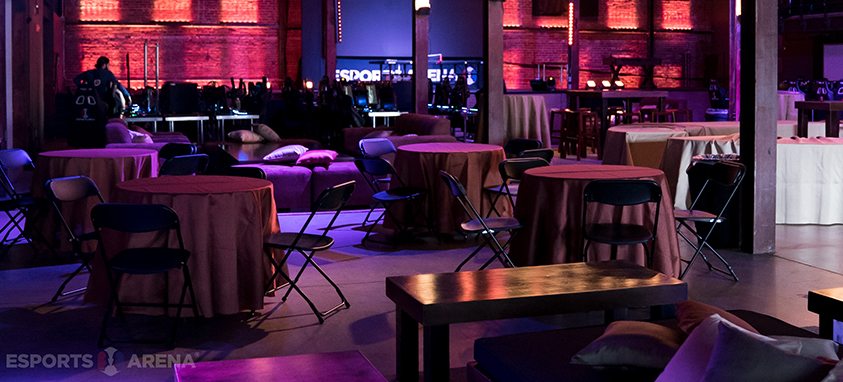
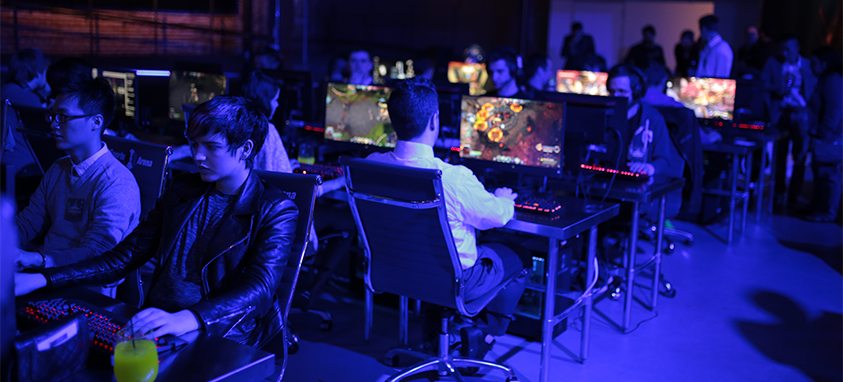
A raft of new eSport facilities is opening across the country. Santa Ana-based Esports Arena built a 15,000-square-foot arena in Orange County in 2015. The company then partnered with Allied Esports—which operates a 14,000-square-foot tournament space in Beijing—to build a 30,000-square-foot facility inside Luxor Hotel & Casino in Las Vegas that opened in March. That was followed by a 16,000-square-foot facility in Oakland’s Jack London Square in April. The company also operates Esports Arena Drive, an 18-wheel, 35-ton semi that brings a mobile competition stage, arena and VIP lounge to your space. Other meeting venues are getting in on the act big time. In March, The City of Arlington announced that the $10 million renovation of Arlington Convention Center will include a 100,000-square-foot eSports stadium.

These theater-style auditoriums resemble the control room of Star Wars’ Millennium Falcon with bar areas, state-of-the-art gaming chairs with vibrating components, and screens everywhere for play.

Niklas Rytterstrom, general manager of Luxor, compares the gaming experience in the former nightclub space to the other entertainment offered on The Strip. “With this partnership, we will introduce a new experience to the market, once again elevating the city’s vast entertainment offerings,” he says.

Despite their growing popularity, Rippee doesn’t believe mega-stadiums will be the norm as many smaller facilities can serve a similar purpose leaving the mega stadiums for the bigger tournaments of the most popular games. It’s all relative according to Rippee, with so many games out there to play, ranging from one player to 100, not all tournaments will draw the same crowd. Unlike sports like football, where there is one game and fans have their favorite teams within that game, there’s many different games with many different players all falling under the eSports umbrella. “The ecosystem of eSports is very fragmented. There are so many, and each one is really different from another. Each is its own sport in itself. The growth of these arenas is driven by the fact that you have an array of fans.”

Millennial Appeal

Meeting planners have found that incorporating online gaming experiences into agendas helps engage a younger audience. “Think about a corporate event looking for entertainment. If it’s mostly 30-year-olds, then eSports may be a better form of entertainment over a concert,” Rippee suggests.

Whether it be renting out an arena, playing games at an event or bringing in a professional gamer to orchestrate mock competitions, gaming facilities make interactive experiences easier. “At the end of the day, esports are a form of entertainment, never mind all the professional gaming leagues. They are there to entertain people. You can make the assumption that if the majority of your attendees are under 35, they are probably going to be into eSports,” Rippee says.

I’ve often marveled at the complete disconnect between what conference organizers and conference attendees think is the purpose of an event. For the organizers, the expo floor offers educational and networking opportunities that simply can’t be found in any other way. It is the culmination of months of work and thousands of dollars, if not more. For some attendees, however, it’s primarily a great excuse to get ridiculously drunk and maybe pick up some swag from vendors.

In fact, let’s look at an all-too common conference attendee’s agenda:

Attendee shows up the day before, checks into room, registers for conference, and receives lanyard. Attendee then heads immediately to the nearest bar, because for the next several days he or she is single–no spouse, kids, chores, or curfew. Attendee celebrates newfound status by drinking excessively and staying out until 3am. Attendee then straggles into the opening session and sits as far away from the podium as possible, as though still in junior high. 

I could continue, but I don’t wish to depress you.  The point is, attendees may have good intentions, but can be distracted. However, you can use their natural tendencies to your advantage. Here are a few ways you can organize your next event to thwart those accidental distractions:

Start an Hour Later

Almost every conference at which I am invited to speak starts at 8 a.m. and ends around 4:30. What about beginning at 9 a.m. and ending at 5:30 p.m. as a gift to those who may not have found their room until the wee hours? You’ll probably have more people showing up to your opening sessions, and you still won’t interrupt their dinner plans.

Rope off Back Seats

Left to themselves, attendees will sit as far from the stage as they can. This makes the room look empty, and it also creates a slight disconnect between them and whoever’s speaking. I’ve learned over the years that conference attendees are terrified of tiny ropes and tilted chairs. If they see either of these things, they will run away from those locations and sit instead in whichever seats are tilt- and rope-free. When the first few rows are full, you can remove the tape and let attendees fill in the “brand new” space. They won’t even know you’ve manipulated them.

Do Giveaways During Breakout Sessions

Everyone does giveaways at the various keynotes when theoretically everyone is in attendance. But if there’s any truth at all that giveaways actually get people to show up, then there’s no reason to limit those giveaways to the main sessions. If attendees are going to skip something, it’s most likely one of the breakout sessions. So, put some giveaways in some or all of those breakouts. The session leaders will certainly enjoy increased attendance, and your attendees will have plenty of time to hang out at the pool later.


Jeff Havens is a professional development expert who addresses leadership, generational issues, and other areas of professional development through a unique blend of content and entertainment. He has been a regular guest on Fox Business News and featured in CNBC, BusinessWeek, and Bloomberg News.

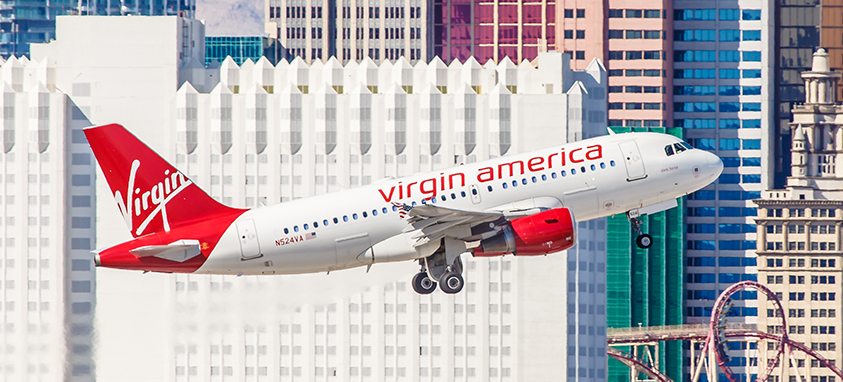
It’s a day to remember for travelers everywhere—Virgin America, after 11 years of service, has scheduled its final three flights for April 24. Two flights will leave from San Francisco, with one arriving in Newark and the other in San Francisco. Employees will enjoy one final hurrah as the last flight travels from Los Angeles to San Francisco, marking the end of an era.
Virgin America was an airline with trials, tribulations and triumphs. Topping Travel + Leisure’s list of the best domestic airlines for nine years in a row and receiving platinum status from Time’s Best in Travel in 2017, it was a beloved and top choice for many business travelers. Smart Meetings looks back on Virgin America’s history.

Early Beginnings

Virgin America was founded by Richard Branson (who just so happened to be featured on the November, 2017 Smart Meetings cover). The goal was to create a U.S.-based, affordable, independent airline. Originally named Virgin USA, San Francisco was chosen as its headquarters, and plans for its first flight were set for 2005. However, due to hesitant investors, the first flight was delayed and re-planned for 2006. The name was changed to Virgin America in the process.

The first flight was delayed yet again when the airline faced opposition from state representatives in California and New York, Air Line Pilots Association and Continental Airlines. The initial application to the U.S. Department of Transportation was denied, but that did not stop Virgin America’s General Counsel David Pflieger and CEO Fred Reid from filing a revised application. With these new revisions—which included voting shares being held by a Department of Transportation-approved trust and potential removal of the Virgin brand all together—the airline received a tentative go-ahead from the Department of Transportation.

First Flights and Stand-Out Offerings

Los Angeles and New York to San Francisco: these were the inaugural flights of Virgin America in August of 2007. Naming this aircraft Air Colbert (in honor of comedian Stephen Colbert), Virgin America was off to the (airline) races. However, it wasn’t an immediate hit among travelers—in fact, it wasn’t until the third quarter of 2010 when it reported its first profit.

In 2009, Virgin America upped its popularity by becoming the first airline to offer Wi-Fi access on every flight. Gogo Inflight Internet was a no-brainer for those hoping to work from 35,000 ft. above ground and others looking for a way to pass the time on longer flights.

The airline also offered the perfect amount of ambience, with violet lights lining the aircraft and relaxing music playing throughout the boarding process. Seatback entertainment was also available on every flight, allowing you to play games, order amenities, watch TV or listen to music. If you wanted to relax, Virgin America was the perfect airline for you.

Alaska Air Acquisition

On April 4,2016, Alaska Air purchased Virgin America. Though founder Richard Branson expressed unhappiness, the airline’s shareholders approved the merger. A lawsuit came next, in which consumers attempted to block the merger. However, the Department of Justice approved the combination and the acquisition was official on December 14.

On March 22, 2017, Alaska Air announced that Virgin America would be retiring its name in 2019. Alaska Air affirmed that it would continue many of Virgin America’s trends, from its in-flight entertainment to its mood lighting, as these were considered important perks cherished by dedicated travelers of the airline. On January 8, 2018, Alaska Air officially received their single operating certificate, beginning the retirement process of Virgin America’s signature logos and name—a bittersweet day indeed.

What This Means for Planners Now

Those who were a part of Virgin America’s Elevate loyalty program were able to activate their pre-assigned Alaska Mileage Plan number starting January 1 of 2018. Remaining Elevate points were automatically converted into Mileage Plan miles.

Exciting perks from the merger? You can expect six times more daily flights from the U.S., Canada, Mexico, Costa Rica and Cuba—much more convenient for those wanting to fly at certain hours. For those in the San Francisco Bay Area, there will be double the daily amount of flights from the Bay to Los Angeles International Airport (LAX).

Through the ups and downs Virgin America has faced, many travelers look back on the airline with a nostalgic fondness.  Alaska Airline’s marketing team hopes their “Different works: More flights. More rewards. More to love.” campaign will help people move on.