Atlanta Convention and Visitors Bureau, in Georgia, promoted Hudgins to sales manager, small meetings. She will aid clients in booking small meetings that require 10 to 50 hotel rooms in Atlanta. She joined Atlanta Convention and Visitors Bureau in 2015 as a trade show administrative assistant.
Jennifer Onishi
Bernice Pauahi Bishop Museum, in Hawaii, named Onishi director of corporate relations. She brings more than 12 years of experience in development, sales and marketing positions. Onishi previously served as the development officer for corporate relations at the Honolulu Museum of Art.
David Beck
Kentucky Venues appointed Beck CEO and president. He previously served 41 years with Kentucky Farm Bureau as its executive vice president. Beck brings experience in agribusiness, government affairs and executive management.
Sharon Cabral
Rosewood Miramar Beach Montecito, in California, named Cabral director of sales and marketing. She has more than 20 years of sales and marketing experience, including 10 years with Rosewood Hotels and Resorts. She most recently served as Rosewood’s area director of sales and marketing for Northern California.
Susan Hinfey
Teneo Hospitality Group, a global representation firm, announced Hinfey director of sales, Western U.S. She comes from The Ritz-Carlton Kapalua, in Hawaii, prior to joining Teneo. She also served at The Ritz-Carlton Global Sales Organization as the global luxury account executive.
Kelly Carr
Reno-Sparks Convention and Visitors Authority, in Nevada, appointed Carr general manager for SMG-contracted facilities in northern Nevada. He will supervise operations and management of the Reno-Sparks Convention Center, Reno Events Center, National Bowling Stadium and the Reno-Sparks Livestock Events Center. He has more than 14 years of industry experience with SMG.
Nalan Emre
IMEX Group promoted Emre from organizing director to chief operating officer. She has been with the company for more than 16 years, having served at the first IMEX Frankfurt show and helped to execute IMEX America in 2012. In her new role, she will work with upper management to create company strategies, forecasts and plans.
Jim Franklin
Aqua-Aston Hospitality named Franklin general manager of its Orlando properties, The Fountains at ChampionsGate and Tuscana Resort Orlando in Florida. With more than 35 years in the industry, Franklin previously worked as general manager for hotels, including Hilton Fisherman’s Wharf in San Francisco and Sheraton in Mahwah, New Jersey.
Anne Marie Doyle
Montage Laguna Beach in California named Doyle director of sales and marketing. She brings with her more than 27 years of experience in the hospitality industry, having most recently served as director of sales and marketing for The Ritz-Carlton Bacara in Santa Barbara, California.
Nick Arnold
The Athens Convention and Visitors Bureau, in Georgia, promoted Arnold to director of sales following his role as senior sales manager. He will be responsible for overseeing the city’s growth within the meeting and events industry.
The end of summer is slowly creeping up on us. Before you know it, the breeze will crispen and the leaves will begin to change. Don’t let the heat’s passing bog you down! Start embracing these cozy team-building activities next month.
Take it caveman style—with a bit of luxe of course. Scouring for your own food doesn’t have to be stressful. Many companies and hotels offer packages for groups wanting to tap back into ancestral roots. In Bradford, Pennsylvania, The Lodge at Glendorn is nestled in the gorgeous Alleghany National Forest. Guests can search for wild ingredients inside the greenery with the help of a guide, and, once back at the hotel, put together a decadent platter with the executive chef. Fall is hunting season, so there’s more focus on gamey meats, such as deer and turkey—plus, trout fishing is available year-round. Seems like an early Thanksgiving may be in order.
Alternately, your team can dive into the waters at Nantucket Hotel and Resort in Massachusetts from November to March for the freshest scallops. Choose between an exhilarating snorkel or a gentle wade into the water to search for the delicacies.
Cook up Some Fun
Nothing brings people together quite like a feast. Cozymeal is a company that partners with local food suppliers and top chefs to give your group food tours or team cooking classes. The sessions are hosted in exquisite venues, or the chef can come right to you. You can cook everything from savory to sweet. Use the website to find an experience near you.
Fancy an apple pie? A la Mode Pies in Seattle, Washington, has got you covered. The pie making classes run until late August to get you in the mood for the fall festivities. Seasonal offerings change between different fruit pies and cream pies. Every student learns the age-old techniques of pastrymaking and takes home their creation at the end. Classes include samples of the store’s homemade pies, espresso from a local cafe and a pint of ice cream churned on-site.
Beer Festivals
If you need to wash down all that food, you’re in luck. Several beer festivals pop up in the fall. Many of them are inspired by Germany’s Oktoberfest. Cincinnati, Ohio hosts one of the largest in the U.S., offering games, live music, salty pretzels and juicy bratwursts. Oh—and don’t forget the gallons and gallons of ice-cold brew.
If there’s not a city-wide Oktoberfest near you, many restaurants have similar events on a smaller scale.
Tailgating
Kick off the season the right away. Tailgating is a laid back activity that can be spun to fit any occasion. If you live close to a NFL or college stadium, pack the truck and load the masses for an afternoon of fun. Fill the time before the game with barbecue, cornhole, ring toss and good music. Then head inside the stadium to cheer on your favorite team (or boo—all a matter of personal preference).
Tailgate Group rents out all the essentials for a great tailgate to multiple locations in the South. You could also opt for an indoor tailgate if these options aren’t in reach. Just hunt down your largest TV or projector.
Give Back
Get in some CSR during your R&R. Simple projects such as raking leaves for senior citizens, or the city in general, is a low-stake activity that puts some good back into the community.
Or, partake in the runs and walks for causes happening all throughout the season. The brisk air makes the perfect backdrop for a group outing. The American Cancer Society hosts events in cities big and small around the country. Proceeds raised go toward research and support for cancer patients.
Fruit Picking
‘Tis the season for quaint apple orchards and pretty pumpkin patches. Fruit picking is the quintessential fall activity your team will be sorry to miss. Turn the activity competitive with a pumpkin carving contest. Or split into teams to see who can collect the most fruits. Don’t forget to hop on a hayride while you’re at it.
Many farms will accommodate large groups if you book in advance. Treelicious Orchards in Port Murray, New Jersey, can host groups of up to 1,000 people. They’ll offer up extra games and serve farm-to-table dinners. Roasted pork with apple and cranberry chutney? Yes please.
Event Tech Tribe—a collection of seven event tech companies focused on innovating the tracking, managing and reporting of attendee behavior—gathered for Unite, an event they called an “unconference” in Las Vegas on a hot summer day.
They downloaded with top customers about innovation, best practices and the features software would deliver in an ideal world. Here are some of the things Smart Meetings took away from the stickie-note-rich discussion.
Numbers Kind of Matter
When it comes to influencers, more followers is only better if they are the right followers. That is the difference between what Tech Evangelist, Idea Igniteur and Netweaver Dahlia El Gazzar calls macro- and micro-influencers. Influencers can come from anywhere, including employees, speakers, partners. Even pets can be influencers (who doesn’t love a great cat video?) For the human kind, you will probably have to pay them or write it into their contract. Treating them as VIPs and making sharing easy with prepackaged, on-brand content helps, too.
Event-influencer marketing software, such as Snoball, can make logistics easier, but success depends on a cohesive strategy tailored to the specific audience. Only by understanding how different audiences behave on different platforms can planners determine the best way to reach them. “You need different strategies for YouTube than you do for Twitter, but they all have to be authentic and add value to your audience’s life,” El Gazzar said.
When software solutions play well together, the insights that result can be powerful. Amy Walter, manager of event strategy at Australia-based Altassian shared her case study of using products from Event Tech Tribe for the company’s annual user conference in Barcelona. By integrating Hubb’s speaker management technology with the event website and scheduling, along with Swoogo’s registration forms and exhibitor resource center—and TRC’s on-demand badge printing, session scanning and lead retrieval—she will be able to produce meaningful analytics that can then be visualized using InsightXM tools. Or, in her words, “equip the event-marketing team to make data-driven decisions on what events they do and how the programs impact the business.”
That focus on coordination was seconded by Kevin Raheja, director of strategic partnerships at HubSpot. He said, “The biggest tech companies in the world today have realized you don’t have to be the leader in software innovation. You have to be the place where people go to access all the software innovation happening anywhere.”
Bottom line: the right combination of products can improve security, ease workflow, save time (meaning money) and produce real-time insights.
Marching Orders
At the end of the day, attendees were recruited (meaning that happy hour didn’t start until after they finished the brainstorming project) to be coauthors of a manifesto for an ideal event tech industry. Topics covered everything from how intuitive and affordable software needs to be to how personalized and supported. El Gazzar went so far as to ask if it is time to kill the RFP in favor of a Request for Collaboration or RFC.
Event organizer Marie-Claire Andrews, who serves as chief operations officer at Event Tech Tribe, vowed to distribute a resulting Roadmap to Brilliance that could act as a human-centric model for creating event tech that delivers real benefits. Stay tuned.
Medical and pharmaceutical events can provide significant value for attendees, exhibitors, sponsors and host organizations, according to the opening statement of 2018 Healthcare Professionals Communication Report, as well as survey results in the report.
“The relationships [that] life-sciences firms and insurance-payers establish with medical professionals are crucial for business growth and improved healthcare outcomes alike,” states the first sentence of the report, created by Atlanta-based Health Link Dimensions and based on survey results from more than 730 physicians, nurse practitioners and physician assistants.
Stephanie Bull, an analyst for Health Link Dimensions, notes that 77 percent of survey respondents said they preferred to learn about life-sciences developments through medical-education programs. But those could take the form of printed materials, an online segment, a presentation a company runs at a hospital location or sessions conducted at an industry event,” she says.
Furthermore, email—as opposed to sitting through online programs or meetings just once or twice a year with reps at industry events—is HCPs’ preferred means of contact from life-sciences companies. “It’s not that those in-person interactions aren’t valuable and desired,” Bull says. “They simply aren’t frequent enough to meet HCPs’ ongoing needs.”
Taken together, those two survey findings suggest that medical and pharmaceutical event organizers should work with their exhibitors and sponsors to craft email campaigns that deliver the right information to the attendee database at the right times of the year.
“Exhibitors and sponsors can begin the dialogue ahead of the event by providing HCPs with compelling information via email and linked digital assets,” Bull says. “Planners who provide those opportunities not only help satisfy the objectives of exhibitors and sponsors, but they also get HCPs to visit more event booths and learn more than if they arrived at the event with a limited base of knowledge. Such benefits drive the long-term health of in-person events.”
Read more about medical and pharmaceutical meetings in Rob Carey’s story, “The Ground Shifts Again: Four Industry Veterans Shed Light on Issues Affecting Medical and Pharmaceutical Meetings,” in the link above and in the August issue of Smart Meetings magazine.
Overpacked crowds and overpriced F&B are so overrated. Summer tends to be the peak season for many desired destinations—but traveling off the beaten path can still give you an astounding and cost-friendly adventure. For groups, off-season might make suppliers more receptive to requests for flexibility.
Consider these destinations for your late summer or early autumn getaway.
Caribbean, Gulf of Mexico, Atlantic
It may sound wild, but hear us out: hurricane season in the Caribbean. The period is typically marked from Mid-August to late October. Director of Caribbean Tourism Sylma Brown told USA Today that flights are cheaper, and you can save almost 50 percent when booking a hotel.
A storm is obviously not hitting the area every day—which means on clear days you can bask on the wide-open beaches in temperatures that stay in the mid- to upper-80s. Cruise ships are a good choice, compared to hotels, because they can “outrun” storms and redirect to different ports if needed.
With careful planning, a trip during this rocky season could be well worth your while. Start smart: travel insurance is a sound investment. When comparing, look at whether policies will cover the cost of missed travels due to bad weather, what will happen if your destination becomes uninhabitable and other pertinent questions.
When booking flights, keep an eye out for providers who give refunds or allow rebooking in hurricane destinations during inclement weather. A major plus during hurricane season is that hospitality suppliers are much more likely to be extra accommodating to ensure your comfort.
The Caribbean is a big place and the southern reaches are less likely to be affected by storms. Think Trinidad, Tobago and Grenada. This applies for southern Central America (i.e. Panama and Costa Rica) as well.
Nordic Countries and Europe
A summer in Europe is a popular dream. However, ticket prices climb into the thousands of dollars, sweltering heat and annoyed-by-the-tourists locals can wreck it all.
In Europe, shoulder season is considered September through October. This timeframe often presents a chance to get to know the cities on a more intimate level. You can partake in more hyperlocal activities at the numerous festivals treasured by residents. Become giddy at Germany’s beloved Oktoberfest in Munich, taking place early in the month. Then hop over to Perugia, Italy, home to one of the largest chocolate festivals, Eurochocolate.
In Nordic countries, the perfect balance of joy is found in the late summer and early autumn limbo. The sun shines for 24-hours-a-day, allowing you to build an unorthodox schedule. This could mean teambuilding sans jetlag! In fact, the Northern Lights begin their mesmerizing eight-month display in late August.
You’ll also avoid the harsh, snowy winters during this time. Instead, you’ll take in the lush and alive wilderness not typically photographed.
United States
Off season in the U.S. can vary by state and city. Often, what a destination is famous for is what you should keep an eye on. But fall is generally safe for off-season travel as the kids head back to school.
For New Orleans, January and February are a no-go as the Mardi Gras festivities begin to kickoff. The summer has scorching temperatures that may be unbearable to some. The fall, however, brings cool breezes and good eats at food festivals, such as the Fried Chicken Festival. The city is prime for outdoor drinking and fresh oysters.
In Portland, Maine, hotel rates tend to drop after Labor Day. Although, the weather remains nice in September. Enjoy the seaside delicacies like a local as the town becomes more subdued. The fall temperatures become the perfect climate for the infamous Rose Garden to blossom. The more than 500 species of roses are sure to enchant you.
Hyper-local experiences are a popular conference incentive for attendees. So are outdoor activities. Luckily for them, the West—and we mean all of it (Southwest, Northwest, West Coast, et al.)—delivers on both ends. Luckily for you, we’ve curated a list of unique wilderness tours that are at once totally far out and very near to some of the most popular meetings destinations on this side of the states. Can you hear the RFPs?
Explore the Wilds of Jackson Hole
Photo credit: Hotel Terra Jackson Hole
Take a break from the feasting in the conference room with an off-site wildlife safari led by Wild Things of Wyoming’s naturalist Kurt Johnson, brought to you by Hotel Terra Jackson Hole and Teton Mountain Lodge & Spa. Get close and personal with bison, elk, bighorn, sheep, moose, coyotes, wolves and bald eagles in Grand Teton and Yellowstone national parks. Bring your camera for a photography workshop in the open, and leave your cares behind.
Go Dinosaur Hunting in Colorado
Photo credit: Gateway Canyons
Join Zebulon Miracle, curator of curiosity at Gateway Canyons Resort & Spa in Colorado, for a trip back in time. Group journeys include a dinosaur track and geology excursion of Dolores River Canyon to find some of the best-preserved proto-mammal tracks in existence, cave art at Roc Creek dating back 1,000 years, and a hanging flume trip to learn about the outlaw mining history of the area circa 1880.
Discover the Real California Stars
Photo credit: Resort at Squaw
Show your guests Northern California’s version of the Walk of Fame—it’s far less crowded, and just as bright. For those staying at Resort at Squaw Creek in Olympic Valley, you’ll head out after dark with the resort’s on-site astrologer to explore the constellations of the Sierra Mountains and North Lake Tahoe—or opt for a daytime tour with a naturalist guide to hike around waterfalls, spot wildlife and soak in beautiful mountain-lake views.
Paddle Your Way Through Santa Fe
Photo credit: Four Seasons Resort Rancho Encantado
Let Four Seasons Resort Rancho Encantado resident Adventure Architect Ismar “Izzy” Uzicanin immerse your group in the stunning New Mexico landscape as part of an educational white-water rafting trip that beats any team building hemmed in by four walls. Izzy’s stories flow as rapidly as the eddies over the rocks, and the memories will last a lifetime.
Soar Over Arizona’s Red Rock Country
Take your Arizona tour to new heights with an early morning hot-air balloon ride over Sedona’s awe-inspiring red rock landscape. Red Rock Balloon Adventures, recommended by Visit Sedona, includes hotel pickup and drop-off, as well as a post-landing picnic—but the real highlight is chasing the sunrise into the sky to explore the cliffs and canyons.
Row Through the Heart of Coeur d’Alene
Experience Lake Coeur d’Alene on a four-hour kayaking trip with The Coeur d’Alene Resort‘s exclusive adventure partner, located one block from the Idaho resort. Surrounded by the crystal waters and dense pines of Cougar Bay Nature Preserve, you’ll learn about the history of the area and the natives who inhabit it, and spot blue herons, bald eagles and more—all in the backyard of this top Northwest meetings destination.
If you haven’t heard of TanaCon, the next generation of event planners certainly has—and TanaCon is a case study in what can go wrong.
To understand what went wrong, let’s rewind.
TanaCon was birthed from a dispute between Tana Mongeau, a YouTuber with 3.5 million subscribers, and VidCon, a conference dedicated to video platforms such as YouTube and its content creators. VidCon offers young fans a chance to meet their favorites. The convention boasts more than 20,000 attendees at Anaheim Convention Center and has been held there since 2012.
Mongeau, 20, had not been given a Featured Creator badge for previous VidCons, resulting in her being swarmed by fans everywhere she navigated in the convention. (Featured Creators get access to nonpublic service hallways in the convention center, preventing just that.)
In April, Mongeau retaliated by announcing her own VidCon-esque convention, calling it TanaCon. It was to take place during VidCon in Anaheim—in fact, right across the street at the Marriott Anaheim Suites. She promised a focus on the fans, with long meet-and-greets with famous YouTubers and an affordability that VidCon couldn’t match: while VidCon charges $150 for entry, TanaCon was free for those who registered in May; VIP passes were only $65.
The VIP passes were supposed to allow attendees to skip lines, have private meet-and-greets and get swag bags that would be “worth more than quadruple the price of the whole ticket,” Mongreau tweeted in May, when TanaCon was less than a month away.
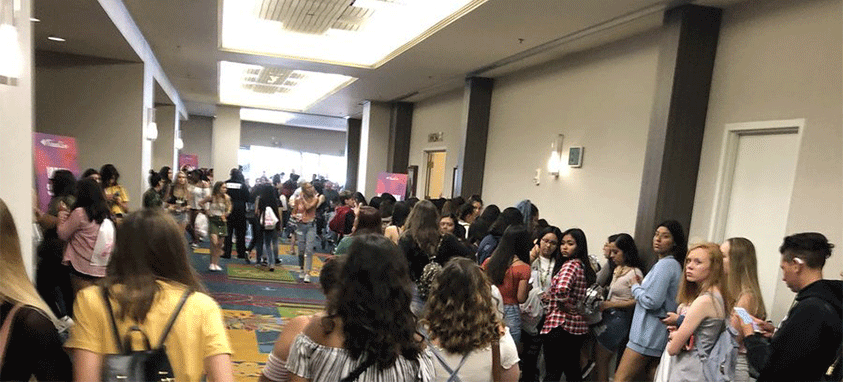
The convention-created-out-of-spite culminated in about 4,000 young fans standing in the hot Southern California sun for hours, waiting their chance to enter TanaCon. Just over 1,000 attendees made it inside the venue, maxing out the capacity of the main ballroom and a small room dedicated to merchandise sales. Outside, a crowd of mostly teens and tweens, alongside their parents, became increasingly sunburned and dehydrated. The chanting for refunds began.
Since all attendees were channeled into the same line—even if they paid for the VIP pass—the chaos resulted in the Garden Grove Police Department being called by the hotel to assist with the unruly crowd. Videos online showed a stampede of teens. One girl was taken to the hospital for minor injuries. The Garden Grove Police Department released a statement not only to explain what occurred but also disputing the 15,000 people Mongeau touted as being in attendance.
After a few hours, the event was canceled for the day, and the crowd was dispersed. Efforts to relocate to a bigger venue for the rest of the planned three-day event were not successful. Good Times Entertainment, the company hired to mount and manage the event, released a statement saying the sheer number of fans who showed up—a 15,000-person crowd, it said—compromised the safety of the event. TanaCon was canceled. Good Times promised refunds within 30 business days.
While some outlets have been reporting that TanaCon took place at Marriott Anaheim, the convention actually occurred at Marriott Anaheim Suites, which has event space clearly listed on its website with a maximum capacity of 1,018 attendees and a total of 9,727 sq. ft.
Veteran YouTuber Shane Dawson covered this issue extensively, interviewing all sides—including 21-year-old Good Times Entertainment CEO Michael Weist—on, fittingly, YouTube. You can watch the saga here.
The disastrous TanaCon reminds us all how much challenging work goes into event planning, especially within a three-month timespan.
Here are our takeaways:
If it’s free, plan big
Free events need a larger space that can be scaled down if needed—could this be why a lot of free events are outdoors? Find venues with adaptable space that can accommodate more people than you expect but can also be made to seem “big” with a smaller crowd.
Don’t underestimate your influencers
Content creators have loyal, dedicated fans—many whom sacrifice to attend. Influencers, while embracing their communities and relationships with their fans, should be aware of the clout they have and take that into account if planning events. Plan larger, especially, when influencers have younger fans.
Security, safety and well-being are Priority No. 1
Separate lines for paid attendees and free attendees are important. TanaCon skipped bag and security checks—a huge no-no. Attendees should feel safe, secure and welcome in the venue. A lack of organization and order for registration is impossible to manage on the fly. Having an event app for attendees to check-in quickly would have come in handy, but it wouldn’t have solved everything. Make sure the area is secured, and all bags are checked.
Visualize far in advance
Three months is simply not enough time to plan a three-day event on this scale. If TanaCon had been pushed to 2019, something a little closer to Mongeau’s vision might have been achieved. Utilize timelines and deadlines to get on track, especially if you’re crunched for time. For an event of about 5,000 people, allow at least six months—a year is better—of planning.
…sang California’s own Beach Boys in 1963, in their hit “Surfin’ USA.” Their friends, Jan and Dean, came out with “Surf City” earlier the same year. It was considered the first song about surfing, and that word immediately became a part of the younger generation’s lexicon.
In truth, however, surfing first gained fame in Hawaii in 1914, when Hawaiian surfing pioneer George Freeth demonstrated his skills at the dedication of the Huntington Beach Pier. In the 1920s, Hawaiian icon Duke Kahanamoku also surfed at the pier.
Huntington Beach now has a Surfing Walk of Fame in front of the iconic Jack’s Surfboards shop. The city also has Surfing Hall of Fame, International Surf Museum (where you can see one of Kahanamoku’s longboards), and the nickname “Surf City USA.”
In addition to Huntington Beach, you can see some of California’s best surfers at other Orange County beach hot spots, such as San Clemente, San Onofre State Beach and the Wedge at Newport Beach.
Have a hankerin’ to get on a board yourself? You can try it at Corky Carroll’s Surf School in—where else?—Huntington Beach.
eSports may not be new—did you know that the first game was released in 1960? But this exciting form of entertainment is emerging as a big business in the gaming world. Robert Rippee, director of the new Hospitality Innovation Lab at University of Nevada, Las Vegas’ International Gaming Institute, spoke with Smart Meetings in a webinar about the opportunities this trend brings for planners. Read on to learn about the history of gaming and its connection to the meetings industry.
A New Way of Thinking
While it may appear that video games are a recent innovation, pixel play has been around for decades. Spacewar! was the first popular game in the 1960s, enticing players to adopt gamepads, the precursers to joysticks. The strategy was radically different than that for board games and was distributed through colleges and research centers. While it’s now considered extremely outdated, the program for PDP-1 computers is now heralded as the birth of modern video games. It brought popular attention to the industry and piqued people’s curiosity.
Pong was the next big hit. Nolan Bushnell was responsible for the release of the game—a virtual table tennis exercise. At this point, games were mostly available at arcades. Bushnell realized this and created Atari, which allowed gamers to play at home. It proved successful and what started as a couple-hundred-dollar venture soon erupted into a multi-million-dollar success.
In the early 1980s, the market exploded. However, demand quickly declined due to an overabundance of games. In 1985, Nintendo Entertainment System released the first generation of 8-bit gaming—think Super Mario Brothers—into homes. Sega Genesis followed suit with their a 16-bit console in 1989. These games were an entry into the modern-gaming world, with fun characters and new storylines to follow.
eSports is Born
Rippee defines eSports as “competitive playing of multiplayer video games.” Capitalizing on the popularity of eSports, major publishers, such as Blizzard and Microsoft Studios, began hosting tournaments independently. In 1995, Microsoft’s Judgement Day offered $10,000 in accessories to the winner. The first large tournament was Red Annihilation Quake, which brought in 2,000 participants. The concept of multi-player gaming quickly escalated in popularity, especially when it came to fighter games.
Millennials were the first generation to grow up with computers in class rooms, making the adoption of skill-based games natural. That technical immersion has spawned a massive industry that has crossed over to the physical real estate space. Rippee estimated current eSports market revenue worldwide at more than $900 million, and it’s projected to reach more than $1 billion by 2021. Space for these games has grown significantly—some games can fill arenas, with tickets selling out within a matter of minutes.
Hotels in Las Vegas are buying into the trend big time; MGM Resorts’ Luxor offers 35,000 sq. ft. of gaming space, while Caesar’s Rio features The Wall, which injects a lounge vibe in competitions. It’s evident: eSports are becoming prevalent, and if you don’t keep up, you’ll experience a disconnect from—and potentially miss out on—younger attendees at events.
The Meeting Connection
eSports adds a modern, competitive edge to team building. Creating a personal tournament can build competitive camaraderie within companies. Destinations and planners can stay current by incorporating these games into their events; eSports is a form of entertainment, an alternative to live music for the right group.
It’s also important to recognize the changing demographic. No longer do you need to differentiate between Pacman and Ms. Pacman—men and women of all ages are discovering the exciting world of virtual communities.
In fact, they have become such a big business that organizing them is a new career option. Meeting planners can contribute to these programs by managing contract negotiation, site selection, and F&B to truly elevate the experience. Nobody wants a repeat of Tanacon—planners are crucial when it comes to a clean execution.