Are planners—and everyone else—who has booked at Starwood properties since 2014 taking a collective gulp or merely shrugging over the news from Marriott International that as many as 500 million guest records have been breached? And what should be learned from this latest instance of massive cybertheft?

More500 Million Starwood Guests May be Victim of Data Breach

Greg Sparrow, senior vice president and general manager at CompliancePoint, an Atlanta-area consultant for cybersecurity and risk management, bemoans the fact that repeated occurrences of data theft at major companies in recent years has led to a “desensitization” of public reaction. “That means the bad guys are doing better than the good guys,” he says.

Marriott says it inherited Starwood’s compromised data when it bought the competitor company in September 2016. “Why did it take almost two years for them to identify that?” Sparrow asks, adding that among the first tasks in such mergers is posing questions, such as, “What’s the state of the system you’ve acquired?” “Has there been a potential breach?” “Is there malware?”

“There are absolutely best practices out there to mitigate this stuff,” he says. “You’ll never completely eliminate it, but you can do a lot.”

In a statement announcing the data theft, Arne Sorenson, Marriott president and CEO, says his company is “devoting the resources necessary to phase out Starwood systems and accelerate the ongoing security enhancements to our network.”

A National Data Protection Law

But Sparrow doesn’t entirely blame Marriott for not detecting the theft earlier. “Hospitality has widely distributed networks that extend around the world. There are many points of entry. If you’re operating on razor-thin margins, protecting data is not the highest priority,” he says. “And, culturally, we don’t put real priority on keeping these breaches from occurring. There are no consequences for the companies involved. We don’t have a national privacy law, and companies won’t truly prioritize data protection without that.”

Some states, such as California, have passed strong data privacy laws. And the European Union’s GDPR includes stiff penalties for both data controllers and processors when systems are compromised. Yet the United States as a whole has lagged behind. “We just don’t have the regulatory landscape to deal with these big data breaches,” Sparrow says.

MoreGDPR Redefines Industry Privacy Practices on a Global Scale

So, what does that mean for planners and all hotel guests? Sparrow’s answer will surprise no one, but is worth repeating.

“Try to silo your risk,” he begins. By that he means, use different passwords for each of your hotel rewards accounts. Never use the same passwords for email and social media accounts, and certainly not for financial accounts.

“People need to realize there’s risk in storing information,” he says. “Companies need to think long and hard about what has to be saved and retained. If there’s no good business reason for it, get rid of it.”

As consumers, he urges, we should “be mindful of the type of information that’s being asked for.” Among the stolen Starwood data, in some cases, were individual passport numbers. Sparrow says they should have been encrypted along with credit card information. “They’re more valuable on the black market than credit card numbers,” he says.

More7 Smart Moves at Four Seasons, Visit Music City and More

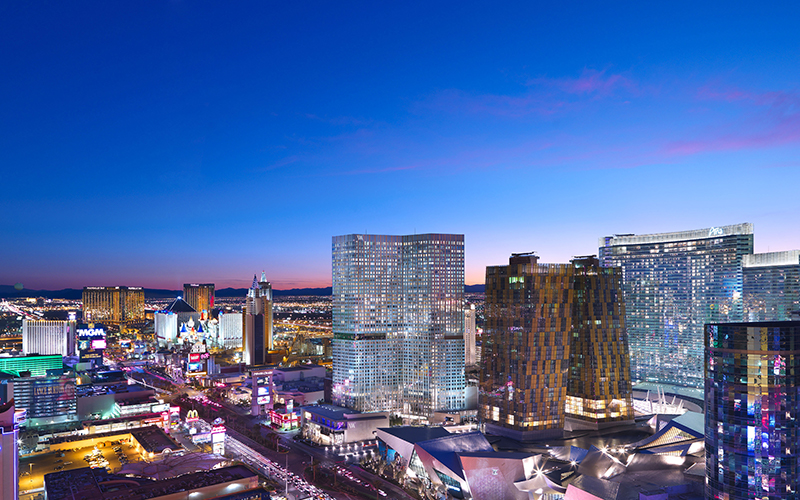
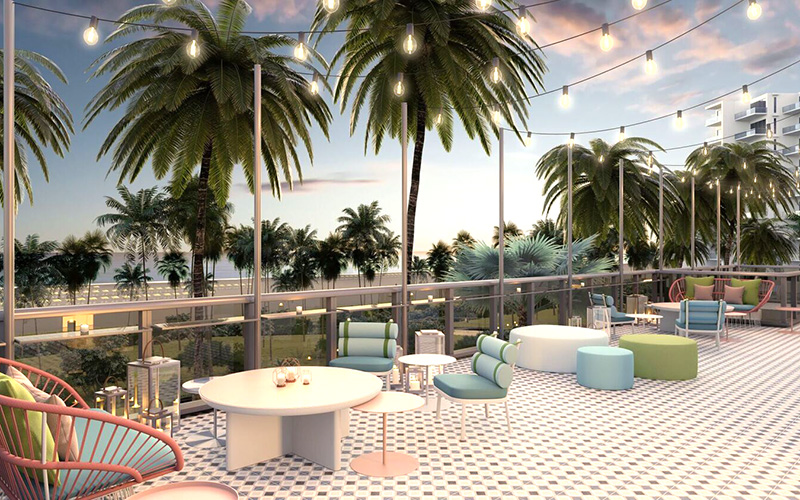
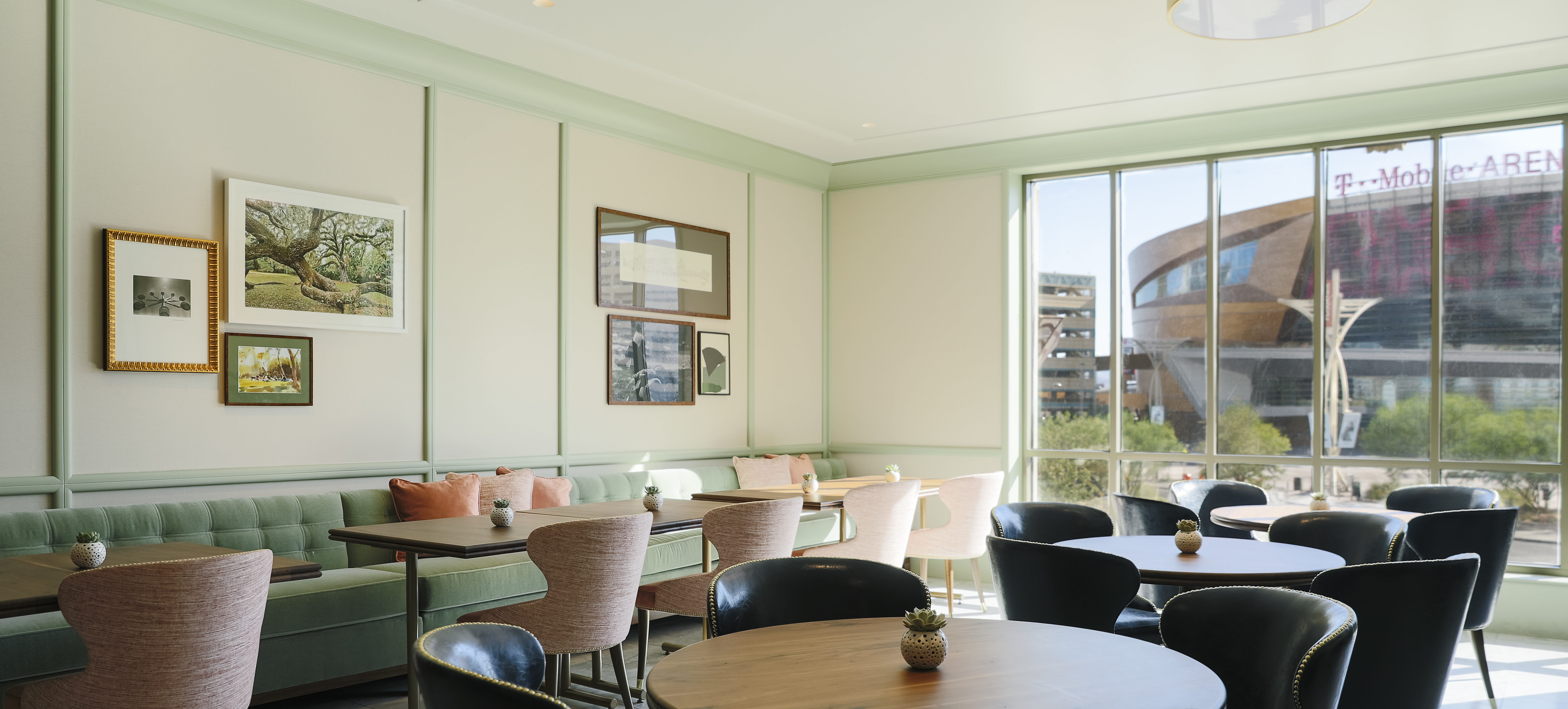
From coast to coast, U.S. cities are doing makeovers to be more engaging for those who visit. From ballrooms with windows galore in Sin City to a sky-high observation deck in Manhattan, there are hotels and attractions around the country to scratch the new year’s traveling itch.

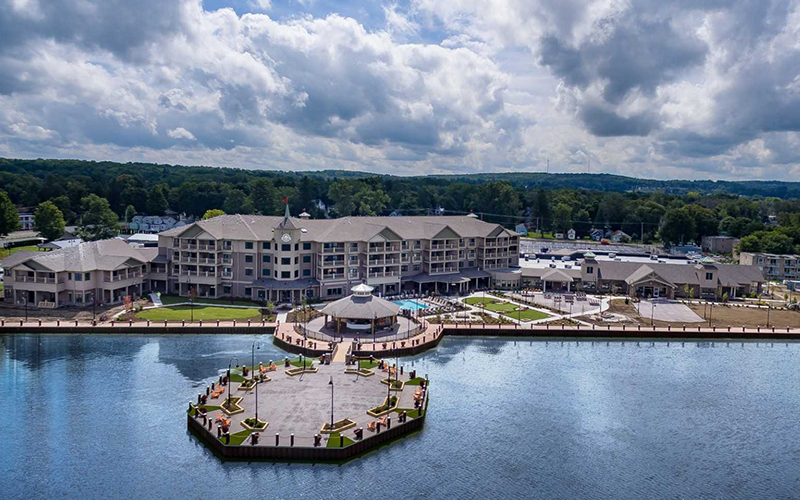
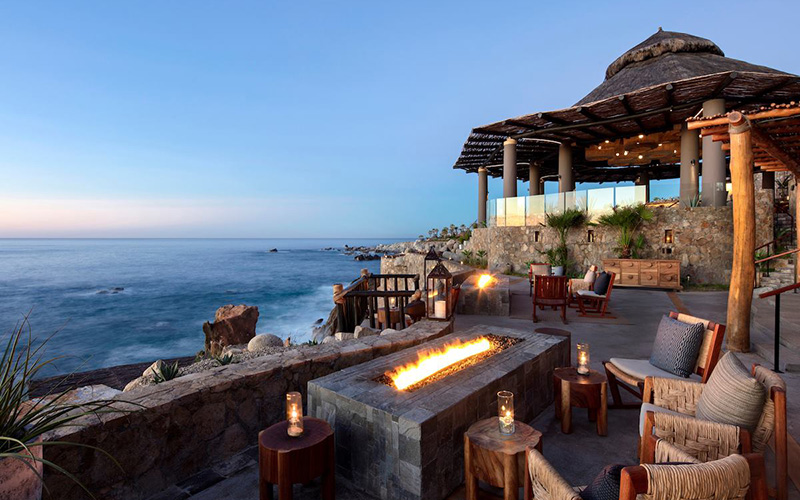
The crashing of the waves. The light of the setting sun twinkling off rolling currents. The gentle hiss of water over rocks. Few things can match the beauty of being right on the water. Here are new and renovated hotels that make the most of their waterside locales.

More: New & Renovated: Getting Out of the Hotel

LinkedIn profile

It’s important to have social media pages for your business. A $20 ad can bring in hundreds of likes and sharing photos—and hash-tagging correctly—can guide Instagram users to your photo to see what you’re all about. But an under-utilized, yet very necessary, social media network is LinkedIn. It’s the “professional” version of who you are and what you do, yet it’s often neglected and left un-updated.

LinkedIn is useful for networking with fellow planners, hotel managers, past clients—anybody you have worked with or would like to begin a conversation with. But you must update your own profile. It’s the first thing people look at before accepting or rejecting your request to connect. Why should you two connect? What do you have to offer this person? These are questions that should be answered when they research you.

So, how do you spruce up your profile? Here are four tips for creating a profile worth connecting with.

1. Add any certifications to your name.

Are you a CMP? Include that after your name. Any certifications relevant to your field should be the first thing a networker sees when you request a connection. It adds a level of legitimacy to you and your work and will give you an edge. Even small certifications are worth adding.

MoreQuiz | Are You Ready to Add CMP to Your Name?

2. Describe your business and what you can offer in your “about me” section.

First, explain what you do. This way, people immediately know how you can relate to them. Choose umbrella words or phrases, such as “meetings industry” and “event planning,” to appeal to a wider audience, then zero in on the specifics. Finally, explain your business and describe what you have to offer to potential connections. Can you plan a wedding? What about a major conference? Are you a facilitator between hotels and clients? Answer these there.

3. List accomplishments under your jobs section.

It’s easy to simply list what you do and have done, but you shouldn’t forget about your accomplishments. Use two or three bullet points to describe what you did (or do) for each job, then follow up with accolades associated with that job.

4. Ask for recommendations.

Finally, ask past clients and co-workers to write you a recommendation. It doesn’t have to be long—just enough to showcase why people should work with you. This works best when you offer to write one in return—people tend to be generous when they receive a positive recommendation as well.

automation

Meeting automation is potentially positioning itself as the next technology to shake up the planning game. While apps and meeting management systems have been grabbing headline and topping lists of “tech to watch,” more complete meeting automation could take those principles another step forward.

A recent study from Aragon Research—a research, analysis and advisory company out of Morgan Hill, California—distinguishes what the company calls “a new business automation category that takes traditional manual meeting processes to a new level.” Aragon calls this category meeting automation platforms (MAPs), pointing to the growing desire from companies for streamlined and hassle-free analytics, scheduling and digital integration. “Critical data is locked within calendars, spreadsheets and other collaboration offerings, and MAPs allow enterprises to unlock these valuable insights,” the firm says in a blog post on its website.

Aragon Research CEO and Lead Analyst Jim Lundy explains further, saying, “With a meeting automation platform, businesses can take the manual work out of scheduling and planning. This not only optimizes the workforce, but gives the added benefit of decreasing time to revenue.”

Overall, tools and systems that fall into the growing category tend to offer automated scheduling, management and analytics, along with mobile-first apps for ease of use, compliance plans for regulations such as GDPR, enterprise scalability and digitized meeting data.

Cited by Aragon Research as one of the companies already beginning to offer these advantages to others, Jifflenow is a business software company implementing automation and data analysis through the platform Jifflenow Event Meetings. Spurred by the study and Aragon Research’s assertion that 50 percent of enterprises will have a MAP initiative in place by 2021, Jifflenow also recently announced new additions to its system.

The add-ons include a staff scheduler which aims to create agendas and manage work groups, the Meetings Insights data analytics dashboard and a new mobile app. Hari Shetty, Jifflenow founder and CEO, says, “Enterprises are looking beyond lead generation at events and have been asking for solutions to influence revenue opportunities by increasing the number and quality of strategic B2B meetings.” That is where meeting automation platforms such as Jifflenow come in.

The company’s CMO, Ravi Chalaka, expands further, saying, “There isn’t a business or an enterprise that can grow without strategic meetings, with suppliers, analysts or any other businesses. You have to understand the effect of your meetings. A business can spend millions of dollars on an event and end up with a measurement of social media engagements and leads. But 90 percent of it isn’t useful. Events have a specialized audience. Having data and a strategy both before and after your meetings means you can capitalize on that.”

By integrating with other management tools such as Salesforce, the idea is for meeting automation platforms to create and track a concrete ROI for event organizers. “How much value are events producing?” Chalaka asks. “Collecting and analyzing all the data can tell you the people and meetings making the biggest impact.” These abilities are all in combination with streamlining the initial meeting process to begin with.

“Meeting automation platforms may not yet be on everyone’s radar,” Aragon Research says on its website, “But they are quickly carving out space for themselves as a valuable and strategic business tool.”

report: savings, book meeting ahead

Planning at least three months ahead could save as much as 10 percent on the bottom line, according to a new 2019 Meetings & Events Future Trends study from Carlson Wagonlit Travel Meetings and Events (CWT M&E). The optimum time for booking meetings for small groups was pegged at more than 30 days; for large groups, that window expanded to more than 75 days. Outside of these booking windows, potential savings dip by 5–10 percent, the report found.

RelatedMPI Report: Shorter, More Frequent Meetings

Ian Cummings, CWT M&E vice president, said in the report, “Our challenge is to get event planners and CMOs thinking about their programs…at least six months in advance.”

In a follow-up interview, Beau Ballin, CWT M&E senior director and business development, cited two challenges being faced by planners in the field. The first is that rates are increasing. This is due to limited inventory and a significant increase in demand on the leisure side. The second is that, although historically many bookings were made far in advance, companies today find it difficult to commit as early. “The current reality is that even with an improving economy and a need to increase lead time, we still see clients coming to us for large events and looking to book and secure space in a time frame of less than six months,” he said. The result is limited availability and extremely high rates, leading to an increase in popularity for second-tier cities.

Power of Strategy

Taking a holistic look at operations using Strategic Meetings Management (SMM) could help further reduce costs, according to the report. By increasing visibility and control of spend using data analysis, SMM can reduce time expended on sourcing by 22 percent and yield a 19 percent savings in room-night costs—all while shrinking risk and delivering high attendee satisfaction. “Consolidation of a meeting program can help with pricing…The possibility of finding savings amid high demand is there for the taking; it is just a matter of planning ahead for a year of events that will motivate, drive knowledge and ultimately lead to business success,” said the report.

Another tool called out in the report for cost savings is integrating online booking for group transportation into event registration platforms. “This allows attendees to have access to the event’s preferred flights and hotels in one place. As with general business travel, it can significantly reduce costs for clients,” the report concluded. Keeping everyone on the same schedule can also simplify transfers and the tracking of arrivals and departures.

RelatedThe Thoroughly Modern Event Budgeting Checklist

Measured Success

Different types of meetings measure the success of a program differently. “Consumer meetings may measure sales three months, six months or a year later. Did employee performance improve? Did sales increase? But post-event surveys are still where most of the feedback comes from,” Ballin said.

Park MGM
Courtesy of MGM Resorts International

What’s the secret sauce to earning the esteemed distinction of being an IACC-certified meeting venue? Park MGM has all the ingredients, so it has become the newest member—and first on the Las Vegas Strip —to join the elite group of 300 venues.

“The designs of Park MGM’s Madison Meeting Center and Ideation Studio have taken into consideration many of the trends and preferences from meeting planners that IACC has identified through its research,” said Mark Cooper, CEO of IACC. “The Park MGM leadership team has poured so much dedication and passion into developing a haven for small meetings, and we look forward to bringing our own events to these inspiring meeting spaces in the future.”

Let’s take a look at why Park MGM met the stringent criteria set forth by IACC to qualify as one of the top 1 percent of meeting venues on Earth.

Reason No. 1: Ideation Studio

Park MGM
Courtesy of MGM Resorts International

Ideation Studio debuted this month. What makes this brand-new 7,000-square-foot space unique is its integration of Cisco Systems technology. It’s the first hotel in the world to equip its meeting rooms with Cisco Webex Boards and Cisco Webex Teams, allowing people to meet virtually through message, note and file sharing, video conferencing and writing on a whiteboard. The room’s design also took into account table and chair height, lighting, flooring and the arrangement of furniture. The studio offers four layouts across its 10 rooms, which can accommodate groups of six to 24 participants.

Learn more about Ideation Studio here.

Reason No. 2: Madison Meeting Center (MMC) 

Park MGM is home to another Las Vegas first. MMC is The Strip’s first executive meeting center, focusing on groups of 10 to 50 guests. The 10,000-square-foot space is broken down into 10 individual rooms and two lounges, with moveable furniture and whiteboards. MMC offers planners all-inclusive, flat-rate pricing on a per attendee basis as part of a first-of-its-kind Daily Meeting Package. The center also prides itself on its attention to health and wellness through its Stay Well Meetings program.

Reason No. 3: Park Theater

“Cher” the stage with the likes of Lady Gaga, Britney Spears and Cher. All three leading ladies have or will soon have residencies at Park Theater. When they aren’t performing to sold-out crowds, the theater can be customized for large events with more than 5,000 attendees.

Agora Lobby Level Fairmont, The Queen Elizabeth
Fairmont, The Queen Elizabeth, Lobby Level Agora

With the announcement of The Ideation Studio at Park MGM, Senior Vice-President and Chief Sales Officer Mike Dominguez notably said, “We’re not just building space; we’re building the right space.” That is the mindset more than a few venues are beginning to adopt in the ever-increasing race to entice groups and redefine expectations. High tech—or “smart”—conference rooms, and the advances that go into them are giving new shape to the future of meetings and events.

Fairmont, The Queen Elizabeth

Fairmont, The Queen Elizabeth, Eureka Meeting Room
Fairmont, The Queen Elizabeth, Eureka Room

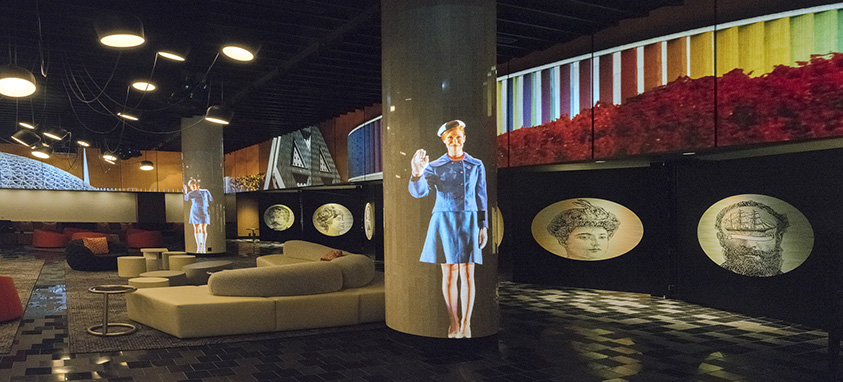
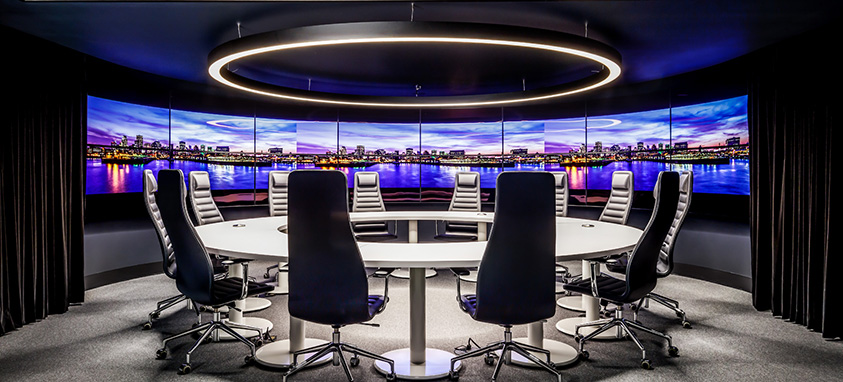
Ahead of the curve, The Queen Elizabeth welcomed Montreal attendees to a newly renovated building last year, complete with creative meeting rooms, chalk full of the latest technology. Whether it is touch screens, video walls—one of which is an impressive 180-degree wrap-around—or 55 high quality ceiling projectors, each room is designed to enable the best presentations and customization a group can ask for.

“Gone are the stark conference rooms that starve the senses,” Hotel Manager Anne Marie Johns says. “For meeting planners, getting participants engaged is always a challenge and we wanted to help. This is where the power of innovative technology came into play.” And the intention is self-evident.

Where there aren’t interactive displays and intriguing new presentation spaces, there are rooms with a ping-pong table as the conference table, swings hanging from the ceiling or walls of stick-on sheets. It all combines for a unique experience for any group. Johns says, “As attendees want to contribute to presentations and share ideas, rather than listen passively, the hotel’s multimedia lounges and technology are great assets to liven up discussions and bring subjects to life.”

The Bently Reserve

The Bently Reserve Apollo Meeting Room
The Bently Reserve Apollo Room

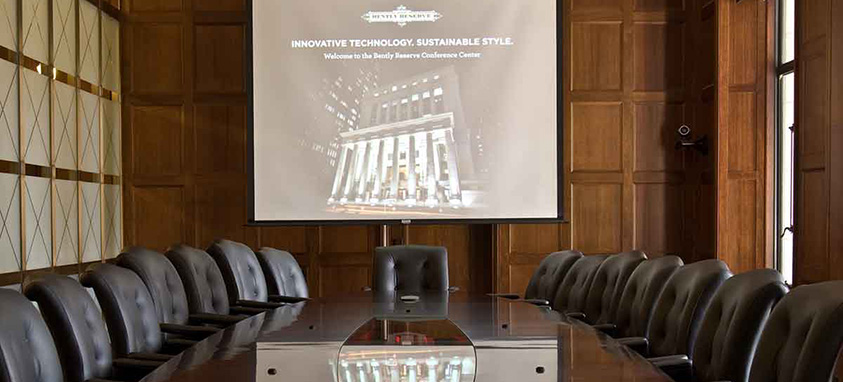
Earlier this month San Francisco’s Bently Reserve unveiled the latest meetings technology incorporated into its meeting and event space. A venue built inside the city’s old Federal Reserve building, The Bently Reserve originally opened in 2008. New renovations, however, bring a streamlined experience, with extensive automation systems in each room, and 4K Apple televisions.

“San Francisco is a hub for technology,” Director of Events and Sales Jim Bruels says. “It’s our responsibility to try to keep up with that. We’re always looking to help foster the next thing.”

Attendees can connect computers or phones to monitors via HDMI or Airplay, and everything from the projector to the window shades is run through the Savant automation system. Sold on its ability to simplify entire home routines to a single click or predetermined time, Savant is meant to bring that power to bear for groups, taking all the second guessing and trial and error out of preparing rooms for a meeting.

Bruels says, “Technology is all about how you make life easier. With Airplay and Savant in the smart meeting rooms, you can have a meeting where you have three people share their work, right in a row, without a problem. It’s more collaborative, and it’s nothing to just walk in and do it. I hope people walk away realizing just how simple it can be.”

The Ideation Studio at Park MGM

Park MGM Ideation Studio

One of Las Vegas’s newest contributions to the meetings industry, The Ideation Studio was all the buzz in the lead up to—and during—IMEX America 2018. Ten unique meeting rooms built from the ground up to inspire creative brainstorming and engagement comprise 7,000 sq. ft. of space empowered through Cisco Webex.

The building’s superpower, however, may be that it is easy to use. “Any high-tech facility I’ve ever heard of in our industry, I need a PhD to figure out how to use it,” Dominguez said in an interview with Smart Meetings in advance of the space’s opening. “That’s what we’re trying to get away from. We are trying to get into something that is just intuitive. Let’s say I am presenting, and I need you to go present something you have on your phone. We can literally hit a button and you’re on the screen instead of me. There’s nothing to plug in, nothing to figure out.”

Along with being entirely device agnostic, the rooms also feature electronic whiteboards that clear themselves after each session, storing any written information for attendees to access later. With aspects of meeting psychology in mind, the tables are designed to keep everyone at eye level, lighting is tailored and efficient, and even the room layouts are meant to encourage people to stand up and engage more.

“This is the first commercial use of something they have never used outside a business or office setting,” Dominguez said of the Cisco partnership. “We are the test pilot for it. But we did an executive day with Cisco and the idea came from, ‘Wow this is really cool. This has real purpose and use.’”

 Facebook Portal

Facebook Portal

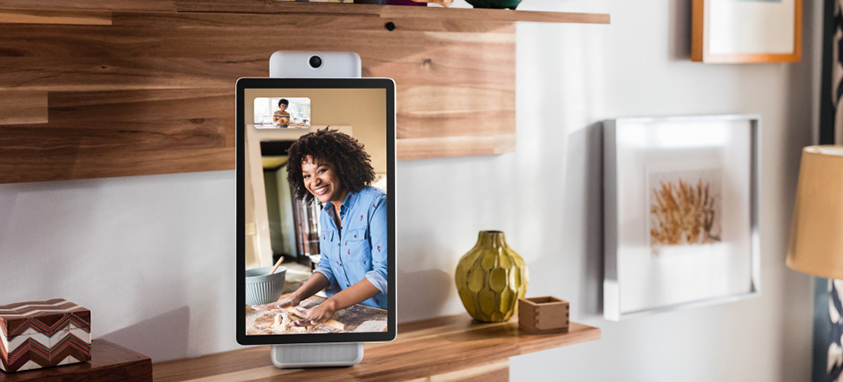
Not all the newest advancements have made it into conference rooms just yet though. Regardless of your feelings about Facebook or the security-concerned skepticism that has overshadowed the device’s unveiling and release, Facebook’s Portal and Portal Plus both pack some eyebrow-raising technology. What the company is calling “smart video and smart sound” could both have major roles to play in meetings and video conferencing in the years to come.

Tracking the shape of a human body, the fixed-place Portal camera can digitally follow and zoom in while you are on a video call. The days of awkward camera positions and staining to get into view might well be behind us. Similarly, the microphones in the Portal zero in and isolate the person who is speaking, wherever she is in the room, minimizing background noise.

“It’s like having your own cinematographer and sound crew direct your personal video calls,” the company promised in its initial announcement. Now that it’s on the market, this is technology that is only going to develop and spread in the years to come.

gen z hospitality

Generation Z is entering the workforce, and its eyes are on the hospitality industry, according to a new study by American Hotel & Lodging Educational Foundation. Gen Z, defined as those born between the years 1995-2010, is the largest age group in the United States, estimated at about 61 million.

The majority of Gen Z-ers have never experienced life without mobile phones, and many take for granted the ability to stay in perpetual contact with one another, usually via social media. The importance social media platforms play for Gen Z is made evident in the study, as 49 percent of those surveyed say they get their information from Facebook and 39 percent from official news sites.

More than half (51 percent) of those surveyed—Generation Z-ers and young millennials between ages 24-30—said they would like a career in hospitality, although only 6 percent have actually worked within it. Events manager ranked as the most coveted position.

Males and females surveyed expressed almost equal interest in working in the industry—53 percent of females as compared to 52 percent of males. In contrast, there was a 27 percent difference by gender in the tech industry and 33 percent in construction, with males heavily favoring those sectors.

Generation Z’s top criteria for a healthy workplace are benefits, interesting work, opportunity for growth and flexibility—all characteristics Gen Z believes the hospitality industry can provide. Social responsibility also ranked high. The top three characteristics Gen Z and young millennials believe are most important in qualifying for a job are a good attitude (67 percent), confidence and team work.

Although 83 percent of Gen Z is currently not employed full-time, 45 percent work at least part-time, according to the study.