
Long-term contracts—three, five or even ten years—can save you money, especially if you book during a hotel or resort’s slower times. “A three-year contract can mean a 10 percent savings,” says John Berglund, CEO of Mira Smart Conferencing, a management software firm in Clayton, Missouri.

At first blush, the idea of signing on the dotted line for multiple years seems daunting. What if you’re not happy with your choice? What if a better idea comes along?

Not to worry. With a careful eye to the details, a multiyear contract can be your friend. Here’s what to focus on.

Plan B: Bailing Out Early

Make certain the contract allows you to end the relationship under three circumstances:

Material breach: if the venue simply does not live up to its contractual commitments;

Force majeure: fire, flood or other disaster beyond the control of the provider;

Discretionary: you need to be able to terminate with at least 30 days’ notice; often this is couched as within 30 days after the conclusion of your most recent meeting. It’s also expected that you pay any charges or fees incurred prior to the termination. It’s best practice to specifically reserve the right to cancel if the hotel or resort changes ownership, brand or star rating.

Other Considerations

Site inspections: for your own protection, require a standard on-site inspection leading up to each meeting date.

Concessions: what can you expect in return for signing a multiyear deal? You lock in the room rate (or small yearly increase), plus value-added items such as room upgrades for your executives and yourself, little or no attrition costs, F&B price breaks and free Internet or audiovisual support. Don’t be afraid to get creative in your requests, knowing that a hotel’s main goals are to predict business and increase occupancy rate. Remember: the larger the sleeping room block, the more leverage you have to win concessions.

Negotiating: never, ever accept the hotel’s first offer, experts agree. You know from experience that hotels always leave wiggle room to negotiate down. Remember that high traffic times mean less flexibility on pricing.

The benefits are not limited to cost savings. “There is a great deal of time and effort that goes into the first year,” says Berglund. On both sides, the second time around and beyond should be easier, and the relationships already formed can be leveraged. “After year one, that hard work really starts to pay off.”

One of the oldest tricks in the event professional’s bag is booking a big-name speaker to get people in the seats. A little star power can be a powerful motivator for selling tickets or convincing people to stay until the last day of a conference. But they can bring baggage to the stage as well—in today’s #MeToo climate, it is more important than ever to find out what you don’t know.

What to Look For

Nancy Lauterbach, co-founder of Michigan-based RedPropeller Speakers Bureau, stresses the importance of doing due diligence on everything from accusations of sexual or other misconduct to inappropriate social media activity. She cites a recent search into the postings of a proposed speaker for a banking group that turned up comments inconsistent with the mission of the group.  As a result, she contacted the manager to pull a contract that had been sent. “You really have to be careful today,” Lauterbach says.

Another background check that paid off occurred when motivational speaker Rudy Ruettiger, former University of Notre Dame football player and the inspiration for the movie Rudy, was charged with security fraud by the SEC. The case was settled out of court, but still. “If a celebrity is accused—even if it isn’t proven—that may not be what you want at an event,” Lauterbach says. If a group books the speaker despite a controversy, she wants them to be forewarned—to be prepared for any fallout.

Similarly, when a group brings a comedian to the stage, Lauterbach wants to know in advance what is coming. Does it need to be family friendly? If the comic’s routine is edgy, to what degree? “That needs to be clear with all parties,” she says.

What to Negotiate

Even when celebrities bring a clean reputation, they still require extra care, Lauterbach says. Because she has been booking speakers since the 1980s, she knows which ones in her stable are more difficult to work with, and can share that in advance with planners. “A celebrity often demands to call the shots; they can have a lot of handlers and strict time limits,” she warns.

For that reason, Lauderbach suggests extra diligence in upfront negotiation.

  • Will they come in the night before?
  • Will they answer questions and take photos after the presentation?
  • Will they stay for a VIP event?
  • Will they share content to make marketing the event easier?
  • Do they have any special travel or hotel requests?

We have all heard about Van Halen’s contract requiring no brown M&Ms. Take no chances. Ask before signing on the dotted line.

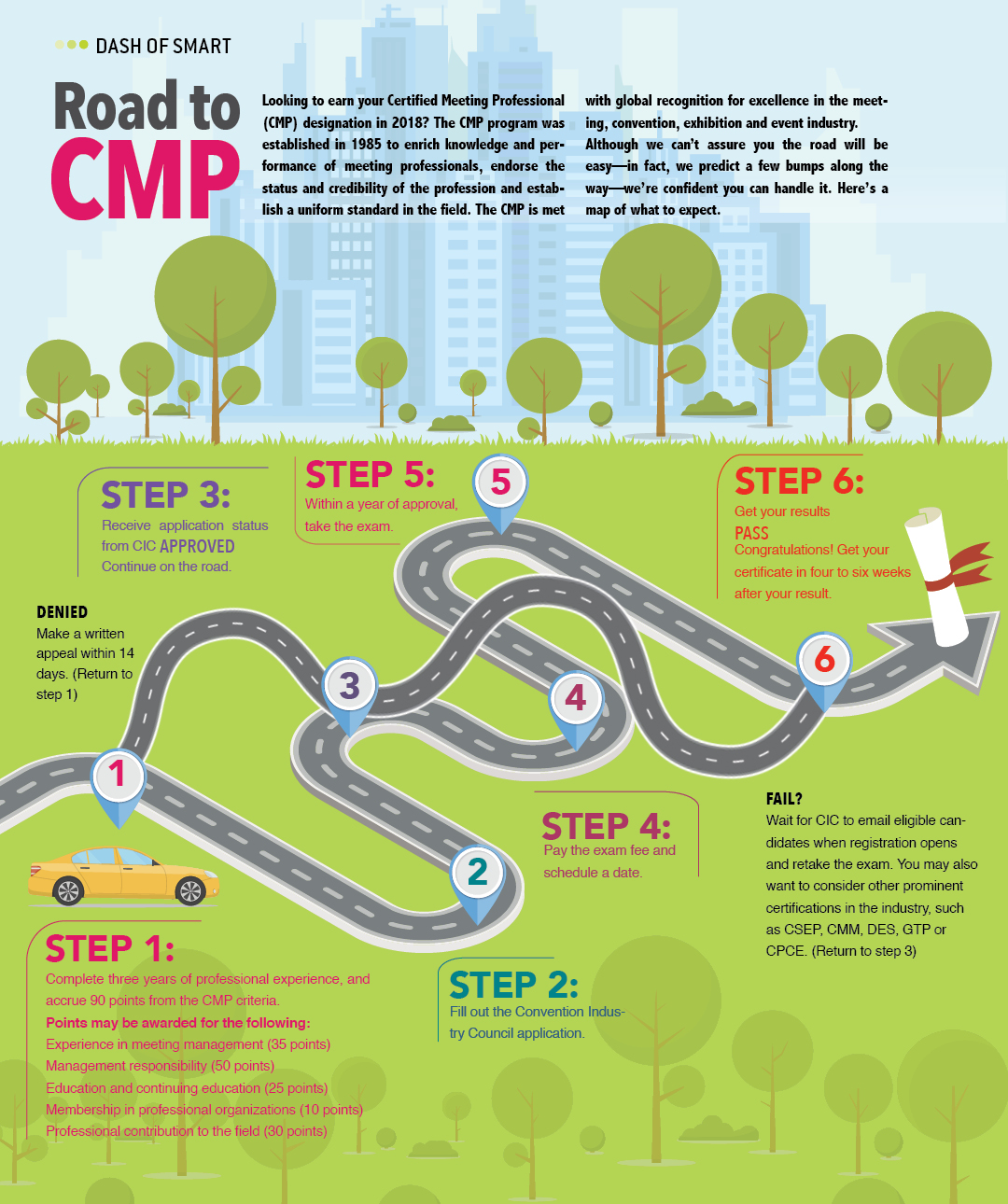
Looking to earn your Certified Meeting Professional (CMP) designation in 2018? The CMP program was established in 1985 to enrich knowledge and performance of meeting professionals, endorse the status and credibility of the profession and establish a uniform standard in the field. The CMP is met with global recognition for excellence in the meeting, convention, exhibition and event industry.

Although we can’t assure you that the road will be easy, in fact we predict a few bumps along the way, we’re confident that you can handle it. Here’s a map of what to expect.

Step 1: Complete 3 years of professional experience, and have accrued 90 points from the CMP criteria. Points may be awarded for the following: experience in meeting management (35 points), management responsibility (50 points), education and continuing education (25 points), membership in professional organizations (10 points) and professional contribution to the field (30 points).

Step 2: Fill out Convention Industry Council application

Step 3: Receive application status from CIC

  • Denied: Make a written appeal within 14 days
  • Approved: Continue on the road

Step 4: Pay the exam fee and schedule a date

Step 5: Within a year of approval, take the exam

Step 6: Get your results

  • Fail: Wait for CIC to email eligible candidates when registration opens and retake the exam. You may also want to consider other prominent certifications in the industry, such as CSEP, CMM, DES, GTP or CPCE.
  • Pass: Congratulations! Get your certificate in 4-6 weeks after your result.

What’s the best way to elevate a gift basket? Put it in a box.

Many CVB’s have caught onto this compact and convenient way to send local goods to their favorite planners. Still, packaging a neat collection isn’t enough. Planners are spoiled with gifts, so you need to include something memorable.

Fortunately, kicking it up a notch doesn’t require a bigger budget. On the contrary, the best CVB gift boxes are those which convey a city’s true flavor, providing something useful or sentimental. These boxes will teach you a few key lessons in the art of box giving.

Valley Forge’s Rock, Paper, Scissors

Just look at that hot pink packaging—it looks fun, doesn’t it? Valley Forge’s tourism board gives rock-paper-scissors a major upgrade, serving a relevant purpose as well. The game raises awareness of the meeting and event offerings in Valley Forge. Specifically, the organization’s Revolutionary Events brand.

“We wanted something universal,” said Scott Higgins, Valley Forge tourism board’s associate director of sales. “The rock, paper, scissors game is a universal language. Regardless of your age, you know how to play it.”

This brings up another key element. The box’s theme is something anyone can identify and associate with. Perhaps it even evokes childhood memories. The kit includes: rock candy—to get a solid start with Montgomery County’s 75 hotels and 1,600 restaurants, a notebook—to stick out from the rest with a noteworthy meeting and scissors—to be cutting edge.

Travel Portland’s Experience Maker

Travel Portland showcases its finest local goods in their box.  It includes: a custom-made Spooltown leather hip back, a Portland map, a Leatherman micra, Portland bee balm, Skout Backcountry organic energy bars and an issue Travel Portland Magazine.

The package supports a vibrant image of Portland. For instance, the map and organic energy bars paint an active, outdoorsy image of the city. Ultimately, the set stands out for its high-quality, variety and distinct character in each product. More often than not, the better the gifts embody the city, the more attracted planners will be to traveling there.

Smart Meetings’ Spooky Sweets

We don’t mean to brag, but we think our Halloween crate is a pretty awesome example of box giving. Christmas and even Thanksgiving gifts are fairly expected. By sending something on a less publicized, holiday, planners get the thrill of something unexpected. The set includes Halloween-themed Olive & Cocoa treats, such as festively-shaped sugar cookies. It’s not only what’s inside the box though. The wooden crates is a bonus gift as well.

2017 was a turbulent year full of natural disasters, sexual harassment accusations and political upset around the world. How can planners protect their meeting from fall out if the worst happens despite their best efforts? We turned to veteran hospitality industry attorney Lisa Sommer Devlin for advice. She counseled that piling on legal clauses may not always be the best option. Here are some things to consider:

Navigating Force Majeure

The problem: Force majeure, meaning an unavoidable accident, has occurred, causing an inability to carry through with the contract on one or both sides. This includes natural disasters, such as wildfires and hurricanes, and excludes circumstances including economy changes or prevailing rate changes.

Common clauses: Wording often includes “threats” or “potential” for disasters, which are not officially defined. Effective force majeure clauses should be unambiguous and objective as broader clauses may cause greater potential for disputes with the hotel.

The better play: In the case of a true force majeure, hotels will not expect you to hold an event or pay. Communicate with the hotel as situations develop. Discuss and evaluate the risk. Consider the financial impact on both parties.

Touchy Political Situations

The problem: The destination where your event is planned has passed a law you and your group disagree with.

Common clauses: Wording that makes an event tentative using ambiguous and uncertain terms. It may even state that you will not hold your event should a certain law pass.

The better play: Politically-categorized clauses are not protected under federal law, and not upholding the contract could result in paying cancellation fees. If cancelling is an option, alert attendees of the potential financial loss. This is another instance where communicating early with the hotel regarding potential cancellation can go a long way toward finding a solution.

Sexual Harassment

The problem: In the wake of #MeToo, planners worry about the safety of their attendees.

Common clauses: Including sexual harassment policies or codes of conduct for the staff. Should a figure at the hotel be accused of sexual harassment or assault, events may be cancelled free of charge.

The better play: Hotels usually already have their own codes of conduct, which you can most likely find on their website. Sexual assault is illegal and the law protects employees and attendees, so there’s no need to add that to a clause.

The Bottom Line

Concerns about disasters and disruptions are real, but clauses aren’t always the best way to address them. Devlin suggests working directly with the hotel to find adequate solutions to potential problems. You can hear more about other concerns planners face and the best solutions in her webinar Beyond Event Contract Basics: Do You Need Special Clauses? on the SmartMeetings.com website now.


Note: Please regard this information as general recommendations. We advise our readers to check with a professional about specific situations. 

content producer planners

Just a few years ago, printed programs resembling metropolitan phone books were as common as shrimp skewers at association conferences. A new Annual Conference Industry Report from content producer Omnipress shows that while the exchange of information is still important, a younger generation of attendees wants to engage in new ways.

Here are four tips we picked up from the answers of nearly 150 planning professionals surveyed by Omnipress, almost half of whom said their top job this year will be to increase attendance.

1. Attendees want engagement, with each other

Trends uncovered in the study include, encouraging peer-to-peer engagement and increasing conference quality, updating technologies to increase engagement and creating more networking opportunities during the event. Make them feel a part of the event. Involve the members by inviting them to contribute articles.

2. To attract a younger audience, re-use past event content and show them what they missed

Since the oldest millennials turn 36 this year, the study focuses on tactics that can be used to meet the needs of a multi-generational audience. This year’s survey saw a significant rise in the number of organizations that are re-using conference content outside of the annual event. Planners can use this up-to-date information to create a fear of missing out (FOMO) effect among potential attendees.

3. Save the trees, turn off the printer

People want convenience, especially at meetings. Attendees are looking for easy ways to get the information they need. Almost half preferred using less printed material, with a third asking for more digital information. Don’t waste paper by printing folders and binders they have to carry around. Put information in their pocket.

4. Keep it local, open presentations to members

Focus on content that not only engages members during the event, but keeps old members coming back and gets new members begging to attend. Open calls for presentations is one way to get members involved. This publicly recognizes the contributions they are making. What is more engaging than praise?

Sometimes, despite our best efforts, a repeated event comes to an end. Whether it’s due to a lack of attendance, budget cuts or unforeseen circumstances, a company or other sponsor may decide that the next event will be the last. Naturally, as an event planner, you’ll want to make this final curtain call unforgettable. Here’s how.

Create a Customizable Agenda

It’s easy to fall back on agendas past—there’s a welcome, a workshop, a cocktail hour and a banquet. Consider changing the agenda around to give guests a choice. If you have the space, give them options by offering workshops that appeal to different wants and needs. Not enough room? Consider inviting experts in a variety of appropriate fields to attend networking events and banquets. One-on-one conversations can feel even more exciting to attendees.

Invite Strong Keynote Speakers

Whether you’re inviting back one of the most popular keynote speakers or choosing somebody new, it’s important to send attendees off with a strong take-home message. Whether the speaker reflects on great memories from past events or celebrates the end of an era, you want somebody who will leave attendees feeling fulfilled and uplifted (and perhaps even sentimental).

If Appropriate, Choose a Theme

Naturally, certain events will be more corporate than others. But if the event is on the more casual side, or the company has a more outgoing presence, consider incorporating a theme. Whether it’s as simple as a Hawaiian luau or enchanting as a masquerade ball, a theme can make the final event feel all the more memorable. If an event is more business casual, add a fun aspect, even if it’s a dress code of bright colors rather than neutrals. You want this event to stand out rather than feel like a retread of previous years.

Include Entertainment

If there was ever a time to go all out with entertainment, the final event is it. Hire a band to play during the cocktail hour, invite a comedian to lighten the mood or consider an acrobatic group to leave your attendees in awe. You know what type of entertainment is the best fit for your event, so give your guests a treat.

Hire a Photographer

If you haven’t used a professional photographer in previous years, forego the selfies and DIY smartphone snaps and hire one this time. You and the company can share these photos on social media, in a thank-you newsletter or a photo album on Facebook. It’s a perfect way to memorialize the event, and it certainly won’t hurt to post a #ThrowBackThursday photo every now and then.

meeting

Stop viewing event proposals as a necessary evil and start embracing them as opportunities to transform your relationship with your clients, team and suppliers. Not only does getting your vision on paper help organize your ideas, goals and budget, it will set the tone for entire project. Clients will view you as prepared, knowledgeable and understanding of their wants and needs. Smart Meetings talked to experts in the field and found out their secrets for writing winning event proposals.

Step 1: The Format

Proposal templates abound, but many planners warn against using them. This is because your event proposal is a chance to introduce yourself, your style and your voice—everything that makes you stand out from other competitors. Relying on a pre-made template may take away from showcasing your individuality.

Make sure to include your name, contact information and logo (if you have one) on the cover page, so clients immediately know whose proposal they’re viewing from the start.

Step 2: The Details

You’ve explained why your work is superior. Now it’s time to demonstrate that with a strong logistics page that outlines roles and responsibilities. Explain what you personally will be providing and what your role will be. If the client will need to do anything themselves, mention that, even if it may seem obvious.

Show that you understand what the client is looking for and that you listened to their initial ideas. While you will ultimately take the reins, you don’t want to propose ideas and accidentally ignore their thoughts. If you can, expand on their ideas—everybody loves a “yes, and…” response.

Step 3: The Bottom Line

Money is one of the most important aspects of a proposal, but some people feel awkward talking about it. Remember that you are providing services and your expertise requires compensation. Payment is part of the plan, so don’t sell yourself short when quoting a price for your services.

While it may be tempting to write the grand total at the bottom, it will be more beneficial to break down every cost, from table linens to lights and ice sculptures. Don’t leave any detail out. This will enable the client to set priorities and understand the true value. You are also letting them know that they have the final say in what stays or goes—and everybody will feel that they’ve won.

coast-of-california-big-sur-along-the-route-number-1-bixby-creek-picture

Hotels and conference centers are the norm for meetings. They’re tried and true, come with the equipment you need, and fit all your attendees. But sometimes it’s nice to break the mold and give attendees a new experience. Have you ever considered hosting your event in the sky? What about an abandoned railroad station? We’ve collected a list of seven unique places to host a meeting.

Monterey Bay Aquarium, California

Whether you’re hosting a sit-down dinner or allowing your attendees to explore, the Monterey Bay Aquarium is sure to be a hit. Their Open Sea Galleries house everything from sardines to sharks. Guests catch watch the underwater action from their dinner tables, or wander around and get up close to undulating jellyfish.

Brunel’s Old Station, Bristol, England

Have you ever considered how interesting the architecture is in an abandoned railroad station? Brunel’s Old Station will shows off the attention to detail paid to travel’s yesteryear. Passenger Shed can hold presentations and conferences, and seat from 400 to 800 attendees, based on the seating style of your choice. Catering is also available.

Lyon Air Museum, Orange County, California

Airport hangars don’t just host airplanes—they can host the perfect event, as well. Located on the west side of John Wayne Airport, Lyon Air Museum is open to those wanting to host a corporate event that’s out of left field. Celebrate surrounding vintage aircraft and meander through historical exhibits with low-lighting that gives the perfect ambience.

Uniworld Boutique River Cruise Collection, Europe, Africa and Asia

Want to sweep attendees off their feet? Consider taking them on a cruise for a change of scenery. Travel for eight days from Brussels to Amsterdam or 12 days from New Delhi to Kolkata, India—all while discussing business, of course. Uniworld’s ships can host up to 130 guests, and the floating boutique hotel will take you along 23 rivers within 24 countries—you choose which.

Dinner in the Sky, Athens, Greece

Hoist your passengers up for Dinner in the Sky, a meal hosted 160 feet above ground with panoramic views of Athens. This adventure may not be for the faint of heart, but you’re bound to be remembered for taking a risk to impress.

National Corvette Museum, Bowling Green, Kentucky

In case you didn’t know, every Corvette made in the U.S. these days comes out of Bowling Green. And now the city has debuted National Corvette Museum Motorsports Park, one of the most recent driving tracks in the United States. Get behind the wheel and take on a three-mile, 24-corner road course for an automotive experience your attendees won’t forget.

SPiN, Chicago, Illinois

Entertaining a techie crowd? SPiN may be the perfect place for you to host your next event. With 19 ping pong tables, available catering and room for up to 600 attendees, you can get the friendly competition going and the ping pong balls flying. Get the blood pumping before a sit-down dinner or end your meeting with a friendly game of back-and-forth.