What will live events look like after COVID-19 pandemic has passed? The coronavirus that has shut down the live events industry is likely to have some lasting impacts even after cases and concerns decline.

More10 Sustainable AND Hygienic Ideas for the Post-Corona MICE World

Attendees may prefer smaller events, with more physical space; the “social distancing” habit will take time to break. There will likely be less interest in activities that involve any kind of direct physical contact—even shaking hands.

But once the pandemic is behind us, some of the big trends predicted for the industry in late 2019 and early 2020 will regain importance. Real action on sustainability was predicted to be one of the biggest trends if not the biggest change for events this year, before coronavirus.

See alsoOn Earth Day’s 50th, ‘Travel’ at Home

Research by PromoLeaf, conducted in February just before the industry shutdown, strongly supports that. The PromoLeaf study found that 60 percent of respondents prefer attending conferences hosted using sustainable practices, with more than a quarter strongly preferring such conferences.

Here are more key findings from the research.

Most Popular Swag

On a multiple-choice question, pens (60 percent), water bottles (59 percent), and notebooks (really, 58 percent for notebooks?!) are the top three swag items event attendees are most interested in receiving from vendors. Surprisingly, these figures are even higher (65 percent, 69 percent, and 64 percent, respectively) among those in the 25-34 age bracket.

Tote bags were the fourth-most desired item—presumably to help carry those pens, water bottles, and notebooks. Interestingly, even pre-coronavirus, more than half of respondents said hand sanitizer was on their most-wanted list; 55 percent of 25-34 year-olds chose this, as did 54 percent in the 45-54 age group.

Among who chose “Other” and provided a freeform text answer to this question, results were a bit different, as shown in this wordcloud. Gift cards, note pads, flash drives, t-shirts, travel mugs—and most intriguingly wine bottle openers topped the list.

Note that the words “healthy,” “eco,” and “sustainable” also figure prominently.

See also: Your Sustainable April Smart Style

The bottom line? Keep sustainability in mind when deciding what swag (if any) to give away at your post-coronavirus events:

  • Consider replacing swag completely with unique experiences (though, interestingly, only 4 percent of respondents overall said they would prefer not to receive any swag, with the largest share—8 percent—in the 55-and-over age group).
  • If you’re going to give things away, think about items that are small, practical and with a long life-in-use such as flash drives and travel mugs.
  • A healthy snack in recyclable packaging is also a good choice.
  • Forget the stress balls, toys and keychains.

Eco-Friendly Dining

Overall, 54 percent of respondents said it matters to them if conference organizers incorporate “eco-friendly dining practices, such as compostable dishware and/or locally sourced menus, into the event.”

However, responses varied widely by age group. Some 63 percent in the 25-34 age bracket, and a whopping 68 percent of those under 25, consider this important. But barely half of respondents in 45-54 age cohort, and just 38 percent of those over 55, agree.

So, as with many other choices about your event, consider your audience first when making decisions about dining practices and options.

Where Unwanted Swag Goes

When asked what they do with swag items they don’t want or can’t use, almost half, 45 percent of respondents overall said they donate those items and 32 percent re-gift them, while 15 percent simply throw them in the trash. But the differences in responses between age groups are again interesting:

  • Respondents over age 55 were most likely (51 percent) to donate unwanted swag.
  • Those in the 35-44 age group were most inclined (35 percent) to re-gift such items.
  • Attendees 25-34 years old were most apt (22 percent) to discard unwanted tchotchkes. More than 20 percent of those under 25 also chose this answer. The group least likely to discard unneeded trinkets? The over-55 crowd, at 9 percent. Go figure.

Preference for Sustainable Event Practices
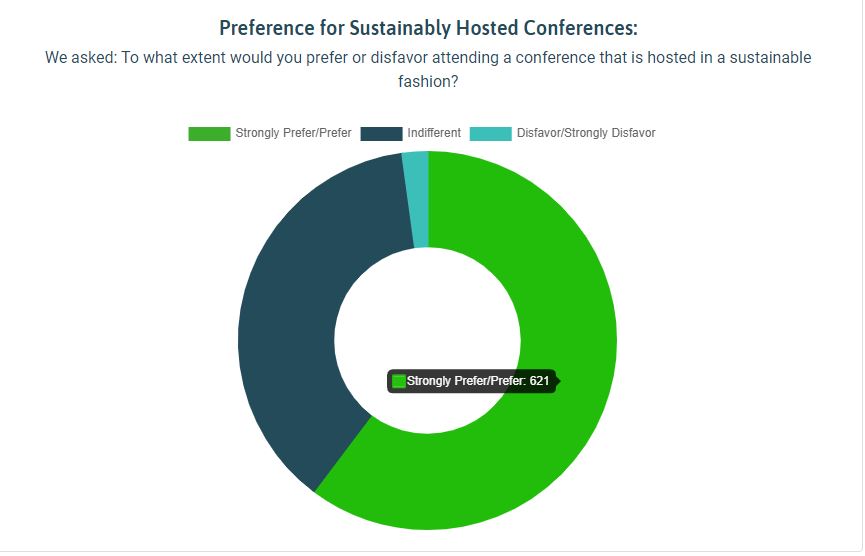
As alluded to above, 60 percent of respondents prefer to attend conferences “hosted in a sustainable fashion,” and 27 percent strongly prefer this. But, once again, the demographic differences in answers are noteworthy:

  • Respondents in the 25-34 year old (34 percent) and 35-44 age group (35 percent) were mostly likely to “strongly prefer” events using sustainable practices.
  • Those under the age of 35 were most likely (68 percent) to prefer or strongly prefer sustainable event practices while those over 45 were least likely (though still 53 percent).
  • The older age cohorts were more likely to be indifferent about such practices, but more striking is the gender difference: regardless of age, women were more likely than men (41 percent to 32 percent) to express indifference about sustainable events.

The Bottom Line

An increased focus on sustainable event practices was a major trend coming into 2020. As the industry emerges from coronavirus-caused shutdown, concern for the health of the planet, and even more importantly the health of attendees, will only increase.

So, as you plan your post-COVID-19 events, look at how you can incorporate sustainability into your events. Plan for smaller events when possible, eliminate or get smart with your giveaways, and seek out unique venues.

Most cortically, keep the health of attendees in mind. Go with fresh, healthy, locally-sourced food whenever possible; offer healthy snacks; and provide adequate space for participants still transitioning away from social distancing habits.

Tom Pick is a digital marketing consultant who works with event management platform developer G2Planet to share the company’s insights and knowledge with corporate event marketing professionals.  

Editor’s Note: This is part of a series reporting on FICP Chats about the future of meetings. You can read accompanying reports here and here.

Attendee and employee comfort with risk will vary widely, as will the regulations for meetings in every destination and the sanitation protocols in each venue. The situation relative to COVID-19, while temporary, will also continue to evolve. What this means, as discussed by more than 330 participants in last week’s Financial & Insurance Professionals (FICP) Chats, is that meetings professionals cannot solve for every potential scenario right now, and should not feel the undue stress associated with attempting to do so.

MoreHow to Support the Mental Health of Event Planners

In the second in FICP’s new virtual education series, focusing on operations and logistics in future meetings, participants discussed the importance of collaborating with experienced partners when seeking to provide a high-quality event experience. Those partners have or will be developing protocols and playbooks for events to help ensure guests and employees are safe, and therefore comfortable attending or working an event. Communities like those within FICP are coming together to share these preliminary ideas and should recognize those plans will need to change to incorporate lessons learned with each event.

Reworking Agendas

Participants discussed options for meeting agendas that will help ensure fewer people gather in the same place at the same time. Ideas included staggered breaks, hosting meals in multiple locations simultaneously, and scheduling several different times for meals such as breakfast. It was believed that the latter could also increase attendee satisfaction, as there are attendees who do not enjoy early breakfast times. For events where multiple rooms are used for a meal, speakers could be live-streamed across the venue.

Groups within Groups

For those staggered groups, it was discussed that attendees and meetings teams should have an easy way to identify groups within the larger group to enforce the schedules or staggered activities. Colored lanyards, badges and other visual cues would not only help attendees better understand how to follow rules, but enable meetings professionals to correct those who were not with their group. It was even suggested that name badges could be put on masks to help increase the safety of interactions between event attendees.

The Registration Experience

A supply kit that attendees pick up at registration with gloves, sanitizers, paper and pen was suggested by participants as a way to help ensure each attendee was equipped with the tools to reduce the spread of their own germs. Combined with these kits, participants suggested a shift to event apps to reduce the number of items an attendee would need to pick up and potentially leave behind during an event. Those apps could be used for both providing crucial event details and housing notes traditional captured with pen and paper.

In the registration area, meetings professionals should also have medical staff to help test or assess attendees as they arrive, and find ways to reduce the number of people who converge in that area at once. Events where health or temperature checks are standards also need documented policies about next steps for attendees who test positive for the virus.

Food and Beverage

For facilities that allow buffet options, participants discussed that single-serving foods with covers, like yogurts or bento boxes, would be good options for attendee meals that would help reduce the risk of disease transmission while also providing a greater variety of meal choices. The bento box concept could also be applied to meals delivered to rooms and used for meals where group seating is distanced but together.

See alsoIs This the End of F&B as We Know It?

 “New Normal” Networking

The traditional cocktail reception may need to be revisited for the short-term, according to participants. Alternatives could include paired networking where attendees could connect in different areas of a location or resort one-on-one, or take to their own balconies or lanais for a cocktail—all at the same time.

Managing Liability

While there are some people who will be reluctant to leave their houses for an in-person event for many months, there will be others who are eager to resume normal activities and willing to assume the risks associated with that decision. It was suggested by participants that companies/event hosts could leverage waivers to help reduce the legal liability associated with hosting events before a COVID-19 vaccine has been developed.

Jennifer Squeglia, CMP, is a member of FICP Board of Directors. In the next FICP Chats, our community will focus on virtual meetings. Learn more about upcoming FICP Chats, part of FICP Anytime.

Editor’s Note: This is part of a series reporting on FICP Chats about the future of meetings. You can read previous reports here and here.

Temperature checks, reduced occupancy and increased physical distancing in shared spaces—these were some of the protocols floated by hospitality partners and meetings professionals as they sketched out what a return to travel after COVID-19 shutdowns will require. Those steps, and others, will be necessary to both reduce risk and assure transient travelers and event groups that safety is everyone’s top priority, according to more than 300 participants in the first-ever virtual Financial & Insurance Professionals (FICP) Chats last week.

Participants focused on safety and cleanliness considerations for event venues, transportation modes, hotels and meeting spaces. The prevailing theme was the need to build trust with event participants, so that they feel comfortable leaving their house. Measures will need to be taken at each step—airline, transfer, hotel and meeting space. Other steps suggested by hoteliers include access to sanitation amenities, extensive cleaning processes, additional employee training and elimination of buffets and offering self-serve food and beverages.

Sanitation Ratings

Participants laid out the need for a body that will evaluate hotel and event venue cleanliness and safety protocols and provide a rating similar to Michelin Stars or Forbes guides. These ratings will help meetings professionals understand the extent of new protocols and their efficacy. The discussion also stressed the importance of meetings professionals working closely with those partners to understand protocols and augment as needed for their groups.

Travel Considerations

Airlines have communicated they may remove middle seats and enact their own new protocols to increase physical distancing and flyer safety. A reluctance to fly may lead to a faster resurgence in regional meetings and events. Those drive-in meetings may be the first that a meetings professional holds when conditions permit. One other byproduct of the slow ramp-up could be limited flight capacities, which will also influence group transfers and event schedules, as it could take longer for all attendees to arrive and depart.

Safety Measures

Additional considerations suggested include adding onsite medical support for every meeting, revisiting room sets, providing additional safety-related amenities and hand sanitizing stations and increasing the number of vehicles needed for transportation to allow fewer passengers per vehicle. These measures will likely decrease occupancy, while increasing room rates and costs. Meetings professionals will need to revisit 2020 budgets and find creative ways to provide for these measures.

Enhanced Communication

Equally important to enacting new protocols will be communicating those changes and re-setting expectations to attendees and stakeholders in advance of upcoming meetings and events. Company executives and corporate communications teams will look to meetings professionals for guidance and information to help instill confidence in event attendees and program qualifiers. Meetings professionals and hospitality partners must be armed with insight from leading health authorities such as the World Health Organization (WHO), Centers for Disease Control and Prevention (CDC) and the Occupational Safety and Health Administration (OSHA) to assure respectful and candid conversations.

Onsite, event attendees will see signage describing protocols, hand sanitizing stations and changes to familiar activities. Examples of these changes may include drivers and bellmen may no longer automatically handle luggage or hold doors, attendees may have their temperature taken at arrival, room service will be delivered in a different way and the number of guests allowed in an elevator may be limited. These additional measures and more frequent sanitization may add time to each step, however, the increases in staff may actually result in a more positive attendee experience.

What was equally apparent in this discussion is that everyone involved in meetings and events is dedicated to the safety of our event attendees and guests, observed Erin Longo, CMP, vice president of conference and meeting services with Prudential. Exhaustive reviews of each touchpoint those attendees have is being conducted and our community will be collaborating closely in the coming weeks and months to create safe new experiences, she said.

Jennifer Squeglia, CMP, is a member of FICP Board of Directors. In the next FICP Chats, our community will focus on meeting and food & beverage operations and logistics. Learn more about upcoming FICP Chats, part of FICP Anytime.

While Memorial Day weekend is usually filled with barbeques, parades and summer cocktails, this year will look a little different. Whether you are planning to honor military personnel or celebrating the unofficial start of summer this weekend or both, there are plenty of ways you can get in the Memorial Day spirit at home.

Drink

Nothing says summer like a cool, refreshing cocktail by the pool. While you won’t be able to lounge poolside at your favourite resorts and hotels this Memorial Day, you can make some of their classic cocktails at home.  Try Andaz Mayakoba Resort Riviera Maya’s Red, White & Blue Cocktail for a patriotic and fruity drink made with coconut cream, vodka, blue curacao liquor and raspberry and strawberry puree. Six Senses Bhutan’s Sunset Pomegranate Martini is also a great option for a pomegranate and Cointreau twist on a vodka martini. If you want to soak in all the island vibes try Hyatt Regency Maui Resort and Spa’s signature frozen cocktail, Pele’s Lava Flow, made with rum, banana, coconut cream and strawberries.

Watch

To really transport yourself to a beachy paradise, virtually travel to Port Douglas in Queensland, Australia with this 360-degree video. For a more botanical view, check out Lewis Ginter Botanical Garden’s virtual visits where you can explore more than a dozen themed gardens. Bonus: they offer tips about at-home gardening so you can update your outdoor space.

If you are a Memorial Day parade-goer, you can virtually partake in the National Memorial Day Parade’s pre-recorded television special airing nationwide on Monday. Another can’t-miss event to stream on Monday is the National Memorial Day Concert, which is normally held on the West Lawn of the U.S. Capitol. This year however, you can watch from your couch as the concert will be aired on PBS and available to stream via their website.

Eat

Food is often big part of coming together with friends, family or colleagues. Just because you won’t be physically with other people, doesn’t mean you can’t enjoy traditional Memorial Day grub. Why not bake an apple pie (and maybe an extra for a loved one) and indulge in the most quintessential American dessert. This weekend is also a great time to fire up the grill for summer cooking. Make burgers and hot dogs or connect with friends or colleagues to share favorite recipes and have a virtual potluck.

Get Active

In between all that eating and drinking, why step it up for a good cause this Memorial Day weekend? Join the Memorial Day Virtual Flag 5k and run or walk 5k anywhere, anytime on Monday to salute national heroes and support frontline workers in New York City. Register for the event on Eventbrite and invite your friends, colleagues or clients to join you virtually. An active, charitable event is a great way to stay connected with friends, or build camaraderie and motivation with colleagues.

Whether it’s a short introductory icebreaker or a team-building activity, icebreakers, bonding breakouts and trust exercises have become commonplace at meetings and events. Yet these kinds of activities are often missing in virtual meetings. TeamBonding says that 65 percent of remote employees report they have never had a team-building session.

As we find ourselves relying on virtual events to stay connected more than ever, why incorporate connection-building icebreakers? It might make inviting 50 people into your living room by logging into that Zoom call a little less awkward.

Here are ideas to get you started.

Don’t Cut the Chit Chat

To begin, it’s important to remember to start your meeting with informal chat. Your clients or colleagues are used to saying good morning when they walk into the office or chatting about their weekend over a cup of coffee. For a smaller meeting with people who know each other, talk about how everyone is staying busy at home. If you have too many participants for that, maybe just ask where everyone is calling in from. It can be fun to see how far apart some people are.

One-Word Icebreaker

For a more organized social chat at the beginning of your virtual meeting, ask participants to think of a one-word answer that describes a particular topic. When the meeting starts, have everyone say or type out their answer and compare notes. The topic can be sent out with the meeting invitation, so participants come prepared with a talking point to fill the time it takes for everyone to log in. Here are two topic ideas to get you started: “the most important part of our business is…” and “my favorite part of working from home has been…”

Goal-Oriented

A perennially popular Smart Meetings article on icebreakers was originally written for traditional meetings, but it can easily be adapted to virtual events. For example, we suggested that if you want to stay on topic in your meeting, have everyone write down what they hope to get out of the session, then compare notes. This can be done virtually by having participants hold their hand-written goals up to the screen or type them into a live chat box. Either way, this exercise gives everyone a common starting point for the session. Bonus: You’ll know what to focus on during the meeting.

See: 11 No-Fail Icebreakers for Gal Bonding

Speed Meeting

“Speed meeting” is another way participants can quickly get to know each other. The meeting equivalent of speed dating, this time-effective bonding experience has participants do a private chat with another group member for two minutes. Dividing participants up into pairs also means you avoid any confusing group conversations, where people accidentally talk over each other or forget to turn mute off.

See: 10 Effective Meeting Icebreakers

Trivia

If you have a little more time and want to simulate a breakout activity, try hosting a short trivia game. Ask questions and have participants write down their answers. At the end of the round, read off the answers and choose a winner. You can also download a template from Conceptboard that might make things easier. Smart tip: Keep the questions on brand for competitive learning or marketing.

Free Advice and Inspired Sources

For another quick bonding activity, try asking participants to share their best piece of advice. Especially now, what could be more relevant than best practices for staying focused and motivated? Speaking of motivation, having attendees add stickers to their nametags that represent what inspires them is a great conversation starter at in-person events. In virtual meetings, ask participants to use emojis in a chat box to represent these inspirations. Sometimes just guessing what the emoji represents is an icebreaking game in itself!

Meeting professionals, just like everyone else, learn best by doing. On Tuesday, some 80 meeting experts learned first-hand that while virtual meetings may not be exactly the same as toasting signature cocktails in person, business, learning and fun can still get done. The second Smart Meetings Virtual Experience built on the innovation pioneered in partnership with Conference Solutions (CSS) to match planners and suppliers to source new properties and test drive simulated meeting room software.

MoreFirst Virtual Smart Meetings Experience Amplified Human Connections

While the group was going for a spin on the customized matching and meeting platform, Tara Thomas, founder of The Meeting Pool, popped in to share other options for bringing the meeting to attendees when it is not safe to travel—or just because it makes good business sense.

“Just go virtual” requires more thought than calendaring a Zoom meeting, Thomas explained. The event-tech landscape actually offers a whole range of choices beyond the ubiquitous Z, and choosing the right one depends on what you are trying to achieve. “There is a maze of virtual platforms,” she said before dropping some landmarks.

Trade Shows

These simulate a virtual world. Avatars may walk around a convention center or hotel, providing immersive, virtual booth solutions. Virtual attendees can chat, share collateral, and drop in on networking areas, sessions and breakouts.

INXPO: One of the larger, more established platforms, it offers enterprise-level functionality for webcasts, online events and trainings.

6Connex: This cloud-based platform offers virtual environments, webinars and flexible, secure design elements.

Hexafair: Billed as a complete, virtual event management and conference solution, this platform offers registration, livestreaming and payment processing.

Social 27: This digital and virtual event platform features a recommendation engine to personalize agendas and make attendee matches. It includes curated content experiences, sales bots and live chat.

ProExhibits: As a legacy events industry company, this tool offers livestreaming, on-demand content, surveys and certification tools.

Video Streaming or Casting

Video presentations have been used more frequently in recent years for financial events or overflow rooms for large events. Casting onto live social platforms has been a way to expand audiences. People have also found ways to have fun with these one-way presentations by placing a webcam in an event so people can make sure in real time that they don’t miss out.

Digitell: A wide range of virtual event and livestreaming services make this an easy solution.

Instagram Live: This popular social media feature is being used for DJ parties and business announcements.

Facebook Live: Turns mobile video into easily shared presentations.

LinkedIn Live: These livestreaming feeds can be used to launch new products or tell company stories.

Webinars

To impart knowledge, webinar platforms incorporate more features than streaming, including screensharing with a presentation, registration and control over participant actions. They also include archiving and data analytics (who attended, for how long and whether they were paying attention).

GotoWebinar: A simple screen-sharing interface makes this a self-serve option for companies to track leads.

On 24: This growing company offers streaming, webinars, on-demand and engagement.

Virtual Networking

When it is time for more than a one-way presentation, these platforms help people feel like they are really connecting. Some allow users to drop by a table just as they would in a physical convention center. Others focus on profiles and connections after the event. Meeting requests or prescheduled meetings allow attendees to meet new people.

CSS: Conference Scheduling Solutions matches attendees and exhibitors using an algorithm for more effective scheduling.

Remo: This meeting platform shows a top-down, 2-D map view of an event venue and allows attendees to pop into rooms to talk to others on the platform and listen to presenters.

Swapcard: This mobile-focused choice offers request networking for virtual and live events based on artificial intelligence.

Alignable: Billed as “the small business referral network,” this platform connects people for long-term relationships.

Zenvoy: This “walled garden” is a network for communities that makes introductions using artificial intelligence and allows for larger group conversations that extend beyond the meeting.

Web Conferencing

Although many are now fatigued from connecting all day through these platforms, they are easy ways to get business done even with the varied network speeds of individual users. They allow whiteboarding, note-taking, sharing files and, in some cases, taking control of screens.

Zoom: These simple online video conferencing, group messaging and screen-sharing platforms are easy to set up.

Microsoft Teams: For offices already using Microsoft software, these are integrated into the workflow with chat, video and file storage.

Whereby: This browser-based video meeting tool allows users to set up “meeting rooms” at economical cost anywhere in the world without downloads or logins.

Virtual Collaboration Tools

These offer a variety of communication tools predicated on real-time chat, using internet or mobile connection so users always feel in touch. Some are softphone-integrated to allow for calls through a virtual PBX system. Some have task management or integrate other project management tools. They help reduce email to what is really important.

Slack: This popular collaboration hub allows companies to create channels to share and communicate quickly in the organization, or it can bring in people from outside to a separate conversation thread.

Flock: The collaboration interface allows for 1:1 or group conversations, video calls and screen sharing.

Fuze: This cloud-based platform combines calling, meeting, chatting and sharing. It has a softphone built in.

Art Hyman
Arthur Hyman

Longtime meetings industry figure Arthur “Artie” Hyman died this week in Palm Beach County, Florida, at the age of 77. Noted for his lively character and in-depth knowledge of the hospitality industry, he was a regional sales manager with Bright Business Media, publisher of Smart Meetings magazine for six years, and had been in the meetings and publishing sector since 1978. He left behind his wife, Sue Hyman, and children and grandchildren.

Marin Bright, founder and CEO of Bright Business Media, called him an industry icon. “I knew Art for over 30 years, and it was a true pleasure to work with him. He will be greatly missed,” she said.

Hyman was a graduate of Elmont Memorial High School in New York City and Hofstra University in Long Island, New York.

In the post-Covid world, planners, hoteliers and businesses will have to decide how to move forward with meetings and events. This week, David Bruce, founder and executive director for Alliance of Independent Meeting Professionals, hosted a virtual discussion to figure out just how to do that. Members of the group shared ideas and insight into what a “new normal” might look like. Here is what we learned by listening in.

Hotels

A concern repeated many times was the now off-kilter room-to-space ratio—square footage per guest based on the number of guest rooms and the total square footage of meeting rooms—at hotels. To limit concerns over coronavirus, guests will need to be seated further apart than previously, meaning that hotels and resorts will not be able to accommodate as many attendees as before.

With these new guest limits, planners want hotels to adjust their space allocations so that RFPs can reflect these new limitations. To help planners navigate these changing accommodation limits, allseated has updated the venues on its platform to give social-distancing options on floor plans.

Discussing safety at events, participants suggested taking the temperature of staff and guests upon arrival. Additionally, offering the option for those who do not feel comfortable showing up in person to attend virtually will be necessary.

Several planners raised the issue of the trust that must be given to hotels and venues where safety procedures are concerned. With protocol guidelines differing by state, region and country, planners will have to work closely with host properties to ensure that their clients feel comfortable and safe.

While some hotel chains, such as Caesars Entertainment, are planning to open by the end of the month, knowing when meetings and events will resume is still largely up in the air.

Food and Beverage

F&B was touched upon in discussion relating to hotels and restaurants. At hotels, planners agreed that pre-packaged food options will become popular, but also that buffet and table service will likely still be available where possible, with modifications to address safety concerns.

New distancing regulations in restaurants mean that group reservations might become increasingly difficult to secure, so planners will have to rediscover how to provide private dining and restaurant-quality F&B to their guests.

Extra Costs

All these changes, especially those that minimize the number of guests allowed in restaurants or meeting spaces, mean that meetings will likely become more expensive. Surcharges for extra staff to ensure a clean environment and social distancing measures might appear, even as some planners are experiencing cancellation fees for meetings cancelled due to the pandemic.

MoreMGM Roars with a ‘7-Point Safety Plan’

Moving Forward

When meetings pick back up again, perhaps as soon as this fall, focus will be on smaller, regional-size events rather than large, national gatherings to ensure that venues can safely accommodate guests. Planners agreed they should take every reasonable safety measure, while also making sure to get consent from attendees before taking their temperatures or collecting health data. The option to attend events remotely was underscored as a key component of meeting going forward.

Because restrictions and regulations will differ by state, planners will need to understand and adhere to regional guidelines. Legal issues aside, however, the bottom line for planners was the comfort level of their clients and attendees.

While the financial hit from massive layoffs and furloughs in the hospitality industry has been devastating, COVID-19 has also highlighted the creativity and strength of the meetings industry. Venues have donated unused food and supplies from cancelled events and hotels have been housing healthcare workers all over the country. Planners have made masks and raised funds for their communities. More recently, industry speaker and resiliency expert Deborah Gardner launched an initiative to help both front-line workers and furloughed or laid-off hospitality staff.

Help Save a Life

Realizing that many currently unemployed hospitality professionals had turned to making masks for frontline workers, Gardner decided to help. While those making masks now have the time to do so, being able to afford materials for bulk producing was proving difficult. The solution? A T-shirt that doubles as a social distancing advocacy tool! Made by a small, women-owned print shop (who also benefit from the business in this turbulent time), all the proceeds from the T-shirts go to materials for mask making. This initiative is also a great way for individuals in the industry to stay connected through a network of giving.

How Can You Help?

You can get involved by purchasing a t-shirt.  Not only will you be supporting front-line workers by providing material for masks, you will be helping your fellow hospitality colleagues make a difference. Also, when you wear your t-shirt you will be reminding those around you (in a polite way) to social distance.

Several things became crystal clear during the 20 presentations that were part of the Taiwan Tourism Bureau event held Thursday evening in San Francisco at Presidio Golden Gate Club: Taiwan hospitality suppliers and tour operators are very proud of their country and what it has to offer, and their warmth and enthusiasm create an inviting vibe that can’t be overlooked by world-class travelers. Continue reading “Taiwan Tourism Bureau Makes Big Impression at Three-City U.S. Junket”