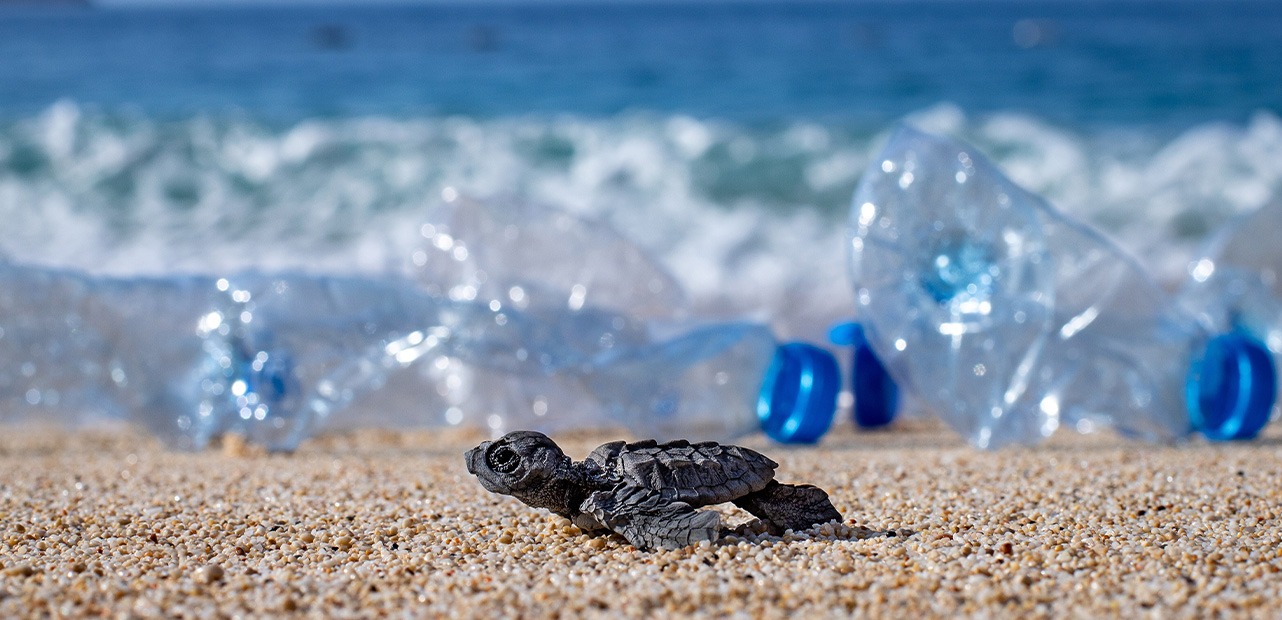
Impacts of plasticware go far beyond landfills
Recently, Glenn Hasek found himself at a dual-branded Tru by Hilton/Home2 Suites by Hilton in Florida. He really likes both brands, and this wasn’t his first stay at a similar property. Hasek is editor and publisher of Green Lodging News, which has reported on sustainability issues in hospitality since 2006.
Tru and Home2Suites offer a complimentary hot breakfast bar. At a prior visit, Hasek had been particularly impressed by the absence of the polystyrene plates and plasticware often found at the morning buffets of other select-service hotels. This time, however, he found both.
He asked Hilton why. This was the response: “You are correct, the Home2 Suites brand standard requires reusable dishware. However, individual properties may periodically be out of compliance on a temporary basis due to unforeseen operational factors, supply constraints or other circumstances that require them to make alternative arrangements for the benefit of their guests. We have reached out to the property to confirm any reason why they may be out of compliance.”
Why was this a problem? First of all, because fossil fuels used to make these products are a major contributor to global greenhouse gas emissions. And, as alarmingly, when buried at disposal sites, polystyrene lasts all but forever. It already fills up an estimated 25% to 30% of the space in the world’s landfills—“if it even ends up there,” says Toxic-Free Future, a leading environmental health research and advocacy group. When exposed to sunlight over time, it degrades into microplastic particles that scientists caution pose serious environmental and health risks because they contain toxic chemicals and accumulate in human organs.
Plastic cutlery is the same horror story—instead of biodegrading, it also slowly disintegrates into minuscule fragments. These now linger on our highest mountaintops, in our deepest oceans. When Monterey Bay Aquarium used underwater robots to sample water in its own bay, one of the most protected ocean areas in the world, it found microplastics from the surface to the seafloor more than 3,200 feet below—and in every creature sampled. As the United Nations has warned, “The impacts of plastic production and pollution on the triple planetary crisis of climate change, nature loss and pollution are a catastrophe in the making.”
Lesson for meeting profs: Rather than assuming a select-service hotel’s setup will be plastic-free, make it a point to ask whether it will comply with brand standards. Then, Hasek recommends, insist on sustainability language in your contract such as: “Hotel will provide reusable china, glassware and metal flatware for all meeting functions whenever operationally feasible. If disposables are required, they shall be compostable, fiber-based or reusable. Plastic plates, cups, cutlery, straws, stirrers and condiment packets shall not be used without client approval.”
Even many select-service hotels that use disposables daily can switch to reusable banquet inventory for contracted meetings, he notes. And for grab-and-go service for groups, plastic clamshell containers, wrapped plasticware and plastic condiment packets can be replaced with fiber-based containers, composable utensils, bulk condiment stations and reusable serviceware.
“Even many select-service hotels that use disposables daily can switch to reusable banquet inventory for contracted meetings.”
– Glen Hasek
Based on publicly announced sustainability initiatives, Hasek notes, planners may find stronger support in this area from:
- Holiday Inn Express (IHG)
- Hyatt Place
- Hyatt House
- Hampton by Hilton
- Home2 Suites by Hilton
- Courtyard by Marriott
- Fairfield by Marriott
- Residence Inn by Marriott
“The key,” he concludes, “is that most select-service hotels can deliver a nearly plastic-free meeting, but planners should make it a contractual requirement rather than relying on the hotel’s default operating practices.”
This article appears in the November 2026 issue. You can subscribe to the magazine here.