How updated CMP standards reflect a changing event professional job
The Certified Meeting Professional (CMP) designation is the events industry badge of excellence. But what exactly does having those three letters after your name tell employers you are capable of delivering? The truth is that mastery of event design, logistics and strategies requires a level of understanding, competency and dedication comparable to other professional designations.
In fact, in order to take the exam, an event organizer has to have worked for three years in a full-time meeting, convention, exhibition or event management role (two years with an industry-related degree). The prospective CMP must have completed 25 hours of continuing education in the last five years.
And to keep the designation, event professionals have to complete 25 hours of continuing education and recertify every five years. It’s a big deal.
And the skills required change over time as the job evolves. That is why, like other certifications, this one is rigorously updated a few times each decade and the newest version was rolled out in August of 2025 to reflect where we are as a profession with the updated EIC study manual in the works.
To better understand how the requirements have changed to reflect daily event prof life, we sat down with Amy Calvert, CEO of Events Industry Council (EIC), the nonprofit that represents the business events sector and administers the CMP standards and testing.
New CMP Standards
The first 44 CMPs were awarded in 1985 by what was then called the Convention Industry Council as a way to set uniform standards and benchmarks for the emerging profession of meeting planner.
Today, more than 13,000 corporate, association and government meeting professionals in 55 countries hold the designation, which comes with real benefits. According to a recent PCMA study, meeting professionals who hold the CMP earn on average almost $11,000 more a year than their noncertified counterparts. When employers know a candidate is certified work-ready, that adds value to the resume.
Every three to five years since then, after collective introspection, the standards have been adjusted to account for changing reality. “This is a continuous improvement process,” explained Calvert. “The standards and domains are not meant to be static. They’re continuously improving based on our joint knowledge. The core is solid. We have a strong foundation to build on.”
It just so happens that the latest updates came on the heels of a global shutdown of in-person events that “changed everything.” Or did it?
Read More: CMP Spotlight Series
To ensure the global temperature check wasn’t reflecting a temporary priority shift, the survey of a thousand event professionals to understand competency requirements was set for 2024 and 2025. By the time the first surveys went out, revenge meetings were in full swing and planners were asking, “How do we create meaningful event experiences, inclusive event experiences given what we learned when we were apart?”
EIC, working with the assessment company Prometric, was proactive in ensuring all sectors of the industry were represented from around the world. The results were used to create industry standards and multiple-choice exam questions based on event scenarios, which underwent bias review to ensure the wording resonated globally.
Some areas—such as risk management—are evergreen and will always be a focus, even if the approach evolves to anticipate current challenges with an emphasis on inclusiveness and adaptability.
The new exam considers the job as a journey, starting with the strategic purpose of the event and an understanding of constituent needs, hopes and dreams. Also covered are the finer points of event operations, talent and venue management.
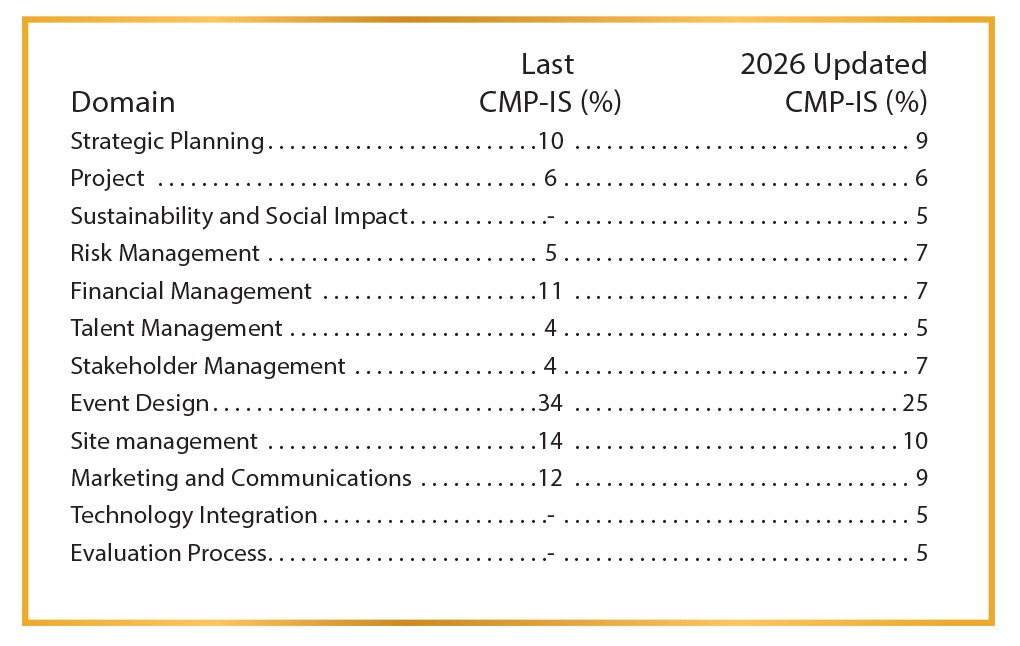
A new domain was added for sustainability and social impact, addressing carbon footprint evaluation, materials management and advancements in inclusive design and well-being. The topics were previously included as part of event design.
Expanded content on technology integration covers virtual and hybrid delivery, data analytics, digital engagement and AI.
A sharper focus on measurement and ROI addresses the need to quantify impact and communicate value to stakeholders.
“These are foundational knowledge areas for an event professional,” said Calvert. “If you’re thinking about your next step, the accreditation program and EIC offer you a place to build your transcript and think about what comes next.”
Attracting the Next Generation
Now that the skills base is established, it is time to communicate, engage and inspire the next generation to come lead the industry forward or, as Calvert puts it, “build stepping stones to a community of CMPs.”
Her vision is that EIC can act as a consolidator on behalf of members so prospective event professionals can learn about educational resources and participate in professional development opportunities around the world in their own language. “We need to be globally applicable but locally relevant,” she said.
Events already embody a sense of purpose. Leaning into that outcome makes a hospitality career appealing to a generation looking for meaning. “There is just such an opportunity through in-person events to help people feel connected,” Calvert said. That’s the story we have to tell.”
The industry is visibly shifting to accommodate calls for more work balance. Even though hotels are open 24/7 and events are labor-intensive, white space is being built into programs. Calvert puts part of the responsibility on the meeting professional to guard their energy and attendees to make smart decisions. “We have to be generous, but we also have to take responsibility for how we prepare to participate. The means coming rested, focusing on the things that matter, identifying objectives and communicating that when you return.”
Another heartening note Calvert is seeing is the increase in the number of event professionals who come to the job with intention rather than having stumbled into the career through a part-time job at a hotel or the like. With more programs at the high school, college and advanced degree level in event planning separate from travel and hotels, candidates are choosing the career because they see the possibilities.
“We have to be generous, but we also have to take responsibility for how we prepare to participate. The means coming rested, focusing on the things that matter, identifying objectives and communicating that when you return.”
— Amy Calvert, CEO of Events Industry Council
They also see the diverse options for contributing. From marketing and project management to event tech, data analytics and organizational management. “We need to continue to partner with schools to share that all skills are needed,” Calvert said.
“Our 2026 Global Economic Significance Study is focused on the lasting legacy impact events have on a community. It’s much deeper than a party. That is the message we need to share with policymakers, stakeholders, young people and anyone who will listen.”
She continued, “My hope and dream is that event professionals are inspired to go beyond their role and think about how they shape the story, advocate in their sphere and show up as leaders.”
CMP Stories
Three little letters can have an outsized impact on confidence and perception, as told by those who have earned the designation.
 Kyle Jordan, CMP Fellow
Director of Meetings
Institute for Operations Research and the Management Sciences
When Kyle Jordan first learned about the CMP, he didn’t understand the scope of what the program offered. “I honestly had no idea what a credential even meant or why it mattered. It took a few years for me to understand how important it could be for career advancement, credibility and creating a shared professional language.”
He was eager to balance what he had learned on the job with formal education. “My graduate degrees gave me a foundation for working with people and organizations. Designations like the CMP connected me to a wider professional community and gave me the structure I needed to deepen my expertise,” he said.
Read More: CMP Spotlight: Get to Know Kyle Jordan
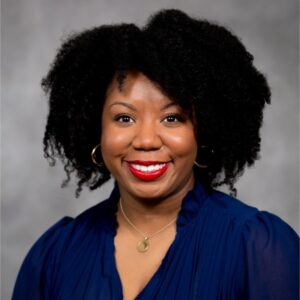 Constance Samuels, CMP
Senior Vice President of Events
Opportunity Finance Network
Constance Samuels, CMP, lives by the phrase, “Work hard, play harder.” Armed with her outlook, notes and events apps, her trusty three-ring binder and a medium black coffee, Samuels leads events that go off without a hitch. Afterward, she treats herself to some much-needed self-care and rest.
She worked in hotel and DMO sales for 7.5 years before pursuing her CMP. “With a hospitality management background, I was aware of the certification but wasn’t sure where my career would lead me and if I would actually need it,” she says. “It wasn’t until my second industry role that I realized that not only would it apply to what I was doing at work, but my company would support me in studying for it and help pay for me to obtain the certification.”
“Planning an event is not simple,” she says. “The CMP designation continues to solidify our existence in the multibillion-dollar event industry not as an option, but as a need.”
This article appears in the September/October 2026 issue.You can subscribe to the magazine here.