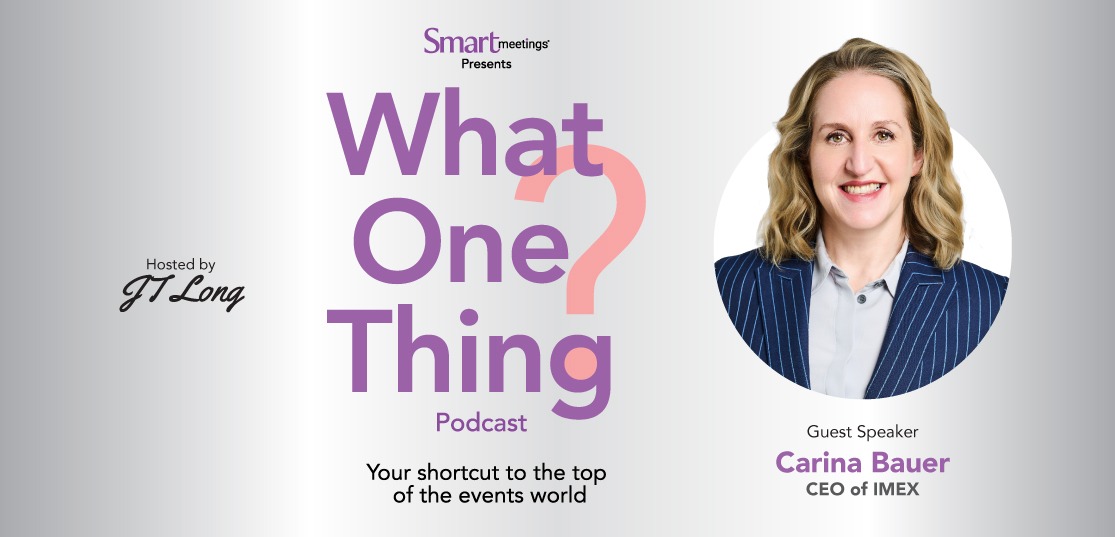
With nearly 4,000 exhibitors, hundreds of education sessions and nonstop networking, making the most of IMEX America starts with a plan. IMEX CEO Carina Bauer joins JT Long, vice president and content director of Smart Meetings, to preview IMEX America 2026 and share how attendees can design a successful week in Las Vegas. Bauer also explores place leadership, sustainability, wellness and practical ideas planners can bring back to their own events.
Further Resources
What One Thing?—Don’t Show Up Cold: How to Design Your IMEX Experience
JT Long
Welcome back to the What One Thing? podcast, where we ask successful people what made a difference in their lives and careers. Today, we are getting excited about IMEX America with IMEX CEO Carina Bauer. Thank you for inspiring the Meet Smart community on the What One Thing podcast. I am excited to have this conversation because every year there is something new at IMEX. This year is going to be bigger than ever. I hear there could be around 17,000 people. What advice do you have for navigating the week?
Carina Bauer
We had 17,000 people last year, and we are predicting a similar number this year. Maybe a few more will come. There is a lot going on at the show, from nearly 4,000 exhibitors to 300 or 400 education sessions and hundreds of networking events. The first thing I would say is prepare. We are four and a half or five weeks out now, so this is the time to get into the app and the website. Meetings go live next week. The best way for planners to make sure they have an effective time at the show is to schedule their meetings first. Through the scheduling app, you can also plan your education sessions and networking events and have everything in one place.
You can also do that from the floor plan. It has been redesigned and now includes the logos of the main stand holders, so it is easy to understand where the different regions and hotels are located. People sometimes say they planned their meetings without realizing they were spread across the show floor. I would definitely look at the floor plan. You can click on a booth and make your meetings from there. It also shows some of the larger networking events around Las Vegas on a city map.
If you are a first-timer, we offer a lot of help and tips. There is a webpage with advice, webinars between now and the show and sessions during the show that provide an orientation and help you meet and connect with other people. We have also launched IMEXscoop, which will be refreshed every week with ideas about exhibitors, what is new on the show floor and tips for the show. I would dedicate some time to those things rather than thinking you will do it on the plane on the way over.
JT
And wear comfortable shoes, right?
CB
Wear comfortable shoes. As you know, the IMEX team has IMEX sneakers now, so we are all in comfortable shoes. That gives everyone permission to wear super-comfortable shoes on the show floor.
Speaking of comfort, we have a new beauty bar for hosted buyers. As you plan your time at the show, you can book a slot to have your hair and makeup refreshed at the end of a show day before going to your evening events. Things like that will book quickly, so I recommend looking at everything that is happening and designing your experience well.
JT
I love that. I read your white paper, Place Leadership and the Business Events Sector. How do you define place leadership, and why is now the time to make impact, legacy and measurement a single discipline?
CB
As an industry, we are good at measuring direct economic impact, including room nights, food and beverage spending and spending in a destination. We are not as good at measuring the long tail of events and the impact an event has in a destination over time through inward investment, innovation and competitiveness.
Place leadership is a shared responsibility across a destination. It aligns public, private, academic and community stakeholders around common goals. Many destinations want to build competitiveness and innovation, attract talent, gain more international visibility and generate inward investment. The principal idea is that business events should be recognized as a permanent contributor to those objectives. That is not simply because our industry wants greater influence or because of the direct economic spending events generate. It is because business events can meaningfully contribute to the broader objectives of a destination. To achieve that, the destination and its stakeholders, including business event stakeholders, need to work collaboratively. That is what the concept of place leadership and the report are about.
JT
Measuring that is difficult. How do you do it?
CB
The report has two parts. It makes the case for place leadership and provides a practical roadmap destinations can follow. It also includes 27 case studies from destinations of different sizes around the world. Measurement depends on the destination, as you can see throughout the case studies, but it must connect to the destination’s key objectives and be done in partnership with its stakeholders. Sometimes that means working with academics, and sometimes it means measuring impact with the planner.
It is not straightforward or easy, but destinations such as Sydney, Melbourne, Calgary and Aberdeen in the United Kingdom have shown that it is possible to measure impact over time. Copenhagen is another strong case study because of the way business events support the city’s health innovation sector. There are different ways to approach measurement, but it has to be specific to the objectives and what the stakeholders are trying to achieve.
JT
I loved the individual stories because they brought the concepts to life, especially Copenhagen. What surprised you when you saw the study?
CB
First, the variety of case studies shows there is no one-size-fits-all model for place leadership. We often talk about these concepts as though they are one thing, but there are many ways to address them.
I was also pleased that the report is practical. It is not just theory or talk. It provides destinations with a seven-step roadmap they can follow based on their sophistication, how they are structured and who their political leaders are. It offers different ways to address place leadership in a practical, stepped approach so destinations can begin the journey.
We were able to achieve that because the report was written by two leading place experts, Professor Greg Clark and Borane Gille. They have not only studied destinations, they have worked with destinations around the world to do this work. That is why the report is practical as well as theoretical. We intend to continue building its bank of case studies and expanding on the report.
JT
It is very applicable. The more destinations benefit from this and understand that benefit, the more planners can benefit from a sense of place and a welcoming experience when they enter the destination. It is all symbiotic.
CB
It is very synergistic and creates a virtuous circle. As planners, when we enter a destination, we want to know it is working with all its stakeholders so the event can have a real impact and be meaningful for the community. It is good for everyone.
JT
We are going to see so many of those destinations in Las Vegas in six weeks. Each IMEX event has a talking point, and this year’s is Design Matters. How does that theme go beyond the content?
CB
Design Matters is not only about an event’s aesthetics. It is about designing every aspect of the event intentionally. We design our hosted buyer program very deliberately so hosted buyers can create their own journeys and micro-experiences within the show’s large ecosystem. It allows planners to use preplanned meetings effectively while leaving time for exploration, inspiration and education. That is fundamental to how we design the show.
We have also relocated the Hosted Buyer Lounge and increased its footprint by about 20% compared with last year. It is now in a ballroom space with experiences that include a new wellness zone and the beauty bar.
For the past two years, we have worked toward comprehensive neurodivergent accommodation, and we have again received the highest-level endorsement available under the Australian Psychological Society’s neurodivergent-inclusive event guidelines. That applies to the aspects of IMEX that are within our control, including areas such as the Hosted Buyer Lounge and Resilience Room. All these elements shape the flow of the show and, importantly, the experience different participants have when they attend.
JT
According to the 2025 Event Sustainability Report, IMEX diverted 90% of waste from landfills and maintained a zero-waste designation last year. Some of the efforts involve exhibitor booth reuse, evergreen signage, reusable serviceware and carpet choices. How can planners and exhibitors partner with IMEX to make a difference in these areas?
CB
We have a People and Planet Pledge on the website that individuals and exhibitors can sign. It includes actions such as agreeing to our Code of Conduct, attending an education session, offsetting travel emissions or downloading the TraffickCam app, which helps combat human trafficking.
In our food courts, we label the food choices so attendees can see water-use and carbon metrics. Making informed choices helps us make the show more sustainable. On the exhibitor side, we are working with Better Stands to audit all the booths. A large part of an event’s carbon impact comes from how booths are built, so we work directly with exhibitors and stand constructors. We will audit all the booths, as we did in Frankfurt, and they will receive bronze, silver or gold certification based on the Better Stands criteria.
The certification gives exhibitors information about how to make their booths more reusable, circular and sustainable and therefore reduce the carbon impact of booth construction. It looks at elements such as floor coverings, graphics and building materials. Exhibitors can see why they received a particular certification and what they need to do to reach the next level if they have not already achieved gold. Working consistently with a certification like this helps us and gives exhibitors a meaningful way to contribute.
One of the largest sources of carbon emissions related to IMEX is air travel. One of the biggest things anyone coming to the show can do is offset the emissions from their flight. It is usually an inexpensive add-on when making a booking, and it can make a difference.
JT
What I love is that after going through this experience with you, planners can apply what they learn to their own programs.
CB
Absolutely. Sharing what we do is a big part of our ethos. We do not share these efforts simply to say, ‘Look at us.’ We share them so others can take the ideas, use them in their events and make their programs more sustainable. Ultimately, we all want to live in a more sustainable world. It is good for everyone and good for the industry if people take our ideas. Please steal them.
JT
IMEX was also early in incorporating wellness into IMEX America. What will that look like, and how is it evolving in 2026?
CB
We have focused on wellness for many years. Our work around neurodivergence is one part of that. We have also offered the IMEXrun, the Heka Health Wellbeing Challenge, which is a competition with prizes based on steps, and the Resilience Room created with Hello! DMC. The Resilience Room is a beautifully designed, quiet space where people can step away from the show floor. This year, we also have the new hair and makeup beauty lounge from Clarity Experiences.
Last year, we worked with Circadian Cove for the first time to create a holistic wellness experience. It has evolved this year to include an emergency medicine physician, red-light therapy, cryotherapy and guided breathwork sessions. That is being delivered by Olympian Meeting.
Coming back to the design aspect, when you attend an event like IMEX, you need to design your week so you can get through it, eat healthfully and maintain your energy for all the meetings and networking events. Some people can go from party to party and feel fine, but many of us need and want to look after our health while traveling. We all need slightly different things. For one person, it might be waking up at 6 a.m. for a 5K run. For another, it might mean visiting the Resilience Room at midday for a 10-minute power nap. Both are fine. You need to design your program and your week so they work for you. Our job is to provide those opportunities, learn from them and build on them each year.
We also offer education about health and well-being. Our Monday keynote speaker, Caitlin Krause, will focus on digital well-being and mindful technology practices. We have other speakers addressing the topic as well. Planners can learn something for themselves and take ideas back to their own events. There is a lot of education around health and well-being in addition to the experiences available at the show.
JT
As excited as we are to return, I want to know what Carina is excited about. Is there a coffee shop you are looking forward to visiting? What is energizing you about coming back?
CB
I always look forward to returning to Las Vegas. I do not get there as often as I did in the early days of IMEX America, so it is always fun to go back. I love the Arts District on the weekend before the show. It has some fantastic coffee shops. My favorite is Vesta, but please do not all go because I like to have it to myself.
JT
You heard it here. Vesta.
CB
There is also a great session I am looking forward to. I will be on a State of the Industry panel on Wednesday in the early afternoon, so naturally I am excited about that.
The other session I am looking forward to will be moderated by Sarah Furness, a former fighter pilot. She will interview my mother, who is a pilot and rally driver, about resilience and getting out of your comfort zone. That session grew out of an interview I did with my mother for an internal team session for International Women’s Day in 2025. The team heard it and said they would love to create a version for the show, so it will be a special one to look out for.
JT
That one has already been preapproved. I love it. Thank you, as always, for bringing the excitement. We are so energized about getting everyone together again in Las Vegas. Thank you for being on What One Thing and always sharing from your heart. We appreciate it.
CB
Thank you, JT. It is always a pleasure.
JT
Thank you all for tuning in. We will be back, and we will see you in Vegas.