From the attendee to the supply chain, everything is in flux
The landscape of hospitality—the role of events in attendees’ lives and the properties and venues in which they occur—is constantly evolving.
Not only is what attendees want and expect from events endlessly shifting, but so is the event landscape where those attendees meet. Taking a look at planners’ on-the-ground experience and their environment provides a holistic view that could be helpful as we head into the new year.
The Planner
The Planner’s Role Is Changing

Brian Kellerman, CEO and partner at corporate event management company Go Gather, calls 2026 “the year of the strategic planner.” When asked why, he says, “The checkbox version of planning is dying.”
“Over the last couple of years, a few things have collided,” he says:
- Budgets are tight, costs are up. “Hotel, F&B and labor costs keep rising while most teams are flat or down on budget. That means every line item has to tie back to a business outcome, not ‘this is what we always do.’”
- Attendees are way more selective. “People are traveling less ‘for the hang’ and more to accomplish very specific goals. They’re efficient with their time: in, get value, connect with the right people and go home. Traditional add-on events like generic cocktail hours are no longer automatic attendance drivers.”
- Event satisfaction has dipped. “You can feel it. Attendees expect personalized, interactive and practical experiences. When events don’t deliver that, they’re not shy about saying so.”
“That environment favors planners who think like business strategists,” Kellerman says. He outlined four ways planners can thrive in the year ahead, starting with clear goals and a strong “why” for the event. The other three are:
- Build cross-functional teams (internal partners, agencies and vendors) around those goals
- Make tough trade-offs so the budget supports what matters most (not just the trends you see on TikTok)
- Use data to refine year-over-year instead of repeating the same agenda and hoping for a better outcome
Read More: Work Smart: The Team Culture Factor
The Gamification of Events
Kellerman says gamified networking will play a larger role in events. “Gamified networking feels less like, ‘Go mingle with strangers,’” he says, “and more like, ‘Here’s a mission. Let’s have some fun with it.’”
Read More: Bridging the Gap: The Key to Engaging Gen Z
He listed three forms this may take:
- A points system. Attendees may earn points for joining small group sessions, meeting with a sponsor, or connecting with people in their role or region.
- Networking “quests” rather than open receptions. His example: “Find three people who work in a similar vertical and share one best practice,” or “Visit three solution stations and collect a code word from each.” You can then turn these in for raffle entries, swag upgrades or exclusive lounge access.
- Team-based challenges. Activities such as problem-solving scenarios and scavenger hunts. “We recently ran a Jeep adventure scavenger hunt in Portugal that hit all the right notes…team bonding, light competition and a shared win at the end.”
We encourage our clients to build gamified networking that gives structure to interaction, Kellerman says. “It takes pressure off introverts, gives extroverts something to run with and creates a trail of data you can use to understand what kind of connections people actually value.”
One Big Surprise
Kellerman says the most significant shift he’s seen because of the influx of the new generation in the industry is how sharply attendees filter what’s worth their time. This is changing the way events are run and structured. Kellerman mentions four ways he sees the event landscape changing as a result:
- Content needs to be hyper-relevant. “Generic thought leadership is a hard sell. Attendees want tactical, niche ‘from the trenches’ sessions and peer-to-peer learning. They expect to hear from people who actually did the thing, not only from motivational speakers or people trying to peddle their offerings. No one wants to hear ‘be strategic’ or ‘set goals’ over and over in a session. What’s worked, what’s failed, what can I take back to my team?”
- Formats are getting smaller and more interactive. “Shorter sessions, more breakouts, small group roundtables, lounges and ‘theater’ talks instead of endless general sessions. People want to consume content in tighter, focused bursts and then talk about it with others. This also gives way to customizing their agendas more.”
- Connection over pageantry. “With hybrid and remote work, a lot of people use events to make up for the relationship-building they’re missing day to day. That means more structured networking, small group experiences, give-back projects and casual late-night lounges instead of only big ballroom dinners.”
- Values and well-being matter. “Interest in wellness activities, outdoor options, and sustainable choices is strong, especially among younger attendees. They notice if your actions on site don’t match what the brand says it cares about.”
“One of the biggest surprises for me is how little tolerance there is now for anything that feels like wasted time, even when the hospitality is very ‘nice’ on paper,” Kellerman says.
He says they’re seeing trends such as attendees skipping traditional receptions or dinners if they don’t see a reason to go, people traveling in tight windows to minimize days from home, and a strong interest in authentic local experiences over typical ballroom functions.
“You can have a beautiful venue, great food and thoughtful amenities and still miss the mark if the experience doesn’t feel purposeful,” he says. “Hospitality used to focus on ‘make it impressive.’ Now it’s more about ‘make it meaningful and efficient.’ And honestly, personal.”
The Planner’s Environment
Top Destinations
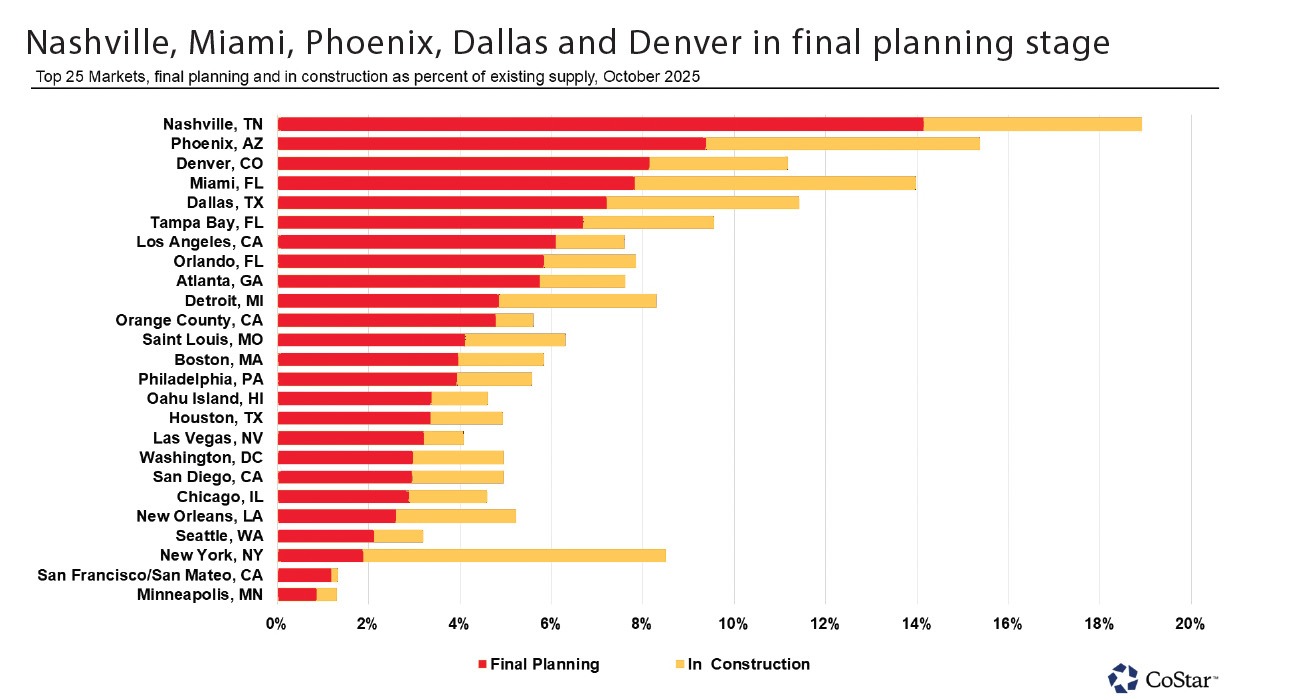

“Supply growth has been quite uneven,” says Jan Freitag, national director for hospitality market analytics at CoStar. His home base of Nashville, for instance, is experiencing one of the greatest years of supply growth; year-to-date, its supply has grown by 3.3%. The national average this year was 0.8%.
Other destinations that are outgrowing the national average include San Diego (2.4%) and New York (2.1%). “I always like to add that once this existing crop of projects in the pipeline opens, there is not a whole lot coming because they changed the zoning laws, and a bunch of developers are trying to get it under the wire, and they did. And so those projects are opening now, and then there will be very limited new construction going on.”
The zoning law change Freitag is referring to is New York’s citywide extension of the City Planning Commission (CPC) special permit, as adopted through the City Hotels Text Amendment. Created in December 2021, this amendment requires a special CPC hotel permit for the development of a transient hotel building, the change of use or conversion of a building to a transient hotel and the enlargement or extension of an existing transient hotel.
International Slump
Freitag says he fully expects the United States’ international inbound travel slump to continue next year. “Statistics Canada tells us that the Canadian border crossings and air crossings are down 27% year-to-date. I don’t think we’re going to see double-digit deceleration next year, but the numbers are not going to move up.”
It’s the same for international inbound overall, just under 3%, he says, according to the U.S. International Air Travel Statistics (known as I-92 data)—but something else interesting is happening in the data. “Americans going abroad is up just over 2%, so it’s interesting that despite the weaker dollar, we’ve seen people go abroad, and that is possibly going to continue, maybe not at that magnitude, just because the American economy is so uncertain. Certainly on the very high end, we continue to see very healthy leisure demand.”
Read More: Destinations International: Meetings Business Is More Important to Cities Than Ever
“We continue to be surprised at the lack of pricing power for hotels,” Freitag says. “When we look at upper upscale hotels, the room rates have increased through the first 10 months of the year, through October year-to-date by 1.3%. At the same time, inflation is up 3%, so hoteliers are not keeping pace with inflation. So, technically, in real terms, hotel rooms got cheaper this year than they were last year, if you adjusted for inflation.”
Freitag understands this doesn’t help planners who’re in compressed environments in one of the larger markets, such as New York or San Francisco, but he says pricing has not been robust. “We track six classes throughout the United States that we slot the hotels into, and only luxury and upper-upscale hotels have seen rate increases; the other four have seen rate declines,” he says. “It’s totally counter to what we’re seeing everywhere else in the American economy, where prices continue to go up.”
Two Big Surprises

In January 2025, CoStar forecasted that the remaining year would see RevPAR growth of around 2%, and they’re now predicting RevPAR will come in at -0.4% for the year. “That’s a 220-basis point swing in our forecast. So that’s not good.”
What happened? You may have a good guess (or three).
“Well, we didn’t anticipate the impact of tariffs,” Freitag says. “We didn’t anticipate the sharp deceleration of international inbound travel, and we assumed there would be some inflation; we just assumed that it would be less sticky.”
Those tariffs have led to the second impact on RevPAR growth: the weakness of group demand over the last seven months. Tariffs have made companies uncertain about their bottom line, and yet the need to budget remains. “Travel is an easy line item to control,” Freitag says, so rather than sending its typical 10 team members, a company might’ve cut that number in half or by 80%.
Although now defunct, Freitag says the other big cut to group demand certainly came through the Department of Government Efficiency (DOGE). “The government employees impacted by DOGE cuts were no longer traveling to group events, and there were other certain group events that existed purely to put private industry and government together in a room,” he says. “Those meetings don’t exist anymore, and then you have a lot of groups that have international participation, and getting into the U.S. has just gotten a lot harder.
“But at the same time, group room rates are up year-over-year by between 2.5% and 3% each month of the seven months where we see our demand decline,” Freitag adds. “That’s a little counterintuitive, because you would think that as demand declines, room rates go down. That’s not the case.”
Given that room rates are typically negotiated at least a year prior, at that time, they negotiated from what Freitag calls a “position of strength,” but as we head into the new year, what the negotiation table will look like remains a mystery. “As we negotiate into 2026, I’m very curious to see if hoteliers will negotiate from a position of strength or not, given the weak demand environment we’re facing on the group side, and what we’re facing for the hotel industry overall,” he says.
This article appears in the January 2026 issue. You can subscribe to the magazine here.