The team at Visit Salt Lake captures the organization’s true identity
Last year, the team at Visit Salt Lake (VSL) made a decision. They needed something that more accurately captured the brand’s identity and gave meeting professionals a better idea of what the organization is about.
Formerly known as a destination marketing organization (DMO), the team has since dropped the word “marketing” from its name, moving from a “destination marketing organization” to a “destination, sales and experience organization” (DSXO).
“The word ‘marketing’ doesn’t do our organization justice in terms of what we actually do,” says Kaitlin Eskelson, president and CEO of VSL. “We took a step back and looked at really our core function is sales and trying to increase room night production. And by way of that, we have to create exceptional events.”
A 2025 study by Destinations International, DestinationNEXT Futures Study, found that 42% of DMOs fear budget cuts or elimination. Eskelson believes this is simply a misunderstanding of the role of DMOs.
“The beauty in all of this is that when we deliver experiences, we can actually deliver numbers,” she says. “We can deliver room nights and revenue projections. That safeguards the organization moving forward and really takes any question out of what we are booking, and what our economic impact on the community.”
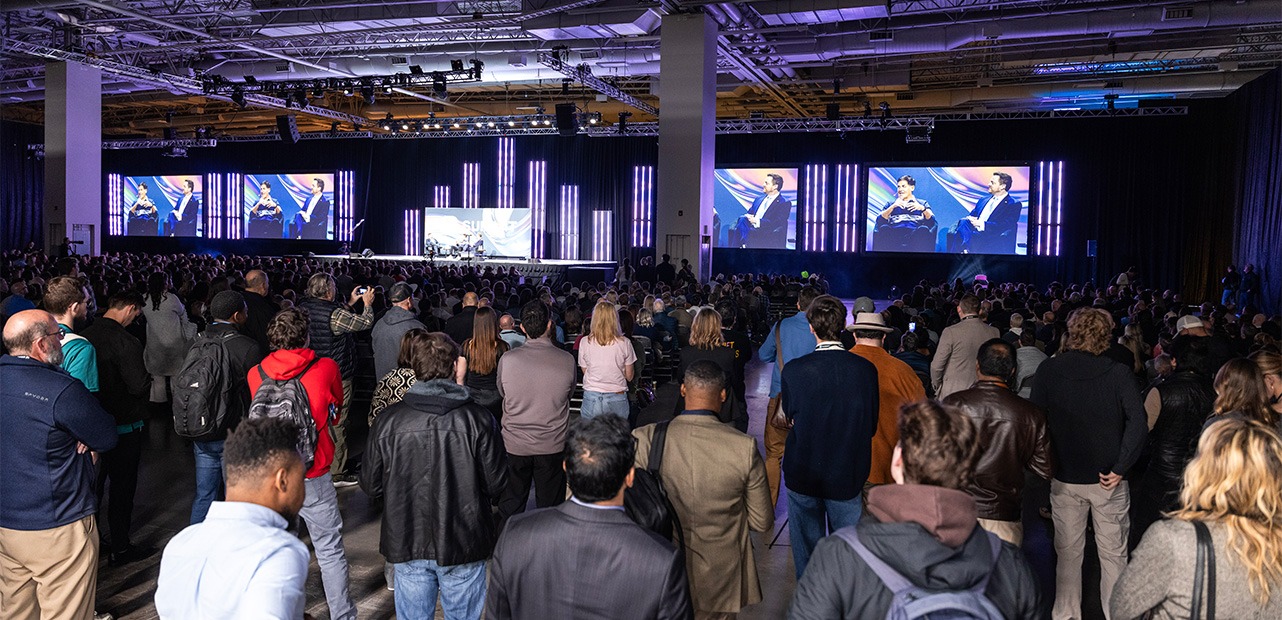
Chad Fraughton, CEO of Cornerstone Technologies and longtime partner of VSL, had his first interaction with VSL’s new model during the four-day Summit, which combined of Silicon Slopes’ 10th annual Tech Summit and VSL’s third Winter Roundup. “What was new was the presence of Visit Salt Lake,” Fraughton says, whose company operated the event’s audiovisual. “Silicon Slope Summit had been in place for some time, but it needed really the help and assistance Kaitlin and her team really brought to it. This year was a pivotal year in creating the foundation to grow and make it a bigger and more inclusive community event.”
Eskelson says the trend in meetings and conventions is moving toward the experiential, aligning with their transition to a destination, sales and experience organization. “We realized we can market all day and get people here, but if they don’t have a great experience, they’re not coming back,” she says.
Summit, which drew roughly 10,000 attendees, was built on the idea that Visit Salt Lake could create its own marquee event. “We realized that while we can depend on our external meeting planners to fill our convention center all day long, but really, with Summit and working with Chad, it was to say ‘Let’s create our own marquee event and fill in a need period when we need the business,’” Eskelson says. “That was kind of the whole premise. It was to say ‘We don’t have to wait to fill the convention center. We can also proactively do it through some of these marquee events and build on them.’”
Convention and Tourism Assessment Area
About two years ago, Visit Salt Lake created the Convention and Tourism Assessment Area (CTAA), a 2% fee added to guests’ hotel bills. “All of the hotels unanimously decided to contribute to this fund,” Eskelson says. “There’s a convention-district-specific area, and those monies are piled and voted on, and a lot of it goes to incentivize meeting planners to come, it could be a marketing incentive, a keynote speaker incentive or an experiential buildout incentive.”
Read More: Utah: The Land of Incentives
She says it was created to meet planners where they are, address some of their needs and allow them to take a bit of risk and go beyond just the standard conference.
Fraughton says the CTAA allows for more opportunities, such as small retail or facility takeovers. “We’re trying to create this ‘globalness’ when you come to the downtown area.” Almost 60% of Cornerstone’s business is outside Utah, working with major markets such as Las Vegas, New York and Los Angeles, and he saw a difference in the way Salt Lake’s hospitality industry operates.
“We saw opportunities here that I don’t see in any other area,” he says. “It’s the willingness of this community to support a larger effort, taking not only where we are, but where we want to go in the future. Those are key pieces to the success of this.”
Where’s the Product?
“Meeting planners can’t buy something they don’t know about,” Eskelson says. An analogy she uses is Coca-Cola’s advertising efforts. “[They] can spend millions of dollars on marketing every single year but if you walk into a convenience store and you can’t buy it on the shelf, then what was it all for in the first place?”
VSL’s “convenience store Coke Zero” is its experience buildout they can show to meeting planners, helping them see what their vision could look like. “That’s what we’re doing, and some of that is from these marquee events we’re running internally. Hopefully, these are all things we can help meeting planners weave into their conventions.”
No More Same Ol’
Eskelson understands the tactic of staying the course year after year—but at some point you have to venture out. “It’s hard to deviate from things, especially when they’ve been really successful,” she says. While this is the case, she believes meeting planners eventually find themselves in what she calls a “sea of sameness.”
“I think what destinations can learn is that sometimes you have to invest money and really creative thinking to demonstrate for clients what their event could look like,” she says. “In our case, it was building out an entire conference. We’re only as good as our local partners, so we want to lean into all those businesses, because at the end of the day, we would love to have the talent right here in Utah, so planners don’t have to outsource it to other states.”
For Summit, everyone at Cornerstone and VSL wanted to take attendees on an emotional arc. “There were moments of surprise and delight, moments of humor, and moments of dancing and celebration, end capped with some really serious topics, like Medicare,” Eskelson says. “That’s what we tried to do, almost similar to music, in a way, where there’s an arc in the story. I think that is what rounded it out for people. It’s important that you end on a high note.”
That high note for Summit was a public skijoring event, in which skiers are pulled by horses. “It was cleverly curated by Kaitlin and her team. It brings these two groups together, and then it becomes a community event. It’s done in a very non suspect way, right by the LDS [Latter-day Saints] temple. It’s right in the heart of downtown Salt Lake City, outside of the visitor convention bureau office at Salt Palace [Convention Center].”
When dealing with a 10-year-old event, Fraughton says, you must focus on the expectations of not only its attendees but also of its community. “We were at a crossroads, where we needed to provide something different to the community,” he says. “That wasn’t their spoken word, it was our acknowledgement. What we learned was reflected in the response from the community. They saw it as something needed. It was like a breath of fresh air.”
Event Credits
AV: Cornerstone/Modern Expo & Events
DMC: Visit Salt Lake/Silicon Slopes
DSXO: Visit Salt Lake
Caterer: Sodexo
Event Tech Platforms: Silicon Slopes, Cornerstone, Modern Expo & Events
Entertainment: Silicon Slopes/Visit Salt Lake
Other: Mindy Young—Event Contractor