What happens when every attendee walks into a meeting and finds a drum on their chair?
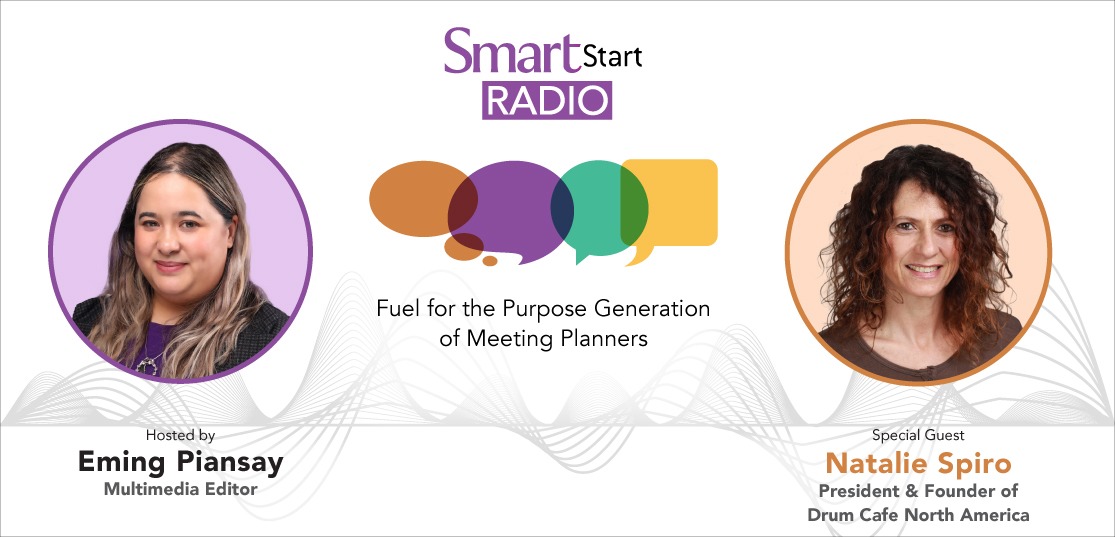
For Natalie Spiro of Drum Cafe North America, it’s an invitation to connect. In this episode, Smart Meetings Multimedia Editor Eming Piansay explores how interactive drumming can shift the energy in a room, break down barriers and turn attendees into active participants.
Spiro shares her unexpected journey into corporate events, explains how she weaves organizational messages into shared rhythms and recalls a reluctant participant who found her voice through the experience. They also discuss how planners can make space for play, welcome different voices and build connection before the first presentation begins.
Further Resources
Wellness That Works: Sonic Power
Well Done: The Connection Effect
Eming Piansay You walk into a conference room, and there’s a drum on your chair. Maybe you’re excited. Maybe you’re thinking, “Wait, they want me to play this?” Then the room finds a beat together, and suddenly you’re part of something. What could this kind of moment do for the rest of an event?
[Smart Start Radio theme music]
EP How’s it going, Smart Start Radio family? Today we’re talking about rhythm as a tool for connection inside meetings and events. Drum Cafe North America brings interactive drumming into conferences and corporate gatherings to energize teams and create shared experiences. The idea is simple. When people play together, they connect. Today, we are speaking with Natalie Spiro to talk about how this kind of experience can shift the energy in a room and why it resonates. Hi, Natalie. How’s it going?
Natalie Spiro I’m good.
EP When I saw that email originally, I was like, “What is this? What is this whole thing?” It’s so interesting. Music is amazing. I love music. I’m a big believer in events and music being merged together. In your own words, describe what it is you do and what you’re all about.
NS I love that question because people hear the words Drum Cafe, and they think of a cafe where people commune and come together, drink coffee, have chats. When we started this company many moons back, the name Drum Cafe was just a metaphor. What we do is bring people, groups, teams, whole companies together. We do all-hands, conferences, retreats, learning, training. It’s really about bringing people together to commune around the drum.
And when we say commune around the drum, I don’t mean we are sitting on the beach. Most people have the vision of a drum circle, people on the beach, nude, drumming by the full moon. That’s one element of drumming in community, but what we do is in the corporate arena.
We usually kick off a conference, close a conference or come somewhere in the middle. We have lots of different programs using different kinds of instruments. Everybody will have an instrument. People will see drummers on stage, music. When the doors open, they’ll be like, “Wow, what’s about to happen here?” Straightaway, it gets them out of their headspace and into their heart space, which is really where we want them to be.
We customize each and every program to each and every client. We weave the information that the clients want us to weave through the program, using the drums as a medium instead of PowerPoint.
EP What does that look like exactly? PowerPoints are very much, “Here’s text on a screen. Read it.” For drums, are you reciting what would be on the PowerPoint as the drums are happening? How does that work?
NS We have a program that we designed ourselves. The doors are closed to a meeting. We break out in rhythm onstage and open the doors. There’s a drum or a Boomwhacker, or there are tables with DIY cajons. There’s an instrument on a chair. People walk in and think, “Oh my gosh, this is not going to be like what we did last year, with a million speakers and a million PowerPoints and people talking at us.”
We drum people in so they feel comfortable. There’s no hierarchy. Whether you’re the CEO, the janitor or the person who runs the front desk, it doesn’t matter. You’re all sitting together, not in groups. You’re in the room with an instrument in your hand, and we start the program with nonverbal cues. There’s no language spoken, because the essence here is that rhythm and music and drumming are a universal language, a language that breaks through all the barriers that tend to separate us. There are many today, whether it’s geography, position in the organization, gender preference, sexual preference, whatever it is.
What music and rhythm do is unite us as a powerful community, whether we are salespeople or IT people. It unites that entire community through the use of drumming. Then we go to other parts of the program that relate to the bass of the drum, which is the heartbeat, and the tone note, which is the communication note.
We do different rhythms, so people on different sides do different rhythms. What it shows is that one group can hold a certain voice. Another group can hold another voice, and each voice is important in the room. We like to include all the voices as rhythms to show people that their opinion, their thought leadership matters. Does that make sense?
EP That’s very powerful. Going back to how this all started, what made you want to do this work?
NS Honestly, it was almost by accident. I immigrated to America in 2000. Most Americans don’t understand the legal immigration process, which is extremely difficult and costs a lot of money. I had a jewelry business that I came to America with because I won a contract with Nordstrom. I used to be a jewelry designer in South Africa, and I did a show in New York and Vegas, and Nordstrom hired me.
My husband at the time, who’s now my ex-husband, and I arrived in San Diego because my parents were there. So was my brother. It was the most logical place to land. Very quickly, my marriage unraveled, my business unraveled, my entire life unraveled, quite frankly. I went through a massive transformation.
At that time, a very good friend of mine in South Africa, who I grew up with and was at school with, contacted me. He said, “Listen, I do this show called Drumstruck in South Africa. Everybody in the audience gets a drum, and we do an interactive show. I’m sure you could take this to corporations.”
I had no idea what this was. I’d never drummed before. I played the guitar when I was a kid, and I was a dancer, but I’d never played the drums. He sent me this video, and I watched it, and the hair on my arms raised. I felt so much emotion around this. Coming from South Africa, you have to understand that the ancestral wisdom of rhythm and drumming is very powerful. It’s almost in my DNA. Because I became an organizational psychologist and have an MBA, he called me to say, “You should do this within corporations.”
I got these video clips, watched them, and the following week, I think it was, I went to a party. I met a woman who asked, “What are you doing in America, so far away from South Africa? What do you intend doing while you’re here?” I started riffing with her based on what I had seen in the videos. She was like, “Wow, I’ve got a meeting for 100 of my managers in Vegas, and I’m not hiring a keynote person. I want you.” I was like, “Fantastic!” I had no idea what I was doing, Eming.
This woman was a senior vice president at Motorola. I ran home and contacted my friend. I said, “Listen, I’m flying to South Africa. You have to teach me how to do some drumming. I’m presenting this to Motorola at the big regional manager meeting.”
I went to South Africa, spent two weeks, learned a little drumming and some facilitation techniques, and went to a farmers market. I found a guy and bought 100 drums from Guinea, West Africa. They shipped them to San Diego. A girlfriend cleared them because I didn’t even have a visa at that time.
This girlfriend took me to an African art opening. As I walked in, there were djembe players from West Africa at the front door. I said, “I want to speak to you, you, you and you.” We had a meeting, and I had them all at my home on my deck. I flew my friend Warren in. We had a couple of rehearsals, loaded the drums into a U-Haul, drove to Vegas and delivered the first event.
They loved it so much that they hired me a second time. In fact, they told me my price was too low, I needed to raise it, and they wanted to buy gift drums for all 100 participants.
EP Wow!
NS That’s how it started. I stored those drums in my garage. From there, I’ve probably been in hundreds of thousands of conference rooms and boardrooms, with companies from Google to Microsoft to W. L. Gore. I’ve traveled the world to Kenya with Google and Prague with Microsoft and Gap. I went with Gap to Japan because they hire me to do the openings of their leadership programs, so you start with rhythm, which is connected to leadership. Right now, I’m writing a book about it, through all my experiences over the 25 years.
EP That’s a wild ride. It’s fascinating. You brought your history into this space. This is where you’re from, who you are, what you grew up with. When you’re doing this, are you also speaking about the history of the music you’re working with? How much of that is in it?
NS I definitely bring the origins of the drum, because the djembe drum is made in West Africa. They carve it from a specific tree. The wood looks like an [unclear]. They cover it with goatskin. In Africa, the goat is very revered. The goats sleep with the men in the hut. That’s how important the goats are. The women tend to sleep on one side, and the men sleep with the goats in the hut. The goats are revered for their milk, their meat, and they use the entire goat. At the end, the skin is used for the drums.
There’s a specific roping system to tune the drums. We talk about it, but it depends on the event. If it’s a very large kickoff to a big conference, I don’t go deep into that. We also do schools, and at schools we go into that.
EP When you’re doing this, you’re watching people engage and have fun. What is the main thing you feel people come out of it feeling? At events, there’s not a lot of that experience.
NS Firstly, it’s highly engaging and interactive. Before COVID, we used to have 15 events a month. COVID hit, and it all died. You would think it would be starting to come back again.
If it’s a big conference and I have 30 minutes, I’m going to weave in as much content as I can. I use a bespoke content form that I send to each client. I do a lot of discovery to understand their business, what they’re going through, what narrative they want through the program. I weave as much of that narrative through the program as I can, depending on the time I have.
EP Are you there the whole span of time, or just the keynote or the end? How much are you involved in that process?
NS I’m typically the keynote. I’ve got lots of different programs, but I’m typically the keynote. The only difference is I’m bringing drums for everybody. I’m making it interactive. I’m busting down silos. People jump out of their heads into their heart space. People have an innate need, a primal need, to bang a drum.
I’ve had people come back to me again and again. Not every year, per se, but maybe every second year. They use me with other groups in the company or hire me for a series of leadership events, so each team gets an experience of this. The one thing people remember is the drumming.
As Maya Angelou said, it’s not what you tell people or what people are hearing. It’s how you make them feel. They’re feeling this. They’re not being talked at, with a million different stats and things they can get in a book. If I have stats, I talk about them through using the drum.
When their fingers are on the skin of a drum and they’re hearing the heartbeat, and they hear me saying, “You have raised by 19% in your sales performance, 8% in team engagement and 5% in team retention,” that’s going to sink into their brain much easier than me standing up and telling them these stats one after another.
EP In your experience, for people planning events, how does your involvement make their event explode? What makes it the reason why?
NS Most people hire me to kick off an event, so I’ll typically do between 30 and 45 minutes. If I’m doing a deeper dive, most of my events are 45 to 60 minutes.
I’m launching a new program for very large groups. In October, I have an event planner looking at 1,800 people. They want a 10- to 15-minute big wow-factor kickoff. I’m offering three different packages. I’m calling that program Connection Before Content, because this is how they’re going to connect before they start getting content for the rest of the day.
We’re either going to use body percussion, because our bodies and hands were the first instrument we ever had, or they can add an instrument like a Boomwhacker. They can bring instruments from home. They can bring knives and forks and whatever they want. We’re going to do a 10- to 15-minute Connection Before Content.
We’ve got lots of different options. I also do half-day events where I start with rhythm, bookend with rhythm, and in between we do a two-hour workshop on communication or the five Cs of leadership. We can do a half day on play. We do rhythm and how important it is to go back to when we were 6 years old, and learn how we can detach our brains so we can play, because we’ve forgotten how to do that as adults. With AI coming on, our minds are overloaded.
Sometimes I feel like I’m in an elevator on my own, and the four walls are squashing more and more in. There’s stress, burnout, all these things being experienced. For people’s mental health, to engage in music, make it meaningful, engage in play that’s meaningful and authentic connections through communication that’s meaningful is a beautiful half-day retreat.
EP That’s really beautiful. Can you walk me through an example of what one session might look like? I haven’t seen it, so I can’t fully understand the scope. How would you engage with the drums and people to allow people to express themselves, but also give them information?
NS Absolutely. We start off with a drum on every chair. We’re onstage. Music’s playing. I give the people a thumbs-up, they open the doors, and people start walking in. “Wow, what’s about to happen here?” They get seated and get their drums. I come forward as a facilitator, or one of my facilitators comes forward. I get them into a single beat so everybody’s on the same drumbeat. Then we get to double time, then single time. Everybody’s on the beat.
Then I get them to rumble on their drum, rumbling at the edge. I’m doing different things to build the learning blocks of how to utilize the drum as an instrument. We do accent beats. I’ll put two fingers up, and they’ll hit the drum two times. I’ll instruct them to do a call and response. I’ll play a rhythm on my drum, and they respond back. I’m doing the building blocks of how drumming is a language.
Then I have a window of communication. We talk about the company celebrations, why they’re here together as a group, why drumming, where they’re from. Let’s welcome all the different voices in the room. What are they going to be doing in these three days together? How impactful is the rhythm to set the tone for those three days?
Then I get them into a bass note. The most powerful part of my program is where one half of the audience is holding the drumbeat. They’re hitting the bass of the drum. The other side has their fingertips on the skin. While they’re doing that, I’m talking to them about what they’re here to be thinking about. What does leadership want them to be thinking about 24/7? Is it about working together more effectively as a team? Working through difficult conversations? Thinking about the five-times multiplier they have to think about as salespeople this coming quarter?
Every company has different information they want their people to understand, and that’s how we weave it through. I have videos I’m going to send to clients, which I might want to send to you for your listeners, with my three different programs and how they unfold. It’s a Loom-type video with footage from events, and it will guide them through each program.
EP I’d love to see that. You’ve done this so often. Has there been an event where you personally felt the emotional shift in the room? Even though it’s for them, you still felt it?
NS Yes, so many times. One example was an insurance group. There was one person in the room who walked in, folded their arms, like, “We’re not interested.” They weren’t going to play.
As we started drumming, the two people next to them were on their drums, and this person still kept their arms closed. Whenever that happens, I never call people out. I like to call people in through the process, which means I want people to join because they’re feeling it.
I had my eye on this person. We started getting into some solos, and all of a sudden, I saw her unfold her arms and start to bang the drum. Slowly but surely, at the end, she was the one who put up her hand. She wanted to come up onstage. I call five or six people to come up to the front, not feeling threatened, to express their sense of leadership and what they have to do this quarter on their drum.
She came up to me afterward and said, “Wow, what you did up there was magical. I did not want to play.” I said, “I know. I saw your arms, but I wanted to leave you. I wanted to let the music consume you, and I wanted you to be influenced by the people next to you. They started drumming, and they were looking at you but didn’t push you, which meant you unfolded. You allowed your inside to come out.” She said, “No one’s ever done that for me.”
Two weeks later, her manager, the woman who booked me, called and said, “I have no idea what you did.” Let’s call this person Valerie. I’m not going to use her name. “Valerie is completely transformed. She is now contributing in team meetings and expressing herself. She’s not taking over, and she’s allowing other people’s voices in the room. I don’t know what you did, but could you come and do this weekly?” That was the impact it had.
In my 25 years, having done this hundreds of thousands of times in many settings, in different cultures across the world, I’ve seen this, even in other languages. When I was in Japan, I had an interpreter for Gap. The program ran a little slower because we had to interpret everything. In China, when I did it for W. L. Gore, which makes Gore-Tex, I had all these people from Asian countries running around the side of the room because I had a single drum, and they all wanted to come and play on it. It was unbelievable. I get cold shivers because it definitely moves you. The vibration moves you.
EP One of the reasons I wanted to talk to you was because a couple of years ago, I went on a trip, and there was a drum circle. I was drawn to it. I didn’t want to leave the space. I was so into it. When I saw your email, I was like, “There’s more of this. I want to hear more about this.”
NS Well, Eming, it’s interesting because Marin Bright and I were very close friends. I heard a year ago that she had passed, and I was devastated. I was so excited to come onto this radio show. I want to get involved with Smart Meetings because Marin and I had a very good relationship. I would do drum events for her day events and three-day strategy events.
She was brilliant, how she brought hotels and event planners together and got me exposure as a vendor. Of course, the money will come, and I’m not doing things for free because I can’t afford that. I don’t have a trust fund.
EP Most of us don’t. You’re fine.
NS What drew me to this was really wanting to shift and change energy on this planet, by one or by many. That’s my mission in life, my why. I’ve been doing that with everything I do. I’ve got a very cool nonprofit project launching, which I don’t want to speak about now. When I launch it, we will have another conversation, and I’m sure you’re going to love what we’re doing. It’s for underserved kids.
EP That’s so cool.
NS Marin gave me the opportunity to be of service. That’s really what I want to do my whole life, till I die. This is why I do what I do, because it energizes me. I love working with creative, artistic musicians. I’m an entrepreneur, so I love building businesses and helping other people step into their best self.
I firmly believe drumming together as a team-bonding experience, together with the leadership development work I do, Gallup CliftonStrengths coaching and executive coaching, really enhances people’s lives.
EP Music is powerful, and I haven’t seen many people like you in event spaces. It’s a big deal when people walk in with drums. You’re just like, “What’s happening today?”
NS You should be seeing me in so many more places. I think people think it’s super expensive, and we’re not. We’ve got a range, and I always work with clients in terms of their budgets. There are always ways to make the event fit their budget.
I think most people kind of budget time on the agenda. The third thing I’ve always heard is maybe it’s too out there, people won’t like it. In 25 years, I’ve never had one group, from engineers to people who work for CNN and everything in between, say, “This was awful.” They’ve only said, “I don’t know what I’m going to do next year to top this.”
EP That’s definitely good for you to hear as feedback. Before we wrap, where can people find you? They might want to book you, talk to you, learn more about you. Where are you on the interweb?
NS I really hope they do, and I encourage them to have even a 10-minute chat. No pressure. My website is www.drumcafenorthamerica.com. My email is [email protected], and my direct phone number is 858-583-1960. You can text me any time of day, email me, call me or get me on my contact sheet. I’d love to hear from you and have a meeting of the minds, a thought leadership chat about how we can elevate your events.
EP Natalie, thank you so much for being on the show today. I didn’t know you knew Marin, so that was a nice surprise for me. Thank you so much for being on the show.
NS Please send my love to her family. I honor her and respect her, and we had a fantastic relationship.
EP You’ve been listening to Smart Start Radio, a Smart Meetings production. Interested in being our next guest? Connect with us at [email protected].