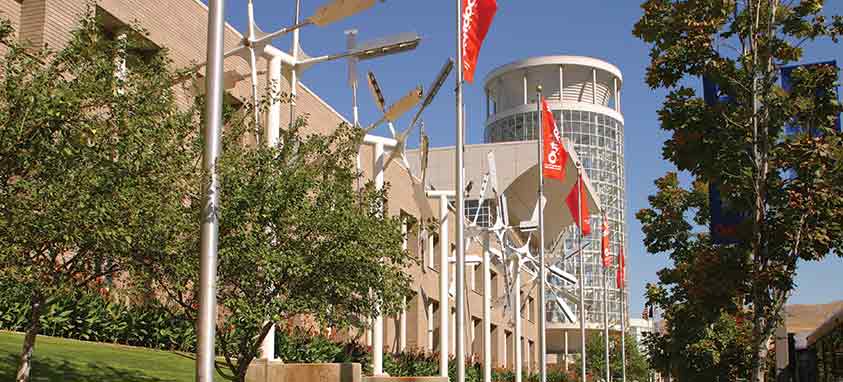
Salt Palace Convention Center

An estimated 5,500 nonprofit and association professionals are attending the ASAE convention at Salt Palace Convention Center in Salt Lake City.

ASAE is known for its parties, and Salt Lake City will keep the party going. The opening night event on Aug. 13 took place outdoors amid crisp mountain air in Liberty Square, a downtown plaza. The event is expected to feature the world’s largest social media wall, which will be projected on the side of The Leonardo, the city’s art, science and technology museum.

The closing bash on Aug. 15, at Grand America Hotel, will have a movie theme to highlight Utah’s Sundance Film Festival. The Bacon Brothers will perform, which is apropos since Kevin Bacon filmed his classic movie hit Footloose south of Salt Lake City.

Smart Meetings Chief Copy Editor Dan Johnson and Publisher Eric Haase are attending ASAE 2016. You can follow their live updates on Twitter at @SmartMtgsDan and @SmartMtgsEric.

Last Updated August 15, 2016 – 8:07 PM

modern-hotel-room-design

In an effort to remain profitable in the competitive hospitality industry, a growing number of hotels are eliminating guest room staples such as bibles and bed scarves, and cutting back on labor-intensive offerings such as artistically-folded towels and toilet tissue.

In a series of blog postings on hotelmanagement.net, editor Glenn Haussman details 15 items that hotels could eliminate—and save money in the process.

1. Bed scarves. This old-fashioned and basically useless design element is usually the first thing guests fling off the bed when they arrive. They do nothing to enhance the guest stay experience, cost hoteliers money to launder, and annoy housekeepers who repeatedly have to pick them up from the floor.

2. Decorative pillows. These are usually the second things to get the boot in a guest room. Guests who want pillows will use the ones on the bed. Decorative pillows, which can attract dust and mites, are superfluous, and they are not routinely washed after each guest visit.

3. Bibles. The bibles found in hotel rooms are Gideon bibles, named after a group of male missionaries and Christian businessmen who hand them out for free. Since 1908, more than 1.8 billion of them have been distributed in hotels around the world. Lately they have become controversial, as non-Christian guests view them as offensive. One solution is to stash an assortment of spiritual texts in the nightstand drawer; the other option is to remove them from guest rooms but have several copies available at the front desk for those who request it.

4. Daily maid service. Many hotel guests do not want to be bothered, especially if they are just staying for a night or two. The same goes for elaborate turndown service. Those who don’t want little chocolates left on their pillow view turndown service as an unnecessary intrusion rather than a valued amenity.

5. Fancy breakfast bars. Hotels that offer complimentary breakfast always seem to be tinkering with the formula. Experts advise keeping it simple. Instead of dozens of options that make set up/break down more complicated and contribute to unnecessary food waste, just provide the basics, focusing on freshness.

6. Business centers. These have gone the way of the dinosaur now that travelers have smartphones, tablets and laptop computers, and can work from their rooms or the hotel lobby. To accommodate those who occasionally need to print out a document, a hotel might want to install a Bluetooth-enabled printer at the front desk.

7. In-room marketing material. Hotels routinely place brochures about their loyalty program, local attractions or the nearby restaurant in guest rooms in hopes that people will read them. Unfortunately, most of the time the fliers just create clutter or end up in the recycling bin.

8. Glassware. While a water glass in the bathroom may seem more elegant than a disposable paper or plastic cup, many people question its cleanliness. Several years ago videos surfaced portraying housekeepers polishing glasses with the same cloths they used to wipe down sinks and toilets. As a result, trust in hotel glassware went down the toilet.

9. Heavily scented bathroom amenities. Hotels often invest time and money selecting bathroom amenities, not realizing that many guests have sensitivities that are aggravated by scents. If the hotel’s signature scent is strong, be sure to have unscented alternatives available.

10. Folded towels and toilet tissue. Although some guests do find them delightful, housekeepers can waste considerable time folding towels into heart shapes or adorable animals, and elaborately folding the first piece of toilet paper on the roll to look attractive.

11. Bathroom phones. These used to be considered the ultimate in luxury, but today everyone has a mobile device so they have become unnecessary. And who wants to use a phone that someone else may have used while perched on the potty anyway?

12. Fresh sheets daily. Many hotels concerned with water conservation have become proactive about asking guests if they really need their linens changed daily. Most eco-friendly guests are happy to oblige with less frequent linen changes, especially if they earn extra reward points for doing so.

13. Paper toilet sashes. Placing a paper sash around the toilet seat that reads, “Sanitized for your protection” is an unnecessary waste of paper. Guests expect the entire bathroom to be clean and sanitized; there is no need to draw attention to it.

14. Traditional desks and dressers. Furniture occupies a lot of space in a guest room and many travelers, especially millennials, eschew it. Instead of desks, they will use laptop trays or coffee tables. Instead of dressers, they prefer hanging their clothes on wall hooks or placing it on wire shelving.

15. Front desks. In many hotels the traditional front desk is disappearing; replaced by small kiosks or hospitality stands. This is part of a nationwide trend of more open and flexible lobby design created to make guests feel as though they are entering a home rather than a hotel.

when-to-book-flights

It’s only August, but already many groups and individuals are starting to think about year-end holiday travel. A common assumption is that the best way to save money on airline tickets for the holidays is to book early, but that generally isn’t the case, according to a global travel search engine.

Skyscanner announced on Tuesday its annual predictions for the best times to book flights for the major holidays, based on data compiled in 2015 from its 50 million users. It found that the top savings are available no more than four weeks prior to Thanksgiving, Christmas and New Year’s.

Thanksgiving: Skyscanner discovered that the week of Oct. 31 will offer the highest potential savings, 7.7 percent, for this holiday. October in general is the best time for savings, with the week of Oct. 17 offering savings of 5.10 percent. Even bookings during the Thanksgiving week could find 1.98 percent savings.

Christmas: The week of Nov. 21 (Thanksgiving week) is likely to be the best time for deals, with projected savings of 6.41 percent. The next-best week is Dec. 5, with savings of 4.93 percent. The week after Thanksgiving (Nov. 28) is also a peak time for booking, with savings estimated at 2.17 percent.

New Year’s: Travelers could save up a whopping 10.57 percent the week of Dec. 5. Even the two weeks before New Year’s are likely to generate healthy savings of 6.72 and 6.67 percent, respectively.

In a survey on Twitter, Skyscanner found that travelers have a tendency to book holiday travel either early or late in the year. Some 44 percent made plans six months to one year in advance, while 39 percent did so four to six weeks ahead. Only 17 percent make plans three to five months ahead.

rio-de-janeiro-olympics

A plethora of hotels have popped up in Rio de Janeiro for the Summer Olympics, with the expectation that the afterglow would boost occupancy rates in the city and other parts of Brazil.

Normally, this expectation would be reasonable, considering that most cities hosting the Summer and Winter Games experience not only an immediate economic boom, but also a long-term lift that often enables them to reach a new plateau.

Rio, however, is reeling from the effects of the outbreaks of the Zika virus, a prolonged recession and a political crisis, among other things. This leaves any immediate post-Olympics economic benefits in serious doubt.

Brazil had every reason to be optimistic about a healthy afterglow in 2009, when it was awarded the games, and this instigated a wave of hotel building. At the end of 2009, the country had 201,301 hotel guest rooms; by June 2016, the number had increased to 235,288, according to STR. Rio’s hotels increased by more than 50 percent during the past six years, states a report by real estate firm JLL.

About 100 additional hotels, with nearly 18,000 guest rooms, are under construction in Brazil.

The new hotels include the 170-room Trump Rio de Janeiro and the Courtyard/Residence Inn Rio de Janeiro Barra da Tijuca, Marriott International’s first dual-branded property in Brazil.

The country’s hotel occupancy rate slipped from 55.9 percent to 51.6 percent during the second quarter of 2016. The Olympics will provide a big jump in August, as many hotels are sold out. But given the country’s crises, the immediate future of the hotel industry doesn’t look very bright.

As a result, some hotel companies have scaled back or dropped their plans to build new properties. Four Seasons announced in 2011 that it would build two properties in Brazil, but has postponed one of the projects. It will be opening the other property, its first in Brazil, in Sao Paulo next year. Sao Paulo is generally considered a better location for the hotel than Rio, because its economy is stronger and more diversified, and it is driven by business travelers.

Eventually, Brazil is expected to rebound from its crises, and when it does, occupancies and room rates are expected to rise as steady streams of visitors once again are lured by the warm weather and many cultural attractions.

“Developers are looking at the medium and long term because Brazil has good fundamentals,” said Diego Bufquin, an assistant professor at Rosen College of Hospitality Management in Orlando, in an interview with The Wall Street Journal. “They are still investing quite a lot of money, but they will have to be a little patient.”

Philadelphia and Cleveland Republican and Democratic National Conventions

Between accommodations and entertainment, media, staffers and convention-goers contributed an estimated $360 million in direct spending during the Republican and Democratic National Conventions, according to a projection from U.S. Travel Association.

Spending was split equally between The Republican National Convention in Cleveland July 18-21 and the Democratic National Convention in Philadelphia July 25-28—both of which benefited from $180 million. Indirect spending pushed the total up to $600 million in economic output, with $300 million for each convention. This includes 1,800 jobs created in each region as a result.

“You’re going to hear a lot from the candidates about their plans to create jobs,” said U.S. Travel Association President and CEO Roger Dow. “It might give some people pause, but one of the easiest ways to do that is to hold more conventions. The economic activity associated with these kinds of events is extremely compelling, and we aim to make sure our policymakers understand that.”

Expenditures such as lodging, meals, transportation, general retail, spending by each host committee and funding for security were considered in the economic predictions. U.S. Travel Association generated convention impact figures using hotel data provided by travel research firm STR, as well as other travel and economic statistics.

During the conventions, the national travel organization shared the message that travel is strong economic driver with an advertising campaign targeted at convention attendees. Ads were placed a Cleveland Hopkins International Airport (CLE) and in Amtrack Acela trains in the Northeast Corridor.

“Conventions and in-person meetings are an absolutely vital creator of accessible, good-paying, un-exportable jobs in this country. An effective way to remind our policymakers of that is to make sure the message is front and center while they’re all in one place,” said Dow.

Combined Numbers for Both Conventions:

Total projected attendees: 100,000-120,000
Delegates: 10,000-12,000
Media members: 30,000-36,000
Other visitors and participants: 60,000-72,000
Average daily trip spending per attendee: $300
Hotel/other lodging room nights: 148,500
Total lodging revenues: $33 million

future-meeting-space-header

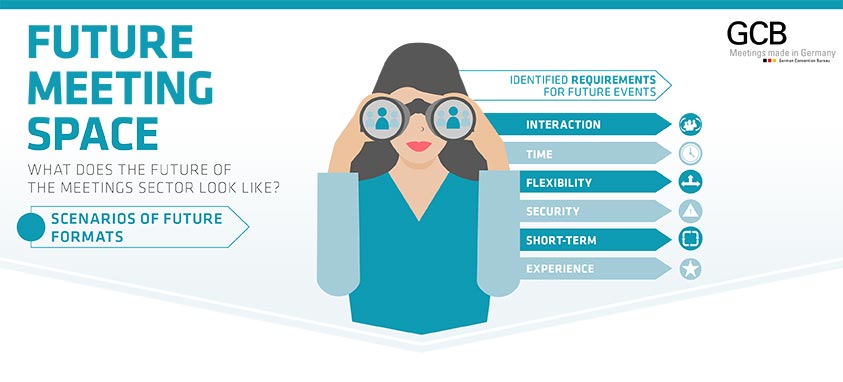
Will meetings of the future go “off the grid” or become even more closely linked with day-to-day work and technology? How will online groups meet face-to-face and how are hybrids shaping up?

As part of its Future Meeting Space research project, which is being completed in partnership with European Association of Event Centres and Fraunhofer Institute of Industrial Engineering, the German Convention Bureau will address these questions and others through a series of hypothetical conference scenarios.

Six great ideas for very different conference types are presented in infographic form below. Infographics courtesy of German Convention Bureau.

Interactive Forum

Meetings of up to 200 participants start with plenaries which provide a road map for discussion, then participants break into small groups to dive deeper, debate and build on these topics. World Cafés and gamification could work will with this setup. Reactions and ideas are aggregated and shared with the group to create connections, highlight common challenges and opportunities, and identify next steps.

Unplugged

Rather than staying tightly tethered to the office, the unplugged meeting deliberately picks a remote location where up to 50 participants can disconnect from daily work demands and outside distractions. Locations can be rural, or “off the grid” urban venues.  This setup does not encourage a lot of technology & device use during the meetings, but knowledge sharing is very concentrated.

Co-Working

Keeping in mind that it’s hard to step away from responsibilities back at the office, this format spreads meeting modules over a longer number of days and provides dedicated working spaces and time to attend to items at the office.  Attendees are more autonomous in this unconference-like format, yet they still remain focused on meeting goals. Extended stays mean more opportunities to network and share knowledge informally.

Virtual to Physical

In this approach, a group that has only worked together online comes together in person to meet and share knowledge. The purpose is to create deeper individual and group connections which will enrich future online interactions.

Multisite

A main meeting is held across several venues simultaneously, with about 50 people per venue. This enables face-to-face connections without forcing groups to endure long distance travel.   Live video transmissions connect the meeting locations and people with a common core agenda, but individual locations can then also break off and discuss local and regional needs and interests as well. Event-specific online platforms, holograms and robots could be used for knowledge sharing across locations.

Hybrid

This model requires a physical meeting and conference space as well as a digital meeting room for individuals or groups. Both sets of participants  have access to identical content, knowledge sharing and program flow in real time. Attendees are tuned in via laptops, desktops, mobile phones or tablets. Time and cost-savings are a focus here, as is unified content.  Group discussions and networking are still very much in the mix.

Whistler Blackcomb Ski Resort

Vail Resorts, one of the largest ski resort operators in the United States, announced that it plans to acquire Whistler Blackcomb Ski Resort in British Columbia for $1.1 billion by the end of the year. Under the transaction, which has been unanimously approved by both resorts’ board of directors and shareholders, Vail Resorts would own 100 percent of Whistler Blackcomb’s stock.

The British Columbia resort will nominate one board member to Vails Resorts’ board of directors, and Dave Brownlie will continue to lead Whistler Blackcomb as chief operation officer. He will also become a member of the senior leadership team of Vail Resorts’ mountain division. Vail Resorts, headquartered in Broomfield, Colorado, plans to retain the majority of Whistler Blackcomb employees, except for duplicate positions in corporate functions.

“With our combined experience and expertise, together we will build upon the guest experience at Whistler Blackcomb while preserving the unique brand and character of the resort as an iconic Canadian destination for guests around the world,” said Rob Katz, chairman and chief executive officer of Vail Resorts. “We are delighted to add such a renowned resort to Vail Resorts and look forward to expanding our relationships in the Sea-to-Sky community, British Columbia and Canada.”

Whistler Blackcomb is one of the most iconic mountain resorts in the world, and was the site of the 2010 Winter Olympic and Paralympic Games. Covering two adjacent peaks— Whistler Mountain and Blackcomb Mountain—connected via gondola, the ski area is one of the biggest in North America with 8,171 acres, 14 alpine bowls and three glaciers. It also offers one of the longest ski seasons in the region.

Vail Resorts plans to invest in the growth of Whistler Blackcomb, including the recently announced $345 million Renaissance project that will add new, year-round attractions and activities, winter and summer improvements and revitalize Blackcomb Mountain’s  upper and lower base areas. It will also add a six-star luxury boutique hotel, residence and club, plus 55-65 ski-in/ski-out townhomes. The developments are aimed at diversifying the local tourism economy and enhancing guest experiences.

The resort operates on the traditional lands of Squamish and Lil’wat First Nations, and intends to continue business discussions with the indigenous communities regarding the partnership, according to Brownlie. Because of broader challenges facing the ski industry, due in part to the unpredictability of year-to-year regional weather patterns, Brownlie believes the acquisition will strengthen Whistler Blackcomb. Vail Resorts will extend its Epic Pass program to the British Columbia resort for the 2017-18 season, which can be used at any ski resort within the brand.

“Combining Whistler Blackcomb with Vail Resorts’ portfolio of outstanding resorts provides Whistler Blackcomb with increased financial strength, marketing exposure, guest relationships and broadens the geographic diversity of our company with resorts across the United States, as well as in Australia and Canada,” said Brownlie. “This relationship will bring greater resources to support our current operations and our ambitious growth plans, including the Renaissance project, the most exciting and transformative investment in Whistler Blackcomb’s history.”

Vail Resorts operates nine world-class mountain resorts and two urban ski areas, including Vail, Beaver Creek, Breckenridge and Keystone in Colorado; Park City in Utah; Heavenly, Northstar and Kirkwood in the Lake Tahoe area of California and Nevada; Perisher in Australia; Willmont Mountain in Wisconsin; Afton Alps in Minnesota; and Mt. Brighton in Michigan. The company also owns a collection of hotels under the RockResorts brand and the Grand Teton Lodge Company in Jackson Hole, Wyoming.

international-meeting-trends

Are trendy, new digital tools or unpredictable economic conditions threatening meetings and events? A recent study conducted by International Live Events Association (ILEA) and Visit Scotland Business Events has identified a few possible culprits that may impact the future of international meetings.

Event Horizons is a report that highlights findings from the ILEA Global Event Summit 2016, which was hosted in Scotland in April. The summit was a collaboration between ILEA, Visit Scotland and IMEX Group, with support from technology providers Cvent and Events are Great Britain. It was hosted at multiple venues in Scotland, including Gleneagles and  Edinburgh International Conference Centre, and preceded IMEX in Frankfurt.

“Our delegates came together with open minds, ready to engage in discussions and activities, aiming to identify the challenges and opportunities faced by today’s industry,” says Jodi Collen, CSEP, president of the ILEA. “They left with their minds exhausted, yet filled with ideas and inspiration.”

International Meetings Threats

The report calls attention to 4 threats to the meetings sector, including:

• Networked digital communication devices
• Unskilled practitioners
• Fear of terrorism
• Unpredictable economic conditions

Besides providing space for creative discussions, Scotland officials were thrilled to show why it’s an ideal place to meet.

“It was great to be involved with such a unique event, and to have the chance to show this influential group why Scotland is the perfect stage for live events,” says Neil Brownlee, head of Business Events Visit Scotland. “The purple paper will act as a crucial outlet to help us meet our shared ambition of keeping the summit’s conversation going within the wider industry, helping to promote the true values and address the challenges currently surrounding live events.”


ILEA (formally the International Special Events Association) was founded in 1987 to foster enlightened performance through education while promoting ethical conduct. ILEA works to join event and meeting professionals to focus on the “event as a whole” rather than its individual parts. ILEA has more than 5,500 members in 52 chapters throughout the world.

jetblue-cuba-flights

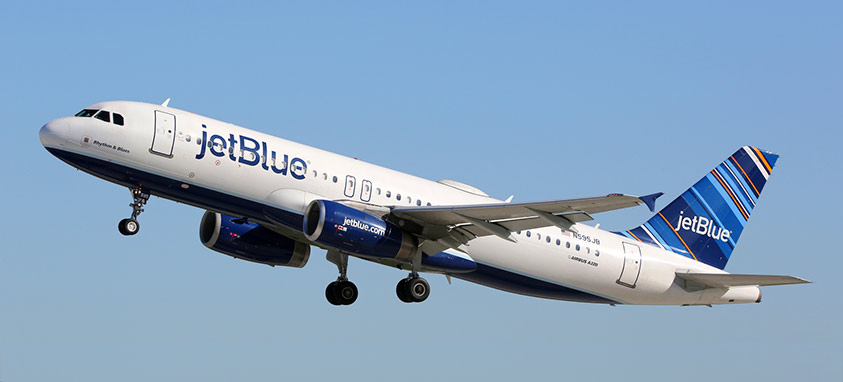
JetBlue is planning to offer regularly scheduled trips to Cuba beginning this month, thereby becoming the first U.S. airline to do so in more than 50 years.

The nonstop flights, which will begin on Aug. 31, will be between Fort Lauderdale, Florida, and Santa Clara, Cuba. JetBlue will offer three flights per week until Oct. 1, when daily service begins. One-way fares will start at $99.

JetBlue plans to start offering daily flights between Fort Lauderdale and two other cities—Camaguey and Holguin, on Nov. 3 and Nov. 10, respectively. Flights to Havana have not been announced, but the U.S. Department of Transportation (DOT) tentatively awarded the airline rights to fly there from Fort Lauderdale, New York City and Orlando.

The U.S. Treasury Department no longer requires special licenses to visit Cuba, but general tourism is still prohibited. Travelers must affirm their visit falls under one of 12 categories, such as educational, religious and humanitarian projects.

DOT has granted American Airlines, Frontier Airlines, JetBlue Airways, Silver Airways, Southwest Airlines and Sun Country Airlines permission to fly to Cuban cities other than Havana. The flights would originate in Miami, Fort Lauderdale, Chicago, Philadelphia and Minneapolis-St. Paul.

Eight carriers—Alaska Airlines, American Airlines, Delta Airlines, Frontier Airlines, JetBlue, Southwest Airlines, Spirit Airlines and United Airlines—subsequently were granted tentative permission to fly to Havana. The flights would be from Atlanta, Fort Lauderdale, Houston, Los Angeles, Miami, New York City, Orlando and Fort Lauderdale, as well as Newark, New Jersey, and Tampa, Florida.

Flights to Havana were awarded later because U.S. airlines requested more flights than were allowed on the routes. DOT is reviewing public objections to its granting the Havana flights, but typically, its tentative permissions for routes such as these become final.

Dallas Fort Worth International Airport

Dallas Fort Worth (DFW) International Airport has become the first airport in North America to achieve carbon neutral status, one of only 23 airports in the world to achieve the distinction. The Airport Carbon Accreditation (ACA) Program upgraded DFW Airport to Level 3+ Neutrality, which is the highest level of environmental achievement available to airports. It recognizes nearly two decades of sustainability efforts by the airport to reduce its own emissions and carbon footprint.

“This major achievement demonstrates DFW Airport’s commitment to serving our community and our world with a comprehensive, holistic approach to sustainability,” said Sean Donohue, CEO of DFW Airport. “Our team has made major strides in reducing DFW’s carbon footprint by how we manage precious resources such as energy and water, and how the airport manages vehicle fuels, emissions, waste, recycling and our land. I want to thank and congratulate our team for this outstanding accomplishment.”

Carbon neutrality occurs when net carbon dioxide emissions over an entire year is zero, meaning the airport absorbs or offsets the same amount of carbon dioxide as it produces. The achievement is recognized and accredited by Airport Carbon Accreditation, an international organization that monitors the efforts of airports to manage and reduce their carbon emissions.

Since 2010, DFW has achieved a 29 percent reduction in carbon emissions on a per passenger basis as well as an overall 38 percent reduction in energy costs, even while total passengers at the airport increased by 15 percent over the same period.

“While this recognition shows that DFW has made considerable progress towards a more sustainable community, we remain committed to future advancement on environmental issues,” Donohue said. “We have a lot of work left to do and a lot of knowledge to gain and share, so our vision for a more sustainable enterprise will require commitment, innovation, and collaboration for many years to come.”

DFW will be highlighted at the ACI-World Annual Conference/World Annual General Assembly in late September in Montreal as the first North American airport to achieve Level 3+ Neutrality. Donohue and Amsterdam Schiphol Airport CEO Jos Nijhuis will become the first signees of the International Sustainable Airport Declaration, which will take place October 31 at the Airports Going Green Annual Conference in Amsterdam.

The DFW Airport Sustainability Program includes:

-Renewable Energy: Electrical consumption from renewable resources includes the purchasing and retiring of enough renewable energy credits to cover total annual usage.

-Vehicle Emissions: The airport’s vehicle fleet has been almost completely converted to clean-burning compressed natural gas, cutting its carbon emissions by 25 percent while saving in fuel costs.

-Recycling: Over 180,000 tons of materials pulled from terminal renovations have been recycled or diverted from landfills.

-Water Usage: Installation of water-conserving plumbing features in restrooms cuts customer water usage across all five terminals by 50 percent, saving more than 5 million gallons of water each month. The airport has also partnered with neighboring cities to create a reclaimed water delivery system to conserve potable water in the region, reducing consumption by over 100 million gallons per year.

-Cooling Systems: Fine-tuning heating and cooling systems has significantly lowered energy consumption across the airport. In the summer, air-conditioning systems are taken offline during peak demand hours. Six million square feet of terminal space are instead cooled with cold water pumped from Energy Plaza thermal storage infrastructure.