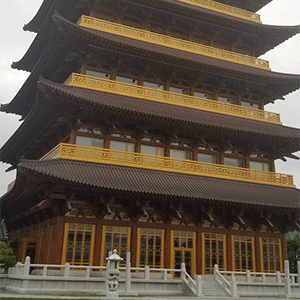
Cities are like people—they have their ups and downs. Many around the world have been struck with crises or have simply become overshadowed by more famous tourist magnets. But these same cities ultimately come bouncing back, offering fresh and enriching experiences and turning into exciting, trending destinations.

The New York Times recently compiled a list of 52 overlooked destinations. Whether you go for business or pleasure, here are our favorite on-the-rise metropolises.

Chandigarh, India

Chandigarh was a dream come true for renowned French architect Le Corbusier. He envisioned a city with a sleek, urban persona and designed innovation into many of the cities’ distinctive buildings. India’s first planned city slowly became a museum itself. Thirty minutes outside the city is The Oberoi Sukhvilas Resort and Spa—a serene wellness hub surrounded by forest, landscaped gardens and private pools. After a rejuvenating Turkish hammam scrub, meet in the resort’s ballroom and al fresco function area that holds up to 500 people.

Rotorua, New Zealand

The thick, bubbling mud pools and springing geysers in Rotorua awe and inspire. The Maori culture surrounding the town also brings to life indigenous traditions through storytelling, performances and cuisine. Many luxury resorts in the area, such as Moose Lodge Estate, offer these experiences onsite. The hotel can host corporate events across its six unique meeting spaces. It also offers a plethora of team-building events, such as rafting, helicopter excursions and private hot springs.

Kigali, Rwanda

Kigali is looking toward the future. The capital of Rwanda is modernizing—introducing sustainable initiatives, such as a plastic bag ban, and implementing the use of technology in daily life. The Kigali Marriott boasts 5-star accommodation and is centered around an animated downtown.  The venue offers more than 16,000 sq. ft. of meeting space, with 14 event rooms and 10 breakout rooms.

Prague, Czech Republic

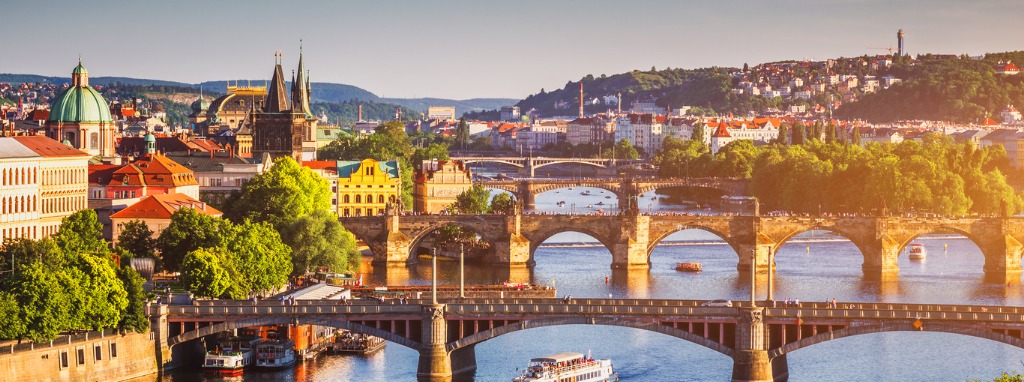
The Czech Republic is celebrating 100 years of independence in October, and its capital city, Prague, is sure to stun with exhibitions, concerts and events. The regality of the city is found in the many castles, theatres, cafes and bars. The Alchymist Grand Hotel and Spa has amenities fit for a king. The unique pops of red in the hotel’s three gothic-style meeting spaces add a refined elegance to your event.

Tasmania, Australia

The crystal blue waters and pure air of Tasmania recently gave life to a bustling food scene that showcases unprocessed produce and seafood. Australian chefs migrate to the island to take part in the gastronomical revolution in the state’s capital, Hobart. The Saffire Freycinet, located two hours outside the city, embraces the spirit of the food scene and offers tailored plates for every guest. The hotel’s boardroom is perfect for intimate meetings and provides access to a terrace overlooking the mountains.

Seville, Spain

This Spanish masterpiece of a city is becoming a cultural epicenter—home to flamenco dancers, Gothic architecture and delicacies. Lonely Planet voted Seville one of the best places to travel in 2018. The Hotel Alfonso XIII was commissioned by the Spanish king in 1929 and remains a cultural icon. The versatile meeting rooms accommodate up to 350 people and blends Neoclassical design with modern service.

Bogota, Colombia

Colombia is finally emerging from decades of strife. In its capital of Bogota, colonial-era buildings are being converted into metropolitan havens. The heart of the city offers plenty of museums, food and coffee designed to spice up life. The Four Seasons’ Casa Medina, built in 1946, is redolent of a bygone era. Event space totals more than 4,500 sq. ft. Unique group activities, such as a mixology class and Iron Chef Contest, are also a bonus.

Glasgow, Scotland

The Times reports that some 20 distilleries are opening in Glasgow. It’s a move that is promoting the resurgence of whiskey culture in the city. The new, $12.3 million Clydeside Distillery will be Glasgow’s first in more than a century. Malmaison exudes the funky spirit of the city. It offers three meeting spaces complete with creatively designed furniture, as well as a cocktail tasting, team-building activity.

Cincinnati, Ohio
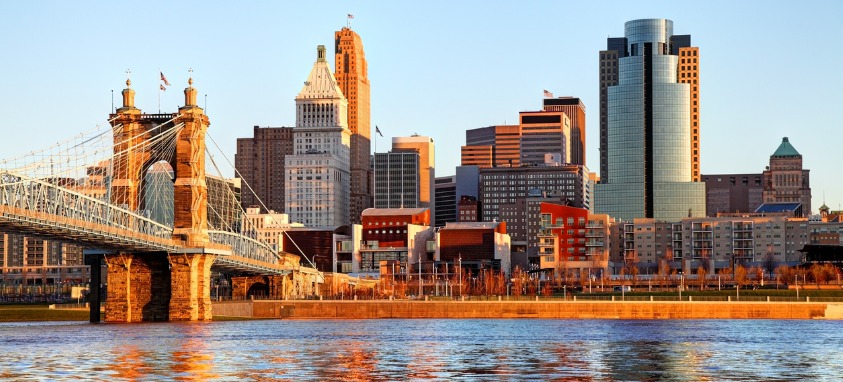
Cincinnati, OhioSometimes the best gems are hidden in our own Midwestern backyard. The Queen City is ushering in a new reign. Over-the-Rhine is a hot-spot neighborhood with vintage Italianate architecture that house microbreweries and culturally chic restaurants, such as The Eagle, a mouth-watering soul food hall. Three new theaters also just opened last year. Many hotels, such as the Hilton Cincinnati Netherland Plaza, are near the city center and offer easy access to museums, the zoo and National Underground Freedom Center, a museum dedicated to the quest of people to be free. The hotel’s flexible meeting space rings in at more than 40,000 sq. ft. 21c Museum and Hotel combines art, gastronomy, relaxation and business in one check-in.

There’s nothing quite as calming as relaxing on the beach after a long day of networking. The salty smell of sea air and sounds of lapping waves is a portal to instant paradise. If you’re looking for the best seaside town for an event, Coastal Living has released its top 10 happiest seaside towns in America. We have updated it with suggestions for coastal meeting.

10. Cannon Beach, Oregon

A small town overlooking the Pacific Ocean, Cannon Beach is ideal for those looking to retreat to a place where nobody knows your name. With fewer than 2,000 residents, the community is close and the location is cozy.

Visit the city’s Haystack Rock, a 235-foot landmark that hosts plenty of tidal creatures to explore when the tide is low. If you’re there spring to mid-summer, catch a view of Tufted Puffins sitting among the rock. And don’t forget to stop by the annual Sandcastle Contest in June to see massive, temporary works of art.

Tolovana Inn is right on the beach, giving you breathtaking views from your hotel room. The inn also offers 3,300 sq. ft. of flexible meeting space, hosting groups of up to 150.

9. Bellport, New York

Didn’t expect to see New York on this list? It may be well-known for the hustle and bustle of its streets, but there are spaces to relax, too. Located on the South Shore of Long Island, this town is the perfect place to go when looking to escape the city, yet stay close enough should anything arise.

Bellport, itself, is a quaint village, dotted with locally owned businesses for shopping—or just browsing. It is also home to the historic Gateway Playhouse, a summer theatre that opened in 1950. Ho-Hum Beach, located a few miles from Bellport Bay, is Coastal Living’s top pick for the area’s beaches.

SpringHill Suites Long Island Brookhaven is perfect for hosting smaller meetings. It offers more than 1,000 sq. ft. of meeting space, including East End ballroom, which can hold 120 people.

8. Hampton/Hampton Beach, New Hampshire

Hampton is home-base for some of the biggest tech and retail companies. But escape to nearby Hampton Beach, and you’ll find a charming little seaside town adjacent to 13 miles of silky sand and gentle waves.

Mosey your way over to the boardwalk for seafood to die for, a line of shops facing the ocean or a concert on its Sea Shell stage. Play arcade games, dance your heart out or listen to live music in Hampton Beach Casino Ballroom, which has been open for more than a century.

Overlooking the water, Ashworth By the Sea is a winner for groups and solo fliers. If you’re looking to host an event along the beach, the hotel has you covered, with more than 6,000 sq. ft. of space, including a grand ballroom.

7. Cambria, California

A secret hidden in San Luis Obispo County, Cambria is a seaside town to hide away in when you’re looking for a special glimpse of the California coast without all the summer tourists.

With bright blue water, tide pools full of starfish and a walkway along the bluffs, you’ll be in heaven. Many houses overlooking the water are available for rent—a splurge worth saving for. Drive 15 minutes north to see legendary Hearst Castle, which overlooks San Simeon, then end the day at Moonstone Beach, discovering colorful rocks and shells to take home.

Host your mid-sized event at Cambria Pines Lodge, a charming hotel with plenty of amenities. Their Peacock Room totals 1,680 sq. ft.; for an outside reception, the Gazebo Garden holds 250.

6. Anna Maria, Florida

Turquoise waters are perfect for fishing, kayaking, paddle boarding and more—and that’s what you’ll find in Anna Maria, a small town known for its white sand and glimmering water.

With the Gulf of Mexico on one side and the mouth of Tampa Bay on the other, this Floridian city is a dream, with boutique art galleries and shops lining its adorable main street and dolphins and manatees lining its shores.

If you’re looking to make last minute copies for your event, Waterline Marina Resort & Beach Club has a 24-hour business center outside of its 1,570 sq. ft. of event space. Catering is made simple with the resort’s on-site restaurant offering a tasty menu.

5. Bluffton, South Carolina

Bluffton is a small Lowcountry town for those looking for a calmer escape than nearby Hilton Head Island.

Visit Old Town, which sits on a bluff overlooking May River, and wander through its farmers market, art galleries and local shops. Take a tour of the Rose Hill Mansion, a plantation house built in the late 1850s. Dolphin and whale watching is an exciting pastime for residents and visitors alike.

Meeting room awaits you at Montage Palmetto Bluff, including its 1,800-square-foot Oak ballroom and 1,410-square-foot River Room. And should you wish to visit Hilton Head Island, it’s a mere few minutes away.

4. Vero Beach, Florida

Is it truly a surprise that Florida wins two spots in the top 10? With plenty of history, Vero Beach is one of the larger towns on the list in size and laidback appeal.

Catch a show at Riverside Theatre, where you can catch professional actors, comedy shows, dueling pianos and a lecturer series. The McKee Botanical Garden features flowers of all types and colors, perfect for wandering through on a calmer day. And don’t forget the historical Vero Beach Museum of Art, which features revolving exhibits and an art school.

Inside meeting space totals 1,500 sq. ft. at Kimpton Vero Beach Hotel & Spa. Include the seaside gazebo and pool deck, and there’s more than 3,000 sq. ft. waiting for you to create coastal experiences, including the 1,806-sqare-foot Shoreline Patio.

3. Cape Charles, Virginia

With lush greenery surrounding the city, a welcoming “Love” statue and plenty of sea activities, Cape Charles is out of the way, but welcoming to anybody who finds it.

Head to the Harbor and watch watermen bring in their catches of the day, then dine on fresh seafood. For guided kayak tours around the Eastern Shore National Wildlife Refuge or Chatham Vineyards, visit Southeast Expeditions or stop by the Cape Charles Museum & Welcome Center.

In the mood to host more than 200 in an intimate setting. Welcome to the private Sunset Bluff at Sunset Beach Hotel & Beach Club. For banquets, look no further than its Barrier Island Room, which can accommodate another 200.

2. Traverse City, Michigan

If you like paddling and sailing, Traverse City is the spot for you. While less of a beach town, it has that seaside vibe to it.

If you visit in July, you can catch the National Cherry Festival, with shops and vendors offering the berry for everyone to taste. Front Street is the place to be if you hope to explore the town and all it has to offer—breweries and distilleries, boutiques and art galleries and a slew of restaurants adorn this hub.

Featuring more than 10,000 sq. ft. of meeting space is Great Wolf Lodge. The White Pine ballroom offers 4,042 sq. ft. of space, while the Northwest Territory holds 250 within 2,016 sq. ft.

1. Ocean City, New Jersey

In first place is Ocean City, overlooking shell-decorated sand and waves for everybody to splash around in.

You won’t find any alcoholic beverages here, as the city prides itself on being a “dry town.” But that doesn’t indicate that the town is any less fun to visit. A three-mile boardwalk, built in 1902 to connect hoteliers and a view of the ocean, is a nexus for bike rentals, street performers and Ocean City’s first brewery.

For a luxurious stay, head to Port-O-Call Hotel. Its location is prime, offering gorgeous glimpses of the Atlantic. More than 2,000 sq. ft. of meeting space awaits you.

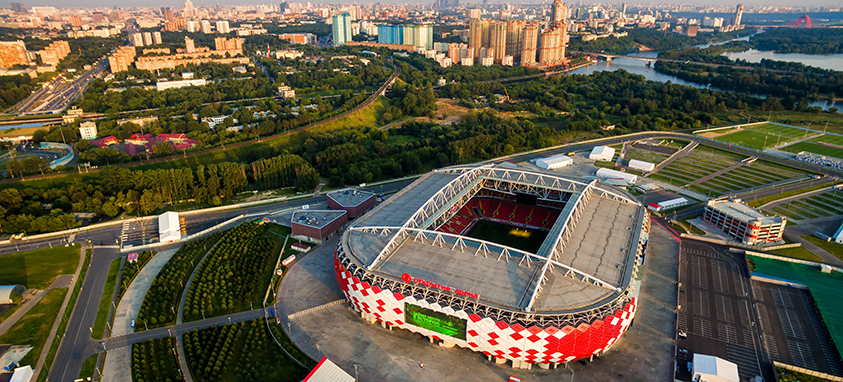
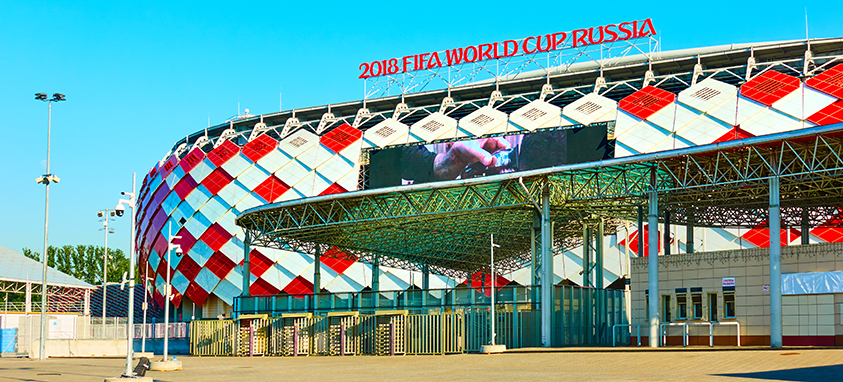
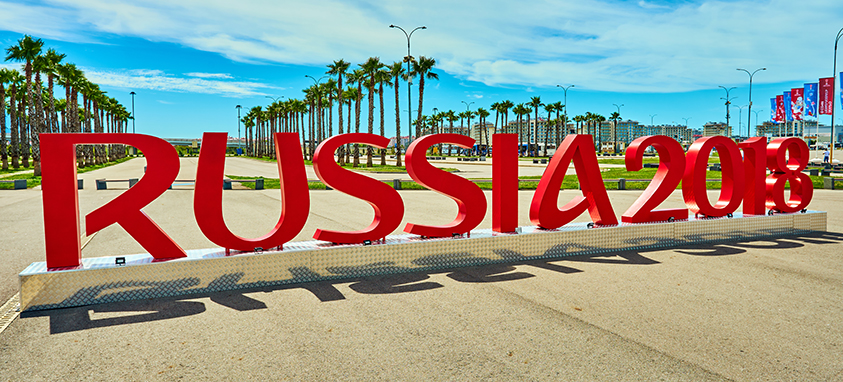
Safety concerns remain high in the days leading up to World Cup 2018, to be held in various Russian cities June 14 through July 15. Governments across the world continue to issue warnings and travel tips for their citizens. Currently the U.S. Department of State lists Russia under a level three travel advisory and encourage Americans to reconsider travel to the country.

International Friction

“U.S. citizens are often victims of harassment, mistreatment, and extortion by law-enforcement and other officials,” says the travel advisory for Russia. “U.S. consular assistance to detained individuals is often unreasonably delayed by Russian officials.”


The advisory also states that the government cannot help citizens as easily because of the reduction of U.S. diplomatic personnel by Russia.

The government advises that U.S. citizens stay up to date on seemingly obscure Russian laws to prevent fines and jail-time. For example, travelers can be detained or arrested for participating in demonstrations, paying for goods and services with U.S. dollars, leaving the country with antiques or not carrying their passport.

Travelers are subject to random I.D. checks in which they will have to provide a passport or driver’s license, migration card, Fan ID and proof of hotel registration. Russian officials do not have to present probable cause to stop travelers.

“We believe this is unlikely to impact visitors acting legitimately,” iJet International, a risk management provider, said about the strict local laws in a Travel Market Report article.

Rise of Hooliganism

In recent decades, Russia has seen a rise of avid and brash soccer fans called hooligans. Their violent nature is comparable to a gang-like culture. These groups are contributing to the fear leading up the World Cup.


Hooligans are composed of different gangs, each rooting for a specific team. Their goal is to fight whoever supports another team. They often fight each other in the deep forests of Russia, where they are unable to be policed. They train vigorously, and their brawls have led to serious, irreparable injuries.

In 2016, Russian hooligans battled off with English soccer fans in Marseille before and during the European Championship. It was an effort to prove that Russian hooligans were more dominant than English hooligans, who had a heavy presence in the 1980s. The incident left 35 people injured.

Now, hooligans have threatened on social media to disrupt the World Cup.

But various Russian officials say the threat will not come to fruition. Since the 2016 Marseille incident, Russian police have cracked down on hooligan groups, threatening jail time for those who make their activities known.

FIFA’s Head of Security, Helmut Spahn, said in an article published by German publication, DW, that there is no need to worry about hooliganism at the World Cup. He insisted that Russia is well prepared for the event.

“We’re analyzing the situation with our Russian colleagues on a daily basis, but of course people still have images of Marseille in their heads,” Spahn said. “We have very good prevention concepts, so I think the risk of hooliganism like in Marseille is low.”

Even if hooliganism isn’t prevalent at the World Cup, the U.S. Department of State also warns of potential terrorist attacks. The site cautions that tourist locations, transportation centers, malls and government facilities may be a target. Also, that public venues, such as stadiums, are subject to bomb threats.

Diversity Relations

The presence of anti-minority and anti-LGBTQ sentiments have been long-standing within Russian culture.

While homosexuality is not illegal in Russia, it is illegal to promote “non-traditional sexual relations” to minors. The crime is punishable by fines, jailtime or deportation.

A U.K. government report says that LGBTQ travelers’ safety is not ensured during the World Cup, as threats of violence have already been announced.

“LGBT individuals in Russia not only face the risk of violence from vigilante groups, but lack adequate protection from the state,” the report says.

The Canadian government warns that harassment and assault is prevalent among those of African and Asian descent.

Players of color have often suffered verbal abuse by Russians at soccer matches. However, Russia’s deputy minister for sport, Vitaly Mutko, said to ESPN, that combatting discrimination is a challenge and a responsibility. There will be a zero-tolerance policy in the upcoming games, he added.

“This is a problem that is not purely Russian,” Mutko said. “It exists everywhere in the world and, of course, FIFA is fighting this phenomenon. We will support FIFA and in our joint efforts we will try to conqueror this.”

FIFA’s efforts include a three-step policy that will allow the referee to stop, suspend or abandon a match if racist chanting or any discrimination occurs.

Christine Cashen
Smart Meeting Mid-Atlantic keynote Christine Cashen

Maybe the caterers are running late. Maybe you have 40 hours of work to do in a 24-day. Maybe it’s a software malfunction. In the meeting planner’s world, there’s always something. What’s important is staying on your game through it all.

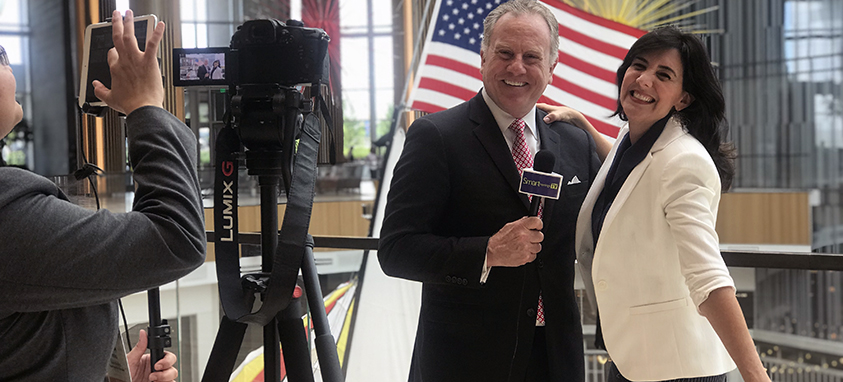
Amid the RFPs and cocktail parties on the D.C. waterfront, the elite meeting planners and suppliers at Smart Meeting Mid-Atlantic at MGM National Harbor gained essential tips on staying positive and staying strong in life and at work. For inspiration, Smart Meetings founder and CEO Marin Bright introduced keynote speakers Christine Cashen—author of The Good Stuff: Quips & Tips on Life, Love, Work and Happiness—and Holly Hoffman, a contestant on season 21 of Survivor. Here are some takeaways.

1. Go to Your Happy Steps

When the lively and entertaining Christine Cashen finds her young daughter in a bad mood, they play a little game called “happy steps.” Put simply, her daughter goes and sits on the stairs until she is happy. It’s not a timeout; it’s not a punishment. “It’s a way of being in charge of your own happiness,” Cashen says.
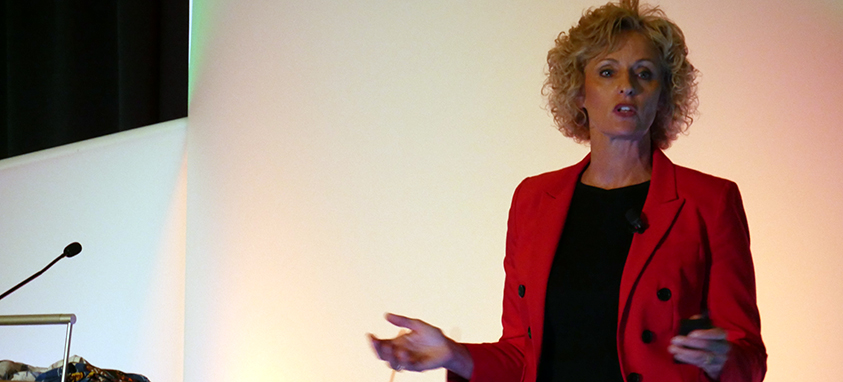
Try this at home: On a mission to stop global whining, Cashen encourages attendees not to waste energy complaining at the workplace. Next time you’re feeling overwhelmed or overstressed, go to your happy steps—mentally. You’ll find taking the time to change your mindset will leave you with more compassion, reason and the energy to find creative solutions.

2. Be a Wishing Well

Smart Meetings
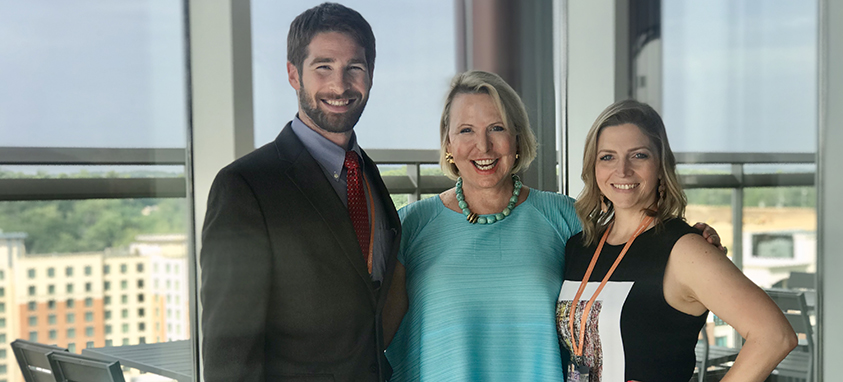
(From left to right): Smart Meetings Regional Sales Manager Max Connors, CEO Marin Bright and DOM Jennifer Harrington

Planners are tasked with making sure everything goes right, so often they find themselves looking only for those things that are wrong—wearing the “gotcha goggles,” Cashen calls it. She makes the case for putting on the “grateful goggles.” Have compassion. Wish people well. Don’t speak the negative thoughts. Does it feel a little forced at first? Maybe. Does it work? Yes.

Try this at home: If someone cuts you off on the way to an event, resist the urge to yell at the driver. Make up a reason why that person needed to cut you off: They didn’t see you because their baby was crying in the backseat…They are on the way to their first baseball game and got excited…Dust flew onto their windshield from the truck in front of them. It’s an easy exercise for practicing compassion. If you must yell, yell encouragement: “Hope you make it to wherever you’re going! Drive safe!”

3. Do What’s Right, Not Easy

Holly Hoffman
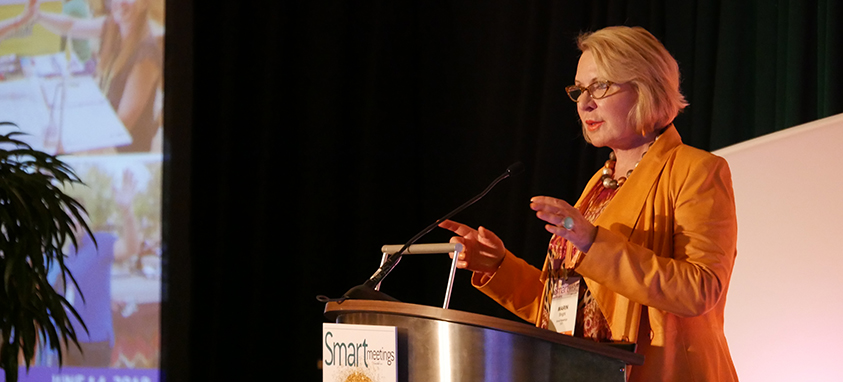
Smart Meeting Mid-Atlantic keynote Holly Hoffman

While there’s nothing easy about surviving 38 days in the jungle of Nicaragua, Holly Hoffman, author of Write Yourself a Note and Your Winner Within (and the last woman standing on CBS’s Survivor Nicaragua), learned a hard lesson while pushing her limits on national television. “You have to do what’s right,” as she put it. Even if you’re starving. During her experience on the reality show, Hoffman sacrificed a hot dog reward to hike back to camp carrying rice for her team members. She apologized on national television after throwing a fellow competitor’s crocodile shoes into the ocean. And she tried to quit—twice. In the face of major stress and leadership among a group of frantic strangers all looking to her for guidance, she learned to rely on her capabilities. Sound familiar?

Try this at home: There was a mix-up at your event, and you now have 15 unhappy attendees looking to you to make things right. It’s easy to want to give up when you’re taking the blame for situations out of your control and chaos is unfolding live in front of you. But take a moment to remember why you are there—and survive. Sticking through the hardships will only leave you more prepared.

4. Stuff Happens

Marin Bright
Smart Meetings CEO Marin Bright

It’s not the end of the world if something goes amiss. “Things happen. Stuff happens. It’s really wonderful to see people flourish even when tricky situations come up—planners do it all the time,” Bright said. What’s important is the great connections (and RFPs!) you’ve secured.

Smart Meeting Mid-Atlantic was held June 14 at MGM National Harbor in Maryland, outside of Washington, District of Columbia.

Smart Meetings will be in one of the world’s hottest, most dynamic meetings destinations—South Korea—from June 10 to 15. Managing Editor Dan Johnson will be in Seoul, Busan, Gyeongju and Incheon, visiting several of the country’s top hotels, cultural attractions, historical sites and restaurants, and participating in Korea MICE Expo on June 15 at COEX, Convention and Exhibition Center in Seoul. Follow our daily adventures in words and pictures on this page!


Day 6

After our usual breakfast buffet, we checked out of Orakai hotel in Incheon and boarded our bus to Seoul. Our first stop there was Coex, known to the meetings industry as Seoul’s main convention center, with four main exhibition halls and 64 meeting rooms. But it also contains Asia’s largest shopping mall, the city’s only airport terminal, three multinational-office skyscrapers and two theaters, among other things.

https://twitter.com/SmartMtgsDan/status/1007630253852889089

We then had a Korean lunch at SMT Seoul restaurant, where the CVB also gave a presentation about Seoul’s elite status as a meetings destination. Next, we visited Seoul Dragon City, South Korea’s first Hotelplex, consisting of four hotel brands from Accor Ambassador Korea. It contains convention facilities that accommodate some 4,900 people and the Sky Kingdom entertainment facility.

https://twitter.com/SmartMtgsDan/status/1007635345133981696

Our last site visit was to Some Sevit (Floating Islands), offering stylish meeting facilities, including a banquet hall that can accommodate up to 500. Some Sevit also provides spectacular views of the Nangang River.

https://twitter.com/SmartMtgsDan/status/1007635354470494209

Later, we checked into our rooms at Novotel Suites Ambassador Seoul Yongsan, and then went to our farewell dinner, hosted by Korea Tourism Organization’s MICE Bureau. It featured excellent Korean barbecue, made right at our tables, as well as Korean side dishes. It was a rousing affair, enjoyed by all, and a fitting conclusion to a truly unforgettable fam trip.

Day 5

Today, after enjoying the breakfast buffet at Orakai, where we are staying, we went to Songdo ConvensiA for Korea MICE Expo. We briefly roamed the floor—I surveyed all of the booths, picking up resource materials and briefly making connections.

https://twitter.com/SmartMtgsDan/status/1007231948962459648

Then, we attended the opening ceremony, which included a keynote address, “Hallyu: the Competitive Edge of Korean MICE,” by Ahn Siwook, managing director of SM Entertainment. His talk was consistent with the focus of the conference—finding ways to blend Hallyu (Korean pop culture, which is very hot) into the meetings industry by including it in visiting groups’ itineraries.

https://twitter.com/SmartMtgsDan/status/1007234355226243074

We then were free to roam the floor. I interviewed staff from Gyeongju (one of the cities we visited) and Temple Stay, a nationwide program that enables individuals and groups to customize experiences at South Korean Buddhist temples. I also connected with dozens of other people at booths that represented South Korean destinations and culture.

https://twitter.com/SmartMtgsDan/status/1007235892820373504

We had a traditional Korean lunch at Caisson24, and then went to G-Tower Observatory, offering panoramic views of the local area. We also visited Gyeongwonjae Ambassador Hotel—it features traditional aesthetics, providing a bit of a balance to the technologically saturated surrounding area.

https://twitter.com/SmartMtgsDan/status/1007242040998940672

In the early evening, we went to the Korea MICE Expo Networking Party. It lasted a couple hours, and featured food, drink, socializing and K-Pop entertainment.

https://twitter.com/SmartMtgsDan/status/1007266786461356033

Day 4

The group boarded our bus to visit Hwangnyongwon, shaped like a pagoda-style wooden temple, that was designed and built in collaboration with Buddhist monks. Its more than 40 guest rooms are intended for people who are participating in prayer and meditation practice there, but the attractive auditorium and garden can be rented to host events for up to 450 people—and there are nice hotels nearby.

https://twitter.com/SmartMtgsDan/status/1006790000506269696

The next stop was Seokguram Grotto, which includes Bulguksa Temple. Some of the finest Buddhist sculptures in the world can be found in this complex, which is a Korean National Treasure and a UNESCO World Cultural Heritage site. It was built from granite, in the eighth century.

https://twitter.com/SmartMtgsDan/status/1006793466318344193

We had an excellent traditional Korean lunch at San Chuk Hyang restaurant and then traveled to Cafe Dayeon, situated in Gyeongju’s Gyochon Hanok Village, where Kim Yang Hee led us through a Korean tea-making session. The group then had time to roam around the village, which is full of shops and family-friendly cultural activities.

https://twitter.com/SmartMtgsDan/status/1006798070787559424

Then, we left for the railway station to catch a high-speed train to Incheon. Gyeongju and Busan are in the southeast part of South Korea, while Incheon and Busan are in the northwest portion. So, the train ride cut diagonally across the country.

https://twitter.com/SmartMtgsDan/status/1006802997274382337

We are staying at Orakai Hotel. The 2018 Korea MICE Expo Welcome Reception Dinner featured traditional music and dance, along with remarks from South Korean officials. This MICE Expo is drawing meetings professionals from 41 countries; it’s the largest annual MICE event in South Korea.

https://twitter.com/SmartMtgsDan/status/1006892359823454211

Day 3

https://twitter.com/SmartMtgsDan/status/1006531329306087424

Today started off with a breakfast buffet at our leisure, at Paradise Hotel in Busan, where we were staying. The group then headed to the Hilton Hotel in Busan for a property tour. It’s a very nice, spacious hotel with attractive meeting space.

https://twitter.com/SmartMtgsDan/status/1006538094336671749

Our next stop was Haedong Yonggungsa Temple, an extraordinary attraction with a traditional Korean feel and stunning views. Built in 1376, it’s one of the few waterfront, as opposed to mountain, temples. We had a traditional Korean lunch at Vin d’el Olive and then traveled to Gamcheon Cultural Village—a fun, interesting place filled with shops and museums focusing on Korean culture.

https://twitter.com/SmartMtgsDan/status/1006540467029151744

We also visited Busan Cinema Center, a modern facility that hosts international film festivals and other events. It has rental spaces available for group gatherings.

https://twitter.com/SmartMtgsDan/status/1006542026567921664

Next, we boarded our bus—which has become like a second home to us—to travel about 80 minutes to Gyeongyu, a relatively small but historically and culturally significant city. We had an excellent traditional meal there. The group then went to Donggung Palace/Wolji Pond, a perfect place for a slow evening stroll.

Day 2

I enjoyed breakfast at Four Season Hotel Seoul’s Market Kitchen, which offers a buffet with international cuisines. It was then time to check out and move onward to our next destination aboard a bus.

K-Style Hub

K-Style Hub in Seoul is a great resource, with travel information about South Korea. It has displays, such as these traditional earthen jars.

I also got to play dress-up in traditional Korean kingly attire.

Korea House

The next stop was Korea House, a kind of cultural center offering traditional Korean cuisine, performances, immersive activities and more.

Korean Cuisine Cultural Center

Groups of up to 10 people can participate in Hansik Cooking Program at Korean Cuisine Culture Center in Seoul.

Day 1

After landing at about 5:40 p.m. local time at Incheon International Airport, I was transported to Four Seasons Hotel Seoul, where I was greeted by this floral display in the hotel’s lobby. I enjoyed dinner on my own and then went up to my room to sleep off my jet lag.

As event professionals, there are days, weeks and months when we are in the air more than we’re on the ground. This used to mean a constant disconnect from the world—36,000 ft. above the ground, you were unable to access texting, calls, emails and social media. This was beyond frustrating, and many demanded that something be done to solve this.

Thankfully, airlines listened. Now, in-flight internet access is available on almost every flight. And some airlines, including JetBlue and Emirates, have begun offering this service for free. For others, it can cost the big bucks to access the outside world. And it would be worth it—if the Wi-Fi wasn’t so slow.

How it Works

Gogo Inc. is the company behind most in-flight Wi-Fi you’ll find on your plane. Gogo uses air-to-ground (ATG) technology; basically, an antenna on the bottom of the plane passes over approximately 200 towers in North America, then transforms this signal into a Wi-Fi network. Shared among tens to hundreds of passengers, the three megabits-per-second received is simply not enough for fast internet. In comparison: most homes have a download speed of 20 to 160 megabits per second, shared among only a few people.

So, why doesn’t Gogo upgrade?

While they have been working to develop newer and faster technology, such as ATG4 and —which reaches approximately nine megabits on 500 planes—and high-speed satellite Wi-Fi, called Gogo FLEX 2Ku, Gogo isn’t necessarily in a rush to fix this problem. “They have paid for the installation and management and they get a significant percentage of the revenue,” says tech consultant Corbin Ball, CSP, CMP and DES. “There are contractual relationships with the airlines based on a specific set of time—often 10-year contracts.”

And passengers desperate for their connection to the ground—which extends to most businesspersons—will willingly pay a large sum for a shoddy connection that allows them to slowly download and respond to emails.

Row 44 and ViaSat

Some airlines offer other, lesser-known host companies. Southwest’s Row 44 offers one to five megabits, and JetBlue’s ViaSat reaches up to 12 megabits. However, these hosts have their downsides.

Southwest’s Row 44 uses geostationary satellites, which in turn sends a signal through the Ku frequency band (read: a frequency that allows for satellite communication and broadcasting, like that of a satellite televisions) to a more complex antenna on top of the plane. ViaSat differs slightly, as the satellites broadcast on a newer, larger frequency—thus enabling faster speeds. These satellite-based services require sending a signal tens of thousands of miles above, then receiving that same signal back in the form of Wi-Fi, which can cause a delay. Because of this, ATG “at times can be faster due to shorter transmission distances,” says Ball. However, “satellites are available globally, [and] generally faster than land-based systems.”

Though satellite-based services may seem like the way to go due to faster download speeds, it’s unlikely they’ll take over every aircraft, says Ball. Those Gogo contracts most airlines have signed and the cost of these antennas have caused a stall in development.

How to Speed Up Your Connection

That doesn’t mean passengers will be stuck with the spinning wheel forever. Ball says there hope for the future. “You may not likely see many price reductions in the near future,” he warns. But the cost could be worth it if the Wi-Fi is upgraded to a close-to-standard speed.

On top of these upcoming developments, there are steps you can take to speed up your internet connection. No, it won’t match what you can achieve at home, but it will keep you from wanting to throw your phone out the window. Ball recommends the following to speed up your connection:

1. Turn off photo back-up. Photos will take extra bandwidth to back-up, slowing down your connection with each photo.

2. Turn off auto-app updates. Certain apps will begin updating the second you connect to Wi-Fi. Disable this feature and update all apps before boarding.

3. Keep the tabs closed. Many are guilty of having multiple tabs open, especially when multi-tasking. Close tabs whenever you stop needing them.

4. Shut down apps that use the internet. This includes weather apps and location-tracking services.

Editor’s Note: Meredith Payette of Gogo Inc. responded after the article was originally published with updates about the service. “Most of our commercial U.S. airline customers are moving away from air-to-ground and upgrading to our high-speed satellite Wi-Fi, called Gogo FLEX 2Ku… This Wi-Fi allows people to choose the experience they want, browse or stream… Pricing also comes down as passengers can chose [if] they want to browse or stream, but ultimately it’s the airlines that select the pricing of their Wi-Fi.”

Social media campaigns have become crucial to event professionals. It’s the fastest way to spread the word about upcoming events, connect with potential attendees and boast about what makes you the best planner. But nothing truly beats good, old-fashioned email.

In Eventbrite’s Pulse Report 2018, 86 percent of planners reported utilizing email campaigns, and 41 said they were “moderately to extremely effective.” So, how do you run a successful email marketing campaign without bothering subscribers, being ignored or sending out irrelevant emails? We’ve put together a list of tips.

1. Focus on your ultimate goal.

Do you want to bring in more clients? Increase attendance at an upcoming event? Remind your audience that you have services they can use? Make sure to set a clear goal. Every email should direct to this initiative, and scrap anything that will move subscribers away from your goal or confuse them.

2. Hone your voice.

If your audience is casual, use an upbeat voice. If you’re going for a more sophisticated style, tone down the exclamation points. Most importantly, choose an approach that feels true to you and your business. If you have a sense of humor, an extremely serious email may feel contrived. Never choose a voice that’s too different than your authentic messaging outside of the campaign.

3. Choose a strong subject line.

The first thing a reader sees when they look at their inbox is a subject line, and they’re bound to look at a lot of subject lines when they open the mail app in the morning. Test different tones and keywords to draw people in, while accurately letting them know what they will find when they open. Use variations of the same subject line for continuity within your campaign.

4. Find an aesthetically-pleasing template for this specific campaign.

Templates can make creating an attractive visual presentation easy. Blocks of black text on a white background can feel boring, and readers will find something else that captures their eye. Whether you choose a neutral palette or pastel color scheme, stay consistent—similar to knowing your voice, know your style, too.

5. Don’t spam.

Some companies send emails every day, and some send them every few hours. Sure, you want to know when the promotion ends…but do you really need a reminder every day, seven days in a row, counting down the hours? To avoid annoying your audience, try limiting your emails to every other day, or even every few days, and filling them with information that remains relevant until your next email. And always include ways readers can control how much communication they receive and when.

6. Connect, connect, connect.

If you have social media links, make sure they’re embedded somewhere in your email—people are curious by nature, and if they’re interested in your campaign, they’ll try to learn more about it through other channels. If appropriate, consider adding an email-specific giveaway or promotion in connection to your campaign; your readers will want to stay up-to-date to reap the benefits.

Event professionals looking to reduce the impact on the Earth from their events have a partner in meetings hotels. Over the past year, a significant number of large properties have stepped up to reduce greenhouse gasses. The latest major announcement came this week: Caesars Entertainment has set science-based targets to reduce carbon emissions by a whopping 95 percent.

Caesars is one of 100 companies with an approved emissions reduction plan from Science Based Target initiative (SBTi), a partnership between World Resources Institute, World Wildlife Fund, CDP Worldwide and United Nations Global Compact. The initiative can drastically reduce greenhouse gas emissions from participating companies and their supply chains.

Targets adopted by companies to reduce greenhouse gas (GHG) emissions are considered “science-based” if they meet the level of decarbonization required to keep global temperature increase below 2 degrees Celsius, as compared to pre-industrial temperatures.

Caesars Entertainment committed to reducing emissions 30 percent by 2025, and 95 percent by 2050 (using 2011 as its base year). The company will also require 60 percent of its suppliers to institute science-based GHG reduction targets for their operations by 2023.

Caesars is the first gaming company to include vendors in its verified science-based targets. This indirect influence also makes it one of the most ambitious goals for a company, explained Mark Frissora, president and CEO of Caesars Entertainment. “With thousands of suppliers throughout the company, Caesars recognized the importance of engaging the full supply chain in order to create meaningful impact,” he said in a press release.

One of the first demonstrations of how Caesars will achieve its aggressive goals is a Request for Proposal that will be issued in June for a major utility-scale purchase of solar energy in the Las Vegas desert. The solar program will deliver power to the company’s Nevada properties as part of its CodeGreen environmental program.

So far, Caesars company has already:

  • Reduced total GHG emissions by 22.9 percent since 2011
  • Reduced water use by 21 percent per-square-foot since 2008
  • Diverted 41 percent of waste from landfills in 2017.

A Green Tide

A recent Green Lodging Trend Report found that sustainable practices are becoming the norm in the industry. Almost all hotels in the Americas reported that they practice recycling in common areas, and almost a quarter of them donate excess food to local nonprofits. Examples of hospitality companies making it easier for planners to do right by the planet include:

  • MGM Resorts partnered with Invenergy to build a solar farm to power 13 properties on the Las Vegas Strip, in addition to building the nation’s largest contiguous rooftop solar array at Mandalay Bay Convention Center.
  • Portola Hotel & Spa at Monterey Bay was the first Central California property to receive U.S. Green Building Council LEED certification through energy and water reduction, ozone laundering and solar generation.
  • Newly remodeled and expanded Moscone Center in San Francisco was designed to meet LEED Platinum certification, with a wastewater treatment system that will save more than 5 million gallons of water each year.

The smells, tastes and spirit of the Caribbean will heat up the food scene June 22–26 at the annual Taste of the Caribbean culinary competition and Caribbean Hospitality Industry Exchange Forum (CHIEF). The events allow chefs and mixologists to show off their skills and promote learning about the food, beverage and hospitality trades.

The Caribbean Hotel and Tourism Association (CHTA) has hosted Taste of the Caribbean for 25 years and CHIEF for four. This year, they will be held at the Hyatt Regency Miami.

Tasteful Connections

Attendees can network to establish new supplier/vendor relationships and sample and purchase each other’s products at Taste of the Caribbean.

“In addition to the exciting competitions, food and beverage managers and hospitality professionals will once again participate in innovative and exciting educational sessions that promise to enhance individual skills and increase the value of their businesses,” Frank Comito, CHTA’s CEO and director general, said in a press release.

The professional development sessions are interwoven between competitions and tastings. The aim is to learn the latest trends and techniques. Topics taught will include liquid spherification, menu planning and pricing, innovative meat cutting, Bordeaux pairing with Caribbean food and a bartender masterclass.

Conversation Reigns

Taste of the Caribbean runs concurrently with CHIEF. The forum will have general sessions, which will focus on diversity and inclusion, communication strategy and the current transformation of the accommodation industry. The breakout sessions will train attendees on everything from sustainability to virtual reality technology and digital marketing.

“CHIEF has established itself as the preeminent forum for the region’s hospitality professionals to share ideas and learn from each other, and we look forward to another weekend of stimulating presentations and discussions to help our industry,” Karolin Troubetzkoy, CHTA’s president, said in a press release.

This is a chance to prepare for the many challenges hospitality professionals will face in their career, Comito added.

Spicing It Up

Countries competing are Bahamas, Barbados, Belize, Bonaire, Cayman Islands, Curacao, Jamaica, St. Lucia, Suriname, Trinidad and Tobago and Turks and Caicos. A Caribbean Strong team, composed of chefs from countries affected by September’s hurricanes, will also compete.

The general public won’t be excluded from the vibrant festivities either. On June 23, the Treetop Ballroom in Jungle Island will let the flavor run wild at Caribbean305. Sixteen Caribbean destinations will serve up authentic creations for guests to enjoy.

Food, dance, music, rum, lively colors and dynamic entertainment will represent Caribbean culture.

An open-bar with award-winning concoctions from Caribbean Hall of Fame mixologists will further enliven the party. Local celebrities, city officials and big names in the food world will also join the celebration.