steps to planning a safer meeting

It used to be, planners could focus their efforts solely on the success of the meeting or event. Now, as a scan of headlines in recent months makes tragically clear, another priority demands your attention—making it safe. Severe weather, earthquakes, protest demonstrations and, yes, acts of terrorism or mass violence must concern every meeting planner now.

Here’s our checklist for meeting safety, with thanks to a pair of veteran event planners—Greg Jenkins, partner at Bravo Productions in Long Beach, California, and Brady K. Miller, CSEP, owner of Unbricked Communications in Topeka, Kansas.

1. Create a risk management assessment prior to the event, along with a protocol and policy for handling emergency situations. The protocol should be coordinated with the venue, which probably has its own policy for how emergencies should be handled. “On numerous occasions, we have been asked to contact security first, prior to dialing 911,” says Jenkins, who formed his award-winning agency in 1987. “If everyone at your event dials 911, it would create chaos and confuse local law enforcement and emergency agencies.”

Once the risk management assessment and emergency protocol is set, share it among all members of your team. If you contract to have a medic on site (advisable for larger events), be sure to share with that person, too.

2. Plan for the worst possible scenario. One event Jenkins managed was the victim of a bomb threat. “Law enforcement did an entire sweep, and security was beefed up,” he recalls.

3. Map all exit routes. Of course, provide this to your on-site staff, too. “It’s similar to getting on an airplane—you need to know how to exit in case of an emergency evacuation,” says Jenkins. “This applies to all venues, whether it’s an aquarium or high-rise hotel or a tent.” This is especially crucial in earthquake-prone zones, but can also be a literal life-saver in case of fire, electrical outage or other sudden emergency.

4. If your meeting topic or a guest speaker is controversial, plan for protest. Miller, who has been planning meetings and events for 14 years, offers detailed advice on this eventuality: “Establishing a location for demonstrations that assures safety for both demonstrators and event guests is important. While demonstrations or protests are, by nature, designed to be disruptive, they are nearly always nonviolent; people simply want to express their opinion.

Once it is clear a demonstration will be taking place, establishing and maintaining communication with the activity’s organizers is paramount. Provided demonstrators remain lawful–having necessary permits, remaining on public property and/or in designated areas–and they are not compromising the safety of any event attendees by threatening guests, blocking ingress or egress, then it is normally best to let them hold their demonstration.

If protest organizers are calmly provided with a clear set of parameters by which they will be allowed to conduct their demonstration, then they will usually referee their own group, though having a security presence is still normally necessary.”

Miller adds that very high-profile speakers and very controversial topics require more extreme precautions, including alternate entrances and exits, personal security and decoy vehicles to avoid confrontations. “In some situations, it is also necessary to have a higher level of security staged out of sight nearby in case they are needed.”

5. For weather preparedness, use common sense and pay attention to official warnings. Monitoring weather forecasts closely. In regions more likely to experience tornadoes, ask your venue about the nearest shelter.

6. Keep calm and carry on. As Jenkins puts it, “It’s the cool head and rational thinker that is needed to handle emergencies or any situation that might arise at a meeting or event.”


feedback without being boring

Let’s be honest about one thing: old school surveys are boring. Often event attendees won’t do them because they feel it is wasted time out of their day. So how do you measure your success without losing your audience’s focus? Here are some creative strategies you can use to make feedback fun again.

Make It Interactive

These days, almost everyone has a smartphone, which makes it easy to utilize technology to connect in a meaningful way. The possibilities are infinite—digital surveys, beacons or links that lead attendees to create online reviews. Technology puts you one step closer to a non-boring feedback session.

One example, have participants use a digital map to place where they’re from, a fun fact about themselves and a bit of feedback on the event.

Or, set up buttons around your event that participants can tap to express how they feel about each element of the program. Use a smiley face emoji, a sad face emoji and a neutral emoji, or red for no green for yes and yellow for in the middle.

Get #Social

Surveys say 83% of Americans have a social media account, so capitalize on this connection to make feedback fun!

Set up a photo booth with props that can be used to express attendee’s feelings about the event; you can utilize toothy smiles, lips and frowny faces. You can throw in hats or sunglasses for fun as well. Because everyone loves sharing via social media, you can ask participants to post their picture along with a hashtag you’ve created for your event.

At the TNW Europe tech festival, attendees seamlessly shared images with a built-in brand stripe on the bottom from the photo booth. The Walt Disney Company used the same tactic with attendees of the newest Captain America film opening.

As an alternative to a photo booth, create giant backdrops representing different emotions in a common space where people are most likely to mingle. Encourage guests to take a selfie with the backdrop that best describes how they felt about your event.

Create Conversation

The hardest part of feedback can be starting a conversation. Eliminate that blank page feeling by providing pointed conversation starters. Some examples include: I loved, I met, I learned, I disliked, I would change. Leave plenty of space for comments.

You can even have participants write down their statement on chalkboard and take pictures to post on social media to generate more conversations.

Be Eco Friendly

If you are using paper at your event, take the opportunity to use the recycling as a success barometer. Cover each bin with a happy or sad emoji and instruct individuals to place their paper in whichever they feel describes their experience. The U.S. only recycles 34 percent of the waste they create, so this option helps you do your part in reducing the carbon footprint of meetings.

Get Survey Smart

If you truly must have a traditional survey, make it mobile. If you make the answers instant, you can turn it into a contest by publicly posting the aggregated results as they are entered. This fosters audience participation and a sense of community. An event app, such as Slido can streamline the process. Twitter polls also provide a streamlined way to ask your audience about the event.

If even you receive negative feedback, thank your critics for their input and let them know you’ll make sure to consider their suggestions in the future.

careful anxiety

Today, event professionals need to be more aware of how they use language and how guests may receive that message. To help attendees feel more comfortable, experts suggest being open and transparent in all communication, while incorporating positive and clear language in your messages.

Per popularscience.com, anxiety disorders are the most common form of mental illness in the U.S. This problem affects 18 percent of the population, according to Anxiety and Depression Association of America (ADAA). Social anxiety alone affects about 6.8 percent of the population and is equally common among men and women. Even more people feel uncomfortable in unfamiliar public situations, such as cocktail parties and networking events.

You can help your guests, and your community, feel more at ease by simply changing the way you communicate.

Be Transparent

  • Practice honesty by being upfront about any issues that arise.
  • Communicate quickly. Whether on twitter, through e-mail or some other medium, delivering updates promptly reduces uncertainty and relieves anxiety.
  • Create a trusting bond. Transparency evokes feelings of being included.

Use Emojis

Remain Positive

  • In a world of unknowns, things are bound to go awry. Don’t let that be the gist of your message.
  • Add a constructive note to messaging whenever possible.

Who can resist the allure of a mystery? This is exactly what experiential event planning company Mystery Trip is founded on. Dave Green, chief mysterious officer/creator (how cool!), discussed the revolutionizing new way to take groups on an adventure.

Green says, “It makes me really happy to show people a good time. It’s not trust falls, it’s a silly time where people get to act like a kid again and get their minds off the office.”

The concept began as a summer party that Green threw friends annually. He would simply email a list of items to bring and the time they’d be leaving. The format worked so well, that each year the trips attracted more people and became increasingly elaborate. By the end of 2010, Green turned his mission of bringing delight into a professional service. And the formula has endured—taking people to undiscovered and underappreciated gems.

Understanding the success of Mystery Trip makes a few lessons clear. Namely, which activities truly engage groups. If you choose an out-of-the-box activity, the unpredictable can be embraced even if you opt out of surprising attendees. These types of activities are guaranteed to bring joy.

Sound of Learning

Music is always a unifying source. Instead of going somewhere to passively listen, groups can learn to create sounds themselves. Mystery Trip has engaged groups in everything from deejaying classes to unconventional karaoke sessions.

A post shared by Smart Meetings (@smartmeetings) on

At the Smart Meetings West National event in September, our attendees were offered the chance to enroll in a cardio drumming exercise. Even though this activity wasn’t about the sounds per say, it was an innovative way to enjoy the motions.

Attendee Action

A post shared by Mystery Trip (@mysterytrip) on

An important element of Mystery Trip is that it levels the corporate hierarchy so everyone can truly connect. When people are sharing an immersive experience, communication comes naturally.

One Mystery Trip activity that accomplished this mission was a flash mob lesson and subsequent performance. Instead of being confined to a table or sitting in rows passively watching a speaker, movement and expression established an open environment. Plus, everyone was in the same boat—dancing in public. Exposure which might be difficult to face alone was encountered with a group mentality.

Under-the-Radar Sports

A post shared by Mystery Trip (@mysterytrip) on

Quirky sports don’t have to be strenuous. Mystery Trip has taken one group to old school roller skating—which created a situation where pretty much everyone was at a beginner level. The group mutually endured the fear and thrill of something new. Additionally, watching an unconventional sport, such as sumo wrestling, can also provide the benefits of engaging in friendly competition and familiarizing with the exotic.

manage rising event costs

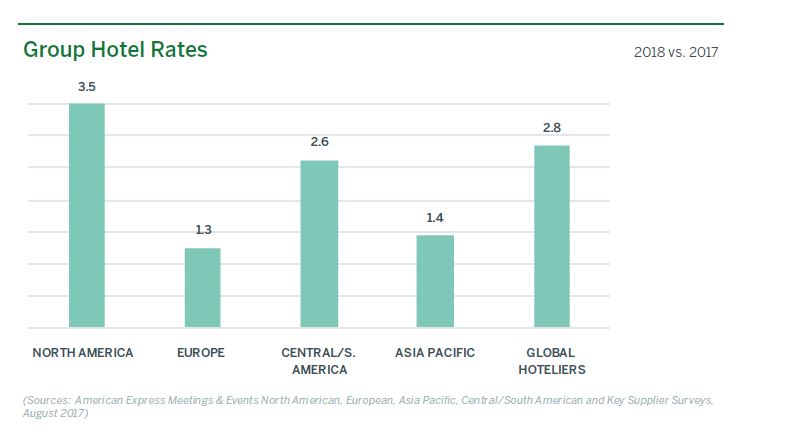
The niche between the proverbial rock and a hard place that event professionals often inhabit could be even cozier in the coming year, according to the results of a new American Express Meetings & Events study. The 2018 Global Meetings and Events Forecast surveyed 600 event professionals and found that at the same time group hotel rates are climbing, overall meeting costs could remain flat, and meeting owners are scrutinizing the details more than ever.

Group hotel rates in North America are predicted to move up at a rate of 3.5 percent, the highest expected increase in the world. The study labels this a sellers’ market and notes the impacts that accompanied the recent round of mergers and acquisitions in the hospitality industry. A majority (65 percent) of respondents in North America said that contract negotiations are more challenging now. On the other side of the equation, many noted that they are seeing more investment in hotel renovations, meetings technology and global preferred hotel programs.

At the same time, meetings have become more complex to produce than ever before as an emphasis is placed on creating “meaningful, quality attendee experience.” This can lead to everything from sourcing a nontraditional venue to trying out new tech features such as holograms or virtual reality. One meeting planner told surveyors, “While there is demand for increasingly complex meetings, budgets are not necessarily increasing. So we have to be smarter. Maybe this means smarter in terms of logistics, where we have one bigger meeting rather than several smaller meetings, or smarter in terms of quality, perhaps smaller meetings with enhanced content.”

Linda McNairy, vice president of global operations and shared services for American Express Meetings & Events, had some suggestions for softening the blow of these converging trends.

1. Think Short and Sweet

Some events are limiting the number of days, but try filling them with hyper-local experiences and sessions carefully designed to meet goals. This could mean fewer speakers with PowerPoint presentations and more team-building exercises that allow merged companies to interact in ways that mirror their future roles, or one less dinner and an additional working lunch that results in a list of goals to take back to the company.

2. Practice flexibility

Just because a meeting has always been done in that place in that way doesn’t mean that has to always be the case. McNairy suggests considering locating a meeting in a mid-size city to reduce costs or negotiating with a property on things such as resort fees or Internet charges. Demand for nontraditional spaces—warehouses, rooftops, a clearing in the woods—is expected to grow by almost 4 percent.

3. Plan Ahead

Locking in prices early and getting on hotel calendars before they are booked solid can help with pricing. Working with seasoned sales and marketing teams can also aid in finding creative ways to deliver value by changing approach or moving dates in a way that works for all parties.

4. Measure Everything

From doorstep-to-doorstep, measuring the quantitative and qualitative experience to understand the value to attendees and measure the return, allows planners to focus on the areas that are getting results and improve or do away with activities that are not embraced.

sustainable to ask dining catering

Sustainable. Farm to table. Local. Buzzwords, or baloney?

There’s no doubt groups today increasingly want to know where their food comes from—how it was raised, and where it was raised. And the trend toward fostering wellness as well as productivity in meetings continues.

So, experts say it is increasingly incumbent upon planners to parse the language used by chefs and catering staff at hotels and other meeting venues. If the healthiest choices—for your attendees, local communities and the planet at large—are the goal, then it’s important to add food sourcing to your due diligence when making venue selections.

Here is a brief rundown of major sourcing issues.

Eggs

Are they cage-free? Wyndham Worldwide Corp. is the latest hotelier to embrace a global cage-free policy for all of its hotels and resorts. All the company’s 8,100 hotels will source 100 percent cage-free eggs by 2025. The move will impact locations in 66 different countries on six continents.

In a statement, Wyndham explained that in the current egg production system, most egg-laying hens are held in wire cages and given space about the size of an iPad on which to live their entire lives. These cages prevent hens from exercising many of their natural behaviors, including fully stretching their wings and dust bathing.

While cage-free does not necessarily mean cruelty-free, notes The Humane Society, cage-free hens generally have significantly better lives than those confined in cages. Cage-free also does not imply that the eggs are organic, a significantly higher bar to achieve, because chickens must be fed pesticide-free, organic feed; cannot be dosed with antibiotics; and must be given access to the outdoors.

All Wyndham brands will take part in the cage-free initiative, including Super 8, Days Inn, Howard Johnson, TRYP by Wyndham, Ramada Worldwide, Ramada Encore, Microtel Inn & Suites by Wyndham, Hawthorn Suites by Wyndham, Wingate by Wyndham, Travelodge, Knights Inn, Baymont Inn & Suites, Wyndham Garden, Wyndham Hotels and Resorts, Wyndham Grand, Dazzler Hotels, Esplendor Boutique Hotels, The Trademark Hotel Collection, and Dolce Hotels and Resorts.

Other global companies that have announced plans to convert exclusively to cage-free eggs include InterContinental Hotels Group and Carnival Cruise Line.

Meat

Is it Animal-Welfare Approved? For farm animals (including chickens), this is the gold standard. The Animal Welfare Approved program audits, certifies and supports independent family farmers raising their animals according to the highest animal-welfare standards, outdoors on pasture or range.

Being grass-fed is another hallmark of agricultural and environmental stewardship. Grass-fed beef and lamb usually have higher concentrations of antioxidants, some vitamins, a kind of fat called conjugated linoleic acid (CLA) and the long-chain omega-3 fats mostly found in fish. It also has less fat overall. Omega-3 levels in grass-fed beef generally are about 50 percent higher than in regular beef. But here’s the catch: Was the animal also “grass finished?” For beef, in particular, standard practice has long been to raise on pasture, then move animals to constricted feedlots, where they are fed grains to fatten them up for market; in the process, the meat loses the benefits of being grass fed.

Again, the very highest standard is organic and 100 percent grass fed, which means no antibiotics.

Is the seafood sustainably caught? More than 90 percent of the world’s fisheries are either fished-out or overfished. In North America, many hotel restaurants and other restaurants have embraced the guidelines for fish to avoid serving from Seafood Watch, issued by Monterey Bay Aquarium. This year, James Beard Foundation announced the national launch of Smart Catch, a program created by chefs to increase the sustainability of the seafood supply chain. More than 60 chefs representing more than 100 restaurants have committed to the program, including James Beard Award nominees and winners such as Mario Batali.

Fairmont Hotels and Resorts, Hilton Hotels & Resorts and Hyatt Hotels Corp. are among the major hotel groups that say they procure sustainable seafood for their restaurants and catering. In Asia, Hilton, Hyatt and Starwood Hotels & Resorts (now part of Marriott International) have removed shark fin from their menus, despite the continuing popularity of shark fin soup in China, Singapore and elsewhere in the region.

Still, there’s another crucial factor in deciding which seafood can be responsibly served—how it was caught. Destructive harvesting methods such as bottom trawling destroy the ocean environment and needlessly harm bycatch—the unintentional capture of other marine species such as dolphins and sea turtles in fishing nets. Line-caught fish are a more responsible choice, except if caught by longline fishing, a commercial fishing technique that uses as many 4,000 baited hooks on one main line. It’s a complicated issue, but in general buying fish from local, small-scale, sustainable fishermen is best.

Call it boat-to-fork dining.

give gifts

Gifts are an exciting part of the holiday season, but for planners, it is a year-round activity, since swag has become an integral part of meetings. The vast array of choices planners face when deciding what to give attendees can be overwhelming, but one way to make the practice more meaningful is to hand out gifts from companies that emphasize socially responsible practices.

Sustainable

Global Gifting, a company that specializes in corporate giving—including incentive travel—makes a point of partnering with firms such as OluKai that practice social responsibility. OluKai, which makes sustainable, Hawaiian-inspired footwear, has been giving items to local communities since 2006, when it delivered its first pair of sandals. The company now supports a more formal giveback program through Ama OluKai Foundation, a nonprofit organization located in Hawaii.

Nike, also one of Global Giving’s partners, emphasizes sustainable performance innovation and several other like-minded processes. When creating footwear, Nike Flyknit products utilize technology that prevents millions of pounds of waste from ever reaching landfills. Nike Grind materials, which consist of regenerated products, are used in 71 percent of Nike footwear and apparel products, including yarns, trims, jerseys and shoes.

OluKai and Nike products were among those available from Global Gifting at IMEX America in Las Vegas Oct. 10–12. The Global Gifting team hosted nearly 300 client appointments, as well as walk-up visits.

Global Gifting works with planners and other clients to help them choose gifts for their guests. Items include electronics, sunglasses, jewelry, handbags and luggage, food and wine accessories, lifestyle apparel, footwear and sandals, bicycles, fragrances, cosmetics and spa experiences.

Personalized

Research has found that customized gifts—and particularly experiences in which attendees are able to personally select them—are becoming more popular. Also, nearly 70 percent of events incorporate some sort of brand experience, according to the Incentive Research Foundation (IRF).

Merchandise and gift-card incentive programs continue to expand in the United States, according to the IRF’s 2017 Trends Study. Some 60 percent of all businesses give merchandise as rewards, and 70 percent give gift cards, the study found.

Some other key findings were:

  • S. businesses annually spend almost $23 billion on name-brand and logoed merchandise for reward programs in 2016, and more than $24 billion on gift cards.
  • 35 percent of respondents said their budgets would increase in 2017.
  • 41 percent anticipated an increase in the number of participants earning a reward in 2017.
  • 75 percent said that they expected they expected electronics to be included in incentive programs.
  • 38 percent said that they would include office accessories in their incentive offerings, and 22 percent said they would include flowers.

2018 resolutions

We’re in December folks—time to get out the ole’ pen and paper (or iPhone, iPad or MacBook) and jot down your resolutions for 2018. Sure, the process can be a little tricky. You don’t want to over- or underestimate your capabilities. Plus, for many, reflecting on the last year can be emotional. Never fear—we’re going make sure this is your best list yet. Here are some essential pointers for creating and following a list of New Year’s resolutions, tailor-made to suit the mind of the planner.

Making the List

Dip into the new and unfamiliar. Continuous learning is part of the job for meeting and event planners. Not only are planners expected to complete continuing education credits and certifications, but they must also keep up with the industry’s latest trends and newest technologies. A pledge to take a class, enroll in a training program or just learn one new thing a day can be an easy first step that leads to new experiences in 2018.

Let go. It can be hard to relinquish control, but at some point you need to let your awesome team fly. Delegate some of your many planning tasks, while leaving the most crucial decision-making responsibilities on your plate. Harvard Business Review suggests test running a less urgent project or two so you can gain the confidence to step back from other tasks to focus on the big picture.

Focus on networking. Say yes to networking events! You can make valuable connections by joining your local chapter of PCMA, attending the nearest trade shows and taking advantage of hosted buyer events such as Smart Meetings’ conferences. You never know who you will meet, what you’ll learn and the opportunities that may arise.

Strive for a balance. Don’t forget about making yourself happy and healthy. It’s easier said than done, but everything falls into place when you take care of yourself. If your relationships, hobbies, fitness or sleep are lacking the time they need, make a point to fix this.

Planning for Success

Be realistic. Being honest and realistic about your goals will definitely promote future success. It may take patience, but working slowly and steadily will increase the likelihood of sticking with your goals.

Make it measurable. This is the best way to stay focused on a goal, maintain motivation and accurately reflect on whether the activity was successful. What is measured gets prioritized.

Set multiple goals. Design your plan with the knowledge that progress involves many small victories and that it isn’t linear. Small accomplishments also deserve to be celebrated along the way. Each time you succeed, the satisfaction will keep you moving forward.

Involve others. By simply sharing your plans to make a change, you’re one step closer to making it. If it’s fitting to the goal, make it a joint effort. For instance, having a partner to enroll in a new course with is a great way to keep you on track.

Pencil in goals. Don’t just make a plan—actually schedule it, put it in your calendar. This way you eliminate the biggest all-too-easy excuse of “having no time.” Be sure not to override it with anything that comes up. These are priorities; treat them as such!

The New Year is just around the corner. And keeping up with the latest trends should definitely be on your resolution list. In an ever-changing industry, corporate planners are expected to always be at the cutting edge—whether its tech, design, F&B or marketing.  Here are some terms to learn before the ball drops.

1. Crowd-shaping

Crowdshaping is the ability to collect real-time data about attendees, and then adjust an event accordingly. For instance, say the crowd isn’t feeling the music. Crowdshaping would relay this information to your smartphone, on which you could change the music. Data is consolidated through social media accounts collected via check-in apps. Other elements such as temperature, volume, lighting, special accommodations and safety precautions could all be optimized.

2. Micro-moments

We have this experience daily. You’re having a conversation or working on a project and another topic comes to mind, often an arbitrary question like what year did Die Hard come out. Our handy-dandy smartphone is accessed for an answer. This situation is a “micro-moment”.

What does this mean for planners? Practically every brand is striving to be an information resource—it’s a main route to success in the digital age. Therefore, those with the most reliable, straight-forward and current information will surpass the others for the most traffic.

The phenomenon is already present. Google found that one in four people now use a smartphone only for search during the day as they seek to meet an immediate need. So if your website isn’t 100 percent mobile- and user-friendly, you’re overdue for a redesign. Plus, the transition from landing on your page to easily accessing services ought to be lightening-speed.

3. Failure as a Service (FaaS)

The past few years have presented a variety of as-a-Service markets. Content, software, infrastructure—the list is long. But how is failure useful? In the fast-paced world of technology failure is inevitable and abundant. Failure-as-a-Service (FaaS) will offer fast methods that rapidly yield a yay or nay (failure). It could revolutionize cloud service performance and allow companies to more intelligently strategize.

4. Social Listening

OK, so your social media accounts are flawless. You upload beautiful images, post daily, exceed your following goal and interact with your audience. That’s all good and well but 2018 is going to take it to the next level.

Precious data is out there waiting be uncovered. Social listening is a sophisticated version of social monitoring. With social listening, you surpass observing and actually analyze and apply the information in the context of a bigger picture.

Here’s an example. Let’s say you own a coffee shop and someone complains that their latte tastes sour one Friday. They’re refunded and you move on. The next week, you hear another complaint on Friday and so on for the next month. With social monitoring you notice a problem with Friday and buy new milk for that day. However, social listening would involve questioning other factors to get to the root. Perhaps it’s time for a colder fridge.

When practicing social listening, look for topics popular amongst your audience, timing trends and pain points, things which people are complaining about frequently. Notice the language, style and types of interactions occurring amongst your audience. All of this should be used to draw several conclusions and apply that information to better cater to your audience.

5. Smart Content

Writing stories targeting your general readership is pretty simple nowadays. Brands are making the move to Smart Content, which is content that’s been personalized for your specific audience. Using cookies, searches, location, interests and other information about a particular user, are personalized in call-to-actions. For instance, if you’re a returning visitor a site might say “welcome back” rather than just “welcome.”

It might seem invasive but it works, very well. In a HubSpot study of more than 93,000 calls to action over a 12-month period, they discovered that the ones which were targeted performed 42 percent better than the generic ones.

6. Service Automation

Human interaction is out, self-service is in. For event processes such as checking in, registering, submitting feedback and selecting a meal preference, attendees would rather click a few buttons than communicate.

Don’t let this get you down, planners, remember that this will also yield faster processes, giving you more time to manage other elements of the event. Not to mention, it’s a seamless way to collect data that can be used in the future. The transition is already widely-seen in the travel and hospitality industries, it only makes sense that events are going to get their hands on these tools.

Can You Negotiate Away Annoying Hotel Fees?

In this case, what happened in Vegas didn’t stay in Vegas. The resort fee—a daily charge tacked onto a hotel or resort room rate for services guests may or may not want—began there about eight years ago. Last year, the U.S. hotel market collected an estimated $2.7 billion for all manner of fees and surcharges, according to Bjorn Hanson of New York University Preston Robert Tisch Center for Hospitality and Tourism.

In other words, hotels and resorts saw what airlines were doing and started figuring out their own ways to increase revenue beyond the basic fare—or, in this case, the room rate.

Some hotels now charge for early check in and late check out. And for baggage storage. Or an “administrative fee” to restock the minibar. At one Las Vegas hotel guests are assessed a $25-a-day “personal use fee” if personal items such as bottled water are stored in the minibar fridge.

Hotels in major cities such as San Francisco call their daily fee an “urban fee.” In New York City, it’s often known as an “amenity fee” or “facilities fee.”

Sometimes the sting of the mandatory charge is softened by including credits at the hotel’s F&B outlets, as well as other specified services. At New York Hilton Midtown in Manhattan, for instance, the $25 added to bills daily as an “urban destination charge” includes a $15 beverage credit at the hotel bar and a $10 food credit at the grab-and-go. The hotel also says it pays for Internet access for up to three devices plus local and toll-free calls.

But the fact remains, these charges are automatically tacked on bills, whether guests avail themselves of the stated benefits or not.

Does this mean meeting planners, or their attendees, are stuck paying them? When it comes to the daily add-on (whatever it may be called), hopefully not.

“I have heard of planners negotiating out this fee,” says Lauren Wolfe, a lawyer who publishes the website killresortfees.com. Wolfe follows chatter on hotel fees on Twitter, and watched as the members of a national nonprofit group recently “went ballistic” over the daily fee charged when they booked at their convention hotel in Maryland. The room rate was renegotiated, she says. “It is embarrassing to professional planners to have something like happen. Even if a hotel has no resort or urban fees currently, I would put it in writing in the contract, so that there is no potential issue in the future.

“More importantly, these hidden fees cause nothing but frustration for convention and event attendees, so it would serve everyone’s best interest to see that they are part of the room rate and not a surprise to guests when they get to the hotel.”

Jeff Kear, co-founder of Planning Pod, an event management and facility management software platform used by event and meeting planners throughout North America, says, “Most meeting planners know to ask if such fees exist and, if they do, simply say ‘we are not paying that’ as part of their negotiations. Sometimes the hotel tries to slip these fees in at the last minute when guests show up, and this is where iron-clad contracts that disclose all fees and charges are necessary when negotiating room rates, minimum requirements and amenities for meetings. That way you are not contractually bound to pay such fees and can simply charge them back if they are assessed without your written approval.”

Kear also advises that planners bring along their financials from previous years’ events to show their hotel spend and P&L. “If a venue sees you have a track record of profitability with your event, they will be more inclined to work with you and drop ridiculous fees like the hotel urban fee, especially if there’s the chance they can win your business for future years,” he says.