As an event planner in 2018, one of your biggest hurdles to overcome when selecting the event agenda is ensuring complete audience engagement. Thanks to smartphones, this has become a monumental task. The reality is that the average user picks up their phone 85 times per day. Your attendees have unlimited, immediate access to information, an open line of communication, and a never-ceasing stream of social posts at their fingertips—24 hours a day, seven days a week. With this constant distraction, event professionals are putting more emphasis on creating experiences that engage attendees with or without their phone. But how do you know if people are really engaging? Here are some signs.

1. Experiences Get Attendees out of Their Seat

It’s easy for attendees’ attention to be deviated to something else, like their phones, when the speaker that should have their attention is 50 feet in front of them. It’s not so easy to be distracted when an experience requires active participation from every person in the room—the level of engagement this achieves simply cannot be achieved using traditional event activities. Not to mention, getting attendees out of their seats appeals to shortened attention spans, and active participation in the experience creates strong engagement.

2. Experiences Connect People

Shared experiences drive interaction between participants while naturally appealing to a wide range of skills, backgrounds and experience levels. Through face-to-face interactions with one another, attendees engage in the experience and with their peers. Going through an experience together builds relationships, delivers a common language to walk away with, and provides memories that last.

3. Experiences will be Remembered

Experiences that are undeniably engaging leave an impression on attendees that does not easily fade away. Not only do attendees leave the event having experienced the outcomes for themselves and feeling like they were truly a part of the experience, but with flawlessly executed theming, they will have had fun! The advantage of an experiential event is that it is unlike people’s day-to-day realities. When you present an opportunity to participate, interact and explore, your event will be remembered.

All this is not to say that smartphones do not play a role in a successful event. In fact, they are a major engagement tool for event planners to use before, during and after an event. By enlisting the help of one of the many event platforms, you can send communications prior to the event and share photos and agenda changes at the event. These platforms also act as an easy access and convenient repository for materials when the event concludes. But adding experiences during the event will quickly put smartphones on the sidelines, allowing you to capture the coveted attention of your attendees.


As Chief Operating Officer of Eagle’s Flight, Sue’s senior leadership experience and facilitation skills have established her as a trusted partner and organizational development expert. She has a proven track record of successfully leading culture transformation in Fortune 500 companies and is an authority on training and development. She has over 20 years of experience in the creation and delivery of programs and custom designed solutions for Eagle’s Flight.
Editor’s Note

This was one of our most popular articles of 2015, so we decided to revisit it to see what has changed in the security line in the intervening three years.

To the surprise of many travelers, mini alcohol bottles, monkey wrenches, roller blades and service monkeys are among the carry-on items that can be brought aboard U.S. airlines.

An infographic produced by Cheapflights shows 25 items that can be either carried on or packed in checked-in luggage. Many of the items must be carefully packed and require extra time getting through airport security, and it’s best to check the official Transportation Security Administration (TSA) guidelines for detailed regulations. Also, to avoid a big surprise once you land, be sure to check state regulations because in many cases, items that can be legally brought aboard are illegal in some states.

Note: By downloading the MyTSA App, you can search the database for updates on what is allowed using a feature called “Can I Bring?”

Here are some of the most surprising items allowed on planes:

Service animals: Airlines have different policies regarding these, and some even allow monkeys—including those service monkeys specially trained to help adults with spinal-cord injuries and other impairments—to board with you.

Note: Airline policies differ regarding service and emotional-support animals, but a rule of thumb is to bring their harness, tags and documentation—and call ahead to be sure.

Liquids: Passengers can carry on one quart-size bag filled with 3.4 ounce-sized containers of liquid.

Note: Parents traveling with toddlers can carry aboard infant formula, baby food and juice. Mothers with or without their infants can bring bottles that are larger than regular TSA standards. Empty water bottles are allowed and can be filled after going through security.

Sporting goods: Baseball bats, fishing poles, golf clubs and spear guns are among the sports equipment that can be checked, but can’t be carried aboard. Ice/roller skates and roller blades can be carried on, as can skateboards if they fit in an overhead compartment or under a seat. You can carry on baseball and soccer cleats, but not snow cleats.

Note: While oversize items such as surfboards can be checked, call your airline for prices and limitations.

Sharp objects: You can’t bring your hatchet on board with you, but it, along with axes, hammers, drills, box cutters, saws and razor blades, are allowed in checked luggage.

Note: Crochet hooks and disposable razors can be tucked into carry-on bags, but scissors must be 4-inches or less from the pivot point and sheathed or put in luggage.

Guns and ammunition: Firearms can’t be carried on, but can be checked if you have a carry permit—and unloaded and packed in a hard-sided container.

Note: Similarly, BB guns, compressed air/paintball guns and flare guns unloaded and packed in proper containers can be checked. Consult your airline about limitations and fees for ammunition. TSA advises packing toy guns in checked bags to avoid confusion and delays.   

Tools: Monkey wrenches, screwdrivers and pliers can be carried on, but must be securely wrapped.

Note: Tools longer than 7 inches are prohibited in carry-on baggage; these items must be packed in checked bags. You also might be surprised to learn you can bring waffle irons, coffee makers and vacuum robots in both checked bags and carry-ons. Mysteriously, Magic 8 Balls cannot be carried on.

Mini alcohol bottles: They’re allowed if in a quart-size bag that is taken through security, or they can be purchased afterward and carried on freely.

Note: Beverages with 70 percent or more alcohol content (140 proof) are banned. Cheers.

Items you can’t travel with include gel sole inserts for shoes, snow globes weighing more than 3.4 ounces, gel-type candles, strike-anywhere matches, spray paint and flares.

Note: New to the banned list in 2016 was the Samsung Galaxy Note 7, which has issues with battery defects that spark fires. Regardless of the rules, the final word about what is allowable rests with the TSA officer you are lucky, or unlucky, enough to encounter.


Like this content? Click here to get it Delivered FREE to your Inbox or your Mailbox

partnering

Want to gain added exposure at a trade show? Smart Meeting Northern California speaker Eileen McDargh says, “don’t settle for just a banner on the stage with your company’s name.” Consider sponsoring a professional speaker and get creative about partnering. Here are some of her must-do tips:

1. Make sure the speaker is versed in your product or service. If possible and appropriate, the speaker might be able to use your company as an example during the presentation. For example, in addressing the administrators of law firms, she spoke about the importance of strategic alliances so the right work is done by the right people. The sponsor, Pitney Bowes, handled printing and mail room services in a manner that was be both efficient and cost-effective for the firm. Pitney Bowes was a great example of a strategic alliance!

2. Use the speaker for both a keynote and a break-out. Many speakers offer a daily fee which means you can schedule them for more than one session. This strategy ensures that every attendee will have the opportunity to see the speaker in action.

3. Ask the speaker to write an article that can be reprinted with your company logo and given away free at the booth. The speaker can be in the booth, autographing the article. Print the article in your company newsletter or magazine for those who could not attend.

4. Ask the speaker to sign books in your booth and greet people. Give away the speaker’s book at your booth for the first 100 people. You’ll be amazed at how much traffic will instantly show up. A variation on this theme is to split the give-away into morning and afternoon, thus generating traffic at different times of the day

5. If possible, work with the speaker to use either her core message or the speech title as part of the background in the booth. This not only reinforces a learning point, but identifies your company to all attendees.

6. Print a postcard with your company information and the speaker’s key learning points. Mail it after the trade show to everyone who attended the conference. In fact, a classy gesture is to write a cover letter about your company and why you sponsored the speaker. Mail it in a hand-addressed envelope and enclose a wallet-size card with the speaker’s main points.

7. If it fits, consider sponsoring the same speaker within your organization. So often, rank-and-file employees do not get to attend conferences. The prevailing view that “sales and marketing have all the fun” can be countered if you bring what you learned back to the corporation. And continuing education is one of the top three retention factors.

To sponsor a speaker for a one-hour session leaves value and opportunity on the table. When you match the association’s needs with your business objectives and strategically avail yourself of whatever services a professional speaker can offer, everyone becomes a winner!


Eileen McDargh, CSP,CPAE is one of top-ranked women business speakers in the United States. She’s an award-winning author, radio commentator, and serves on the Board of Directors of the National Speakers Association.

Tucson is one of those cities with one foot headed toward the future and one happily planted into the past. But the “future” foot is really active these days. A lot of interesting things are happening there, particularly in the hospitality and meeting industries.

In September, Tucson was designated a World Festival & Event City by International Festivals & Events Association, one of nine cities around the world to receive that designation. Small wonder. Tucson supports nearly 50 annual festivals and major events, as well as many smaller ones throughout the year.

An exciting new development is happening downtown. City Park, a retail/restaurant/office complex, is scheduled to open mid-year. Plans call for the first floor to have a food hall with numerous restaurants, and adjoining restaurants in the buildings on either side. The second floor will be a fun, flexible venue with a bowling alley, pinball arcade, bar and private event space. The top level, the fifth floor, will include a 2,600-square-foot deck for outdoor entertainment and corporate events.

Mercado San Augustin is undergoing an expansion that will double the number of shops this year. This is Tucson’s colorful public market, and there are surprises around every turn. Expected to open are four new restaurants and bars, several eclectic clothing shops, a bike shop that will encourage urban cycling, and home-design and urban-living shops, along with an Many Mouths, One Stomach arts cooperative and Flam Chen Theater Company. Of special interest to planners, the Mercado will also have festival grounds with seating for 500.

We’ve saved the best for last: Some of these new shops and restaurants will be in old shipping containers.

Read more about Arizona in the story “Meeting Spaces in Unusual Spaces,” in the February issue of Smart Meetings.

Located just off the coast of South America, Aruba and Curacao count pristine turquoise waters, Dutch influence with American ease and year-round cooling trade winds among their many assets. The two islands, along with Bonaire, comprise the former Netherlands Antilles, and offer beach lovers, adrenaline junkies and everyone in between a slice of paradise—and some exciting hyper-local options.

Aruba Marriott Resort & Stellaris Casino, situated on Aruba’s white-sand Palm Beach, is the island’s largest property, with 411 guest rooms, featuring large, private balconies overlooking lush landscape and the gorgeous waters of the Caribbean. It also includes the largest casino in Aruba, a 6,500-square-foot spa, and nine restaurants and bars.

One popular new fitness activity offered to groups near the Marriott is stand-up paddleboard yoga in the waters off Palm Beach. The resort strives for mental well-being, as well, with a designated area referred to as the Happy Zone featuring hammocks swaying between palm trees. If happiness means flavor, then groups will flock to Paladar, a Cuban-inspired pop-up cookout experience. Set by the ocean, the vibe is beach-chic and the island tunes make for perfect mixing and mingling.

Aruba Marriott Resort & Stellaris Casino partners with De Palm Tours to cater to adventure seekers. Event planners can choose from off-road Land Rover tours through Arikok National Park or sunset sail and snorkel excursions that stop at the historic Antilla shipwreck. Whether by land or sea, an exciting time is guaranteed.

Curacao is Aruba’s larger neighbor, and pastel-hued Willemstad is its former Colonial capital. Curacao’s oldest hotel, Avila Beach Hotel was built in 1949 in the 18th-century governor’s home. Modern luxury wings have been added, and it combines stately Colonial architecture with a buzzy modern twist.

The boutique hotel, with 154 guest rooms, fits most small groups, and since it’s only 3 miles from the city, it offers easy access to some of the main sights and the airport. Avila’s Blues Bar and Restaurant is renowned for its live jazz, delicious food and fun locale—a raised gazebo-style structure over the sea. Groups can reserve the space, or large tables near the elevated stage.

Avila Beach Hotel is a member of Pack for a Purpose, an organization that encourages travelers to pack goods such as school supplies and toys in their suitcase to donate to nearby schools.

The Caribbean’s year-round warm temperature perfectly lends itself to dynamic group activities outside of the board room and traditional meeting space,” says Robbin Vogels, general manager of Avila. “Who doesn’t want to bond with their colleagues while sailing or trying stand-up paddleboard yoga for the first time? The island offers a diverse range of outdoor excursions, such as kayaking, diving, hiking, ATV trips and more. Groups will love the island’s rich heritage, eclectic cuisine and year-round concerts and events.”

Attendees can experience local culture during Chichi VIP Workshop with Bubbles, which provides an opportunity to learn special painting techniques, enjoy champagne and interact with members of the community. (In the Papiamento language, spoken on Curacao, chichi refers to a respected elder sister or female relative.) The Chichi doll is a must-create souvenir.

Read more about the Caribbean’s hyper-local options in the story “Taking a Deep Dive on the Islands” in the February issue of Smart Meetings magazine.

Managing an event may not require rocket science, but successfully engaging with attendees does require manipulating the properties of neuroscience, the study of the nervous system, particularly the brain. In the last 10-15 years we have learned more about our thinking brain than in all of human history combined. Many of these discoveries have a huge impact on best practices for holding meetings and conferences, and, in turn, how we think about what it means to be engaged in a meeting setting.

1. Impact on Happiness and Creativity

When we are engaged, our frontal cortex releases dopamine (a pleasure hormone) which allows us to be more creative and causes an elevated perception of the world around us. This release makes us happier and more free in our exchange of knowledge—leading to better learning retention and more efficient networking. It can also create more effective conflict resolution and better emotional regulation, meaning productivity skyrockets where competing perspectives may have thrived in the past.

2. Emotional Contagion

The most emotionally expressive person in any given room will transmit their mood to everyone else in just 2 minutes. This is the conclusion Daniel Goleman reached in his book Primal Leadership: Realizing the Power of Emotional Intelligence. This means the tone of a meeting or event can change dramatically based on one person’s mood.

Creating a safe, positive environment that fosters collaboration is of utmost importance in meeting design. One way to ensure this is through open collaboration with an unbiased moderator or facilitator; someone who can represent the group as a whole while at the same time allowing them a voice.

3. Fight or Flight vs. Social Engagement

Neuroscientists have discovered that our brains are constantly either in a state of fight or flight or social engagement (a behavior known as Polyvagal Theory). If we feel important, free and comfortable, we let our guards down enough to fully engage in a meeting setting.  Otherwise we tend to default to an acute stress response where we shut down emotionally and sometimes physically, unable to get important things done (let alone breathe or speak properly). Ice breakers, team building, and interactive entertainment can help break down barriers and create a fun, positive zone for learning and networking.

4. Storytelling

Storytelling stirs a wave of phenomena in the brain that creates more effective learning and communication. It triggers mirroring, which allows audiences to experience similar brain activity to the storyteller and each other and connect on a deep physiological level. It also creates neural coupling—a process in which the listeners relate the story to their own past experiences for greater connection.

This, in turn, allows the listeners to solve problems in new ways by looking at information in a way that draws on different areas of their existing knowledge. Speaker training can ensure your content experts provide information that weaves storytelling into the mix for greater learning retention and audience satisfaction.

5. Priming

Asking your attendees questions they might not necessarily have the answers to ahead of time can actually help them be ‘primed’ to learn better. Pre-testing or prompting with open-ended questions ahead of sharing new information gets the mind ready for better learning retention by providing the brain with an outline that we fill in with the details as we learn later.

Priming can also be useful in the event design phase. Before the event, incorporate quizzes, video sneak peeks into content, or simply poll your audience to see what they are most interested in learning. This is a great marketing tool and excuse to engage participants ahead of time to generate buzz and excitement.


As director of sales and marketing for Engagement Unlimited, Jenny Stanfield helps organizations and meetings be more engaging and maximize their potential. She continuously demonstrates her passion and advocacy for the meetings industry through her position as director of sponsorship for Professional Convention Management Association across Western Canada.  She is also a proud 20 in their Twenties award recipient.

The hard part is over—you’ve put together a rock-solid branded event, created awareness and people have registered to attend. But event marketers know that any conference is only as good as the conversation it starts. The key to making any event supremely effective and worth the investment is to keep people talking about it and your brand—even after the event that sparked their interest has long since passed.

Here are five ways to keep the conversation going after the event is over.

1. Provide Opportunities for Social Sharing.

An effective way to get people talking about your brand after they return home is to use the event itself to provide opportunities for posting to social media. Events are best when they feel fun and valuable to the attendees—and when that experience is clear to others who aren’t attending the event.

Stage experiences at your event that encourage attendees to post to social media. For example, you could set up a photo booth with fun props so your attendees are more likely to post about it.

A key component of social media marketing is leveraging your platforms and content to appeal to potential customers just outside your network. People don’t have to be following you to learn about your offerings. They may simply notice an interesting post from a friend and want to learn more.

2. Use Branded Hashtags.

Of course, if your attendees are posting about your event, you want to make it clear to their followers that your brand is associated with it. Hashtags are crucial for collecting posts from an event in one place. Display your branded hashtag clearly in several different places at your event.

If you know your target audience well, you can be creative with an unusual hashtag campaign. As Ethan Martin explained in Adweek, “Once equity and recognition are established with users, brands can roll out campaign hashtags with less overt branding, based on the target audience affinities and marketing initiatives. Brand engagement is built as brands speak directly to their target audience affinities and results in valuable content.”

3. Send a Post-Event Survey.

A survey sent out after your event is a great way to gather honest feedback from attendees and gauge whether they’d want to attend a similar event in the future. Platforms such as SurveyMonkey are very user-friendly—just create your survey and email it to your event attendee list! Ask them about things like food, venue, ambiance, presentations and speakers. Give customers the option to rank each item on a scale from 1-5, and allow them space to leave comments as well.

You can also use a survey as an opportunity to offer a discount code. This can both drive business and generate more interest in taking the survey in the first place.

4. Run a Post-Event Contest on Social.

Another great use for hashtags: after the event is over, host a social media contest for attendees, including a small prize. For example, you could invite guests to share photos from the event on Instagram or Facebook, and have them tag your brand and use the event or campaign hashtag to be considered. The photo with the most likes or shares wins.

Start drumming up excitement for the contest early—make it known to attendees while the event is still happening, and use your own social channels to promote it. A simple photo or caption contest is an excellent, cost-free way to get more people talking about and engaging with your brand on social media.

5. Extend Exclusive Offers to Event Attendees.

Finally, once your event is over, it’s a great opportunity to extend an exclusive offer to attendees. In fact, according to EMI & Mosaic, 74 percent of attendees feel more positively about a brand or product being promoted after attending an event.

If your product or service was being offered at a discount at the event, be sure to extend the offer for a day or so afterward—attendees may want to jump at the offer, or else miss out on a great deal. Additionally, you can extend an offer that is exclusive to event attendees. Perhaps a discounted rate if they pre-register for next year’s event, or maybe a free consultation for their business.

Staying connected with your customers online is crucial. That’s especially true when you’ve given them an opportunity to engage with your brand in person—you don’t want to squander it! Positive brand promotion, encouraging active social engagement and collecting feedback will do wonders for your ROI, even after your event is over.

You do it all. As the owner of your own third-party planner business you are the captain of the ship—and the crew. To help you navigate the sometimes rough waters of running your own business, we put together this handy resource guide with tips for everything from marketing and taxes to technology and negotiating. Feel free to bookmark this page as we will continue to update it with new tools for managing and growing your company. Until then, we wish you fair winds, following seas and full agendas.

Planner of the Year 2018

What’s an event without a planner? Most likely, a disaster.

We want to recognize those that go to extensive, sometimes tiring lengths, for their craft. Their meticulous work should not go unnoticed.

If you know a planning star that dazzles despite the mishaps that inevitably come with event planning, show your appreciation by nominating them for Smart Meetings’ first annual Planner of the Year award.

We’re looking for planners big and small who show incredible tenacity and zeal for the world of planning. Nominees should demonstrate consistent ingenuity, significant contributions within their means, and most importantly, a desire to do it over again.

Self-submissions are more than welcome.

Nominations are made by industry professionals and will be carefully considered and selected by the Smart Meetings Editorial team. Winners will be featured in Smart Meetings’ September print and digital issues. Submissions are due by July 16.

Nominate a planner, today!

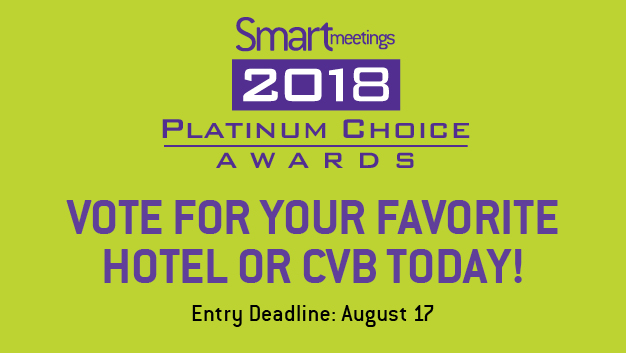
Start voting for the 15th annual Platinum Choice Awards at Smart Meetings and choose which hotels and CVBs stand out from the rest. Consider details including guest services, amenities, food and beverage options and technology, then nominate your favorites that offer the perfect event planner experience. List as many nominees as you want until August 17th.

Nominations are cast by industry professionals, and winners will be featured in the December issue of Smart Meetings’ print and digital magazine. When you vote, you will be automatically entered to win a $250 gift card, so cast your ballot now!

VOTE NOW