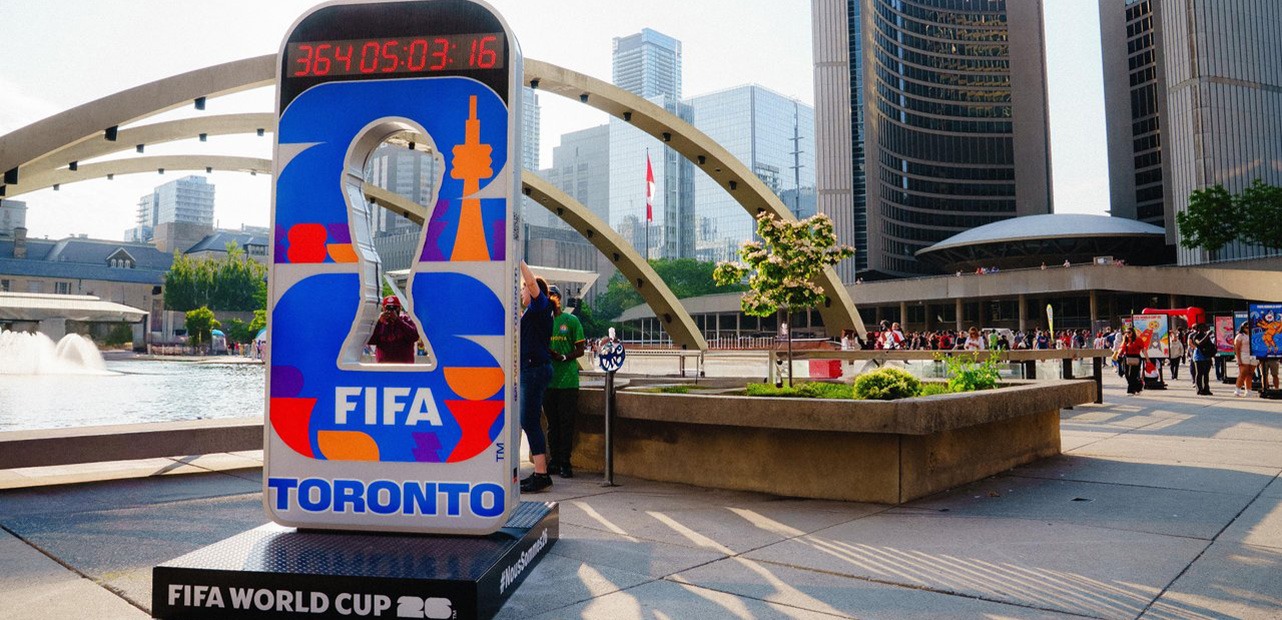
Of the 16 host cities that are set to host FIFA matches across North America, Canada will be home to two, in Vancouver at BC Place Vancouver (dubbed “BC Place” during FIFA) and in Toronto at BMO Field (Toronto Stadium). The latter will host Canada’s opening group stage game on June 12—and visitors can expect more excitement beyond the country’s inaugural match.
“There is a lot of excitement across Toronto as the city prepares to welcome FIFA World Cup 2026,” says Paula Port, chief marketing officer for Destination Toronto. “As one of the most diverse cities in the world, the global nature of the event resonates deeply here. There is a real sense of pride in welcoming the world, and strong engagement from local businesses, cultural organizations and residents who see this as an opportunity to showcase Toronto on an international stage. For the meetings industry, that kind of community energy matters because it helps create the sense of welcome and vibrancy that planners want delegates to experience when they come to the city.”
Infrastructure Improvements and Beyond

Toronto is using FIFA World Cup 2026 to strengthen its infrastructure and visitor experience in ways that’ll benefit the city beyond the matches. Toronto Stadium’s original 30,000 seats will be temporarily expanded to 45,000 seats, and will also feature a new pitch, dugout and player areas, and added hospitality spaces.
“Other upgrades include four LED boards at each corner of the stadium, an upgraded control room, an isolated sound booth, 32 new suites, 4,000 hospitality seats, upgraded arena audio and Wi-Fi, and an expanded food and beverage program,” Port says. “Centennial Park is also being developed as Toronto’s official training site with a FIFA-compliant pitch and fieldhouse, while the Soccer for All Legacy Program is adding mini-pitches in parks across the city. These investments strengthen Toronto’s broader event ecosystem and reinforce the city’s ability to host large-scale events with confidence.”
Read More: More Cities Hosting FIFA World Cup 2026
Beyond infrastructure, Toronto is connecting with its hospitality and tourism channels to develop training programs, service readiness initiatives and global visitor engagement strategies. Port says this is to “ensure a world-class welcome.” She continues, “At the same time, the city is planning a vibrant calendar of cultural programming, festivals, fan experiences and community events that reflect Toronto’s diversity and creativity.”
Safety and Security
Port says Toronto has partnered with the city’s transportation and public safety to develop a comprehensive, multi-agency approach to manage mobility, safety and visitor experience during the matches.
“The city is taking a transit-first approach, encouraging visitors to use public transit, walking and cycling, supported by service adjustments from the Toronto Transit Commission and Metrolinx,” she says. “Targeted measures will include enhanced pedestrian routes, increased access to bike share services, designated pick-up and drop-off areas, and temporary traffic and parking controls in key areas such as Exhibition Place, Liberty Village and Fort York.”
Event Safety PSA: Failing to Prepare Could Cost You
Port says a Unified Mobility Coordination Centre will monitor conditions in real time and support coordinated decision-making across partners that include the Toronto Police Service, Toronto Emergency Management and other agencies. “Together, these measures are designed to support a safe, well-managed environment for large volumes of visitors, while strengthening Toronto’s ability to plan and manage future major events through improved coordination, safety planning and overall visitor experience,” she says.
After FIFA
Toronto is one of the most international cities in the world, with more than 250 ethnicities who call the city home and more than 180 languages spoken.
“With 53% of Torontonians born beyond Toronto, it is truly a world in a city,” Port says. “Visitors can experience iconic attractions like the CN Tower, explore vibrant neighborhoods such as Kensington Market and the Distillery District, and discover communities that reflect the global spirit of the tournament—all while enjoying one of the most diverse food scenes in the world.”
For meeting professionals and groups who will be making their first visit to Toronto, Port says she wants their takeaway to be that Toronto is a global destination with a distinctly Canadian perspective: open, diverse, creative and deeply connected to the world. “That energy shows up in our neighborhoods, our culture, our food, our business community and the way people feel welcomed here,” she says. “For meeting professionals, it means a destination that can deliver world-class events with a sense of place that is unmistakably Toronto. And for FIFA fans in 2026, it means every game here will feel like a home game.”