
Highlighting the most attended Sports ETA Symposium yet
Sports Events and Tourism Association (Sports ETA) Symposium at Caesars Forum in Las Vegas just held its highest-attended event in its history, with nearly 1,200 attendees made up of sports associations, sports event planners and event rights holders.
“Our total attendance is up 10%, our total number of organizations is up 7% and events rights holders are up 25%,” John David, president and CEO of Sports ETA, remarked enthusiastically during the opening general session.
The event hosted a record 25,466 appointments, which was impressive but also posed a brief problem. David said the Tuesday before the event, his team said they broke Cvent. “I’m like, ‘What do you mean you broke the app?’ They said, ‘We broke the app, it can’t handle more than 25,000 appointments.’ Luckily, Cvent fixed that and we’re in good shape now but that’s the kind of magnitude of what’s happening at the conference.”
State of the Industry 2026
Sports ETA unveiled the results from its 2026 State of the Industry Report. For the first time, association combined the impact of participatory sports such as youth, amateur and collegiate championships that move host cities and spectator sports such as professional and minor league sports, as well as collegiate season games that don’t move host cities. While spectator sports are the industry’s main driver, spectator sports drive travel as well but at a level difficult to quantify.
Read More: Bowling Together: Four Months of Ten Pin in Reno-Tahoe
The report, at 122 pages, is the most comprehensive yet. “Over the last 365, days to create a report that’s unlike anything we’ve created,” David said. “When we started back in 2015 of measuring sports tourism, we started with what we knew. We started with participatory sports tourism and measuring, tweaking and adjusting, but we continued to miss a major and vital part of that report. Well, in 2026 we certainly fixed that.”
David started the presentation with a question: What is a sports traveler?
“It’s simple,” he said. “Somebody who stayed overnight or someone who traveled more than 50 miles to attend an event. How do we measure that and how do we equate and quantify what we’re doing?”
Direct business sales are the foundation, he said, followed by indirect business sales and induced sales. How did the sports tourism industry fair in 2025?
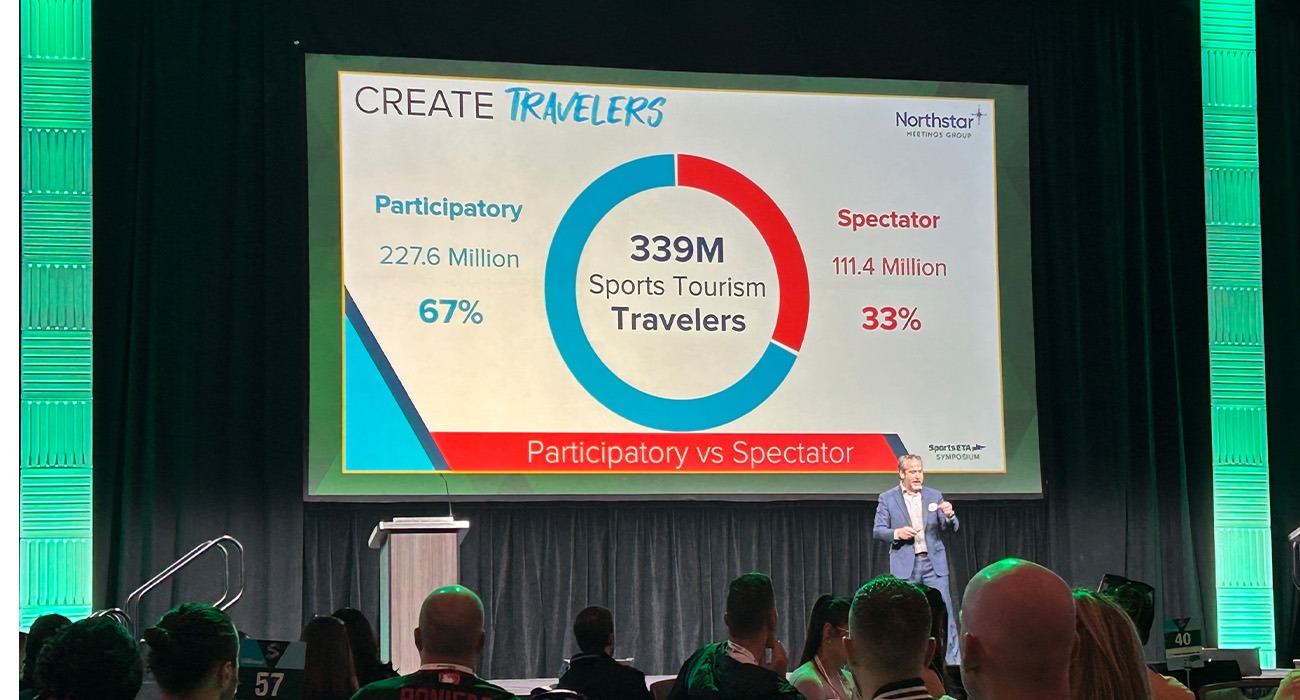
“2025 produced an astonishing 339 million sports tourism travelers,” David reported. That number is split between 227.6 million participatory travelers (67%) and 111.4 million spectator travelers (33%). The remaining numbers are just as staggering.
- 3 million room nights
- $111.2 billion direct spending (54% participatory/47% spectator)
- $274 billion on economic impact (54% participatory/47% spectator)
- 6 billion jobs (55% participatory/45% spectator)
“The numbers are unbelievable,” he added as he broke down where the economic spend was located.
- $1.6 billion in lodging tax
- $42.2 billion in total tax revenue
- $16.1 billion in air transport
- $19.7 billion in lodging
- $20.6 billion in food and beverage
- $5 billion in tournament operations
- $17 billion in retail
- $19 billion in recreation
With this, the participatory sports industry is now a $60 billion industry. “I’ll be kind of frank with you, I like to pick on spectator sports tourism a little bit,” David said. “I love my mega events, but I love to illustrate the fact that actually youth, amateur and the events you’re primarily hosting are the ones leading the day.”
Participatory Sports State Rankings
In 2025, Texas took the top spot for participatory sports, replacing Florida, which is now in 2nd place. These two are followed by California (No. 3), Pennsylvania (No. 4) and Ohio (No. 5). The remaining five in the top 10 are:
- North Carolina
- Tennessee
- New York
- Georgia
- Illinois
Spectator Sports State Rankings
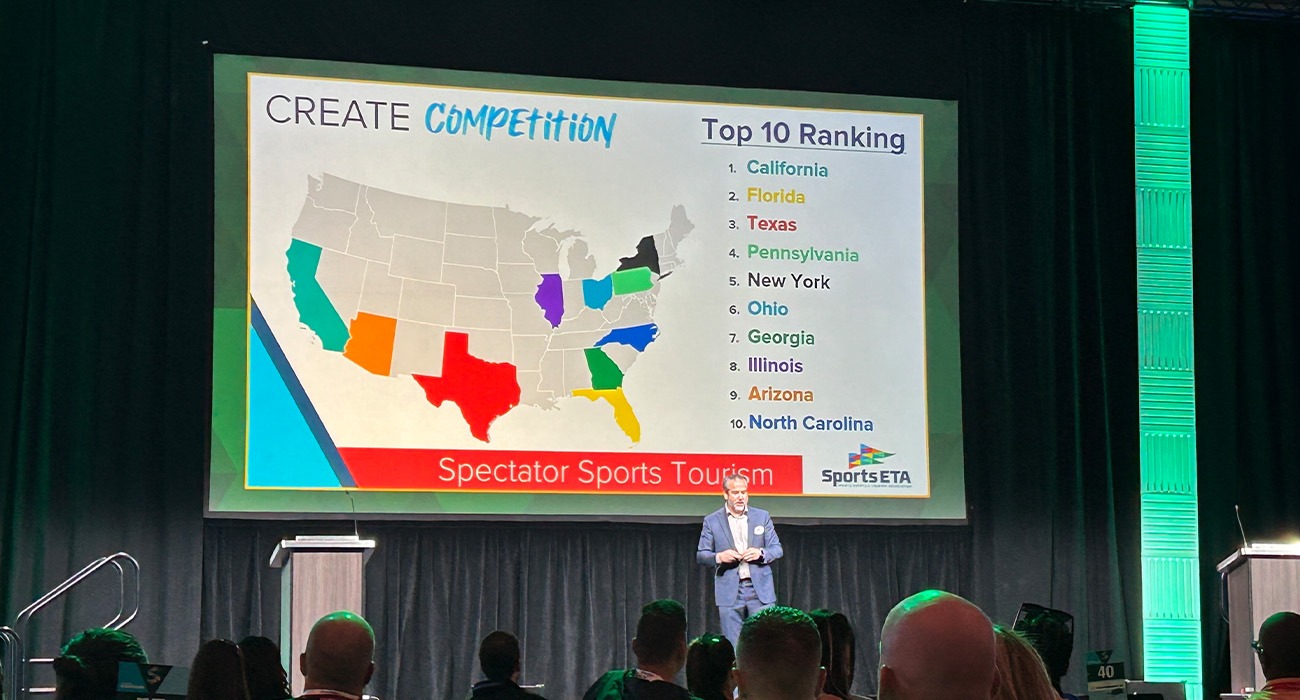
In 2025, spectator sports in California stayed at No. 1, and Florida and Texas flipped again, with the former taking 2nd place and the latter taking the 3rd spot. Pennsylvania moved up one spot to take 4th place, followed by New York, which moved down one spot. The remaining five are:
- Ohio
- Georgia
- Illinois
- Arizona
- North Carolina
David pulled a significant stat from the study: the increase in international sports tourism during such a turbulent time. It has increased 3.4% from 2024 to 2025. “In an era where inbound travel to the United States is down 20%, one category was not, and that is sports tourism.”
Road to the Olympics

The last day’s general session began with a show by the Flying Ace All-Stars, a group of winter and summer Olympians, world champions and athletes, such as American Ninja Warrior’s Brent Stephanson, former Cirque du Soleil performer James Johnson, freestyle skier Luke “lukeflipz” Fedderson, national trampoline champion Elijah Vogel and Olympic gold medalist in acrobatics Chris Lillis who performed trampoline tricks right in the middle of Alliance Ballroom.
Read More: Case Study: Visit Salt Lake Debuts DSXO Model
Highlighting Sports ETA Symposium 2027 location in Salt Lake City, the session was followed up by a conversation, moderated by Chris Mazdzer, a four-time Olympian among three Utah-based Olympians, Kaysha Love, two-time Olympian and world-champion bobsled athlete; Casey Dawson, speed skating World Cup gold titlist, two-time Olympic medalist, multi-national and world-record holder; and Lillis, Stifel U.S. freestyle ski team aerials athlete.
The athletes discussed their journey toward Olympic status and how Utah served as the perfect foundation for their sports careers to blossom. In addition to proper training, Lillis credited the pool at Utah Olympic Park. “That’s where I get the confidence,” he said. “I’ve done all these tricks, but when it’s actually happening, we [Olympic skiers] deal with a tremendous amount of fear.”
At the end of the discussion Mazdzer asked all three Olympians to finish the sentence, “Utah is the right place to host the Olympics because…”
Lillis started it off. “I’ll say access,” he said. “Having all those facilities up and running is why I live in Utah. That’s what drew me out there from New York. It’s something that is just amazing to see, especially when you travel around the world to do it. They’ve got so many facilities, so much access, especially for young kids who want to try. If you grew up in Salt Lake City, you could try sliding, bobsled, skeleton speed skating, skiing, alpine skiing…there are just so many opportunities. That’s just why it’s a great place to have the 2034 Olympics, because we’re going to have a lot of local kids there representing the U.S.”
Dawson said it’s the sports legacy of the state. “Legacy has always lived on in Utah. Without the Olympic legacy foundation in Utah and all the great access they have for young kids to get into sport, I would have never heard of skiing in the first place,” he said. “My local club, they were just so accommodating for me when I was 10 years old. They had Olympians coaching me when I was 10 years old. That’s unheard of. The legacy we have in this state is just something you don’t get around the world. I’ve heard the 2002 games are one of the best-hosted games in history, so just being able to have that legacy to live on towards the 2034 games, it’s just amazing.”
Love credited Utah’s community. “The support and the love for sports is like nothing I’ve ever seen before,” she said. “You get to travel the entire world, you see how other countries host the Olympics and how they feel about sports, and then you get to Salt Lake City, and you really see how Salt Lake City and Utah feel about sports. The legacy of greatness and champions in the Olympics is so real, and everybody that goes there feels it.”