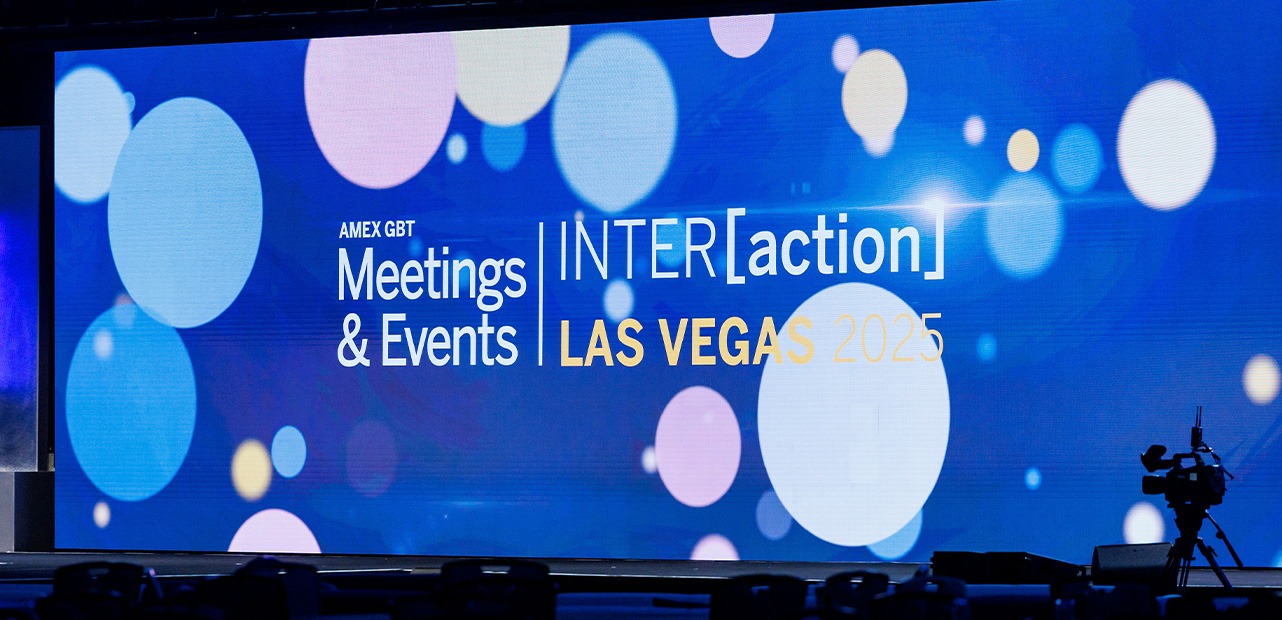
Amex GBT brought 1,000 total attendees to Harrah’s Las Vegas. This attendee list included client-facing employees such as sourcing managers, account managers and meeting managers, and business partners, such as CVBs and DMOs.
The more questions, the merrier the experience
“Inter[action] started 14 years ago. It started as an all-employee meeting that included business partners. About five years into it, we realized that we really needed to change the focus of the event,” says John Palmisano, senior manager, CES and global strategic events at Amex GBT.
“We realized that because we are becoming more remote, we need to interact more,” says Noelia Herranz Quijada, vice president of global strategy at Amex GBT. As a global organization, this event enables Amex to connect its employees and clients face-to-face. “We are a meeting point for employees and business partners to learn about what each other values.”
This year at Harrah’s Las Vegas, Amex GBT brought 1,000 total attendees, consisting of client-facing employees such as sourcing managers, account managers and meeting managers, and business partners such as CVBs and DMOs.
The event has grown over the years. At last year’s event in Puerto Rico there were 423 business partners. This year saw 550. “The hope is to grow it each year,” Palmisano says. “With the larger employee base, then you hope to grow that business partner base. It’s almost a one-to-one ratio from employee to business partner participant. We have 120 business partner companies here, and then about 550 participants from the business partner side.”
Read More: Amex GBT Showcases 2024 Forecast at IMEX America 2023
This year’s educational track, dubbed “Illumination Events,” aligned with the event’s theme, “Illuminate.”
“The topics were curated by asking our employees during the registration process, ‘What do you want to know?’” Palmisano says, “‘What do you want to take away from this event?’ Put down anything in terms of how we can make your role better. We took all that data back, and then we built education sessions, some internal, some external.”
“We wanted to get attendee personas for all of our attendees, employees and business owners, because to understand what our attendees’ needs are, professionally, personally, you have to ask them questions,” Palmisano says. “But nobody does. It’s like, you can just guess what everybody thinks they want.”
Or you can do what Palmisano, Noelia and the rest of the team did: Ask 20 questions.
Ranging from professional to personal, questions such as “What do you want to learn?” and “What are the highs and lows of other events you attend?” to “What’s your favorite song?” and “What’s your favorite food?”
Palmisano says some of the answers were deep. “Some were very personal, and some of the stuff is beautiful,” he says, “That’s what we want, we want to know who our people are and who our partners are. In terms of building relationships, you don’t go right to business.” He says it’s important to find out who the person is before you can do business.
On the business level, asking questions is crucial for knowing what to cater to whom. “For example, a sourcing manager might have a different expectation or goal for this event versus a CVB or a destination, but if you just say ‘business partner’ and ‘employee,’ you put them all in one bucket, but you’re not addressing what their needs are, and that’s what we’re doing,” Palmisano says.
Read More: Practical AI: Weaving Personalized Experiences into Your Events
He says some respondents said that there were too many questions, but they wanted to go big on the questions regardless. “We wanted to learn not just the answers, but how many questions are people willing to ask,” Palmisano says.
“My whole team said, ‘Don’t ask 20 questions.’ I said, ‘What if we unearth something that we weren’t thinking of?’”
He said Imagine if multiple people requested the same thing, then you have something to work with. “That’s an opportunity for us to infuse the event with maybe a moment that a person will have, even if it’s an individual moment, say someone goes up on stage to receive an award and their favorite song plays when they walk up.
“I would rather have more information than less information,” he says. “Did we ask a lot? Yeah, but you know what? That’s how you learn.”