As an attendee, events can sometimes feel hectic, with general sessions, one-on-ones, lunches and the closing reception. That’s the nature of events.
Yet, when more than 150 attendees gathered for ConferenceDirect’s (CD) CDX 2025 at Caesars Palace last week to network, explore Las Vegas and learn a thing or two about the industry, wellness was on full display to provide a sense of calm for attendees.
Wellness as a Standard
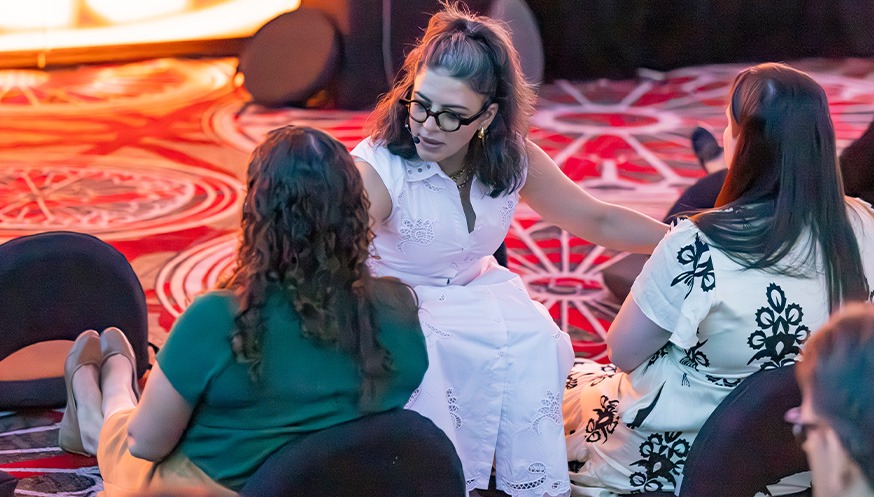
Starting with the opening reception, wellness was front stage at Pinky’s, one of the latest dining outlets at Flamingo Las Vegas, along with hors d’oeuvres, cocktails and mocktails. There was an aromatherapy station with crystals and essential oils for attendees to experience.
“Wellness is one of the fastest growing trends,” says Patrick Espinoza, director of sales for Caesars Entertainment. “Engagement is higher when wellness is incorporated and net promoter scores increase. We believe strongly in wellness and hope wellness for conferences becomes the norm for meetings and events.”
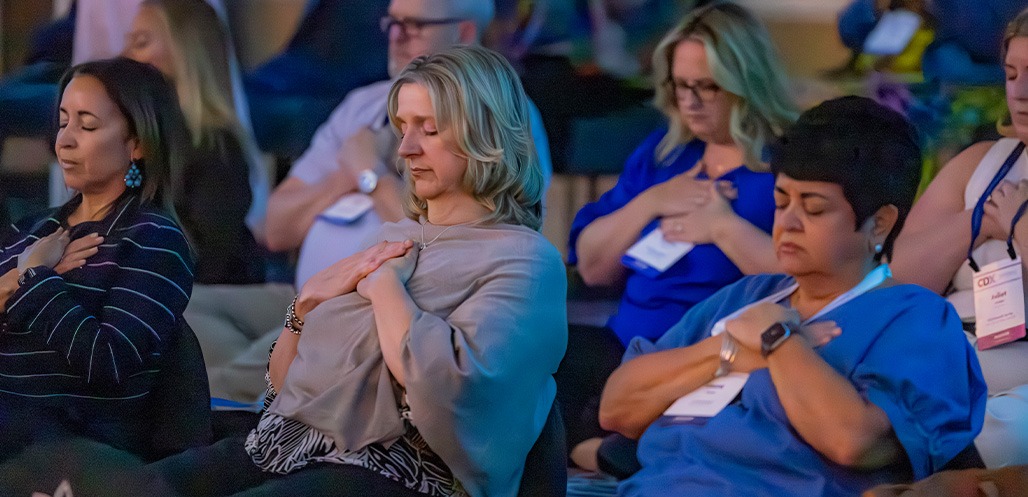
The four-day conference included early morning yin yoga, aura readings throughout the day and a somatic breathing session led by Sepidah Eivazi, founder of wellness company Dawn of the Earth—and a 2025 Smart Speaker Award winner.
Read More: Caesars Wellness Roadshow Event Resonates
“Providing unique experiences and things maybe people don’t quite expect is something that we’re always looking to do,” says JJ Wills, senior vice president of marketing programs and business development for CD. “Having a wellness focus in Vegas was a nice balance to all the fun, nightlife and excess that Vegas has to offer. And [Caesars] introduced us to Dami Kim [executive director of Body & Brain Wellness] and brain tapping.”
Kim’s brain tapping is the practice of periodically tapping the front, sides and back of your head with your fingers and taking deep breaths. According to Kim, this practice is meant to relieve stress and help you focus.
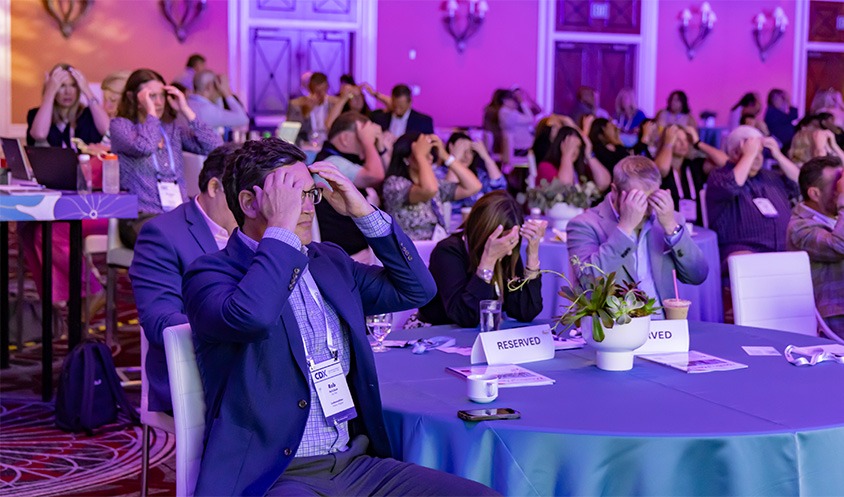
Wills says that many attendees participate in wellness activations, but there are some who just won’t choose that. “It was an opportunity for everyone to experience it as part of the main programming, versus an add-on at some other point during the day.”
Jerry Horan, president and CEO of CD, led the event’s general sessions that came right after Kim’s brain tapping activation, recalling how she used these practices backstage to calm herself as well. “She was backstage with me, and she was doing all these motions out of her normal practice to get her calm before going out on stage. It gets people centered. It’s a remarkable way to start off a program. It gets everybody in the moment.”
For meeting professionals who don’t know where to start with wellness, Espinoza recommends, “Work with convention services as they have seen what works and what does not. Start small and consider adding healthy options and one or two wellness activities. For example, five minutes of brain tapping or breathwork prior to an opening keynote is a great way to introduce this. The impact is big, and the cost is low. Add more breaks or lengthen them so that participants have time to absorb and connect. ”
Going Beyond Coffee Carafes
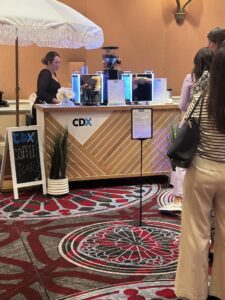
Coffee is a big deal around the world, let alone in the meetings industry, yet when attending most events, coffee is subject to containers of black coffee, packets of sugar and cream. ConferenceDirect did things a little differently by having a coffee bar in a space that served lattes and other specialty drinks. One drink was even named after the event, CDX Matcha Mix.
Listen to More: Coffee Chat—From Grounds to Greatness: How One Cup Can Transform Your Entire Event
“Coffee is an important part of our culture,” Wills says. “We all like our coffee a certain way, so having variety meant that people could have a taste of home. If they like to have a latte or like to have oat milk, we’re trying to give them a taste of that. For those who are used to black coffee, maybe they tried something new. The other thing that’s great about it is some people will find it no matter what, which means they’re going to wander around and find a gourmet coffee shop, and they might come to the program late. So, by having it there, we were meeting their need and making it convenient.”
“Many people, younger generations, find themselves looking for these specialty drinks. And for some people, black coffee with sugar isn’t as attractive as a latte or cappuccino. This goes back to [the idea that] the event will only be successful by giving the attendees what they want. They don’t want to go looking for a Starbucks at seven o’clock in the morning. I want them at our meeting. I want them to talk to other customers.”
Filling the Talent Gap
We may be beyond Covid-19, but its lasting effects in the hospitality world—like the lack of mentorship in the industry caused by that era’s mass exodus of leaders—remain.
The talent gap is still an issue in the industry. Organizations like ConferenceDirect have embraced this and are working to bridge that gap.
Wills says it’s a small part they can play to expose students to the careers available in the field and reinforce the value of the hospitality industry. “We’re hoping to inspire and help attract the next generation of leaders,” she says. “We host students five times a year in different cities, and we partner with locals to help connect us to a university and bring in students.”
Wills says CD welcomes both high school- and college-age students. This year welcomed college students from the University of Nevada, Las Vegas (UNLV). “Las Vegas has a great hospitality school at UNLV, so we welcomed them in and exposed them to other career paths they hadn’t thought of and helped them make some connections.”
Read More: Leading Hospitality, Travel and Events Orgs Are Investing in the Next Generation of Talent
Horan says he hears from schools that there is a lack of interest in the hospitality industry, particularly hotels. Fifteen years ago, he says, everyone wanted to work for a major hotel brand, but these days, not so much. “They look at it like, ‘Well, that’s five days a week in an office.’ So it’s kind of about reinventing the industry. That’s why we feel it’s important to expose those considering the hospitality industry to what we do.”
He adds that it’s said that by the time students enter college, it’s already too late, as they’ve already decided about their chosen career field. “They’re going to go work at a tech company or travel agency, but not a hotel. We really help many of them find their way to the hotel business,” he says.
ConferenceDirect has 425 associates that work for the company. Horan says most of them came from the hospitality industry, including himself, having worked for Hilton Hotels for 14 years before transitioning to CD. “What we want to see is more young people get into our industry, particularly from the hotel side or the convention and visitors bureau side, he says. “That is where we really lost so many good people; we need to attract those people back into our industry and share with them that this is a viable industry and a great career move.”
The Sessions
The general sessions at CDX offered attendees insightful tips and tricks they could take home and use when planning their next event, from ensuring a better room block turnout to event cancellation advice.
Managing Room Blocks in Uncertain Times
The general sessions began with a talk about hotel room bookings with Adam Briggs, senior vice president of operations for ConferenceDirect, and Ron Falcone, chief source officer for For Inspiration and Recognition of Science and Technology [FIRST].
The discussion focused on how Falcone could take his previous room block compliance, which could never break over 50%, to more than 90% by implementing a mandatory stay policy. This would take him from 6,000 rooms at peak to 15,000 with 50,000 attendees.
Read More: Smart Meetings Incentive Experience in the Bahamas Pointed to a Path Through Uncertainty
“Half of our attendees were booking online no matter what we did. Whether through incentives or swag, we just couldn’t break the 50% ratio. We knew they were coming to our event, we knew they were staying in hotels, but it’s hard to leverage and negotiate with the city or with hotels when you don’t know where your attendees are staying.”
“We wanted control of our block. We wanted control of where attendees are staying. We wanted to instill the safety and security aspect of it. We also wanted to increase our revenue, which allowed us to negotiate with the city of Houston. We went from 50 hotels to 225 hotels. And that’s truly with the partnership with ConferenceDirect and the city of Houston working together.”
Falcone says there was a lot of pushback. The answer to this? “Thick skin,” he says. “We prepped our leadership and board to expect pushback and phone calls. We prepped our leadership team to hold the line to see why we’re doing it, so when a CEO called to complain, they knew what to say. We stopped reading social media because it was emotionally damaging for us at times, but we learned that we had to communicate in many different ways. We need to pull the curtain back to explain the value of the program. This isn’t just the money; this is to create equity for our team.”
Event Cancellation as Risk Mitigation
Ray Chiang, CEO of Society for the Promotion of Japanese Animation, and Gregorio Casalenuovo, partner and senior vice president of USI Insurance Services, talked about how getting event cancellation insurance against communicable diseases and viruses for his organization in 2016 protected him against what was to come later in 2020. Although it took them three years to settle the case, “not a lot of companies out there had [protection] . . . a lot of our peers suffered during those couple years.”
They discussed the difference between cancellation insurance and general liability insurance. “There’s insurance that you have to buy, and there’s insurance that you should highly consider buying, and that’s having that conversation with your risk control partner. With general liability, you won’t be able to get into this event area without checking off the box with the business you’re doing business with. It’s a standard.”
Read More: Event Risk Is Inevitable—Planning for It Isn’t
Casalenuovo said there are two ways to use event cancellation insurance, which he talked about. “If you’re working with a ticket agency, like Eventbrite, for example, they may not deliver funds to you until after the event happens, because if it gets canceled, then they’re stuck holding the bag, having to reimburse people with the credit cards. So, in that contract, if you secure event cancellation insurance, they could start to give you some of those funds before your event happens, It increases your cash flow throughout the year.”
The other part is about whether the event does or doesn’t happen. With this, you can secure total revenue or insure the expenses. As an example, Casalenuovo talked about boxers he has worked with. “If somebody gets injured, the revenue’s too expensive to cover, but the expenses are always covered, because we can move the fight to three months. Everything depends on what occurrence would trigger.”