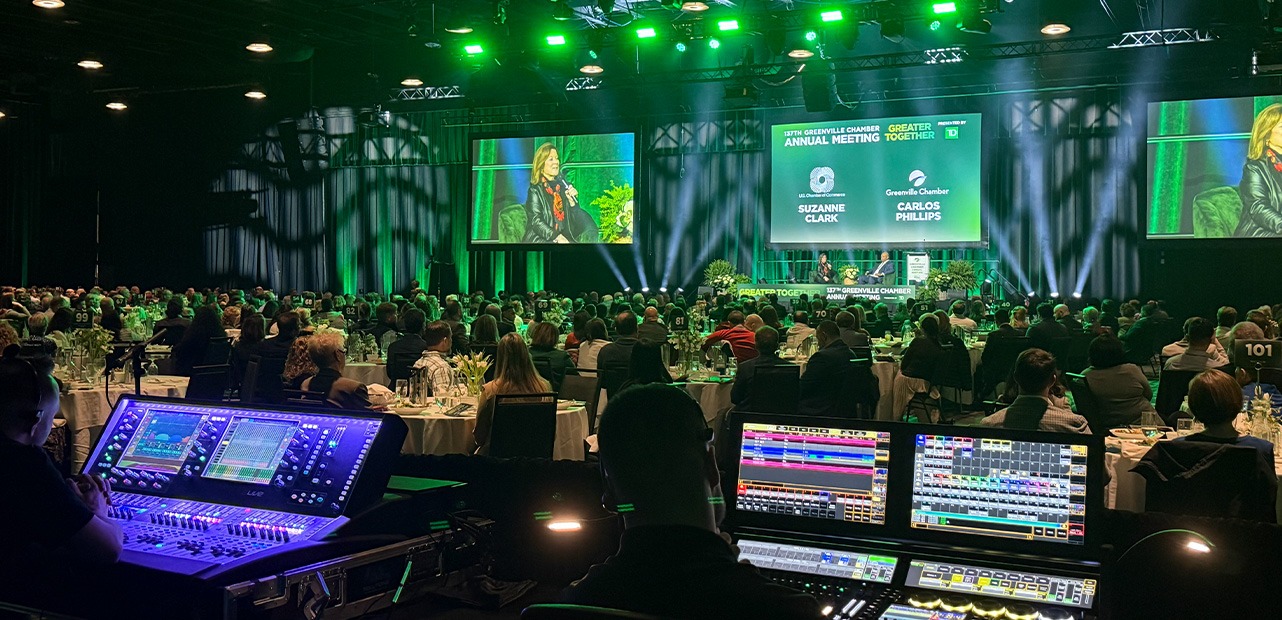
Most event failures don’t start on show day—they start weeks earlier, when key production decisions are treated as flexible instead of foundational.
Event planning is an exercise in prioritization. Venue, catering, staffing, and experience design all compete for the same budget, and AV is often treated as a flexible line item—something that can be adjusted without fundamentally impacting the outcome.
From a production standpoint, that assumption rarely holds.
When AV is done well, it disappears. When it’s compromised, problems become visible—and often in ways that directly affect the audience’s experience. In most cases, those issues aren’t caused by equipment failure. They stem from decisions made much earlier in the planning process.
Where AV Decisions Start to Break Down
Omission occurs when AV isn’t brought into the conversation early enough. By the time production is considered, the event flow is already defined, the budget is largely committed, and expectations are set. At that point, AV teams are no longer designing a system—they’re working within constraints that may not support the event as envisioned.
Read More: Event Tech: Audiovisual Staffing
Reduction tends to happen later. Budgets shift, other categories exceed projections, and AV becomes the place to recover costs. Equipment is scaled back, support layers are removed, and technicians are expected to deliver the same result with fewer resources.
Both scenarios introduce risk, but omission is often more limiting. Early planning creates options. Without it, flexibility disappears.
Where Small Cuts Create Big Risk
One of the first places planners often look to save is redundancy.
Backup systems can feel unnecessary—especially when everything runs smoothly. But these safeguards are what separate a seamless recovery from a visible disruption. It’s the difference between resolving an issue instantly and stopping the program while a room full of attendees waits.
Read More: Experts Offer Tips for Meaning-Rich Events on Any Budget
Removing redundancy doesn’t eliminate risk; it concentrates it.
From there, cuts often move deeper into the infrastructure that supports the event. Routing, signal flow, and system capacity may be reduced in ways that aren’t immediately visible but affect performance under pressure. On paper, the event may look the same—but the system is less stable when it matters most.
We’ve seen events where a last-minute cut removed a backup audio path. Everything functioned as expected until a single failure brought the program to a halt. The issue wasn’t the equipment—it was the absence of a safety net.
Audio Is the Baseline
Of all production elements, audio has the least tolerance for compromise.
Clear, intelligible speech is not an enhancement—it is the baseline requirement. If attendees can’t clearly hear what’s being said, nothing else matters.
Audio is also one of the most underestimated aspects of production. It’s easy to think in terms of microphones and speakers, but delivering consistent sound across a room requires intentional system design: coverage, acoustics, delay, tuning, and distribution.
When audio is underspecified, there is very little that can be done in the moment to fix it. The limitation is immediate and affects every person in the room.
For many planners, this is where the biggest disconnect occurs. Audio is critical, but often undervalued. Cutting corners here doesn’t just reduce quality—it determines whether the message is received at all.
What Actually Protects the Event
The most reliable events share a few consistent traits: early planning, clear communication, and defined expectations.
The more clearly a planner can articulate the desired experience, the more effectively a production team can design toward it. That clarity allows for better decisions—preserving what matters most while identifying where flexibility exists.
Without that clarity, systems often need to be built with added flexibility to account for unknowns, which can increase cost and complexity. With it, resources can be allocated more precisely.
Communication also plays a critical role in managing expectations. If compromises need to be made, understanding the tradeoffs ahead of time changes how those outcomes are experienced. When expectations are aligned early, there are fewer surprises.
A simple but important question can guide these decisions: will this system actually accomplish what the event requires—not just in theory, but under real conditions?
That alignment—between expectation, design, and execution—is what prevents most issues.
Choosing the Right Partner
AV is not just about equipment—it’s about how the system is designed and supported.
Different providers operate under different models, and those differences shape outcomes. In-house AV teams, for example, may appear cost-effective at first glance, but pricing structures or inventory limitations can influence what is ultimately delivered.
Read More: The Hidden Cost of ‘Good Enough’ Event Partners
The key is understanding whether the proposed solution is built around the needs of the event or around available resources.
Ask specific questions. Define what the event needs to accomplish. Ensure that expectations are documented, not assumed.
Most production issues don’t stem from equipment failure—they result from misalignment between what was expected, what was designed, and what was delivered. When corners are cut without that alignment, those gaps are what the audience experiences in real time.
Closing Thoughts
Cutting corners on AV doesn’t just reduce cost—it shifts risk into the live environment, where there’s little room to recover.
The most successful events aren’t the ones with the biggest budgets, but the ones where the right decisions were made early. Treating AV as a foundational element isn’t about spending more—it’s about ensuring the event performs exactly as intended.
—
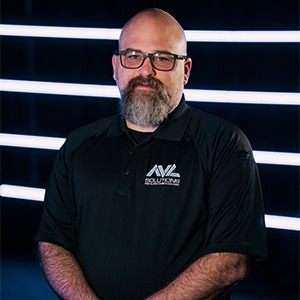 Chris King has been part of the event production world since 2000, when he began his career as a freelance audio engineer supporting local live music. In 2006, he joined the team at AVL Solutions in Greenville, South Carolina, where he has spent the past two decades growing alongside the company.
Over the years, Chris has worked across nearly every facet of the business, from audio and visual technician to front of house and monitor engineering, system design, retail sales, and contract audio work. That breadth of experience gives him a deep, hands-on understanding of what it takes to deliver great results across a wide range of environments and events.