Further Resources
Event Security Reminder: Don’t Let Your Attendees Lose It
JT Long
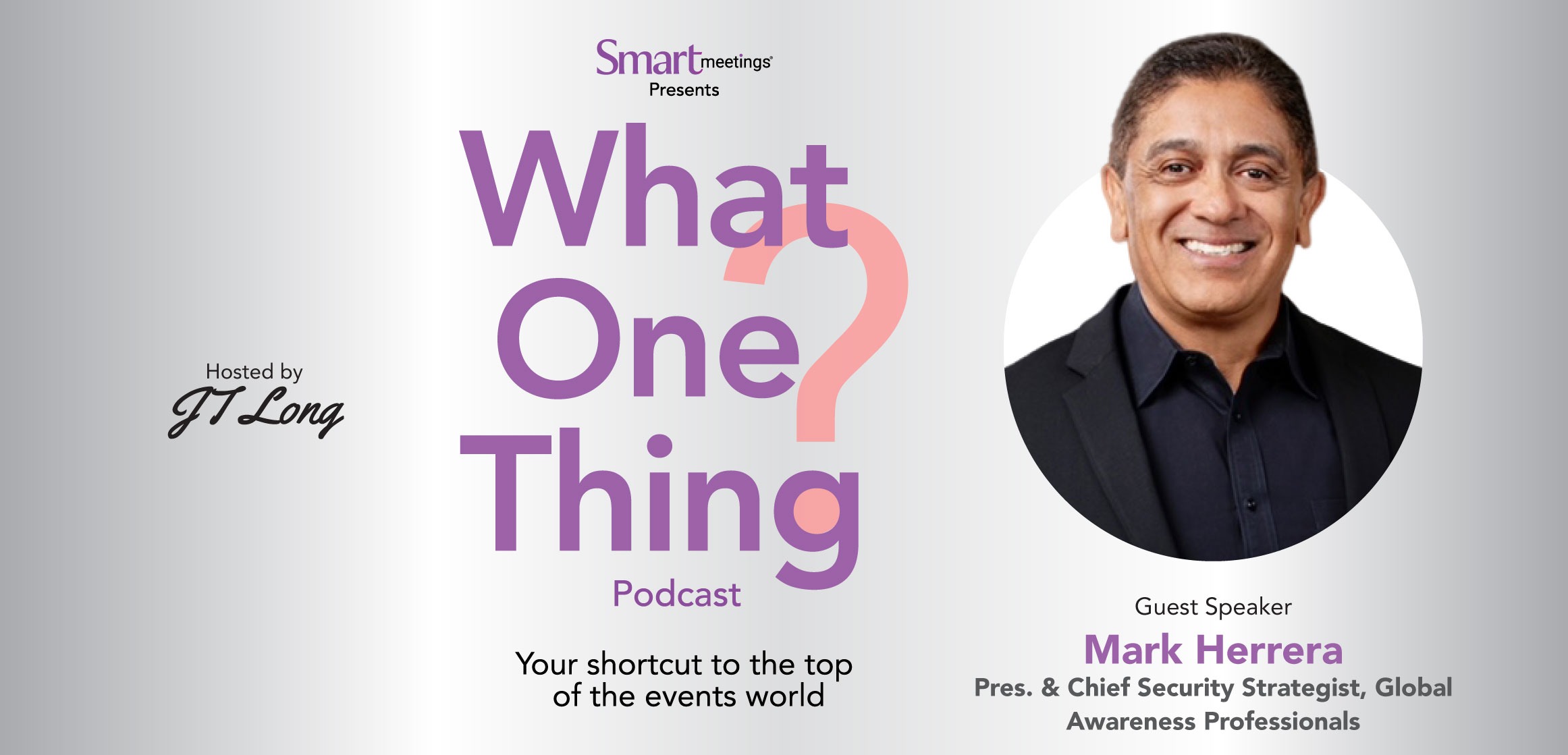
Welcome back to the What One Thing? podcast. This is the Smart Meetings platform for learning from the most successful people in the industry, what they did that made all the difference in their lives and careers.
And I am so lucky I am here with Mark Herrera. Mark is the knowledge of everything that is safety and security in the world. He has a brand-new venture we’re going to learn about, and I want to hear what he’s been up to.
Now, Mark, your background includes stints as an EMT, a police sergeant, a special weapons and tactics officer, human resources representative and flight deck instructor before you took your role as director of safety and security with IAVM, which is how I knew you, and now as you’re on your own as president and chief security strategist with Global Awareness Professionals.
Did you grow up saving people from burning buildings? When did you know security was your passion, and how’d you find it?
Mark Herrera
JT, first of all, let me just say it’s always a pleasure. When I talk about reliable, incredible resources out there that really inform the world that we live in, when it’s right side up or upside down, you and your team do such a really great job. And I want to go more into that a little bit later.
But yeah, my career, it’s a little bit different. I’ve spent my career in moments where seconds mattered, and what I’ve learned is that there’s a difference between chaos and control. Team recognition before anything happens, that’s critical. It’s so important.
But all that being said, my background and 50 cents won’t buy you a cup of coffee. I didn’t grow up thinking I’d be in security. That’s not how I grew up. I did grow up understanding one thing that I think was really important, and that is responsibility.
Early on as an EMT, and then moving into law enforcement, I realized something very powerful, and that is that people don’t rise to the occasion. They just basically fall back to their level of training.
I always wanted to be that source and that catalyst and that individual that could really help build and develop those unstoppable elite teams. That was always something that was a passion of mine. I didn’t know how it was going to unfold, but that was a passion.
The turning point for me, JT, was I saw the biggest impact wasn’t just responding as a police officer or as an EMT. It wasn’t just responding to incidents. It was being very crafty and strategic in how to prevent them, and that’s what I focused on.
It’s not about going right of bang. It’s about staying left of bang, and how do you prevent these things from happening? So I was always intrigued with that. That’s where that passion came from.
I always wanted to be the one that said, I want to protect those people that can’t protect themselves at the end of the day. Raised between my mother, my grandmother, my grandfather, I can tell you right now that they just instilled a very powerful work ethic. But one of the things that they did instill was always protect those people that can’t protect themselves, go above and beyond and make those sacrifices. That was always ingrained in me as a kid, and a hard work ethic, so it never left me.
So I’d say that is where the passion came from. And today, now through Global Awareness Professionals, which is my company with an amazing team, I have one of the best marketing directors, which is Mary Klida. She’s amazing. I’ve got such an amazing team. Steve Flynn, Karen. They’re awesome.
With GAP, I focus now at a different level on helping teams recognize, engage and act before something becomes a crisis. That’s important, and I talk about that on all the news briefs that I do, which I’ve done over 900 of those, because real security isn’t reaction, JT. It’s preparation. That’s the key.
So I know I went all the way around the world across the street to answer that, but maybe that kind of gives you an idea.
JL
Well, and I can see that in everything that you do, that preparation is so important, right? And the fact that you’re out there training teams for what you just called, I just learned left of bang versus right of bang, right? And if you focus on that, being ready for whatever happens.
I don’t know if I ever told you, my father was law enforcement. He was an undercover narcotics agent, and he and his partners trusted each other for everything. You never knew what they were going to be. So then, as kids, we all played with the other kids that were the children of the narcs, because that’s who they spent all their time with.
There was teasing. Oh my God, there was terrible narc humor. But there was also just this understanding that they had each other’s backs, no matter what. That was so impressive, and you do that for teams.
MH
Oh, JT, thank you. So first of all, kudos to your dad. It’s never an easy job being a police officer, especially in the world that we live in today.
But one of the things that you brought up, and I think it’s very important to highlight, is you’re only as good as your team at the end of the day. If you’ve got leadership and your team that’s driving it in a good direction, I’ll tell you right now, that’s the key to success in any organization. That’s the key to building those teams, having your team that backs you and supports you, having that team that you can rely on.
I always say it’s not me that’s behind the scenes doing this hard work. It’s my team that does that. The team makes me look good at the end of the day. I’m just simply delivering the message. But you’re always only as good as your team, and you’ve got to really take care of that team at the end of the day.
I think that’s what I needed to bring up because, from a leadership perspective, you want the right leaders in place today because the world has been challenged. It’s a little bit upside down. With that being the case, your security risk goes up, your guest services kind of diminishes a little bit. So, how do you maintain resiliency? You have to have the right leader in place, and you have to have a solid team that supports and backs you along the way.
JL
And meeting professionals are so recent that they say their job is as stressful as law enforcement, right? They are in that moment, and they need to feel that they have the people around them who can do what needs to be done, because no one person can put on an event.
MH
Absolutely. One hundred percent.
JL
Well, you and I met during COVID when you were leading these weekly meetings for venue operators from all sectors of the live events industry. They were giving status reports in real time, and when we were all so anxious, it was really a touchstone for me to have that window into reality.
What was it like living that from your side, trying to keep everyone moving forward, keep everyone safe? That was crazy times.
MH
It was, JT. That was one of the most intense and meaningful periods of my career and in the world, because every week we had venue leaders from across the country and globally looking for answers. They were trying to find the truth, and none of us had that playbook. So it’s like, what does that playbook look like?
What we did have was each other. We didn’t have the playbook, but we had each other. Now, those calls became more than just updates. They became a lifeline at the end of the day.
We were sharing real-time intelligence, what was working, what wasn’t working and how to keep people safe while trying to keep the industry alive. That’s really what we were trying to accomplish.
From my side, it was about staying grounded, JT. Not spreading fear. That’s what we were trying to avoid. But providing that clarity, not pretending that we had all the answers, but just making sure that we were asking all the right questions.
That experience just reinforced something that I believe deeply in today, that security is a shared responsibility, and leadership, again, as I mentioned, matters most during those times of uncertainty.
We were running like six different task forces. But I do want to say this, JT. What’s really interesting is that during those times, we needed to get good information out to the industry so that we could make sense of the unknown and start building that playbook, getting the event industry back on board and making sure everybody was healthy and safe and secure and not vulnerable during these challenging times.
But the way we got that information out there was through really good publications and resources. And I have to say, I follow you and your team everywhere all the time. I always tag you with my posts, and there’s a reason why I only align myself with those sources that are professional, where the integrity is the highest and the information is fact-based. It’s not assuming. It’s really good factual information.
I found that you had such an amazing resource to utilize Smart Meetings to deliver the message. And I would always say, if you want a reputable publication or an organization that can push out the message, I knew that I could always call you and your team.
JL
I appreciate that. I do. And the fact that you were able to give us the best information was so helpful.
And the thing that we learned is that all security has to be covered, but the focus of what we worry about in any given moment can change. Sometimes it’s active shooters, sometimes it’s infectious disease or getting caught in the crossfire of conflict.
What do meeting professionals often get wrong, considering the safety of their guests?
MH
The biggest mistake, I think, is that they treat safety as a plan on paper instead of a capability in people. I think that’s the best way I can put it.
You can have the best emergency plan in the world, but if your frontline staff and your teams can’t recognize a threat, a hazard, a vulnerability, and they don’t know how to communicate that, or they hesitate to act, then the plan really doesn’t matter. The plan is only as good as those people, those organizations and teams that actually exercise the plan.
Another gap in thinking is thinking that security is only about worst-case scenarios, like active shooters, as you mentioned. In reality, most incidents, JT, they start small. Behavioral indicators are there. The conflicts are there. Medical issues, things that escalate because they weren’t recognized early.
That’s the one thing that we’re really pushing out, trying to understand. It’s called predictive behavioral profiling. It’s understanding behavioral patterns that are not conducive to an environment, training teams how to interject, defuse, remove and not trigger a bad situation.
We were doing this thing called risk mitigation through guest service interjection. I may be wrong, JT, in assuming that we have anomalous behavior, but if I approach that with a guest service approach, I draw those behavioral patterns out. But at the same time, if I’m wrong in the assessment of the anomaly, I’m never going to be wrong in a guest service approach at the end of the day.
So that’s why we focus so heavily on predictive behavioral awareness. And I always say this: If your team, or any team out there in the room, can engage early and de-escalate, they will prevent most incidents before they ever escalate.
And that’s what we’re doing here in Fayetteville. What I’m doing here in Fayetteville with all the venues is making sure that they’re operating left of bang in preparedness versus right of bang before they push out to one of their first major events this Sunday.
JL
Mark, can you share some of those? I know I always read when they have the article that says stewardesses are looking for these things when they see you come in. What are the things that meeting planners need to look at for the predictive behaviors that would indicate maybe they need some de-escalation, maybe they need to take a service approach to getting to understand what’s going on a little better?
MH
I think the key there, JT, is when you’re talking about behavioral indicators, you have to understand that anxiety levels are up.
When I was on CNN, Jake Tapper had asked me at one point, “What’s wrong with the world today? Why is it upside down?” I said, “Here’s the reason. Keep in mind that a lot of folks were removed from their social networks at the time that we were going through COVID.”
So there’s a lot, there are high levels of anxiety, but there’s also that heightened level of energy going into an event because they’re no longer going to be pulled in their mind from those social networks anymore. So they will assume the risk to do whatever it takes to attend an event.
At the same time, when they’re attending this event, because there are some folks who have those unresolved personal experiences that we don’t know what they are, you can spot the anxiety if your teams are trained and they know what to look for. That behavior is involuntarily projected, and so we’re training teams on how to spot it.
That nervous energy. The constantly looking for your entry points and your exit points. We’re going heavy on the threat side now. We’re looking at the swaying back and forth, the clenched teeth.
If you can catch those behaviors in advance and just kind of intercept it and interject, it can be as simple as just an acknowledgement of, “Good afternoon. Welcome to the event. How are you doing?” That’s enough to defuse a lot of bad situations and even to reduce those levels of anxiety, just to name a few.
JL
Love that. Love that.
So, when you talk about training the team, I did a white paper recently on safety and security, and a lot of planners said they rely on the venue for safety and security. That’s their team. It’s not the team that comes with them to the event, because the venue knows the security and the layout and all of that better than they do.
How much can planners rely on the DMO, the hotel, the convention center to help them with this work?
MH
I think, JT, everybody has to have a plan, and all those plans have to work seamlessly. The venue will have their emergency plans, but your planners also, for their clients, they have their emergency plans as well. All of that needs to speak to each other.
That is one of the reasons why I always said anything that we do from a security perspective, training-wise, we need to make sure that we include planners, organizers and the service contractors as well. Integrate them into the emergency planning process. Even bringing them in, again, as I mentioned, to all of our security offerings because that way they have an understanding that the venue and the facility is going to focus on emergency planning, risk management, security operations and training.
And how do we integrate that with the meeting planners? Because they’re such a vital component to that emergency planning process. But we don’t want to work in silos.
Those plans need to be able to sit down in front of the venue and go, here are the things that I want my clients to have access to. It’s for their safety, their reassurance that we have all the security protocols in place. At the same time, the venue is going to be able to say, yes, we have those in place, or we’re able to accommodate, and we can work those and integrate those into our emergency planning so they’re seamless.
So, I think that’s critical because, for the longest time, those are kind of siloed up, JT.
JL
That’s true, and we all got to work together, including the attendee. The attendee needs to take responsibility for not coming if they’re sick or being aware of their surroundings and really trying to be good participants.
MH
Yeah, I think it boils down to, it starts with kind of shifting that mindset that security, again, is not just kind of a department. Kind of like the venue, they have their own thing. No, the venue, the planner and even all the attendees, they play a role.
But alignment doesn’t happen by accident. It’s got to be a holistic effort among all the key stakeholders pushing out an event.
JL
Absolutely.
So Mark, you have achieved so much, and you have supported so many people. What is one strategy you have added that our community of listeners can consider to help them stay safe and fulfilled in their career and life? No pressure.
MH
OK. That’s a good question.
I think for me, it comes down to one principle: staying aware professionally and personally. Not just situational awareness in a venue, but awareness of your environment, your team and the mindset is critical.
Awareness gives you options, and options give you control. Whether it’s in security, leadership or in life, when you slow down enough to truly observe, you make better choices and make better decisions, if that makes sense.
That’s what keeps you safe and fulfilled at the end of the day, because you’re not just reacting to life. You’re kind of leading through it.
I always say one strategy is to know that you’re an integral part in what I call assumptive risk analysis and being a part of those that are able to identify all of the hazards and all the vulnerabilities because it’s no longer just assigned to one individual. I can’t solely rely on a director of security to provide for my safety at the end of the day.
It’s incumbent on me to be able to have the tools, the knowledge and those levels of confidence to say, I know what vulnerability looks like. I know what risk looks like. And I want to make sure that I make a difference in making sure that I know how to combat or mitigate all of those different types of risks.
So, I’d say those are some strategies that I would push over to others.
JL
There you go, Meet Smart community. You are now empowered to be part of the solution.
Thank you, Mark, for all you do to keep us safe. Thank you for being such a dear friend of the industry and of Smart Meetings and for all you do out there, keeping us prepared and going forward.
MH
Hey, JT, thank you so much. And I’m going to say this: Somebody says, “Well, too much safety, security breeds paranoia.” On the contrary, preparedness beats paranoia.
And I always say, preparedness isn’t a checklist. It’s a mindset. You’ve got to have that mindset, and the teams that commit to that mindset are the ones that make a difference when it matters the most.
And I always say this: We train, train, train. We reinforce it so that we can program the subconscious mind to react to the different conditions. I’m basically building the hazard library.
And I always say this, for those of you that are tired of training and training and training: Remember this. The more I reinforce it, the more inoculated you become to that condition.
But remember this: The body will know where the mind has been. If the mind hasn’t been there, the body’s not going to follow.
JL
You heard it here on What One Thing? Have a great day, Mark. Bye, everyone.
Smart Meetings’ What One Thing? was produced by Bright Business Media.