What happens when you bet on yourself, embrace what makes you different and leave a little room for the unexpected?
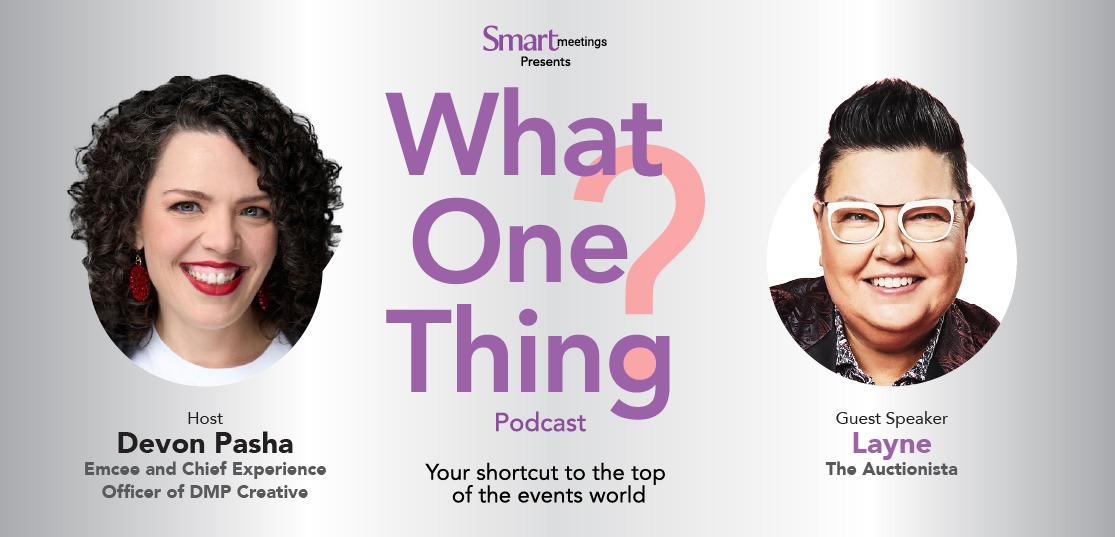
On this episode of What One Thing?, host Devon Montgomery Pasha sits down with keynote speaker, entrepreneur and fundraising powerhouse Layne the Auctionista to talk about finding a new career at 47, building a life around joy and human connection, and raising more than $70 million for charitable organizations. Layne shares lessons on belonging, authenticity and resilience; the difference between the “glory givers” and “grim reapers” in our lives; and why asking for help can be one of the first steps out of a difficult season. Their one thing? Know your why, be gentle with yourself and others, and don’t be afraid to live life a little spicy.
Devon Montgomery Pasha
Hello, everyone, and welcome to another episode of What One Thing?, a Smart Meetings podcast where we ask successful people what made all the difference in their life and career so you can learn from their journeys and spark your own growth.
Layne
It is so great to be here with you. I have missed you. I’m so excited to chat with you, and let’s see what kind of rabbit-hole trouble we can get into today. Joyous trouble.
DMP
Let’s start at the beginning. What first drew you to auctioning, fundraising and speaking?
L
Like many people, I literally fell into my career completely by accident. I was 47 years old when I attended my very first charity gala. My wife, Sue, and I walked in, and I didn’t know what to expect. Then the auctioneer came out, and what I remember is how I felt. I felt jarred, pushed and extremely uncomfortable. I thought, “This is the best that this charity can do? This dude is driving me out the door.”
L
I said to Sue, “Oh my gosh, I think I could do this.” She said, “Honey, you don’t even know what this is. You’re a financial advisor.”
L
So I found the auctioneer and asked him, “How do I learn to do what you just did?” He looked me up and down and said, “Hey, little Missy, this is a generational career,” and turned his back on me.
L
I was like, nobody puts Layne in the corner.
L
Six months later, I did my research and went to auction school in Mason City, Iowa. My vision was very small. I thought if I could do two or three auctions a year, I could earn a little play money. One auction turned into 10, then 50, then 100, and eventually into a business that opened the gateway to keynote speaking. I’ve written a memoir that will be published later this year. It gave me my purpose in life, my why. Who knew the day I walked through the doors of that gala room would be the day I found a superpower I didn’t even know I had?
DMP
Before becoming the Auctionista, was there something about yourself that you already knew was different or unique?
L
Absolutely. It’s my inner child. It’s Baby Layne. I feel very connected to my inner child. I’m playful. I like to have fun. I’ve always been a bit of a ham.
L
I also always felt a little different. I’m gay, queer and non-binary, and I always felt there was something quite different about me compared with the other kids at school.
L
So many adults forget to play. They forget about joy. I always go back to being that little 2-year-old self, standing in my crib when my mummy comes into the room and says good morning, and I’m like, “Yes, it’s daytime! What are we going to do? What are we going to explore? What’s going to happen today?”
L
I feel very strongly about keeping that in the forefront of everything I do.
DMP
That sense of play seems deeply connected to the way you bring people together. What has fundraising taught you about people?
L
I think the greatest gift we can give each other as human beings is our time and our resources. I talk a lot about privilege and acknowledging our privilege. When you use your privilege for good, to lift others up and help them thrive and reach their goals, that is incredibly powerful.
L
Fundraising is storytelling. It is connecting with each other through lived experience and showing how donors, by giving their financial resources and support, have helped individuals succeed.
L
Philanthropy is a beautiful thing, and it comes in all kinds of shapes and sizes. It can be volunteering. It can be making a donation. It’s a gift of your time and your resources, whatever that looks like for you. It’s something we can all give to each other in one way, shape or form.
DMP
What do audiences need most right now that they may not even realize they’re looking for?
L
I don’t think people really think about the importance of belonging and what that word truly means. Belonging is the feeling that you’re in a space where people want you, where they value you and where you feel at ease being your authentic self.
L
When you don’t have that sense of belonging, it can lead to code-switching. I’ve changed the tone of my voice and made it a little higher so people might not wonder, “Are you a man or a woman?” because I have been asked that question. Sometimes you change the way you dress to fit into a box or into societal expectations.
L
When we do those things because we don’t feel like we belong, it damages us. We don’t perform as well at work. We’re not at our most creative. We check ourselves instead of thriving. That has a massive ripple effect on our psyches.
DMP
That idea of authenticity and belonging runs through your keynote From She to They. Where did that presentation come from?
L
It came from my lived experience. When my pronouns were she and I made the change to they/them, I couldn’t bear hiding anymore. Then came the reactions, the questioning, the inappropriate curiosity and lines of questioning. It hit me hard, sometimes from people I thought really knew me.
L
I talk about the “grim reapers” and the “glory givers” in our lives. The glory givers are the ones who say, “Layne, you changed your pronouns to they/them? Awesome. I love you. This is great for you. Go do your thing.” The grim reapers are the ones who try to tear you down, question you or judge you.
L
There was this internal realization that some of the people I thought were my glory givers were giving me grim-reaper energy. I had to ask: How do I work through that? How do I stay true to myself and protect myself?
L
That’s really what spawned the keynote. I felt strongly about opening up because if I was experiencing this, other people were too. We live in a world with so much judgment, and we don’t know what another person may be going through. Be kind and gentle with ourselves, but also be kind and gentle with each other.
DMP
You also use the phrase “bidding on yourself.” What does that mean?
L
One of my keynotes is Bidding to Be Your Best. Bidding on yourself means investing in yourself.
L
Breaking societal expectations isn’t easy. Being the first person to step forward and say, “I’m not OK with this. I’m calling it out. I’m not going with the status quo,” is difficult.
L
So I ask: What is right for Layne? What feels good for Layne?
L
This might sound crazy, but if it’s not fun, I’m literally not going to do it. That is how I live my life. If it’s not going to feel good to me, I don’t want any part of it.
L
It has taken me almost 64 years to get to this place. People tell me I’m courageous, but I’m a vulnerable child as well. I’m incredibly sensitive. I get hurt. I still cry. But I always come back to: Layne, if it feels good, that’s the lane you need to be in. Do what feels right. Go with your gut feeling. Listen to Baby Layne. Ask who the glory giver is and who the grim reaper is.
L
That courage is a skill I’ve built over time through lived experience, trauma and pain, which we all have.
L
Our lives are filled with highs and lows. We dive down into these deep valleys of pain and trauma, but as we rise out of them, we have built new skills. Maybe we’ve strengthened our courage, adaptability or flexibility.
L
When I come out of a deep valley, I know I will be another improved version of myself. Sometimes those lessons are not easy to see when you’re in the middle of stress or trauma. Reflection itself is a skill I’ve built over decades.
DMP
When someone is in one of those valleys, what is the first baby step toward resilience?
L
As a survivor of domestic violence decades ago, I learned very early that you need to ask for help. You can’t navigate some of this stuff on your own. We’re not always built for that, and when we’re in stress mode, we’re not necessarily seeing things rationally.
L
I learned that it’s OK to ask for help. It’s good to seek help. It’s good to surround yourself with people who are going to support you in the right ways.
L
One question you can ask somebody who is stressed or traumatized is, “What do you need right now?” That says everything.
L
Maybe you need a hamburger or an ice cream. Maybe you need to vent and unload, and the other person simply says, “Yep, I hear you.” No judgment.
L
The first step is taking a moment to ask: Who are the people around me who will give me what I need right now? Then being able to express that need.
L
There’s also a mindset shift around those deep valleys: I’m in this thing right now, and I will come out of it. I’m going to learn something about myself. That can provide hope. The sky will be blue again. Things will be better because that’s how our lives ebb and flow.
L
Resilience is a skill you have to train and build. Finding the right support system can make all the difference. You are not alone, and you don’t need to be alone.
DMP
You’ve reinvented yourself and built this second career later in life. What keeps you curious and excited about what comes next?
L
Because I don’t know what it’s going to be, and I love that.
L
I love improv and surprise. I love exploration. I was never going to be that 35-year, gold-watch career person behind a desk. I love my life spicy. I love my friends a little spicy.
L
I follow my heart, and I don’t know where that’s going to take me. That excites me. I don’t want the straight path forward. I don’t want the predictable life. I want to be a child until the day I’m not on this earth anymore, looking through those wondrous little eyes and saying, “What is possible?”
DMP
As we wrap up this conversation about belonging, authenticity and resilience, we always ask our guests the same question: What one thing has made all the difference in your life and career?
L
Understand your why. When you know what your why is, when you know why you’re here and what your purpose is, that is everything. The fun part is figuring all that out, trying new things and being spicy about it.
L
And I have a two-pronged response: Be kind and be gentle, always, to yourself and to others.
DMP
Understanding your why can be fun, and the journey to finding it can be joyful. It can add a little spice to your life. Look for the glory givers, ask for help, bid on yourself and be authentic.
L
Layne, thank you so much for sharing your story and a spark of wisdom with our Meet Smart community. Conversations like this remind us how small moments can make a big difference and that inspiration may always be closer than we think.
L
To our listeners, thank you for joining us on What One Thing?, a Smart Meetings podcast where every story sparks inspiration for your own journey. Until next time, keep creating, keep connecting and keep sparking change.
L
Thank you for having me.
L
What One Thing? is produced by Bright Business Media. Visit SmartMeetings.com to subscribe to your daily dose of inspiration.