With AI evolving so quickly, how can meetings and events organizations tell whether it’s making a meaningful difference?
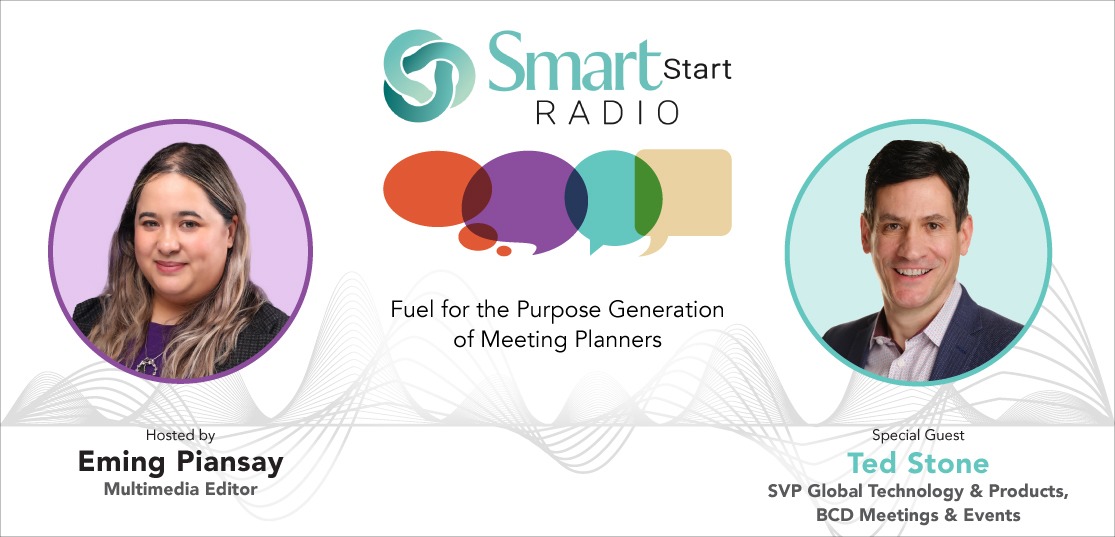
Smart Meetings Multimedia Editor Eming Piansay sits down with Ted Stone, senior vice president of global technology and products at BCD Meetings & Events, to explore AI’s practical value across the industry. From reducing repetitive work to measuring results, Stone shares how organizations can approach adoption with clear goals, training and human oversight. The conversation also explores data privacy, changing roles and how technology can help teams devote more attention to the human connections at the heart of meetings and events.
Eming Piansay (0:00)
There is always another AI tool, another update, another possibility. And with everything moving so quickly, I wanted to take a step back and ask what we’re actually getting out of it.
Today, I’m talking with Ted Stone, senior vice president of global technology and products at BCD Meetings & Events, about what meaningful AI adoption looks like in our industry. How do we know it’s helping? How are our roles changing? And where does human connection fit into that conversation?
I’m Eming Piansay, and this is Smart Start Radio.
(0:40)
[Theme music]
EP (1:12)
Welcome back to Smart Start Radio. Today, I’m very excited to have on the show Ted Stone, senior vice president of global technology and products at BCD Meetings & Events.
Today, we are discussing AI and its value, what folks are wanting and needing in meetings, and where it’s going and evolving. At Smart Meetings, we’ve talked a lot about AI recently, and I thought Ted had a lot of insights that we want to explore and get into. I kind of wanted to go outward and see what we have not really seen in AI for this industry. I thought Ted would be the perfect person for this chat.
So, Ted, welcome, and I’m so glad you’re here. For starters, I’m really curious about AI and what you’re seeing. Where is AI creating the most value in events right now?
Ted Stone (1:58)
Sure. First of all, thanks for having me, Eming. Always glad to join a conversation, particularly on AI. I think, as we all see in our daily lives on the news, on radio, on podcasts such as this, the rapid evolution of AI and automation. The meeting industry, obviously, there’s been a great amount of momentum over the years, and I think there’s even more to come in the future.
I think where we’re seeing a lot of value is really within two areas. So, operational productivity in terms of planning, creating the meeting, and then attendee engagement. Once it’s actually on-site, AI adding value in the delivery and on the attendees’ return on investment for showing up and spending their time and energy within that meeting.
EP (2:44)
When you say using it to create the meeting, what does that look like? How is it being used in that respect?
TS (2:51)
In the meetings and events industry, there are a lot of manual processes involved, and on-site, there are a lot of different experiential pieces that come into play.
On the operational side, a concrete example: Any meeting has multiple contracts involved in it. Traditionally, a planner is reviewing a contract. It could be for a venue, it could be for a DMC, it could be for catering. And kind of going through it, reviewing that against a client addendum, and really coming out with a comparison, looking at areas of opportunity, things that might need to be further negotiated within there.
As humans, looking at five to 10 pages and comparing information, it takes time, it takes effort, and there are opportunities for efficiency in there. AI is one of those areas. With just a simple example of contract comparison or contract-to-addendum comparison, it can really highlight the risks and opportunities within there, saving the planner hours and allowing them to then focus on the judgment aspect and the engagement with the client and with the venue in this example.
EP (3:56)
I’m curious, though. Have you seen a difference between, let’s say, five years ago and now? Are you seeing a difference between how things are being done now and then? Are people saving time with this process now that AI is able to help more?
TS (4:12)
Yes and no. Yes, we’re seeing that, especially within BCD Meetings & Events. We’re definitely seeing it. But it’s one of those areas where, what does the adoption look like in the broader marketplace? The opportunity is there with AI, but it’s the practical application of it that I think is where most people are trying to find that sweet spot within AI.
EP (4:36)
In your opinion, what is that sweet spot? What does that look like to you?
TS (4:41)
I think that sweet spot is AI amplifying the human. It’s not necessarily completely taking over things from A to Z. It’s taking over a lot of those repetitive tasks, a lot of the tasks that may be very detail-oriented. So, for example, list comparison, and really giving that time back to the individual to focus more on the strategy, to focus more on decision-making and to engage more with the client rather than having to do a whole lot of those manual steps along the way.
EP (5:12)
Outside of that, which parts of that process do you feel have the greatest shift and impact?
TS (5:18)
I think where that shift and that impact is going to be is dependent on the individual that’s using it. I think today, being able to help write content, summarize information, is kind of table stakes. It’s moving away from that and finding those pain points or friction points within your process and being able to employ AI within that workflow.
Really, I think more of the opportunity is not just in the use of AI or checking a box saying that we’re using it.
TS (5:53)
What are the outcomes that it’s delivering for clients? I think that’s really where the conversation has shifted from, “Are you using AI? How do you govern it?” to, “What are the outcomes, and what is this driving in terms of value for the client?” And then ultimately, in terms of value for the attendee.
EP (6:11)
I’m curious. I know there’s a lot of discussion about how people feel about AI. They love it, they hate it. People are neither here nor there about it.
EP (6:21)
Are you seeing people concerned about that being used at all, in any capacity? Or is it just like, it’s fine if you’re using it to organize lists or things, but beyond that, maybe they have concerns?
TS (6:33)
I think with any technology, as it grows and evolves, there’s always some potential hesitation at first. But AI is a skill set, really, like anything else. Especially as more modern workforces are being put into place and evolving, AI is really part of the equation.
This was before I came into the industry, but at one point, registrations were sent in via fax. If you look at where humans were involved there, there were probably some people gathering paper from fax machines and then recording those or typing those into Excel to get a list. Then the advent of meeting technology came about, and now there’s electronic registration.
It’s kind of a natural evolution with technology. I think initially there’s probably some hesitation, but with anything, it’s a skill that is important, and it’s a skill that needs to be adopted and cultivated. It isn’t something where people should be checking a box saying, “We’re using AI.” It’s where is AI adding practical value within your process, and most importantly, where is it adding practical value for the client?
EP (7:41)
Are you seeing anything that people are asking for in terms of AI? What they hope to either add into the industry or use within events or meetings? Anything that you think they’re hoping for, or currently have but haven’t actually shifted into yet?
TS (7:54)
I think the opportunity is really in the proper deployment of it. The technology has grown at an incredible pace over the past 18 to 24 months, and it will continue at that rapid evolution. I think where the opportunity is, is really on how you use it. That’s going to be different agency to agency. It’s going to be different client to client.
It’s really finding that sweet spot within a job function, within an organization or dependent on the client engagement of how and where it’s used.
Obviously, there’s the entry point of generative AI, using AI to give you better answers to potential questions, helping with various aspects of it, doing something as simple as comparing A and D lists to look for inaccuracies, all the way through agentic AI, which is really empowering AI to make more independent decisions and complete more tasks autonomously.
There’s a great wide scope, and it’s really finding where it fits in with the workflow and with the goals and ambitions of the organization.
EP (9:02)
Is there anything that you personally hope AI within this industry can take on or do in the next, let’s say, year, because it’s evolving so fast?
TS (9:12)
Sure. Yeah, I think there are some things that can definitely help. Obviously, there are very manual processes within any industry, but particularly within meetings and events. I think where AI can connect disparate data sets, where it can connect disparate workflows, would be great.
Not necessarily something that’s agentic A to Z, but rather than moving from one system to another or having to enter data in one portion or another, can you start to blend those flows together through the use of automation or AI?
I think that would be something that would really start to enable planners, sourcers, on-site teams to focus more on the attendee and more on the outcome, and think more strategically rather than kind of the doing aspect.
EP (10:01)
If you were to talk to a planner who hasn’t necessarily used AI or doesn’t really know how it fits into their process, how would you verbalize how it may help make their events, their work, better than it was?
TS (10:14)
It’s probably almost starting with the end in mind. Less about providing examples or information on where AI can help them. Start with, what are some friction points within your daily workload? What are some areas where, if you did less of this, you could do more strategic aspects?
Look at those, and look at the workflow and process around those, and then start to discuss where AI might be able to provide some efficiency gains or provide more headspace to focus on the more pressing matters within the planning process, for example, that delivers that better experience.
EP (10:51)
I was at a conference a while ago, and I was in a room of planners in a session about AI. Almost the entire room had not used it and didn’t fully understand it, which I thought was very fascinating because it was still newish, but it was still pretty prominent.
I was kind of curious. How would they eventually get into it, and who would actually get them there? What would that look like? It’s not something that you just hop into. I mean, you can hop into it, but someone has to sort of show you at some point how to use it in your job, whether it’s your work or someone that you know.
I’m curious, in your opinion, have you seen people in the industry learn the process haphazardly, as we would put it?
TS (11:36)
I think it’s something where you definitely don’t want to just drop AI into a team and say, “Here you go, good luck. Let’s see some results.” It’s the same with any technology. A new meeting system or a new registration system or a new sourcing tool. You’re not just going to drop it in and say, “OK, have at it, and let’s hope for the best.”
What we do within BCD Meetings & Events is we have a structured team that focuses on this and a structured team that works hand in hand with the business to identify those opportunities and then set up a realistic deployment and training program.
Regardless of the size of an organization, just throwing technology into the mix and hoping for the best isn’t a recipe for success. Especially something as powerful as AI, where, if you’re not looking at the output and you’re not putting that human touch to it, and you’re simply just passing that output on to the next stage or to the client directly, you’re really setting yourself up for failure.
We’ve all heard about AI coming up with stuff that sounds extremely well-polished but is based on untrue facts. It’s really that human aspect of making sure that there’s governance past the training, of ensuring that things are being looked at and reviewed, and they’re not being simply passed over.
EP (12:58)
When an organization is using AI, and they’re like, “OK, we’re doing it. It’s supposedly helping us do great,” how can they quantify that it’s making their work and jobs excel? How can they actually measure that based on using it?
TS (13:12)
While AI has been all the buzz for the past couple of years, for me, data is still king. KPIs are still highly important. It’s really making sure that you’re not just using AI for the sake of AI, but you’re using it for practical value. That practical value has to have some sort of measurement tied to it. Otherwise, you have no idea whether you’re doing the same, better or worse than you were before.
It’s really looking at a timestamp of what you’re doing today, deploying AI within that with all the right caveats before and after, and then measuring, did that improve? And not just the operational efficiency, but attendee engagement. Are you getting more engagement out of the event before, during and after? It’s really putting in the measurement, which is important because otherwise you’re just throwing darts at a wall.
EP (14:08)
Are you concerned with any safeguards around AI that you may need to think about in the future? I know data is such a big deal right now in general, not just meetings, but the world. Are there any issues or concerns around that in the industry right now?
TS (14:23)
I think any agency should put data security and privacy at the forefront of anything that they do. That’s what we do at BCD Meetings & Events. More so than ever, because depending on what AI provider you’re using, depending on the level of subscription you have, data can go a lot of different ways.
If you’re simply using a free tool, or if you’re using the lowest tier, more often than not, your data is being used or could be used, depending on the provider, for training. You probably need to know where the large language model is sitting. Is your data going outside of a region that you prefer it to?
It’s really important that it’s not, again, sounding a little bit like a broken record, but it’s not AI for the sake of AI. Whenever a meetings tool is deployed, there’s a great deal of analysis and risk assessment that goes around it. The same should be true for any AI tool that’s being used. Data privacy and security should always be the focal point, and that’s a huge aspect of trust between an agency and a client.
EP (15:28)
A while back, we were talking about how people are using AI for different job aspects, and it might affect people’s roles and jobs. Is there still a concern about that? Do you think people are worried about jobs being adjusted or downsized? Or has AI reached a point where we’re using it for this specific tool, whether it’s data or organization, and it’s probably not going to take our jobs, but it will just make it easier?
TS (15:49)
I would say that, again, if we look at technology in general, any technology over time changes people’s roles. That’s just a fact of life. Where that’s going to go, I don’t have a crystal ball in terms of what it means to roles in any industry or specifically in meetings and events.
What I can say will happen, though, is that there’s a reshaping of roles. Roles start to move from a lot of doing hands-on-type actions. If we go back to the contract comparison piece, there’s going to be a point where a human does not need to put two contracts together and compare them. That day is close to being here.
Rather, their job shifts to, based on the analysis, based on the risk, what is a decision or what is consultation I should provide back to my client to ensure that they’re getting the best possible contract for this particular venue? For me, it’s probably less about predicting what will happen to roles, and it’s the realization that roles will be reshaped and they will change.
EP (16:52)
I guess my last question for you, because obviously there’s probably more we could talk about, and there’s probably more I haven’t asked you. Is there something that we’re missing about AI that we’re not talking about? Obviously, it’s a very dense topic. There are so many ways you can go in this direction for AI. Is there something that we in this industry are not speaking on that you think is essential to this work that we’re doing?
TS (17:26)
Sure. I think the conversation today is on the outcome. Probably two years ago, it was, “Are you using AI? Where are you using it? What are you using?” We’ve moved to probably the more important topic of what is the governance and security around it.
I think, as we’re moving forward, it’s less about, “Are you using AI?” I think the assumption is that you are. I would say there will be very few tools, if any, in the next six to nine months that don’t have some aspect of AI already baked into them.
Where the conversation is shifting, where we’re speaking with our clients at BCD Meetings & Events, is on what is the outcome that’s being delivered. Not just from an operational side, but what is the attendee gain that we have? Attendees are taking time out of their life to attend a meeting, attend an event. How are we ensuring the greatest outcome for them, and how are we ensuring the greatest return for the client?
I think, in terms of technology itself, it’s hard to keep up with the conversation because it just evolves day to day, week to week. There’s always a new model. There’s always a new feature. There’s always something new. It’s kind of getting past that because you can’t keep up with that conversation. It’s talking about what is the delivery that is coming out of this new technology, this new way of working.
EP (18:49)
We went through a lot of different things really quickly. Is there anything that we didn’t touch on that you feel is essential and important to share with our Smart Meetings audience?
TS (19:01)
We touched on a lot, and quite honestly, we could probably be on this chat for 24 hours and still only scratch the surface. There isn’t one technology company, there isn’t one meetings agency that has any of this all figured out. I think this is a growing, evolving conversation that everyone should be a part of.
The meetings and events industry is based on human connection. At the end of the day, that’s what it’s all about. The view, at least from my seat, is AI is something that helps to further deliver that human connection, with great oversight from humans, us humans. Really, to allow us to focus in on the more important aspects: the decision-making, the efficiency, driving greater experiences within these meetings and events, and then ultimately, what is that outcome that it’s helping to provide?
EP (20:00)
Awesome. Well, thank you, Ted. You’ve given such great insight into this, more than I could have ever imagined. So deeply appreciative of this, and I hope in the future, if there’s ever more information that you would love to share with us, we would love to have you back on the show. You were awesome.
TS (20:14)
Absolutely.
EP (20:15)
Thank you for your time. We really appreciate it. Thank you.
TS (20:18)
Great. Thanks again for having me on, and thanks for putting out this platform for us in the meetings and events industry to share knowledge and experience and all learn and grow together.
EP (20:28)
Of course. My pleasure. You’ve been listening to Smart Start Radio, a Smart Meetings production. Interested in being our next guest? Connect with us at [email protected].