digital-marketing-hotel

Marriott Hotels was ranked as the best digital brand among upper-upscale and luxury global brands, and Starwood had the most brands in the top 12 in a recently released survey by a New York-based consultancy firm.

Marriott, which took top honors for the second straight year, was the only brand to receive a genius level in L2’s annual Digital IQ Index: Luxury Hotels 2016. It was singled out for its Travel Brilliantly microsite—which encourages guests to submit user content—as well as its mobile site, mobile app and online Marriott Traveler magazine.

Each brand was given a numerical score, which fell into one of five categories: genius (140 and above), gifted (110–139), average (90–109), challenged (70–89) and feeble (69 and below). Marriott received a 140 score, followed by Hilton Hotels & Resorts (137) and Mandarin Oriental Hotel Group (132).

Starwood’s top-ranked brands, all in the gifted category, were W Hotels, Westin Hotels and Resorts, St. Regis Hotels and Resorts, Le Meridien Hotels and Sheraton Hotels & Resorts.

All brands were ranked by digital marketing (30 percent), mobile (30 percent), site and e-commerce (30 percent) and social media (10 percent). The top brands were:

1. Marriott Hotels (140)
2. Hilton Hotels & Resorts (137)
3. Mandarin Oriental Hotel Group (132)
4. InterContinental Hotels & Resorts
    W Hotels Worldwide (tied with 128 each)
6. The Ritz-Carlton (127)
7. Westin Hotels & Resorts (122)
8. Waldorf-Astoria Hotels & Resorts (121)
9. Fairmont Hotels & Resorts
    Four Seasons Hotels and Resorts
    Shangri-La Hotels and Resorts
    St. Regis Hotels & Resorts (all tied with 120 each)

The survey also revealed trends that point to increased mobile access for guests at the 55 worldwide luxury brands that were studied. Approximately 91 percent of brands now have a mobile-optimized site via smartphone, compared with 84 percent in 2015. Also, at least half of all brands now offer a local online destination guide, compared with 42 percent last year.

millennials-in-hospitality

Only 15 percent of millennials in the hospitality industry feel that their employers welcome their feedback on technology and other subjects, according to a recent survey.

The survey, Millennials and Hospitality: The Redefinition of Service, was commissioned by Oracle Hospitality and was taken by more than 9,000 millennials in eight countries. The response to the feedback question, one of the key findings in the survey, suggests a disconnect between millennials and their employers. Here’s the breakdown, by country, of respondents (who have worked for at least the past five years in the hospitality industry) saying that their employers welcome their feedback on subjects such as technology.

United States: 18.1%

Australia: 17.7%

Brazil: 17.7%

Mexico: 16.3%

United Kingdom: 14.8%

Germany: 12.5%

France: 11.7%

Japan: 6.8%

Another significant finding is that 36 percent of millennials working in the industry think that their employers don’t use technology well. When asked whether they agree with the statement, “I thought they made bad use of tcchnology,” the results were:

Germany: 46.8%

Japan: 44.9%

Brazil: 37.1%

United Kingdom: 35.4%

Australia: 35.3%

Mexico: 33.6%

United States: 32.5%

France: 21.3%

Some of the other findings indicate that millennials are seeking highly personalized and other options on mobile devices that are currently unavailable to them. Participants were asked if they want to manage loyalty programs offered by restaurants, bars and coffee shops on their mobile devices, and if they actually are doing so. Here are the results:

Country Want to Manage Currently Managing
Brazil 61.88% 14.11%
France  58.46% 12.47%
Mexico 57.54% 14.97%
United Kingdom 53.27% 16.83%
United States 51.68% 23.20%
Australia 46.35% 15.58%
Japan 45.54% 20.38%
Germany 44.28% 13.90%

The survey also suggested that millennials want to have more options available to pay for food and drinks by using their smartphones and tablets, as shown by the following responses.

Country Want to Pay Currently Paying
Brazil 55.1% 22.5%
Mexico 53.4% 22.5%
Australia 44.2% 23.6%
United States 43.6% 28.7%
United Kingdom 42.6% 21.7%
Germany 29.1% 15.6%
France 24.0% 13.9%
Japan 19.3% 6.6%


mandalay-bay-convention-center

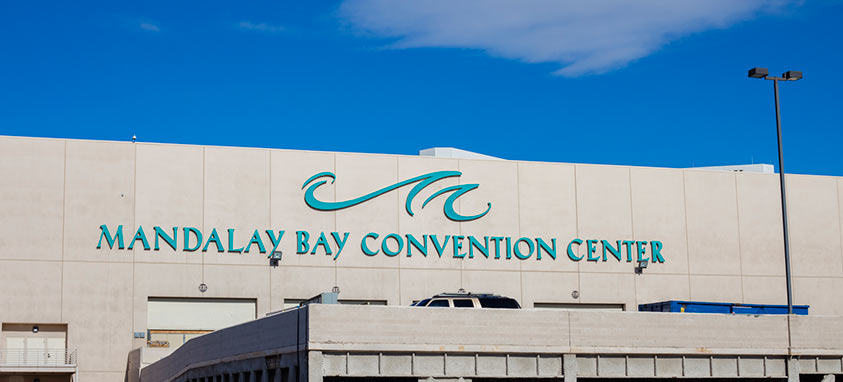
Nevada’s hospitality industry continues its green streak with MGM Resorts International‘s newly expanded rooftop solar array, which is the largest of its kind in the United States. MGM partnered with NRG Energy, Inc. to expand the solar array atop Mandalay Bay Convention Center.

Installed on the roof of Mandalay Bay Convention Center, the expanded solar array covers more than 28 acres and has more than 26,000 photovoltaic panels and produces a combined 8.3 MW dc (6.5 MW ac) of electricity, a new national record for rooftop arrays. At full production, the system supplies 25 percent of the power demand of the entire Mandalay Bay Resort & Casino campus.

The expanded solar installation is expected to displace approximately 8,400 metric tons of carbon dioxide annually, the equivalent of taking more than 1,700 automobiles off the road. The electricity produced is also equivalent to the average annual usage of 1,340 U.S. homes. Since completion of the first phase in 2014, the project has helped provide pricing stability for MGM Resorts, while reducing the amount of energy drawn from the southern Nevada grid during times of peak electricity demand.

“MGM Resorts International has a long history of integrating environmentally responsible practices throughout our operations to help preserve the planet’s limited resources,” said Cindy Ortega, senior vice president and chief sustainability officer of MGM Resorts International. “Our continued partnership with NRG is a source of pride and inspires our desire to continually implement innovative solutions that promote renewable energy.”

“Companies like MGM Resorts are driving an evolution in America’s energy mix as they seek cleaner sources of power that provide more certainty over energy costs,” said Craig Cornelius, senior vice president of NRG Energy and head of NRG’s Renewables group.

NRG owns and operates the installation for MGM Resorts at Mandalay Bay Resort and Casino. Through a 25-year Power Purchase Agreement, Mandalay Bay Resort will purchase all the electricity generated by both solar arrays.

The hospitality industry is constantly talking about future innovation. The next big thing in hotels is always right around the corner. The largest driver of those changes is customer integration; guests want customization and the ability to share their experiences. That means successful hotels will be open to customer review, will be social media-savvy, and will provide their guests the ability to access their amenities on-the-go. Here are some of the ways in which hotels in the future will appease their guests.

Infographic provided by Killarney Hotels

cventCvent Connect 2015

This week, the acquisition of Cvent, Inc., a cloud-based enterprise event management company widely used by planners and hoteliers, by Vista Equity Partners, a private equity firm that invests in technology-enabled businesses, was cleared by the U.S. Department of Justice.

Cvent and Vista have agreed that all conditions to the completion of the merger have now been irrevocably satisfied, and that the merger will be closed on or before November 29, 2016. The company’s Board of Directors unanimously approved the deal and recommended that stockholders vote in favor of it.

According to Cvent, Vista will acquire 100 percent of the outstanding shares of its common stock for $1.65 billion. Cvent stockholders will receive $36 per share in the all-cash deal, representing a 70 percent premium over Cvent’s average closing price over the past 30 trading days.

Cvent, which is based in Tysons Corner, Virginia, will become a privately held company. The headquarters will remain there.

A Mutually-Beneficial Deal

“We are pleased to announce this transaction that provides a significant premium for Cvent stockholders,” said Reggie Aggarwal, founder and CEO of Cvent in the press release. “This milestone is the next chapter in our 17-year history. With Vista’s financial strength to invest in Cvent now and in the future, we will be better positioned to deliver innovative solutions that transform the meetings and events industry, and to offer employees new opportunities for career growth.”

“Reggie and the Cvent team have built a leading portfolio of products and are positioned for expansion in a large and underpenetrated market,” said Brian Sheth, co-founder and President of Vista in the press release. “We are excited to work with the Cvent team to lead the business into this next phase. Over the last several years, Vista has developed a leading portfolio of meeting technology providers. This acquisition is our most significant investment in this space, and further solidifies our commitment to the broader industry.”

About Vista Equity Partners and Cvent

Vista Equity Partners is a leading private equity firm that invests in software and technology-enabled businesses. Vista, which has more than $20 billion in cumulative capital commitments, has offices in Austin, Chicago and San Francisco.

Cvent, Inc. has approximately 16,000 customers and 2,000 employees worldwide. Event planners often use the service for online event registration, venue selection, event management, mobile apps for events, email marketing and web surveys. Hoteliers turn to Cvent to increase group business demand through targeted advertising, and improve conversion through proprietary demand management and business intelligence solutions.

capsule-hotel-high-tech-hotelsPengheng Space Capsules Hotel, Shenzhen, China

Holographic meetings, robot concierges and underwater music systems are no longer items of science fiction—they’re current hotel amenities. These are 10 of the most high-tech hotels in the world right now.
The-W-Singapore-at-Sentosa-Island

1. The W Singapore at Sentosa Cove
Sentosa Island, Singapore

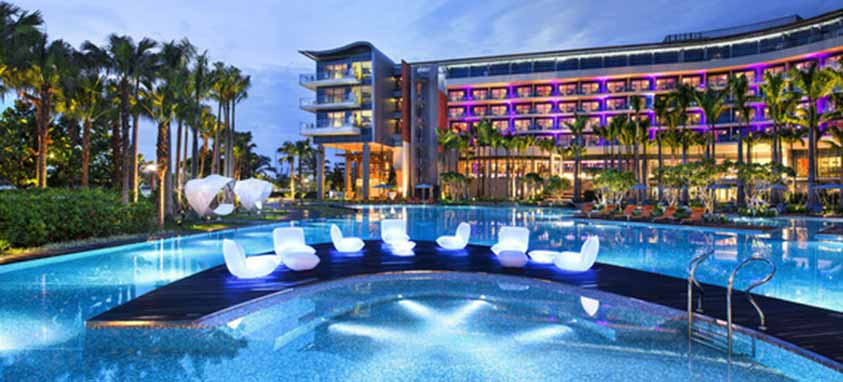
The W Singapore elevated the average dip in the pool with underwater speakers. Poolside music can also be enjoyed in a private cabana—loaner iPad included. The music technology extends to the hotel’s WOW Suite, which comes with its own private DJ booth.

LED lighting runs throughout the hotel, setting a stylish and futuristic tone. The hotel boasts 240 guest rooms and features special meeting amenities such as mood music and signature scents. The event space spans nearly 15,600 sq. ft.

2. NH Collection Berlin Friedrichstrasse
Berlin, Germany
NH-collection-berlin-friedrichstrasse

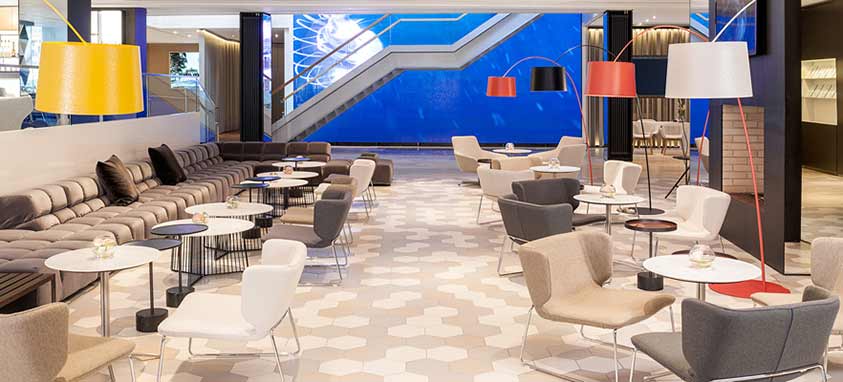
The NH Hotel is a business traveler’s dream. Holographic technology is available to guests, making 3D image projections of meeting attendees or work presentations possible. The chain’s other hotels, in Milan and Barcelona, also utilize this technology.

If inspiration strikes, guitars and keyboards can be delivered to rooms upon request. The hotel has 268 guest rooms and planners can choose from 10 different meeting spaces with a maximum capacity of 350.

3. The Hotel Silken Puerta América
Madrid, Spain
Hotel-Silken-Puerta

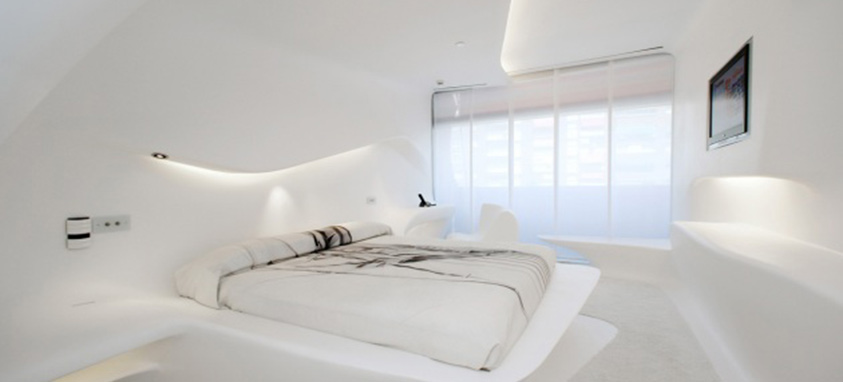
The Hotel Silken Puerta America surpasses all architecture standards. Each of the 12 floors in this rainbow-colored tower was carefully designed by nineteen top-notch architects. In an unprecedented endeavor, each floor exhibits an individual architect’s vision. Concepts are materialized in designs such as white caves and red lacquered walls. Five flexible spaces on the ground floor offer 1000-person capacity for meetings and events. The hotel offers 315 guest rooms.

4. The Peninsula Hotel Tokyo
Tokyo, Japan

The-Peninsula-Hotel-Tokyo

At The Peninsula Hotel of Tokyo, guests indulge in tech perks such as unlimited internet radio with over 3,000 stations, mood lighting pads, nail polish dryers and Skype-compatible wireless phones. The hotel’s digitally-interactive Pokémon hunt serves as an amenity for the latest kid-friendly game. The hotel has 314 guest rooms and 10 meeting spaces that can host from 18 to 250 guests.

5. The Yotel
New York City, New York, United States
the-yotel

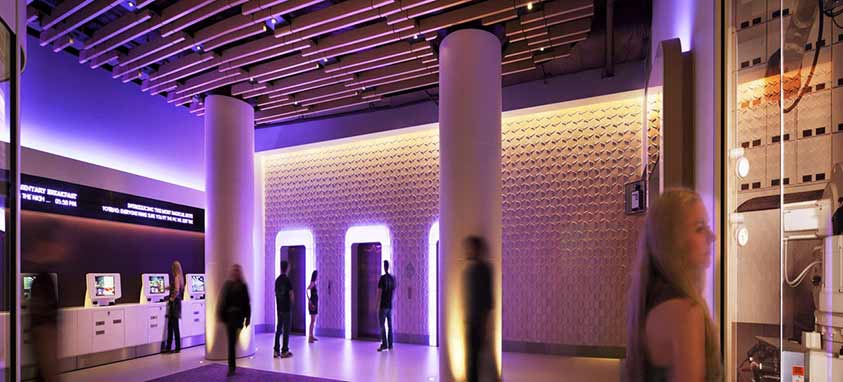
The Yotel provides a variety of advanced systems such as kiosk check-ins and fold-up beds. Perhaps the most enthralling hotel feature is YOBOT, a robot that stores luggage in locked bins. Items can later be retrieved with a pin code and last name.

Bedrooms come with techno walls and optimal Wi-Fi, audio streaming and motion-sensor air conditioning.  There are 669 guest rooms and an event space for up to 400 attendees.

6. Eccleston Square
Pimlico, London, England
eccleston-square

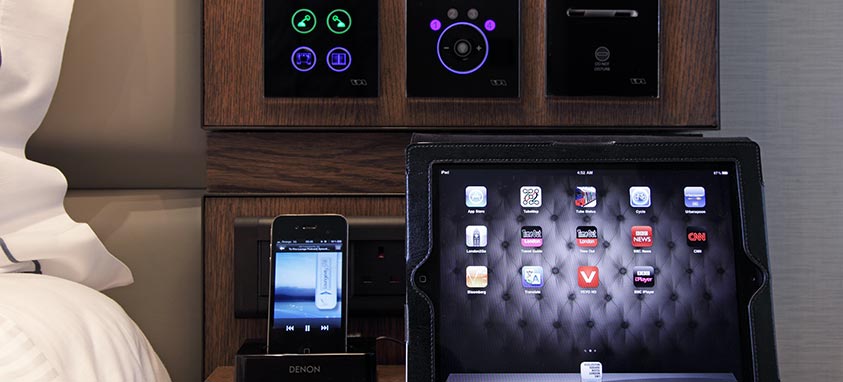
The exterior of Eccleston Square looks divinely historic. The interior, however, pulses with technologies such as keypads that control the music and lighting-controlled, shower walls with an instant frosting option, flat-screen televisions embedded in bathroom mirrors and iPads that provide concierge service from the comfort of your room. The hotel holds 39 guest rooms and a Media Lounge which can sit up to 14 guests boardroom style (up to 30 for a standing reception.)

7. Aloft Cupertino
Cupertino, California, United States
Aloft-Cupertino

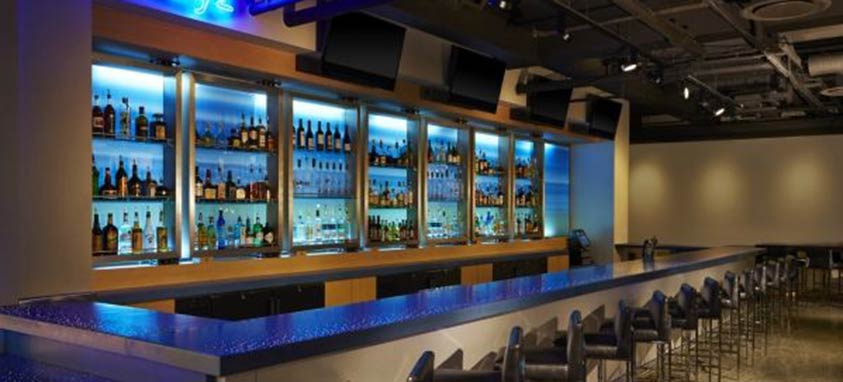
Situated in Silicon Valley, the tech capital of the world, Aloft Cupertino fittingly resembles a high-end startup. A robotic butler distributes poolside towels and room snacks. The bot also rides the elevators and alerts guests of deliveries. Each room is decorated with trendy furniture, including an Apple TV.  Aloft Cupertino offers 123 guest rooms and 3 meeting spaces and the largest event space is 1,110 sq. ft.

8. Pengheng Space Capsules Hotel
Shenzhen, China
capsule-hotel

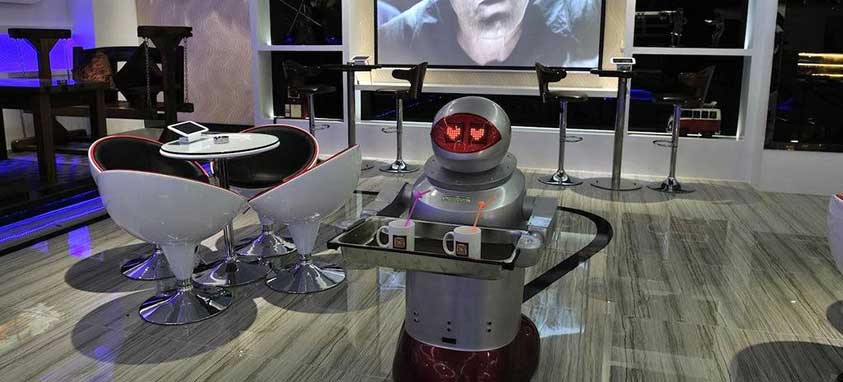
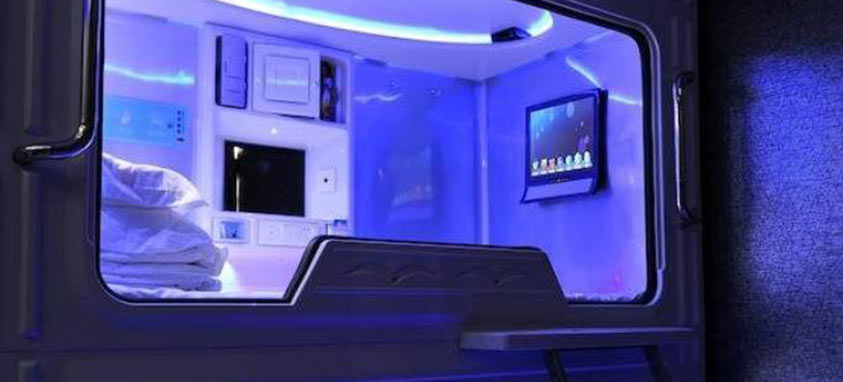
Pengheng Space Capsules Hotel has an entire staff of robots: doormen, waiters and front desk attendants. Glossy, neon surfaces, robo-waiters and banks of computers are just some features making this hotel a sci-fi reality. Beds are designed as innovative space station bunks. The minimalist design, lodging only 17 capsules, permits an affordable rate.

9. Blow Up Hall 5050
Poznań, Poland

Blow Up Hall 5050 is a hotel, restaurant and bar that also doubles as an interactive work of art due to its numerous digital art installations. The lobby installation blows up images of guests through surveillance-type shots. Traditional check-in is outdated at Blow Up Hall 5050. Instead, guests find and access their rooms using a digital key sent to an iPhone provided by the hotel. Blow Up Hall 5050 contains 22 guest rooms and event spaces that can hold up to 700 people.

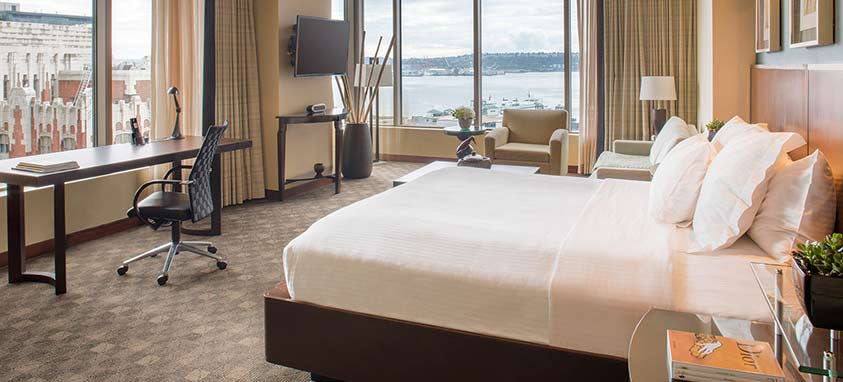
10. Hotel 1000
Seattle, Washington, United States
Hotel-1000

Hotel 1000 has mastered the art of customization through its fully converged IP infrastructure, or multimedia on a single structure. This gives guests the option to select desired room temperatures, artwork and music. There are infrared detectors in the rooms which alert housekeeping staff of guest occupancy.

The five-star waterfront hotel also offers Microsoft Surface tablets in each room, touchscreen VoIP phones and a virtually simulated golfing room.  There are 120 guest rooms in the property. Its event space can accommodate up to 75 seated guests, 80 for an event with a dance floor or 110 for a reception.

hotel tech trends

There’s no denying that millennials have a remarkable influence on modern society. For that reason, many new hospitality amenities cater to their values and needs. Implementing these cutting-edge features can also enhance guest comfort, support staff duties and advance the hotel brand. With more competition than ever, staying current is essential for hotels and resorts. Here are five major hotel tech trends we’re seeing in 2017.

1. Energy Efficiency

Adopting energy efficient products and processes benefits everyone. Some of these products include smarter thermostats and laundry units with water recycling. Making a major change in this direction can save a business thousands of dollars in utilities and energy bills.

Eco-friendly in-room features contribute to efficiency while also reinforcing positive habits. For instance, keycard-activated lighting is both practical and environmentally beneficial. Many guests also appreciate eco-friendly practices as they align with their personal ethics.

2. Smart Screens and Entertainment Streaming

Screens and streaming are emerging everywhere and certainly in the hospitality realm. Hotel elevators are beginning to introduce touch pad controls and wall art is now exhibited on big screens in some hotel rooms and lobbies for a more innovative presentation. Hotels are also realizing the value of offering popular steaming services such as Hulu and Netflix in guest rooms. Adding the ability to control room functions such as blinds, smart thermostats and lighting on smart devices will also be an exciting amenity.

3. Social Media Influence

At this point, all businesses are expected to have well-managed social media accounts. Consequently, the emphasis shifts to strategy. For the hospitality industry, proficiently tracking guest feedback and engagement is perhaps the most crucial component of social media. The voluntary data that social media provides is invaluable for improving guest experiences and attracting new guests.

4. Location-Based Services

Guest personalization has become a major concern of hotels, evidenced by the industry’s focus on geolocation-based technologies. Interestingly, 74 percent of hoteliers surveyed by Zebra Technologies, a technology company that provides hospitality tech solutions, said they plan to use geolocation to assist with guest check-in by smartphone. Additionally, 69 percent report plans to track guests’ location, facilities used and preferences. For hotels, this is ideal for leveraging the sales of their other onsite facilities.

5. Mobile Functions Across the Board

Many bookings are made on smartphones—8 percent, according to a study by Hospitality Net. Within a year or two, this number is expected to reach at least 35 percent. The growth of this platform also indicates the importance of having an optimized mobile website, which is a reflection of the entire brand. To stay ahead of the curve, many hotels are developing mobile check-in and room service apps.

mobile booking

The process of booking a trip has evolved tremendously in the last few decades. From face-to-face meetings with travel agents to phone calls to online booking—the process is nearly unrecognizable. The next step in this progression is mobile booking. The following facts about the shift come from a variety of compelling statistics.

1. Mobile search and site visits are huge

According to eHotelier, 31 percent of consumers will search their next trip from a mobile device. While searches for hotels are significant, this does not always translate into actual bookings. Smart Insights also notes that 48 percent of consumers begin mobile research with a basic search engine. Therefore, hotels should prioritize having a mobile-friendly site and good search engine optimization (SEO), even before creating a supplementary app.

2. People want on-demand booking

An Adobe Digital Report reveals that 35 percent of consumers claim to be more active on their mobile devices while on vacation than at home. Mobile booking is especially useful for last-minute bookings. Even though apps such as HotelTonight have made the popularity of last-minute bookings apparent, when a hotel offers this service directly they boost traffic and profit. A 2015 study from Statistic Brain found that 65 percent of bookings were for last-minute stays, reiterating the value of speed and real-time availability.

3. The process should be as easy as possible

Google dashboard data from April 2014 to January 2016 reveals that most consumers will use whichever device is nearby when making travel arrangements. Year-over-year, mobile device searches for hotels rose more than 27 percent. All figures point to the prediction that mobile booking will continue to rise, largely due to the prevalence of smart devices (and perhaps some human laziness). According to an Adobe Digital Insights report, 65 percent cite “simplification of tasks” as the most important component in mobile travel experience. Therefore, the ideal booking process is intuitive, navigable, clear and as concise as possible.

4. Growth figures are irrefutable

Marketing expert Frederic Gonzalo found that mobile travel bookings have risen 1700 percent between 2011 and 2015—growing from 1 percent of online revenues to 18 percent. Mobile bookings have undeniably been growing exponentially. Overall, mobile booking has become an incredibly important avenue for the hospitality and travel industries to focus on.

snapisode

Marriott is ahead of the curve. Rather than trying to outdo Airbnb, the world’s largest hotel chain has discovered a more effective solution to vie for the attention of millennials. Marriott is boosting its visibility by engaging with the right platform.

Marriott Rewards has officially entered the wonderful world of Snapchat. The award-winning loyalty program premiered the first video in its four-part series, “Six Days, Seven Nights,” on March 30. This series will showcase Marriott International’s portfolio of top properties and highlight program perks such as free Wi-Fi and room upgrades.

“There are a million reasons to travel and thousands of great places to visit, and we have incredible properties in just about any destination our guests want to go,” says Amanda Moore, senior director, social & digital Marketing, loyalty, at Marriott Rewards. “Six Days, Seven Nights introduces the Snapchat audience to the places, properties, people and program benefits that fuel our members’ experiences while traveling the world.”

A win-win scenario

Marriott has used Snapchat in the past for influencer takeovers, Snap Ads and geofilters. However, this is Marriott Rewards’ first venture into generating content for the platform. And it seems that the company has concocted the perfect blend of influencer marketing, paid ads and Snapchat’s Spectacles, which are wearable glasses that record—and Snap—from the user’s viewpoint).

This is also an exciting new venture for Snapchat. Although media partners such as IGN and The Food Network have been providing the platform with valuable episodic content, Snapchat has always had the potential for a wider scope. Marriott’s new use of the platform creates endless possibilities for introducing different brands to sponsor takeovers or even establish their own channels.

Star influencers

Each episode of the vertical video series, or “snapisode,” will be three minutes long and partially filmed using Snapchat Spectacles. The series showcases unscripted perspectives from four top social media influencers, including Tom Jauncey of Beautiful Destinations, a creative agency with one of the world’s biggest followings on social media. These media influencers will explore various destinations, cultures and relevant Marriott properties.

“We only have a limited amount of time to capture your attention, so we felt like these influencers have such a strong presence, they’re camera-ready [and] they have a built-in audience to really bring those brands to life,” says Moore.

The Snap-series will take viewers to Berlin; Seoul, South Korea; Dubai, United Arab Emirates; and New York City. Every snapisode will begin with an influencer stating their “mission” for the upcoming week. The influencer will then strive to accomplish this goal throughout their segments. Hotel staff, locals and channel audience members will make appearances as they help the influencer accomplish their mission.

In the first snapisode of Six Days, Seven Nights, influencer Levinson tries unfamiliar German food in Berlin, such as currywurst and schnitzel. The series will continue to air regularly on Marriott Rewards’ Snapchat, Facebook and YouTube. Each influencer will also compile a “best-of” travel list about their destination for @MarriottRewards Instagram Stories. The series will run through July.

AccorHotels MoodMatch

Mood rings were a major trend in the late 1970s. The accessory would change colors that were supposedly determined by the mood of the person wearing it. AccorHotels is such a fan of the concept, the hotel chain is applying it to the booking process.

On April 4, AccorHotels released its latest booking service, dubbed “MoodMatch.” Powered by tech startup Travelsify, MoodMatch aims to match user moods with appropriate hotels. Pairs rely on “Hotel DNA,” which is made up of Travelsify’s 34 key criteria formed by millions of travel reviews.

“With the launch of MoodMatch, AccorHotels once again proves its capacity to innovate and adapt to the new ways of searching for hotels,” says Bruno Chauvat, CEO at Travelsify.

“Nowadays, travelers aspire to unique travel experiences; with this new, user-friendly and fun way of finding their next destination by initially being led by their emotions and where the mood takes them, AccorHotels.com is providing a groundbreaking way of searching…which goes far beyond finding a hotel solely based on destination,” says Romain Roulleau, SVP, e-commerce and digital services for AccorHotels.

To access the MoodMatch search engine on AccorHotels.com, find the “Inspire Me” section in the “Find Your Hotel” tab. The site will then prompt you to fill out four categories that ask what the traveler is in the mood for, their preferred style, location and more. A few mood options include romantic, party and chilled-out.

Once these have been selected, the search engine provides a list of hotels, each with a percentage included. Percentages represent how closely the user’s mood matches with the corresponding hotel’s DNA. Hotels come from AccorHotels’ database of 4,100 hotels in 95 countries. The AccorHotels portfolio contains properties ranging from economy to luxury across brands such as Fairmont, Novotel, Mecure, Sofitel and Ibis.

Clearly the secret’s out—experience is the biggest incentive for the modern traveler. And customization is certainly a major part of creating a memorable experience. While AccorHotels is taking the booking process in an innovative and timely direction, one may wonder whether moods can be a bit too fickle to hold such weight in the booking process. We’ll have to wait and see if this trend takes off.