A new computer virus threat is sending event professionals scrambling to secure documents as breaches are being reported by organizations large and small across the world. The ransomware, being called NotPetya because of the computer code used, takes a similar approach to the WannaCry attacks in May that locked documents on as many as 75,000 computers, including NHS personal computers. Like the previous virus, victims receive a message on their screen telling them that their files have been encrypted and they will have to pay to get access. The attacks have hit infrastructure companies hard and may have led to flight delays at an airport in Kiev and the Ukraine.

Although many have already followed best practices and updated Windows operating software with patches since that event, officials are reporting that even those computers are vulnerable. While hackers continue to get more sophisticated and find new ways around security systems all the time, this is a reminder that event professionals, who often travel and use public internet access, need to use best security practices at all times.

Matti Kon, a security expert and president and CEO of InfoTech Solutions for Business shared these simple tips for protecting yourself and your attendees at events and on the road.

1. Install anti-virus software and keep it current.

While some features of anti-virus software can seem inconvenient, the time spent typing in passwords will be insignificant compared to losing data or the embarrassment of accidently spreading a virus to clients. Firewalls and intrusion-detection software can further help to minimize threats. Virus scanners can also protect from possible problems on flash drives and documents from speakers accessing your computers for presentations.

2. Routinely change passwords.

Again, the inconvenience of memorizing new, more complex passwords can seem counterproductive, but the first time a hacker tries “password1234” and gets in, will be the last time that person uses it. Unfortunately, in a world of frequent attacks that is lived even more often online, variations on a theme can leave vital information vulnerable.

3. Practice safe open Wi-Fi.

When in public places like coffee shops, airports, hotels and conference centers, ensure that you are using the hotel’s actual Wi-Fi. When possible, create your own VPN for added protection. Then immediately disconnect when you are done and erase traces of connectivity from your device.

Disable file-sharing or system access rights on your laptop, computer or PDA device, and secure the browser by forcing the use of Hyper Text Transfer Protocol Secure (HTTPS) as well.

4. Rely on experts.

For additional protection when hosting offsite events, IT outsourcing firms can run penetration tests on systems to assure that firewalls and Wi-Fi networks are secure and correctly routed.

uber for business remodel

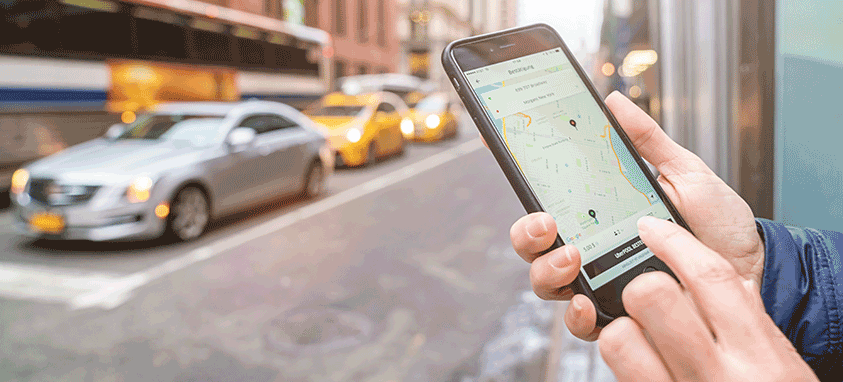
Uber for Business released a new version on Aug.  15, marking the first significant change since the feature’s debut 3 years ago. Employers can now set travel restrictions for when their employees use the service. Preset restrictions include: time of day, specified geographic limits, type of car used and amount of rides.

Custom programs are also available. For instance, First and Last Mile programs for commuters, recruiting and travel programs, employee perks and other travel expense programs may be applied. In addition, employees can assign different types of programs and perks based on employees’ roles.

When signed into their business accounts, employees can see their specific programs. If a trip does not qualify to be expensed, the rider will be asked to use their own payment method.

Automatically Easier

Uber for Business has also streamlined the process. Rather than relying on human resources to inform and track (often inaccurately) employee usage, rules are automatically enforced. Plus rides may be expensed directly. The manager-facing back end for Uber for Business has also been redesigned for simple functionality. And Uber Central is directly incorporated into the interface, allowing approved managers to make particular adjustments or exceptions outside of the current policy.

“This new version of the platform is focused on truly enabling those use cases that businesses were already turning to us for, but Uber for Business wasn’t built for yet,” said Greg Greiner, Uber for Business’ head of product, to Skift. “The future is really about how we continue to expand to allow the product to be used for more.”

Companies of all sizes and employers of all tech proficiencies will benefit from the program’s upgrade.

new ar at events

Event planners are starting to inject real-world connections in meetings by including artificial intelligence, virtual reality and augmented reality. Often this has been limited to merging data from social media profiles to populate conference apps and suggest meetings. GPS capabilities most often show up in treasure hunts and suggestions for breakout sessions, but Apple could be taking that interaction to a higher level if rumors about the inclusion of augmented reality in the September release of Apple iOS11 are true.

The blog Apple Insider is reporting that ARKit, a new framework built into the next iPhone release, could make creating immersive augmented reality easy for anyone to incorporate in new products. This is good news for planners, who will be able to connect with attendees in more meaningful ways.

After years of speculation, Absolute Exhibits, a trade show display provider, is calling AR one of the top trade show trends of 2017. Here are some examples of how you might incorporate the virtual world on the exchange floor in the near future.

1. Push Notifications

Conference apps can include the ability to sense in real time when someone you know you want to meet is within a set distance, and send them a note on their phone, inviting them to drop by for a chat.

2. Demonstrations

We all know the power is in the showing rather than the telling. AR and VR allow you to demonstrate how a property or product will feel and perform, rather than listing out square-footages and room amenities. A virtual tour allows potential visitors to explore on their terms, looking closer at what catches their attention. Taking a photo of a product can reveal more information and easily notify a vendor if follow-up is appropriate.

3. Interactive, Accurate Maps

If realistic AR is built into most phones, it will eliminate the need for awkward headsets and put the power in the hands of anyone who wants it. It untethers attendees from relying on GPS satellites to figure out where they are by referring to actual 3-D images from their phone to guide them to the next session or the right booth. Changes in the floor plan? No problem. Unlike a printed map, a few clicks can update the app for accurate results every time.

wake up and smell the airplane scent

Scents provoke very powerful emotions. They can lift your spirits or arouse a vivid memory. Businesses of all kinds have discovered this secret weapon and that includes airlines.

You might be thinking—smell is never a positive topic when it relates to planes. It’s easy to understand why. Recycled air amongst dozens of people for hours at a time isn’t exactly something perfume companies are eager to bottle up and sell. That could be about to change.

Appeasing Your Fifth Sense

A new fragrance diffusion system, called FIVE, is being developed by Zodiac Aerospace’s California-based Pacific Precision Products. The name FIVE embodies the fifth sense—smell. Brian Jorgensen, Zodiac’s director of sales, explained to CNN that the product satisfies an “unfulfilled need” in the luxury aviation and business-jet market.

“Using scent [can] enhance the airline’s brand and customer retention, boost on-board sales, and provide their passengers [with] a completely enhanced sensory experience,” Jorgensen tells CNN.

“The experience has been designed to be very subtle, almost just felt in a subliminal way, below conscious level,” he explains, adding, “something that positively influences the moods and emotions of the passengers, but without necessarily being detected as the smell of a specific fragrance.”

FIVE uses “dry scent” technology developed by ScentAir, its fragrance partner. Each FIVE unit runs on up to four different cartridges which can be programmed to diffuse allergen-free aromas through a space of nearly 1,300 sq. ft. at interval times. Once the scent has adequately dissipated, the unit automatically shuts off. And it leaves no trace unlike fragrance alternatives (liquids or sprays), which can leave residue left on clothing or seats.

ScentAir clients are mainly in the hospitality, gaming, medical and real estate industry. Major brands such as Hilton, Marriott, Starwood and IHG have gotten on board with these exquisite aromas. FIVE is now targeting business and VIP aircraft operators.

Scents Get Personal

There are currently 50 different fragrances available in their catalogue. These scents are designed to embody different types of moods, including: Luxe & Sophisticated, Relaxing & Soothing and Voyage & Escape. They also aim at appealing to specific regions and cultures. General consumer preferences and tastes inspire various fragrances.

“Geography, which drives regional availability of food ingredients and living habits, plays a large role,” Ed Burke, vice president of customer strategy and communications at ScentAir, tells CNN.

Europe, the Middle East and Africa favor the FIVE Warm Bread fragrance, which is described as “fresh baked bread with a hint of warm butter.” Meanwhile, Asia Pacific markets prefer a scent called Black Orchid, a “sophisticated lush green floral fragrance.” Mexico, Central and South America preferred Lemongrass and Vanilla Bean.

Too Little, Too Late? Add London to the Uber Ban List

On Friday, Transport for London announced London’s decision to ban Uber, claiming the company “demonstrates a lack of corporate responsibility in relation to a number of issues which have potential public safety and security implications.” And if history repeats itself, Uber will successfully stall the ban.

Dara Khosrowshahi, Uber’s CEO, responded with an apology and emphasized plans for change. Still, a history of unethical behavior cannot just be forgotten. Of course, Uber is an extremely useful tool while traveling and during events. Yet some skepticism still lingers among professional planners. Here’s why the situation isn’t so simple.

A Controversial Past

Although word of Uber’s questionable tactics has spread far and wide, the whole picture is often unclear. The spying programs, lawsuits, sexual harassment and discrimination claims have created an unsettling saga. We’ll lay out a few of the big major issues levied against the sharing economy king.

Let’s begin with Uber’s former CEO, Travis Kalanick, who was compelled to resign on June 21. Kalanick first received backlash in February 2014, when he made a sexist joke to an Esquire reporter that ended with the punchline, “We call that Boob-er.” Although there were many road bumps in-between, Kalanick was caught on camera yelling at his Uber driver in March 2017. This caused another typhoon of backlash.

The app has also been dubious when it comes to privacy. In November 2014, Uber’s “God View” technology was exposed. This means Uber had the technology to track the locations of its users. It came out that this power was being abused when a reporter complained that an Uber manager accessed her profile without permission. Adding to fears, it was revealed in December 2016 that the app had a tendency to frequently spy on exes, politicians and celebrities. Finally, work on a secret program called Hell, which allowed Uber to spy on its top competitor, Lyft, was leaked in April.

The most concerning objections involve Uber’s mistreatment of both its drivers and customers. After advertising false figures to drivers, Uber was forced to pay a $20 million settlement in January. Later that month, the #DeleteUber campaign popularized. The hashtag formed in response to skyrocketing surge prices during a taxi protest at a New York City airport (a demonstration against the Trump travel ban).

Just two months later, a highly publicized leak revealed that a top executive at Uber had hidden medical records of a woman who was sexually assaulted by an Uber driver. Eric Alexander, the executive, was fired. However, the woman still carried forth a lawsuit. She protested that the company violated her privacy and wrongly deprecated her allegation.

Once the madness accumulated to irreparable levels, Kalanick was forced to resign. In an effort to implement major improvements, U.S. Attorney General Eric Holder gave the company a lengthy list of provisions. The 47-step plan is based on an investigation into harassment, discrimination and retaliation.

The Uber Ban List

In the United States:

  • Alaska
  • Austin, Texas (due to city policies)
  • Oregon (minus Portland)

Internationally:

  • Australia (northern territories)
  • Brno, Czech Republic
  • Bulgaria
  • China
  • Denmark
  • Hungary
  • Italy
  • Japan
  • Taiwan
  • Vancouver, British Columbia, Canada

The Planner’s Predicament

Evidently, it’s safe to say that Uber employs some questionable tactics—to say the least. Still, here’s why planners might have some trouble parting ways with the app.

No cash, no problem. It can be difficult to remember cash while on the road, especially when you have a million other things to remember. Plus, there’s no need to convert currencies when traveling abroad.

Availability and reliability. While there’s no guarantee Uber will be readily available at any given time, the chances are very high that it will—especially in a big city. Even when there’s a crowd, Uber has a supply of cars.

Fairly safe option. Barring some very rare incidents, the app has historically been safe. Since the car will pick you up from a chosen location, the risks of walking to, or waiting at, a bus stop are eliminated.

Time saver. Uber shows up pretty quickly. Aside from its speedy response time, both the amount of time to get to a location and for the car to arrive is evident to the passenger. Therefore, you can plan more efficiently.

In Conclusion

Lyft is perhaps the best alternative to Uber. It might not be as widely available as Uber, but the system is nearly identical and the prices are often comparable. In addition, Lyft runs more vigorous background checks on its drivers.  Ultimately, the choice of whether or not to use Uber falls on the individual. If you’re currently debating where you stand, perhaps it’s best to wait and see. Even though Uber has failed to follow through in the past, perhaps it’s only fair to give the new CEO an opportunity to amend the app’s problematic history.

pedal phone power

Photo credit: Indianapolis Airport Authority

Name two essential things about meetings. The list can be fairly long, actually, but we’ll nominate communication and well-being. Well, now attendees can multitask them together.

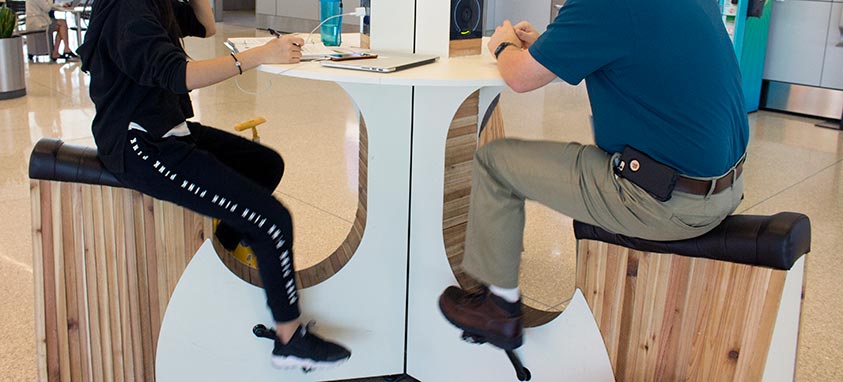
It’s called a human-powered charging station. If you’ve been through Indianapolis International Airport (IND) lately, you may have seen one of them on Concourse B. It’s a three-seated kiosk without wheels that charges your cellphone or other electronic device—thus becoming an enabler of communication—as you pedal away (the well-being part) between being stuck in an airplane. You can also find them at Flagstaff Pulliam Airport (FLO) in Arizona and Long Beach Airport (LGB) in Southern California.

The units are made by WeWatt, a Belgian company, and are a hit in Europe at airports, railroad stations, shopping malls and universities.

But you don’t have to buy one. You can rent one for your next event.

That’s the offering of an Oakland, California-based company called Rock the Bike.  Its version of a bike recharge station is available in four bright colors and looks more like a stationary exercise bike with a desktop where the handle bars usually are located. “That was on purpose,” says Brittany Rowles, director of sales and customer experience. “We want to get people inspired to get on bikes again.”

Rock the Bike’s base price is roughly $600 per day for one bike (the charge varies depending on number of bikes rented, number of days and shipping distance). For an extra $450, you can brand the wheel. Or you could upgrade to a readout that provides live pedaling stats, including instantaneous wattage and accumulated energy. Its version charges eight phones (or any device that can be connected by a USB cable) at a time and it sparks the kinds of informal conversations and networking that draw people to conferences, concerts and meeting in the first place, Rowles says.

For best results, Rowles adds, a coach can “help people feel more relaxed and comfortable, plugging in their phones and adjusting the seat to the right height for new riders.” A Pedalometer shows users how fast to pedal to maintain consistent charging—which works as fast as the latest wall-powered chargers.

“It’s not like the cardio machines at the gym,” Rowles maintains. “Talking and pedaling is very doable, even while charging eight phones.”

what to know about krack

If you’re even the least bit freaked out by the KRACK Wi-Fi security flaw, and wondering how it might possibly impact your life and meetings, here’s a bit of reassurance and advice.

First, What Is It?

KRACK is shorthand for Key Reinstallation Attacks, and it was discovered way back in May by a web security researcher in Belgium named Mathy Vanhoef. It’s technical, but basically it means he discovered a key flaw in something called Wi-Fi Protected Access 2, or WPA2, which has been the go-to option to protect your data over Wi-Fi since 2004.

The flaw means data you thought was safely encrypted can potentially be read and stolen. Or, in some cases, manipulated. “In practice,” intoned Wired recently, “that means hackers could steal your passwords, intercept your financial data, or even manipulate commands to, say, send your money to themselves.”

Whoa.

But on the Other Hand…

Take a deep breath. Breathe out and try to relax.

First off, this is not kid stuff. Or, more accurately, not every teenaged nerd in his bedroom can now steal your stuff or hack your event. In fact, no one has actually gotten ripped off yet, as far as we know. Vanhoef delayed making his discovery public for the very reason that he wanted to give the software engineers at companies whose products could be compromised (who he did alert) time to fix the flaw by making a “patch.” Furthermore, experts agree exploiting the flaw is a sophisticated undertaking.

Perhaps most important of all to know, your event is in no danger whatsoever from some internet criminal in Russia or Transylvania using KRACK.

An attacker has to be in range of your Wi-Fi.

So, What to Do

Vanhoef advises: “To prevent the attack, users must update affected products as soon as security updates become available. If your device supports Wi-Fi, it is most likely affected.”

Obviously, that means adding a new checkbox to your event to-do list. Have your Wi-Fi routers and other Wi-Fi enabled hardware been patched to make them KRACK-proof?

If not—and you can’t or don’t want to switch venues—advise attendees of the situation and suggest disabling Wi-Fi in their personal devices if they are concerned.

If possible, connect to the local network the old-fashioned way, using an Ethernet cable.

When sharing sensitive data, make sure you do so only with sites that use HTTPS encryption, for a higher level of security.

A Final Few Words

This is serious business, even if the media hype is a bit hysterical. “The problem is not so much that there are a ton of bugs in WPA2,” Matthew Green, a cryptographer at Johns Hopkins University explained to Wired. “It’s that it will be very hard to patch most low-cost consumer devices. So all it takes is one bad one to screw a lot people up for years.”

Wired concluded: “There’s some good news. Most current versions of iOS and Windows aren’t vulnerable, or are only vulnerable in one niche circumstance, because of the way Apple and Microsoft implemented the WPA2 standard…But the millions and millions of impacted devices will present a challenge to fix.”

google mobile payment

You’d be hard pressed to find a place that doesn’t take card as payment these days. Even small businesses such as food trucks and coffee shops are utilizing square technology, and there’s less need to keep cash in your wallet. However, the mobile pay trend is growing in popularity at a rate that may one day obliterate the need to carry plastic, as well. As event planners are constantly on the move, with a constant switching of carry-on bags, purses, and wallets, it becomes difficult to know which card is where. Thankfully, Google is taking steps to make day-to-day mobile transactions easier.

Introducing Pay with Google

The tech giant announced Monday that it’s launching a new way for customers to pay with mobile devices, using any card you have on file—including those saved to their Google Accounts via products such as Google Play, YouTube, Chrome and Android Pay. Dubbed Pay with Google, the option ties all your saved payment options together in a single interface, which app makers and retailers can then implement using only a few code lines.

The goal is to create a faster, more seamless checkout for retailers and consumers. As busy event planners, this technology saves time in lines, at airports, at hotels and even on airplanes by eliminating a need to dig through wallets searching for the right cards or wait for the loading of multiple mobile payment apps.

The technology has been in the works for a long time, and was announced this May, at Google’s I/O Developer Conference. It’s aptly named The Google Payment API.

How Does It Work?

When you opt to check out using Pay with Google, you’ll be presented with a list of payment cards saved in your Google account. To continue, you just tap the card you want to use, and Google sends this information, along with your shipping address, to the merchant, who then handles the rest of the transaction.

Allowing Google users to tap into any payment card they have on file with Google, rather than those they’ve specifically saved to Android Pay, creates an easier system for transactions as well as better conversions for merchants. This technology is pivotal for vendors and event planners alike; pay with Google provides an easy way to pay on the road, in your hotel or on the plane.

Where Can I Use It?

Pay with Google presents a seamless way to pay for anything from hotel and airfares to that much-needed, early morning cup of Joe. You can use Pay with Google on your laptop, mobile phone, iPad and other devices. We live in a technology-dependent society, in which we need to use multiple devices and interfaces frequently; this makes Pay with Google a helpful modern-day program.

Google partnered with more than 40 payment providers to make integrations simpler for merchants who want to offer Pay with Google. Kayak, Doordash and Wish are just a few of the services currently providing Pay with Google in their Chrome browsers.

The payment providers—including PayPal’s Braintree, Stripe, Vantiv, Worldpay, Adyen and Groupe Paysafe—will continue to process the consumer’s transactions just as they’ve done before.

What Happens Next?

Because the option to Pay with Google requires merchants to use the Google Payment API, the option is not yet available everywhere. The API is however, available globally, which allows for room to reach other markets, including Brazil and Europe.

For now, Google Pay works within specific mobile apps and Chrome, with potential to grow and expand to include other browsers in the future.

bitcoin

What Is It?

Bitcoin is a decentralized, digital “cryptocurrency” powered by a vast computer network. It’s been recognized as a currency by the European Union, yet China recently closed cryptocurrency exchanges serving its local markets—where more than 80 percent of the world’s Bitcoin transactions and financing activities were taking place until recently. Pan Gongsheng, vice governor of the People’s Bank of China, told a financial meeting over the weekend that Bitcoin is a bubble waiting to burst, like “tulip mania” in the 1600s and the dot-com crash.

Why Do We Need It?

Blockchain, the technology that underpins it, is “a machine for creating trust,” as The Economist puts it. It lets people who do not know (or trust) each other execute a secure transaction. It does this for a small fee, but without having to go through a bank or other central authority.

Why is this important? Meeting planners can potentially save money by paying in Bitcoin. Think of every transaction where a planner would typically pay via credit card or, say, PayPal. If a hotel accepts Bitcoin in payment, planners could potentially negotiate better prices by reducing the cost of fees third parties typically charge for processing transactions. Similarly, savvy planners can potentially use price fluctuations in Bitcoin to their advantage.

Can We Trust It?

The Economist says yes: “Bitcoin’s blockchain ledger prevents double-spending and keeps track of transactions continuously…Any attempt to tamper with any part of the blockchain is apparent immediately.” Bitcoin’s risk is its price volatility.

How much does the value of Bitcoin fluctuate?

In July 2010, 1 Bitcoin was worth 8 cents. After a rapid rise in value in 2013, the cryptocurrency’s value more than halved by mid-2015. A year ago, a Bitcoin was valued at about $765. Today, one Bitcoin is worth nearly $11,500. There are 16,720,225 Bitcoins in circulation.

Who Accepts Bitcoin?

The list grows longer by the week. Many hotels now accept Bitcoin—as do some casino slot machines. Bitcoin.travel has one of the most comprehensive lists of businesses that use Bitcoin, according to Forbes. It offers accommodation, apartments and attractions around the world. Expedia accepts Bitcoin payment through a partner, Coinbase. Expedia’s website states, “To complete your booking, you will be re-directed to Coinbase’s website, where you will see the total cost of your booking in Bitcoin, based on an exchange rate set by Coinbase. The Bitcoin price for your booking will remain valid for 10 minutes. If you do not initiate a payment during this time, the Bitcoin exchange rate will be updated and the Bitcoin price for your booking may change.”

OwlTing, a Taiwanese technology company, announced today it has launched the world’s first blockchain hotel management service. It plans to be in 30,000 hotels and hostels in the United States, Taiwan, Japan, Malaysia by 2019. Among other services, the software supports PayPal, Stripe, WeChat, Alipay, Apple Pay, Bitcoin and “other cryptocurrencies in the future.”

How Can Bitcoin Be Acquired?

The easiest way is use Coinbase’s app, which lets anyone trade in Bitcoins. A much harder way is to become a Bitcoin miner, which now requires purchasing custom mining hardware. Mining is actually the process of verifying other Bitcoin transactions, which users are rewarded for. To be worth it, mining requires a powerful gaming computer, says Wikihow.com.

The Bottom Line Here?

Be aware of Bitcoin, but beware.

Photo credit: The Bullock Texas State Museum of Art

Emerging technology is turning museums into stars. Many are incorporating innovative and interactive media in exhibit spaces to enhance the visitor experience. And it just so happens that some venues offer masterpiece meeting spaces as well.

Following is a collection of places that have mastered the art and science of the meeting.

Franklin Institute, Philadelphia, PA

Have you ever wondered what diving into gushing blue waters with mammoth whales would be like? Or what it feels like to breeze past the bubbling sun? The Franklin Institute in Philadelphia makes these experiences possible by offering virtual reality (VR) designated spaces.

At this museum, visitors use VR goggles to interact with exhibits and view 360-degree photos and video supplements, as well as immersive “worlds.”

The 15 meeting venues in the building also embrace the colorful spirit of technology. If a high-voltage cocktail party is on the agenda, try the Electricity Room. Attendees can light up the floor just by moving around—a stimulating incentive for networking. Or have Ben Franklin look down upon your VIP event in the Ben Franklin Memorial hall. A 20-foot statue is erected in the founding father’s honor.

Many hotels in the area are less than a 15 minute walk away.

Cleveland Museum of Art

The bemoaned proverb “Don’t Touch the Art,” has taken the backseat. In this museum, art is available at your fingertips.

Cleveland Art Museum features a 40-foot touchscreen ArtLens Wall. Patrons can browse a collection of more than 4,000 artworks grouped by time period, materials used and technique. It rotates images every 40 seconds to keep things fresh. Visitors can zoom in for more information, or “favorite” artworks on the curated app and build a personalized tour through the museum.

In the ArtLens studio, it gets even more interactive with virtual painting and pottery making. Specialized stations further explore the gallery’s collection. For example, the Reveal station uses motion-senor technology to enhance an image from blurry to crystal clear. Visitors use sweeping motions to enhance the overall composition, and miniscule movements for the finer details.

The Ames Family Atrium in the museum strategically uses a three-story, glass-enclosed space to create a welcoming air for an event. The grand venue also connects to an outside terrace for the warmer months.

Detroit Institute of Arts

This museum adds another layer to the world—or unravels it in the case of applying augmented reality (AR) tools to a mummy’s skeleton. Lumin, a mobile smartphone tour, uses 3D mapping and AR to bring exhibits to life using overlays, videos, photographs, sounds and touch-activated animations that provide in-depth information about an artwork.

For example, using the device at the Ishtar Gate exhibit can replicate a walk through the gates of Babylon. The technology additionally invites visitors to play games or solve puzzles at different stops for deeper engagement.

The museum’s 12 event spaces also feature artful and historic decorations. Your next meeting could be in an interactive exhibit.

Bullock Texas State Museum of Art

Everything’s bigger in Texas, including the museum experience. Bullock aims to tell the whole story of Texas and its many characters.

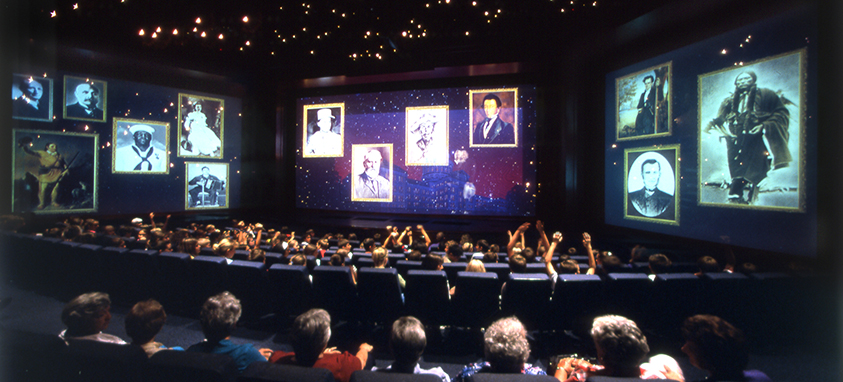
From June to December, the museum theater will screen “Shipwrecked.” It’s a rocky story told through Pierre Talon, a real-life passenger aboard French explorer La Salle’s 1684 North American colonial expedition. The multi-sensory film that will introduce rain, lightning and “other fun surprises,” to the viewing experience.

Flexible meeting space totals more than 67,000 sq. ft., including an exhibit that can simultaneously double as a venue. Bullock’s two theaters can also be rented out.

Renwick Gallery, Washington D.C.

If you can’t go to the art, the art will come to you! Wonder 360 is a specially curated app that allows users to view the Wonder exhibition at the Renwick in 3D panoramic views. It also includes video interviews with the artists and curator.

The experience can be best enjoyed with a VR viewer, such as Google Cardboard—a device that costs as little as $8.

So, go ahead and transport the sculptures to your event in Renwick’s 4,000 sq. ft. of gold-accented event space. Or, just a few minutes down the road is the Smithsonian American Art Museum (SAAM). One great find in SAAM is The Luce Foundation Center venue that overlooks a sculpture gallery and showcases more than 3,000 artworks.