family friendly events

With more professionals striving to achieve the perfect work-life balance, family-friendly meetings and conferences can go a long way toward providing the perfect mixture of business and pleasure for attendees.

Although some planners fear that a family-friendly meeting will provide yet another distraction to the already saturated mix, many see including family members as an enhancement to the experience. In fact, when attendees bring loved ones along, they take more time to truly relax and enjoy a destination, and as a result are more likely to arrive at the conference or meeting more refreshed and ready to take on the day. An added bonus is that attendees are less likely to be constantly connected to their devices checking-in with family back home, allowing more face-to-face time with their colleagues and peers.

Following are some tips for hosting a family-friendly program.

Drive Connections Through Family Involvement

When a meeting planner decides to move forward with a family-friendly event, the most important tool to ensuring success is a balanced itinerary. Of course, the meeting program will need to include specific business-only portions, such as keynote sessions and teambuilding activities, but it is just as important to arrange social activities that the family members can also enjoy.

One of the most impactful ways for attendees to network and connect is by spending time with each other’s families. For example, a family social hour or reception where everyone can meet and mingle helps people connect on a personal level. Interactive family activities, such as relay races or tournament-style yard games can help to forge lasting memories.

When possible, schedule some time-off for attendees so they can experience the destination with their loved ones. Allowing sufficient downtime goes a long way toward creating a trip that attendees will cherish.

Select the Appropriate Venue

When securing a destination, research sites to ensure that venues not only provide a wide-variety of activities, but also has the appropriate meeting capabilities. For example, at Hyatt Regency Lost Pines Resort & Spa, meeting space features the most updated technologies, paired with exciting and fun activities for every age—from lounging by the 1,000-foot lazy river or taking a horseback ride, to enjoying a round of golf or relaxing spa treatment.

Additionally, some destinations provide incentives or conference programs with discounted rates for groups to bring their families along while not breaking the bank.

Keep Your Audience in Mind

Tailor the experience to the attendee list. When coordinating a family-friendly meeting, request the ages of each family member who will be attending as part of the RSVP to better plan age-appropriate activities and services. For example, if attendees have younger children, it may be worth finding a venue that has special accommodations for young children and babies or arrange for child care on-site.

Providing family members with overviews or brochures of activities that they can take part in while their loved one is at the business-driven portions of the meeting can also make the trip more enjoyable for everyone.

Erin Cook is director of sales and marketing at Hyatt Regency Lost Pines Resort & Spa. She has nearly 10 years of experience working in the hospitality and meeting industries.


This November, Smart Meetings is featuring the best hotelfies of the year and we need your help! Post a selfie at your favorite hotel and be automatically entered to win a 4-night stay at a private island resort, Cayo Espanto! Maybe you know a boutique hotel with a beautiful view or a breathtaking resort with stunning grounds. Whichever property you love, strike a pose—you could be featured in Smart Meetings magazine (and picture yourself at the breathtaking Cayo Espanto, obvi).

Here’s How to Enter

Entry Deadline: August 31

  • Snap your selfie
  • Post it to Instagram and include a fun fact about why you love that property
  • Follow @smartmeetings (hint: in order to enter, this is a must!)
  • Tag or “check in” with the hotel you’re featuring on Instagram
  • Use #hotelfie in your post

We will feature our favorites in the November issue of Smart Meetings so make it a good one. All entries are automatically entered to win a 4-night stay at Cayo Espanto—winner will be announced in the November issue.

Distinguished hospitality partners earn coveted Smart Meetings honor

After much voting and decision-making, the 15th annual Platinum Choice Award winners have been selected by the Smart Meetings magazine judges. This highly esteemed award salutes excellence in service and amenities among meeting hotels and resorts in the United States, Canada, Mexico and the Caribbean. Also recognized is exceptional service by destination marketing companies and CVBs from across North America.

Selecting top tier winners from the thousands of properties that host groups is not an easy task. Recipients of the award have demonstrated exemplary standards of excellence ranging from ambience, amenities and guest services to meeting space and packages, recreational activities, dining options and technical support. Platinum Choice Award recipients were nominated by dedicated industry professionals and received a thoughtful review by the Smart Meetings editorial team who selected the final honorees.

“Over the years, our list of winners has become a crucial resource for many meeting planners,” says Marin Bright, founder and CEO of Smart Meetings. “The Platinum Choice Awards really identify the best of the best in today’s hospitality industry. I hope you use this roster of supplier partners when selecting your meeting destinations for the coming year—they certainly have earned your business.”

The new honorees will be celebrated in the December 2018 issue of Smart Meetings magazine. Those winners are as follows:

Hotels & Venues

CVBs

Alohilani Resort Waikiki Beach
Aria Resort & Casino
Arizona Biltmore, A Waldorf Astoria Resort
Atlantis Casino Resort Spa Reno
Atlantis Paradise Island Bahamas
Austin Convention Center
Barceló Maya Grand Resort
Borgata Hotel Casino & Spa
Boston Harbor Hotel
Colonial Williamsburg Foundation
Eden Roc Miami Beach
Eldorado Hotel & Spa
Fairmont Grand Del Mar
Fairmont Royal York
Fairmont San Francisco
Fairmont Scottsdale Princess
Four Seasons Resort and Club Dallas at Las Colinas
Foxwoods Resort Casino
Gaylord National Resort & Convention Center
Grand Fiesta Americana Coral Beach Cancun
Grand Geneva Resort & Spa
Grand Hotel Mackinac Island
Grand Hyatt Baha Mar
Grand Hyatt Kauai Resort and Spa
Grand Hyatt San Antonio
Grand Wailea, A Waldorf Astoria Resort
Hawaii Convention Center
Hershey Lodge
Hilton Cincinnati Netherland Plaza
Hotel del Coronado
Hotel Pullman San Francisco Bay
Hotel Teatro
Hutton Hotel
Hyatt Regency Hill Country Resort and Spa
Hyatt Regency Lake Washington at Seattle’s Southport
Hyatt Regency Minneapolis
Hyatt Regency Orlando
Hyatt Regency St. Louis At The Arch
Hyatt Regency Tamaya Resort and Spa
Hyatt Ziva Cancun
Innisbrook, A Salamander Golf & Spa Resort
Inn on Biltmore Estate
Jackson Lake Lodge
JW Marriott Austin
JW Marriott Marquis Miami
JW Marriott Nashville
JW Marriott Scottsdale Camelback Inn Resort & Spa
Limelight Hotel Aspen
LondonHouse Chicago
Manchester Grand Hyatt San Diego
Mandalay Bay Resort and Casino, Las Vegas
Margaritaville Hollywood Beach Resort
MGM National Harbor
Miramonte Indian Wells Resort & Spa, a Curio Collection by Hilton
Miraval Arizona
Mohegan Sun
Monarch Beach Resort
Montage Palmetto Bluff
Nemacolin Woodlands Resort
Nizuc Resort & Spa
Ojai Valley Inn
Omni Orlando Resort at Championsgate
One&Only Palmilla
Oregon Convention Center
OUE Skyspace LA
Paradisus Los Cabos
Park Hyatt Aviara Resort Golf Club and Spa
Peppermill Resort Spa Casino
PGA National Resort and Spa
Pinehurst Resort
Ponte Vedra Inn & Club
Renaissance Dallas at Plano Legacy West Hotel
Reunion, A Salamander Resort
Rosen Shingle Creek
Royal Sonesta New Orleans
Salamander Resort & Spa
San Luis Resort Spa and Conference Center
Sea Island
Seaport Hotel & World Trade Center
South Seas Island Resort
Suncadia Resort
Tanque Verde Ranch
The Breakers Palm Beach
The Broadmoor
The Coeur d’Alene Resort
The Davenport Grand Hotel
The Diplomat Beach Resort Hollywood, Curio Collection by Hilton
The Grand Vidanta Convention Center at Vidanta Nueva Vallarta
The Kahala Hotel & Resort
The King and Prince Beach & Golf Resort
The Naples Beach Hotel & Golf Club
The National Conference Center
The Peabody Memphis
The Phoenician, A Luxury Collection Resort, Scottsdale
The Post Oak Hotel at Uptown Houston
The Resort at Paws Up
The Resort at Pedregal
The Resort at Pelican Hill
The Ritz-Carlton, Dove Mountain
The Ritz-Carlton Bacara, Santa Barbara
The Roosevelt Hotel New York City
The Sea Pines Resort
The St. Regis Mexico City
The Westin Grand Cayman Seven Mile Beach Resort & Spa
The Westin Jekyll Island
The Westin St. Francis San Francisco on Union Square
Tradewinds Island Resorts on St. Pete Beach
Tropicana Atlantic City
Trump National Doral Miami
Turnberry Isle Miami
Unico 20°N 87°W Hotel Riviera Maya
Universal Orlando Resort
Villas of Grand Cypress, Orlando
Walt Disney World Swan and Dolphin Resort
Wynn Las Vegas and Encore Hotel
ATL Airport District Destination Marketing Organization
Banff & Lake Louise Tourism
Choose Chicago
Destination DC
Discover Newport
Discover The Palm Beaches
Explore Asheville Convention & Visitors Bureau
Explore St. Louis
Greater Fort Lauderdale Convention & Visitors Bureau
Greater Miami Convention & Visitors Bureau
Greater Palm Springs Convention & Visitors Bureau
Hilton Head Island Visitor & Convention Bureau
Long Beach Area Convention & Visitors Bureau
Los Angeles Tourism & Convention Board
Meet AC
Memphis Tourism
Monaco Government Tourist Office
Monterey County Convention & Visitors Bureau
Naples, Marco Island, Everglades CVB
Nashville Convention & Visitors Corp
NYC & Company
Philadelphia Convention and Visitors Bureau
Tourism Santa Fe
Tourism Vancouver
Travel Portland
Travel Tacoma + Pierce County
Virginia Beach Convention & Visitors Bureau
Visit Alexandria
Visit Anaheim
Visit Billings
Visit Charlotte
Visit Denver
Visit Orlando
Visit Seattle

Election Results: What the Mid-Terms Meant for Events

From minimum wage increases to hotel taxes and subsidies for new conference properties, voters in mid-term elections on Tuesday were asked to weigh in on a number of issues that could affect where you hold your meetings and how much they will cost. Smart Meetings reached out to local experts to find out what you can expect once all the ballots are counted.

MorePost-Election, Associations Must Act as Civil Refuge

Hotel Staffing

Finding people to work at events is an issue that is being debated through ballot measures, candidate stump speeches and on the streets as Unite Here!, the hospitality worker union behind strikes at Marriott properties across the country, is making demands for living wages, safety in the form of panic buttons and job security. The first week of November, the union announced that it had agreed to contracts in Oakland, California and Detroit, but 7,000 employees were still on strike at Marriott properties in California, Hawaii and Boston.

Additionally, in Oakland, California, minimum wage amendment Measure Z passed with 74 percent approval. The initiative supported by Unite Here! 2850 raised the minimum wage for the Bay Area city’s hotel employees from $13.23 to $15 with healthcare benefits.

Jan Freitag, senior vice president at the research company STR, explained that at the macro-level, staffing is linked at the hip to immigration issues. Hotels in large metro areas and rural resort areas are having a difficult time finding people to work in restaurants and clean rooms—to the tune of 900,000 openings in the industry as of the most recent jobs report. He said that traditionally immigrants have been a source of that labor. As the rhetoric from elected officials at the federal level has become more confrontational and the process becomes more difficult, that impacts hoteliers. “This is something planners need to be aware of,” he said.

American Hotel & Lodging Association President and CEO Katherine Lugar pledged that in the aftermath of the mid-term election, hoteliers will continue to work across the aisle to advocate for important policy priorities, which include increasing the talent pipeline, “upskilling” the workforce, comprehensive immigration reform, promoting international and domestic travel and tourism, and ensuring a level playing field in the lodging sector.

Tax Creep

Transient Occupancy Taxes were on the ballot in a number of cities, including Jackson Hole, Wyoming; Laredo, Texas; and San Francisco. Transient taxes are always popular because the people voting on them are not the people paying them, Freitag said.

Voters in Jackson Hole, Wyoming, renewed a 2 percent hotel occupancy tax. Jackson Hole Travel & Tourism Board Executive Director Kate Sollitt called the measure vital to providing fire, emergency medical care, maintenance, parks and other critical services to visitors and locals alike. As the Gateway to two National Parks, Teton County sees more than 3 million visitors every summer in a valley where the entire population is roughly 23,000. The lodging tax has been in place since 2010. “Without the lodging tax, the community would be hard pressed to provide services that are so necessary to mitigate the impact of visitors and maintain the well-being of our community,” she said.

In Laredo, Texas, voters approved a venue sales and use tax to relocate and expand a sports complex, but said no to a combined 5 percent motor vehicle rental tax and 2 percent hotel occupancy tax increase to pay for a Laredo Convention Center. Celina Villarreal, marketing manager for Visit Laredo, said planners there are creative about finding space. They combine resources at the three full-service hotels in town, golf courses, universities and even large ranches.

In San Francisco, voters approved a plan to earmark 1.5 percent of the 8 percent base hotel tax to arts and cultural services. San Francisco Travel promotes the arts as one of the key assets of the destination for meeting attendees as well as leisure travelers and supported the measure. Kevin Carroll, executive director of the Hotel Council of San Francisco, said, “The connection between our arts and our industry is huge. Arts make the city more vibrant. From pride parades to other cultural activities, it’s all tied together. It makes San Francisco the destination it is.”

“All of these taxes and fees for convention center renovations and special assessments add up,” Freitag said. “But the question is does it deter people from coming to meetings,” he asked. Then he answered: “The corporate traveler usually just sees it as a cost of doing business in a city.”

Ballot Box Development

Meeting infrastructure projects in Anaheim, California, and Miami were on the ballot. Voters gave the green light for the Beckham group—yep, a development company linked to the soccer superstar—to build Miami Freedom Park, a $1 billion, 25,000-seat stadium linked to 750 hotel rooms.

City of Miami Beach voters also said yes to leasing public land for a privately-funded, 800-room hotel to be connected to the newly renovated Miami Beach Convention Center. A statement by The Greater Miami Convention & Visitors Bureau credited the development with making the destination more competitive, saying a convention center hotel is “the missing ingredient in the destination’s meetings and convention package.”

Unification

U.S. Travel Association President and CEO Roger Dow saw the elections as a starting point for conversations about the importance of travel and tourism for the economy. “We have long stressed that travel is not a red or blue issue—it’s a red, white and blue opportunity. Our approach might change slightly depending upon who’s in office, but our mission to make sure travel and tourism are part of the policy-making discussion never does,” he said.

Sales and marketing teams are hungry for leads and the more data attached to these leads, the better. Yet some of the best, most promising leads often come to sales teams with few details about interests and behaviors attached. We’re talking about the attendees of your company’s in-person events. We call these prospects Event-Qualified Leads (EQLs) and they are the first step in linking events to sales.

One reason why they are valuable is pretty obvious. They have already proven their commitment and excitement. They have arranged their busy home and work lives, traveled, and expended valuable resources to attend your conference, furthering their education about your products and the industry they serve. These attendees are not casual click-throughs or passive demo audiences. They are actively engaged with your messages and, if all goes well, they will be glad to hear from you after the event’s conclusion.

As things stand at most events today, a wide gap looms between what happens at the convention center and what a sales team would like to know. The main sources of insight into attendees result in pretty sparse data. Though registration information is handy, it is far from comprehensive. You’ll likely have the demographic basics like names, locations and job titles, but that can only get you so far. Job title, in particular, can be tough to parse, and what exactly that person does and what their decision-making capacity is can vary wildly by company.

Perhaps attendees—at least some of them—filled out surveys at some point during the event. Again, their responses offer some additional guidance, but can’t get you the full granular portrait most sales teams want and need to do their best work.

The challenges to understanding attendees based on these traditional information-gathering approaches make those precious EQLs hard to segment effectively. You end up spraying out the same, non-targeted message to everyone. This limits your effectiveness and undermines the value of the lead.

To achieve effective EQLs, you need to collect meaningful data. Here are some key questions to answer when in your quest to better understand the needs of your attendees—and fulfill the needs of your sales team.

1. How extensive was the planning?

Did they register for sessions online weeks in advance or make spur-of-the-moment decisions to attend this session, not that one? Their level of planning may indicate their level of dedication to the topics or products discussed. Advance planning is a potential signal of greater interest.

Example: An attendee registers for an event and immediately following the registration fills their personal session agenda with topics related to security for cloud-based server. If your company sells security software or a GDPR security compliance product, the fact that this attendee immediately acted on sessions and that the sessions were around a similar topic is a great start to quantifying them.

2. What sessions drew their attention, and which got them into the room?

Is there a clear pattern to their behavior at the event? Are there topics that they seemed to focus on?

While events teams love this data to help determine future offerings, it’s important to sales, too. Just imagine how specific your outreach to these leads might be if you knew that this group of contacts were all about cybersecurity or hardware choices of particular AI modeling projects, say. You’d know how to start a meaningful conversation with them.

3. How often they have attended similar events?

Are these repeat attendees? If they return year after year, you know they are getting something significant from the experience. Engaging with these multi-year EQLs can likely yield especially robust sales data and results.

For companies and brands that run events, EQLs can become the north star, a crucial element that helps quantify and focus both events and subsequent sales conversations. They are the first significant bridge that helps you close that gap between the registration table and the sales contract.

With 20+ years of leading highly impactful service and SaaS business, JR Sherman is highly regarded for his expertise in SaaS, events marketing and now, experiential marketing. After leading companies such as Right Source, Active Network BSG, and Lanyon, he is now CEO of RainFocus.

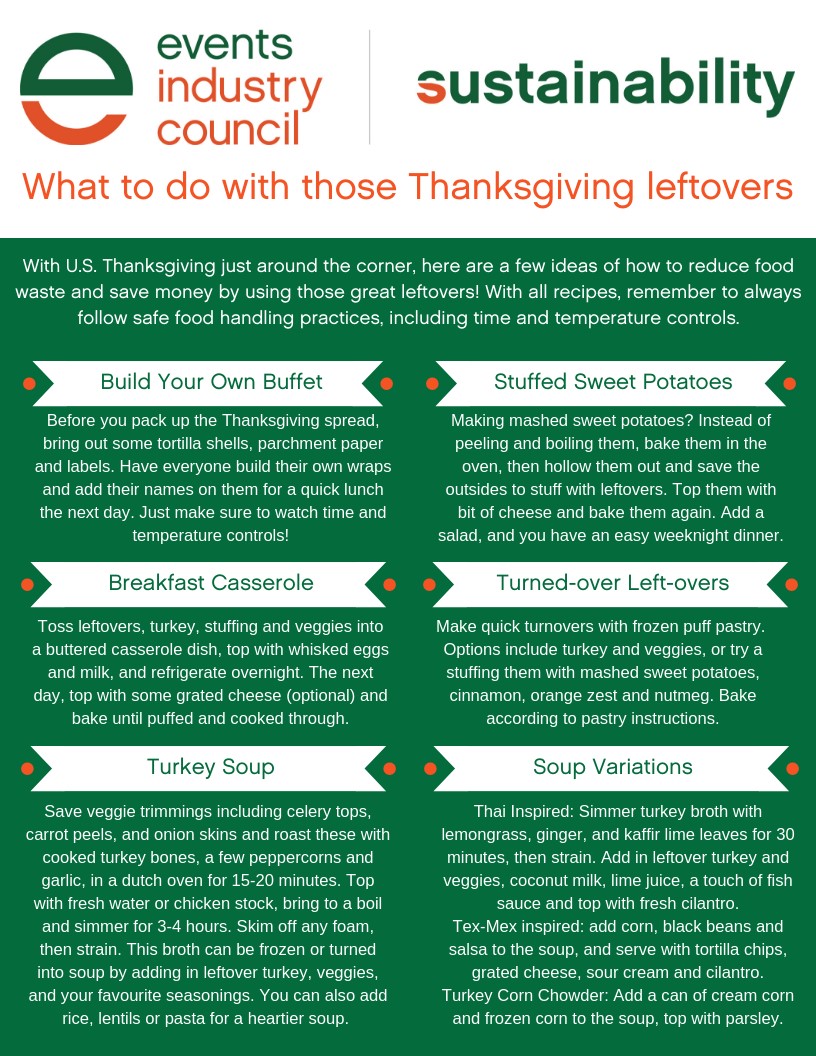
Whether you’re a turkey or pie fan, there’s no arguing at the table when it comes to saving money and reducing waste. Check out Event Industry Council‘s six delicious leftover creations that you can practice come Turkey Time—and perhaps even post-boardroom meeting spread time? You tell us! Share your innovative Thanksgiving leftover dishes on Twitter to be featured on @SmartMeetings.

thanksgiving leftovers

The impact and importance of meetings for medical and pharmaceutical industry attendees is not only increasing, but the complexity of the events and what is expected of planners is more demanding as well, according to a new report from American Express Meetings & Events and a survey conducted by Smart Meetings.

The report, “In-Depth Look at Medical Meeting Content: What Drives HCPs to Attend, Engage and Learn,” assembled interviews from 12 major health care providers (HCPs) and found that due to the number of meetings vying for their precious time, attendees are more discerning than ever when making plans. Showcasing similar results, the Smart Meetings survey highlighted the trends forming among med/pharma planners in response to the competition.

While the content and quality of the speakers are first and foremost in attendees’ minds, it is clear that factors such as the food and destination, in addition to industry regulations, still play a pivotal role in shaping how planners tackle sourcing and agendas.

Related: Med/Pharma Meetings Need to Be Carefully Leveraged

Meetings Numbers are Increasing

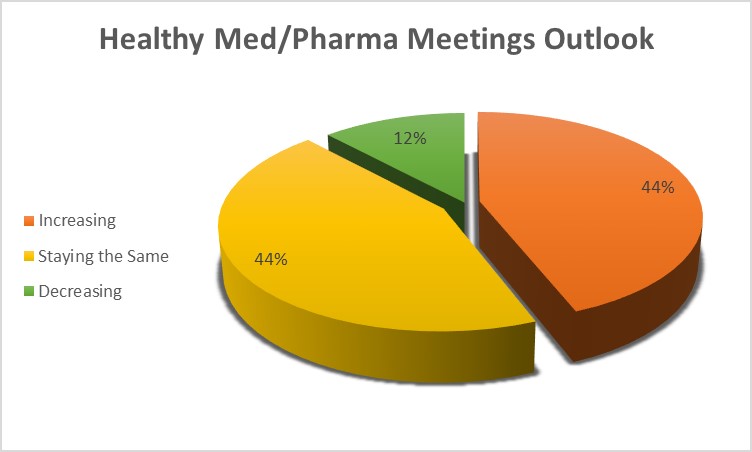
An overwhelming majority, 88 percent, of respondents to the Smart Meetings survey said the number of med/pharma meetings they are planning each year is staying the same or increasing. Meetings generally, not just in the pharmaceutical realm, are seeing an increased turnout. “The meetings industry is in a state of extended growth,” says Bill Voegeli, president of Association Insights.

This surge in the number of meetings hasn’t gone unnoticed by HCPs, either. While Amex M&E estimates health care providers see an average of 16 event invitations a year—and usually attend about eight—some of the report’s respondents saw far more.

“I estimate the number of promotional e-mails I receive across all types to be about 40 a day on average” one respondent said. “I would say that probably anywhere between two to five of those is some sort of event or meeting, or conference or seminar.”

What Makes a Meeting Stand Out?

With so many meetings to choose from, Amex M&E found an event’s reputation and the reputation of the speakers plays a major role in driving HCPs decision to attend. “If you run a really good meeting, you’re going to be well-attended for a long time because word gets out very quickly,” one respondent said. “If you run a very poor meeting, it will take you four or five years to recover because word gets around that fast.”

The quality of the event also goes a long way toward convincing hospitals to allow their doctors and professionals to take the time to attend. If there is no valuable information to be gained from a meeting, most attendees put it on the backburner.

Related: The Ground Shifts Yet Again for Medical Meetings

Interacting with speakers personally and having a more open exchange of ideas ranked as one of the primary goals. Fittingly, a striking majority of med/pharma meeting planners can agree on a need for breakout rooms to accommodate more personal meetings. All but two Smart Meetings respondents, 96 percent, said the availability of breakout rooms was a determining factor in choosing a venue.

Of those, three in 10 said they needed at least 11 separate rooms. Overall, access to breakout rooms ranked higher in planner’s priorities than AV/wireless capabilities and flexible ballroom space.

The use of mobile events apps can be of significant help for gathering information. Features such as educational quizzes are also valued as an immediate refresher after an event.

Using such tools to access slides from a presentation is an added benefit. “I’m also expected to be able to bring something from those experiences that I can take back and share with my colleagues in the form of a presentation over lunch,” a respondent said.

Meeting Types

Pharma-sponsored meetings are viewed as valuable, even if some question the objectivity of the content. National and international congresses were favored by some because they are less biased and are more focused on one specific area of interest. For those HCPs who want to meet individuals in the same field of study as them, national and international congresses are the meetings to attend.

Long days are often the norm for HCPs, so attending a dinner meeting after a long day at work does not appeal to many, while going right home to the family does.

Location, Location, Location

Many respondents said they choose meetings based on factors such as proximity to home. Traveling can be tough for some, especially for those with children. “I have a young daughter at home, so to go further afield is quite difficult,” a respondent said.

Even for those who travel, location is often the deciding factor. Everything from ease of access to being somewhere exciting nudges HCP decisions.

“There are certain programs that I do try to go to because I can bundle a little family getaway to it and it’s a place that my family members would definitely be interested in going to,” an Amex M&E respondent said. “If we can spend a long weekend or a week in San Antonio or Orlando or [do] something like that, then I always try to fit in at least a couple of those every year.”

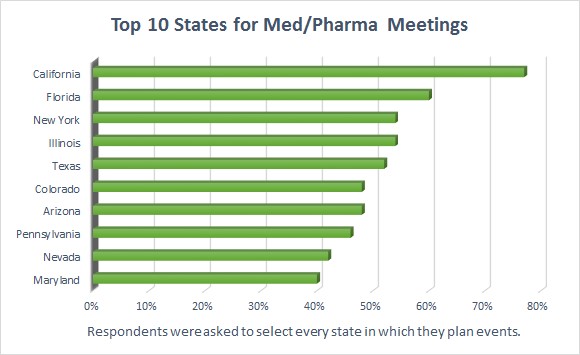
That is mirrored in our findings with planners in the United States, who reported a preference for states often associated with tourism. California, closely followed by Florida, led the list.

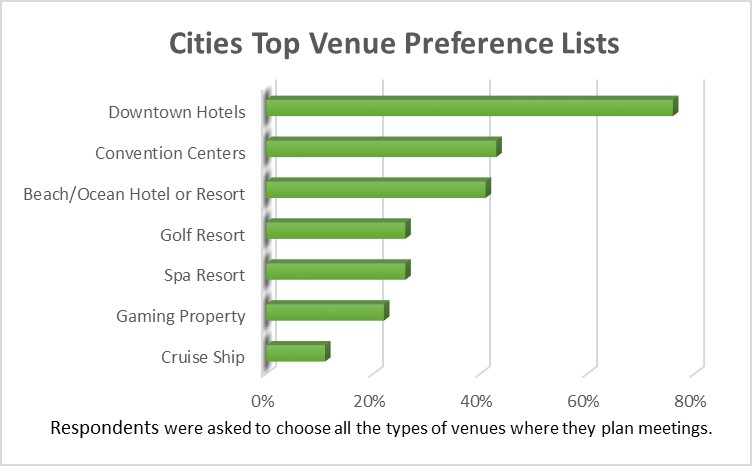
Attendees need something to do when they aren’t in a meeting. When looking for things to do, any downtown area is usually the first place people look. Seventy-six percent of Smart Meetings respondents said that downtown hotels are the type of venues they typically use for pharmaceutical meetings. Almost half (46 percent) of respondents stated off-site activities as most important, second to food, which 86 percent said was most important.

The preference of downtown hotels as opposed to spa resorts may be owed to organizational regulations and guidelines, such as Transfer of Value and EFPIA HCP Code, which place limitations on what meetings HCPs can attend. Spas are often misconstrued as a bribe of sorts by regulators.

“From a pharma standpoint, they’ve certainly changed the way they present conferences,” a respondent said. “I don’t even think you need the word ‘spa’ anymore. If the hotel happens to be a hotel and spa, you can’t say that, just because of those laws. There’s been a lot of change, for sure, in the last 10 years with that stuff and how it’s presented.”


Nominate the Talented, Accomplished Women in Your Circle

Smart Meetings is proud to announce the fourth annual Smart Women in Meetings Awards. This annual awards program recognizes uplifting industry forces in a special issue of Smart Meetings magazine and at a bespoke event, custom designed to advance careers, create powerful networks and pave the way for the next generation of women in meetings.

From visionaries and industry leaders, to entrepreneurs, stellar performers and rising stars, join us in recognizing the top women in the meetings industry who continue to open new doors for all with creativity, passion and drive.

NOMINATE HERE

Show your support for your colleagues and submit your nominations today.

Winners Will Receive National Recognition

Winners will be featured in the March 2019 issue of Smart Meetings magazine (print and digital editions), as well as recognition and exposure through smartmeetings.com, national email newsletters and social media, a national press release, and, of course, on-stage honors at the Smart Women in Meetings Awards Dinner at the 2019 Smart Woman Summit.


Smart Stars voting season is officially open! Each year, the meeting industry’s premier awards program salutes outstanding properties, venues and destinations in multiple esteemed categories.

These exceptional hospitality brands are voted upon by thousands of Smart Meetings’ subscribers and dedicated meeting professionals nationwide, and they continue to play a vital role in the meeting planner community.

Do you have a favorite property, venue or destination that helped make your event a smashing success? Honor their commitment to excellence and cast your vote for the 2019 Smart Stars Awards! Review the 2019 ballot of distinguished hospitality brands or submit your own nomination and be automatically entered to win a stay at a winning Smart Stars property.

Cast your vote right here!

Winners will be featured in the June edition of Smart Meetings (print and digital editions), will receive recognition and exposure throughout smartmeetings.com, national email newsletters and social media, and exposure in a nationwide press release distributed over a major newswire.

A lot has changed since Conrad Hilton’s parents turned their general store into a hotel for traveling salespeople in San Antonio, New Mexico, in 1919. His mother cooked homemade meals for guests and his father managed the front desk. Hilton and his brother, Carl, manned the store. Today, the global hospitality company boasts 5,600 properties under flags as diverse as Curio Collection, Tapestry Collection and Canopy by Hilton, with more than 2,400 new hotels in the current pipeline.

Hilton is celebrating its 100th anniversary this year and is looking at trends that have shaken up travel as the brand and the meetings industry grew—and what might be ahead for hoteliers and their event professional partners in the years to come.

RelatedDishing 2019’s Hot F&B Trends for Groups

From flush toilets and air conditioning to the international highway system and central reservation systems, technology has played a role in making travel for face-to-face meetings more convenient and, well, hospitable. Hilton hotels were at the forefront of the guest room evolution, adding room service, in-room televisions, the minibar and other amenities that are standard today in most properties.

Satisfying Guests Requires Satisfied Employees

Any hotel’s central task is keeping guests satisfied, but Hilton understood that the best way to achieve that was to improve the level of satisfaction among its employees. The Hilton Effect, a book marking the centennial by New York Times bestselling authors Chip Heath and Karla Starr, described how the company orchestrated success for anyone with determination by “creating a culture where it’s possible for restaurant servers to become C-suite execs.” Hilton encouraged an entrepreneurial attitude in his employees by constantly praising them.

That focus on the well-being of staff is what the authors credit as the source of the welcoming reception guests feel when they stay at any Hilton property. Personal attention from empowered employees “allows guests to replenish both physically and mentally.” This replenishment may come from a free waffle or an extra measure to help guests feel safe in their hotel room. These are luxuries that many travelers take for granted, but they would not be possible without the effort of all employees—no matter how small or large their role.

Today, group travelers want authentic local experiences when they visit a city. Frank Passanante, senior vice president for Hilton Worldwide Sales in the Americas, says the hotel’s job is to deliver that sense of place. “We see ourselves as partners in creating ‘wow’ events,” he said. “It is more than the ratio of guest rooms to meeting space. It is about delivering above expectations.”

A Happier Community Makes a More Prosperous Hotel

Hilton also understood early in his career that a successful hotel can’t continue to thrive without a well-functioning destination. In Buenos Aires in 1999, Hilton stepped in and helped rebuild the economy. The company teamed with Albert Gonzalez and Spanish architect Santiago Calatrava to build a bridge that became a landmark in the city, attracting worldwide attention, which in turn brought money back into the city.

The brand is actively restoring historical buildings in Latin America and the Caribbean with 80 such projects in the pipeline, including nearly 30 planned projects in Mexico. For example, Umbral, Curio Collection by Hilton in downtown Mexico City is a 59-guest room property with a rooftop restaurant that is set to open this year.

New Trends Built on Classic Values

As the brand continues to add new technology, such as connected rooms that allow guests to control temperature lighting and television content from their phones, and premium brands with upscale dining options, what are the trends Hilton executives are seeing for the hospitality sector in the coming years?

Passanante pointed to a recent focus on sustainability and social impact initiatives. “Meetings and events are no longer just a place to exchange business cards and do business deals: Attendees are looking to develop a greater connection with other attendees and the communities that they affect,” he said.

RelatedWyndham to Offer Wellness Guest Rooms in All Hotels

Wellness, too, is taking a higher priority on planner checklists. “In 2019, I expect that integrating end-to-end wellness for our guests will create a total 360-degree wellness travel experience that ensures they simply feel better on the road,” said Melissa Walker, senior director of global wellness.

Jonathan Wilson, vice president of customer experience and innovation, food and beverage and wellness, added surprise and delight to the list of deliverables coming to a hotel property near you. “As the popularity of pop-up concepts grows and gains presence more broadly, we may see very specialized, localized pop-up offerings that ‘spice up’ room service,” he predicted.