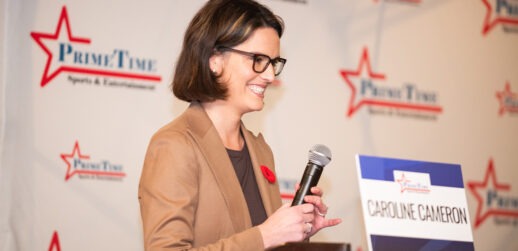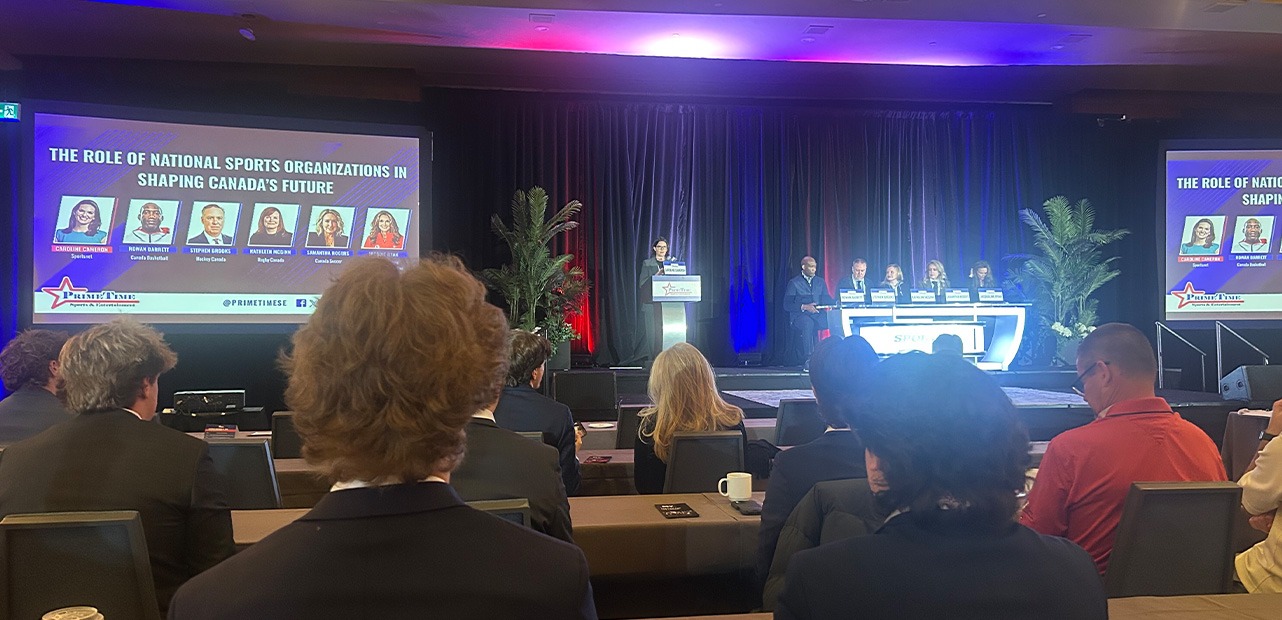
The 19th annual PrimeTime Sports Management Conference took place at The Westin Harbour Castle in Toronto across three days, during which leaders who run professional sport and industry executives gathered for education, networking and reconnection.
Growth of Women’s Sports
During the first discussion of the conference, Marian Agyei-Gyamera, director of business operations for the PWHL’s Hamilton Havoc; Brian Burke, former hockey executive for the Vancouver Canucks, Anaheim Ducks and Toronto Maple Leafs; and Amy Williams, director of corporate partnerships for WNBA’s Toronto Tempo.
Women’s sports are having a moment, and the increase in expansion teams and fandom reflects that. Agyei-Gyamera said it feels like all the right pieces are coming together in this moment. “People are investing,” she said. “Fans are really making sure that everybody knows their feelings and their true thoughts around wanting women’s sports. I think one other thing that I’m recognizing is that it feels like everybody has a place.”
For Williams, who’s just wrapping up the first season with the Tempo, what she noticed is heightened visibility. “Sustaining fandom is going to be the next important chapter for all of our teams,” she said. “I was at a Canadian women’s sport event last week, and one of the stats said 75% of Canadians are fans of women’s sport, but 65% of that group didn’t know where to watch or didn’t know how to tune in. For us we need to make fans, we need people to know the athletes and their stories. That will help kind of drive the industry forward if we get people tuning in”
The Creation of Superfans
Matt Afinec, president and chief operating officer for NLL’s Toronto Rock acted as moderator for a panel discussion about turning spectators into superfans. The panel consisted of Rajan Kalsi, general manager, Canada for WNBA’s Indiana Fever; Russ Kovshoff, director, game presentation for the Tempo; Taylor Mansillo, director of integrated brand marketing for Maple Leaf Sports & Entertainment (MLSE); and Darwin Murray, director of business operations for PWHL’s Toronto Sceptres.
The panel began with answering the question: What is a fan?
Kovshoff looks at fandom in two ways, using his mother and brother as examples. His mother, fan No.1, “She wants to come to the game and have the full experience and see what it’s like to be at an event in a venue and take in the moments, whether it’s the dancing, the mascot, the whole spectacle and sense of community.” His brother, on the other hand, is a more intense kind of fandom, who love the stats and details and needs to know who is running what position. “Fandom to me is just like creating something that brings people together, inspires them, and also enhances the community around our culture together,” he said.
Mansillo said it isn’t up to her or the organization to determine what a person’s level of fandom is. “You are a fan if you define yourself as a fan,” she said.
For Murray, a fan engagement trend people should be paying attention to is community engagement. “Our players are amazing, they love to be out in the community,” he said. “When players are able to meet fans face-to-face, something special happens. They become invested and know about that player. They’re going to want to learn more about the team, the league and follow the sectors of the community to join.”
Kalsi said that, as part of a sports institution, you understand that game day is just one way to compel prospective attendees to come, engage, and build a relationship with the team. He used FC Barcelona as an example, which has the third most visited museum in Spain, and for which he does its marketing. “Fundamentally, you could be as relevant as broadly as possible with kind of like a tailored offering,” he said.
2026 World Cup Legacy
Christine Simpson, features reporter for The NHL on Prime; Sharon Bollenbach, executive director for FIFA World Cup 2026; Nick Eaves, chief operating officer for MLSE; and James Johnson, group CEO for Canadian Soccer Media & Entertainment.
Johnson said Canada was ripe for growth in soccer, so the announcement that the country would be a co-host of the 2026 World Cup was exciting news. “It was a country that had performed very well on the women’s side, but there was an opportunity to also grow the men’s side. I think to grow a sport like soccer, you really need both firing at the same time.”
Read More: FIFA 2026: How Meeting Planners Benefit from Upgraded Sports Infrastructure
Eaves said he would’ve liked to be as thrilled as everyone else when Canada’s presence in the World Cup was announced. “But I’ll admit, I was not,” he said. “It just felt like another event, to be perfectly honest. I was like, ‘Well, hopefully Toronto will get games because that hadn’t been that wasn’t part of the first announcement.’ We had just come off the NBA All Star League Rappers to make the playoffs, World Cup hockey, World Junior. So we’re in this big event mode. I underestimated how enormous the whole thing was going to be, so I was excited, but I had no idea what we were doing.”
Looking back, Eaves said, it was clearer how big the moment would be. “As we got closer and closer to it, the enormity of what this World Cup and these matches in Toronto were going to be just became more and more obvious,” he said.
Eaves said FIFA chose Toronto to host World Cup matches for all kinds of reasons that soon became apparent “in terms of what a phenomenal world-class, multicultural city that shows up for big events…. The legacy speaks for itself.”