Incentive Research Foundation (IRF) Invitational 2026 brought together more than 500 DMCs and incentive planners for four days at Fairmont Scottsdale Princess hotel in Arizona. Amid the networking among participants, various industry topics were discussed, such as AI and unavoidable situations in event contracts.
Read More: Notes from the Road: Scottsdale, Arizona
AI’s Role in Fostering Human Connection
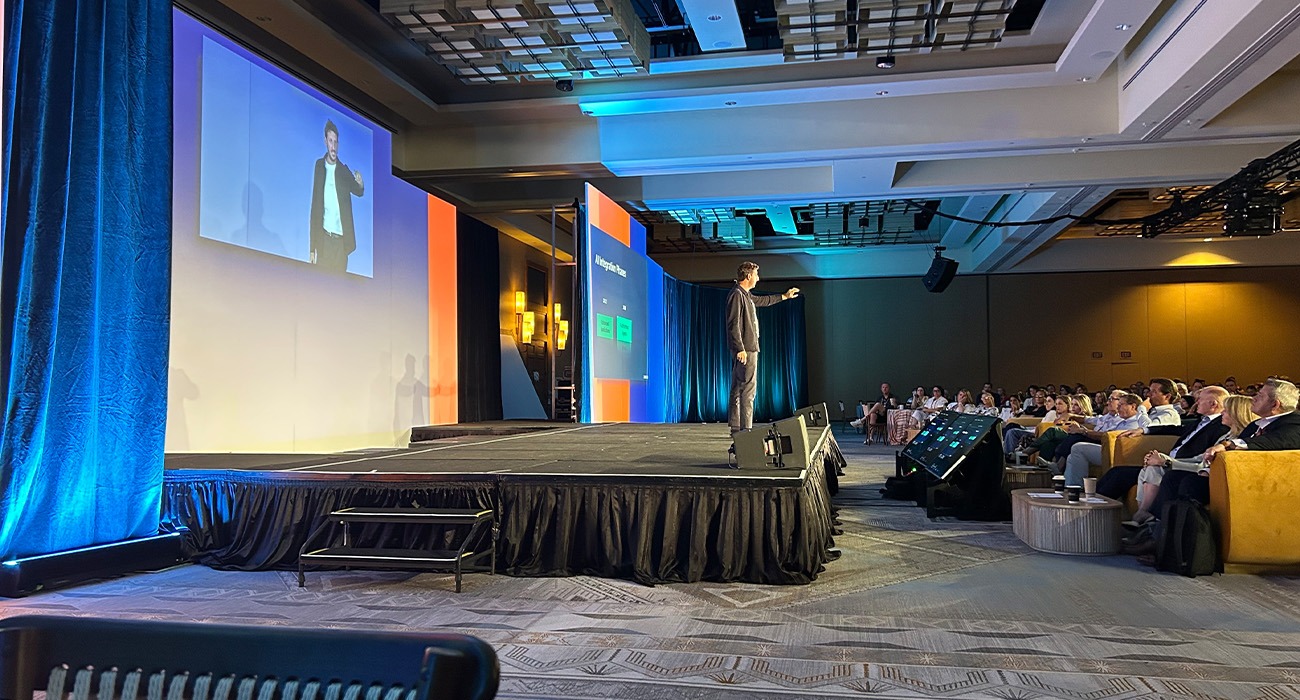
Zack Kass, strategist, speaker and author of The Next Renaissance: AI and the Expansion of Human Potential, began writing his book with no clear audience in mind—at least, until he had a child late last year. “It became very clear to me on that day that I wrote this book for parents, for everyone on earth who’s responsible for another human in a world that is moving much faster than they can make sense,” he said.
As an experienced global speaker, Kass realized that by talking to people, he’s talking to two versions of the same person: one who wears a fiduciary hat, concentrating on the business side of life, and the other who acts as a parent, grandparent, aunt, uncle or caretaker. “Everyone is probably trying to figure out how to make sure they use this technology to build better incentive structures to plan better events, but also to make sure that the next generation is actually better off because of it.”
Read More: AI Is Here. Are Event Teams Ready?
The Automation Boundary
Some time ago, Kass embarked on an experiment he called the “automation boundary,” a reference to the line between what people want to do themselves and what they’re willing to automate. Kass said people are willing to automate much more than they realize. Outside of a grocery store, he and another researcher asked about 20 people about their purchase choice of either toothpaste, tortilla chips or water. What they found is that people don’t have as strong a preference for things as they say.
“Most people at some limit realized they were making these decisions not out of brand preference, but out of preference for computational load protection,” he said. “Inertia and randomness are how people pick most of the things they buy, because how could we possibly be bothered to do the research necessary to figure out our favorite tortilla chip. With that said, I’ve come to realize it’s very clear that most humans are going to discover their automation boundary is much further than they would have originally guessed. People are very willing to outsource a lot of the decisions they make.”
He continued by asking two follow-up questions: What do we actually care about? What do we really want to protect? “This is true for each of you on an individual basis, and it’s true for your employers,” he said. “How do you actually know that your customer deeply cares about you? You’ll find out quickly when an AI agent disintermediates them. Every company must figure out as soon as possible where they sit on their customer’s brand preference stack, and if their customer willing to outsource the purchase of that good or service, and if so, you’ve got to figure out a new strategy.”
Kass believes that at some point, professionals will not be judged on their brilliance, but on their ability to connect with other human beings in a world where technology frees us up to do so. “What more do we want than a technology that actually requires and emphasizes the most humanistic of us,” he said. “I don’t know when, but at some point, my daughter, our kids, will be measured not on their brilliance, but on their curiosity, empathy, courage, wisdom, humor, morality—the measures of a man don’t actually have to be brilliance, that is the point of technology.”
Contract Execution and Compliance
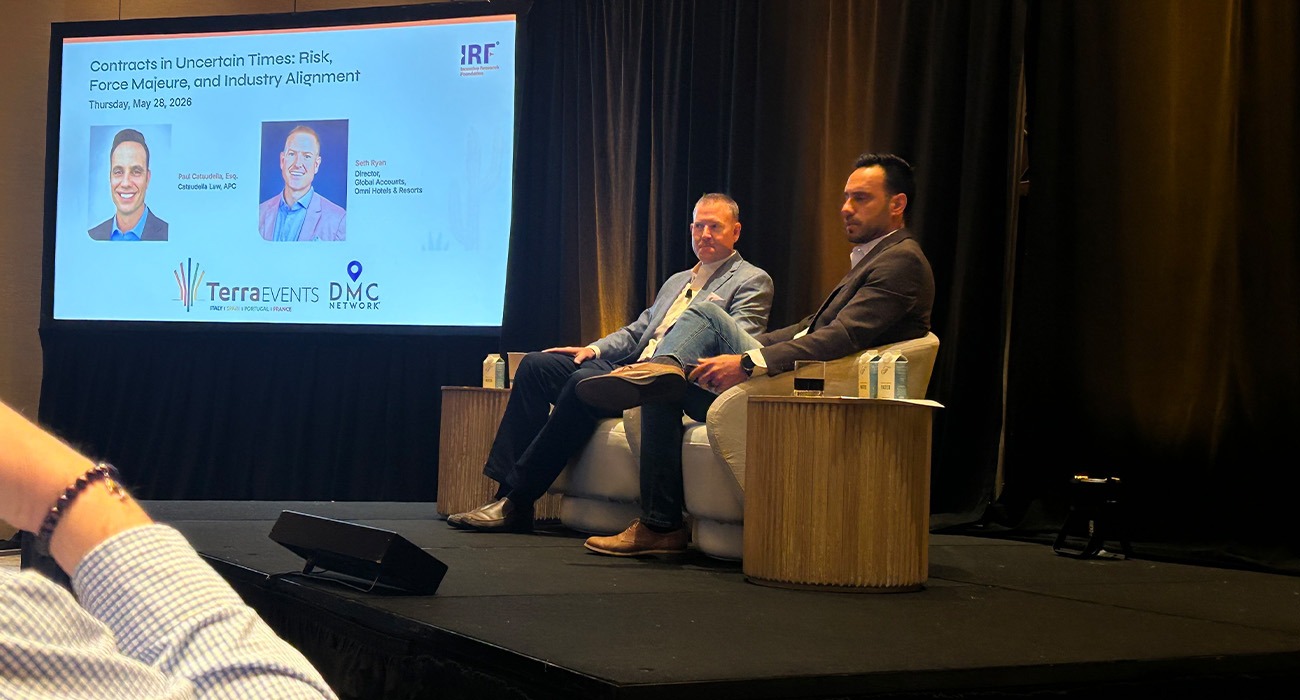
“One thing to note is we’re not striving for perfection,” said Paul Cataudella, principal attorney of Cataudella Law, when speaking about meeting planners looking for too-specific terms in their contracts. “What you want to focus on is the most substantive terms and how it impacts you and the stress points you and your client may have. I think that’s where you want to devote the most of your time.”
Read More: The Four Contract Clauses Every Planner Must Master
That Unavoidable French Clause
Of the many topics to discuss, Cataudella said one he believed would be less discussed this year, but keeps popping up, is force majeure. “I promise there were a lot of topics to discuss, and in discussing and trying to assess what we were going to chat about, we kept naturally coming back to it because the whole ‘uncertain times’ thing still exists, right?”
Cataudella shared a slide with three different force majeure provisions, ranging from simple to complex. “The point that I want to convey is that there is no such thing as one force majeure provision,” he said. “A force majeure provision is whatever you ultimately make it.”
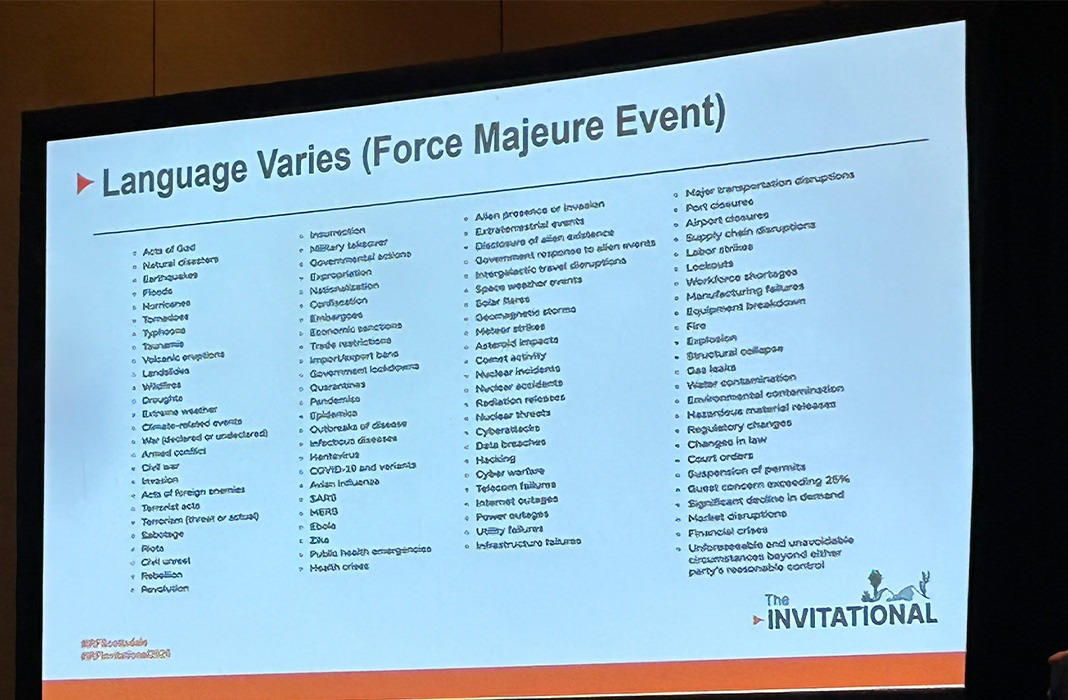
He went on to show a slide featuring real-life definitions of a force majeure event, ranging from “war (declared or undeclared)” to “alien presence or invasion.”
“When it comes to a force majeure provision, there are three elements: defining what the force majeure event is, the threshold for when it’s engaged or enacted, and what happens to the money and the event,” he said.
“The whole thing about force majeure is you have the definitions of it, you have the thresholds, but here’s what really matters,” he said. “It doesn’t matter that the event’s not going on, that one party doesn’t want to do it. What matters is what happens to the money, what happens to the time spent and energy and effort that went into it leading up to the events, all of that takes place in advance of operation, right? Ninety-five-plus percent of everything that happens preprogram is before operation, maybe more.”
Cataudella said what’s important is the money that hasn’t yet been earned prior to the force majeure trigger and if you negotiate that particular item, it shouldn’t be as much of a problem. If you’re comfortable with what happens after the force majeure is triggered, whatever caused it matters much less. In response to a participant who advocated for sole usage of the terms “illegal” or “impossible” to avoid ambiguity, Cataudella said, “Those elements are important, don’t get me wrong, but you can see how they may pale in comparison to the net result.”
Negotiating with Bots
In this new age of AI that provides quicker access to information via chatbots such as ChatGPT and Claude, Cataudella said he finds himself negotiating with robots all the time.
“I think we’ve all received regurgitations of ChatGPT analyses from contracts that have been submitted. Some people are even so lazy that they just copy and paste it with fire emojis that are in there. Other people try to doctor it up a little bit,” he said. While this may be an exaggeration, AI’s use in law is still a real thing. Cataudella referenced a case in New York that said anything put in the contract is “discoverable,” meaning if any contract dispute arises, either party can be placed in a deposition where they’ll be asked about how deeply they use AI.
He continued, “Everything’s fine until it’s not, and when it’s not, now you’re in the midst of litigation, and litigation is a completely different conversation.”