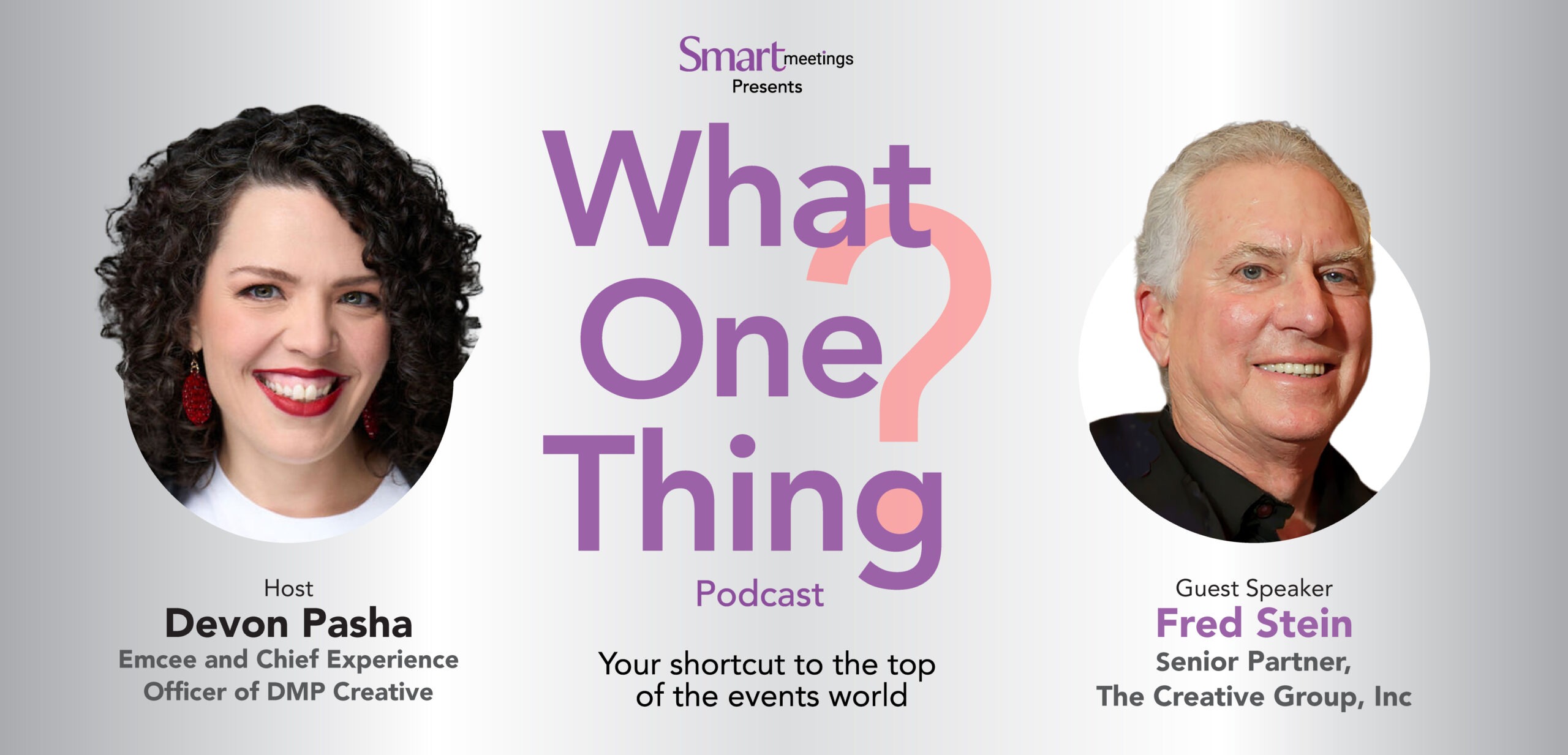
Fred Stein has produced nearly 3,000 major events, including Philadelphia’s 300th anniversary, the bicentennial of the U.S. Constitution, Pope Francis’ visit to Philadelphia and two Philadelphia Eagles Super Bowl parades. Stein is managing a health condition that affects his speech, so listeners may notice pauses or vocal difficulties during the conversation. He appreciates your patience during the recording.
In this episode of What One Thing?, Stein joins host Devin Montgomery Pasha to explore how his early career in journalism shaped his approach to event production. He shares why research, personal stories and audience participation remain at the center of his work, whether he is producing an intimate gathering or an event attended by millions.
Stein also reflects on the unexpected moments that can define an experience, the responsibility of representing diverse communities and the sense of accomplishment that has kept him inspired throughout his career.
Further Resources
Well Done: The Connection Effect
How to Organize End-to-End Inclusive Events
Devin Montgomery Pasha
Welcome to What One Thing, a Smart Meetings podcast where we ask successful people what made all the difference in their lives and careers, so you can learn from their journeys and spark your own growth.
I am beyond delighted to introduce our guest today. Fred Stein is one of the most accomplished event producers in the United States and a true pioneer in our industry.
He is the founder of the Creative Group, a special events production company that has produced nearly 3,000 major events around the world. His work includes Philadelphia’s 300th anniversary, the bicentennial of the U.S. Constitution, the visit of Pope Francis to the United States and not one, but two Philadelphia Eagles Super Bowl parades.
He has also produced university milestones, groundbreaking ceremonies and galas for some of the nation’s most respected institutions.
Born and raised in Philadelphia, Fred began his career as a journalist before serving in city government and the U.S. Congress. He eventually launched a company dedicated to transforming history, purpose and community into unforgettable shared experiences.
He has also helped establish event programs at Temple University and Drexel University to help shape the next generation of event professionals.
Fred, I am beyond delighted to welcome you to What One Thing.
Fred Stein
Thank you so much for having me.
DMP
It has been delightful to follow your career and see the vast array of events you have brought together.
You began your career as a journalist. How does that background influence the way you uncover the deeper story behind an event?
FS
When I went into journalism, my aim was to tell stories that would intrigue people, get them excited or explore how to correct failings throughout the city.
Research, conversations and interviews were critical. It is much the same when I produce events today.
I talk to people to understand what makes them excited, thoughtful or caring. That can include interviews, live video or having their friends, relatives and other influential people become a vital part of the event.
DMP
Interviews and personal connections remain at the foundation of every event you produce.
Your work ranges from civic and historic celebrations to victory parades and capital campaigns. Is there a common thread that connects all of those different experiences?
FS
It is the ability to be creative in my approach.
I have produced some events for 25 or 30 years in a row. It may be the same event, but it still needs to be different each year.
For example, I produced an annual awards ceremony and gala for Jefferson Health in Philadelphia. About eight or nine years into the event, the organization was recognizing a medical dignitary and a businessperson.
I visited the businessperson’s office to collect photographs and get a sense of who he was. I noticed he had pigs everywhere.
I asked his assistant why, and she explained that pigs were something he collected.
When approximately 1,000 people sat down for the ceremony and dinner, they suddenly heard a pig squealing. A stuffed pig came flying from the back of the room and landed on the stage. Then a potbellied pig I had borrowed from the Philadelphia Zoo came out from backstage.
That event was completely different from the previous nine or 10 years. I have not used a pig since, but you are always looking for something different, whether it is serious or as joyous as that.
DMP
I love the joy of that story. For every institution that has ever said, “We will change when pigs fly,” you have now given us permission because pigs have actually flown at your events.
FS
Exactly.
When Pope Francis came to Philadelphia, he arrived by plane and walked down a red carpet. Joe Biden was there, among other people.
The pope got into a very small Fiat. A band and choir from a local parochial high school were performing as he drove past them.
Suddenly, the car stopped. He was supposed to continue, so I walked over with the police to find out what was happening.
The pope got out of the car and walked toward the band. A young child was sitting in a wheelchair. The pope walked over and kissed him.
The child had significant medical needs. He was not placed there for the pope to notice. It was hard to believe the pope had even seen him.
There were more than 100 members of the press there, and they wanted to know who the child was. He happened to be the son of the bandleader.
The moment spread across social media, and enough money was raised to cover the child’s medical care, the family’s home and other expenses.
It was one of the most amazing things. Sometimes, events happen through moments that were not planned.
DMP
Those can be the best parts. They are the moments we slow down for.
You cannot plan for them, but you can design an experience with enough space for delight, awe and serendipity.
I remember the photograph of the pope with that young boy becoming one of the defining images of his connection with the community.
FS
It went beyond viral.
DMP
Many of your events involve historic moments and major anniversaries.
What do you believe people are seeking when they come together to celebrate something larger than themselves?
FS
They want to experience a sense of participation. Whatever their life may be, they want to feel that their life is part of what we are commemorating.
They may feel pride, anger or another strong emotion, but they want to participate.
There is often a performance element. When the pope comes to visit, we do not necessarily need an international performer.
We need music, entertainment or spoken-word poetry created with intention and capable of generating a reaction from the audience.
The audience is who you are doing it for.
DMP
When you produced the papal visit, there was considerable thought given to who would actually be coming to Philadelphia.
Some hotels wanted to charge significantly higher rates as though it were simply a major attraction. You reminded them that the people coming were not necessarily travelers who could spend hundreds of dollars per night.
They were religious communities coming to celebrate, participate and experience a moment of reverence.
How do you represent communities that may look different or seek different forms of participation?
FS
One example is the Liberty Medal, which I helped start after the Constitution’s bicentennial.
The award began in 1988 with Lech Walesa. It has since recognized various national and international recipients.
Each year, we look at who the recipient is and what that person represents.
In 1993, the award went to South African President F.W. de Klerk and Nelson Mandela.
They both came to Philadelphia. The purpose was not only for Americans to appreciate what they represented. It was also for people around the world who understood what Mandela stood for.
Mandela spoke at Independence Hall and at a dinner for approximately 3,000 people at the new convention center. President Bill Clinton was also there.
People around the world, not only those in Philadelphia, understood what Mandela represented and what he was seeking to accomplish.
DMP
That award represents one of the highest accolades for people whose work affects their countries and the world.
FS
When you create celebrations, the question is what they will leave behind for the future.
We determined that the legacy of the Constitution’s bicentennial would not simply be a building or a capital campaign. One legacy became the award.
What we did not fully realize at the time was that the National Constitution Center would become another legacy.
DMP
When you begin designing an event, whether it has happened once or 100 times, you start fresh.
What do you hope people carry with them after the experience ends?
FS
I hope it means they continue following through on their hopes and desires and try to make them happen.
DMP
I love that answer. It is not simply that they enjoyed themselves or contributed to a campaign. You want them to carry a deeper meaning and intention with them.
Is there an example that stands out?
FS
There are nearly 3,000 possibilities.
One example is the tricentennial of Mobile, Alabama.
When I was asked to speak with the organizers, they did not know what they wanted to do. I flew down expecting it to be a one-time visit where I would offer some advice.
As I learned about Mobile’s accomplishments and its history as a diverse city, I thought it would be exciting to work on a variety of events.
I was ultimately hired to plan the celebration for six years.
I realized that I loved the city. I was even offered the job of leading the convention and visitors bureau.
They knew I had fallen in love with an incredible home on the main street and wanted to buy it for me. I came close, but I love Philadelphia.
DMP
As a daughter of Philadelphia, I will take it.
Your love for the city is evident in the way you have helped it celebrate as a diverse and historic community.
I also love that when I asked what people carry with them, the example you shared was about how an experience affected you.
Those of us who help create community experiences are members of those communities, too. We can be just as affected as our clients, customers and attendees.
FS
Anyone planning an event, whether it is for 20 people, 200,000 people or 2 million people, must consider each person’s reaction and feedback. That is important.
DMP
After a career spanning thousands of events and historic moments, what keeps you curious and inspired enough to view each experience through a different lens?
FS
It is a sense of not only accomplishment, but achievement on behalf of my clients.
I am not producing many personal events. I produce experiences whose impact can be felt regionally, nationally or worldwide.
That is important to me. I love what I do, so I want to continue. I do not want to retire.
DMP
We heard it here first. Fred is going to hold on to the doorframe, and we are going to have to kick him out.
As we wrap up, I have to ask our favorite question.
After your remarkable career and all the events you have produced, what is the one thing that made all the difference in your life and career?
FS
I would say a sense of accomplishment.
Last night, I produced the 10th anniversary awards gala for the Philadelphia Police Foundation. I have worked pro bono with the organization for a decade.
The head of Wawa received an award, as did the family of a police officer who had been killed.
At the end, the chairwoman stood up and said she wanted to present another award. She held up a medal and said it was going to the “voice of God.”
In event production, the voice of God is the offstage announcer. At nearly every event I produce, I am usually the person doing it.
People do not see me or know me, but I do it.
I received the award, and the 400 or 500 people in the audience were so excited.
But that recognition was not the aim of the event. The aim was the sense of accomplishment.
The event raised $950,000 for the organization. That is the accomplishment. It is not about me or my voice.
That is what it is, and I will continue doing it.
DMP
Fred, thank you for sharing your warmth and wisdom and for reminding us that a sense of accomplishment is what resonates with our clients, attendees and stakeholders.
Thank you for sharing your remarkable perspective on how events can help communities celebrate their history, strengthen their identity and create memories that last for generations.
From papal visits and 300th anniversaries to Philadelphia’s first Super Bowl parade, your work has allowed generations of families to celebrate hope, success and pride in their communities.
Thank you for taking the time to share that wisdom.
To our listeners, thank you for joining What One Thing, a Smart Meetings podcast. Every story sparks inspiration for your own journey.
Until next time, keep creating, keep connecting and keep sparking change.
FS
Thank you.
Announcer
Smart Meetings’ What One Thing was produced by Bright Business Media. Visit SmartMeetings.com to subscribe to your daily dose of inspiration.