Connection is at the core of the events industry. But what happens when that connection is needed beyond the ballroom?
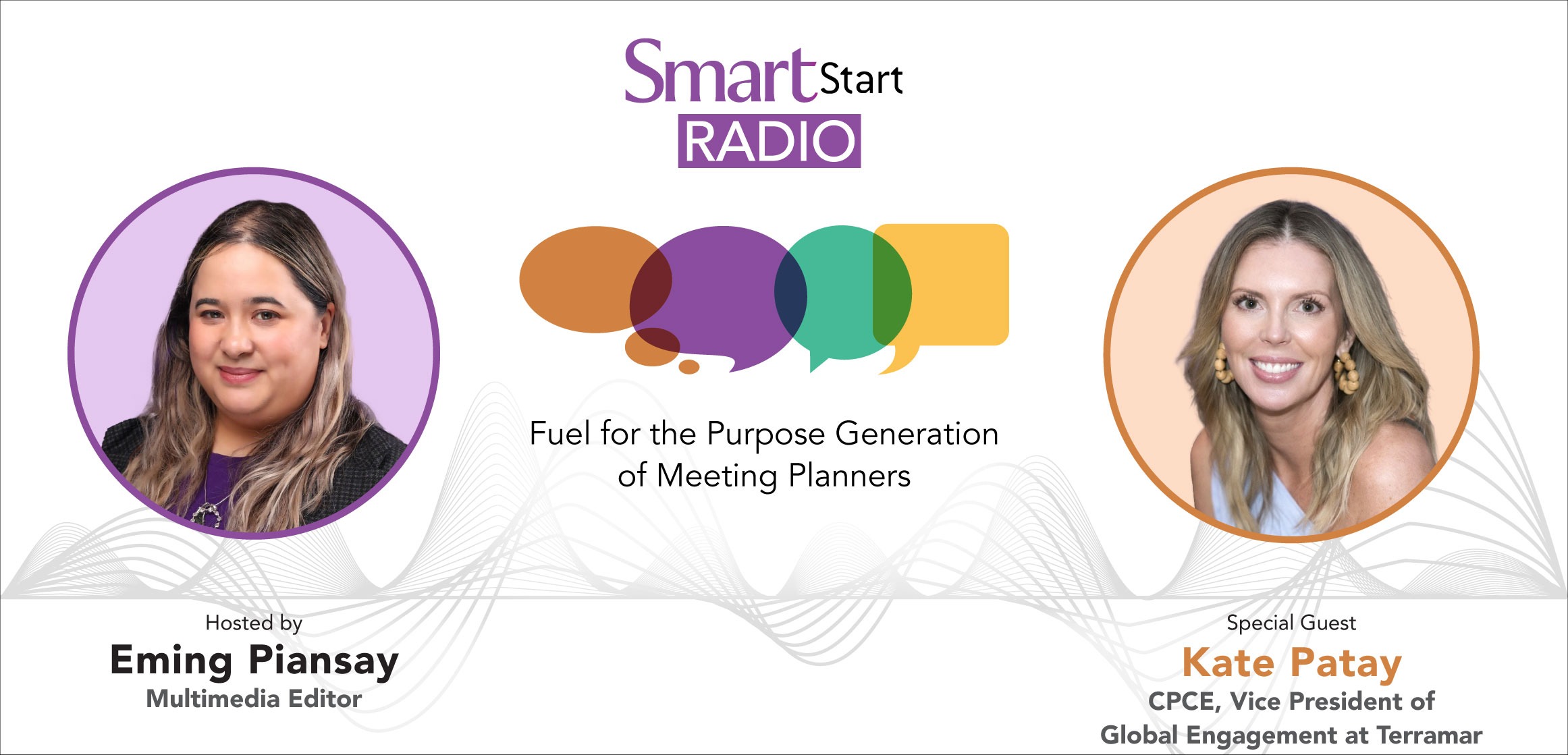
In this episode of Smart Start Radio, host Eming Piansay sits down with Kate Patay, vice president of global engagement at Terramar DMC and chair of the SEARCH Foundation, to explore what it really means to support the people behind the events.
From crisis response to more intentional CSR strategies, Patay shares how the industry is evolving from performative giving to meaningful impact. She also offers a behind-the-scenes look at how Search Foundation operates, why financial support often matters more than physical donations and how even small contributions can create lasting change.
This conversation is a reminder that the true strength of the meetings industry is not just in the experiences it creates, but in how it shows up for its community when it matters most.
Further Resources
How to Organize a Build-A-Buddy CSR/Team Building Activation
Eming Piansay
We talk a lot about connection in this industry. Bringing people together, creating meaningful experiences and designing moments that stick. But what happens when someone in your own community needs support—not as an attendee, not as a client, but as a person going through something real?
That’s where this conversation starts.
Today, I’m joined by Kate Patay, vice president of global engagement at Terramar DMC and chair of the SEARCH Foundation, an organization dedicated to supporting events professionals in times of crisis. And full transparency, I may fan girl a little bit in this episode. Just a little. You’ll see why in a second.
Eming Piansay
Smart Start Radio. I am so excited to have Kate Patay on the show. She is basically a celebrity in this industry. At least in my world. I hear about you constantly, so I’m like, oh my God, Kate Patay is going to be here. Do I look OK?
Thank you so much for being here. Can you give us a little rundown on yourself?
Kate Patay
Oh my goodness. I don’t know how to follow that intro.
My day job is vice president of global engagement at Terramar DMC. I work across Latin America and the U.S., engaging clients, teams, media and PR. I genuinely love what I do, and I think when you’re excited to go to work every day, that shows.
I’m also chair of the SEARCH Foundation. I’m on my third term. It’s a three-year commitment, and it’s incredibly meaningful to me. I’m fortunate to have a company that supports me in doing this work.
Eming Piansay
Congratulations. That’s amazing.
KP
Thank you. SEARCH is really close to my heart.
EP
For people newer to the industry, can you explain what SEARCH does?
KP
SEARCH is the only 501(c)(3) in our industry dedicated to crisis relief for individuals. There are a lot of associations and foundations, but SEARCH is the only one that directly funds individuals.
If someone has a medical diagnosis, is in an accident or experiences a natural disaster—hurricane, wildfire, flood—they can apply directly for financial assistance.
EP
That’s really cool.
So we’re talking about CSR broadly. When you look at the industry right now, what’s top of mind?
KP
I see it from a couple perspectives. Through our day-to-day work, we integrate CSR, and through SEARCH, I see the impact side.
The biggest shift right now is authenticity. It’s about aligning what you’re doing with your event, your audience and your destination. It’s not just about doing something to check a box.
For example, in Mexico, we do a lot of gifting tied to local artisans, especially women supporting their families. Every piece connects back to the community.
And when you go deeper into CSR, it should be local. If you’re traveling somewhere, support that destination. Create an impact where you are.
EP
That intentionality feels newer. It used to feel more performative.
KP
Exactly. The goal should always be to leave something better than you found it. But you also have to understand what’s actually needed.
One of the biggest misconceptions is that sending physical items is always helpful. It’s not.
During the Los Angeles fires in 2025, people wanted to send everything—diapers, water, supplies. But when a disaster hits, people are trying to get out. Adding more logistics can slow relief efforts.
Financial support allows organizations to respond in real time with what’s actually needed.
EP
That makes a lot of sense.
KP
With SEARCH, we fund individuals directly. And every case is different.
Someone might need a plane ticket to leave a dangerous situation. Someone else might need help paying a mortgage or buying essentials for their kids. There’s no one-size-fits-all.
EP
Do you work with other organizations to manage that?
KP
We do it internally, but we also build resource lists for every crisis. Our team identifies government resources, vetted organizations and local support systems.
We don’t just provide funding—we guide people to everything available to them. And we make sure those resources are actually accessible, not buried behind 17 clicks.
EP
That’s huge.
KP
It is. Because when someone reaches out, they need help immediately.
EP
Outside of major disasters, what kinds of cases are you seeing?
KP
A lot of illness. That’s actually what made this role very personal for me—I was diagnosed with breast cancer.
I was fortunate. I had support. Not everyone does.
We see cases every week. Accidents. Illness. People losing everything overnight.
There was one case—an AV driver who lost his eyesight in an accident. You read these stories, and they stay with you.
It shifts your perspective. It makes you grateful, but it also makes you want to do something.
EP
Yeah… that’s heavy.
KP
It is. But it’s also what makes the work meaningful.
During COVID, we expected an influx of people needing help. Instead, we saw an influx of people wanting to give.
People saying, “I’m OK. How do I help someone else?”
That was something I didn’t expect, and it said a lot about this industry.
EP
We’re in a strange moment right now. People are struggling. Are you seeing more giving or less?
KP
People are more cautious, but also more intentional.
They’re asking, “Where is this going? Does this matter?”
And I love that. It’s pushing all of us to be more thoughtful and transparent.
EP
That feels like a positive shift.
KP
It is. The people who get involved now—they stay involved. They see the impact.
EP
What’s next for SEARCH?
KP
We have a new board launching, our annual event in Los Angeles and more affiliate events where organizations integrate giving into what they’re already doing.
You don’t have to reinvent anything. You can build this into what already exists.
EP
I imagine the emotional toll of this work is intense.
KP
It is. We’ve structured our team so no one person carries all of it.
But there are moments that stay with you.
I got a call once from a woman escaping domestic violence. She was in her car with her kids, crying, with nowhere to go.
Sitting with someone in that moment… it changes you.
And then seeing her case come through and knowing we could help—that matters.
EP
That’s… a lot to hold.
KP
It is. But it also builds compassion.
I don’t think I always led with that. I’ve grown into it because of this work.
Now, I feel like my purpose is to help as many people as I can.
EP
You’re an everyday superhero.
KP
Not all of us wear capes. Some wear high heels.
EP
That’s fair.
Looking ahead, what do you hope for CSR in this industry?
KP
I hope it becomes standard. Not an add-on.
Something as simple as a $1 donation during registration can create massive impact.
We’ve seen it happen.
This is an industry built on community. We should take care of our own.
EP
I hope it becomes something we do without thinking. Just part of who we are.
KP
Exactly. Even small actions create ripple effects.
EP
Is there anything I didn’t ask that you want to share?
KP
What’s your hope for 2026?
EP
I hope the industry thrives. I hope giving back becomes second nature.
That we recognize someone is always having a harder day—and we show up for that.
KP
I love that.
EP
Thank you so much for being here.
KP
Thank you. I’m so glad we’re connected.
Eming Piansay
And thank you to our Smart Start listeners. We’ll see you next time.