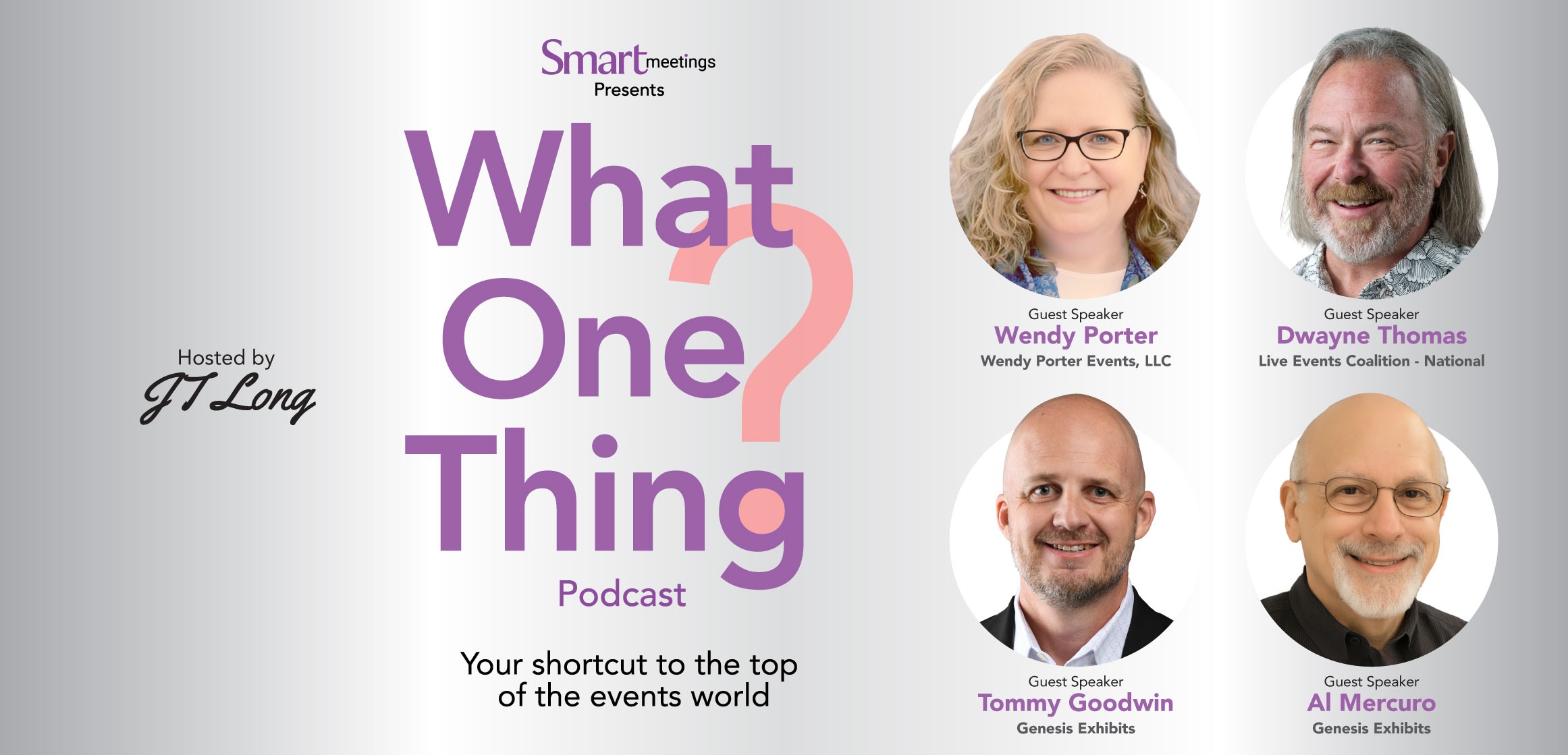
Together, they unpack the pressures planners face right now, from rising costs and healthcare access to tariffs, visas and economic uncertainty, and why live events remain vital to trust, innovation and human connection.
In a closing segment, Tommy F. Goodwin, executive vice president of the Exhibitions and Conferences Alliance, joins the conversation to offer a policy-focused perspective on workforce development, affordability and how planners can turn advocacy into meaningful action. The episode leaves listeners with a clear reminder that their voices matter, and that engagement at every level helps shape the future of meetings.
JT Long
Welcome to the What One Thing podcast, where we ask successful people what made the difference in their lives and careers. Today, we’re addressing a serious topic. Support for meeting professionals at the highest levels. When even your family doesn’t always understand what you do, how are policymakers supposed to understand the vital role meetings play in our economy, medical and scientific advances and human connection?
Joining me today are leaders from the Live Events Coalition to talk about the threats facing meetings and how you can be a force for good when you’re out in the world. Please welcome Wendy E. Porter, chief events strategist at Wendy Porter Events LLC; Al Mercuro, strategic marketing and client engagement advisor at Genesis Exhibits; and Dwayne Thomas, director of government affairs for the Live Events Coalition – National.
JL
Wendy, I want to start with you. What was your aha moment when you realized you had to speak up on behalf of the hospitality community?
Wendy E. Porter
Rewind to March of 2020. I was on show site in San Francisco when it became very clear that we were in trouble. Within days, business was vaporizing in front of me. As a small business owner, I don’t rely on an employer to pay my bills. Everything shutting down was very real, very fast.
When the Live Events Coalition formed, it became clear this wasn’t just an individual problem. It was an industry problem. I started getting involved locally in Minnesota, tracking regulations and shutdowns, and then collaborating nationally. That’s when I realized advocacy had to be part of what we do.
JL
Dwayne, what about you?
Dwayne Thomas
In March 2020, a small group of us in Oregon started daily calls asking, “What are we going to do?” We assumed this would last a few months. Then we saw the national petition explode with hundreds of thousands of signatures.
That’s when we realized how big this was. We formed a state coalition, got involved nationally and started learning in real time. I didn’t plan to work in government affairs. I was asked because I was willing to speak up. That’s really how this work happens.
JL
Al, what pulled you into advocacy?
Al Mercuro
I had to stay busy. I couldn’t do nothing. I joined Zoom calls, listened, learned and saw the work the coalition was doing. I reached out and asked where I could help. Marketing and social media needed support, so I jumped in.
I come from trade shows and large expositions. I watched booths get built and then immediately torn down. That moment made it clear this industry needed representation.
JL
It often feels like planners can’t catch a break. Rising costs, economic uncertainty, tariffs. What are the biggest challenges you see right now?
AM
Tariffs were a big concern, and while they haven’t hit us as hard yet, they’ve created decision paralysis. Clients are hesitant. Vendors are raising prices. We’re watching closely.
DT
Healthcare access is a major issue. ACA credits drying up is affecting real people. I had staff tell me they simply wouldn’t have insurance. That’s when storytelling becomes powerful. When you share those stories with elected officials, it can actually move the needle.
WEP
Costs across the board are rising. Clients are scaling back or pulling planning in house. Add geopolitical uncertainty and visa concerns, and it affects attendance and destination decisions. Perception alone can shift an event to another country.
JL
We’re not always the best at telling our own story. How do you describe the live events industry to people outside it?
WEP
I describe events as a tapestry. It’s leadership, sales, marketing, product and culture coming to life in three dimensions. We now have research showing events are the number one channel for trust and ROI. In an AI-driven world, that human connection matters more than ever.
AM
This industry isn’t nine to five. We’re the first in and the last out. If you love being behind the scenes and making something happen, you’re hooked for life.
DT
People don’t realize how many vendors it takes to make an event happen. We wear black so we disappear. Advocacy forced us to explain that this is one interconnected industry, not dozens of separate ones. Once lawmakers understood that, things started to change.
JL
Lightning round. What’s the one thing planners can do right now?
DT
Speak up. Call your elected officials. Tell your story. You might give them the exact words they need.
AM
Get involved. Volunteer. Stay adaptable.
WEP
Adaptability. Stay engaged. Use your voice.
Segment 2: Policy Perspective
JL
In our closing segment, I’m joined by Tommy F. Goodwin, executive vice president of the Exhibitions and Conferences Alliance.
Tommy F. Goodwin
Advocacy works when you’re in the room. Change happens when you speak the language policymakers can act on. Right now, affordability is the issue everyone is talking about in Washington. Rising costs, tariffs, workforce shortages and international travel barriers all affect meetings.
JL
What’s the biggest challenge planners face going into 2026?
TFG
Affordability and perception. Small policy changes can create big ripple effects. Visa delays. Fees. Headlines. They add up. Our job is to tell the story of why meetings matter to communities, workers and economies nationwide.
JL
What’s the one thing planners can do?
TFG
Get involved. Raise your hand. You are the most powerful advocate because you live this every day. Whether it’s an email, a meeting or inviting an official to an event, it all matters.
JL
Thank you for representing the meetings community and helping planners understand the power of their voices.