Pack your best orange onesie pajamas and get ready to do the cellblock tango! No, this isn’t a game of Monopoly involving jail and hotels. Former prisons across Europe are now welcoming guests to voluntarily check in. Best of all, you can roam free and get released whenever you want.

Travelandleisure.com reports that because the incarceration rate in the Netherlands has significantly decreased in the last 10 years, prisons are sitting vacant—quite a stark difference from the overcrowding issue of American penitentiaries. Hotels such as Het Arresthuis in Roermond, the Netherlands, are transforming their buildings into luxury accommodations.

Het Arresthuis, which means “house arrest” in Dutch, is a great venue to host a small-scale meeting or event. The hotel offers meeting rooms for up to 28 people and dining for up to 120 guests. Their Galerij, situated in the middle of all the cells, has hosted sophisticated seated dinners with a long table down the center and an aerial act.

Hotel room doors still have the original jail cell bars, so careful not to lose your key! Helsinki, Stockholm and Oxford, England, have also transformed former prisons into hotels.

Business travel has always been wearing, and hard on occasion, too. Now, in this time of terrorism, it’s tempting to call it scary. As a meeting professional, travel is in your DNA—but you still might ask yourself from time to time, “Should I really go?” “Should I really ask them to go?” Here’s expert guidance on how to manage travel anxiety in today’s uncertain world.

1. Remember what President Franklin D. Roosevelt said: “The only thing we have to fear is fear itself.” Remind yourself that the odds of being caught in the crosshairs of a terrorist attack are infinitesimal in most locales—by far the biggest danger any traveler faces is road safety, as Rob Walker of International SOS recently told David Shaftel for an article in The New York Times. If you feel jittery in airports or in crowds these days, Shaftel suggests you actually have less to worry about as a result: “Behavior economists say that a heightened sense of collective fear actually makes us more vigilant and therefore safer.”

2. Lull your lizard brain back to sleep: That’s the fight-or-flight headquarters of the brain, and the oldest in evolutionary terms. Dr. Deepak Chopra, Dr. Andrew Weill and other experts on harnessing the subconscious have written extensively on the power of positive visualization (e.g., imagine yourself lazing in the hotel spa whirlpool), affirmations (“I am safe”) and mindful breathing. Practice, as they say, makes perfect.

3. Rest easier by taking appropriate precautions: Just as risk management plays an integral part in planning for meetings and events, similar considerations apply to your own travel. Covering your bases beforehand means you’ll enjoy greater peace of mind on the road. “The hazards associated with travel cannot be eliminated, just as the risks of staying home are not zero,” states the Centers for Disease Control. “The goal in travel…should be skillfully managing risk, rather than trying to eliminate risk.” Make certain your family and supervisor have detailed copies of your itinerary, with emergency contact information. If traveling internationally, enroll in the U.S. Department of State’s free Smart Traveler Enrollment Program (STEP) to receive important information about safety conditions in your destination country, and to help the U.S. Embassy, family and friends contact you in an emergency.

4. Neutralize your normal travel fears: A reader of the website BuzzFeed confessed he took photos of all the things he was afraid of not doing—such as turning off the stove burners—to document his departure and feel at ease while away. Others shared equally clever ways they deal with anxiety while traveling.

5. Travel more: Counterintuitive, right? Yet it’s akin to the wisdom behind the adage about getting right back up on a horse after being thrown. Shaftel quotes a London tour operator as saying, “When people have traveled to destinations where they have initially been nervous [about] going to and they haven’t encountered anything adverse, they come back correspondingly more relaxed about traveling again in the future.” Shaftel agrees, adding this personal observation: “The more I travel, the more I feel at ease about traveling. My anxiety generally rears its head in the run-up to a trip. When we’re actually traveling, those fears tend to be displaced by more practical matters, like whether we have enough diapers, snacks and patience to last through the day.”

Fifty-seven percent of Americans say federal courts were right in blocking President Donald Trump’s travel ban while 39 percent disagree with the judges, according to a new poll.

Not surprisingly, the poll, by The Associated Press-NORC Center for Public Affairs Research, shows opinions are sharply divided along partisan lines: 82 percent of Democrats favor the courts’ rulings on this issue, while 73 percent of Republicans do not. Fifty-six percent of independents agree with the courts.

Sixty-two percent of those polled agreed that trying to protect the United States from security threats was a major reason for the travel ban, while 26 percent thought it was a minor reason and 11 percent thought it was not a reason at all.

Half of all those who responded to the poll said they think preventing Muslims from entering the country was a major reason for the ban, while 20 percent said it was a minor reason. Twenty-eight percent thought it was not a reason.

Trump’s original order banning people from seven Middle Eastern nations was blocked in federal court, and an appeals court later concurred with the ruling. A second, slightly modified order was also blocked.

The Trump administration has asked the Supreme Court to immediately reinstate the updated ban, saying the United States will be safer if it is in place.

The AP-NORC poll of 1,068 adults was conducted June 8–11 using a sample drawn from NORC’s probability-based AmeriSpeak panel, which is designed to be representative of the U.S. population. The margin of sampling error for all respondents is plus or minus 4.1 percentage points.

There were more international association meetings than ever last year, but on average the meetings had fewer participants, reports the International Congress and Convention Association (ICCA).

The ICCA did not speculate on the reasons behind these two opposing trendlines in its annual report on international association meetings. Based on data supplied by ICCA members, the top three countries for both meetings and number of participants are the United States (934 meetings and more than 400,000 participants), Germany (689 meetings and more than 280,000 participants) and the United Kingdom (582 meetings and almost 230,000 participants). Italy, Spain and Japan follow next in the rankings.

Cities with the most international association meetings last year were Vienna, Seoul and Barcelona, Spain, followed by Copenhagen, London and Amsterdam. No U.S. city was in the top 10 in this category.

Looking back over the past decade, ICCA says the average number of attendees to an international association meeting decreased from 672 in 2006 to 404 in 2016. Over the same time period, the number of meetings per year has doubled, from just under 6,000 to more than 12,000 in 2016.

This “trend of exponential growth” in meetings, as ICCA calls it, is consistent with past decades in the organization’s 53-year history.

Event professionals have a multitude of host cities to select from, but more and more are making San Jose, California, their top pick. What is it about San Jose that is wooing major companies and associations away from the competition?

From June 5 to 9, Apple triumphantly returned its annual Worldwide Developers Conference (WWDC) to San Jose, where it hosted the inaugural event in 2002. For the last 15 years, it was held in San Francisco.

“We’re ecstatic that Apple has chosen to host its WWDC 2017 in San Jose, the heart of Silicon Valley and site of the very first WWDC,” San Jose Mayor Sam Liccardo told The Loop. “And on behalf of our entire city, I’d like to extend a warm invitation to Apple developers, partners and enthusiasts from around the world to join us in downtown San Jose as Apple unveils its latest innovations.”

Since losing WWDC to its neighbor to the north 15 years ago, San Jose has grown exponentially.

“Our convention center underwent a major expansion in 2013, creating a new grand ballroom with an additional 35,000 sq. ft. of meeting space,” said Rachel Davis, public relations and communications specialist for Team San Jose. “Our downtown also underwent revitalization and offers a wealth of activities in its museums, restaurants and cultural neighborhoods. Two popular districts in downtown that have seen the most development are San Pedro Square and SoFA District. These have been the catalysts to many high-rise developments.”

The tech giant’s new headquarters is located in Cupertino, just minutes away from San Jose. The Loop writer Jim Dalrymple speculated the decision to relocate the conference from San Francisco to San Jose could have been influenced by rising costs in San Francisco.

“My big hope is that the cost of hotels, restaurants and all of the sundry expenses that developers found overwhelming in San Francisco will decline in San Jose,” he wrote. “I know many developers that stopped going to WWDC because the cost of a week in San Francisco was just too high. Some developers stayed outside the city to reduce costs, but that left them out of many events that happened during the evening.”

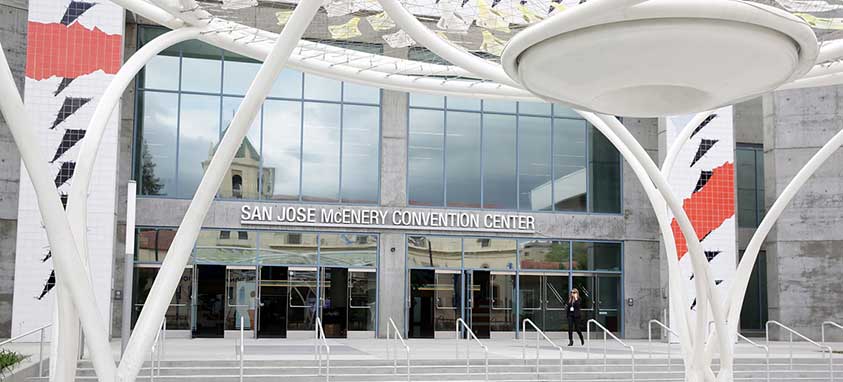
The Apple event was held at McEnery Convention Center, but third-party and evening functions took advantage of various locations around the city including San Pedro Square Market, Tech Museum of Innovation, Discovery Meadow, San Jose Marriott, Hilton San Jose, Montgomery Theater, California Theater and Hyatt Place San Jose.

Davis emphasized that Team San Jose welcomes events with open arms and assists planners with everything from housing to facilities, catering, permits, marketing and more.

“We also provide the perfect branding opportunity for planners with our ‘Own the City’ campaign,” she says. “This campaign allows groups to post their branding throughout downtown, the convention center, and the airport. We also boast Wickedly Fast Wi-Fi, the nation’s best free Wi-Fi experience.”

International attention will once again be directed at San Jose in January 2018 for the U.S. Figure Skating Championships, which also serves as the Olympic qualifying event. The event was previously held there in 1996 and 2012. USA Gymnastics also selected San Jose’s SAP Center as the site to host the last two Olympic trials.

“What an honor to be selected to host the U.S. Figure Skating Championships in the Olympic year,” said Patricia Ernstrom, executive director of the San Jose Sports Authority. “With the continued support of our key community partners, including the city and its Office of Economic Development, San Jose Hotels Inc., and Team San Jose, San Jose has proven itself as a premier destination for successful, world-class sporting events.”

Besides Apple and Team USA, San Jose has proudly hosted Silicon Valley Auto Show, Hadoop, Silicon Valley Comic Con and Facebook.

ritz-carlton yacht

Anchors away! The Ritz-Carlton Hotel Company, L.L.C. is puttin’ the Ritz on the high seas. The luxury hotel brand announced Thursday that three large yachts are on the docket.

The Ritz-Carlton, one of Marriott International’s brands, will be the first in its category to go surf and turf. The itineraries for the seven- to 10-day voyages are yet to be determined, but travelers can expect destinations in the regions of the Mediterranean, Northern Europe, the Caribbean and Latin America. Ports of call may vary depending on season.

“The Ritz-Carlton Yacht Collection will have a distinctive personality and the vessels are sure to be true stand-outs in some of the most glamorous ports around the world,” said Herve Humler, president and CEO of The Ritz-Carlton Hotel Company, L.L.C. “This unique combination of yachting and cruising will usher in a new way of luxury travel for guests seeking to discover the world in a relaxed, casually elegant and comfortable atmosphere with the highest level of personalized service.”

Measuring 624 feet in length, the fleet is significantly smaller than the average cruise ship. Its small size will allow the ships to fit into waterways too slender for mega-size boats, such as Capri, Portofino, St. Barths and Cartagena.

The yachts will welcome 298 passengers aboard to stay in its 149 suites, each of which features a private balcony. Those who want an ultra-exclusive experience can book one of two 1,485-square-foot duplex penthouse suites designed by The Ritz-Carlton and Tillberg Design of Sweden. Passengers can bring their appetite to an eatery by Sven Elverfeld of Aqua and Michelin three-star restaurant Wolfsburg. They can wind down at the spa or the Panorama Lounge and wine bar.

The first ship is slated to set sail in the fourth quarter of 2019 and reservations will be accepted beginning May 2018. The yachts are available for private charter, a great option for corporate meeting planners. Funding for this project is being backed by Oaktree Capital Management, L.P.

Olympic Day is celebrated annually on June 23rd. Meetings professionals can infuse the Olympic spirit into their next event by selecting a venue that has hosted the world’s greatest sporting competition.

London, England (1908, 1948 and 2012)

Dive into the London Aquatics Centre, located within Queen Elizabeth Olympic Park in London. Spaces can accommodate anywhere from 18 to 250 people for meetings. Event professionals also have the fun option to host a function atop the pool on a raised floor. Free Wi-fi is available in the building as well.

Lake Placid, New York (1932 and 1980)

Olympic heritage is frozen in time in Lake Placid, New York. Make your event as memorable as the historic Miracle on Ice. With more than 90,000 square feet of flexible meeting space, the Conference Center at Lake Placid is complete with 12 breakout rooms, a 9,000 square-foot ballroom, full-service kitchen, state-of-the-art AV and lighting, stages, storage and Gold LEED Certification. Receptions can be held high in the sky atop the 120 meter ski jump tower at the nearby Olympic Jumping Complex. Mirror Lake Inn Resort & Spa is the most exquisite hotel in the quaint village tucked in the Adirondack Mountains and offers 130 guest rooms in addition to meeting space.

Los Angeles, California (1932 and 1984)

The Los Angeles Memorial Coliseum was named a National Historic Landmark on July 27, 1984. Sitting on a sprawling 18 acres in Downtown LA’s Exposition Park, event professionals can stage an event here of any magnitude. The stadium fits 93,000, but smaller spaces are available as well. The field, promenade, locker room, boardroom and more can be rented for groups of 35-8,000. Los Angeles is hoping to win the bid against Paris host the 2024 Summer Olympic Games.

Squaw Valley, California (1960)

Pass the torch to Squaw Valley, which offers 40,000 square feet of breathtaking event space and can host 900 champion attendees. Venues, such as High Camp, feature floor-to-ceiling windows to give you a birds-eye-view of the slopes and venues down below. The Olympic House also rents out various spaces for private functions.

Calgary, Canada (1988)

Go for the gold in Calgary at the site where all the medal ceremonies took place. The world’s best athletes stood on the podium within the city’s Olympic Plaza. Canada’s Sports Hall of Fame gets a perfect 10 as a sports-themed venue. The 40,000 square foot building houses a grand hall, boardroom and 120 seat theater.

Seoul, South Korea (1988)

Set your sights on Seoul! The Seoul Olympic Museum has two floors, plus an underground level, of exhibits and event space dedicated to preserving 1988 Olympic history. Monuments and flags are sprinkled throughout Olympic Park to commemorate the games. Three gymnasiums and the Olympic Hall can play host to events of all shapes and sizes.

Lillehammer, Norway (1994)

Håkons Hall was used for the ice hockey competition during the 1994 Games. The arena can seat 2,500 for a meal and can also be configured as a pillar-free conference center. The Norwegian Olympic Museum contains artifacts and interactive displays to immerse visitors in the Olympic spirit. It’s the only one of its kind in all of Europe.

Atlanta, Georgia (1996)

Make your event as magnificent as the Magnificent Seven gymnasts at the 21-acre Centennial Olympic Park in Atlanta. Guests will flip for the Fountain of Rings, Georgia’s most photographed monument. The park has open grass spaces, an amphitheatre and plaza that can hold up to 15,000 people. Operated by Georgia World Congress Center Authority, the park is currently undergoing a $17 million renovation, scheduled to be completed in January 2019, so they are temporarily not accepting new bookings.

Sydney, Australia (2000)

Bring your winning spirit Down Under and make a splash at The Water’s Edge event space, which fits up to 2,000 guests poolside at the Aquatic Centre. You can wow your guests with an acrobatic or diving show, fireworks, jet skis, hovercrafts and more. The entire Sydney Olympic Park can accommodate all sorts of events at various venues that have been well maintained and utilized ever since the 2000 Summer Olympic Games.

Salt Lake City, Utah (2002)

Hold an event rinkside at the Olympic Oval in Salt Lake City, Utah. You can rent the very venue where Apolo Anton Ohno captured the hearts of Americans. The 39,000 square foot venue can accommodate receptions as large as 6,400 attendees. And, lace up your skates because the rental comes along with exclusive use of the ice.

Turin, Italy (2006)

The Olympic spirit was never extinguished in Turin, Italy more than a decade since playing host to the winter games. The Oval arena houses more than 215,000 sq. ft. of space and two meeting rooms. Its auditorium can comfortably fit 13,000 attendees. The glazed walls enhance its natural lighting.

Vancouver, Canada (2010)

Buckle up for the thrill of a lifetime at the Whistler Sliding Centre. Corporate groups can slide down the ice track at high speeds in bobsleds and on skeleton sleds. The facility can accommodate 120 at its Thunderbird Pavilion, located in the track. Other sites at the venue, as well as throughout Whistler Olympic Park can host larger group sizes. Event professionals can arrange for teambuilding activities such as biathlon, snowshoeing, tobogganing and more Olympic sports.

Lausanne, Switzerland (International Olympic Committee Headquarters)

Reach for the stars at the Olympic Museum in Lausanne, Switzerland, home of the International Olympic Committee Headquarters. Event professionals can plan meetings, receptions and seminars in the museum for anywhere from 60 to 300 attendees. Guests can participate in team building activities such as Tai Chi, archery, curling, slackline or an Olympic trivia quiz.

Happy Independence Day! If you’re interested in throwing a bash in a patriotic locale, Smart Meetings has hand-picked star spangled venues to consider from “sea to shining sea.”

Statue of Liberty & Ellis Island (New York, NY)

Ferry your guests across the New York harbor aboard Statue Cruises for a truly memorable occasion with Lady Liberty. Liberty Island offers 12 acres of open air space for up to 1,200 guests. Retrace the steps of your ancestors who immigrated to the Land of Opportunity through the Golden Doors of Ellis Island. A maximum of 1,200 people can be seated in the 13,000-square-foot indoor space. A meeting room and The Ferry Building are also available for smaller groups to rent. Because New York gets cold during winter months, May through October are prime season.

Ronald Reagan Presidential Library and Museum (Simi Valley, CA)

Prepare for takeoff! The Ronald Reagan Presidential Library and Museum offers expansive event space with a breathtaking scenic view. The most unique area to host a gathering is The Air Force One Pavilion, where visitors can board the retired plane. It can accommodate up to 1,600 people and an additional 700 can overflow on the outdoor terrace. A replica of the White House Rose Garden and conventional ballrooms are also available on site.

Liberty Bell (Philadelphia, PA)

Take a crack at planning an event in the City of Brotherly Love. The Liberty View is an exquisite event space located adjacent to the Liberty Bell. The venue can be configured to meet your needs for anywhere from 10 to 200 to 300 or more guests.

Mount Rushmore (Keystone, SD)

Get out your chisel and host a meeting overlooking Mount Rushmore. Dine beside U.S. presidents George Washington, Thomas Jefferson, Theodore Roosevelt and Abraham Lincoln. From Labor Day until Memorial Day, Carver’s Cafe, the only 3-star Certified Green Restaurant in South Dakota, is available to be reserved for events ranging from 25 to 250 attendees. The catering menu can even be customized to reflect the former Commanders in Chief etched into the mountain.

Ronald Reagan Building and International Trade Center (Washington, D.C.)

Covering 3.1 million square feet, Ronald Reagan Building and International Trade Center is currently the largest structure in the nation’s capital. Its 65,000 sq. ft. of event space can accommodate groups of up to 3,000 guests in various settings. The Reagan Building offers an indoor amphitheater, atrium, ballrooms and an outdoor plaza.

travel ban reinstated

Pending legal arguments before the Supreme Court regarding President Donald Trump’s travel ban this fall, the justices today allowed a limited version of the ban to go into effect.

Foreign nationals from six majority-Muslim nations who lack any “bona fide relationship with any person or entity in the United States” can be denied entry to the country in the meantime, the high court said. Students accepted to U.S. universities and those who have accepted a job in America were cited as examples of allowable interim immigrants.

The unsigned opinion is seen as partial victory for the Trump administration, which has been blocked by lower court rulings in its efforts impose the travel ban. The administration insists the ban is merely a security measure, while the lower courts have agreed with those who say in reality it is a Muslim ban and therefore is in violation of the First Amendment of the U.S. Constitution.

American public opinion and that of many meeting professionals has been solidly in favor of killing the travel ban.

Paul Van Deventer, President and CEO of Meeting Professionals International, commended the justices for taking action. “MPI believes that it’s critical to strike the right balance between enhanced security and travel facilitation,” says Van Deventer. “We continue to encourage the administration to enhance our country’s safety, while also promoting it as a welcoming destination for international travelers. As such, we are pleased that the Supreme Court has brought clarity to the executive order.”

In an official White House statement, Mr. Trump hailed the court’s action as “a clear victory for our national security. As president, I cannot allow people into our country who want to do us harm.”

Justice Clarence Thomas, joined by Justices Samuel A. Alito Jr. and Neil M. Gorsuch, dissented from part of the court’s opinion. They said they would have revived the travel ban in its entirety while the court considered the case.

The court agreed to review two lower court rulings upholding the ban and said it would hear arguments in October, noting the Trump administration had not asked it to act faster. Court observers have speculated the case could be moot by the time it is argued because justification for the travel ban in the first place – an opportunity for the government to review and likely revise rules on visitors from specific Muslim-majority nations – could be completed before then.

Air passengers flying to the U.S. from foreign countries can happily keep working away on their laptop computers – for now, at least — if airlines comply with new requirements announced by Department of Homeland Security.

U.S. Homeland Security Secretary John Kelly today unveiled enhanced security measures for the 2,000 or so commercial flights arriving daily in the United States from 280 airports in 105 countries. These involve heightened levels of screening of personal electronic devices, passengers, airport staff and explosive detection.

U.S. airlines have expressed concerns that further restrictions on laptops would seriously hurt business, especially among business-class passengers who generate twice or more in fares compared to the average ticket price. Likewise, business travelers have made it clear they want to continue flying with their electronic devices.

In reaction to the new security requirements, Jonathan Grella, executive vice president for public affairs for U.S. Travel Association, said, “It’s not just the travel and tourism industry that’s affected by any new restrictions—it’s our entire economy. Travel is the fundamental artery of trade and commerce for our country—and that artery is beginning to clog as a result of both perceived and actual security hurdles for travelers.” He added: “The world must hear that we are closed to terror, but open for business.”

The United States banned laptops as carry-ons in March on flights originating from 10 airports in eight mostly Middle Eastern countries. Britain followed with similar restrictions.

Homeland security officials said those 10 airports can once again allow laptops onto passenger cabins if they satisfy the new security requirements. These measures include increased explosive trace detection and vetting of airport staff as well as additional detection dogs, according to Reuters.

Government authorities are reacting to Intelligence reports indicating terrorist efforts were underway to foil airport security scanners by disguising explosive devices as lithium laptop batteries.

“Inaction is not an option,” Kelly said, saying he believes airlines will comply with the new screening. But he warned the measures are not the last step to tighten security.